How Twitter is helping to foster debate in the Middle East – #WhatisTheSolutionForLebanon & #ImHalfQatari

Despite social media’s reputation for negativity (and getting people jailed in our region), Twitter and other platforms are ideal for beginning and engaging in debate on social issues (image source: lawrencewray.files.wordpress.com)

What’s exciting about social media in today’s Middle East is how the medium is being used to promote conversations organically, and without prompting from any organization. Two examples of hashtag conversations about issues of national interest are #WhatisTheSolutionForLebanon and #ImHalfQatari.

According to the Beirut-based English-language newspaper the Daily Star, the Twitter-based conversation about Lebanon’s political issues began after a crackdown on terrorist cells across the country, which itself was spurred by three suicide bombings within the country. To quote the article:

“Don’t give visas upon airport arrival” was a very common response on the platform, alongside requests to “elect a president now” and “close off Lebanon’s borders.”

When it came to tweeting solutions to Lebanon’s pitfalls, Twitter users split between pessimists who believed that “there is no solution, Lebanon will never be a country,” and others who felt that certain recommendations would improve the situation.

LBCI reporter Yazbek Wehbe’s tweet expressed the view that “ Lebanon should remain neutral [with respect to] regional problems.”

One user suggested a fresh take on security raids by tweeting “[the ISF] should form a special raid unit comprised of Haifa Wehbe, Maya Diab, and Ammar Houry.”

The #ImHalfQatari hashtag was created by Dr. Amal Al-Malki, Associate Professor at Carnegie Mellon University in Qatar. Dr Al-Malki is herself both Qatari, on her father’s side, and Lebanese, on her mother’s. She began the debate after reading an article in the Doha-based Arabic daily Al Raya that suggested Qatari men are increasingly marrying non-Qatari women due to inflated demands for dowries.

The article is excellent and is well worth a read on the state of cultural affairs both in Doha and the wider Gulf in general.

Social media has been criticized by many in the Gulf as a negative phenomenon that often harms both society and individuals. However, as these two hashtags show, Twitter and other social media platforms can be used to foster a positive dialogue about issues that need talking about.

Death, Arrests and Censorship: How the Middle East’s media has fared over 2013

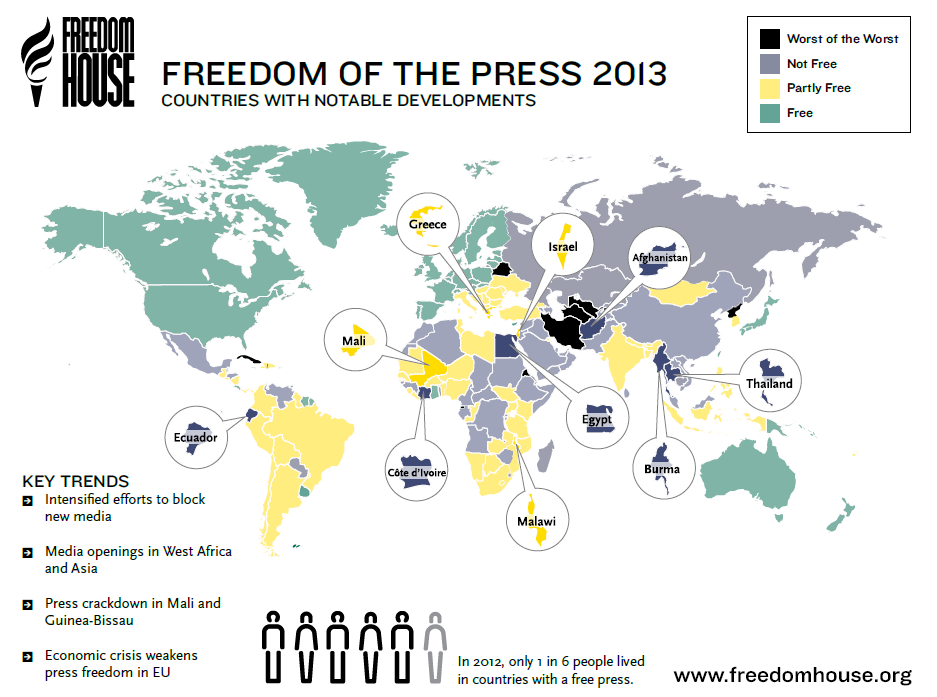
The Middle East's press freedoms have, on the whole, suffered in 2013 (image source: Freedom House)

The Middle East’s press freedoms have, on the whole, suffered in 2013 (image source: Freedom House)

The past twelve months haven’t been lacking in terms of seminal events across the Middle East – we’ve experienced war, coups/democratic/popular revolutions (choose/delete based on your bias), and economic revivals across this diverse region. However, it’s fair to say that 2013 hasn’t been a wonderful year for good quality and independent journalism in the Middle East and North Africa region.

Overall, 2013 recorded a grim milestone for global media. According to the Committee to Protect Journalists, the year documented the 1,000th journalist killed in relation to his/her work since the organization began documenting fatalities in 1992. Sky News cameraman Mick Deane was killed in Egypt in August of this year while covering the violence in Cairo.

Over half of the 70 journalists lost this year were killed in the Middle East trio of Syria, Iraq and Egypt. One of those whom we lost at the end of 2013 was Molhem Barakat, a young Syrian freelance photographer who submitted dozens of pictures of the bloody conflict in Aleppo to Reuters. Molhem was killed while covering fighting between government and opposition fighters on December 20th.

A full list of those who have laid down their lives to bring us the reality in war zones and areas of conflict can be seen here at the Committee to Protect Journalists.

Journalists working in safer climes across the MENA region have also faced serious challenges which has impeded their work. Media freedoms were curtailed across the region, with Lebanon being ranked by the US-based NGO Freedom House as the country with the most free press (Lebanon came in at number 112 globally and its press was rated as partly free).

I’m going to quote below from Freedom House’s Freedom of the Press report on the Middle East and North Africa. The report in full is available to download in pdf format here.

The Middle East and North Africa region continued to have the world’s poorest ratings in 2012, with no countries ranked in the Free category, 5 countries designated Partly Free, and 14 countries assessed as Not Free… Although new information platforms — including blogs, social media such as Twitter and Facebook, and smart phones — have had a positive impact, traditional media in much of the region were still constrained by emergency rule, state ownership and editorial directives, harsh blasphemy legislation, and laws against insulting monarchs and public figures.

While the concept of citizen journalism has been slow to take root in the Middle East, a number of countries have jailed persons who have uploaded information such as videos and photographs onto the internet on charges ranging from insulting the national image and harming the country’s reputation to defamation.

The over-riding trend over 2013 has been efforts to monitor, control and censor online debate. A number of countries in the Gulf and North Africa have enacted highly restrictive laws targeting online publishing including blogs and social media that hurts national interests. Even in Kuwait, which was ranked by Freedom House as the Gulf nation with the freest press, journalists have been jailed for reporting on opposition demonstrations. Journalists have been jailed and remain imprisoned in at least eight countries across the Middle East and North Africa according to the Committee to Protect Journalists.

Looking forward, there’s no reason to believe that 2014 will prove to be different to 2013. Civil disputes in Syria, Iraq and Egypt show no signs of being resolved, and sectarian issues seem to be growing in prominence across the region. One bright spot may be a thaw in relations between the West and Iran, following the election of President Rouhani and discussions over Iran’s nuclear programme. However, as social media becomes the most common form of communications across the Middle East the odds are that online censorship will become ever more prominent.

Is the Middle East’s CSR industry forgetting about its youth?

We’re in a region where the majority of the population is under the age of 24. The youth is the story of the Middle East. And yet I didn’t feel this way at a recently-held event on corporate social responsibility here in Dubai. Many of the speakers were in their fifties or sixties. The audience, while slightly younger, were still old enough to be a decade or two above the region’s median age.

While the speeches about sustainability and social responsibility were notable for their good intentions and advice, there still seems to be a good deal of the old leading the young rather than empowering young to help themselves. There have been a couple of notable attempts to break this mould, such as Coca Cola’s Ripples of Happiness which supported university students in Bahrain, Palestine, Saudi Arabia, Lebanon and Jordan to identify opportunities for CSR and employment projects.

I hope that corporations and governments understand what I’m trying to convey above. If we’re going to engender change in the region, the agents of change will be the youth. They need to be given the chance to set an agenda for social change and social responsibility rather than have ideas developed by older generations.

For more info about Coca Cola’s Ripples of Happiness please see the video below which is from the Dubailynx.com website.

Why do Middle East executives not blog and five reasons for starting a corporate blog today

Is this question even relevant any more? Middle East execs, what are you waiting for? (image source: http://www.homeschoolblogging.com)

There’s no doubt about it, blogging is huge. But don’t take my word for it, let’s look at the numbers. On blogging platform WordPress there are almost seventy million blogs, which are read by 360 million people each month. There’s even more blogs on the Tumblr (over 100 million as of April 2013) and Livejournal platforms (approximately 62 million blog sites as of April 2013). While blogging may not hug the headlines as much as social media, the online writing format continues to grow. By the end of 2011, NM Incite, a Nielsen/McKinsey company, was tracking over 181 million blogs worldwide, compared to only 36 million in 2006.

Similarly, blogging has become one of the most popular tools among corporations in a number of geographies. Research by the Center for Marketing Research at the University of Massachusetts has pointed to growth across both the Fortune 500 and the Inc. 500 in 2012. Forty-four percent of Inc. 500 companies, the fastest publicly-firms in America, were blogging, while twenty-eight percent of America’s largest publicly-listed firms had a corporate blog. The most interesting statistic was that sixty-three percent of CEOs of companies who did blog contributed personally to content.

These statistics from the Center for Marketing Research at the University of Massachusetts Dartmouth underline how popular blogging is with corporations in the US (image source: http://www.umassd.edu)

It’s fair to say that the Middle East corporate world, and the Gulf in particular, doesn’t share this same level of enthusiasm for blogging. Few publicly-listed companies have a blog – we’re literally talking a handful – and even those blogs that are online are rarely updated.

While it’s hard to speculate on the reasons why so few CEOs blog here, the one assumption that I’d make is either they don’t feel a need to communicate with their stakeholders or they don’t want to reveal information through a medium such as a blog (this subject does need more research, but the lack of blogging here maybe reflects a wider lack of understanding of digital communications).

For a pastime that was once considered on the fringe of journalism, blogging is a pivotal online media channel for breaking news, sharing content and developing an audience. Blogs are often quoted in the media and it allows a corporation to control the message and yet promote a healthy dialogue with its internal and external stakeholders.

There are many reasons for starting a corporate blog, but we’re going to focus on the five basics which should underline to your chief executive officer the value in having a blog for your company and including blogging as part of our communications strategy.

1) It’s all about transparency

We all want and sometimes need more information, and yet corporations often keep too much of a lid on what external stakeholders see and know. A blog allows you to let others look inside the company and give them a better understanding of any and every issue you care to tackle, from sustainability to product development and customer relations.

The benefit of transparency is increased trust. Your (potential) customer base should better understand why you do what you do. Customers and investors will feel much better informed and they may be more willing to buy your product and invest in your company.

However, don’t take transparency to mean republishing your press releases in a different format. Some of the most successful corporate blogs are those that take a nuanced approach, that tackle the good and the bad. The less biased you are, the more likely you are to be trusted when publishing a blog.

2) Bringing some humanity to the Corporation

Corporations are often seen as soul-less, grey worlds. And the same can often be said for a corporation’s communications approach; the bland press releases, the staid web-site which rarely seems to be updated. As people we all thrive on interaction and dialogue and that’s why blogs are so successful. They’re your corporation’s personal voice, a voice that need not use corporate-speak and jargon but instead adopt a tone that is more informal and conversational.

Your blog will need a face. It could be the CEO or another senior person. But a blog doesn’t need to be written by an executive. Some of the most insightful blogs are written by product managers, researchers and others who are passionate enough to make what they are saying interesting.

The beauty of blogging is that you don’t need to stay on message all the time. You can write about diverse topics which don’t need to be about the company. Customers will see through marketing pitches so step away from the self-promotion. Instead, offer human insights into recent events, industry news and other related information. Let your customers know more about you than just your product line-up and they’ll begin to become more loyal to your brand.

3) Starting a dialogue

Unlike many other forms of communication, blogs are there to receive feedback as well as to be a voice for the company. When you engage readers and respond to dialogue – both positive and negative – you’ll be doing much more than just promoting your company.

Blogs are a great way to test the water, to understand your customers’ perception on certain issues. And even if the comments are negative, at least you’ll know what your customers are thinking and be able to respond and bring them back on board. Get talking on a blog and even those stakeholders who may not agree with your company’s strategy will appreciate your efforts to talk with and about these issues in a forum that allows for and encourages debate.

4) Drive that web traffic!

Want a business reason for blogging that your sales team can measure? How about the web traffic that a blog will drive to your site. Many web engines such as Google rank sites based on content, on relevance and popularity. A blog that is updated regularly, that has content that is popular and that links to other sites you’ll find your own corporate site being ranked much higher by search engines such as Google. Once your own blogging site has become established you’ll find others linking to you, which will further propel your blog to the top of the search rankings and towards the nirvana of a first page listing.

5) Measure your blogging success

The beauty of communicating on your own site is that you can analyze your visitor statistics, to understand where your visitors are coming from, what they’re doing on your blog, what they’re using to read your blog (are they viewing your blog on a PC, a tablet or a mobile?) and how they’re reaching your site. The beauty of web analytics is that the more you have, the better you can make your blog and improve your visitor numbers. From there you can start defining your blog’s goals and measure your goal conversion, review how you’re promoting your blog and understand which topics and keywords are the most successful in driving traffic to your site.

Unlike traditional public relations metrics, online measurement tools are instant and can give you a full picture of what you’re doing right and how you can improve your blogging outreach. Blogging technologies are evolving but don’t feel daunted by the technological challenge. Blogging can be simple enough to begin with, and most blogging platforms have their own in-built analytics to help you out.

Fifty Three Million and Counting – Facebook’s hold on the Middle East

Based on the latest statistics shared at the Studio Edge event Facebook is the one network to rule them all (unless you’re a keen bird watcher that is)

Facebook came to town last week, and they brought lots of numbers with them. I was lucky enough to be invited along to the first Studio Edge event in the Middle East region. And I was astounded by the numbers that the team kept on rolling out. I’ve summarized these numbers below for you.

According to Facebook’s own research there are fifty three million active Facebook users in the region who use the service at least once a month. Egypt is Facebook’s largest market, followed by Saudi Arabia and then the United Arab Emirates.

Fifty two percent of Facebooks users access the site solely through their desktops and laptops; thirty eight percent use both mobile phones and computers, and ten percent only use their mobiles updating their profile and other Facebook activities. Twenty million people in the Middle East and North Africa are using Facebook today through their smart phones.

The average age of Facebook users in the region is 27 years and 64 percent of MENA users are male. That’s in contrast to the global split of male to female users which is currently 50/50. MENA Facebookers spend approximately seven hours on Facebook a month (that’s double the global average). And fifty two percent of Facebookers in the UAE use Facebook whilst watching television.

Middle East Facebook users like 84 pages compared to the global average of 51, and they view approximately 550 pages a month. Over forty percent of their time is spent on the news feed section of Facebook.

And to top off all of that, Facebook’s user base is growing in excess of 20 percent in the region.

With all of this information above, I’m hoping that we’re going to see more businesses online using the site. But if there was ever any doubt that Facebook is a first-tier consumer communications channel then please do re-evaluate how you use the network and start using the site properly.

One other interesting observation from the Facebook event. Most of the attendees were from advertising and creative agencies. I only spotted one public relations company. And yet, Facebook is all about content. Shouldn’t the Middle East’s PR industry be getting in on the act and promoting the quality of its social media services more?

What is the future of the internet in the Middle East?

The past week has thrown out a couple of fun and serious stories and news reports about the internet in the Middle East. The first was Iran reportedly deciding to create its own version of YouTube in order to filter out what it deems to be inappropriate content posted on the world’s largest video-sharing network. There’s a screenshot from the Mehr site, which loads remarkably slowly for a site which hosts videos for viewing and sharing, below.

Will Iran's version of Youtube be as big a hit as the original?

Will Iran’s version of Youtube be as big a hit as the original?

The second story wasn’t as funny. The International Telecommunications Union had gathered its member states in Dubai to discuss a number of issues at the World Conference on International Telecommunications. The one which hit the headlines was internet regulation. In short, a number of countries from the Middle East and other emerging regions submitted proposals that would have allowed member countries to monitor and control data flowing through their respective parts of the internet.

While this is already happening in many parts of the world, the proposed resolution would have basically made it legal and proper for all 190 or so of the ITU’s “member states” to have the power to regulate the Internet to promote security, fight spam, et cetera.

A number of opinions and views can be found online on the issue, including interesting posts by technology historian Peter Salus entitled The UN and your Business: Why ITU Dubai Loss is your Gain and Why the ITU is the wrong place to set Internet standards by Tech writer Timothy B. Lee.

I for one am concerned about the future of the internet and online access. While internet filtering and domain blocking isn’t new to the Middle East (the Gulf’s telecommunications bodies block material that they deems offensive including religious or pornographic material) it’s clear that the past two years have opened a Pandora’s box when it comes to control of the internet. Governments in Egypt and Tunisia tried to close off access to the internet to stop revolution. That didn’t work. Gulf countries have legislated against online threats. As I’ve pointed out above Iran is building its own country-wide internet whilst blocking access to foreign-hosted sites that pose a threat to the Islamic Republic.

So where are we headed to next? How far will governments in the Middle East go in order to secure their own national communications networks? And is there anybody or anyone out there who will bring some common sense to the issue of web regulation in the Middle East?

While I don’t expect multinationals like Google and Yahoo (or even Facebook) to step up to the plate and say to Arab governments we will not regulate the web for you (after all, Yahoo and Google didn’t say no to China), I am hopeful that the region’s populations will become more vocal about their online rights. Egyptians and Tunisians have proved that they will demand and protect their new-found rights. Let’s hope others, especially in the Gulf, will begin to seriously think about what their governments are doing online and asking:

  • Who is watching me online?
  • What online data do they want and why?
  • Can I be jailed for my online activities? Do I have to self-censor my thoughts and activities?

What is the future of the internet in the Middle East? Are we headed towards a patchwork of national or regional wide webs aka Iran? Or will sense prevail? Goodness knows we need commerce and entrepreneurship to flourish in this region to generate more jobs and an open internet is essential to both. Answers on an email, an online comment, or (if your connection is monitored) a postcard please!

Are you up for some (more) government censorship and online monitoring?

Reflections on why we all should adapt to the cultures around us

How much do you understand about and live in harmony with the culture around you?

I was reading a short but poignant piece by Annabel Kantaria, the Daily Telegraph’s journalist in Dubai. The column was about Dubai’s Brits and how today’s British expats in the Emirate are a breed apart from their predecessors (have a look at the article here).

My take on culture and our settings may be different to most, partly cause of my background and partly due to my circumstances. As a child of two cultures, I’ve always been acutely aware of the importance of the need to adapt and become part of the community within which I am living. For years my family lived in Saudi Arabia, a country that has a very distinct set of cultures. I’ve married into another culture as has my sister.

For those that aren’t from a melting pot of genes, traditions and customs I can imagine that it isn’t easy to let go of what you know so well. Is there an urge to make others adapt, to conform? You could certainly say that the walls of a compound are a way to keep out external influences.

However, isn’t there more to living in a foreign location than just a job or a salary? How much more can we enrich ourselves through adapting to the local culture and becoming part of the local community?

It pains me when I meet with people who can’t utter a word of the local language despite having lived in the country for years, and whose only contact with their environment is the food (usually hummus). Admittedly exchanges do need to be two-way; a dialogue needs two or more people to talk and listen to each other. However, someone needs to make the first move and look beyond their boundaries to understand, learn and appreciate what is different.

Despite its reputation for being a harsh place to live, I loved my time in Saudi Arabia. Why? Because I became part of the community. I spoke the language, I developed friendships and spent time with locals talking about what is important to them.

I miss that cultural understanding, that bridging of the divide between me and them. The world will be a better place with more understanding. Adapt to your surroundings, thrive in your local environment rather than simply live there, and you’ll end up calling your foreign adventure your home rather than a ‘couple of years abroad.’

The dangers of speaking your mind online – lessons from the Middle East

Kuwaiti graphic designer Mohammed Sharaf @MohammadRSharaf created the following image to support Nasser Abdul during his trial for tweeting offensive material

The internet is full of misconceptions. I often feel that most people think that the world wide web is a place where they can go to say anything, both positive and (most often) negative. The past 18 months and pending legislation should make anyone and everyone think twice about the above. Cases in Saudi Arabia, Bahrain, and Kuwait have cast aside the notion that cyberspace is a domain where anything and everything goes.

A number of trials and guilty verdicts both underline the importance of tempering what people say online as well as underscore what authorities do and do not deem as illegal. The first high-profile legal proceedings took place in Kuwait when in June of last year a Kuwaiti national was charged with slandering Bahrain’s royal family and a religious group.

Despite claiming that his Twitter account was hacked Nasser Abdul was found guilty and sentenced to three months in jail which he had already served by the time his sentence was pronounced. There have been other cases in Kuwait, including the prosecution and sentencing of Mubarak Al-Bathali to six years in jail (this was commuted to six months) for Tweets attacking certain religious groups.

The most famous case of jailing for tweeting is that of Hamza Kashgari, who published three tweets about an imaginary meeting between himself and the Prophet Mohammed. His comments drew an instant reaction from Saudis online; in the hours that followed over 30,000 tweets regarding Kashgari were published online. Kashgari was accused of apostasy and fled to Malaysia. He was deported back to Saudi Arabia and jailed. Kashgari is still in detention, despite pleas by his family for his release and his apology for his actions (the basic story and roundup can be read here on Wikipedia).

Bahrain’s authorities have also taken to court individuals for publishing their thoughts in online public forums. The most famous and most recent case is that of activist Nabeel Rajab who tweeted about the Prime Minister’s visit to Muharraq in June and was accused of publicly insulting Muharraq’s residents for their support of Sheikh Khalifa bin Salman al-Khalifa. According to Bahrain’s prosecutor Rajab had claimed that Muharraq’s residents had only welcomed the Prime Minister during a visit because he had offered them subsidies.

Bahrain’s Information Affairs Authority said his acquittal on defamation charges “was due to the judge’s uncertainty regarding the evidence submitted to support the lawsuit”. Rajab, who has spent two months in jail while awaiting the outcome of this and another case, had been faced with possible charges before for his use of Twitter, in 2011, in what would have been the first such case in the Middle East.

Clearly the Arab Spring, which has led to regime change in three Middle East countries and is still being felt across the region, has sharpened the thinking of numerous governments across the region. According to media reports in June of this year, Bahrain is introducing legislation to curb misuse of social media.

I am still trying to fully understand the full implications of Bahrain’s proposed social media law, but I am assuming that this would cover and make an illegal offense the publishing of any comments online or through social media that would appear to contradict government policy or government statements. Kuwait is also leaning in this direction, as this editorial by Reuters makes clear.

What is clear is that the Middle East’s online community is becoming increasingly politicized. I’d argue that many people, frustrated with the lack of political debate in traditional media, are going online to voice their issues and concerns. The Dubai School of Government has estimated that there are 1.3 million active users on Twitter in the region.

Switching tack slightly, how will the increase in political discourse affect online communication efforts/campaigns? Will communication professionals and agencies steer completely away from anything that could be construed as political or biased to one community? And will we see more people using online aliases? While many governments would like to regulate online activity, how are they going to force users to reveal their true identities when using services that are based in Europe or the US?

Would we even see sites such as Facebook or Twitter blocked by governments in the region (this did happen in Egypt during January 2011 when the authorities tried to stop any and all access to social networking sites)? That’s the logical conclusion, but how would you do this when these sites have become part of people’s everyday lives? As always, there seem to be many more questions than answers when it comes to the Middle East. The freedom to voice one’s thoughts online are no exception.

Twitter and politics in the Middle East – Arab political figures on Twitter

Following on from a previous post on the top religious figures in Saudi Arabia using Twitter I’m profiling a couple of the most prolific political and governmental officials and rulers in the Gulf.

If you’re looking for a good resource on global political movers and shakers then check out the Twiplomacy report by global PR agency Burson-Marsteller. There’s some interesting insights here, though I hope the below snapshot will give you a little more information on the Middle East region in particular.

So here’s the top five six countdown. I could add a lot more and I hopefully will do over time.

1. Jordan’s Queen Rania Al Abdullah.
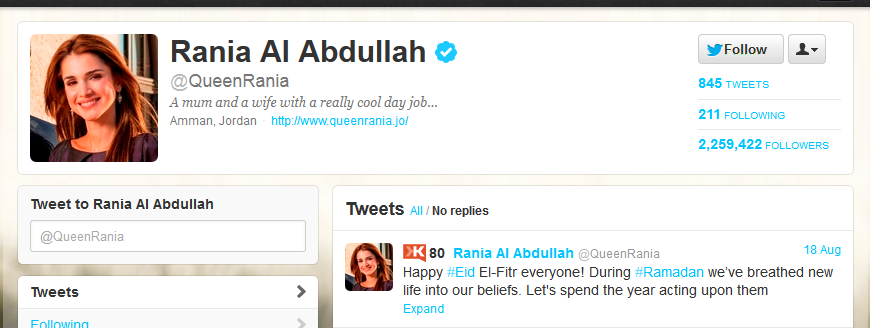
Jordan’s Queen Rania is the most popular political figure in the region with over two million followers.

The most popular political figure on Twitter is not based in the Gulf, but rather on the Arabian Peninsula’s periphery. Jordan’s Queen Rania Al Abdullah is without a doubt the most popular government-related figure in the Middle East (I saw government as her husband King Abdullah II is the head of state). To date she has amassed two and a quarter million Twitter followers. The Queen usually tweets about charitable issues which she is involved in or supports, such as education, healthcare, and youth-related schemes. Queen Rania also has a YouTube channel and Facebook site as well as her own website at http://www.queenrania.jo.

Queen Rania has used social media to engage in conversation. The best known example is a campaign launched in 2008 entitled Send me your Stereotypes. The Queen asked people to send her their questions about Islam and the Arab world. She talked about topics such as honour killings, terrorism and women in the Middle East.

Queen Rania started using Twitter in the Spring of 2009 and she has occasionally used the site to answer questions from followers. She is not a prolific user of Twitter (having sent 845 tweets her account averages less than a tweet a day), and her engagement and communications are spread across all of her social media channels. Queen Rania messages in English primarily rather than Arabic.

2. Sheikh Mohammed bin Rashid Al Maktoum

Sheikh Mohammed passed the one million mark on Twitter at the end of July 2012

The ruler of the Emirate of Dubai and the Vice President of the United Arab Emirates, Sheikh Mohammed bin Rashid Al Maktoum has a large following on Twitter through which he disseminates information on Dubai’s economic development, charitable initiatives, and (sometimes) religion.

Sheikh Mohammed often writes in Arabic to address issues which are important to UAE nationals. In addition to his twitter feed there’s a Facebook site which was set up in June 2009 and has over 600k likes and a more recent Youtube page which was set up in February of this year but which already has 580 thousand video views.

Sheikh Mohammed tweets on average less than once a day (he posts at approximately the same rate as Queen Rania and has posted to date 862 tweets) but he does retweet fairly often (once every 9.1 Tweets). An avid horse racer, the Sheikh does talk about his passion for racing as well as the environment.

3. Abdul Aziz Bin Fahd Al Saud

Abdul Aziz Bin Fahad is an avid user of Twitter and has written just under 5,500 tweets in 10 months.

The claimed twitter account of the youngest (and it’s always claimed the favourite) son of Saudi Arabia’s late King Fahd Bin Abdul Aziz Al Saud has only been active since November of last year but already has 637 thousand followers. The account, which hasn’t been verified by Twitter, is supposedly owned by Abdul Aziz Bin Fahd Al Saud (the account is his initials followed by his birth year).

While not in government, as a son of Saudi Arabia’s previous king Abdul Aziz Bin Fahd Al Saud wields considerable influence in the Kingdom both through his family as well as his various assets. He owns half of MBC, the Middle East’s largest broadcaster, as well as other investments both regionally and globally. Abdul Aziz was previously head of the Diwan of the Council of Ministers in the Saudi government.

Tweeting exclusively in Arabic Abdul Aziz Bin Fahd Al Saud talks about both the mundane (for example sending holiday greetings to followers) to voicing his support for the Saudi King (and his uncle) Abdullah. Abdul Aziz Bin Fahd Al Saud has written about controversial topics such as trying to stop the broadcasting of MBC’s latest Ramadan blockbuster Omar, which was based on the life of the Prophet’s companion Omar Bin Al-Khattab, as well as allegations of excess leveled against him by others using Twitter.

On average Abdul Aziz Bin Fahd Al Saud writes twenty tweets a day and regularly engages with followers.

4. Sheikh Abdullah ibn Zayed Al Nahayan

Abdullah ibn Zayed Al Nahayan engages more with followers on Twitter on a daily basis than any other minister in the region

The UAE’s Foreign Minister is another avid Twitterer. Despite only having joined the social media site in November 2011 Sheikh Abdullah ibn Zayed Al Nahayan has written over 7,600 tweets at a rate of 24 a day.

Writing in Arabic Sheikh Abdullah focuses on national and regional issues related to the UAE such as the Abu Mousa island dispute between the UAE and Iran as well as more general topics such as religion and culture.

Sheikh Abdullah often engages with his audience which is mainly UAE and GCC nationals and retweets every 2.5 tweets. Over half of Sheikh Abdullah’s tweets are replies to followers.

5. Doctor Walid Al-Tabtabai

Doctor Walid Al-Tabtabai is a controversial figure in Kuwaiti politics both for his views as well as his use of Twitter

One of Kuwait’s most colourful politicians, Doctor Walid Al-Tabtabai is a conservative Islamist (Salafist) member of parliament who has attracted controversy for many of his views (which he frequently expresses via his unverified Twitter account). Dr Al-Tabtabai talks most frequently about Kuwaiti and regional politics with his 227 thousand plus followers which he has built up since joining Twitter in November 2010.

Dr Al-Tabtabai was at the center of a legal case when he posted screenshots of a Kuwaiti national’s Twitter page and demanded the man be arrested for what were described as “insulting tweets of the Sunni sect and severe criticism and insults to the Saudi and Bahraini regimes for their stand against the Bahraini protests.”

The case was one of the first in the Gulf to see someone being prosecuted for airing their views on Twitter. However, as a parliamentarian Dr Al-Tabtabai enjoys immunity from public prosecution.

On average Dr Al-Tabtabai writes 7.3 tweets per day in Arabic and retweets every 2.2 Tweets.

6. Khalid ibn Ahmed Al Khalifa

Diplomat, Ambassador, Foreign Minister of Bahrain, Bon Vivant… Khalid Al khalifa is many things on Twitter

With possibly the best Twitter bio of any politician in the Middle East and over nine thousand tweets sent it’s maybe no surprise that Bahrain’s Foreign Minister has been so active on Twitter. Khalid Al Khalifa has had to contend with the diplomatic consequences of Bahrain’s security policies following a year and a half of demonstrations against the government.

The Foreign Minister is one of Bahrain’s most outspoken figures online and uses his Twitter feed to talk about government policy as well as to promote the Bahraini government’s point of view overseas as well as at home.

Khalid Al Khalifa also tweets on issues not related to Bahrain such as regional politics, and frequently talks about his travels and his meetings with other politicians. He also frequently uploads pictures to his Twitter account. The Minister retweets every 5.4 tweets and writes in both English and Arabic.

Is the Middle East’s Communications Business now 24/7 due to #SocialMedia?

There have been a slew of articles coming out from the US and Europe on social media and when to communicate to ensure that a message gets heard by a maximum number of people. Blogs from Bitly and other social media tools have highlighted the issue of timing and its importance in terms of how content goes viral.

The When Should I Post this Infographic by digital agency Raka was based on Bitly’s data for social media content distribution

I hadn’t heard of anything along those lines in the Middle East until recently, when one agency told me they’d won a contract to promote a national sports league via social media. The agency in question claimed that they had an ace up their sleeve during the pitch; they’d guaranteed the client that they would communicate in the evenings during the matches themselves, rather than promoting the games during office hours.

The thinking was simple. The target audience would be most focused on the sport an hour or two before, during and an hour or two after the games.

By that logic, wouldn’t the same also ring true for a variety of other audiences across the region? For example, for non-alcoholic drinks such as Barbican one of the prime times for selling is during football games. Similarly, wouldn’t restaurants and other venues which do most of their business in the evening do well to communicate afternoons and evenings rather than in the morning?

It’s an interesting one to think about for marketing and communications professionals. I’d love to see someone coming up with similar studies to the bitly blog and Infographic above, particularly for the GCC region. But I’m guessing most business and brand-related social media communications in the Middle East are being posted during office hours.

Everyone I know in the marcomms industry has a smartphone, a laptop, a tablet, and a 3G mobile connection. Connectivity doesn’t seem to be the issue to communicating outside of office hours, so then what is? Is it all down to the permissions and approvals processes that companies here have in place?

There are a myriad of tools which can help measure responses and even suggest the optimal time to post messages on social media based on previous data. One to look at is Crowdbooster. This online tool is free to use and you can use it to schedule messages to Twitter and Facebook. If you’re looking for a basic but useful tool to work out when to post to social media, try out Crowdbooster.

Crowdbooster is a great tool to use when you need to know the best timings for posting messages

But do remember, don’t sleep and tweet or Facebook! Or else you might end up writing something that you will regret.