Lessons from West Africa: The Need to Move Beyond Media Relations and Other Observations

https://www.instagram.com/p/BB7XX8UDO46/?tagged=prsaccra

Every now and then I’m allowed out of the country, and some of those trips make for some remarkable learnings. One of my recent trips was to Ghana. I met with a fair number of communications professionals from across West Africa, including from Nigeria. There was much talk around what I call the usual suspects – digital, social media, measurement et al – but what struck me most was the challenge that our colleagues in West Africa face when it comes to educating clients on the need to move beyond media relations.

There was one panel which opened my eyes to how similar West Africa is to the Gulf. Four gentlemen (and no ladies) from the national Nigerian and Ghanaian PR and African associations took to the stage to talk about the challenges and opportunities faced by communicators in the continent.

A fixation on media relations

What seemed to be repeated over and over again was the need to move communications away from pure media relations and towards a more holistic model; like in the Gulf, it seems that many clients are keen to get their pictures in the papers, their voice on the radio and their silhouettes on television. There wasn’t much in the way of a response from the panel, aside from pointing a finger at the numerous journalists who had joined the public relations profession and who were keen, or so the argument would go, to keep the industry focused on media relations as the only deliverable for clients.

Nigerian regulation and the slow pace of change

What was a surprise to me was that Nigerian comms professionals have to be registered with the Nigerian Institute of Public Relations to hold mid to senior-level comms roles in the country. Living in a part of the world which is unregulated when it comes to PR (nearly all of the comms people I know don’t even have a formal education in the discipline), I do like the idea of having an independent standard to meet and maintain. However, as one member of the audience pointed out, it had taken her just over a decade of chasing to secure her membership of the Nigerian Institute of Public Relations and hence be eligible to hold a senior comms role. While some aspects of the sector may be different in Nigeria, bureaucracy remains.

Discussing the the evolution of PR in Africa #PRSAccra

A photo posted by Gideon Kodo (@gideon_kodo) on Feb 19, 2016 at 6:33am PST

//platform.instagram.com/en_US/embeds.js

The rise of the female comms professional

You don’t need me to tell you that women are better communicators. They simply are, full stop. It was wonderful to see that three-quarters of the room were women, and many of them young ladies at the beginning of their careers. The local panel was full of men, an observation not lost on one brave lady who pointed out the imbalance between those on the stage and those in the room. However, looking long-term women will hopefully dominate at the top as they do at the mid and entry levels in the comms sector in West Africa.

A photo posted by @chiyneze on Feb 19, 2016 at 6:27am PST

//platform.instagram.com/en_US/embeds.js

A focus on national talent

Another observation was the strength of the national talent. There were very few expats, which was a revelation for yours truly after being based in the Gulf for so long. While I was imagining Nigeria’s Lagos becoming a hub for comms across Western Africa and hence attracting expat talent, what I saw was a room full of (mainly) young, talented Nigerians and Ghanaians who care deeply about what they do and why they do it.

A photo posted by Mya (@mariann.balogun) on Feb 18, 2016 at 9:29am PST

//platform.instagram.com/en_US/embeds.js

If you have experience of comms in West Africa I’d love to hear your inputs. Do you agree with the above, is there more you’d like to add or am I off on my observations. Don’t be shy, leave a comment or two!

Lessons on media relations and transparency from the World Government Summit

Dubai's World Government Summit has become a global event for government employees and is closely followed by the media (image source: Trade Arabia)

Dubai’s World Government Summit has become a global event for government employees and is closely followed by the media (image source: Trade Arabia)

This month was host to another mega event in Dubai, the World Government Summit. The conference, which even hosted an address by President Obama, aims to become the leading platform for governments, the private sector and the public to learn about and collaborate together for innovation in government.

Two areas caught my eye. The first was that of media relations. There’s been a good deal of talk about how the communications industry is changing and media relations will become less important. That isn’t the case, at least for the vast majority of us who spend most of our day pitching, preparing for media interviews, and following up.

There was a sizable media presence at the event, which is testament to the World Government Summit’s global reach. However, while there were dozens of international journalists – whose flights and accommodation were paid for – the story for the local journalists I knew was different. Few Dubai-based media were reached out to except by email, with no phone calls. And some didn’t receive an email to arrange for registration. One journalist I talked to spoke about his frustration on having to chase the agency to get his registration sorted out. He was particularly peeved by a lack of support or empathy from the agency about the issue, and not only him but his whole team being missed out. As he told me, ‘a sorry would have gone a long way when it comes to good will.’

While I understand the urge to engage globally – after all, the event is now the World Government Summit – not involving local media is a idea that will only sour the agency’s relationship with the local journalists in the short to medium term; and trust me, you don’t want to deal with an aggrieved journalist, let alone put them in front of a client. Plus, in today’s digital age, I don’t buy this concept of local and global media. Everything is online, and much of it is curated by services such as Google News. It’s now a case of getting that content seen by the relevant stakeholder, which can be done through increasing paid reach or seeding the content on other sites.

Transparency and its impact on credibility

The second insight is around the inaugural “World’s Best Minister” Award. According to the summit’s website, the “World’s Best Minister” Award was “thoroughly and independently managed by Thomson Reuters where the search for the nominees is conducted according to the established criteria”.

To quote from the Summit’s website, details on the criteria and judging panel are below:

The criteria of the Award were set by the organizer of the World Government Summit. The criteria for selecting the candidates WAs based on various financial and non-financial metrics, and their improvement over time. These are based on data disclosed by the World Bank, United Nations, Legatum institution and various other well known resources that provide data and statistics on economic information, social metrics and government services.

The primary focus for 2016 has been on initiatives in the healthcare, education, social and environmental services.

The judging panel consists of six judges from various backgrounds, who provide different perspectives on the candidates based on their experience, expertise and insights. They include senior executives from the World Bank, OECD, Ernst & Young, Strategy & Co and the Abraaj Group on their personal capacity.

From an initial selection of 100 ministers, the winner turned out to be Greg Hunt, Australia’s environment minister. This choice has proved to be highly controversial, particularly in Australia where the Australian government has been criticized for its approach to green issues.

My focus however is the response from Thomson Reuters who, I feel, have sought to distance themselves from the choice of the winner. To quote from the Guardian.

But Thomson Reuters said it was “not correct” to say that the company initiated the award or were responsible for designing the selection process.

“Thomson Reuters was solely responsible for assisting in the administration of the award, to a set of criteria approved by the World Government Summit organisers,” said Tarek Fleihan, head of corporate communications for the financial information company in the Middle East, Africa and Russia.

Transparency is key to credibility. And whilst I do love the idea of awarding government officials who innovate on behalf of their citizens, the controversial choice and the ensuing contradictions surrounding the process hasn’t helped to make the award as credible as it should be.

What are your thoughts? Were you at the event? I’d love to hear your views on these two points.

Executives promising to go naked on television, Cobone’s PR stunt, and The Address’ post-crisis crisis?

Paul Kenny's fake PR release for Cobone, Ziad El Chaar naked on TV and Emaar's ongoing issues following the Address fire made this week an interesting one for media in the UAE (image source: Arabian Gazette)

Paul Kenny’s fake PR release for Cobone, Ziad El Chaar naked on TV and Emaar’s ongoing issues following the Address fire made this week an interesting one for media in the UAE (image source: Arabian Gazette)

Media in the Middle East is rarely dull, and the past few days have proved that there’s some hilarity as well as serious questions about what people in our region do and then tell to the media.

Let’s start with the real estate brand which is developing a reputation for foot-in-mouth disease. Speaking to the Sunday Times, Damac’s Managing Director Ziad El Chaar told The Sunday Times he would “go on TV naked and resign” if the worst market projections are realised. Aside from the fact that any naked executive dance on television would be illegal in the UAE (at least without a VPN), his comment hasn’t been taken too well judging by the reaction on Arabian Business’ online portal. Maybe there’s some fans of naked real estate executives out there. If so, please do show yourselves so we can get you help…

Another bizarre piece from last week which wasn’t picked up widely. Speaking to an audience of entrepreneurs last week, the founder of discounting site Cobone Paul Kenny admitted that he used a PR stunt to kick-start his business. Shortly after founding the site, Kenny put out a press release claiming that 1,000 vouchers for a discounted pizza had been sold to Cobone consumers. That release, Kenny now claims, was a fake. Let’s quote Kenny from the Arabian Business story.

“We were second to market. GoNabit [an online group buying website founded by Dan Stuart and Sohrab Jahanbani] was first. When we launched, everyone was saying: ‘You are the same as GoNabit,’ which we were but I said we weren’t.

So I went to at Vapiano, which is an Italian restaurant, and bought a thousand pizzas at a huge discount and they sold out by 12pm. I put a big sold out sticker on the site and an hour later I released a press release saying ‘Cobone.com breaks e-commerce record in the Middle East.’

And the truth is that everyone started reading and asking ‘Who is this company Cobone.com?’ ‘What is e-commerce?’ ‘What’s a record?’ You know it created a lot of interest in the business and instantly people started recognising us as a different business.

I remember that a day after you could do a Google search to see we were on around 483,000 websites. First, e-commerce in the Middle East was never covered. Then what is an e-commerce record? What is Cobone.com?

So you got a ball rolling of media interest from that point.”

There’s a popular saying about the luck of the Irish. And there’s another saying about making one’s own luck. Luckily for Kenny, no asked if the news was real (or checked with the restaurant). If they had, his deception may not have worked so well.

And finally, another follow-on story about the New Year’s Eve fire at The Address, from The National in which one owner of property at the hotel lost 1.3 million Dirhams worth of art in the blaze.

Ramin Salsali spoke out this week urging The Address owner Emaar Properties to quickly process residents’ compensation claims as well as repair the property. To quote from the story.

“Until now, they [Emaar] have been very fair and have quickly reacted to accommodate people, put them in hotels, give them the first basic possibilities just to start to recover.”

He expected “a very unbureaucratic and pragmatic approach” from the developer in terms of how claims were handled – especially since a police report last week indicated that an electrical short-circuit from a spotlight caused the blaze.

“The whole world is now watching. The effect on real estate is unbelievable. People have pulled out of contracts where they don’t know about the fire safety of the cladding. It’s not good for Dubai.”

One of the greatest challenges any organization can face is not just the crisis itself, but the post-crisis reflection and learning. Emaar isn’t there yet in terms of dealing with any major grievances from those who lost property and items during the fire (and there’s been remarkably little negativity from any of the hotel’s residents so far), but the communication with this group of people needs to be both clear and quick to get these issues resolved. Otherwise, Salsali’s point about blow-back for the Emirate’s real estate sector may become true. Let’s hope not.

And for the next post I’ll be talking daddy issues again. It’s been a while since I posted any stories about my little princess, and I’m looking forward to it!

What does Authenticity mean in the Gulf?

Are you being authentic? And what does authenticity mean to us in the Gulf?

Are you being authentic? And what does authenticity mean to us in the Gulf?

The notion of authenticity, that feeling of genuineness, has long been an issue to us communicators. The theory goes that the more authentic we (or our clients) are, the more people will believe us and like us. Even the use of the word authentic has grown; in the US, the word’s use has grown 74.5% since 2012 according to the Holmes Report, to 8,069 press releases and 20,471 media stories.

Well, you’d think that being in a world where everything is online it’d be harder than ever to fake it. Well, an Australian teen with over half a million followers on Instagram has put the sword to that theory. Here’s an excerpt from The Guardian on Essena O’Neill and how she strived to be perfect online:

An Australian teenager with more than half a million followers on Instagram has quit the platform, describing it as “contrived perfection made to get attention”, and called for others to quit social media – perhaps with help from her new website.

Essena O’Neill, 18, said she was able to make an income from marketing products to her 612,000 followers on Instagram – “$2000AUD a post EASY”. But her dramatic rejection of social media celebrity has won her praise.

On 27 October she deleted more than 2,000 pictures “that served no real purpose other than self-promotion”, and dramatically edited the captions to the remaining 96 posts in a bid to to reveal the manipulation, mundanity, and even insecurity behind them.

At a recent event I was chairing, one of the speakers told an anecdote about a Saudi youngster who claimed to be an entrepreneur, partly because it is the popular thing to do and also because he was unemployed. The experience also reminded me of comments left on a popular website about two local entrepreneurs who have set up their own business. Three of the comments were negative, and called into question the ‘authenticity’ of the two young gentlemen. One person wrote, “I have also noticed many so called ‘Entrepreneurs’ are only ‘Instagram-perneurs'”.

The question then comes to mind – who is being genuine and how can we tell if they’re genuine? Will the media challenge people on their achievements? Will the public call out these people? We live in a region where social media is all pervasive and yet, due to various barriers such as culture, language and traditions, it can be truly difficult to know if someone is being genuine or not. For me, the best way to understand the true meaning of authenticity is to grasp its meaning – one who does things himself/herself.

What are your thoughts on authenticity and the Gulf? Do people live to a certain image, or are they true to themselves? And what does this mean for how we communicate? I’d love to hear your thoughts on the issue.

Flip-Flopping during a crisis – how Damac’s handling of the Trump backlash has proved costly

First you don't see it, then you do. Damac initially removed Trump's name after his comments on Muslims, only to restore it a couple of days after (top photo by Reuters/bottom photo by  Rahul Gajjar of Khaleej Times)

First you don’t see it, then you do. Damac initially removed Trump’s name after his comments on Muslims, only to restore it a couple of days after (top photo by Reuters/bottom photo by Rahul Gajjar of Khaleej Times)

Imagine for a moment, if you will, one of your key business partners/influencers saying something controversial. Imagine that they’ve just racially attacked your most important group of customers. And then imagine that, rather than dumping this partner, you instead flip-flop around the issue and end up not only looking rather foolish, but do yourself and your reputation a fair amount of harm in the process.

If you work at Damac, you don’t need to imagine any of the above. The Dubai-headquartered real estate developer, which counts Donald Trump as one of its business partners, has been flip-flopping since Trump came out with a comment on the 7th of December that there should be a “total and complete shutdown of Muslims” entering the United States. This statement, which was made following the deadly shootings in California’s San Bernardino, weren’t the first Trump had made about Muslims. He had previously that he was in favour of shutting down American mosques and establishing a database for all Muslims living in the US or giving them a form of special identification that noted their religion.

Damac’s relationship with Trump International includes branding for two Trump-branded gold courses and a collection luxury villas at the developer’s Akoya project in Dubai. I don’t know the full extent of the relationship, but local newspaper 7DAYS claimed that, in addition to the licensing fees that Damac would have to pay to Trump for the use of his name and image, Trump himself had invested in the project.

Following the controversy around Trump’s latest Muslim statements, Damac put out a statement that could be called, at best, avoiding the issue.

Damac Properties senior vice president Niall McLoughlin told 7DAYS in a statement: “We would like to stress that our agreement is with the Trump Organisation as one of the premium golf course operators in the world and as such we would not comment further on Mr Trump’s personal or political agenda, nor comment on the internal American political debate scene.”

Instead of publicly taking Trump to task and distancing the company from his statements, Damac took a different approach. A couple of days after the outcry, on the 10th of December Damac took Donald Trump down – his image and name that is, from their developments. To quote from 7DAYS.

Hoardings that previously carried photos of the billionaire businessman advertising Damac’s Trump-branded golf course and luxury villas stood bare on Umm Suquiem Road on Thursday, right at the entrance to the development.

All well and good you may think – Damac quietly rebranded their development and distanced themselves from Trump. However, in a further twist, Trump’s name was back on billboards two days later, on the 12th of December. Here’s how the English-daily Khaleej Times put it:

On Friday, a prominent advertising billboard showing Trump golfing that had stood at the Akoya development, where the housing and one of the golf courses is being built, was gone. All that remained of it was the board’s brown wooden background. Another billboard declaring the development “The Beverly Hills of Dubai” still stood nearby.

Trump’s name also appeared to have been pulled off one sign greeting visitors to the complex. The sign, outside a sales office at the site, originally had Trump’s name in lettering on a stone wall. But on Friday the letters were littering the ground in front of it.

A second, similar sign facing a major road was intact with Trump’s name on it. Earlier in the week, that sign had been taken down but by Friday, it was back in place.

“The exterior signage at Trump International Golf Club, Dubai was temporarily removed on Tuesday for a short period of time, however as of last night, the signage is back up and fully intact,” the Trump Organization said in a statement to The Associated Press on Friday.

Also, the Damac webpage dedicated to the Trump PRVT gated community, which is part of the development, appeared to have been removed, leading only to a “not found” page.

Since the development is still under construction, the removal of the branding with Trump’s name and image seemed to be largely symbolic. It was not known if it signaled Damac will outright break the licensing contract.

Damac Properties has declined to comment on the removal of Trump’s name and billboard from the property. It earlier said it “would not comment further on Mr. Trump’s personal or political agenda, nor comment on the internal American political debate scene.”

To change the issue, Damac has switched tactic. Instead of talking politics, the developer announced that it would guarantee rental returns for those buying in its Akoya (Trump-branded) project. The National broke the story last week.

Damac Properties, the developer caught in a storm over its partnership with the controversial US presidential hopeful Donald Trump, is offering lucrative rental returns on some of its properties to lure investors.

Damac, which said it would stick with Trump International despite his anti-Muslim tirade, is providing a 24 per cent rental guarantee on selected units in Dubai, including the Akoya project associated with the billionaire, the developer said in a statement.

Owners of selected properties will be able to secure an eight per cent annual return in the first three years after handover.

The company was offering these returns because it believes the Dubai property market is “set for stable growth in the medium term”, Damac said. “We have seen quite a bit of scaremongering in the market in recent months, which can have a detrimental effect on sentiment in the market,” said Niall McLoughlin, the senior vice president at Damac. “By providing such a high, tax-free offering on our units, we are putting our head above the rest and underwriting any fluctuations that may occur down the line.”

Reputational issues become even more important for companies which are listed, as Damac is. Damac’s shares initially fell 15 percent following the muted response. Investors may also not have appreciated the rental guarantee initiative, as you can see from the share price chart below.

Damac's share price fell after the initial outcry. The share price has also fallen following Damac's attempts to repair the reputational damage through the rental incentive promise.

Damac’s share price fell after the initial outcry. The share price has also fallen following Damac’s attempts to repair the reputational damage through the rental incentive promise.

While I don’t know the relationship between the two, would Damac have been wiser to have taken an initial hit and exited the contract with Trump rather than flip-flopping on the issue, drawing it out and drawing more attention to the brand association? Add in the costs with guaranteeing rental returns in addition to the share drop, and this crisis will prove costly both in the short as well as the long-term. To me, the media and the company’s shareholders the answer about whether or not to dump Trump – and take a short term hit through contractual obligations but save the company’s reputation and keep shareholders and customers happy – seems fairly obvious.

When should brands step away from a toxic celebrity – the Trump effect

The Trump is known for his outspoken views, but what damage have his latest rants done to brands in the Gulf?

The Trump is known for his outspoken views, but what damage have his latest rants done to brands in the Gulf?

I know you’re tired of hearing about Donald Trump. Everywhere I look on the internet and social media, all I see is Trump, Trump, Trump… I am sorry to write about this man again, and give him yet more coverage that he doesn’t deserve, but this time I’m focusing on brands and what they do when their engagements with celebrities turn toxic.

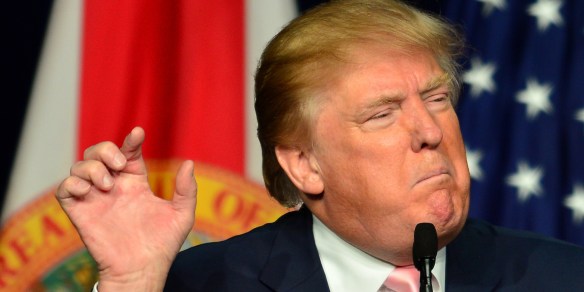
As everyone with an internet connection knows, Donald Trump said something very stupid about stopping Muslims from entering the US. Here’s the Trump in action below.

The problem for Donald, or should I say the brands that are associated with him, is that he has business interests in the Muslim world, including here in the Gulf. Dubai-headquartered real estate brand Damac has been working with Trump for several years, and has a number of golf courses and other developments named after Trump and his family. Dubai’s Landmark Group sells Trump Home-branded products across the Gulf in its Lifestyle shops. While the Al Tayer Group opened two Trump Home by Dorya galleries in the UAE in June.

The response to Trump’s comments about banning Muslims from the US has drawn different reactions from these three entities. Damac was the first to comment, with the company’s Senior VP for Comms saying effectively the Trump brand is distinct from the man himself.

“We would like to stress that our agreement is with the Trump Organisation as one of the premium golf course operators in the world and as such we would not comment further on Mr. Trump’s personal or political agenda, nor comment on the internal American political debate scene,” said Niall McLoughlin.

Al-Tayer shared its own views with the Dubai media’s 7Days paper, with the following statement: “The statement Mr Trump made on the campaign trail is unfortunate. Given his diverse business interests in the region, we hope that he will reconsider this stand.”

Most interestingly, Landmark Group has decided to drop the Trump range of products from its stores. Landmark works with another celebrity who has a love/hate relationship with the public. Bollywood star Salman Khan was convicted of manslaughter earlier this year back in his home country of India, and yet he is still a brand ambassador for one of Landmark’s retail brands.

“In light of the recent statements made by the presidential candidate in the U.S. media, we have suspended sale of all products from the Trump Home decor range,” Lifestyle CEO Sachin Mundhwa said in an email to media outlets including the UK’s Independent.

Will Damac and Al-Tayer follow Landmark’s example? Or will they stick out the ensuing furor? When does a celebrity engagement do more harm than good? With Trump unlikely to apologize for his comments this can only get messier for those companies which are still associated with the Trump.

How did Facebook fail with its Safety Check in emerging markets?

  
There are some times you really shouldn’t be making a distinction. Last week two tragedies took place, the first in Beirut and the second in Paris.

Others have written, much more eloquently than myself, on the raw emotion they felt after the two acts of terrorism – Beiruti blogger Elie Fares was one of the first to write about his anguish at Lebanons’s suffering being ignored by the West.

What is telling with the decision to activate the Facebook Safety Check was a comment by Alex Schultz, Facebook’s VP for Growth, who said:

In the middle of a complex, uncertain situation affecting many people, Facebook became a place where people were sharing information and looking to understand the condition of their loved ones. We talked with our employees on the ground, who felt that there was a need to fill. So we made the decision to try something that we’ve never done before: activating Safety Check for something other than a natural disaster. There has to be a first time for trying something new, even in complex and sensitive times, and for us that was Paris.

While Facebook’s intentions were to help those in need, the appearance to many in emerging markets such as Africa and the Middle East was that of bias. In effect, it was as if a life in Paris was worth more than a life in Beirut, or in Kenya or in Nigeria. This was compounded by Facebook’s decision to provide users with the option to upload the French flag over their profile picture.

Schultz’s comments that it was a human decision to activate Safety Check for Paris lead me to lose this question. Who at Facebook should have put forward the idea to use this service anywhere or everywhere where there is a crisis? My answer would be the communications and policy teams.

Communications in particular is the function that should act as the bridge between the outside world and the corporation, the part of the business that brings the outside in. That’s why, for example, Comms leads on issues and crisis management. Comms should have a robust understanding of the different stakeholder groups and how they impact the organization.

However, my take on Comms goes further. Comms should act as the conscience of the organization, and the Comms team should be able to advise when something is not right ethically. Unfortunately, Facebook’s team missed this opportunity here and instead turned what should have been an opportunity to play a vital role in helping inform families and friends re the safety oftheir loved ones into an example of unintended double standards (this was compounded by the Safety Check being used for residents of a Western capital rather than an Arab or African one, which in the context of colonialism also doesn’t look good).

Mark has said that Facebook’s policies will change and rightly so. Facebook is considered by many in emerging markets to be a tool for good, which is helping to promote positive change. It’d be a shame to see that opinion shift due to a lack of cultural awareness.

McDonalds Saudi and the Saudi national who was arrested – a lesson in virality and crisis comms

Last week Saudi’s social media space was alive with chatter and calls for a boycott. But this wasn’t for a global cause, a political issue, or a case of consumer activism. It wasn’t even about the color of a dress or the shenanigans of a Kardashian. Instead, it was about a Saudi national who tweeted a complaint about the drink he’d been served at a McDonalds restaurant and the rapidly escalating series of events which got him put in jail.

I’m going to try to keep this story as simple as possible for factual reasons.

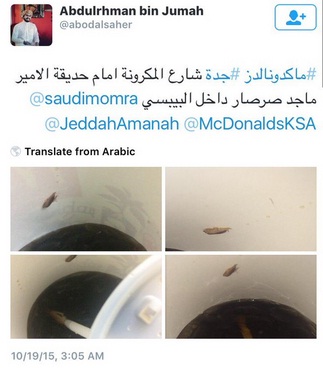
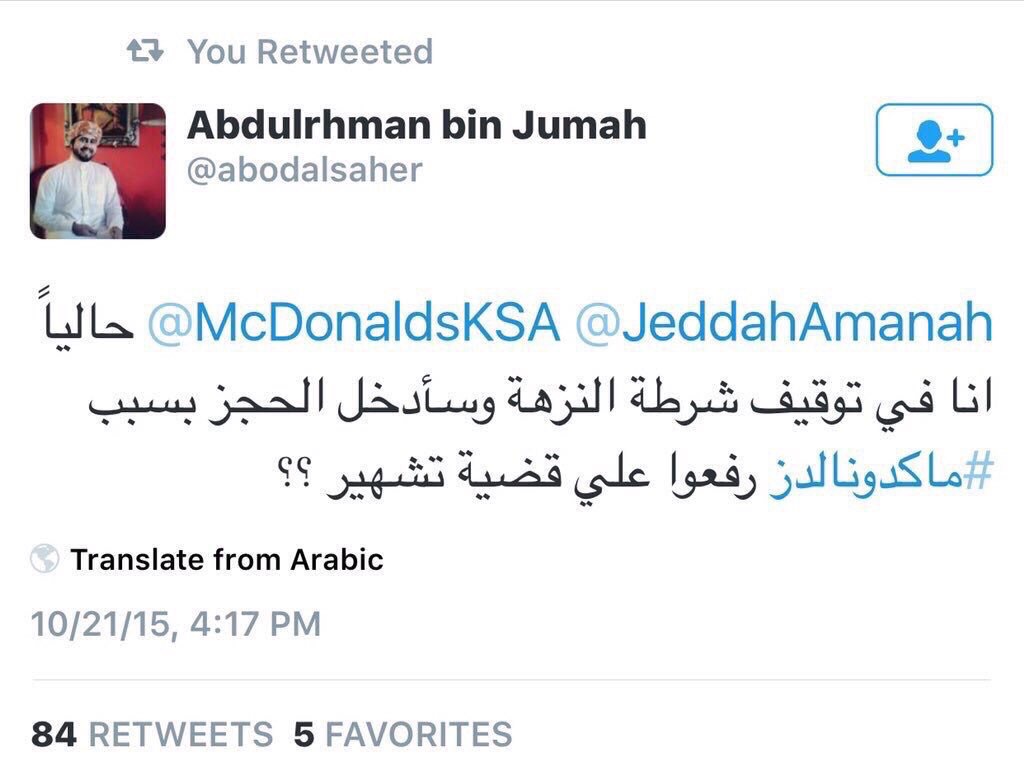
A young Saudi national Abdulrahman bin Jumah was at a McDonalds outlet in Jeddah on the 19th of October and ordered a meal, which included a coke. Inside the cup, he claimed he found a cockroach. He then shared the image on social media to his followers (which I assume would have been less than the 3,216 followers he has now). As Abdulrahman deleted his Tweets, here’s an alleged image from another Saudi Twitter account who retweeted the Tweet.

This was the initial tweet from Abdulrahman on the 19th of October with the alleged cockroach in the cup

This was the initial tweet from Abdulrahman on the 19th of October with the alleged cockroach in the cup

Abdulrahman tweeted his experience and contacted the local municipality online at their Twitter account @JeddahAmanah. The municipality took swift action and closed the branch in question the day after on the 20th.

Simple enough? You’d think so (and restaurant closures are a fairly common occurrence in Saudi as you can see from this tweet announcing the closure of a KFC outlet in Jeddah. I cannot comment as to whether a restaurant closure would be common for McDonalds Saudi).

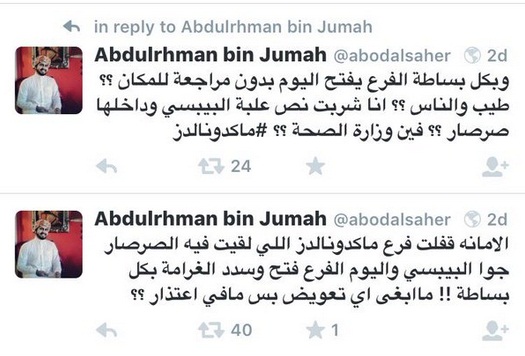
After a day however (I’m assuming here the 21st), the branch reopened and Abdulrahman tweeted his thoughts on the issue, namely that he was surprised that the branch could open so soon, and that he wasn’t looking for compensation but rather an apology for the experience. Again, these are screen shots as the original tweets were deleted.

Abdulrahman tweeted his surprise at how the restaurant could have opened so soon after its closure for an alleged health violation

Abdulrahman tweeted his surprise at how the restaurant could have opened so soon after its closure for an alleged health violation

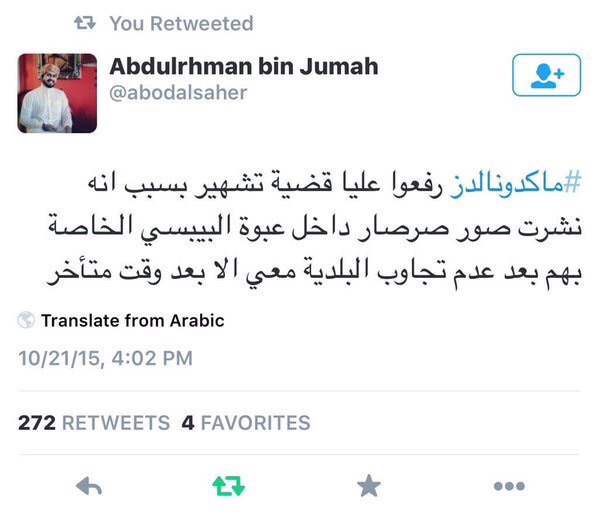
Now this is where it gets murky as later on in the day Abdulrahman was accused of defamation by McDonalds Saudi Arabia. He tweeted his experiences as he was first accused of defamation…

Abdulrahman shared on Twitter the news that McDonalds had made an allegation of defamation against him. Defamation is a criminal offense in Saudi Arabia

Abdulrahman shared on Twitter the news that McDonalds Saudi had made an allegation of defamation against him. Defamation is a criminal offense in Saudi Arabia

And then arrested by the police. Defamation is a criminal rather than a civil offense in Saudi Arabia. After the below tweet Abdulrahman’s timeline supposedly goes quiet.

The Saudi at the center of the allegation was even tweeting as he was being held by police for defamation

The Saudi at the center of the allegation was even tweeting as he was being held by police for defamation

On the 22nd Abdulrahman tweeted an apology, four times, writing that the bug was not in the cup and that he was sorry for using social media when making the allegations against McDonalds Saudi. The second time he used two hashtags, McDonalds arrests the national and we are all Abdulrahman Jumah (ماكدونالدز_تعاقب_مواطن #كلنا_عبدالرحمن_جمعه#)

https://twitter.com/abodalsaher/status/657194881635495936

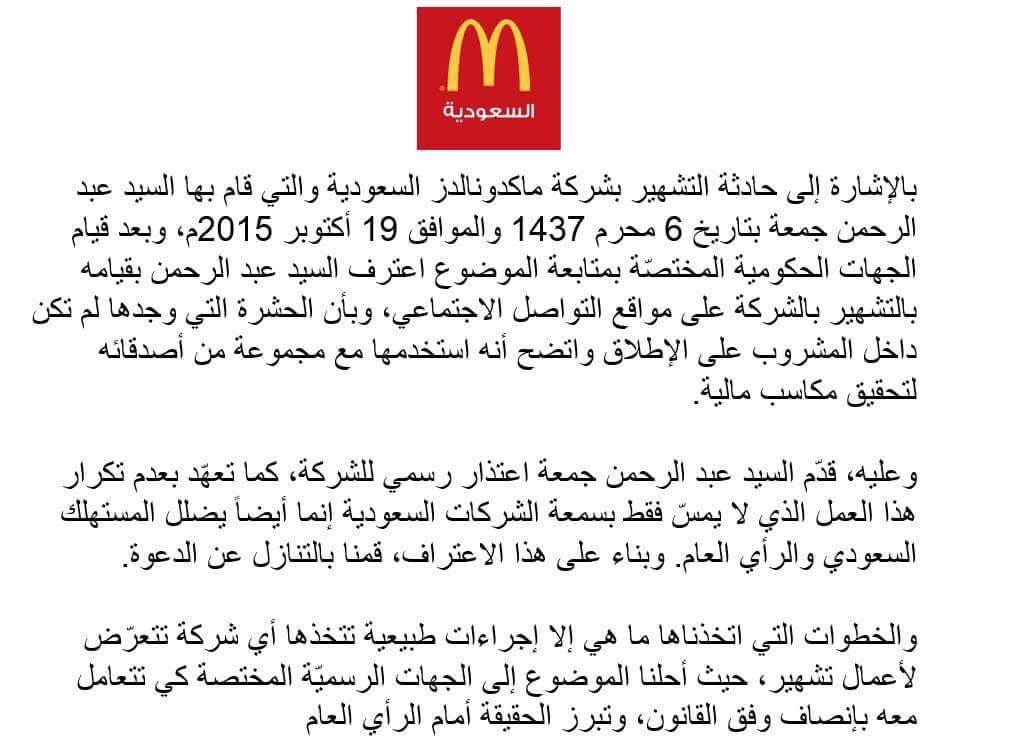
McDonalds Saudi also put out a statement online in response to many in Saudi who have come out to ask about the allegations or who have supported Abdulrahman stating that the case was caused by an intention to gain financially from the allegation that he’d made and that, following the apology, McDonalds Saudi had dropped the case.

McDonalds issued a statement

McDonalds issued a statement that the allegation was false and the case is now closed

Abdulrahman deleted all of the story’s tweets, except those in which he makes an apology.

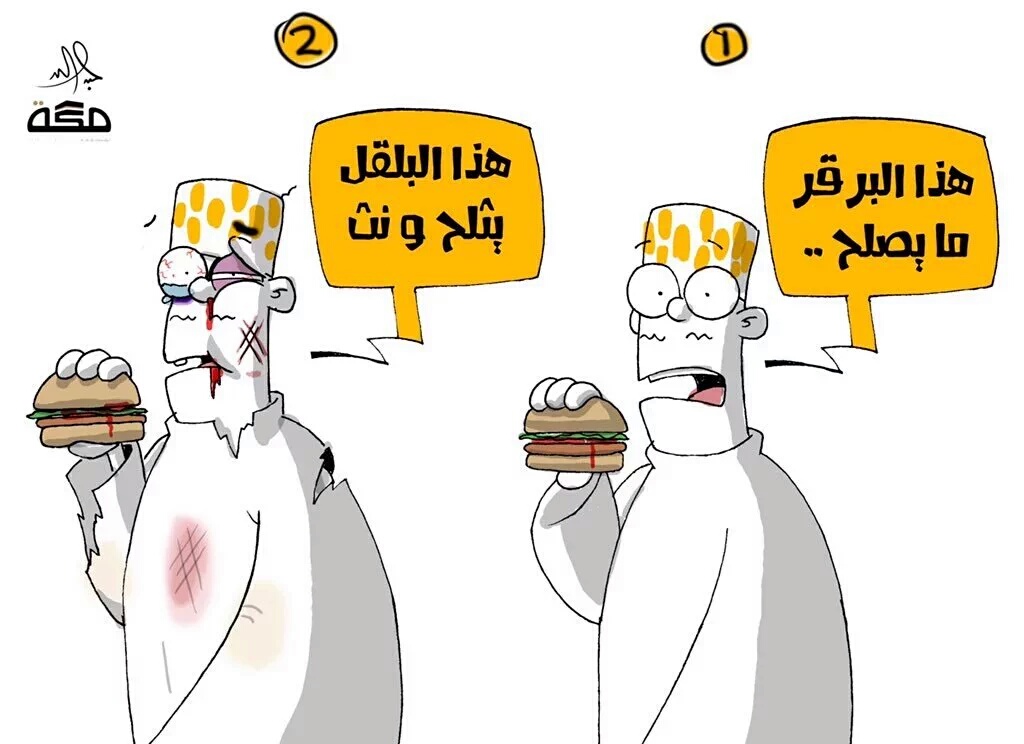
Without knowing the facts in the case, it’s hard to know what really happened. Did Abdulrahman really find a cockroach in his drink or was it a case of extortion? However, Saudis on Twitter have not been kind to McDonalds Saudi and their involvement of the police. The hashtags used by Jumah are replete with angry responses to McDonalds Saudi. The case has also made the national media, albeit indirectly.

Makkah Daily's Abdullah Bin Jaber parodied the story in typical fashion by lampooning McDonalds for their actions

Makkah Daily’s Abdullah Bin Jaber parodied the story in typical fashion by lampooning McDonalds Saudi for their actions

McDonalds Saudi certainly acted quickly in terms of responding to the crisis, but did they respond in the right way? Has the issue done more damage than it otherwise would have thanks to the actions of McDonalds Saudi, or were they right in involving the police when they did due to their belief that they were being blackmailed?

What are your thoughts? What lessons can we take from this case? I’d love to hear from you.

PS Saudi social media personality Omar Hussein has also talked about the issue. For you Arabic-language speakers out there you can see his Facebook video below.

The Gulf’s push to improve its image – why actions speak louder than words

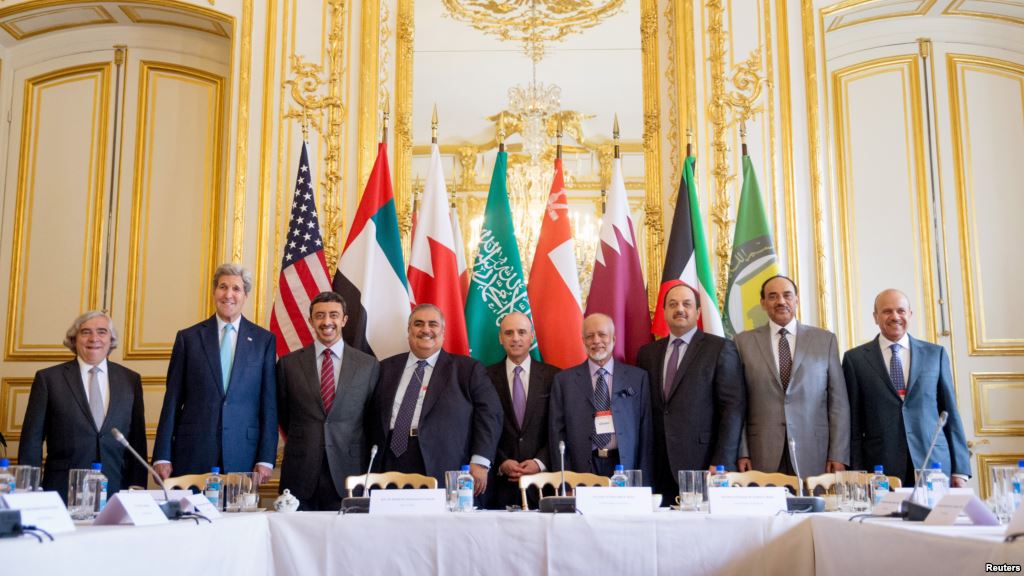
The Gulf's foreign ministers have worked hard to change perceptions of the region abroad. But is there a simpler solution?

The Gulf’s foreign ministers have worked hard to change perceptions of the region abroad. But is there a simpler solution?

I love a good read, especially fiction. But when living in the Gulf, fact can often feel more surreal than fiction. Last week the UAE’s English language daily Gulf News reported on efforts by the six-member Gulf Cooperation Council to improve its image abroad, most notably in Europe and the US. To quote from the newspaper:

Foreign media officials in the Gulf Cooperation Council (GCC) have stressed the need to formulate a common media strategy that will reflect the positive image of the six member countries abroad.

The officials, who were holding a meeting in the Qatari capital Doha, reviewed plans and suggestions for future actions in their communication drive with the international community.

The GCC, established in 1981, comprises Bahrain, Kuwait, Oman, Qatar, Saudi Arabia and the United Arab Emirates.

“The participants discussed several issues related to the progress of their work, including a common strategy to rectify the distorted image that some Western media have about the countries in the region,” Ahmad Al Buainain, the head of the foreign media department at Qatar News Agency (QNA) said.

“The meeting also discussed several papers and new ideas regarding the way forward for the GCC foreign media in European and Asian countries in order to convey the realities on the ground, he said, quoted by QNA.

Plans include holding seminars and meetings with research centres or organizing events at international functions in Europe and in which the GCC countries are participating, he added.

“This new drive is a continuation of the activities conducted by the foreign media officials at past events,” he said.

Ahmed Mussa Al Dhabyan, the head of media cooperation at the GCC Secretariat General, said that the GCC foreign media officials sought to build on their successful experience and formulate a new strategy that matched the latest developments in the communication field.

“The world has gone beyond the global village concept and has now become a single house,” he said. “The GCC has a significant political and economic weight and it has a special standing internationally, and therefore it needs to have a foreign media presence that matches its stature,” he said.

Earlier this month, reports surfaced from Washington D.C. that Saudi was hiring a variety of lobbying groups to bolster its public image in the US. Clearly, the Gulf cares about its reputation abroad, especially when the region’s governments see what they feel to be negative coverage.

On his Facebook account, political commentator (and Sharjah royal family member) Sultan Al-Qassemi gave his take on the article in the Gulf news with a list of suggestions to improve the Gulf’s image abroad.

1- Release activists.
2- Suspend capital punishment.
3- Allow political participation.
4- Eliminate Kafeel (sponsorship) system
5- Expand women’s rights.
6- Enact environmental protection.
7- Broaden citizen’s rights.
8- Bolster freedom of expression (yes within “limits”)

I’d make it even simpler. As any good and ethical public relations practitioner will tell you, your actions speak louder than your words. If the region is serious about tackling any negative perceptions or reputation issues abroad, then behaviour which is contradictory to accepted human norms in regions outside of the Gulf (read the West) must be tackled, and free(r) access should be given to the media. With social media and the internet, it is so much harder to hide anything or to spin information or events. Take for example the leaking of documents from Saudi’s Foreign Ministry recently.

The best way to been seen in a positive light is not more seminars or meetings in European capitals with research centers. Instead, one must behave in a positive light, followed by encouraging the media, both local and international, to report without bias.

While I’ve been in this region long enough to know better, I am still an optimist at heart. And I still believe we are capable of change for the better, as this region is magical in so many ways. However, a word of note. If my face turns shades of blue or purple, do please remind me to breathe.

Social media crises – Lebanon’s Fransabank and the email banning employees from attending Friday prayers

A second post this week focusing on social media and the digital world. And, similarly to the STC story, this article is also about a crisis. However, the background to what happened with Lebanon’s Fransabank is different to that of the public backlash against STC and its alleged poor customer service.

On the 22nd of July a picture began to circulate on social media channels of an email allegedly sent from an administration assistant banning male employees at Fransabank from going to Friday Prayers. A little context here for those who don’t know Lebanon. Unlike in the rest of the Middle East, Lebanon’s weekend is Saturday and Sunday and not Friday. For Muslims, the weekly communal prayer is held on a Friday at noon, and according to Lebanon’s constitution regarding freedom of religion all Muslim employees have the right to attend Friday prayers during their working day.

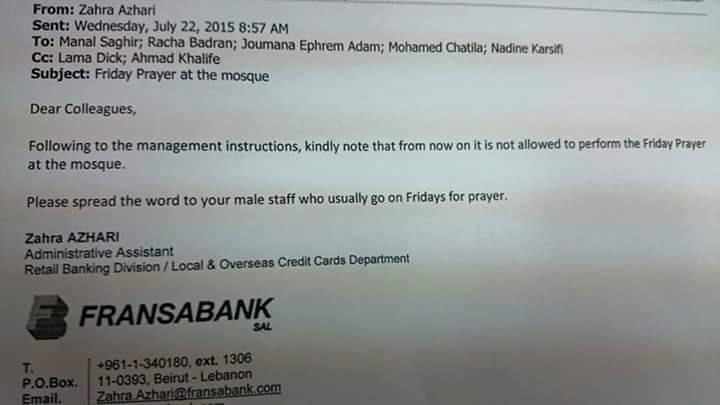
The connotation behind the alleged email was that male Muslim employees were not returning back to work after their prayers. You can see a screenshot of the email below.

This is a copy of the email allegedly written by a Fransabank employee and then leaked to the net

This is a copy of the email allegedly written by a Fransabank employee and then leaked to the net

As with many other religious issues in Lebanon, a country that is home to a complex mixture of religions and ethnicities, the email set off a storm of commentary on Facebook in particular. The issue reached back to Fransabank and their communications team acted to take control of the situation.

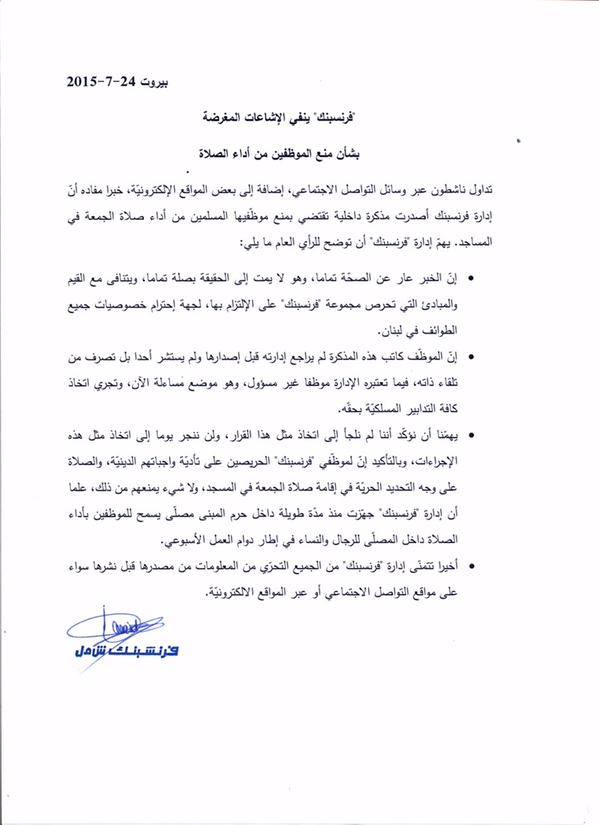
On the same day they issued a statement, in the form of a letter in Arabic, reaffirming respect for all of their employees and their religious duties. In addition, the letter (which is a fairly long crisis statement), also noted that the email was not authorized to be sent by the Bank (which would imply that the email was sent by an actual employee).

This was the first response from Fransabank on the email leak.

This was the first response from Fransabank on the email leak.

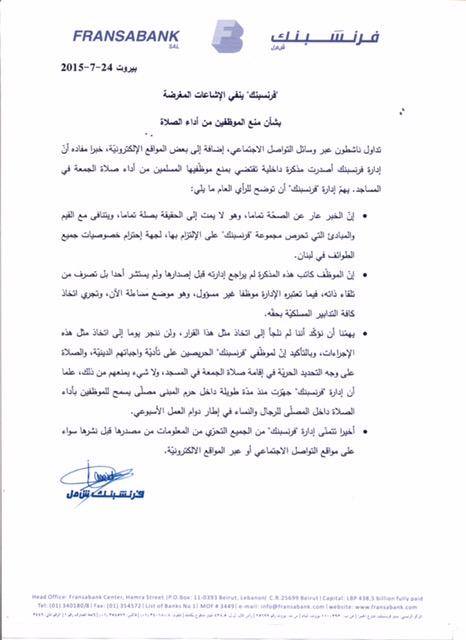
All well and good you’d think, but it didn’t stop there. Unfortunately, the first statement was signed but no one knows by whom as there was no name underneath the signature. Secondly, the letter was printed on a plain piece of A4 rather than a Fransabank letterhead. Cue the second letter, which you can see below.

Which was followed by a second statement from Fransabank, this time on an official letterhead

Which was followed by a second statement from Fransabank, this time on an official letterhead

There are obvious lessons here for all of us in communications. Firstly, get your internal communications right and make sure that your employees are aware of your values and your obligations. Legally, no employee should have shared an email regarding stopping their colleagues from performing their religious duties. From the perspective of values, would any Muslim employee want to work at an institution that doesn’t respect their right to pray on a Friday? While there were allegations of employees not returning to work after prayer, was such a response the right reaction? If values and compliance were communicated internally well and the issue of non-attendance handed in a different manner, maybe the email would never ever have been written, let alone leaked via social media.

Secondly, the response. Kudos to the Fransabank team for responding promptly on the same day after becoming aware of the issue (one question I have is how did they come across the original email post). But was the response adequate? Was a letter the right way to do it, especially a letter with no name attached and which is not printed on the bank’s letterhead? Could the team have responded differently, through a video message from a senior executive or a briefer holding statement that goes to the core of the issue about respect for religion and respect for their employees’ right to pray on a Friday?

The Fransabank story is another reminder that social media can bite you at any time. Every employee will have access to the internet, if not on their company computers, then through their mobile phones. Every employee will also have access to a camera, thanks to those same internet-enabled phones. Any content can be uploaded which can harm a person’s reputation. Was Fransabank ready for the crisis? And are you ready if something similar leaks online?