A Lack of Quality: Why the Comms Industry needs a professional qualification

Why don't we have a standard certification for the PR industry? Isn't it time we change this?

Why don’t we have a standard certification for the PR industry? Isn’t it time we change this?

I don’t want to offend, but enough is enough. I want to tackle the elephant in the room, the issue that many of us face but few of us have the bravery to talk openly about. We have far too many people in the communications profession who haven’t gotten to where they are on merit or who are unsuited for the role.

You know what I’m talking about, the person who got into the job because his or her father is the best friend of the GM. Or the comms manager who has been appointed because global wants to increase their diversity count (despite all of their customers being male). Or the person who is overseeing comms for a specific industry (let’s say, social media), and yet doesn’t even use the product. Or the employee who has been shunted into communications because the company can’t get rid of them. Or the person who has been employed because of their nationality and there’s a quota, despite their lack of experience (or ability).

We have to tackle the issue of quality in the profession. Why, one may ask? Simply because they represent all of us. Their actions shape the views of others. As communicators, we often talk about a place at the table. We won’t claim that board or management seat, unless we’re qualified and able to add value to the organizations that employ us. And, there’s the issue of agencies, which I’ve talked about before.

Who would hire an accountant who isn’t chartered? Or a lawyer that hasn’t passed their bar exam? And yet, there are many who work in our industry without a single qualification. We need to change this approach to professional qualifications. There are many to choose from, such as the accredited or the chartered status from the CIPR. And there’s the CMP examination from the IABC. There’s a host of qualifications out there.

As an industry, we need to change the debate from years of experience to competency and skills. To me, it’s no longer good enough for organizations to seek out communications professionals with little to no understanding of our profession. There needs to be a concerted effort by our industry, by communications professionals who care about how we are perceived by others, for us to adopt a minimum certification.

Only by making a case for a professional certification, which will act as a symbol of our dedication to continuous study and development and our adherence to ethics and best practices, will we receive the respect and trust that we crave and need to be taken as serious as the profession needs to become a boardroom position.

Are you with me?
What makes an award-winning communications campaign?

There's nothing better than being recognized for your communications work. Just make sure you're focusing on these three key points.

There’s nothing better than being recognized for your communications work. Just make sure you’re focusing on these three key points.

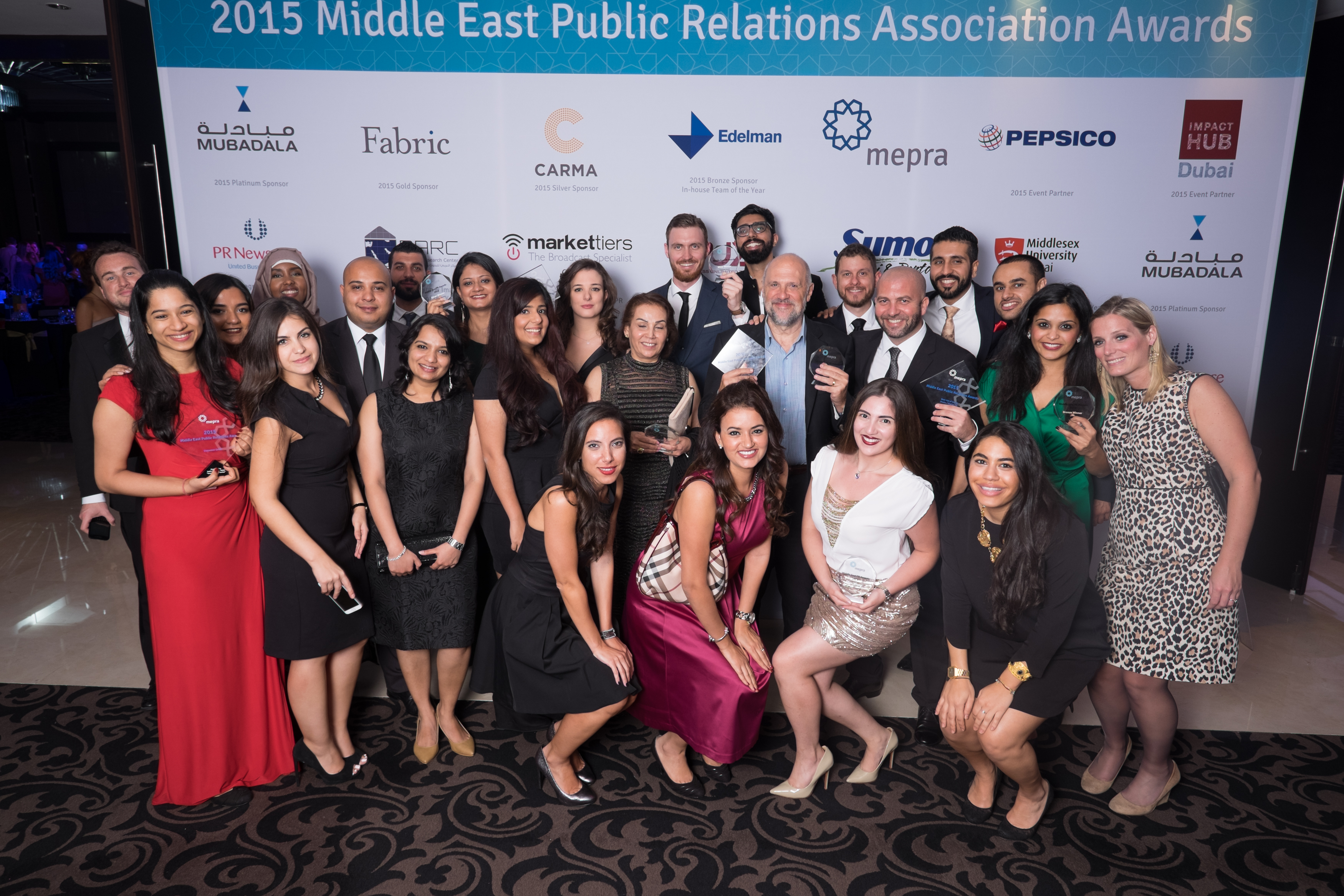
I’m fortunate to have been asked to judge many communications campaigns, for the likes of the Middle East Public Relations Association Awards, the Holmes Report’s SABRES, the International Association of Business Communicators’ Quills, and the Global Alliance Comm Prix Awards. That’s many hours spent pouring over communications campaigns.

As a judge, what do I look for? What is, to me, an award-winning campaign? There are three basic points:

  • The reason why: Firstly, what is the logic behind the campaign? What is the organization trying to achieve? And is the why supported by research or insights derived from the stakeholders the organization is looking to engage with and influence. This could be as simple as focus groups, one-to-one interviews, or information derived from surveys. Too many campaigns aren’t supported by research, and as such there’s no logic or a clear, evidence-based objective underpinning the campaign.
  • What was done: We now come to the activation piece, both the strategy and the tactics. How innovative was the overall strategy in terms of its budgeting and composition. How effective were the tactics re stakeholder targeting and engagement. Were the tactics used suitable for the audience, and is there a strong enough idea at the heart of the strategy? How well has the strategy blended together different channels?
  • Where are the results: A well-executed strategy will show not only strong outputs but also clear outcomes and, ideally, business impact. An award-winning campaign will clearly demonstrate the impact their work has had on the organization and stakeholders. And here I’m not referring to AVEs (Advertising Value Equivalencies), but rather other measures such as sentiment analysis, awareness, recognition and credibility. If you want more information on what measurement means, have a look at this white paper by Ketchum’s David Rockland.

If you can get each of these elements right, you’ll stand a good chance at winning an award, no matter the competition. So go and do your good work, and be recognized for it. Good luck, bon chance and bil-tawfiq, especially to all those entering into the MEPRA Awards today and over the past couple of days.

The Role Communicators Have in Promoting Sustainability

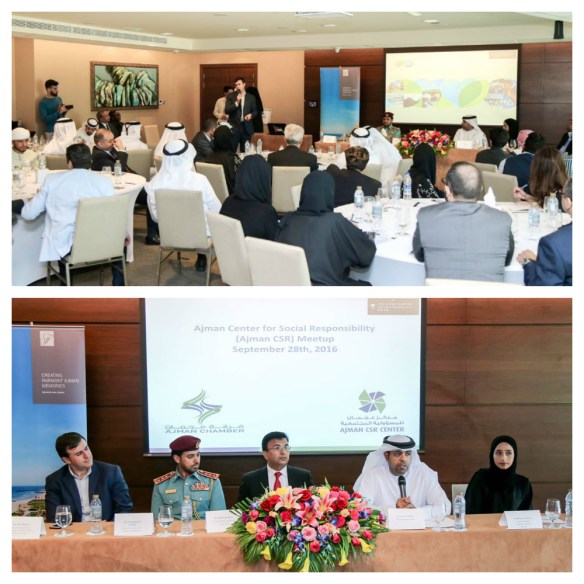
ajman-sustainability-day

I’ve been fortunate in my career to have worked with some amazing brands and organizations. In particular, the most forward-thinking have focused on the issue of sustainability. It’s become a passion for me, as I want my daughter to inherit a world that is better than ours.

I’m often asked to support events on sustainability. One such initiative which I’m very proud of being able to help is that of the UAE’s Ajman Center for Social Responsibility. Launched by the Ajman Chamber this year, the Ajman Center for Social Responsibility aims to promote the concept of sustainability for both the public and private sectors as well as create a resource for sustainability across this emirate. Assisted by the consultancy firm Sustainable Square, the team at the Center have set for themselves a vision of becoming the regional and global reference for social responsibility and sustainability practices. And, judging by the energy they have, I feel they’ll reach this goal.

For many of us communicators in the Middle East region, we’ve taken on the mantle of championing sustainability. Sometimes it’s due to reputational reasons; the need to be seen to be doing good. For others, it’s been about the willingness to tackle an issue that isn’t going away. There’s some confusion around sustainability and the role of communications in the Middle East; I remember well one senior comms professional erroneously commenting  during a public meeting that the function has always been with communications, despite all of the literature from the 1950s and 1960s by Bowen, Freeman and others which argues that organizations have a social obligation to “to pursue those policies, to make those decisions, or to follow those lines of action which are desirable in terms of the objectives and values of our society.” In short, when it comes to sustainability in the Middle East, we can come across as a confused bunch.

For me, sustainability should be at the heart of any organization – it should be a part of every person’s job function. So, what is the role that communicators should play? We are the change agents, the people whose job it is to tell stories around purpose, and who can best use engagement to win over various stakeholder groups, be they internal (employees, management or shareholders), or external (government, NGOs or the public) as to why there is a need to become more sustainable and how we should get there.

Examples of good sustainability communications work are both global and local in nature. Take for example  the work done by Mars for its M&Ms brand. Mars reached out to the M&Ms consumer base in a smart way, by using the M&Ms characters everyone knows, to talk about initiatives around sustainable cocoa production and other CSR causes by telling the stories through the same M&M characters used to promote the brand.

On a local level, a good communications campaign can be something as simple as promoting safe driving, which environmental and engineering consulting services firm CH2M launched both globally as well as locally.

As communicators, our role is to understand our audience(s), know how to engage with them, and shape messaging that will impact both attitudes and behaviours. It’s never easy to change habits that have been ingrained for years, especially when it comes to sustainability (anyone who has worked on a recycling initiative will know how hard it can be to get people to recycle rather than throw materials into the trash).

However, that’s the beauty of our job as communicators. We’re the front line, the people who take a concept and make it happen with those groups whom we need to come on board. To quote from the United Nations Environmental Program:

Public communication has a key role to play to build on these emerging trends and to make sustainable development approachable and understandable. Informed, motivated and committed people can help us to achieve our sustainability goals. However, communicating effectively about sustainable lifestyles is a challenge. One needs to consider not only what to communicate, but how to communicate it.

Important factors of success include content, messenger, choice of media and tone. Experts are coming to realise that traditional messages from governments and green groups urging the public to adopt the environment into their day-to-day decisions need to be overhauled. Many of these messages are simply too patronising, guilt-laden or disapproving. Instead of turning people on to the environment, they risk switching
them off. The lesson to be learned is that communication styles have to be positive and tailored to different circumstances and cultural contexts.

If you want to know more about communicating sustainable issues, there are people who specialize in this issue. Sustainable Square’s Monaem Ben Lellahom is a great person to approach as he both understands the issue of sustainability as well as how to communicate around it; another person who focuses on sustainability is Stephen King, who focuses on the sustainable development goals. I’d urge you to reach out to either or myself to ask questions about how we can communicate sustainability better in this region.


The Agency-Client Conundrum: How to get the best out of your public relations agency

Working with clients in the region can sometimes be a challenge for agencies. We need to change this (image source: Shamley Productions)

Working with clients in the region can sometimes be a challenge for agencies for a variety of reasons. We need to change this (image source: Shamley Productions)

The one issue I hear about again and again from my friends on the agency side is the difficulty of working with clients. The most common retort is that clients don’t understand how to work with agencies. I’ve even seen agency-side colleagues praising their clients on LinkedIn for being open enough to share information with them, which for me is pretty much the basis of any agency-client relationship.

The current state of affairs between clients and public relations agencies needs to be changed. My friends and colleagues on the client side in particular need to change how they engage with their agencies; we need to understand that shouting, raising our voice, berating agency employees or simply demanding all of their time isn’t the basis for a healthy, long-term relationship that will benefit the client.

So, how do we change this? Here’s a couple of pointers:

  • Agencies are Consultants – For me, my agency team are consultants. They’re not there to be transactional, to give me a press release and then send it out. They’re there to advise me on the external environment, to provide counsel on opportunities and risks, and to support me in my job. More of us need to think consultants rather than simply implementers of basic tasks (and if you’re an agency which lives on press release writing and distribution, you also need to step up your game.
  • Inform them – I’m always amazed by how little agencies know about their clients. And it’s often not their fault. Clients need to give as much information to their agencies as possible. Agency teams are an extension of the client, and they’re representing the client with external stakeholders. Agency teams should be meeting regularly with clients, they should be give access to internal materials, and they should be made to feel that they are a natural extension of the client.
  • Learn how agencies operate – Far too few people on the client side have worked either as media or on the agency side. If client leads don’t have this experience, they need to develop an understanding of how agencies work. This means spending time with the agency teams, listening and observing how they operate. This will help in promoting a better understanding of agencies, which clients can then take back into their own operations.

These three pointers are pretty simple. It’s up to clients to put in the effort, to learn about their agencies and respect the value that agencies can bring when they are empowered by clients. As a client, if you’re not happy with your agency then change agencies. If you’re changing agencies regularly, maybe the problem isn’t on the agency side.

If you’re on either the agency or client side, do let me know your thoughts on the above. What have I missed, and what would you change or add to the above? As always, I’d love to hear from you.

Caroline Sapriel and a masterclass in crisis communications

While I’ve been in the communications industry for a while (read the lines on my face!), every now and then I have the opportunity to meet someone who wows me. I had that feeling two weeks back when I met with Caroline Sapriel. Caroline, who is an expert in crisis management and communications, was invited along by the International Association of Business Communicators to talk about her insights on crises. What with all that is happening globally, it seemed apt to talk about how we can communicate better on issues that have an adverse impact, both on reputations and operations.

First of all, Caroline defined a crisis by three points:

1) Surprise

2) Brevity or shortness of time

3) Threat

What is fascinating is Caroline’s assertion that two-third of crises are smoldering, in other words they’re issues which aren’t tackled properly or which are ignored. However, as Caroline also adds, “most organizations don’t properly understand what a crisis is.”

Now, to the good news. Organizations rarely face true crises, issues which can substantially damage or stop operations and ultimately destroy reputations. However, most crises are still handled incorrectly. Many leaders look to manage a crisis in the same way as they manage through normal times, by forming a consensus and aligning others. However, Caroline states that a crisis needs a different type of behaviour, one that follows a command and control model where one person takes charge and acts decisively, with or without the approval of others. She spelled out five key competencies that leaders need to navigate a crisis.

1) Situational awareness and analysis

2) Sense-making

3) Stakeholder mapping

4) Scenario planning

5) Decision-making in a crisis

Now, let’s come to our role as communicators. Caroline was very kind to share her company’s integrated business contingency framework as well as spell out her 10 commandments of crisis management, which are based on decades of hands-on experience as well as research.

CS&A's integrated business contingency framework seeks to explain how communications and stakeholder management can support organizations in a crisis, through every stage of a crisis.

CS&A’s integrated business contingency framework seeks to explain how communications and stakeholder management can support organizations in a crisis, through every stage of a crisis.

The 10 commandments is also a fantastic read:

#1 Own up to and communicate the problem early on

#2 Recognize that you cannot make what is bad look good

#3 Be prepared for the worst. In a crisis, things get worse before they get better

#4 Prioritize and remember people’s safety is always first

#5 Focus on protecting your credibility and not winning brownie points

#6 Set the course, have a Mission Statement and stick to it

#7 Map and remap issues and stakeholders as the situation develops

#8 Use every available channel to communicate with your stakeholders

#9 If the crisis drags, don’t retreat into a siege. Stay out there!

#10 Manage the aftermath of the crisis. Remember, it’s not over until it’s really over

Caroline adds that in a crisis we can’t control the events, but we can control our credibility.

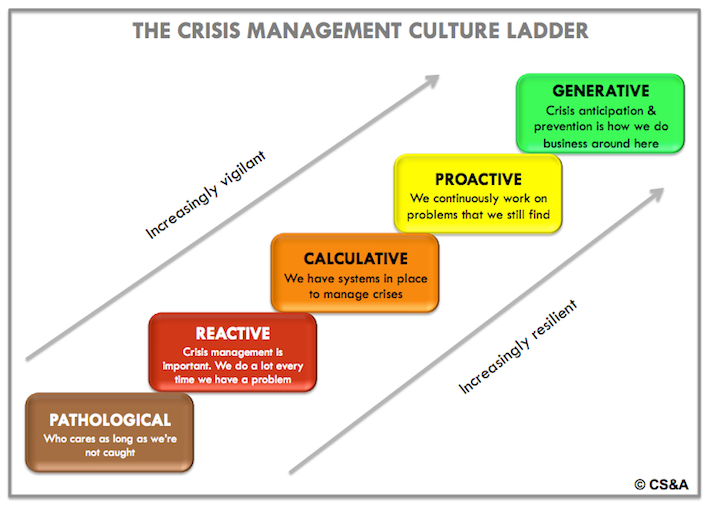
If you’re wondering how your organization is doing, have a look at the below image which has been developed by Caroline and her organization. The crisis management culture ladder will help you to understand where you are in terms of preparing your organization for a crisis.

CS&A's crisis management culture ladder maps out where organizations are in terms of their ability to manage and learn from a crisis. At the bottom are organizations who essentially don't care as long as they're not caught; at the top are organizations who thrive on and grow with every crisis they encounter. Where are you at?

CS&A’s crisis management culture ladder maps out where organizations are in terms of their ability to manage and learn from a crisis. At the bottom are organizations who essentially don’t care as long as they’re not caught; at the top are organizations who thrive on and grow with every crisis they encounter. Where are you at?

As an additional plus, Caroline has shared a reading list that will help guide you on improving your understanding of crises and what you should do to prepare as a communicator and leader.

On a final note, I’d like to thank Caroline for her time. And if you’re interested in knowing more about Caroline Sapriel, she’s the managing partner and founder of CS&A International, a pioneer and a recognised leader in the field of risk, crisis and business continuity management. For additional information please visit her company’s website.

#CIPRElection – What do the CIPR’s international members want?

The CIPR can do much to promote public relations overseas, and, most importantly, support its international membership.

The CIPR can do much to promote public relations overseas, and, most importantly, support its international membership.

As part of my bid to stand for the CIPR Council this year, I’ve written about what I want to bring to the table on behalf my fellow CIPR members who are not based in the United Kingdom.

I’d like to turn the tables slightly and talk about what the CIPR needs to do when it comes to its members abroad, many of whom (including myself) look to the CIPR for leadership and guidance when it comes to the industry. Let’s start with the obvious.

1) Ethics – While the industry has come a long way in terms of ethics since the days of Edward Bernays, ethics is still an issue for communicators. For people who are tasked with managing reputations, professionalism must be at the top of the list when it comes to engagement with all CIPR members. To its credit, the organization has one of the strongest and most robust codes of conducts I’ve ever read. In addition, the recent launch of a compulsory ethics CPD module is also a step in the right direction.

I’d like the CIPR to build on these steps, and launch ethics campaigns outside of the UK throughout ethics month (which is normally held in September), as well as all-year round. This can take a number of forms, such as social media dialogues and webinars. It could also include working with other public relations bodies, to share best practices. For those of use who care about the reputation of our industry, I’m sure this would be more than welcome.

2) Training and Development – The CIPR has the best development program in the industry, full stop. Its Continuing Professional Development program is exceptional, and covers everything any communicator needs to develop (I’m even talking Chief Communication Officers here). Likewise, the range of academic qualifications offered by the CIPR is outstanding. I have the utmost respect for anyone who has undertaken and completed a CIPR qualification.

This positive attitude needs to spread. We need more communicators outside of the UK to understand the importance of ongoing training and development. We also need more employers to understand that when they look to hire, they should look for CIPR qualifications. We have far too many communicators who haven’t studied communications, either because they don’t understand the importance of doing so (I hope these are far and few between), or because there are no institutions that offer courses in subjects such as internal comms, public affairs or public relations. The CIPR needs to step into this gap, and bring its know-how to bear, to promote a respect for training and development and to offer the tools needed for CIPR members outside the UK to enhance their own abilities.

3) Networking – We’re part of the family, but sometimes out-of-sight can be out-of-mind. One aspect of my membership that I enjoy the most is networking with my fellow CIPR members. I’ve had the good fortune to visit the CIPR offices in London and meet with the organization’s leadership. But many others who are abroad haven’t. We can use technology to bridge that gap (the CIPR International has done great work, with webinars on countries outside of the UK for its home-based members), as well as promoting the development of local chapters outside of the UK where numbers allow. The more we feel that we’re one family, the more we’ll benefit from what the CIPR has to offer.

These are but a few ideas that the CIPR can use to engage with members abroad. I hope to be able to provide a voice for those members, and bridge that gap. The CIPR is an incredible organization, and I have benefited enormously from all that is has to offer. I want others who live outside of the UK to have the same experience that I have had with the CIPR. I hope you agree, and will support me during the #CIPRElection.

CIPR and why I want to speak up for International Members

I'm standing to bring a voice to CIPR's members outside the UK, and support CIPR's growth in markets where we could benefit from CIPR's leadership

I’m standing to bring a voice to CIPR’s members outside the UK, and support CIPR’s growth in markets where we could benefit from CIPR’s leadership

I’ve been a proud member of the Chartered Institute of Public Relations for a number of years, and it’s an honour and a privilege to be part of an organization that puts the industry and its professionals first, that promotes what we do, and pushes for change for the better.

I was asked several weeks back by Jason MacKenzie a number of weeks ago if I’d stand for the Council. His thinking was clear; he wants to broaden CIPR’s scope, to reach out to the hundreds of CIPR members who live and practise their trade outside of the United Kingdom.

CIPR and the Need to Cross Borders

Both Jason and I share the same sentiments. While I am a member of the CIPR and have benefited from its world-class training and its ability to bring the industry together to tackle challenging issues, I want the CIPR to do more for all of us who aren’t in the United Kingdom.

Take my region, for example. Dubai and the wider Gulf are home to thousands of UK nationals who are public relations and communications professionals. Many of us here know the CIPR, we respect the work done by the CIPR, and we’d love to see the CIPR bring that gravitas to bear for issues that matter to us.

Representation for CIPR Members Abroad

As an organization that represents many in the communications industry, the CIPR has a strong membership base outside of the United Kingdom. Many of my own associates, colleagues and friends in the United Arab Emirates are members of the CIPR. While the CIPR International has done stellar work, it is time to step up representation on the Council for CIPR’s members abroad, for them to voice their needs. More international voices on the Council will also help promote to CIPR’s members the industry outside of the UK.

The Bridge Between the CIPR and the Global Industry

I’d also bring my experience to bear, as a board member of both the Middle East Public Relations Association and the International Association of Business Communicators, to promote mutual interests across a wider region for the benefit of all (an example of this is bringing the Chartered Status to the Middle East through the agreement with MEPRA). As an industry we are much stronger when we work together to engage on what we do and its value. I want to bring my board experience and the work I’ve done in emerging markets on behalf of the industry to bear for others in the CIPR.

I’m happy to field any questions from any CIPR member. I’m all for transparency and engagement, and I’m always keen to talk about the industry and how we move forward.

On a final note, I’d like to thank my nominators: Eva Maclaine; Jason MacKenzie; Donald Steel; Sarah Pinch, and Julio Romo. They’re all communicators who I admire for their abilities, their passion and their commitment to giving back to the industry. I hope I’ll do you all proud.

The need to move comms past window-dressing: Adopting a standard certification for comms

For many companies, it feels as if communications is simply window-dressing. We have to change perceptions about our profession (image source: http://www.hansboodtmannequins.com)

There are times when I have no other reaction but to laugh. I was sat with an acquaintance and we were talking about a company which was hiring for a senior comms role. Me being me, I wanted to help out and recommend someone, and I asked the obvious question.

“What are they looking for?” I said.

“A pretty Lebanese girl,” was the response.

My friend was part joking, but also part serious. And here’s why. For far too long, communications has been seen as a nice-to-have, a function that isn’t really strategic. Unfortunately, what has often happened is that communications has become the department where either someone senior is left to ‘retire’, or it’s the place where an inexperienced but attractive character is brought in.

This Has To Change

We need to stop treating communications as a window dressing. Reputation matters, in both good and bad times (ask anyone who works at Volkswagen about the importance of reputation and its cost to the business). Today, thanks to social media, any one consumer or stakeholder can call out your company, for both good reasons and bad. And yet, few companies in the MENA region have people who can effectively steward and build reputations.

So, how do we do it?

Firstly, the industry needs to talk more about what communications truly is and what it can do for organizations and their publics. Many of us will work tirelessly for our brands, but we’re awful at doing public relations for ourselves. There’s not enough people out there, particularly among the C-level crowd and within human resources who actually know what communications is about. As an industry we have to spend more time educating our peers, so that they know what we do and the value of our work.

Secondly, we need a universally accepted certification. Would you go to a lawyer who doesn’t have a degree. Or how about a doctor who didn’t attend medical school? And yet, most of us in the communications industry have never studied public relations and understood the theory underpinning our work. If we’re to evolve, and become better at what we do, then we need to go forward as an industry and adopt a standard certification, be it that advocated by the CIPR or IABC. We need people who are accredited, who have invested time in their development, and who can say, “I know my communications theory and this is how I can prove it.”

I’m used to the status quo. But it doesn’t mean that I don’t want change. I want our profession to be respected, to have a seat at the table, and to be strategic. I hope you’ll join me, so that together we can push for change.

@Wadds on uncertainty and life in the UK post-Brexit

In another guest post, I’ve asked the respected public relations industry figure Stephen Waddington to share his thoughts on Brexit. Strap yourself in for the read.

The vote for Brexit will have many consequences for the UK, including for its communications industry, argues Wadds (image source: http://www.fortune.com)

The lack of planning and political fallout from the UK’s European Referendum mean that Brexit will remain a work in progress for a long time to come.

Alex asked to me to draft a guest blog post reflecting on life in Britain post Brexit shortly after the European Union (EU) Referendum result at the end of June.

I dodged the opportunity initially, not because I didn’t have a view, but because for three or four weeks it was really difficult to make sense of what was happening in the UK.

It’s has taken me the summer to come to terms with the fact that the UK voted to leave the EU. I was convinced by conversations on Facebook and Twitter that UK citizens would vote remain. I was stuck in a filter bubble.

The Referendum divided the country. The remain campaign was based on rational argument; the Brexit campaign, by contrast, on emotion.

UK citizens used the Referendum as an opportunity to vent their anger at the political classes in London and Brussels. It exposed a split between London, Northern Ireland and Scotland which all voted remain and the rest of the UK which voted Brexit.

More than two months after the result we’re becoming used to living with the uncertainty. What Brexit means and how it will happen are both a work in process.

The Conservative Prime Minster resigned and was replaced without a leadership election. The Labour party remains in the midst of leadership election.

The new Prime Minister Theresa May has created a Ministry for Brexit led by Eurosceptic David Davis, and has appointed Brexit campaigners Liam Fox and Boris Johnson as trade secretary and foreign secretary respectively.

Both Davis and Fox are recruiting the small army of people needed to work on the exit negotiation with the EU. 1,250 positions have been created in trade and diplomacy.

The UK will have two years to negotiate its exit once it triggers Article 50 of the Lisbon Treaty.

In that time it will need to determine how to manage more than four decades of law that are entwined with the EU, and negotiate trade deals on an industry-by-industry basis with the 27 member states, and major countries around the world.

There’s also the issue of the free movement of people. Take back control [of UK borders] was a campaign slogan for the remain campaign.

It’s an issue that impacts the UK’s future trade agreements but also impacts UK citizens living in EU countries and EU citizens living in the UK.

People like markets don’t respond well to uncertainty. The government needs to move quickly to reassure people and investment that the UK remains a good place to both invest and build a career.

The UK is a centre of excellence for talent in the creative industries, including my own trade, public relations. I’m keen to see this remain the case.

The emergency budget, and recession, both predicted by the remain campaign haven’t happened. But UK currency shows no sign of returning to pre-referendum levels.

£1 was worth $1.50 on the day of the Referendum. Today the £ is trading at an average of $1.30. The foreign exchange markets have priced down UK assets by more than 15%. It’s the one area of absolute certainty.

The rest is yet to be seen.

Stephen Waddington is Partner and Chief Engagement Officer, Ketchum and Visiting Professor in Practice, Newcastle University. He blog at wadds.co.uk and you can connect with him on Twitter @wadds.

Two-Thirds of UAE Residents Will Take Advice from Social Media Influencers on a Purchase, Apparently…

Now, this may shock you. But, we’re all now listening to social media celebrities to decide what we want to buy and eat. At least, that’s the result of research carried out by PR agency BPG Cohn & Wolfe with YouGov. Out of over a thousand people surveyed, 71 percent of those aged between 18 and 40 said they’d be happy to take advice from their favorite social media influencer before buying. And if you don’t believe me, Results for BPG Survey (Fashion Food, & Beauty Influencer), see the press release or have a look at the infographic below.

The growing power of social media influencers and bloggers has been borne out by new research from Dubai-based PR agency BPG Cohn & Wolfe that shows that 71 per cent of UAE residents aged 18-40 are happy to take advice online before purchasing.


Beauty, fashion and food are the areas where residents are most likely to turn to leading social media influencers for recommendations say the results of the research undertaken for the agency by YouGov who interviewed 1000 men and women across the country.


Tech-savvy residents used their smartphones to follow their favourite influencers with 68 per cent of those polled admitting that where they eat out can be prompted by online recommendations or reviews and 63 per cent more likely to buy fashion or beauty products based on what these influencers might say.


BPG Cohn & Wolfe PR Director, Consumer Practice, Taghreed Oraibi managed the research process and said: “We are working closer than ever with bloggers and influencers and wanted to find out just how influential they have become in a country that is more switched on and digital than many all over the world.


“The results have clearly shown that companies now have to take these online influencers seriously and listen to what they have to say and find creative and engaging ways to work with them to tell their story and reach customers in that vital 18-40 demographic.


“BPG Cohn & Wolfe has identified the rise in influence of bloggers for some time and this led to commissioning the research to assess just how widespread their influence is and in what areas they have the most impact.”


BPG's research has found that over two thirds of UAE consumers will take advice from social media influencers before they buy. But what does this really mean?

BPG’s research has found that over two thirds of UAE consumers will take advice from social media influencers before they buy. But what does this really mean?

The issue of social media influencers is controversial (have a read of this guest blog post from yesterday by Rijosh Joseph). I’m personally a fan of working with social media influencers when they’re used strategically (i.e. who they are and what they do is aligned to the brand they are working with), when there’s a long-term commitment rather than an agreement for a single post or three, and when the goals are clear and there’s a sensible set of measurement metrics in place.

And, I’ll be honest, I don’t see many organizations in the region thinking through what influencer engagement can do for their brands or customers. Instead, it’s a ‘me-too’ approach. I hope I’m wrong.on this (if I’m wrong, then tell me). In the meantime, I’ll be listening to my influencers when making my next purchase, namely my wife and daughter.