How the Media Industry can regain its influence in today’s Social Media world

Is Print Dead

Print may not be dead in the region, but are there way that the media industry can regain influence lost to social media celebrities? (image source http://abcodigital.com)

I recently had an email exchange with a colleague in the PR industry here in Dubai on the issue of the communications industry and how to develop. I asked, what do we need to do better to make the communications function in the region better. His response was fascinating. To quote:

The truth remains that more and more media outlets are closing down, journalists being made redundant, consumers not reading much – but “following” social trends!

All what most of us have done is jump into the “influencer” band-wagon and discuss $ rates on the number of posts along with potentially a storyline. This should change. We need to find something more creative than being short-sighted to tap into the money.

But what keeps me awake at night (beyond other things, of course!) is what if media outlets close down, journalism as a profession becomes history – who the hell do we pitch our stories to?

While it’s true that the PR industry in the region has had a hand in the rapid and prominent rise of social media influencers, what about the case for the PR industry’s role in the declining influence of media, particularly print.

Here’s my two cents on how the media in the Gulf should work to regain its influence in today’s digital age. Let’s start with a look at one issue which the media has struggled with, namely transparency:

  • Audited Media – The number of audited print publications in the region is relatively low (we’re probably talking percentage-wise in the single digits). Whilst publishers such as ITP, and, most especially, Motivate have pushed for audited print titles, few others have followed suit. Audited numbers make our job of targeting the right media easy; we’re able to easily compare media titles, understand the reader breakdown and make a judgement as to whether a certain title is worth working with editorially (and then, later down the line, through advertising). It helps PRs clearly align media outreach with the business strategy, and it gives us trusted, independently audited numbers to back up our approach.
  • Unaudited Media – The vast majority of media in the region isn’t audited. Their numbers cannot be verified, and my assumption (which I assume is commonly shared in the industry), is that distribution numbers and readership is over-inflated. There’s no way that we can trust the circulation numbers given by publishers, and there’s no way that we can trust that the audience that we need to reach is seeing our messaging.
  • Advertising Media – Forgive the name for this third category. This is media which is created solely for the purposes of capturing advertising revenues, with limited to no circulation. With little to no circulation to talk of – in contrast to the publicized circulation numbers – such media and their publishers have done little to no favor to the reputation of media in the region. And it doesn’t help our cause in promoting media as the most effective means to reach out to our target audience, especially when the publication has effectively no audience.

The second issue is digital. Whilst some publishers, titles and journalists have embraced digital platforms including websites, podcasts, vlogs and social media, others have yet to leverage the power of online distribution and amplification. Digital remains a challenge for much of the media industry globally; no newspaper has been able to make a profit and run its business from its online sales revenues. However, with consumers in the Gulf region essentially living their lives online, does it make sense for traditional media publications to not be online?

The other aspect of digital which media needs to leverage is its ability to engage in real time with its audience, and build audience profiles. I’m yet to see or meet an influencer who will be able to give me an up-to-date breakdown of their followers’ interests, age ranges, geographies and other demographics. The media can and should be helping to build up reader profiles which in turn will help us work with them to target the right audiences. This requires trust and transparency, which is still hard to come by with many titles (see the above).

I feel its especially important that journalists build their online profiles. While many are being laid off as publications shrink, brands need reputable voices to work with. For me, there’s little comparison between a professional journalist and a social media influencer in the Gulf (there are exceptions). When reviewing a product, it’s much more likely that a journalist will give a less biased viewpoint, and will include both positives as well as negatives. That builds integrity and trust with readers, which advertisers should seek out as the holy grail of brand building. Journalists need to think about transitioning into content creators and distributors for brands, much like their social media influencer counterparts. The difference will be in their ability to tell a balanced story that is trusted by their readers.

Whilst the region’s media scene is slowly feeling the impact of ad spending shifting online (just look at the recent closures, including 7Days), I cannot and don’t want to image a day where we have no media to work with. The media industry has to play its part in changing to meet the needs of consumers, through embracing both transparency and digital platforms. I have a great deal of respect for the professionalism and expertise of many publications and journalists in the region, and I know how influential they can be. We need to ensure that their influence is recognized in a fashion that is understood outside of the media industry, by businesses who want to engage publicly.

Do you have any inputs or thoughts on the media industry and how they should change to remain relevant? If yes, then please do share them with me in the comments below.
Join me and pledge to work with and hire comms people on merit

On merit

Merit. I just love that word and what it means. To quote the Oxford Dictionary, the noun merit is understood to mean, “the quality of being particularly good or worthy, especially so as to deserve praise or reward.” Hence the phrase, to be deemed worthy of something on merit.

I was reminded of the notion this week, by a journalist who was Tweeting about being treated poorly by a brand. Her frustration was in part to her feeling that she was being mistreated by the brand’s agency due to her cultural heritage. I completely understood her frustration and her sense of injustice, hence why I’m writing this post.

In one sense, we’re lucky to work in the Gulf. It’s an up-and-coming region which has attracted some remarkable communications and media talent and experience from around the world. There’s a dynamic feel to working in such a multi-racial industry.

At the same time, I often get the feel of tribalism, of people in companies and institutions wanting to work with one of their own, not for any other reason than culture or nationality. It probably doesn’t surprise many of us that people stereotype (and if you don’t believe me, look at this research from Berkeley-Haas Asst. Prof. Ming Leung who analyzed 3.9 million applications), but there’s also official discrimination – the hiring of certain nationalities to fill quotas – as well as unconscious bias . Finding people on merit, who can do the best job, seems to be a challenge we employers often get wrong.

The question I then have to ask is what does bringing the wrong people do to our industry, or even people who are too junior or who don’t have the right understanding of the role or the audience? In my own view, it devalues the work of us all, pushes us farther away from the board room, and loses us respect from those we work with, be they colleagues internally, media professionals or other stakeholder groups.

We have to look beyond traits such as race, nationality, gender, and ask if the person you’re looking to hire and work with has the right attitude, understanding, skills and experience for the role. We need more diversity and inclusion in our industry which mirrors that of our audiences and communities, and that will happen by understanding our biases and looking beyond them to finding the best talent out there, who deserve and will succeed in a role based on their own merit. That includes working with representative bodies such as the CIPR, IABC, Global Alliance and MEPRA who promote skills-based learning and certification programs.

I’m willing to take a pledge now to work with and hire comms people on merit. I want you to join me in taking this pledge. Either share this article or leave a comment below. Together, we can and will change the comms industry for the better, to be a function that respects and promotes the notion of merit.

What PR training do you want MEPRA to offer in the Middle East? Share your thoughts with us.

Print

Are you a communications professional based in the Middle East. Do you want to improve your abilities, learn new skills, and develop your career. As part of its commitment to the region’s communications industry, MEPRA Academy is calling out to all communications professionals working in the Middle East to have their say on its new training programme set to begin in September.

By completing a short survey on current skills, expectations and preferences, industry professionals will help design a programme that is responsive to local needs and supports a wide range of practitioners.

As the Middle East’s leading industry body, MEPRA is committed to providing education and training that is aligned with global standards, responsive to industry trends and meets the needs of communications professionals across the region. Through its Academy, MEPRA hopes to provide an avenue for continuous professional development at every stage of a practitioner’s career.

To complete the short survey and have your say, please click here: https://www.surveymonkey.com/r/mepratna


Stepping up with the Global Alliance: How do you want the Comms Industry to develop?

Global Alliance

I wanted to share the news here first. I’m honored to be nominated to serve on the board of the Global Alliance as a director. I’ll be taking up the post on a voluntary basis from July of this year.

The Global Alliance for Public Relations and Communication Management is the confederation of the world’s major PR and communication management associations and institutions, representing 160,000 practitioners and academics around the world.

The Global Alliance’s mission is to unify the public relations profession, raise professional standards all over the world, share knowledge for the benefit of its members and be the global voice for public relations in the public interest.

As part of this mission, I will be serving to represent communications practitioners in the Middle East. And I want to put a question to you all, my friends and colleagues around the region – how do you want the communications industry to develop?

I want to hear your thoughts. I’ll be working to represent the industry, and I care about your opinions. So let me know your response to my question, and let’s find the answer together.

How Psychology Promotes Organizational Change – A Guide by Hilary Scarlett

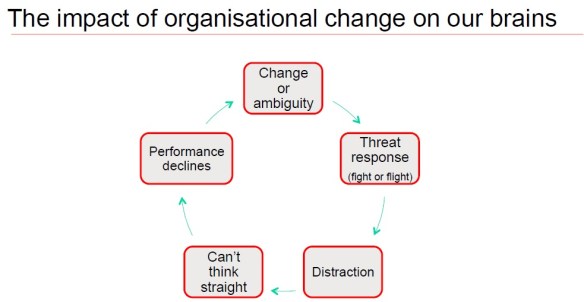
Organizational change impact on our brains

According to Hilary Scarlett, organizational change can often be a stressful experience for most employees, whose performance declines as a result.

I’ve said it before and I’ll say it again – communicators aren’t spending enough time getting their heads around psychology and how it can help us better engage with our audiences (what’s the point in understanding the how of our jobs, if we don’t get the why).

The above reason is why I was thrilled to see a keynote presentation on neuroscience by Hilary Scarlett at IABC’s Eurocomm event recently. Hilary is an expert in the area of cognitive neuroscience; she’s written extensively on how the discipline can and should be used by communicators and management teams, especially during times of change.

I’d like to share key takeaways from Hilary’s presentation, as well as from her book, Neuroscience for Organizational Change (thank you for the gift Jasna!), here, in the hope that these insights will help you manage organizational change.

  • We’re not Designed for Change

Our brains haven’t evolved at the same pace as our workplaces. As Hilary explained, our brains aren’t designed for 21st century corporate life. Rather, the brain’s goal is survival. We do this by avoiding threats and seeking rewards. However, of the two responses the threat response is much stronger, which explains why there’s so much resistance to change. Our brains are constantly looking to predict what will happen.

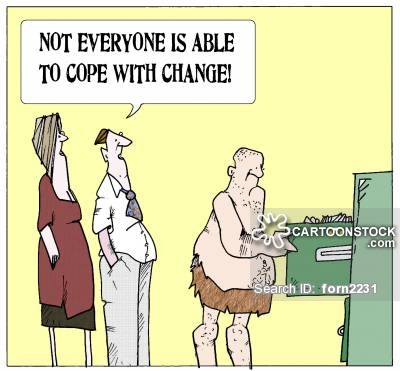
'Not everyone is able to cope with change.'

Cavemen in the office? Our brains haven’t developed at the same pace as our workplaces (image source: cartoonstock.com)

But there is neuroplasticity; our brains can restructure, change and learn throughout our life, if we choose to continue developing ourselves (lifelong learning).

  • We Don’t Like Change

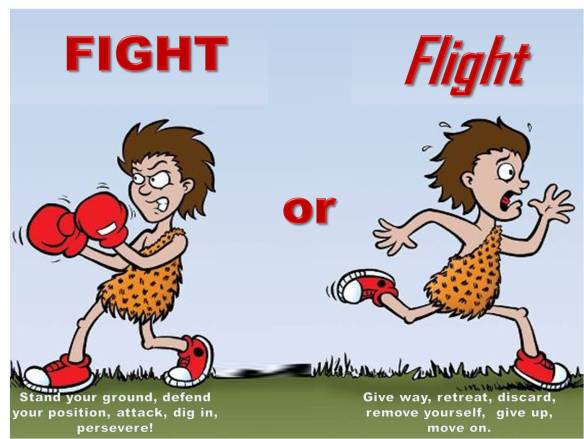
This is a logical extension to how our brains work. We want predictability, which helps with survival. For many of us, organizational change is the exact opposite of predictability, and we see it as a threat. When we see a threat, we switch to a ‘fight or flight’ mentality and think less rationally. We become more hostile in the workplace.

Fight Or Flight

When we feel threatened, we switch to a fight or flight mode. This is especially true during times of change (image source: psychlopedia.wikispaces.com).

The issue of certainty is crucial here. Research shows that we’re more comfortable with knowing bad news, than not knowing anything at all (the don’t say anything to the last minute approach, which seems to be the way many organizations work when it comes to communicating bad news).

We’re also guided by our past experiences, and they shape our current behavior and attitudes.

  • SPACES – A Planning Tool for Supporting Change Management

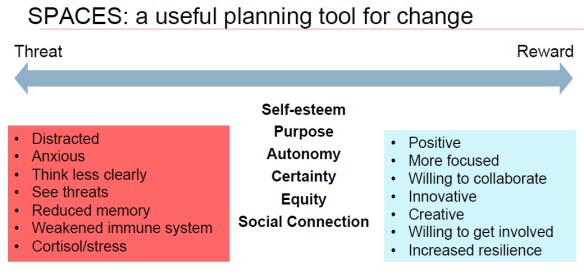
Hilary provides a wealth of good advice on how to support change management. One which I found especially useful was her own planning tool on supporting change. Named SPACES, you can see the visual framework below.

SPACES planning tool for change

SPACES is a planning tool developed by Hilary Scarlett to help communicators navigate organizational change. The six central elements can either positively or negatively impact on employee reaction during a change in the workplace.

Hilary outlines six key factors that can push people to either see the change as a threat or as a reward. She then outlines the impact that a shift in either direction will have on behavior.

The six elements are:

  1. Self esteem – the feeling of importance relative to others.
  2. Purpose – having a sense of direction, meaning and usefulness.
  3. Autonomy – the perception of having control over events, being able to make choices and having your voice heard.
  4. Certainty – being able to predict what will happen and how to respond.
  5. Equity – the notion of fairness and transparency, especially during times of change.
  6. Social Connection – feeling connected to others, especially as part of a group.
  • The Role of Communicators in Change Management

The good news is that we communicators have a key role in any change project. People want information, and the sooner they get it, the better it is for their level of certainty.

We need to be the people who provide that certainty, through providing information and positioning change in a way that doesn’t infer what we are doing is wrong.

Some of Hilary’s key suggestions are putting in place regular communications timings (which supports our need for consistency and predictability), supporting the organization’s ability to understand employee insights through engagement and dialogue, guiding leadership on messaging and how to deliver this messaging through visuals and narratives, and creating a sense of purpose for everyone to support.

I’m going to end on this note. if you want to know more, then go out and grab a copy of Hilary’s book, Neuroscience for Organizational Change. You can thank me later!

Step up, support the Comms industry. Volunteer for the IABC EMENA Board!

Volunteer

I’ll be the first to admit it. It’s a well-known secret in the communications industry that we’re awful at PRing what we do. The public relations sector doesn’t engage enough with the outside world in terms of what we do and why we’re of real value to any organization.

For me it was exciting to see the turnout at the annual regional Eurocomm event in London recently. The number of professionals who cared enough to travel to London for several days, and engage in learning and debate about the industry, was inspiring. There’s a lot of good will and positive sentiment around the communications sector at the moment, which I hope will long continue.

But, I’m never satisfied. I’d like for us to build on that engagement, and ask you, the communications professionals who I engage with here online, or through social media, to put themselves forward to volunteer to support the industry’s growth and act as leaders and mentors to those who want to learn about and join the sector.

As a not-for-profit organization that aims to promote public relations both globally and throughout Europe, the Middle East and North Africa, IABC works through volunteers. The Europe, Middle East and North Africa board supports activities across the most diverse, and most exciting region for communicators. Under the board, IABC has a host of country chapters that help with everything from organizing our large events (think Eurocomm which was held in London in March), to smaller activities such as media evenings, webinars and training. Volunteers can also help in research work and soliciting ideas and thoughts from our wider family of members.

If you want to give back and help, why don’t you step up and volunteer on the EMENA board? Volunteering is one of the most rewarding activities that I’ve engaged in, and I’m sure you’d enjoy working with a group of people who could not be more passionate about what we do and why we do it.

Please do drop me a line in the comments or send me a message through social media and we can take the conversation from there. You can find more details here on the IABC website. Nominations are open until Wednesday the 17th May.

So, what do you say? Are you up for it?

The End of An Era as the D’Abo sisters and Jason Leavy leave Edelman Dabo

Dabo Picture

The D’Abo sisters, Jason Leavy and the whole team at Dabo took on, and often won against, global agencies in the region (picture source: Pinterest)

Many in the region’s PR industry will have learned over the past 24 hours that Camilla and Lucy D’Abo are leaving the agency they founded 13 years ago. Jason Leavy, who headed up the agency and then led the brand team after Dabo was acquired by Edelman.

It’s fair to say that the D’Abo sisters and the agency which still bears their name transformed  the PR industry in the Gulf. Whilst Dubai has always been a hub for the comms sector – there’s at least a hundred agencies in the city – there’s always been a stark gap between locally-established firms and global names.

What the sisters were able to do, and what Jason Leavy was able to build on when he joined in 2010, was to establish an agency which grew in size thanks to the quality of the work produced by the entire team. Dabo regularly won business from and against global agencies, and the firm’s headcount grew to over a hundred. They showed that it was possible to build an agency from the ground up that didn’t compete on price, but on the quality of their work. Others have followed them, but they’ve always set the standards as to how an independent agency should run.

After the acquisition by Edelman in 2015, there was also going to be change; it’s rare for founders to stay on for a lengthy period of time. Likewise, Leavy will also be missed. His drive and passion, and his experience and knowledge of the publishing and public relations sectors set him apart from many agency heads.

I’ve leave the last word to one of the founders. I wish them and Jason all the best in their new adventures. “We leave a combined business that offers the very best integrated brand service in the market,” Camilla d’Abo told the Holmes Report. “Our teams and clients are in great hands. This is not a decision we have come to easily, but we both feel that now our commitment to Edelman is complete it is time we explore new opportunities.”


Expats, Localization and the Need for Balance

The marcomms industry can and should benefit from both local talent as well as foreign expertise (image source: The Daily Telegraph)

There are some places that are so inspiring, they fill me with passion and energy. I just love working with colleagues and friends in London and New York. Their creativity and insights are exceptional. What strikes me most about these places is their ability to absorb talent from abroad, to the extent that you can’t even tell who is the native and who is the immigrant.

Whilst there’s much to admire about how the region’s marcomms industry has developed, there’s still much work to do when it comes to marrying local insights and talent with foreign know-how. For years there’s been a divide between the Gulf’s public and private sectors: the public was staffed by nationals, and the private by expats. Whilst there were exceptions, this was the norm.

There have been changes, both good and bad. The economic changes in countries such as Bahrain, Oman and Saudi, combined with the increasing number of local marketing and communications graduates, have helped to increase the number of nationals working in the private sector. An insistence on hiring nationals in both government and semi government organizations have led to there being fewer expats in comms and marketing roles in both Abu Dhabi and Doha. For many multinationals, there’s still an over reliance on expat communicators, many of whom don’t know or try to learn about either the local language or culture.

I’ve always believed that there should be more locals in marcomms in the Gulf (one such person who is an inspiration to me and who I will always be proud of is my wife, who is both a local and who heads up marcomms for a multinational across the Middle East region). However, we need to place people based on merit, and we need to have structured succession planning in place. Both are missing today, across the public and private sectors.

Let me highlight my point. I live in a city which wants to be a global hub, attracting investment and tourism from abroad. That city’s government has been prioritizing national hiring to such an extent that it’s rare to find a foreigner in a mid or senior level comms post today in either a government or semi government role. What has happened is young nationals who don’t have the necessary experience or knowledge have been brought in (or roles have been left open), and as a result the work done and respect given to the function has dropped. There’s less diversity and inclusion in these government organizations, leading to a lack of understanding of foreign audiences and stakeholders.

I’ve also come across countless multinational executives who don’t understand the importance of hiring local knowledge. To them, global strategy only needs to be translated. There’s no understanding of local insights, and an inability to communicate with local audiences because of the lack of any marketing or communications people who are from or connected to the local population. I’ve known regional comms people in the private sector who’ve never even gone to Saudi, despite it being the biggest market in the Gulf. It’s all too easy to manage issues remotely, and let the agency deal with an issue.

We’ve got to change these two approaches in the region. There needs to be a balance, an understanding that foreign expertise is often needed whilst initiatives are created to support knowledge transfer to capable locals. Rather than replacing foreign expertise overnight (which has happened in some places), let’s get these professionals to pass on their expertise through job shadow programs, teaching and mentoring. In one of my previous roles I was asked to do this, and I considered it part of my role in developing the local profession. Others should do the same.

Our region can be as diverse and as exciting as London and New York, and I don’t see why the marcomms industry should be any different. Let’s start making use of both local insights and foreign experience, and combining them to create better work. We need balance in approaching this issue. As always, I’d appreciate your thoughts on this issue.

Lessons for the PR Industry from the Dubai Lynx

Dubai-Lynx-Branding-in-Asia-696x496

The Dubai Lynx highlighted the issues that communicators (and their marketing colleagues) will need to face up to. But is anyone listening?

It was an early morning, but the 6.30am start from Abu Dhabi was certainly worth it. The Dubai Lynx is always worth a visit for anyone working in marketing and communications. The Festival, which is organized by the people behind the Cannes Lions, has been going for over a decade. And, as the two disciplines of marketing and communications coverge, the Dubai Lynx (which billed itself this year as the MENA region’s biggest celebration of creative communications) is becoming a must-attend for communications professionals.

For me, there were two basic takeaways from the Dubai Lynx:

  1. It’s all about data, data, data: Every other word seemed to be data. The push to incorporate data – big, small or something in-between – is understandable; the marcomms industry has always struggled with the question of ROI, and data measurement, when used wisely, should help answer the question of what are organizations getting for their money’s worth. When analyzed well, data will also help marcomms professionals better understand both their audience and their impact. However, what wasn’t mentioned was ‘creativity’. Have we swung too far over to talking about data, rather than marrying data with creativity? While I’m sure there are computers and algorithms that are far smarter than me, I doubt there’s any machine which understands the human mind better than we can. Could a computer have understood why the ice bucket challenge would have gone viral? Or the success of the Chewbacca mom? I doubt it.
  2. Agency Convergence gathers steam: There’s no marketing or communications in our industry anymore, as the list of agencies offering everything under the sun grows longer. Those marketing agencies who were already one-stop shops are going further, and breaking down the internal silos to promote better integration between the various disciplines. Some PR firms are creating new roles, such as creative leads and digital heads. And then there’s the big consultancy firms, the data goliaths such as Accenture, IBM and McKinsey, using their IT know-how and their understanding of strategy to break into the marcomms industry (we’ve already seen this with Accenture and IBM, and expect to see it with McKinsey in this region following their acquisition of marketing firm Elixir). For an industry which used to be mainly focused on media relations about a decade or so ago, this is a seismic shift. Expect to see the gap between those offer an ever-expanding range of services (think creative, digital, public affairs, technology) and those who stick to old-school offerings such as media relations to grow significantly over the coming year.
  3. Marketeers are doing PR (and some of their work is exceptional): One of the best PR executions I’ve seen in a long time was from last week. It was the ‘Fearless Girl’, a statue commissioned by State Street Global Advisors and executed by McCann New York. The concept, which was timed to coincide with International Women’s Day, saw the ‘Fearless Girl’ face off against the famous Wall Street Charging Bull. The stunt symbolized the power of women in leadership and emphasized that companies with women in top positions perform better financially. Ask anyone in the business and they’ll tell you that McCann isn’t a PR agency, but rather a creative. However, much of the work which has been winning plaudits at Cannes recently has essentially been PR work executed by creative agencies.

The PR industry has gone through some remarkable change over the past decade. However, we’re going to see much more disruption over the short and medium term as creatives and consultancies move into new disciplines. Are PR firms ready to both embrace data and expand their own offerings? Or are we about to see another wave of industry consolidation over the coming five years? Time will tell.

Do You Know Your Rights? Public Relations and the Law

scared

Yes, I also used to have nightmares about lawyers. But don’t worry, they’re a friendly bunch, especially if you work agency-side.

The law! These are the two words that’ll send most PR practitioners running into the distance and over the horizon. Public relations practitioners aren’t always savvy about their legal rights, or what local legislation means for how they (or their clients) operate.

It was a refreshing change to see this issue tackled at this year’s PR Pressure conference. Organized by Secret PR and now held for a second year, the event included a panel of legal minds who were willing to tackle everything from intellectual property (including pitches), to social media and influencers and chasing debts.

I’m going to summarize some of the key points made by the speakers – Cedar White Bradley Group’s Fatema Fathnezad, Norton Rose Fulbright’s Dino Wilkinson, Al Tamimi’s Fiona Robertson, Lincoln Legal Consultants’ Nasir Ilyas and Rafi Yachou from InDate.info – on a number of areas which are, or should be, of concern to communicators.

Getting Your Contract Right

As Fiona Robertson clearly pointed out, much of what goes wrong legally starts with the contract. Be as precise as possible in terms of deliverables, avoid jargon, and ensure that you understand what recourse you have to legal help in the jurisdiction under which the contract is applicable. You’ll end up spending much less on a good contract than on any legal dispute (up to a tenth according to Robertson), so ensure that the contract is watertight and clear to all parties.

Who owns the Intellectual Property (and pitches)

We work in a content industry, and yet so little of what we do with content is understood within a legal framework. For example, do you ask for consent from those people that your photographer is taking pictures of? Are you clear on when and where content which you have purchased usage rights for can be used? And what happens when your content is misused, such as after a pitch?

Fatema Fathnezad suggested that agencies trademark their logo and services, and include these trademarks on all materials. In addition, before and after a pitch agencies need to communicate in writing that the material being presented is under copyright and that as such the execution of these concepts cannot be undertaken without the agency’s permission and compensation being paid. Remember that you cannot legally own an idea, but you can copyright and protect the execution of that idea.

Social Media and Influencers

This one may be common sense, but the first thing that agencies and clients need to bear in mind is that they need to manage administration rights of social media accounts.

Secondly, when it comes to influencers any paid content must be considered as advertising. Dino Wilkinson pointed out that many influencers in our region are reluctant to clarify to the public when content is paid for, but as per the advertising laws there are rules which must be followed by both brands and influencers (you can see them here).

Like many other jurisdictions around the world, there’s not as much legislation around influencers as they should be (for example, do they need to have a business license to operate). Both Dino and Fiona spoke of the need for agencies to have contracts in place with influencers, and for there to be background checks on the influencer – remember that these people will be representing your brand or your client, and so the proper due diligence should be done.

Chasing Payments/Debts

Some of the most interesting comments were made by Nasir Ilyas and Rafi Yachou on the issue of debts. Some of the inputs were logical – chase on payments before they’re due and reschedule payment terms if the client has issues paying. If non-payment occurs, look to resolve the situation directly but amicably. And get a lawyer involved – up to a quarter of cases are settled by a letter from a lawyer. There are dispute mechanisms available in the country, such as the DIFC Small Claims Tribunal, but these mechanisms will cost you time and money, so beware of what you’re getting yourself into.

Yachou suggested two novel agency approaches to clients – firstly, do a background risk assessment, so that you understand the history of payments both for a particular industry and a specific client. Secondly, there are insurers who will underwrite agency billing; if a client doesn’t pay, the insurer will make up the shortfall. We’re talking about billing in the millions of Dirhams here, so it’s not going to help small agencies, but it is a thought for those medium and larger sized agencies who want to hedge their risks.

Thank you to Secret PR

I want to say a big thank you to Sarah Mohamed and her Secret PR team for arranging this event, which is free to attend and which does tackle the big issues that the industry faces (other topics included the Arabic language and digital). Sarah and the team put a great amount of effort in to make this work, and it’s good to see a group of people take the initiative to educate others. Thank you Sarah!

sarah-mohamed_new-600x431

Sarah Mohamed is the head of Secret PR and the dynamo behind the PR Pressure event (image source: Campaign Middle East)