Unknown's avatar

About alexofarabia

I'm am obsessive compulsive communicator who has lived in the Gulf for almost a decade. Enjoying the challenge of working in a region where you've got to be innovative, patient and determined to make things happen. Miss being a full-time journalist! Miss family even more! Sometimes I mouth off, but more often I grit my teeth and try to encourage change through a smile (not as easy as you think). Despite now living in Dubai Bahrain is home for me.

Does the Bloomberg deal with ADGM impact its impartiality or not?

Does this deal with ADGM (pictured) mean something for Bloomberg's journalistic impartiality in the region?

Does this deal with ADGM (pictured) mean something for Bloomberg’s journalistic impartiality in the region?

The issue of impartiality is one which is seldom discussed in the Middle East – this probably isn’t a surprise when considering that much of the region’s press is owned by some form of government authority. However, when it comes to international media the issue of impartiality is a different story. Journalists from abroad, news wires in particular, often have to navigate the challenging waters of what to report on and how to report. They know that the consequences of their work can be dire, and I have known several brave journalists who have been asked to leave the country they were based in. For me, they’re often the most trusted source of information.

The deal between Bloomberg and Abu Dhabi Global Market (ADGM), the aspiring, brand new international financial centre located in the heart of the UAE’s capital city, was announced last week. The deal, which had been in the works for some time, will include the following details as reported by The National:

The partnership will involve major media initiatives from a new office on ADGM’s Al Maryah Island base, including a dedicated digital platform, new programming and an annual conference of global business leaders in the capital.

Tracy Alloway, Bloomberg’s executive editor of markets, based in New York, and a former Financial Times US correspondent, will lead the ADGM editorial operation.

The TV centrepiece of the new initiative will be a daily global markets programme, from new studios in the Dubai International Financial Centre, which will include editorial content from Ms Alloway broadcast live from ADGM.

A new “anchor” broadcaster will soon be named to present the show, which will seek to bridge the gap between Asian and European markets in Bloomberg’s global network.

There will also be a dedicated Middle East edition of the Bloomberg website, with original input from its 80-strong editorial team, headquartered in Dubai.

I heard about the deal some time back, and what was said to me was that ADGM would be financially supporting Bloomberg’s news organization in Abu Dhabi. It’s a great deal for ADGM, which was recently set up and which has aspirations to become a global hub for financial trading. Alongside the likes of Reuters and Dow Jones, Bloomberg is a global name when it comes to business reporting.

However, is impartiality impacted when money is involved? How will Bloomberg report bad news from ADGM? And how would ADGM respond? All of us who have worked in the media industry in the region know stories of how publishers will behave differently for advertisers, often not reporting negative pieces and instead pushing out good news.

Bloomberg is a different proposition to a local publication; its reporters do write everything, warts and all. Similarly, there’s been a major push to make ADGM a global player on the financial stage, with experienced executives brought in from Singapore and London.

For the sake of argument, let’s address the elephant in the room. As a matter of principle, should Bloomberg have said yes to the deal? Even if no reporting lines are broken, does the deal imply that there could be a measure of bias? Time will tell and each and every organization has its ups and downs. I’m looking forward to seeing Bloomberg’s new setup in ADGM and what it means for journalism and impartiality in the Middle East.

What Customer Service? Etisalat and its inability to put customers first…

Etisalat never ceases to transform me into a mass of seething rage and frustration thanks to its inability to do anything right for its consumers

Etisalat never ceases to transform me into a mass of seething rage and frustration thanks to its inability to do anything right for its consumers

I’m a patient man. Really, I am (I can imagine my wife shaking her head right now, but it’s true). I can put up with anything. It’s just that I don’t want to give up the good fight when it comes to telling companies that we customers in the Gulf (and especially in the UAE) deserve more. Here’s one story of a company that could do a whole lot more to be customer-friendly, my favorite Etisalat.

At the beginning of the year, I was jumping up and down with excitement. For the first time I could change my home internet provider at my home in Abu Dhabi. For years, I’d been stuck with Etisalat and its atrociously poor customer service. Now, I could move to Du. I took up the opportunity, and moved. Unfortunately, no matter how much I wanted it to work, it was a doomed romance. I couldn’t get television services as part of my internet and telephone services (I still can’t explain this one), and, most importantly, Du’s internet connection was poor and often dropped. With a tear in my eye, I had to go back to Etisalat.

I head on down to one of Etisalat’s outlets and make the request for internet at home. The request was simple enough, until we got to the nitty gritty of the agreement which included a router and phone. There was no need for either, I explained, as I’d already spent on both. No worries, I was told by the sales person, I could use my routers but I’d still have to take the router and phone as part of the package (in other words, the package was fixed).

First step done, I waited for the engineer to come around. He did and he had a look at my internet setup. He then asked if could set up the network, including the Etisalat router, a D-Link AC1750 router. I said I’d like my router set up, a Linksys WRT1900ac which I’d already spent a significant chunk of money on and which I’d already set up for my home.

After an hour of ‘discussion’, including lines such as ‘the Etisalat connection will only work with the D-Link router from Etisalat’, and that ‘the Linksys wouldn’t work as it couldn’t be configured’ (both of which were utter nonsense), I spoke to a supervisor who told me that it was a sales decision and that I’d need to go back to the store to sort it out. I even offered to take the router but not to use it. My request was turned down. In essence, no Etisalat router installed = no internet.

Two days later, I received an SMS saying that my original request for internet had been declined and that I’d have to make a new request. Which of course I did, and during which I asked the same things, to be told the same excuses. Essentially, someone in head office had decided that he knew best, better than his customers, and that without a router from Etisalat, which we pay for, we can’t get internet from Etisalat.

What pains me throughout this is that I’m not alone in my point of view (and my suffering). The first engineer explained that every day new seven or eight customers would tell him the same thing, and yet he couldn’t do anything. All that we customers can do is dump our expensive kit so that someone in Etisalat can make more money. Forget listening to the customer, forget keeping them happy and increasing their average spend through giving them what they want. Let’s ram products down their throat as there’s nowhere they can go and no one they can complain to. It’s naturally disappointing, especially when you consider the leaps and bounds that are being made by other operators across the globe, even here in the Gulf.

The experience was topped off by my wife paying the second engineer to reconfigure all of our wireless extenders at home to work with the new router.

Customer service and Etisalat? It seems I, like many others, have no choice but to suffer as we wait for a customer-centric epiphany among Etisalat’s executive management.

Is a lack of Arabic content and low digital spending a challenge or opportunity for MENA marketers?

What should one be doing online in the Middle East? It’s always been a mystery, to me at least, that companies aren’t more active in the digital space in the region. Well, the researchers at the Northwestern University in Qatar and the Doha Film Institute have come up with some findings that underline how organizations are missing the boat when it comes to the Arab consumer and the internet (there’s been plenty of coverage on the study, including this piece on Stepfeed).

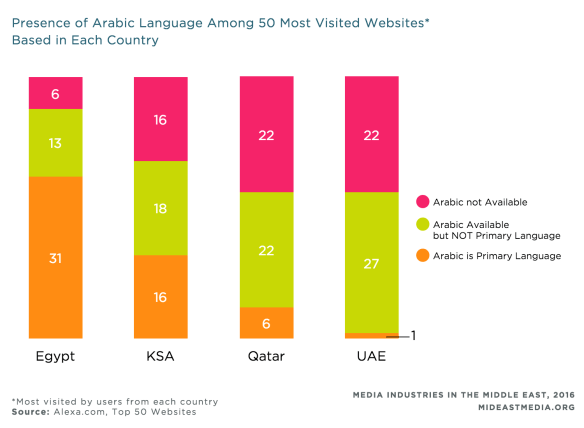
Firstly, let’s look at Arabic language content on the web. The researchers used a number of methods to understand how much Arabic content was online. One of the most interesting means used was to look at the 50 most popular web sites in Egypt, Qatar, Saudi and the UAE based on Alexa rankings to understand if Arabic was used and, if so, whether Arabic was the primary or secondary language. The results may, or may not, surprise you.

The research surveyed the 50 most visited websites in each country to understand how Arabic was used.

The research surveyed the 50 most visited websites in each country to understand how Arabic was used.

As the report itself states:

Despite a rapid increase in the number of Arabic-speaking Internet users, Arabic content remains one of the most under-represented languages online in terms of its share of the world’s websites. Even in predominantly Arabic-speaking countries like Egypt, a third of the top 50 visited websites are either not available in Arabic or do not include Arabic as the “default” or primary language.

It’s not all bad news however, according to Klaus Schoenbach, Associate Dean for Research, at Northwestern University in Qatar. He believes that content generated by users, particularly on social media, makes up for this corporate shortfall.

The findings do not necessarily suggest that Arabic content is low overall. Relative to the approximately 6 percent of Arabic speakers in the world, it is true that there are a disproportionately low number of Arabic websites on the Internet; however, by some metrics Arabic has a disproportionately high representation in social media. One possible reason for this could be that much of the Arab world came fully online during or after the rise of a social-dominated Internet, which replaced the original website-based Internet.

Still, the question remains. Why are businesses not focusing more on Arabic? Isn’t this a huge (and easy) opportunity to get right?

The second obvious challenge is spending online. Right, let me ask you lot. Who uses the internet? Did you use it today? Did you use it for a couple of hours? You probably answered in the affirmative to all of those questions. And yet, ad spending online in the MENA region is only 10 percent. To quote from the research:

Advertising on digital media is continuing to grow both globally and regionally. Worldwide, total digital advertising spend has sustained high growth over the past five years at an 18 percent CAGR. While MENA only represents 0.3 percent of global digital ad spend, it has grown at a phenomenal CAGR of 39 percent, by far the biggest growth rate in the world and almost double the rate of most other markets. Digital ad revenues were worth USD 550 million in 2015, contributing to about 10n percent of the region’s total ad revenues. But while MENA’s digital share of ad spend is catching up, it is still far behind advanced markets, where digital ad spend typically holds a 30 percent share.

This chart tracks approximate online spending from 2010 to 2015 both in terms of revenues as well as  a percentage of total ad spending.

This chart tracks approximate online spending from 2010 to 2015 both in terms of revenues as well as a percentage of total ad spending.

Considering the ubiquity of online usage across the Gulf, including via mobile, the question one must ask is obvious. Why isn’t more being spent online? Consumers are online, so shouldn’t marketers be online with their brands as well?

The full report can be accessed at http://www.mideastmedia.org. It’s well worth a read for anyone interested in media across the region.

Rein in or let loose? How should an in-house communicator behave with media-friendly colleagues?

As an in-house communicator, would you reel an experienced colleague in or trust them to communicate well? (image source: http://www.questionpro.com/)

As an in-house communicator, would you reel an experienced colleague in or trust them to communicate well? (image source: http://www.questionpro.com/)

I had an interesting conversation today with a journalist (I still do that every now and then, as they’re a very fun bunch to be around). He was telling me about a recent event, of how a communications head for an organization came to him and asked about an award won by this person’s organization. It seems that the award nomination hadn’t been vetted by the communicator, and they wanted to know more about the nomination, including who specifically had submitted the nomination.

The journalist wasn’t particularly happy with what he saw interfering after the event. His viewpoint was clear, telling me that:

Yes, some journalists actually have relationships with people in organisations that don’t involve PR or comms, and while you can help that relationship, don’t mess around with it when it works so well!

As communicators, it is a natural instinct for us to control the message, especially when there’s an external party such as a journalist involved. However, does this always work? Does it make sense to rein in fellow staff members, especially when there’s potential to damage a relationship with your colleague or with the journalist whom your colleague has a relationship with.

For the journalist in question, much of his frustration comes from a feeling that when the marcomms team gets involved, the editorial process comes to a halt. In contrast, his source get to the point, he knows what to say and gives content that the journalist wants.

Would you rein in a colleague, especially one who is able to communicate well and who has a good relationship with a journalist? Or would you let them loose, albeit with some conditions and observations. You tell me, I’d love to hear your views.

And by the way, the award nomination won a top prize on the night.

How do you make a whole country hate a child-focused health intervention programme? Ask Nido…

It’s not often that the first (and most popular) comment on a YouTube video is a request for ISIS to blow up a company’s headquarters. However, as I have learned time and time again, anything is possible when you combine the Gulf’s nationals with social media and an issue they’re passionate about.

To cut a long story short, a video for Nestle’s Nido brand been trending in Saudi. The video tells the story of an initiative by Nestle and the company’s consumers on the occasion of the powdered milk brand’s 70th anniversary, to provide 14 million cups of milk to 40,000 children for six months. The activation is a cause-related marketing exercise which involves the region’s shoppers. And you’d think everyone would love it; who doesn’t like seeing kids being fed and a corporation giving away its products to a good cause?

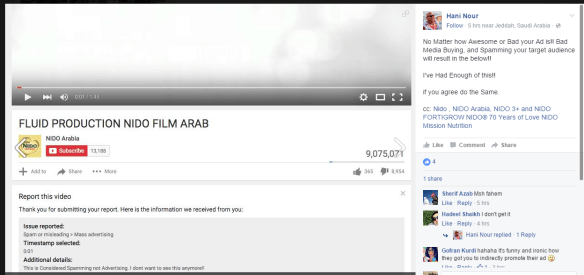
Well, here’s the issue. Someone behind the video/brand thought it’d be a good idea to boost the number of videos through paid media. For the space of how many days beginning from the 3rd of March, this video was everywhere. To the extent that it’s been watched over ten million times. Which is great, if you like big viewer numbers. However, people don’t like to be forced to do anything online, especially being forced to watch the same video over and over and over again.

The statistics sum it all up – 419 likes versus 9,663 dislikes. But it’s the venom in the comments, the hatred of how someone (please stand up) who has decided to spend a load of cash to promote the video has ruined the viewing experience of tens of thousands of Saudis who have had to sit through this content. Saudis complained en mass, even going so far as to tweet @nidoarabia and @nestle to ask them to stop promoting the video as well as reporting the video as spam. Peeved that their own content is being pushed to one side and having to deal with disgruntled YouTubers, Saudi content creators have apologizing endlessly. And there’s even been calls for a boycott. Now, that’s how you change beliefs and habits whilst also inspiring action Nestle!

The comments, many of which are hilarious, range from pure hatred of the brand’s blanket to many admitting they’re now beginning to hate drinking milk (and children…).

https://twitter.com/rayankarkadan/status/706429657424523264

We've had enough of Nido!

We’ve had enough of Nido!

There were some Saudis even reminiscing for Marwan Taloudi, the man who spammed Saudis with his YouTube get-rich-quick ads.

YouTube is still a business after all, but if you’re going to get people to like what you do, then don’t shove it down their throats for days on end.

And just cause I love you all, and I love Nido even more, I’d like to share the video with you. I hope you enjoy watching the most hated video in Saudi right now.

A big thanks to Osama Natto for the story and the content.

Lessons from West Africa: The Need to Move Beyond Media Relations and Other Observations

https://www.instagram.com/p/BB7XX8UDO46/?tagged=prsaccra

Every now and then I’m allowed out of the country, and some of those trips make for some remarkable learnings. One of my recent trips was to Ghana. I met with a fair number of communications professionals from across West Africa, including from Nigeria. There was much talk around what I call the usual suspects – digital, social media, measurement et al – but what struck me most was the challenge that our colleagues in West Africa face when it comes to educating clients on the need to move beyond media relations.

There was one panel which opened my eyes to how similar West Africa is to the Gulf. Four gentlemen (and no ladies) from the national Nigerian and Ghanaian PR and African associations took to the stage to talk about the challenges and opportunities faced by communicators in the continent.

A fixation on media relations

What seemed to be repeated over and over again was the need to move communications away from pure media relations and towards a more holistic model; like in the Gulf, it seems that many clients are keen to get their pictures in the papers, their voice on the radio and their silhouettes on television. There wasn’t much in the way of a response from the panel, aside from pointing a finger at the numerous journalists who had joined the public relations profession and who were keen, or so the argument would go, to keep the industry focused on media relations as the only deliverable for clients.

Nigerian regulation and the slow pace of change

What was a surprise to me was that Nigerian comms professionals have to be registered with the Nigerian Institute of Public Relations to hold mid to senior-level comms roles in the country. Living in a part of the world which is unregulated when it comes to PR (nearly all of the comms people I know don’t even have a formal education in the discipline), I do like the idea of having an independent standard to meet and maintain. However, as one member of the audience pointed out, it had taken her just over a decade of chasing to secure her membership of the Nigerian Institute of Public Relations and hence be eligible to hold a senior comms role. While some aspects of the sector may be different in Nigeria, bureaucracy remains.

Discussing the the evolution of PR in Africa #PRSAccra

A photo posted by Gideon Kodo (@gideon_kodo) on Feb 19, 2016 at 6:33am PST

//platform.instagram.com/en_US/embeds.js

The rise of the female comms professional

You don’t need me to tell you that women are better communicators. They simply are, full stop. It was wonderful to see that three-quarters of the room were women, and many of them young ladies at the beginning of their careers. The local panel was full of men, an observation not lost on one brave lady who pointed out the imbalance between those on the stage and those in the room. However, looking long-term women will hopefully dominate at the top as they do at the mid and entry levels in the comms sector in West Africa.

A photo posted by @chiyneze on Feb 19, 2016 at 6:27am PST

//platform.instagram.com/en_US/embeds.js

A focus on national talent

Another observation was the strength of the national talent. There were very few expats, which was a revelation for yours truly after being based in the Gulf for so long. While I was imagining Nigeria’s Lagos becoming a hub for comms across Western Africa and hence attracting expat talent, what I saw was a room full of (mainly) young, talented Nigerians and Ghanaians who care deeply about what they do and why they do it.

A photo posted by Mya (@mariann.balogun) on Feb 18, 2016 at 9:29am PST

//platform.instagram.com/en_US/embeds.js

If you have experience of comms in West Africa I’d love to hear your inputs. Do you agree with the above, is there more you’d like to add or am I off on my observations. Don’t be shy, leave a comment or two!

Lessons on media relations and transparency from the World Government Summit

Dubai's World Government Summit has become a global event for government employees and is closely followed by the media (image source: Trade Arabia)

Dubai’s World Government Summit has become a global event for government employees and is closely followed by the media (image source: Trade Arabia)

This month was host to another mega event in Dubai, the World Government Summit. The conference, which even hosted an address by President Obama, aims to become the leading platform for governments, the private sector and the public to learn about and collaborate together for innovation in government.

Two areas caught my eye. The first was that of media relations. There’s been a good deal of talk about how the communications industry is changing and media relations will become less important. That isn’t the case, at least for the vast majority of us who spend most of our day pitching, preparing for media interviews, and following up.

There was a sizable media presence at the event, which is testament to the World Government Summit’s global reach. However, while there were dozens of international journalists – whose flights and accommodation were paid for – the story for the local journalists I knew was different. Few Dubai-based media were reached out to except by email, with no phone calls. And some didn’t receive an email to arrange for registration. One journalist I talked to spoke about his frustration on having to chase the agency to get his registration sorted out. He was particularly peeved by a lack of support or empathy from the agency about the issue, and not only him but his whole team being missed out. As he told me, ‘a sorry would have gone a long way when it comes to good will.’

While I understand the urge to engage globally – after all, the event is now the World Government Summit – not involving local media is a idea that will only sour the agency’s relationship with the local journalists in the short to medium term; and trust me, you don’t want to deal with an aggrieved journalist, let alone put them in front of a client. Plus, in today’s digital age, I don’t buy this concept of local and global media. Everything is online, and much of it is curated by services such as Google News. It’s now a case of getting that content seen by the relevant stakeholder, which can be done through increasing paid reach or seeding the content on other sites.

Transparency and its impact on credibility

The second insight is around the inaugural “World’s Best Minister” Award. According to the summit’s website, the “World’s Best Minister” Award was “thoroughly and independently managed by Thomson Reuters where the search for the nominees is conducted according to the established criteria”.

To quote from the Summit’s website, details on the criteria and judging panel are below:

The criteria of the Award were set by the organizer of the World Government Summit. The criteria for selecting the candidates WAs based on various financial and non-financial metrics, and their improvement over time. These are based on data disclosed by the World Bank, United Nations, Legatum institution and various other well known resources that provide data and statistics on economic information, social metrics and government services.

The primary focus for 2016 has been on initiatives in the healthcare, education, social and environmental services.

The judging panel consists of six judges from various backgrounds, who provide different perspectives on the candidates based on their experience, expertise and insights. They include senior executives from the World Bank, OECD, Ernst & Young, Strategy & Co and the Abraaj Group on their personal capacity.

From an initial selection of 100 ministers, the winner turned out to be Greg Hunt, Australia’s environment minister. This choice has proved to be highly controversial, particularly in Australia where the Australian government has been criticized for its approach to green issues.

My focus however is the response from Thomson Reuters who, I feel, have sought to distance themselves from the choice of the winner. To quote from the Guardian.

But Thomson Reuters said it was “not correct” to say that the company initiated the award or were responsible for designing the selection process.

“Thomson Reuters was solely responsible for assisting in the administration of the award, to a set of criteria approved by the World Government Summit organisers,” said Tarek Fleihan, head of corporate communications for the financial information company in the Middle East, Africa and Russia.

Transparency is key to credibility. And whilst I do love the idea of awarding government officials who innovate on behalf of their citizens, the controversial choice and the ensuing contradictions surrounding the process hasn’t helped to make the award as credible as it should be.

What are your thoughts? Were you at the event? I’d love to hear your views on these two points.

Who’d be a social media manager? @theregos, @soukonwheels and a teeny Twitter meltdown…

social-media-meltdown-1-638

Disclaimer – There is foul language below (though not from me).

Social media isn’t all it is cracked up to be. True, you do get paid for being online and on Facebook, Twitter, Instagram, Snapchat, YouTube… But, you’re the voice of the organization. As such, you have to be on best behaviour at all times, to ensure that the company is represented in the right fashion. One wrong Tweet and you’re going to get called out for it.

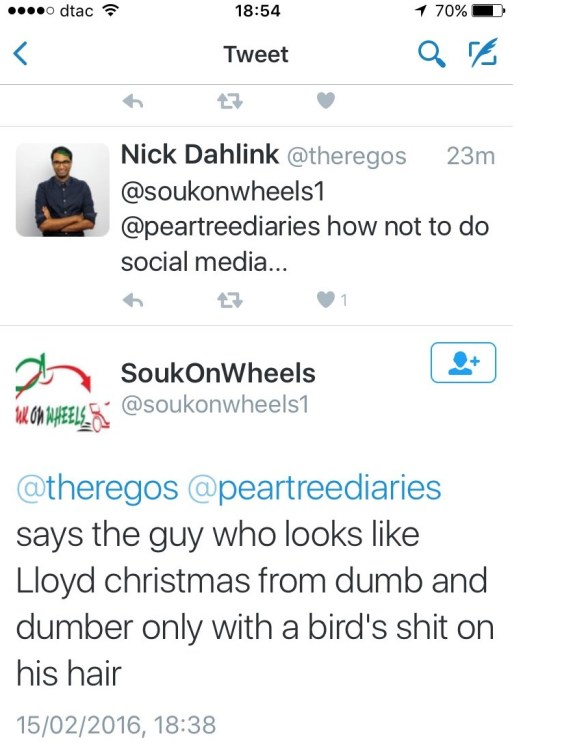
Well, this is a call out for @soukonwheels and @soukonwheels1 (this account is now closed). The person who was handling the account did something which was pretty rude yesterday. And unfortunately for them, they did it to a journalist. Nick Rego isn’t your typical hack either, he’s the ‘dahlink of Twitter’. An open question from Nick about shopping for clothes was followed by the person handling the account jumping in (the brand sells fruit and veg), which Nick didn’t appreciate.

However, the response really wasn’t called for:

How not to win friends and influence people online...

How not to win friends and influence people online…

Kudos to the brand which apologized for the tweet (I do hope they apologized directly to Nick). But really, do you want to be a social media manager? Think carefully, very carefully before you say yes.

And before I forget, there’s a couple more pointers:

1) Once you’ve posted something online, it’s online. If you don’t want it copied, shared or saved, then don’t post it online. And if it offends your mom, then definitely don’t post it online.
2) The community will always do a good job of policing itself, by rallying around and calling out those who offend. This will damage your brand.
3) We all make mistakes. Learn from them, change how your accounts are managed and come back stronger.

Executives promising to go naked on television, Cobone’s PR stunt, and The Address’ post-crisis crisis?

Paul Kenny's fake PR release for Cobone, Ziad El Chaar naked on TV and Emaar's ongoing issues following the Address fire made this week an interesting one for media in the UAE (image source: Arabian Gazette)

Paul Kenny’s fake PR release for Cobone, Ziad El Chaar naked on TV and Emaar’s ongoing issues following the Address fire made this week an interesting one for media in the UAE (image source: Arabian Gazette)

Media in the Middle East is rarely dull, and the past few days have proved that there’s some hilarity as well as serious questions about what people in our region do and then tell to the media.

Let’s start with the real estate brand which is developing a reputation for foot-in-mouth disease. Speaking to the Sunday Times, Damac’s Managing Director Ziad El Chaar told The Sunday Times he would “go on TV naked and resign” if the worst market projections are realised. Aside from the fact that any naked executive dance on television would be illegal in the UAE (at least without a VPN), his comment hasn’t been taken too well judging by the reaction on Arabian Business’ online portal. Maybe there’s some fans of naked real estate executives out there. If so, please do show yourselves so we can get you help…

Another bizarre piece from last week which wasn’t picked up widely. Speaking to an audience of entrepreneurs last week, the founder of discounting site Cobone Paul Kenny admitted that he used a PR stunt to kick-start his business. Shortly after founding the site, Kenny put out a press release claiming that 1,000 vouchers for a discounted pizza had been sold to Cobone consumers. That release, Kenny now claims, was a fake. Let’s quote Kenny from the Arabian Business story.

“We were second to market. GoNabit [an online group buying website founded by Dan Stuart and Sohrab Jahanbani] was first. When we launched, everyone was saying: ‘You are the same as GoNabit,’ which we were but I said we weren’t.

So I went to at Vapiano, which is an Italian restaurant, and bought a thousand pizzas at a huge discount and they sold out by 12pm. I put a big sold out sticker on the site and an hour later I released a press release saying ‘Cobone.com breaks e-commerce record in the Middle East.’

And the truth is that everyone started reading and asking ‘Who is this company Cobone.com?’ ‘What is e-commerce?’ ‘What’s a record?’ You know it created a lot of interest in the business and instantly people started recognising us as a different business.

I remember that a day after you could do a Google search to see we were on around 483,000 websites. First, e-commerce in the Middle East was never covered. Then what is an e-commerce record? What is Cobone.com?

So you got a ball rolling of media interest from that point.”

There’s a popular saying about the luck of the Irish. And there’s another saying about making one’s own luck. Luckily for Kenny, no asked if the news was real (or checked with the restaurant). If they had, his deception may not have worked so well.

And finally, another follow-on story about the New Year’s Eve fire at The Address, from The National in which one owner of property at the hotel lost 1.3 million Dirhams worth of art in the blaze.

Ramin Salsali spoke out this week urging The Address owner Emaar Properties to quickly process residents’ compensation claims as well as repair the property. To quote from the story.

“Until now, they [Emaar] have been very fair and have quickly reacted to accommodate people, put them in hotels, give them the first basic possibilities just to start to recover.”

He expected “a very unbureaucratic and pragmatic approach” from the developer in terms of how claims were handled – especially since a police report last week indicated that an electrical short-circuit from a spotlight caused the blaze.

“The whole world is now watching. The effect on real estate is unbelievable. People have pulled out of contracts where they don’t know about the fire safety of the cladding. It’s not good for Dubai.”

One of the greatest challenges any organization can face is not just the crisis itself, but the post-crisis reflection and learning. Emaar isn’t there yet in terms of dealing with any major grievances from those who lost property and items during the fire (and there’s been remarkably little negativity from any of the hotel’s residents so far), but the communication with this group of people needs to be both clear and quick to get these issues resolved. Otherwise, Salsali’s point about blow-back for the Emirate’s real estate sector may become true. Let’s hope not.

And for the next post I’ll be talking daddy issues again. It’s been a while since I posted any stories about my little princess, and I’m looking forward to it!

Snapchat, Messi, and jail – the story of how a Dubai cop breached the cybercrime law

Will this official be behind bars for a video he took of Messi's passport? (picture courtesy of Hilary Clinton's  Twitter feed)

Will this official be behind bars for a video he took of Messi’s passport? (picture courtesy of Hilary Clinton’s Twitter feed)

It’s happened. That social media channel which everyone under the age of 30 is using (that’s why I’m not on it), has got someone into trouble. The ephemeral network Snapchat has gotten one Dubai police officer into trouble, for taking a picture of the passport of Barcelona footballer Lionel Messi when the footballing superstar came to Dubai. The picture, which I am assuming disappeared after being viewed, found its way to the authorities, and the gentleman in question has been charged with falling foul of the country’s 2012 Cybercrime law. The full story, courtesy of the Washington Post, is below:

A police officer in Dubai is facing a six-month prison sentence and a $130,000 fine for posting a video of Lionel Messi’s passport to Snapchat last month. Prosecutors say the act violated the United Arab Emirates’ Cybercrime Law of 2012.

The officer, identified only as a 26-year-old named J.J., appeared in court this week to plead guilty to the accusations, but maintained his intentions weren’t nefarious. Instead, he said he posted the Messi’s passport to Snapchat out of frustration from being denied the chance to meet the star who had traveled to the country on Dec. 27 to attend the Dubai International Sports Conference.

“I waited for Messi’s arrival [at Dubai International Airport] to take a photo with him … but his private escorts informed me that the player was tired and would not be able to take a photo,” J.J. explained in the Dubai Misdemeanors Court (via Gulf News). “Thereafter I walked to the passport control’s office where I saw Messi’s passport on a desk. I grabbed the passport and opened it to the page that contained Messi’s personal details and took video images with my iPhone via Snapchat.”

The video, which can still be found on YouTube, shows Messi’s photograph and data, and a man (presumably J.J.) can be heard narrating over the image.

“This is Messi here in Dubai… what shall I do now? Burn his passport or let it go?” the man says in Arabic in the Snapchat (via the Independent). “Alas… I will let it go.”

Prosecutors seem less alarmed about the man’s narration than the video itself, however.

“What the suspect did is an act punishable by the Cybercrime Law,” prosecutor Al Shamsi told Gulf News. “His behavior is deemed a breach of Messi’s privacy because the passport is considered a private possession just like the details mentioned on it.”

A verdict is expected this week. But, for those on Snapchat, beware! You may think your images disappear, but remember, nothing ever truly disappears once it goes digital.