Bahrain, Saudi and the UAE use Facebook to Announce Ambassador Pullout

It’s pretty remarkable – I’m not just referring to the withdrawal of the Bahraini, Emirati and Saudi ambassadors from Doha but also the way the news was announced. I, like many others, saw the news first not on traditional news channels but via Twitter. And where was the original announcement? On the Facebook page of the Saudi Ministry of Foreign Affairs. It’s pretty remarkable to see social media being used to release such information, especially considering the medium is designed with dialogue in mind. If you read Arabic have a look at the comments on the Ministry’s page.

The original announcement, which was later carried in the region’s papers, is below.

The Saudi Ministry of Foreign Affairs announced the pullout of the three ambassadors via its Facebook page before the story broke in the traditional media

The Saudi Ministry of Foreign Affairs announced the pullout of the three ambassadors via its Facebook page before the story broke in the traditional media

Saudi Bans Energy Drinks Advertising – What Now Happens To Social Media

The Kingdom’s Government took the drastic step yesterday of introducing a raft of measures aimed at restricting the sale, promotion and consumption of energy drinks. The move, which was not expected, will mean that as of now energy drinks companies will no longer be able to advertise or carry out promotion campaigns through ‘electronic or print media or any other means’.

It doesn’t end there. The Saudi Cabinet banned the free distribution of energy drinks to consumers belonging to all age groups. Energy drinks have also been banned in restaurants and canteens at government establishments, as well as educational and health institutions, public and private sports clubs and halls.

To quote from the report on the Al-Arabiya news-site, the full list of measures includes:

1 – To prohibit advertising of any energy drink or do advertising or promotional campaigns for any energy drink via any readable, audible or visible media organ, or by any other means.”

2 – To prohibit energy drinks companies, their agents, distributors and marketing associations from sponsoring any sporting, social or cultural event, or taking any procedure leading to promotion.

3 – To prohibit the free distribution of energy drinks to consumers of all age groups.

4 – To prohibit the sale of energy drinks in restaurants and canteens in government facilities; education and health facilities; halls and public and private sports clubs.

5 – Upon the decision, factory owners and importers of energy drinks shall be committing to writing a text on the tin of any energy drink in Arabic and English languages – warning of the harmful effects of energy drinks.”

In a market that has been constantly growing for the energy drinks sector (you can find Red Bull, Bison, Power Horse and other popular energy drinks brands everywhere), this is going to be a major blow for the business. Red Bull has already put out statements defending its position, including its availability in 165 countries worldwide and a lack of evidence to show that it is harmful (you can read the statement in full here). Red Bull and other brands are major event sponsors, and it’s uncertain where the shortfall in funding will come from.

However, the one area which has yet to be clarified is social media. Red Bull has its Saudi Twitter feed (@RedBullSaudi) and Facebook pages for its events. Red Bull did put out a tweet today from its Saudi feed. How is social media classified? Is it advertising or is social media more subtle? And how do the authorities class social media? It’ll be interesting to see how this plays out, both in the real world as well as on social media.

Saudi women raising the bar – Somayya Jabarti becomes the first female newspaper editor in the Gulf

Somayya Jabarti has become the first female editor-in-chief in the Gulf region. She’ll be leading the Saudi-based Saudi Gazette following Khaled Almaeena’s departure (image source: metrotvnews.com)

Saudi Arabia often gets a bad wrap when it comes to how it treats its women. However, for those of us who have lived in the Kingdom, we know of the strength and abilities of Saudi women. They’re tenacious, eloquent, hard working and, in my view, a wonderful bunch. The latest media announcement coming out of the Kingdom has made headlines the world over.

On Sunday, the English-language newspaper Saudi Gazette announced that its editor-in-chief Khaled Almaeena would be stepping down from his role with immediate effect. Almaeena, who joined the Saudi Gazette in October 2011, penned his own farewell letter which was published on the newspaper’s front page. It’s a wonderful read and spells out Almaeena’s views on how a newspaper should be run and why editors should be pushing the boundaries when it comes to reporting contentious issues.

Unarguably the most important announcement made by Khaled and the Saudi Gazette that morning was the promotion of Somayya Jabarti to the top editorial position in the newspaper. I’m going to quote directly from Khaled’s piece:

Today I proudly leave my nominee, a female journalist — Somayya Jabarti — who will take the helm of the paper. She has been associated with me for almost 13 years, and I’ve had the goal almost as long of wanting to see a Saudi woman enter the male-dominated bastion of editors-in-chief. It was not a question of gender but of merit that decided and earned her this opportunity. I am proud to have played a role in her career. She is determined and dedicated, and I can assure her and the team that I will be there to assist and advise, so that Saudi Gazette further advances as a media unit in a highly competitive and digital age.

I’ve known of Somayya for many years and I’ve interacted with her on a number of occasions. She’s tenacious, independent and determined that she and her team cover the news without self-censoring the editorial (this is still a common trend in the Gulf). I’d go further however, and say that Somayya is representative of today’s Saudi women. Saudi women are often viewed from outside the Kingdom as oppressed, as in need of help and support.

However, my own experiences have often shown the opposite to be true. If anything, Saudi women are the most independent in the Gulf when it comes to wanting a career and earning a living. If anything, Somayya is proof of what Saudi women are capable of and how the Kingdom is changing. For me, what’s most telling is that this first didn’t happen in other Gulf states which often tout how they’re advancing women’s rights, but in Saudi. I often feel that the pressures Saudi women face mold them, make them become stronger and more focused. Saudi women have learned to fight and they’re no longer willing to wait for change or to accept what they’re being given with platitudes.

In the Kingdom all top editorial positions at the country’s newspapers are approved by the Ministry of Information and Culture and so Somayya’s appointment would have been given the government’s blessing. I’ll leave the last word to the lady herself, for an interview she gave with Al-Arabiya. I’m sure she’ll do her fellow Saudi women proud!

“There’s a crack that has been made in the glass ceiling. And I’m hoping it will be made into a door. This is a first for a Saudi daily… A mold has been broken where editors-in-chief of Saudi daily newspapers are concerned. Being the first Saudi woman [newspaper editor] is going to be double the responsibility… One’s actions will reflect upon my fellow Saudi women.”

Make a New Year’s Resolution for your company and go volunteer in 2014

Volunteering will benefit you, your employees and your business more than you may imagine (image source - www.zmetravel.com)

Volunteering will benefit you, your employees and your business more than you may imagine (image source – http://www.zmetravel.com)

You’re finished with the festive period, the time of year when we have a tendency to overindulge. Now, having seen in the new year, most of us will have made a number of resolutions for our own betterment. But if you’re thinking of a way to make a difference in 2014, why not take a step forward and make a resolution for your company and community?

The concept of corporate social responsibility (CSR) is gaining a foothold among businesses across the region and one method that all businesses, both large and small, can adopt is to volunteer their time to support local charitable organisations.

There’s a misconception among business owners that volunteering or other forms of CSR is the preserve of large corporations. Nothing could be further from the truth. Giving back by donating your time and expertise to your community can be beneficial to you, your staff and business for many reasons. Not only can volunteering help your community and create a shared sense of achievement among your employees, but giving back can even help your business grow in way that you may not expect. Here’s how:

Volunteering can broaden your experience

Volunteering provides an opportunity to work on something different, with new people in a new place for a new cause. The experiences are not only personally rewarding, but you may and your staff will develop new skills and thinking from the not-for-profit sector that may benefit your own business. When you volunteer for the right reasons to give back to the community, you’ll not only develop new perspectives but you’ll also become more of an empathetic, well-rounded leader and be able to bring these skills and experiences back to bear on your own goals and those of your business.

Your employee morale will improve

Giving to the community has significant benefits for employee satisfaction. Studies by London in 2010 found that 94 per cent of companies had found that volunteering positively impacted employee morale. Volunteering allows your staff to give back to their communities, learn new skills and participate in causes that many of them may passionately believe in, such as the environment, good health and childcare. Volunteering has been found to boost employee health as well as their morale.

Doing well is good for your business reputation too

As a business owner, no one will know better than you that your actions impact your business reputation. Giving back to the local community will have positive effect on your brand. The more that you become part of your local community, the faster your reputation as a business that cares will grow. Volunteering helps your company show that you are empathetic and that you do understand the needs and concerns of local communities.

Develop new relationships and strengthen existing ones

There’s no better way to develop and maintain good relationships than working together with others for a good cause. Getting out there and volunteering will enable you to meet new people who you may not otherwise meet. Even if these relationships don’t initially seem relevant to you and your business, the power of networking will mean that you’ll have a group of individuals outside of your usual business circles to consult with and give you different perspectives.

If you haven’t ever volunteered before and don’t know where to start, there are a number of organisations and bodies that can advise you. For companies based in Dubai, the best place to start is the Dubai Chamber of Commerce and its Engage team that already has a strong connection with most of Dubai’s charitable organisations. The Engage team may be able to point you and your business in the right direction as to how and where to start. The Dubai Chamber of Commerce and the Engage team can be reached at responsiblebusiness@dubaichamber.com.

For companies in Abu Dhabi, the Abu Dhabi Sustainability Group is a governmental organisation that promotes sustainability best practises and would be best placed to provide similar advice as to where to start in the UAE’s capital. You can contact them at contact@adsg.ae.

For business owners in Saudi Arabia, your best resource may be the Ministry of Social Affairs, which has a database of all locally registered charities in the kingdom. The ministry has offices in most of the kingdom’s cities, so do check out its website at http://www.mosa.gov.sa.

Volunteering doesn’t have to take a tremendous amount of time or energy and yet giving back can be one of the most rewarding things you do over 2014 for yourself and your employees. Get started today and make a difference not only to yourself, but to your local community as well.

This piece was first published on the Kipp Report.

The Gulf, social media and its self-deprecating humour

The Gulf is known for many things but a sense of humour hasn’t traditionally been on the list, even less so self-deprecating humour. With the advent of social media, in particular YouTube, both the Gulf’s residents and nationals have started to develop content like there’s no tomorrow. The best is currently coming from Saudi Arabia. One example is La Yekthar, one of the most popular comedy shows on the net. The team regularly tackles and takes on stereotypes of Saudis, and one of their latest clips was a fantastic set-up of how Saudis are often perceived by foreigners. The video, which is below, also sends a not-so-subtle message to Saudis that this type of image, of arrogance and violence, isn’t the right thing to do.

Bahrain has also followed suit with a number of send-ups of the typical Bahraini stereotypes. The clips, which are common on the video-sharing site Keek, focus on a variety of stereotypes which are mainly based on geography (for example, Al-Riffa and Muharraq). I’m going to have to search for these but I’m going to upload as soon as I can.

Even Qatar is getting in on the act. The only local Qatari comedian I know, Hamad Al-Amari, routinely does stand-up routines poking fun at Qatari stereotypes before switching effortlessly into an Irish accent (he spent part of his childhood in Ireland). Have a look at one of his sets below.

And then there’s the UAE. While there are a number of local comedians here including the likes of Ali Al Sayed the country has arrested those, even nationals, who have poked fun at the country’s stereotypes. Emirati Salim Dahman and a group of young males who made a spoof YouTube video named the ‘The Deadly Satwa Gs’ were arrested after uploading the clip. No reason seems to have been given for their arrest, but the assumption would be that they’ve been detained for insulting national sensitivities.

To quote from 7Days, which featured the story yesterday, ‘The Deadly Satwa Gs’ video is a spoof of young people who try to act tough. At the martial arts school, the recruits learn how to throw a shoe and call for back-up on their mobile phones. When they graduate from the school, they are all given Barcelona football jerseys, supposedly matching a style worn by young men in Dubai.

The video, which is still available online, is hardly groundbreaking satire and is fairly tame when compared to the content coming out of the Magic Kingdom. However, comedy isn’t always a laughing matter depending on where you are in the Gulf.

PS If you want to know why I haven’t mentioned Kuwait ask any Gulf Arab about Kuwaitis and humour.

The Middle East and its addiction to Facebook – 2013 stats and figures

Yes, we Arabs have adopted Facebook as our own (image source: muslimscrisisgroup.wordpress.com)

Most of us in the region already know how effective and powerful Facebook is. The social media site played a prominent role in the Arab Spring, particularly in Egypt, and its popularity has endured in the face of challenges from other services such as Twitter and YouTube (I’m not even going to mention Google+ in the same sentence).

Facebook released some figures this week about the site’s usage in the Middle East. According to Facebook’s head of MENA Jonathan Labin over twenty eight million people in the Middle East and North Africa are using Facebook every day. Fifty six million use the site every month and of those thirty three use a phone or tablet device to check their profile. Fifteen million people access the site on a daily basis from their mobiles.

I’m going to give you a little more insight into a couple of different regions: Saudi Arabia; Egypt; the GCC; North Africa, and the Levant. The below figures, which were compiled last month, give a good deal of insight into gender split, age, marriage status, number of friends and page likes, access methods, and interface usage. If you’re a marketer in this region and you’re not using or leveraging Facebook (especially on mobile) then start rethinking your advertising and communications approach.

The importance of the mobile web for Gulf-based businesses

Remember the good old days, when mobiles were there only for making or receiving calls? Forget them, and start thinking mobile web sites and more business (image source: tandemdigital.co.uk)

It’s official! The UAE is again a world leader, but this time in smartphone penetration. Seventy four percent of UAE residents carry a big, bad smartphone in their hands (some of us have two of them on the go at a time). Saudi Arabia is third, with seventy three percent of people carrying mobile devices according to research conducted by Google for its ‘Our Global Planet’ project.

The good people at UAE-based PR agency Spot On PR have summarized the findings for the UAE and you can do the same by going to Google’s website and customizing your query. What’s most striking is local behaviours. Have a look below.

Have a look at the frequency of local searches and look at the growth from 2012 to 2013

Have a look at the frequency of local searches and look at the growth from 2012 to 2013

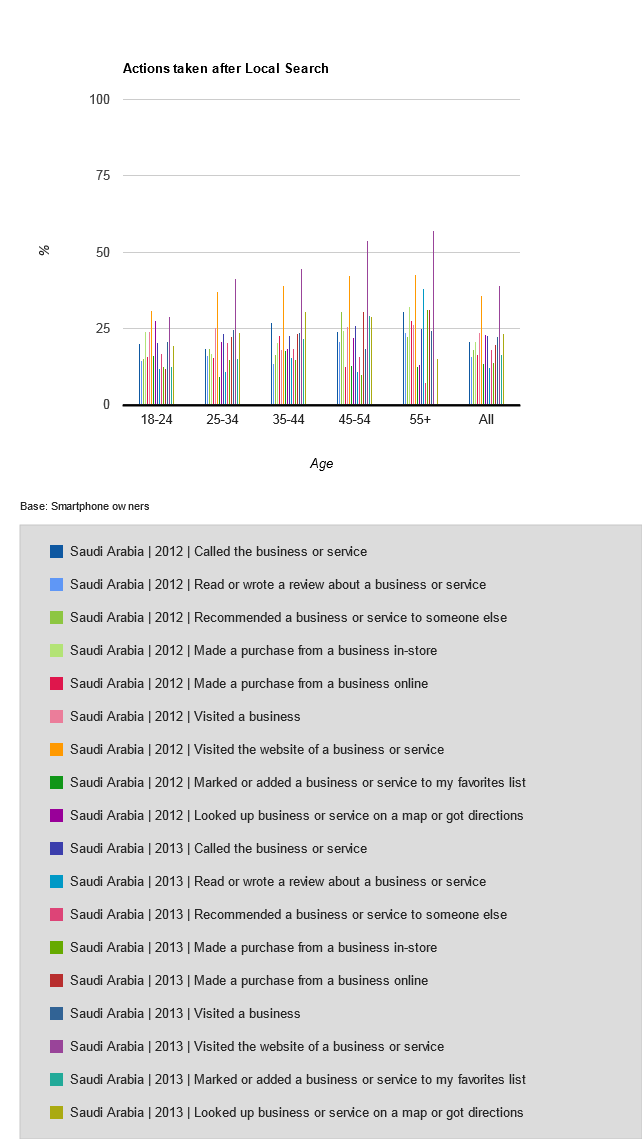
Actions taken after Local Search in Saudi Arabia in 2012 and 2013 across all age ranges and gender types

Actions taken after Local Search in Saudi Arabia in 2012 and 2013 across all age ranges and gender types

What is strikingly obvious from both of the graphs above is that local search is now essential to local businesses. And yet, we’re still pretty awful when it comes to developing websites for mobile browsers.

So how do you change this? The first piece of news is pretty obvious. Go and get a website (it’s amazing how many businesses still don’t have sites in this part of the world). Secondly, if you’re not sure about how mobile-friendly your website is then test it using a tool such as W3C’s Mobile Ok Checker. These will be able to tell you what you’re doing right and what you’re getting wrong when it comes to rendering or displaying your site on a mobile browser.

If you’re stuck on how to develop a website that renders well on mobile browsers why don’t you consider using a content management system such as WordPress. WordPress has website styles that automatically adapt or respond to different browser types. WordPress is free and you don’t need to even pay hosting fees if you use WordPress’ own servers.

Even if you have a mobile-friendly website remember to use back-end analytics programmes from Google or other providers to better understand what your customers are doing on your website and what you can do to improve their experience. If you’re looking for more advice on what you should be doing to generate business from mobile have a look at this crib sheet for mobile e-marketing by local developer Saad Bhatti or get in touch with the good people at Spot On. But the general message is, do more on mobile!

Social media and diplomacy – @IsraelintheGCC, Israel’s virtual embassy in the Gulf

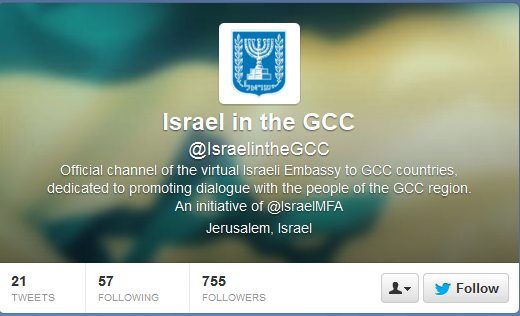
The launch of the @IsraelintheGCC twitter account is a cheap but potentially effective media channel for the Israeli government

The launch of the @IsraelintheGCC twitter account is a cheap but potentially effective media channel for the Israeli government

No matter your political persuasion, you have to admit that the Israelis are an ingenious bunch. Their latest idea is a simple concept, a virtual embassy for a part of the world where there’s little/no Israeli State presence, the Gulf. Israel, which doesn’t enjoy official diplomatic relations with any of the Gulf states, has launched a ‘virtual embassy in the Gulf’ through Twitter. The account, which is named @IsraelintheGCC, aims to “open lines of dialogue” with people living in the Gulf according to a report by the UAE-based English-language daily Gulf News. According to the Israeli daily Haaretz, the person behind the idea is Yoram Morad, Director of the Department of Digital Diplomacy at the Ministry of Foreign Affairs of Israel.

Not unsurprisingly, Israel has always faced challenges when trying to communicate its point of view to its Arab neighbours. However, that hasn’t stopped the State from engaging various mediums to argue for its policies. Israel launched an Arabic-language television channel in 1994 following the announcement of the Israeli-Palestinian peace process. The establishment of the @IsraelintheGCC twitter account follows news of a potential re-engagement between the Israelis and Palestinians as well as mounting pressure on Iran to halt its nuclear enrichment programme.

It could be argued that Israel has been much more active than the Arab states in terms of communicating its key messages – there were plans to launch a Hebrew-language channel in Egypt as of last year according to the Christian Science Monitor, but I haven’t heard much in the way of an actual launch.

The messaging employed by @IsraelintheGCC, which is being run by the Twitter account of the Israeli Foreign Ministry, would appear to be aimed at propagating a more diplomatic tone than that of Israel’s internal politics. The account, which has tweeted 21 times to date, has only quoted the country’s Prime Minister twice (its fair to say that Bibi Netanyahu wouldn’t win many popularity contests in the Gulf), but it has talked about social media in the Arab world, sustainability issues, and wished followers a Ramadan Kareem. The one time Netanyahu has been quoted was in relation to European sanctions on the Lebanese organization Hizbollah which isn’t well liked in the Gulf due to its pro-Iranian stance. There are tweets in Arabic too. Have a look at some of the posts below.

Over the past couple of years social media has allowed companies, politicians and celebrities to directly bypass the media and reach out directly to anyone that wants to listen. Now the same can be said of social media for States who, for diplomatic reasons, cannot establish a physical presence. I’ll be following the account, and am looking forward to seeing how long this project lasts, how much dialogue it generates and how successful it becomes for the Israeli government.

Was Alwaleed’s decision to take on Forbes the right one?

Will Alwaleed make up with Forbes or will this fake front cover be the closest he gets to being featured positively in the magazine again? (picture credit: Forbes)

In terms of Saudi Arabia and the Middle East, they don’t come much bigger than Alwaleed Bin Talal Al Saud. The ‘Rainbow Prince’ and grandson of the founder of the state of Saudi Arabia, is one of the world’s richest men. But recently his fortunes have taken a tumble. The Prince has taken offense to Forbes magazine this year during the publication’s compiling of its annual Rich List. The publication, which is the leading authority on the world’s richest people, has been accused of libel by Alwaleed over a claim that it underestimated his fortune by $9.6bn through stock market manipulations of his publicly-listed company Kingdom Holding.

Alwaleed, who’s often named the richest businessman in the Middle East, has made his anger with Forbes well-known to the media through a decision to take Forbes to the high court in London. His legal counsel has filed a defamation claim against the Forbes publisher, Forbes editor Randall Lane and two Forbes journalists for undermining his name. The prince insists that he’s worth closer to $30 billion, which would take him from the 26th richest person on the Forbes Rich List to a ranking within the top ten.

“The basis for actively pursuing a legal action against Forbes would not be about ranking on some list or personal wealth, it is about correcting seriously defamatory comments that have been made about HRH Prince Alwaleed as an individual and Kingdom Holding Company.”

While the prince has played his hand, the question is was this the right reaction? Was bringing everything to the surface the best action Alwaleed could have taken? Forbes initially responded to Alwaleed’s anger the same way that most top-tier publications do, by rebuking his claims through a research-based argument. Below are some excerpts from the feature.

“That [Forbes] list is how he wants the world to judge his success or his stature,” says one of the prince’s former lieutenants, who, like almost all his ex-colleagues, spoke on the condition of anonymity for fear of reprisal from the Arab world’s richest man. “It’s a very big thing for him.” Various thresholds–a top 20 or top 10 position–are stated goals in the palace, these ex-employees say.

Forbes ran down a whole history of its dealings with Alwaleed in relation to the Rich List and the excerpts below don’t paint the prince in a good light (as one may expect following such a fall-out).

“That [first] outreach [to Forbes] proved to be the first in what is now a quarter-century of intermittent lobbying, cajoling and threatening when it comes to his net worth listing. Of the 1,426 billionaires on our list, not one–not even the vainglorious Donald Trump–goes to greater measure to try to affect his or her ranking.

In 2006 when FORBES estimated that the prince was actually worth $7 billion less than he said he was, he called me at home the day after the list was released, sounding nearly in tears. “What do you want?” he pleaded, offering up his private banker in Switzerland. “Tell me what you need.” Several years ago he had Kingdom Holding’s chief financial officer fly from Riyadh to New York a few weeks before the list came out to ensure that FORBES used his stated numbers. The CFO and a companion said they were not to leave the editor’s office until that commitment was secured.”

As can be expected, when you take on a global publication and accuse it of lies, that publication isn’t going to take things lightly. Forbes has run subsequent pieces on Alwaleed contradicting his uncle, the King of Saudi Arabia, in an article entitled Is Prince Alwaleed Trying To Undermine The Saudi King? The piece focused on Forbes initial allegations that the stock market was manipulated to suit the valuation of the Alwaleed-owned investment vehicle Kingdom Holding.

In my article about Prince Alwaleed that Forbes published in March, we quote a former employee of Alwaleed’s, who describes the Saudi stock market as follows: “The players are not many. They come in with big funds, and they buy from each other. There are no casinos. It’s the gambling site of the Saudis.”

As the Forbes writer Kerry Dolan notes, stock market manipulation is an issue that the King himself has taken umbrage with. As a journalist in the country, market manipulation of stocks on the Saudi Bourse Tadawal is well-known and many Saudis will openly tell you whom they suspect of manipulating pricing.

Forbes has also published a very classy picture library detailing what it describes as The Fabulous Life of Price Alwaleed Bin Talal AlSaud (It’s an interesting read, but did Forbes have to drop to tabloid level?).

More recent events have also, in my mind, put Alwaleed’s decision to take on Forbes into a different context. The prince has been involved in another civil case in a London court after himself being sued by a Jordanian businesswoman named Daad Sharab who says she was not paid a promised $10 million commission for brokering the sale of a jet owned by Alwaleed to Libya’s former leader Muammar Gaddafi. The following comments were noted during the cross-examination of Alwaleed by Reuters.

[Alwaleed] repeated time and again that the agreement all along had been that Sharab would receive an amount that would be decided “at my discretion”, and she overstepped the mark by asking for $10 million.

“She did not respect the fact that it was my discretion … Discretion means I have all the right to do whatever I want,” Alwaleed said. “When she came with 10 (million dollars) I went to zero.”

These comments prompted Sharab’s lawyer, Clive Freedman, to ask the prince whether his discretion was supposed to be exercised reasonably, or “like the discretion of an absolute ruler who follows his every whim”.

Freedman accused the prince of making up his evidence as he went along and of being a “debt-dodger” who had refused to pay Sharab for years of work on his behalf, giving no reason until forced to by litigation.

The prince said he did not lie, adding that Sharab had understood all along that she would be paid at his discretion and no one had forced her to work for him on those terms.

But Judge Peter Smith expressed surprised at the prince’s defense. “Nobody is going to do business with you if it relies on your discretion and your discretion becomes capricious,” the judge told the prince.

“Your case then is that your discretion entitles you to not pay her anything? I thought you were an honorable man and you wouldn’t take advantage of people in this way,” he said.

The judge said that it would be better for the parties to settle the case out of court, warning that one or both parties were at risk of being branded liars in his judgment. “I cannot believe that’s in the interest of either of you,” he said.

More recently, at the end of June, one of Kingdom Holding’s board members stepped down from his role for personal reasons. While Ahmed Halawani, who led private equity investments for the prince, may have felt it was time to leave Alwaleed after ten years of service, did recent pressures influence his decision?

And finally, there’s the case of another of Alwaleed’s former business partners. Pierre Daher, the CEO of Lebanese television station LBC International, has given several interviews with Dubai-based marketing publications focusing on his fall-out with Alwaleed. The story is another fascinating read, and is well worth your time.

In all of this, the focus shifts from the other party to Alwaleed. The issues of transparency and of trust keep repeating themselves. Who do we believe? Putting out a media statement is a very different thing to taking another party to court. As Alwaleed has already seen himself this summer, a London court is very different from the Middle East.

Alwaleed has excellent media relations in the Middle East, where he’s seldom questioned (Alwaleed owns a minority stake in several media outlets globally and locally, including in the region’s largest publisher Saudi Research and Publishing Group). But was it wise to openly question and then take to court a global title such as Forbes? We will soon see how this plays out, but I for one am looking forward to what should be an explosive trial between Forbes and Alwaleed.
Will there be more Farsi-language newspapers? On its 35th birthday Al-Sharq Al-Awsat goes Iranian

Al-Sharq Al-Awsat in Farsi? It’s going to happen, and most likely soon.


There’s few pan-Arab newspapers of note. Al-Sharq Al-Awsat, or AAA as I and others so lazily call it, is one of those papers that is everywhere and which demands respect. The green-tinted paper, which only this week celebrated its 35th anniversary and which was one of the first to be printed offshore in London, is a must-read for anyone looking to understand politics in the Gulf and between the Gulf states and the rest of the Middle East.

Owned by the Saudi Research and Marketing Group, the paper is set to again make history by being the first tier-one newspaper in the region to publish in Farsi. While I don’t have the full details on when or how (I’m assuming that the focus will be more on online rather than an actual print version simply to reach as many Farsi speakers inside and outside Iran), the move may mark the beginning of an effort by Saudi Arabia – the Saudi Research and Marketing Group is run and majority owned by the Saudi Royal family – to proactively communicate with Iran’s people directly in their own language.

The timing is also fascinating, coming as it does after the conclusion of Iran’s former President Ahmadinejad’s time in office and the election of the new President-elect Hassan Rouhani. Rouhani has been described as a moderate and one of his many tasks may include reducing the amount of censorship imposed on Iranians living in their own country; Iran has one of the most sophisticated web filter systems active globally today allowing the Government to block any external site at will.

Al-Sharq Al-Awsat’s Farsi move may be long overdue. There’s been concerted efforts by the Iranian Government for some time to speak directly to an Arab audience, most noticeably through its television station Press TV. Will other Gulf governments follow Al-Sharq Al-Awsat’s lead and print their own Farsi language paper or launch more Farsi-language websites?