Please don’t put your foot in your mouth. If you have to say something do mutter the words when the room is empty, or when you’re in the middle of the ocean. And it’s also advisable to stay away from media (image credit: http://www.ronedmondson.com)
There’s a condition that I like to name foot-in-mouth syndrome. Basically, foot-in-mouth happens when an executive talks to a journalist and doesn’t think before they speak. This results in classic ‘how did they say that’ quotes which often whip up a storm of protests from all and sundry.
Parents have no right to complain about fees if they choose a high school they cannot afford, GEMS Education chairman said of “grumbling” parents in an interview with Gulf Business.
“If you put your children in a school that you can’t afford then you can’t grumble,” Sunny Varkey said.
“You understand what I’m saying? You must choose a school that you can afford.
“It’s normal human behaviour [for parents] to defend fees. But parents can very well see which are the schools that are good, outstanding, fair, or not good. And, accordingly, they can choose a school.”
I love media sites on the internet, partly because of the ability to leave comments and the inevitable pearls of wisdom that readers leave. Varkey’s foot-in-mouth (and if you can’t see why this is a disaster of an interview for Varkey, you’re beyond the pale) was attacked from all sides by parents. Comments included such wonders as ‘It’s no wonder GEMS and HSBC (?) are the two most hated firms in the UAE’, and ‘If graduates from your schools are as arrogant as you are then your schools are definitely not worth the tuition. I would highly recommend getting media training before giving out interviews.’
I wish I could show you more comments; the last time I saw the piece with the comments section still live there were 98 printed which must be a record for the site. However, Arabian Business’ publisher ITP has taken off comments for this piece, either due to the severity of the comments or, more likely, someone possibly threatening legal action.
What happened to the comments on Sunny Varkey’s case of foot-in-mouth? I don’t know. But I can at least leave you this cached screen shot to show you that what goes on the internet can always be found!
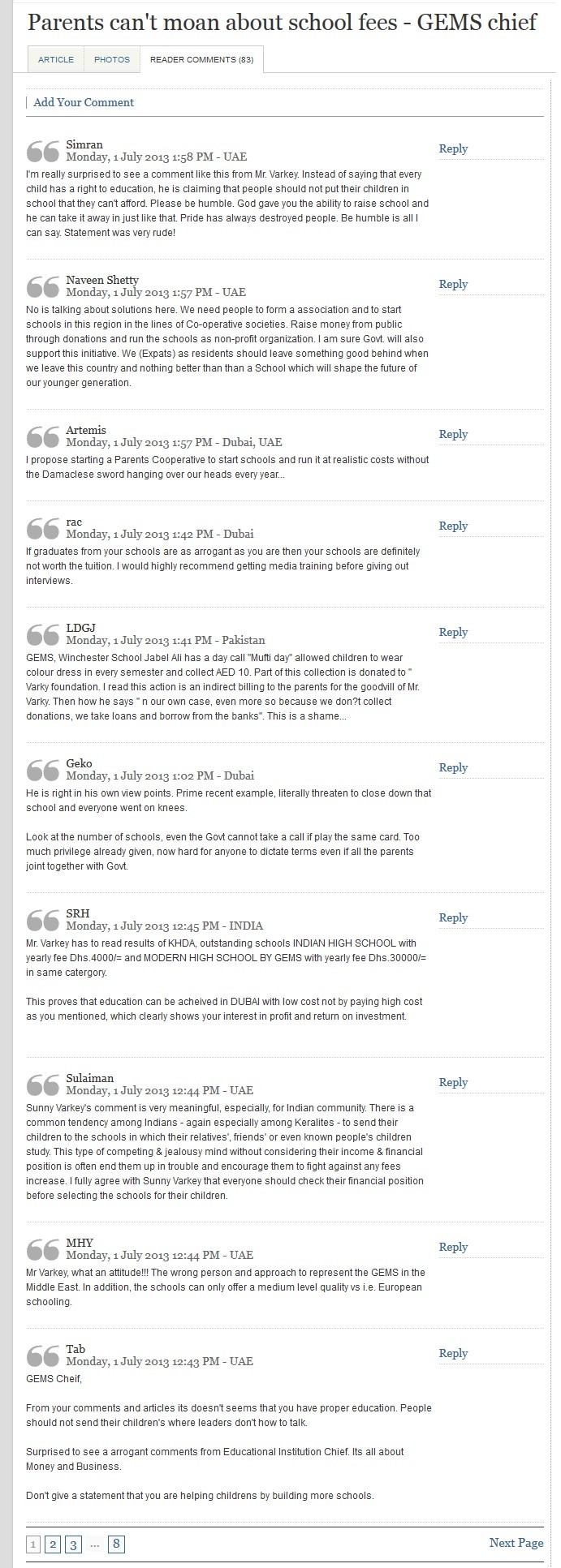
Where did the comments go? Only ITP and GEMS will know!
Is Dubai ready for the scrutiny that will follow the Expo 2020 win? Has the country learned any lessons from Qatar’s FIFA World Cup experiences? (image credit: http://www.expo2020dubai.ae)
The stage is all set, the bids are in. If I were a betting man I’d probably place my house on Dubai winning the Expo 2020, the World Fair that is set to be held in 2020 and which is expected to attract millions of visitors over a six month period. Of the other four national/city bidders Thailand has pulled out of the process and of the other three (Brazil, Turkey and Russia), two have been experiencing mass protests of late relating to governance issues (that’s a very PC way of saying riots, teargas and and general chaos as played out on television).
I wonder how much Dubai is ready for this level of scrutiny? The Emirate suffered during the global economic crisis, and it could be argued that Dubai’s cause wasn’t helped by its lack of transparency on financial issues. How will Dubai cope with the level and intensity of questioning that will come win the Expo 2020 win? While I don’t see the Expo as being as high profile an event as the FIFA 2022 World Cup, Dubai and the UAE aren’t so dissimilar to Qatar in terms of issues such as labour rights, security issues and freedom of expression.
Is Dubai ready for the questions that will come after, Inshallah, the Emirate wins the Expo 2020 win? What do you think?
The GCC is as diverse and complicated as any other part of the globe (credit: rasheedsworld.com)
Looking on in from the outside, most expatriates see the Arabian Peninsula as one monotonous geography. The women wear black (unless they’re Kuwaiti) and the mean wear white. The language is the same, and everyone is a Muslim. And that’s the Gulf.
Well, hardly. Each country is unique, and offers a wealth of diversity in terms of culture, history and opinions. The range of accents in Bahrain is so prominent that a local will be able to tell where a compatriot may be from how the greeting alone.
Saudi is the most diverse country in the region. Its twenty million nationals come from all four corners of the world, and don’t be surprised to meet a Saudi whose roots trace back to Indonesia, China, or Western Africa. The Kingdom’s Western Region is the richest melting pot you’ll come across, thanks to hundreds of years of pilgrimage to the two holy cities of Makkah and Madinah. Often foreigners think that Dubai or Doha are the two cities that offer the greatest contrast of cultures and groups, but they don’t come close to what Jeddah has to offer.
And Christians in Kuwait and Bahrain? And a Jewish community in Manama? Yes, they’re locals (but there’s not many of them).
And of course, with variety comes discrimination. There’s a good deal of nepotism across the Gulf mainly due to the tribal, bedouin nature. It’s not uncommon to find a certain group dominating in one company – it’s not so much where a person is from as often as what their tribal name is. Many Saudis don’t use their tribal names any more. And there’s also discrimination based on region (Jeddah versus Riyadh, Dubai versus Abu Dhabi etc), on the history behind the family name (in other words how far back can the family’s genealogy be traced), and on religion (which mathab or religious affiliation a person adheres to).
While this isn’t unique to the Gulf (tell me a place where there isn’t any discrimination) what I do find interesting is the institutionalized discrimination in certain parts of the GCC. Some states, most notably Saudi Arabia, Kuwait, Bahrain and Oman count GCC nationals as locals when it comes to hiring and nationalization quotas. The UAE and Qatar do not – when they say local they mean local. For a European the difference in policy between the two groups is hard to fathom (especially when considering the relatively small populations of both Qatar and the UAE when compared to Saudi Arabia).
So, the next time you’re sitting in the coffee ship and sipping on your coffee do remember to ask yourself where the gentleman in white is from. You may be surprised at how much you can learn about a region that is full of culture and contrast.
Dubai woke up Sunday morning to a horror story. In what seemed to me to be a throw-back to the movie the Towering Inferno a fire broke out on the roof/top floor of a 34-storey tower in the city’s Jumeirah Lakes Towers development at around 2am. Incredibly, no one was killed or seriously injured and the tower’s 600 residents were evacuated from the building.
The fire, which you can see a clip of below, took several hours to be brought under control. However, for the families who lived in the property which is owned by the Islamic mortgage company Tamweel, their ordeal has only just begun.
According to news releases and press statements Tamweel has been supporting those made homeless by providing them with hotel accommodation.
At Tamweel, our very highest priority is the safety and well-being of the owners and residents,” said Varun Sood, Acting Chief Executive Officer, Tamweel. “Our staff are on site and have provided transportation and hotel accommodation, in coordination with DMCC, to any resident who requires such assistance. We will continue to work with the Building’s Owners Association to assist all residents and we remain fully committed to ensuring their well-being.
It’s no exaggeration to say that many families lost everything in the fire. Radio interviews with Tamweel Tower residents spoke of people running out wearing only their underwear and having to borrow clothing from others after they’d assembled at the emergency evacuation points outside the building. A wonderful piece was written in the Khaleej Times, a piece that conveyed the feeling of loss and confusion. If you’re hoping to gain a sense of how much some people were going through on the morning of the fire then do click through and read.
The tragedy has been covered extensively in both traditional media and on Twitter, Facebook and Youtube. Residents were tweeting from the site pictures and uploading videos before the first stories had been published online (I read one Twitterer write in the early hours of the 18th that traditional media were yet to publish anything on the fire – if I can find his tweet I’ll publish here).
The morning of the tragedy companies and individuals started to reach out via community forums and other online media to offer their services and support as well as provide details for those who want to volunteer and donate.
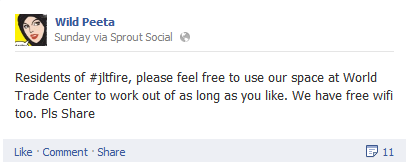
One Dubai restaurant chain offered to host residents and businesses based in Tamweel Tower at their premises
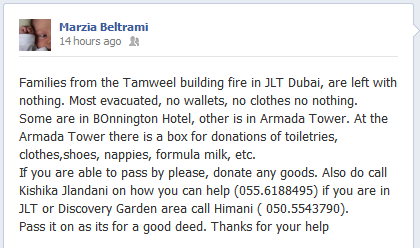
nappies, formula milk etc. If you are able to pass by please donate any goods you can miss. #JLT
Many people posted details of people to get in touch with for donating items to those left homeless
These community charity efforts are ongoing, as is the support given by Tamweel, and will be some consolation for residents who have lost all of their belongings in the fire.
The speed with which social media has allowed people to express their support and rally others in the community to help the victims of the Tamweel Fire has been remarkable. How long would businesses or government bodies take to do the same? What is interesting to note is that Dubai Police also use Twitter to put out news alerts.
For me, what’s also been striking is that the owner of the building Tamweel doesn’t have a social media presence. I’m sure, after what has happened, that will change in a very short space of time.
To celebrate Halloween in Dubai my artist friend Jehan Abdulkarim has mocked up another beautiful piece of art after her Eid piece last week. See if you can spot the landmarks in the background!
Witches can often be seen flying above the skies of Dubai at the end of October! Thank you Jehan for this Halloween fun!
It’s (hopefully) common sense that leadership can make or break any company or organisation. A leader, normally the CEO, will define the company’s direction, they will set the agenda, lead the execution and innovate.
Leaders like Steve Jobs define their organisation and create success on their own terms, much like Dubai’s Sheikh Mohammed Al Maktoum has done.
The late, great Steve Jobs has been acclaimed as one of the best CEOs in business. Jobs did it his way, he focused on the business and on creating works of art/technology that changed how we live our lives.
For me, the Apple of today is different to the Apple of yesterday. Nothing would go out of the door until Jobs was satisfied that the product was right and ready.
Apple had been developing the iPhone for years. After major arguments about materials, the team had decided to use reinforced plastic on the screens for the first version. That was the plan, and everybody spent more than a year working on it.
Just one month before the first iPhone shipped, Jobs summoned his team and issued an edict: The screen would be glass. He just didn’t like the plastic screen.
Of course, Job wasn’t perfect. He had his flaws. But I can’t imagine that Jobs would have let Apple Maps into the world without the solution being ready (the linked article here does make the point that Jobs himself was late to realize the importance of a maps application). As a leader could we imagine anyone else taking Apple forward better than Jobs? No. That is evident more so today when he’s missed.
So how is this relevant to us in the desert? I was talking to a work colleague, a well-respected Emirati, about the Gulf and how it has developed. He was talking about Bahrain, and commenting on how 20 to 30 years back Bahrain was where Emiratis would travel to shop and vacation.
What he was saying made sense to me; Bahrain had a well-developed economy at the time and Dubai was setting out on the journey to become one of the globe’s trading hubs. Bahrain was the GCC’s banking hub, Gulf Air was the airline of the region, and the island could do no wrong.
Fast-track to today, and it’s as if the roles have been reversed. Dubai is now the trading hub for the region, and it’s the one must-visit destination for business and tourism. Emirates is the world’s largest airline by passenger numbers, Dubai-owned Jumeirah is becoming a global brand for the hospitality sector, and, despite the credit crunch, Dubai is still thriving. As for Bahrain, it’s fair to say that the country isn’t doing as well as Dubai.
Countries are no different from companies. The leadership shown by the ruler, the prime minister or whoever at the top can be and often is the difference between success and failure. Nowhere is that more apparent than in today’s Gulf and in the vision set out by Dubai’s ruler Sheikh Mohammed Al Maktoum. Leadership is success, and a lack of leadership can be the opposite.
How much do you understand about and live in harmony with the culture around you?
I was reading a short but poignant piece by Annabel Kantaria, the Daily Telegraph’s journalist in Dubai. The column was about Dubai’s Brits and how today’s British expats in the Emirate are a breed apart from their predecessors (have a look at the article here).
My take on culture and our settings may be different to most, partly cause of my background and partly due to my circumstances. As a child of two cultures, I’ve always been acutely aware of the importance of the need to adapt and become part of the community within which I am living. For years my family lived in Saudi Arabia, a country that has a very distinct set of cultures. I’ve married into another culture as has my sister.
For those that aren’t from a melting pot of genes, traditions and customs I can imagine that it isn’t easy to let go of what you know so well. Is there an urge to make others adapt, to conform? You could certainly say that the walls of a compound are a way to keep out external influences.
However, isn’t there more to living in a foreign location than just a job or a salary? How much more can we enrich ourselves through adapting to the local culture and becoming part of the local community?
It pains me when I meet with people who can’t utter a word of the local language despite having lived in the country for years, and whose only contact with their environment is the food (usually hummus). Admittedly exchanges do need to be two-way; a dialogue needs two or more people to talk and listen to each other. However, someone needs to make the first move and look beyond their boundaries to understand, learn and appreciate what is different.
Despite its reputation for being a harsh place to live, I loved my time in Saudi Arabia. Why? Because I became part of the community. I spoke the language, I developed friendships and spent time with locals talking about what is important to them.
I miss that cultural understanding, that bridging of the divide between me and them. The world will be a better place with more understanding. Adapt to your surroundings, thrive in your local environment rather than simply live there, and you’ll end up calling your foreign adventure your home rather than a ‘couple of years abroad.’
Every once in a while, you come across a story that is heartbreaking. What happened to Natalie Creane is tragic. Four years ago Natalie and her new fiance celebrated their engagement by staying at the Emirates Palace Hotel in Abu Dhabi. After arriving she opened the wardrobe door and bent to put her shoes in the wardrobe. She looked up as a wooden panel fell from the front of the AV unit and hit her on the head, right on the temporal lobe.
According to a number of sites set up on her behalf Natalie was diagnosed with intractable refractory epilepsy and brain trauma. Since then she has been in four comas, she suffers from seizures which cause her to collapse suddenly and she has frequently sustained serious injuries during these seizures, including broken bones. Natalie has been on ventilators, had blood clots in her lung and leg, extreme blood toxicity, paralysis, temporary loss of sight, massive hair loss, severe debilitating headaches, temporary loss of speech, confusion, permanent memory loss, insomnia, constant infections due to suppressed immunity and has been admitted over 20 times to intensive care. Natalie suffers from Post Traumatic Intractable Refractory Epilepsy and Traumatic Brain Injury.
Despite all that has happened to her Natalie’s case with the Emirates Palace Hotel is still outstanding. The Emirates Palace Hotel initially referred the family to its insurance company. After talks with the company broke down, the family was faced with the hotel’s lawyers. Forced to take their case to court, a full two years after the accident, the family is still fighting for justice now – four years on from Natalie’s accident.
After four years of what I can imagine to be a living nightmare, including two years of litigation, Natalie’s family have finally gone public. They set up a Facebook page on the 9th of July which you can see here, and the family also set up two twitter handles, @JusticeForNatal and @JusticeForNat.
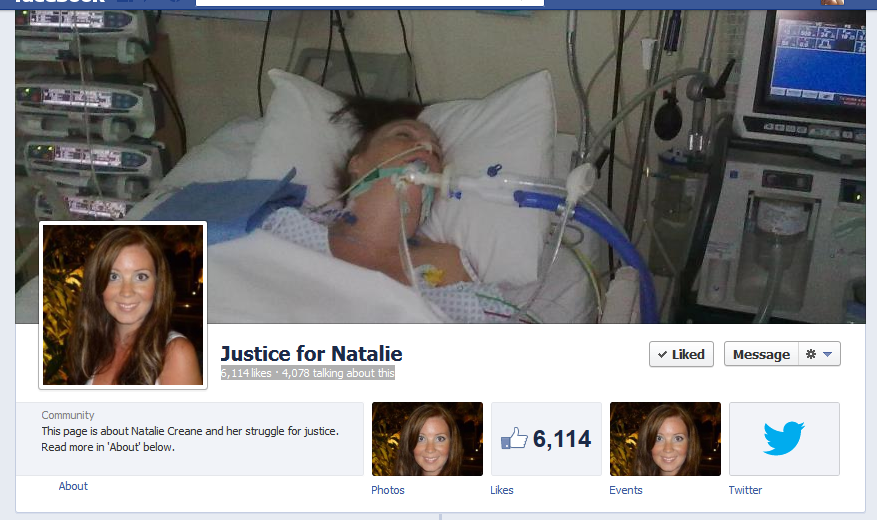
As of today, the Facebook page has 6,114 likes. Even more importantly when it comes to measuring influence and importance on Facebook 4,078 users are currently talking about Natalie. Here’s a screenshot of her page below.
The Justice for Natalie Facebook Page has only been live a few weeks but has already gone viral in the UAE and beyond
Her family have made use of Twitter to get her story noticed by media through retweets and mentions, posting pictures both via Twitter and Pinterest, and using the hashtag #justicefornatalie (there was some initial confusion online around the 20th when the Twitter handle switched from @justicefornatal to @justicefornat).
Ten days after setting up the social media channels Natalie’s story broke in mainstream media with a news piece in the UAE’s largest English circulation newspaper Gulf News followed by news pieces online at Albawaba and in print with another English-language UAE newspaper, 7Days. Natalie’s story has since been covered by global news outlets such as the BBC and the Huffington Post.
(Natalie’s story was first covered here last year by the National, but owing to the UAE’s defamation and libel laws newspapers use initials rather than full names when covering an active case).
Natalie’s family have also set up an online petition via Care2 where they’re aiming to gather 2,000 signatures (the petition is here and they’ve set up Team Natalie Marathon in Abu Dhabi for November (you can sign up here).
There’s even videos on Youtube, including the below which was put together by a supporter of the campaign.
Natalie’s family have stressed that the campaign has one aim, namely to raise her case’s profile and find some settlement so that Natalie can receive the support that she so desperately needs.
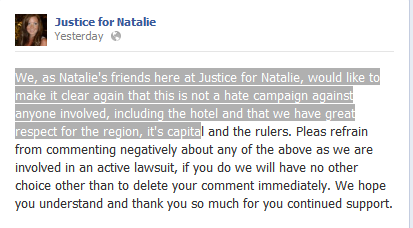
Rather than being a negative, hate campaign against the hotel the family are using human interest messages and regular updates on Natalie’s condition to attract attention and build a community online. In the space of two and a half weeks Natalie’s case has gotten more attention than it has done over four years. Understandably, the family have tried to get this issue resolved in a way that will not prejudice a court settlement, but with Natalie’s condition not improving it’s understandable that they feel the best way to ensure that their daughter has the care she needs is now through public relations.
Natalie is currently in a public hospital in Dubai, Rashid Hospital, where she is receiving palliative care. As her family write on Natalie’s Facebook page, “she urgently needs to receive specialist neurological help but the family has spent all they have over the past four years as they fought to get the hotel to step up and admit its liability for an incident which has resulted in such appalling consequences for Natalie.”
I for one hope that the Emirates Palace Hotel and the Kempinski Hotels group which manages the property settle this as soon as possible. They’re harming their own reputation. And, most importantly, they are denying their own responsibility to provide care for an incident which could be said to be a result of their own negligence.
How online communities have rallied round Natalie’s family is remarkable. And it goes to show how effective social media today can be in highlighting a worthy cause. Let’s all hope that Natalie finally gets justice and receives the support she needs to recover from all that has happened to her.
I love to post random videos. And this is a beauty. In Saudi seeing a camel by the side of the road isn’t unusual. The drive from Dubai to Al Ain used to be infamous for car-camel crashes (due to a camel’s body weight, height in relation to a car bonnet and its spindly legs, if you hit one it’d fall through the windscreen and seriously injure or kill the driver and front seat passenger). However, having a camel running up a bypass off Dubai’s main highway is unheard of (at least over the past couple of years).
So next time you drive, never mind those inane motorists, the plodding trucks and speeding taxis. It’s the camel that you have to take care to avoid. Especially while filming a clip for Youtube.
I was incredibly lucky last week to listen to two compelling business consultants. I’m usually a hard critic to please and I don’t often take to consultants coming in to tell me what I should and should not be doing. But the two gentlemen who came into the company last week, Scott McKain and Jonar Nader, both emphasized the importance of listening and knowing your customer.
To quote from one of Nader’s recent essays, “Most people are plagued by miscommuication, jealousy, and immaturity, resulting in poor performance. Individually, staff members might be great workers, but when lumped together with a range of personalities, egos clash.”
“As a technical genius, your success will depend on how well you marshall your team. Sadly, many technical gurus either isolate themselves and become eccentrics who lack influence, or they jump in the deep-end of management and drown in unfamiliar territory.”
I couldn’t agree with Nader more on people management being at the core of a company’s success and failure. Both Nader and McKain talked about information, about communication between employees. One of the best tools that I ever used and managed was was an internal website, an intranet. It may sound strange – after all an intranet is only designed for use by employees rather than the general public. Its audience is strictly defined and limited.
However, I’ve found that companies with intranets have a much better educated workforce. Employees generally understand their firm’s rules and regulations much better than companies who don’t have an intranet. An intranet also plays a major role in keeping the workforce up to date in terms of new products, successes, and company changes.
In short, the more a workforce is empowered with information, the more your employees will communicate. The less they’ll be in the dark about where the company is headed and how the company intends to grow. Your employees become your advocates rather than your naysayers. For the return on the investment is there anything better than an intranet and more internal communications in general?
And if you’re interested in knowing about Scott McKain have a look at this video!