@Wadds on uncertainty and life in the UK post-Brexit

In another guest post, I’ve asked the respected public relations industry figure Stephen Waddington to share his thoughts on Brexit. Strap yourself in for the read.

The vote for Brexit will have many consequences for the UK, including for its communications industry, argues Wadds (image source: http://www.fortune.com)

The lack of planning and political fallout from the UK’s European Referendum mean that Brexit will remain a work in progress for a long time to come.

Alex asked to me to draft a guest blog post reflecting on life in Britain post Brexit shortly after the European Union (EU) Referendum result at the end of June.

I dodged the opportunity initially, not because I didn’t have a view, but because for three or four weeks it was really difficult to make sense of what was happening in the UK.

It’s has taken me the summer to come to terms with the fact that the UK voted to leave the EU. I was convinced by conversations on Facebook and Twitter that UK citizens would vote remain. I was stuck in a filter bubble.

The Referendum divided the country. The remain campaign was based on rational argument; the Brexit campaign, by contrast, on emotion.

UK citizens used the Referendum as an opportunity to vent their anger at the political classes in London and Brussels. It exposed a split between London, Northern Ireland and Scotland which all voted remain and the rest of the UK which voted Brexit.

More than two months after the result we’re becoming used to living with the uncertainty. What Brexit means and how it will happen are both a work in process.

The Conservative Prime Minster resigned and was replaced without a leadership election. The Labour party remains in the midst of leadership election.

The new Prime Minister Theresa May has created a Ministry for Brexit led by Eurosceptic David Davis, and has appointed Brexit campaigners Liam Fox and Boris Johnson as trade secretary and foreign secretary respectively.

Both Davis and Fox are recruiting the small army of people needed to work on the exit negotiation with the EU. 1,250 positions have been created in trade and diplomacy.

The UK will have two years to negotiate its exit once it triggers Article 50 of the Lisbon Treaty.

In that time it will need to determine how to manage more than four decades of law that are entwined with the EU, and negotiate trade deals on an industry-by-industry basis with the 27 member states, and major countries around the world.

There’s also the issue of the free movement of people. Take back control [of UK borders] was a campaign slogan for the remain campaign.

It’s an issue that impacts the UK’s future trade agreements but also impacts UK citizens living in EU countries and EU citizens living in the UK.

People like markets don’t respond well to uncertainty. The government needs to move quickly to reassure people and investment that the UK remains a good place to both invest and build a career.

The UK is a centre of excellence for talent in the creative industries, including my own trade, public relations. I’m keen to see this remain the case.

The emergency budget, and recession, both predicted by the remain campaign haven’t happened. But UK currency shows no sign of returning to pre-referendum levels.

£1 was worth $1.50 on the day of the Referendum. Today the £ is trading at an average of $1.30. The foreign exchange markets have priced down UK assets by more than 15%. It’s the one area of absolute certainty.

The rest is yet to be seen.

Stephen Waddington is Partner and Chief Engagement Officer, Ketchum and Visiting Professor in Practice, Newcastle University. He blog at wadds.co.uk and you can connect with him on Twitter @wadds.

The importance of reputation – the examples of Mubadala and IPIC


The concept of reputation, which can be defined as how much stakeholders trust organizations, is often difficult to measure. It’s an intangible, an idea which is often best understood at the most inappropriate time (in other words, during a crisis).

In Abu Dhabi last week news broke about a merger between two government-owned investment vehicles. The deal between Mubadala and IPIC would create a combined fund worth US$135 billion according to Reuters. At a time of budget tightening due to low oil prices, the merger promises to bring about significant cost savings according to media reports.

Reuters had another interesting take on the merger, which I’ll copy from the article.

IPIC is also in the midst of a row with 1MDB. The Abu Dhabi fund has asked a London court to arbitrate in a dispute with the Malaysian state fund over a debt restructuring in which IPIC is claiming about $6.5 billion.

While unlikely to impact these proceedings, the sovereign wealth fund analyst said the scandal had undermined IPIC’s reputation and so a tie-up with Mubadala, which is considered one of the better-run state investment funds in the region, would be beneficial.

The analyst that Reuters spoke to argued that IPIC’s reputation was hit by the issue in Malaysia. In addition, the departure of its previous CEO and dealings in its investments such as Arabtec have also contributed to reputation all issues. In contrast, Mubadala has a strong brand, helped in part to the leadership of its management and financial transparency.

It’s not only communicators who need to understand that every action will impact organizational reputation (leaders of listed companies know all too well what public sentiment can do to the stock price, and their jobs). The Mubadala-IPIC merger is an example of how much both good and not so good reputations can impact the business.

What can Brexit tell us about the importance of listening to communications

Was the Brexit vote a result of politicians not listening to voters? And what does this mean for us communicators? (image source: Asda.com)

For many, the events of last week were a shock of the greatest magnitude. The vote for Britain to leave the European Union wasn’t foreseen, even by the pollsters, those professionals whose vocation it is to use real-time data to build a picture of how the mass population will vote. Even the Exit camp had foreseen a narrow defeat.

Much of the post-event analysis has asked why people voted for Brexit and how everyone misunderstood the public mood. Reporting has focused on those areas of England in the North which have suffered as a result of the closure of heavy industries in the 1980s. One theory as to why more Brits voted for Brexit than for Bremain would seem to be, “we’ve suffered for years, and you haven’t listened. This is our rejection of Westminster and the politics in London.”

It’s an interesting observation, especially when one considers that the areas which pushed to leave the EU received fewer immigrants and received the most aid from the European Union. The idea that the electorate punished the politicians for failing to listen is a compelling one, and it offers a reminder to all organizations that listening to their stakeholders is key to success.

By listening and understanding the views of these groups, be they the public, consumers, customers, or members, organizations can better represent those they wish to engage with and talk to. Organizations, particularly those which aim to speak on behalf of a certain constituency, should comprehend that they can only lead through having the needs of their members at heart, and building trust through asking their stakeholders what is important to them.

The example is no different in our region, where organizations are often led top-down and executives rarely interact with their members or stakeholder groups. If Brexit proves anything to us communicators, it is that we must be the link between those on the inside and others on the outside, to develop and provide the means for these groups to talk to each other and for differing opinions to be heard in an environment which is conducive to understanding. There was little of this in evidence among many Brexit voters, not just during the campaign but for years prior to the vote.

As a recap, active listening helps to improves mutual understanding and trust and enables the listener to receive and accurately interpret the speaker’s message. Active listening doesn’t just help with building trust and respect, but it also helps to reduce tension, encourage information sharing and creates an environment that promote collaboration and problem solving. It’s key to communications and is a skill that a good communicator should possess and practice.

Conversely, organizations who don’t listen end up becoming irrelevant, and serve no purpose than to fulfill the wishes of their management rather than those which they aim to represent.

There’s much more to talk about when it comes to communications and Brexit, including the use of positive and negative messaging to influence voter outcomes and why those areas with the most to lose in terms of EU funding voted for Brexit. There was obviously a disconnect between the politicians and voters on the Bremain side, which wasn’t the case with the Brexit politicians. However, as we’re only just at the beginning of this story, I’ll save that post for another occasion.


Ramadan and the Impact of Social Media

We’re only a week or so away from the holiest month of the Islamic year, when Muslims fast to remember the first revelation of the holy Koran to the Prophet Muhammed. Just as the Middle East has embraced social media, so have Muslims. Ramadan is one of the most active times of the year for social media in the Middle East, on all social media channels, as Muslims reach out to friends and family, as they prepare for the Holy Month, and as they celebrate in the run up to Eid.

First of all, let’s look at Twitter. The short messaging service recorded over 51 million mentions of Ramadan last year, with 8.4 billion impressions.

The number of Tweets during Ramadan in 2015 based on Twitter's own internal statistics

The number of Tweets during Ramadan in 2015 based on Twitter’s own internal statistics

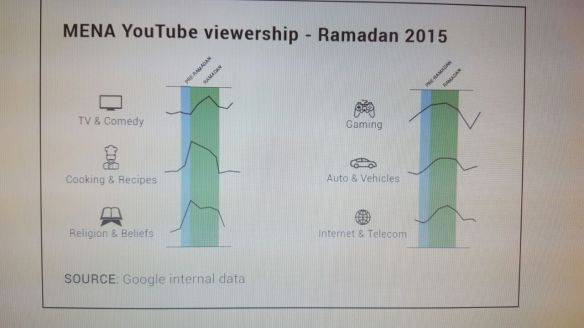
Google’s focus is on YouTube, in particular channels which have a specific relationship with this period of the year. Cooking is initially popular (Ramadan meals are cooked and served at home), followed by religious channels and general entertainment.

YouTube viewership during Ramadan changes dramatically as you can see from this internal Google data

YouTube viewership during Ramadan changes dramatically as you can see from this internal Google data

And last but not least, there’s Facebook. During 2014, 14.6 million Muslims in the MENA region posted 47.6m updates on Ramadan and Eid. The attached presentation from Facebook provides fascinating insights into when Muslims are online and how much more time they’re spending online, as well as the shift towards mobile and a breakdown of chatter by age and sex. Facebook believes that millenials are shifting away from television and towards the internet, which may be disconcerting for advertisers and television networks.

Facebook MENA Ramadan Insights

While it’d be fascinating to understand how Muslims are using Whatsapp and other messaging services to spread religious messages and other related content, I don’t have any data on this (and other) channels.

Whatever you’re planning for Ramadan, do remember the importance of social media channels to Muslims across the region. Make your content engaging (either entertaining or informative), relevant, and shareable. And Ramadan Mubarak!

Working Mothers and the Gulf – Will efforts to promote flexible working and gender diversity be a game changer for the region’s women and economy?

Will the region's businesses embrace mom-friendly policies?

Will the region’s businesses embrace mom-friendly policies?

It’s no secret to those of us whom know the Gulf; this region has lagged behind when it comes to women in the workplace, particularly mothers. A number of new organizations are looking to change this, either through working to push for the return of working mothers to the workforce or by calling for more female participation in the board room.

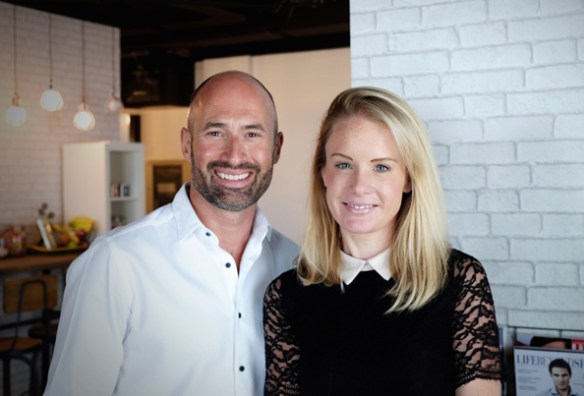
Co-founded by two of the most experienced recruiters in their respective fields in the United Arab Emirates, Hopscotch and Mums@Work are working to transform perceptions about working mothers and promote a change in working practices, such as the introduction of flexible hours and remote working.

Hopscotch's Helen McGuire's own experiences as a career professional who took time out have inspired her to help other women in the Gulf

Hopscotch’s Helen McGuire’s own experiences as a career professional who took time out have inspired her to help other women in the Gulf

“Hopscotch was set up to be much more than a recruitment firm. We’re a support platform to support women and get them back into the workplace. Part time work is doable, but it’s not how it is perceived,” explains Helen McGuire, co-founder and managing director of Hopscotch, which was set up by her and her husband Justin McGuire who himself founded the recruitment agency MCG Associates. “A lot of full time roles are full time simply because that is the standard, that’s the norm. We’re opening up a new talent pool that hasn’t existed before and that means potentially a new way of working for everyone in the region.”

For Louise Karim, the managing director of Mums@Work, her goal is two-fold, namely to promote flexible and part-time working as an option to women who have taken a break from their career for family reasons and to support both these women get back into work as well as corporations who are looking to hire working mothers but don’t know where to start.

“We’ve done our research here and we did a survey [through our parent company Mackenzie Jones] to ask our clients about mums in the workplace. We got an outstanding positive response when we asked if they’d hire mothers,” says Karim. “We also undertook a You Gov Survey which indicated 77% of mothers in the UAE would return to work if flexible options were available.”

Both organizations are looking to tap into what they believe is a significant pool of professionals, many of whom were senior-level executives, who are based in the region but whom don’t feel ready to commit to full time work but would work flexi-hours or remotely if the option was available. As Karim explains, the response has been remarkable.

Mums@Work's Louise Karim (pictured on the right) aims to create a community that will help get moms back into the workplace

Mums@Work’s Louise Karim (pictured on the right) aims to create a community that will help get moms back into the workplace

“Since our launch over a month ago we have had 3,000 CVs, a good percentage of which are very strong candidates, women who were in management and executive positions,” says Karim. “With clients we have had a strong response and our roles range from regional project manager for a multinational retailer, to legal, finance, marketing support. These include full-time flexible work to one or two days a week.”

The reaction to Hopscotch, which was also launched this year, has similarly exceeded expectations states McGuire. The organization, which McGuire describes as being unique in terms of its commitment to training, skills and support through ongoing Workshop series and online resources, has been overwhelmed by a positive response from both corporates and moms who want to get back into work.

“We have been astounded by the response, not just from women, but also from businesses and the media. We imagined some companies would take a little persuasion, but so far the response to bringing a new product to this market which we have done has been really positive.”

As part of their engagement with mothers who have been out of the workforce for some time, both Hopscotch and Mums@Work are going beyond the typical recruitment service and providing additional support to get them ready to re-enter the workforce. Hopscotch is currently running a series of workshops in association with HSBC. In addition to workshops and mentoring, Mums@Work is developing a portal which Karim hopes will turn into a support network for sharing advice, providing guidance and support.

A different approach is being taken by the 30% Club, a movement which was conceived of in the United Kingdom back in 2010 and which found its way to the Gulf last year. The idea is simple – get more women on company boards and they’ll push for a change from within. The 30% Club, which advocates for a minimum of 30% female representation at board level, has spread rapidly around the globe, including in the Gulf where it is being supported by a host of organizations.

Felice Hurst, a board member of the 30% Club in the Gulf, wants to see more female executives sitting on the boards of the region's businesses

Felice Hurst, a board member of the 30% Club in the Gulf, wants to see more female executives sitting on the boards of the region’s businesses

Gender balance on boards not only encourages better leadership and governance, but diversity further contributes to better all-round board performance, and ultimately increased corporate performance for both companies and their shareholders,” explains Felice Hurst, Gulf chapter board volunteer and MENA managing director for Hanson Search. “Women play a very powerful role in the Middle East when it comes to business, and we are witnessing an increased number of women in government, running private businesses, and driving the economy forward in countries such as the UAE, Qatar and Saudi.”

For Hurst, herself a working mother, the issue of getting mothers back into jobs is part of the wider debate about female representation in management. “As an executive recruitment professional, the topic of enhancing the female talent and enabling them to perform well both as Mothers and businesswomen is at the top of the priority list. Women bring in a “new” and often wider perspective to management problem solving, and expanding the female participation in the workforce will expand the pool of talent that the GCC organizations can tap into.”

The argument is also economic, explains Hurst. More female participation will only be better for the local, regional and global economy. “McKinsey recently produced a report “Women Matter” highlighting that companies greatly benefit from gender diversity in leadership positions, with more diversity going hand in hand with higher organizational effectiveness. The report argued that there is an economic case for gender parity, and that advancing equality could add US$12 trillion annually to global GDP by 2025. This is a pressing global issue with huge ramifications not just for the lives and livelihoods of girls and women but, more generally for human development, productivity and GDP growth.”

While it’s too early to tell what impact these organizations and initiatives have made on perceptions and hiring, the fact that we’re seeing a groundswell of support for changing attitudes and policies towards working mothers should be applauded. I for one will be doing what I can to cheer on the 30% Club, Hopscotch and Mums@Work.

What Customer Service? Etisalat and its inability to put customers first…

Etisalat never ceases to transform me into a mass of seething rage and frustration thanks to its inability to do anything right for its consumers

Etisalat never ceases to transform me into a mass of seething rage and frustration thanks to its inability to do anything right for its consumers

I’m a patient man. Really, I am (I can imagine my wife shaking her head right now, but it’s true). I can put up with anything. It’s just that I don’t want to give up the good fight when it comes to telling companies that we customers in the Gulf (and especially in the UAE) deserve more. Here’s one story of a company that could do a whole lot more to be customer-friendly, my favorite Etisalat.

At the beginning of the year, I was jumping up and down with excitement. For the first time I could change my home internet provider at my home in Abu Dhabi. For years, I’d been stuck with Etisalat and its atrociously poor customer service. Now, I could move to Du. I took up the opportunity, and moved. Unfortunately, no matter how much I wanted it to work, it was a doomed romance. I couldn’t get television services as part of my internet and telephone services (I still can’t explain this one), and, most importantly, Du’s internet connection was poor and often dropped. With a tear in my eye, I had to go back to Etisalat.

I head on down to one of Etisalat’s outlets and make the request for internet at home. The request was simple enough, until we got to the nitty gritty of the agreement which included a router and phone. There was no need for either, I explained, as I’d already spent on both. No worries, I was told by the sales person, I could use my routers but I’d still have to take the router and phone as part of the package (in other words, the package was fixed).

First step done, I waited for the engineer to come around. He did and he had a look at my internet setup. He then asked if could set up the network, including the Etisalat router, a D-Link AC1750 router. I said I’d like my router set up, a Linksys WRT1900ac which I’d already spent a significant chunk of money on and which I’d already set up for my home.

After an hour of ‘discussion’, including lines such as ‘the Etisalat connection will only work with the D-Link router from Etisalat’, and that ‘the Linksys wouldn’t work as it couldn’t be configured’ (both of which were utter nonsense), I spoke to a supervisor who told me that it was a sales decision and that I’d need to go back to the store to sort it out. I even offered to take the router but not to use it. My request was turned down. In essence, no Etisalat router installed = no internet.

Two days later, I received an SMS saying that my original request for internet had been declined and that I’d have to make a new request. Which of course I did, and during which I asked the same things, to be told the same excuses. Essentially, someone in head office had decided that he knew best, better than his customers, and that without a router from Etisalat, which we pay for, we can’t get internet from Etisalat.

What pains me throughout this is that I’m not alone in my point of view (and my suffering). The first engineer explained that every day new seven or eight customers would tell him the same thing, and yet he couldn’t do anything. All that we customers can do is dump our expensive kit so that someone in Etisalat can make more money. Forget listening to the customer, forget keeping them happy and increasing their average spend through giving them what they want. Let’s ram products down their throat as there’s nowhere they can go and no one they can complain to. It’s naturally disappointing, especially when you consider the leaps and bounds that are being made by other operators across the globe, even here in the Gulf.

The experience was topped off by my wife paying the second engineer to reconfigure all of our wireless extenders at home to work with the new router.

Customer service and Etisalat? It seems I, like many others, have no choice but to suffer as we wait for a customer-centric epiphany among Etisalat’s executive management.

The Fire, the Selfie and Prison – why you should care about what your friends say online

Was this inappropriate? Most certainly. But what could get you jailed is not just a picture that is in poor taste, but rather the comments your friends make on that post.

Was this inappropriate? Most certainly. But what could get you jailed is not just a picture that is in poor taste, but rather the comments your friends make on that post.

We all do stupid things, and we unfortunately then post these acts of idiocy online. Combine that with a situation like we had during New Year’s Eve, and you’ve got a situation that could at best be described as combustible.

As the flames ravaged Dubai’s The Address Hotel on New Year’s Eve, some people decided to take selfies. A few posted these selfies online, to Instagram and Facebook. At least two people, two young men, were arrested for their selfie (pictured above) while the Emirate’s Public Prosecution investigated their case.

There’s been much speculation online as to why the men were arrested, with many commentators arguing that the action defamed the country and its image – let’s remember that defamation is a criminal offense in the Gulf, with a minimum fine of 500,000 Dirhams and jail time in the UAE (as well as deportation for expatriates). Many have posted selfies at the same location, with smiles, grins and laughs, and such expressions of emotion may have been considered a case of schadenfreude by the authorities.

However, according to the English-language newspaper 7Days which spoke to the lawyer of the two accused, they were investigated not for the image per se, but rather for the comments made about the image. The argument goes that the person who posts content is also responsible for the comments on that post, even if those comments are not written by the same person but his or her friends, family (or anyone who wants to get you jailed).

Luckily for them, the two were released from prison after a couple of days with no charge after investigators found that there was “no evidence of criminal intent”. However, remember that in future it’s not just your stupidity that could land you in jail, but that of your online contacts as well. Their comments could cross the legal line of what is defined as defamation, so don’t post images or any other type of post that could get you into trouble. Just don’t…

What does Authenticity mean in the Gulf?

Are you being authentic? And what does authenticity mean to us in the Gulf?

Are you being authentic? And what does authenticity mean to us in the Gulf?

The notion of authenticity, that feeling of genuineness, has long been an issue to us communicators. The theory goes that the more authentic we (or our clients) are, the more people will believe us and like us. Even the use of the word authentic has grown; in the US, the word’s use has grown 74.5% since 2012 according to the Holmes Report, to 8,069 press releases and 20,471 media stories.

Well, you’d think that being in a world where everything is online it’d be harder than ever to fake it. Well, an Australian teen with over half a million followers on Instagram has put the sword to that theory. Here’s an excerpt from The Guardian on Essena O’Neill and how she strived to be perfect online:

An Australian teenager with more than half a million followers on Instagram has quit the platform, describing it as “contrived perfection made to get attention”, and called for others to quit social media – perhaps with help from her new website.

Essena O’Neill, 18, said she was able to make an income from marketing products to her 612,000 followers on Instagram – “$2000AUD a post EASY”. But her dramatic rejection of social media celebrity has won her praise.

On 27 October she deleted more than 2,000 pictures “that served no real purpose other than self-promotion”, and dramatically edited the captions to the remaining 96 posts in a bid to to reveal the manipulation, mundanity, and even insecurity behind them.

At a recent event I was chairing, one of the speakers told an anecdote about a Saudi youngster who claimed to be an entrepreneur, partly because it is the popular thing to do and also because he was unemployed. The experience also reminded me of comments left on a popular website about two local entrepreneurs who have set up their own business. Three of the comments were negative, and called into question the ‘authenticity’ of the two young gentlemen. One person wrote, “I have also noticed many so called ‘Entrepreneurs’ are only ‘Instagram-perneurs'”.

The question then comes to mind – who is being genuine and how can we tell if they’re genuine? Will the media challenge people on their achievements? Will the public call out these people? We live in a region where social media is all pervasive and yet, due to various barriers such as culture, language and traditions, it can be truly difficult to know if someone is being genuine or not. For me, the best way to understand the true meaning of authenticity is to grasp its meaning – one who does things himself/herself.

What are your thoughts on authenticity and the Gulf? Do people live to a certain image, or are they true to themselves? And what does this mean for how we communicate? I’d love to hear your thoughts on the issue.

Innovation, Data and Control – Squaring the Circle in Dubai

Can governments in the Middle East find a way to balance control with innovation and access to data?

Can governments in the Middle East find a way to balance control with innovation and access to data?

Someone re-found their mojo this month. The English-language newspaper The National published a number of eye-opening pieces on two issues that are often discussed, but little understood.

The first was an investigative piece (yes, I know!) on the challenges that Dubai’s Road and Transport Authority (RTA) has faced with the disruption caused by app-based taxi providers such as Uber and its local rival Careem. To put the story into context, the RTA does not only regulate taxis in the Emirate of Dubai, but it also manages its own fleet of taxis.

The piece, which is a fascinating insight into how the Emirate is not only run but also how it is looking to balance control with innovation, poses the question of how a government which controls much of the business in the country promotes innovation whilst protecting its revenues. For me, the key paragraphs in the article, written by the newspaper’s business editor Mustafa Alrawi, are below.

In Dubai, The National understands, Uber and Careem have narrowly escaped a clampdown by the regulator that would have significantly curtailed their abilities to operate. The biggest issue has been the alleged failure to maintain prices above taxi fares. On its website Uber states that “ … in Dubai, regulations require our fares be 30 per cent higher than taxi fares”.

It is understood, however, that the regulator had been planning a far stronger response to the practices of private hire companies booked by smartphone app, ahead of new regulations to address the emergence of technology-led companies in the transport sector. These regulations are expected next year, according to previously reported comments from the RTA.

It is understood that the Dubai government stepped in before the row escalated to ensure that innovative companies such as Uber and Careem would not be hamstrung by any action by the RTA. The circular is understood to represent a kind of temporary truce between the regulator and the technology firms maintaining the status quo for now.

A second article the following day in The National touched on another important issue for the country – that of statistics and control over information. Here’s the introduction:

A new law that demands companies seek government approval before carrying out surveys in Dubai could damage the property sector and discourage research in the emirate, experts have warned.

The Dubai government announced a law late last month intended to help enable the Dubai Statistics Center “to establish an advanced statistics system”, according to a statement. But experts zoomed in on a provision in the new law that forbids private companies from “conducting any survey[s] without obtaining authorisation from the Dubai Statistics Center”.

As pointed out by one of those interviewed, there’s no such thing as a data vacuum. The lack of any official data will be filled by rumours, which can prove to be much more damaging.

Professor Joseph Kadane, chair of the American Statistical Association’s committee on scientific freedom, which produces reports for the United Nations on best practice in government statistics, warned that the new law would likely lead to the spread of “uninformed rumours and uncertainty about the extent of the downturn” in Dubai’s property market.

“This will do far more harm to Dubai’s economy than allowing private surveys to be conducted and published,” Mr Kadane said. “International investors, in particular, are sensitive to the quality of the information available to them in deciding where to invest.”

Both articles touch on fundamental issues relating to innovation and data. The underlying theme is control. Governments in the Middle East have long controlled everything around them, including their economies. In today’s digital world, where innovation can come out of nowhere and where data can be created and spread in an instant, governments need to understand that the control of yesterday is no longer possible and instead look to collaborate.

And, on a final note it’s great to see good local reporting. I hope The National keeps it up.