The #MeToo movement has rarely been discussed in the Middle East. It’s time we start talking seriously about sexual harassment in the region, especially in the marcomms industry (image source: http://www.alaraby.co.uk)
The article is a must-read for all of us who work in marketing and communications (I was dismayed by a point of view shared by Ricarda Ruecker, vice-president of leadership and organisation development at MCN, that women could be to blame for any harassment they suffer due to their dress or behavior).
I want to applaud Iain and ArabAd for taking on this issue. The allegations are well known in Dubai, but they haven’t been published till now due to the nature of local defamation laws and the understandable reluctance of those women involved to talk about their ordeal publicly. Iain and ArabAd have taken a risk in publishing this piece.
Sadly, there’s so little straight talk on what women here have to deal with in the workplace. There’s lots of PR from certain quarters about the importance placed on women’s rights in certain parts of the region. And yet, I can’t help but ask one question; how does all the talk translate into action? Are companies asked, for example, to published pay scales for their male and female staff, as is now the case in Europe. The answer is no. Do we have enough female management in the industry? My answer would be not enough. And do women in the industry feel that they’re protected from harassment? I don’t feel that they do.
Small steps are being made when it comes to gender parity in the region’s marketing and communications industry. A group that I’m part of, the Advertising Business Group, is pushing to tackle gender stereotypes in the region’s advertising space. But it’s obvious that we need to do more. I’d argue that industry associations should play a larger role in talking about the issue and affording support to female members and organizations on both listening to their concerns in the case of the former, and helping put in place zero-tolerance policies for all types of harassment.
Ultimately, each and every one of us should not only pledge to fight discrimination and harassment, but we should also support anyone who feels that they have been wronged. Nothing justifies discrimination and harassment, and it’s time we started talking more about the issue openly and honestly.
The research looked at a number of key areas, and I’ll outline the key findings below.
The Value of Communications
Although the value of communications as a central business operation is implicitly accepted by CEOs, many communications directors still need to make a more convincing ROI case for the impact of their own work.
CEOs are still uncertain that the company’s social media activity is driven by either a strategic purpose or a clear sense of the desired returns.
Reputations are more fragile than ever. CEOs frequently see this as the key value point provided by the communications director.
“We see a corporate communications director as the builder of the brand value proposition, the custodian of the corporate reputation – not in a reactive way but proactively. In order to sell our products and services, increasingly we first have to sell the company. Whether it’s government giving you incentives, or it is customers buying because they trust you. Unless you’ve got a meaningful brand proposition you can’t get off first base.
A strategic communications director understands that and understands that’s their role, and it really ought to have as much value on the balance sheet as other assets of the business because any strategic move will create stress points in the brand proposition that need to be managed.” David Lockwood, CEO, Laird PLC
Strategy: Is Communications Trusted
Communications directors are frequently involved in strategy creation; almost always at least with some input.
The Majority of CEOs actively involve the communications director when there is a demonstrably ‘communications-centric’ issue.
Three core strategic viewpoints that communications directors bring to the discussion: how to translate the strategy into content and channels; and the reputational rewards and risks of strategic decisions.
CEOs from multinationals see communications’ input more broadly and progressively – as a vital strategic voice in all business decisions, especially from the perspective of reputation and brand.
“I think it’s obvious that a communications professional needs to be closely linked to the strategy because what they work on – formulating the communications and regulatory environment – is of strategic importance. So communications and public affairs needs not just to be ‘part’ of the company strategy but actually linked to the strategy – wired into the board and well resourced. If it’s an afterthought you might as well save yourself the money and not do it.” Wim Mijs, CEO, European Banking Federation
All Change – The New Communications Culture
The digital revolution has brought arguably even more significant changes to the approach and culture of communications than to the core skills of the job.
The ‘message control’ model is over. Key challenge: communications professionals must somehow now find a new way to create alignment among audiences without ever dictating to them.
Authenticity and transparency are the essential tonal cues today – otherwise your communications will be dismissed out of hand.
Audiences expect evidence of a new type of business model – socially responsible, publicly responsive, democratically inclusive.
“We’ve noticed a big and increasing demand for transparency. Our consumers and stakeholders at Arla want to know where their food is coming from. They want transparency in the supply chain. And I would say that the balance between a ‘communications’ approach to stakeholder engagement and a ‘marketing’ approach is shifting in favor of communications. In my business, that’s manifested by an increasing preference for having very honest, authentic, transparent conversations, and moving away from grand claims, mass advertising and so on.” Tomas Pietrangeli, MD, Arla Foods
The Challenge of Filtering in an Age of Noise
Discernment and filtering have become core skills – the ability to select from a vast and noisy information flow what is of actual value to the business.
Communications professionals need to rise above the manias and mass panics the online world can create, providing a cool head in a crisis.
A key, proactive part of filtering is to anticipate major disruptive events coming down the pipeline and to have a plan of action for how to deal with them.
“I don’t think anyone’s figured out quite how corporate communications works in a world where social media is on the scene before you are. Trying to control the message is really tough in that environment, of course. But it’s the speed with which other people out there react – with real-time messaging before you’ve even had a chance to get your messages out and establish the facts.” Mark Tanzer, CEO, ABTA
The Need for True Leadership
Core technical skills are still important; they must now be supplemented by more core business skills.
CEOs want more than support, counsel or executive ‘translation’ services. Businesses now need true leadership from communications directors.
Proactive endeavour is the critical element – delivering new business growth, rooting out commercial opportunities, driving change internally.
“I find that communications people should be closer to the business. They should be able to understand the company figures properly – to understand the business, but also where it’s heading and what issues it’s going to face. In general, if communications people have sufficient insights in the business, I truly believe they are able to generate more value.” Paul de Krom, CEO, TNO
The Future: A Profession in Revolutionary Change
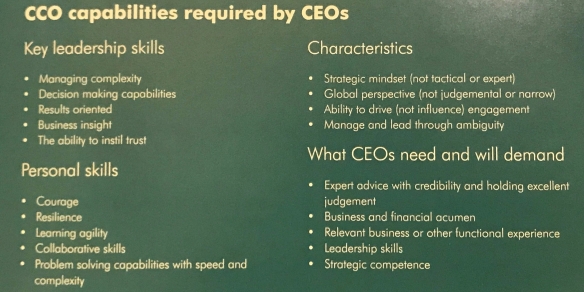
There’s no key findings here (I’ve highlighted the capabilities required by CEOs today in the image at the beginning of the article). However, I do want to pull up one last quote, as it’s particularly apt to the Middle East, where we have an issue with speaking truth to power and instead focusing on political maneuvering inside the organization.
Before that, I’d like to say thank you to the VMA Group for this thought-provoking report, especially the International Association of Business Communicators EMENA board member Willem de Ruijter, for handing the report out to IABC EMENA and pushing this onto the agenda.
“The communications director works in the same room in the building as the secretary of the board – in fact we are all now on one floor, we do not have separate rooms anymore. S/he has full access to everything, no restrictions. S/he is actively involved and is asked to stimulate and to give feedback. Her/his message should be frank when required… and provocative too. S/he needs to be able to tell a senior leader who has worked at KPMG for 25 years that he or she does not possess the correct KPMG vision. That takes a certain character.” Albert Röell, CEO, KPMG NL
This ebook will help communicators understand the how, what and why of internal communications and what it means for their own work.
For far too long, we communicators haven’t done enough to communicate what we do and why we do it. We haven’t put the day job to use when talking about our own value.
With the help of groups such as IC Kollectif, this is changing. The IC Kollectif’s founder Lise Michaud launched an initiative to bring together communications from across the globe, to talk about different aspects of internal communications to help others understand what we do, how we do it, and why.
The result of Lise’s efforts in persuading thirty communicators is an ebook. Named Disrupting the function of IC – A Global Perspective, the ebook is free and covers a wide range of topics, including Changes and Challenges in Internal Communication, the Skills and Knowledge of Internal Communication Professionals, the Impact of Technology on The Profession, the Leadership Role of IC Professionals, Employee Advocacy, the Convergence and Integration of Communication Disciplines, Collaboration Between Internal Communication and Other Disciplines and the Future of the Profession.
I want to draw on the inspirational foreword to the book. Written by Anne Gregory, who has devoted her professional life to promoting the communications profession, the foreword sums up why internal communications matters, now more than ever.
Not only is [organizational life] getting less predictable and the issues that have to be grappled with more slippery, but organisational form is changing too. Companies like Uber and AirBnB are totally different from traditional companies and their disruptive influence means that more traditional, established companies are having to respond in radical ways. Governments, too have to re-engineer the way they are interacting with citizens and this requires huge internal change programmes in the public sector. People want a level of constancy when all around is changing. This is driving a huge focus on organisations reexamining their purpose and values in ways that provide meaning for people who are not only coping with huge organisational change, but who are experiencing all the lack of certainty and turbulence that is present in the world. Organisations are a point of stability for many and at the heart of this is IC. For all these reasons internal communications has come of age, and not before time.
That this volume is available free is testament to the commitment of these authors of IC Kollectif to share their work and thinking widely for the benefit of the global internal communication community. For this, our professional community is deeply grateful.
Firstly, Ramadan Kareem! I know I’m late (it’s the workload), but I wanted to share a guide on how to deal with the media in Ramadan. For those who don’t know, Ramadan is the holiest month of the calendar for Muslims globally. This annual observance of spirituality is regarded as one of the five pillars of Islam, and Muslims fast from dawn till dusk. This also means a shift in work schedules for many, with those fasting working shorter hours.
So, what does it mean for PR in Muslim countries or regions such as the Gulf? Here’s my guide to media relations in Ramadan below.
A season for greetings
It’s usual to receive two sets of greetings during Ramadan. The first is at the beginning of Ramadan, where people wish one another a happy or beautiful Ramadan (we usually say Ramadan Kareem). The second message is shared at the end of Ramadan, for Eid, the festival which marks the end of the month.
The Middle East is a society built on relationships, and it’s no surprise that many PR professionals send out such greetings to media to build their relationship with those in the media. A decade back, I used to receive greetings the old-fashioned way, in paper format. Today, I’m much more likely to receive an electronic version, either shared by email or via instant messenger.
Here’s two sample Ramadan message designs for you.
The start of Ramadan is marked by a crescent moon, and this image is commonly used for Ramadan greetings
Besides the crescent moon, there’s many different images associated with Ramadan. Another common image is the mosque, the place of worship for Muslims.
The Iftar or Suhoor Gathering
It’s also common to invite media to an Iftar, the meal which breaks the fast at sunset. The Iftar and Suhoor, which follows the Iftar later in the evening, are occasions to engage with others. PR agencies and clients will often invite a group of media to dine with them.
What’s great about a media Iftar is the opportunity to meet with and talk to journalists in a relaxed atmosphere, without the need to discuss work. The Iftar and suhoor gatherings are a great opportunity to build relations with key media contacts for an hour or two.
There’s other occasions during Ramadan, which are unique to certain parts of the region. In Bahrain, Kuwait and Qatar, many firms celebrate with their employees or media during a Ghabga, which is a gathering between Iftar and Suhoor. Whatever they’re called in their respective regions, make sure you know these events and how you can use them for media relations.
The Media Working Hours
Many companies reduce their working hours for those fasting (some reduce the hours for all employees). I asked three media people, one in a newspaper, the second from TV, and a third from a magazine, about how Ramadan changes their operations. Their responses are below:
The Newspaper Editor: Working hours do change, and they don’t. My organization reduces hours like everyone else, but reporters must still find stories to fill our pages. The paper still has to come out. We try to reduce the workload but we still have to provide coverage. We’re less demanding on how many stories they file, but since there are fewer press conferences and events, reporters really have to go the extra mile to find people to talk to. Page counts come down slightly on slower news days, but that usually just means fewer international stories for the editors to source. But deadlines don’t change, reporters must still file stories, and the presses still need to be fed. And in the unlikely event that something big breaks… it doesn’t matter if Iftar is in 15 minutes. We want that story. Now, before competition gets it.
The TV Editor: There aren’t many operational changes. Working hours are reduced for those in admin and management positions. For the editorial and operations teams, the hours are the same as outside of Ramadan. The biggest change is that we shift shows around, so the morning show is moved even earlier. Other program timings may change too.
The Magazine Editor: There’s really no change to how we work in Ramadan.
Ramadan Themes
The other major change during Ramadan is a shift in coverage. Top of the list are issues related to Ramadan, such as charity, spirituality and other related issues. A simple example of a charity initiative is shown below.. The Dubai-based Virgin Megastore launched an initiative called Pay it Forward, in collaboration with delivery service Fetchr, to support the Dubai Foundation for Women & Children, which provides protection and support services to victims of domestic violence, child abuse and human trafficking.
Unsurprising, there’s less discussion about certain subjects (think alcohol, conspicuous consumption on luxury goods, and other issues which contradict the spirituality of the month). Many have come up a cropper on this issue, such as the below which was put out by a hotel in Dubai.
Atelier was criticized on social media for its gold-themed Iftar (and for the advert also mentioning alcohol)
Make the most of the holy month
Ramadan is a great time for engaging with media, and building relations. I hope that you’ll enjoy this time of year as much as I do, both for the spirituality of the occasion as well as the opportunity to see media friends.
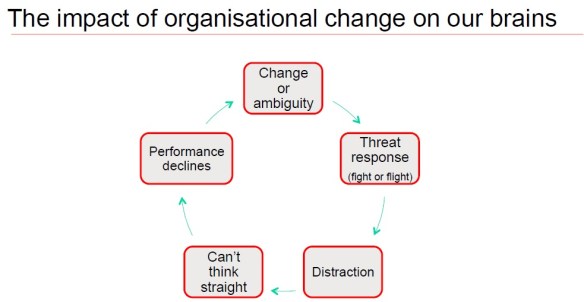
According to Hilary Scarlett, organizational change can often be a stressful experience for most employees, whose performance declines as a result.
I’ve said it before and I’ll say it again – communicators aren’t spending enough time getting their heads around psychology and how it can help us better engage with our audiences (what’s the point in understanding the how of our jobs, if we don’t get the why).
The above reason is why I was thrilled to see a keynote presentation on neuroscience by Hilary Scarlett at IABC’s Eurocomm event recently. Hilary is an expert in the area of cognitive neuroscience; she’s written extensively on how the discipline can and should be used by communicators and management teams, especially during times of change.
I’d like to share key takeaways from Hilary’s presentation, as well as from her book, Neuroscience for Organizational Change (thank you for the gift Jasna!), here, in the hope that these insights will help you manage organizational change.
We’re not Designed for Change
Our brains haven’t evolved at the same pace as our workplaces. As Hilary explained, our brains aren’t designed for 21st century corporate life. Rather, the brain’s goal is survival. We do this by avoiding threats and seeking rewards. However, of the two responses the threat response is much stronger, which explains why there’s so much resistance to change. Our brains are constantly looking to predict what will happen.
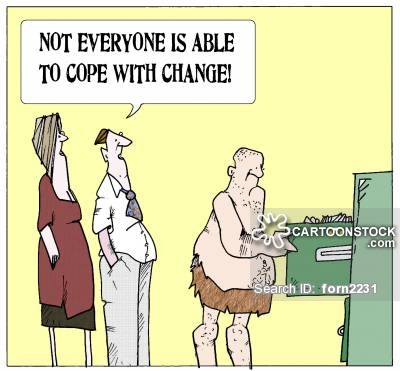
Cavemen in the office? Our brains haven’t developed at the same pace as our workplaces (image source: cartoonstock.com)
But there is neuroplasticity; our brains can restructure, change and learn throughout our life, if we choose to continue developing ourselves (lifelong learning).
We Don’t Like Change
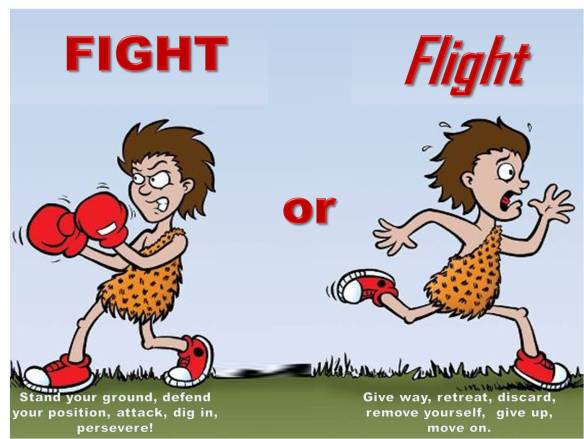
This is a logical extension to how our brains work. We want predictability, which helps with survival. For many of us, organizational change is the exact opposite of predictability, and we see it as a threat. When we see a threat, we switch to a ‘fight or flight’ mentality and think less rationally. We become more hostile in the workplace.
When we feel threatened, we switch to a fight or flight mode. This is especially true during times of change (image source: psychlopedia.wikispaces.com).
The issue of certainty is crucial here. Research shows that we’re more comfortable with knowing bad news, than not knowing anything at all (the don’t say anything to the last minute approach, which seems to be the way many organizations work when it comes to communicating bad news).
We’re also guided by our past experiences, and they shape our current behavior and attitudes.
SPACES – A Planning Tool for Supporting Change Management
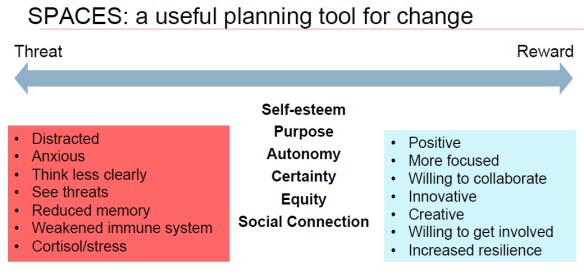
Hilary provides a wealth of good advice on how to support change management. One which I found especially useful was her own planning tool on supporting change. Named SPACES, you can see the visual framework below.
SPACES is a planning tool developed by Hilary Scarlett to help communicators navigate organizational change. The six central elements can either positively or negatively impact on employee reaction during a change in the workplace.
Hilary outlines six key factors that can push people to either see the change as a threat or as a reward. She then outlines the impact that a shift in either direction will have on behavior.
The six elements are:
Self esteem – the feeling of importance relative to others.
Purpose – having a sense of direction, meaning and usefulness.
Autonomy – the perception of having control over events, being able to make choices and having your voice heard.
Certainty – being able to predict what will happen and how to respond.
Equity – the notion of fairness and transparency, especially during times of change.
Social Connection – feeling connected to others, especially as part of a group.
The Role of Communicators in Change Management
The good news is that we communicators have a key role in any change project. People want information, and the sooner they get it, the better it is for their level of certainty.
We need to be the people who provide that certainty, through providing information and positioning change in a way that doesn’t infer what we are doing is wrong.
Some of Hilary’s key suggestions are putting in place regular communications timings (which supports our need for consistency and predictability), supporting the organization’s ability to understand employee insights through engagement and dialogue, guiding leadership on messaging and how to deliver this messaging through visuals and narratives, and creating a sense of purpose for everyone to support.
I’m going to end on this note. if you want to know more, then go out and grab a copy of Hilary’s book, Neuroscience for Organizational Change. You can thank me later!
President Trump and his team have shown increasing disdain for the media during their first weekend in office. Some commentators have drawn parallels to my own region (image source: Vocativ)
If the first two days were anything to go by, we’re in for four years of presidential reality TV. From the spectacle of the inauguration of the 45th President of the United States to an impromptu press announcement at the White House (there were no questions, so I won’t call it a briefing), and news interviews by White House staffers attacking the media; all of these events have made for compelling viewing.
Looking in from the outside, here in the Middle East, none of these actions should surprise or startle me. I live in a region where the words media and propaganda are often used to mean the same thing in the Arabic language by the region’s population. I’ve also heard many commentators in the region (and in the US) compare what the Trump administration is doing with the media to how regimes such as Iraq’s Saddam Hussein ‘communicated’ (if you want an example, just watch this clip from Saddam’s Minister of Information Muhammed Saeed al-Sahaf during the 2003 Iraq invasion – the link has been updated).
While there’s been much laughter at some of the messaging (the phrase “alternative facts” is my vote for the dictionary addition of 2017), I’ve seen a number of worrying signs that the Trump Administration wants to take the media and the public down a path that we’re all too familiar with in the region. Here’s why.
Delegitimize the Media
The first step on this road is silencing critics. And those who have been most critical of President Trump are the media. During the weekend when visiting Langley, the CIA’s headquarters, he uttered the line, “The reason you’re my first stop is that, as you know, I have a running war with the media. They are among the most dishonest human beings on Earth.” This was in part due to their coverage of the Presidential Inauguration, and their rebuttal of the claims on the number of attendees.
This isn’t a new statement. President Trump has made the claim numerous times, including in April 2016 when he said, “You know we have a great time considering the subject matter is no good. Right? But when we say—look at all those hats, right?—”Make America Great Again.” When we say that—you know somebody, a reporter—by the way the world’s most dishonest people are back there. Look at all the cameras going. Look at all those cameras. It’s unbelievable. They are dishonest. Most of them. Not all of them. But Most of them.”
And, here he is on camera saying the same thing (the link has been updated).
The reasoning is simple. American media is independent of any government ownership, and as such it often takes politicians to task for their words and deeds. By delegitimizing the media and going straight to the public through social media (mainly Twitter), President Trump and his administration won’t face the same level of intrusive questioning. The administration has already threatened to hold the media to account, and President Trump has held one press conference since July 2016, during which he claimed CNN and Buzzfeed were fake news sites. A free media is an essential tool to hold governments to account; muzzle the media, discredit them, and you’ll face fewer questions from a diminishing press sector.
Trump uses Twitter as a tactical weapon, hitting out at opponents, and directly countering attacks.
Tweets are literal, short and direct. He uses capital letters, single words and repetition for effect. There can be no uncertainty in the content or context of a message, and he seldom entertains any further discussion.
It’s an approach is known as the dead cat, created by political strategist Lynton Crosby. His response to losing an argument was to throw an issue, known as a dead cat, on the table.
The appearance of a dead cat, albeit metaphorical, is shocking. It quickly shifts attention, forcing opponents to move on and focus on a new issue.
And then there’s a concept called the Overton Window. Developed by political analyst Joseph Overton, this is a spectrum of views which are deemed acceptable to the public. It also explains how a theory of how a policy that’s initially considered extreme might over time be normalized through gradual shifts in public opinion.
There’s a similar theory in marketing. Known as the Anchoring Effect, this describes a common human tendency to rely too heavily on the first piece of information offered (the “anchor”) when making decisions. Once the anchor is set, decisions are then made by adjusting around the initial anchor, regardless of the legitimacy of the actual anchor number. For example, a brand will introduce a new, super premium/expensive toothpaste. That new product will shift perception of the whole category, and push consumers to spend more on toothpaste by choosing the second or third most expensive option.
We’re seeing this use of the Overton Window and the Anchoring Effect in US politics today, with politicians introducing extreme ideas to shift the discourse away from the mainstream and towards their own views and beliefs. They’re changing the narrative over the long-term, to make what was once unpalatable an acceptable argument.
These narrative tactics have been used in countless societies, most recently in countries such as Israel, where the public has accepted once right-wing ideas such as the expansion of settlements. It’s clear that President Trump’s team aren’t interested in answering questions on issues such as the Affordable Care Act, but rather they want to change the narrative around “Making America Great Again”, an idea of little substance but great appeal. We’re used to such efforts in the Middle East (Saddam regularly compared himself to great Iraqi heroes from history, as a means to encourage nostalgia and promote similar ideals).
Create a Cult of Personality
It’s also clear that President Trump has a thin skin. He’s repeated countless theories and statements about winning the popular vote (the President claims, without any evidence, that he lost the popular vote based on mass voter fraud). And then there’s the debate around the Inauguration attendance. This President takes things personally. He sees himself as a nation strongman who will change US politics for the betterment of its people. And woe betide those who disagree with him.
What’s also remarkable is how his team speak of the President. During the CIA visit at the weekend Vice President Pence introduced the President by informing the audience that he had never met anyone “who is a greater strategic thinker” on matters of national security. The White House Chief of Staff Reince Priebus said on Sunday that, “I’ve never seen anyone work harder or have more energy than this president.”
If you were to listen to the administration’s messaging, you’d think President Trump is a superman, an Übermensch from the pages of Friedrich Nietzsche. The Chicago Tribune’s Steve Chapman points out the folly in their praise, but how many will believe the fawning praise? And where will this lead us to? Will we see the White House building a cult of personality around the President?
As a person who straddles both Eastern and Western cultures, I can see the successes and failures of these societies a different clarity. I admire the US for its freedom of speech (which is enshrined in the Constitution) and for its media industry. I’m also a believer in public debate when it comes to governance. Are the past couple of days a sign of things to come in the US? I hope that I’m mistaken, but over this first weekend of the Trump Presidency I have seen parallels between the two regions when it comes to media messaging. And this isn’t what I want to see for the US. I hope I’m wrong.
The past 18 months has been a remarkable time for crisis watchers. We’ve watched as global brands and leaders have become embroiled in crises. Some of these have been of their own making (think Sepp Blatter and FIFA, or Volkswagen and emissions). Others have been due to unfortunate circumstances, such as with Emirates flight 521.
As communications professionals out there know, there’s nothing like working on a crisis. In an excellent piece for the Financial Times by David Bond, Rupert Younger, director at the Oxford University Centre for Corporate Reputation, sorts crises into two basic definitions – a crisis of competence or a crisis of character. To quote from the piece:
Examples of competence scandals include Toyota’s 2009-11 recall of 4m of its cars because of defective accelerator pedals, or the battery defaults on some of Boeing’s Dreamliner aircraft. These, according to Mr Younger, can deliver a direct, and in some cases short-term, hit to a company’s sales figures.
A character crisis calls into question the culture and behaviour of a company and its senior executives and often arises out of media scrutiny or criminal or regulatory investigations. Fifa and News International were both crises of character.
The worst type of crisis involves both. The BP Deepwater Horizon oil spill in 2010 is a case in point. It was triggered by a disastrous oil rig explosion that called BP’s offshore drilling competence into question. But the company’s response turned the crisis into a far wider issue of trust.
As communicators, our roles have traditionally covered managing the fallout from a crisis. However, whether we like it or not (I hope the former), we’re also becoming the conscience of our organizations. It’s incumbent on us to speak up when we hear about or see an issue that could harm an organization’s reputation. This is easier said than done. Volkswagen is a great example of a crisis of character – dozens of VW employees must have known about the manipulation of data, and yet no one spoke up (or, if they did, the information didn’t get to the right people).
To tackle such a crisis, communicators need to work with executive management to create an ‘incident aware culture’. Employees should feel that they can report issues without reproach or fear of retaliation. Employees also need to feel that they’re working for and in an ethical organization that cares about doing the right thing. This requires continuous communication from and engagement by the board and management, as well as support from legal and HR teams. If things do go wrong, communicators and management need to proactively engage with stakeholders to explain what has happened and why, a strategy known as stealing thunder. This is best defined as an organization “breaking the news about its own crisis before the crisis is discovered by the media or other interested parties” (Arpan & Roskos-Ewoldsen, 2005).
Unfortunately, as has been noted by academics such as An-Sofie Claeys, this type of self-disclosure is rare in practice. As with the case of VW, organizations are tempted to conceal the crisis rather than make it public.
Crises of competence are easier to deal with. However, many of us still aren’t prepared for what happens when this type of crisis occurs. Here’s a simple crisis communications assessment grid developed by the communications team at US firm Timken, which establishes crisis severity based on the type of incident and the involvement of various stakeholders, as well as who needs to be involved.
For my third guest post this week, I’ve asked internal comms specialist Kevin Ruck to weigh in on the link between good internal communications, employee engagement and customer service. Kevin Ruck, who is a founding director of PR Academy, initiated and designed the internal comms qualifications accredited by the Chartered Institute of Public Relations. Kevin is a regular speaker and author on all aspects of internal comms. He can and should be followed on Twitter at @AcademyKev. Over to you Kevin!
Guest post – Communication, Engagement and Excellent Customer Service
As exceptional levels of customer service become more commonplace and enable organisations to thrive in challenging times, poor and mediocre service are increasingly noticeable. And in this ‘age of outrage’ customers are likely be more inclined to call out poor service in a very public way.
So how can organisations find ways to ensure that customers love what they do? In this post, I reflect on my own experience as a customer service manager and consider how internal communication might be one way to underpin a customer service oriented culture.
I spent many years early in my career dealing with complaints about poor telephone service in the UK. This was back in the 1980s when most telephone exchanges were mechanical (not digital like today) and the state of the line plant was fairly poor, resulting in lengthy delays to repairs and ongoing problems. Anyone remember crossed lines?
Dealing with people who complain is a very demanding job. No organisation will always get everything right, but it’s how customers are treated when things go wrong that matters. Even back then we realised that turning round a dissatisfied customer could be very beneficial for business. This often entailed doing something unexpected or behaving in a way that showed that you really cared.
I ran a great customer service team and we had to resolve some pretty tough problems. However, Shep Hyken, a US speaker and author says that ‘Customer service is not a department, it’s a philosophy’. And he’s right. But if this is true, it begs the question ‘what is a philosophy of great customer service like?’ In an article for the Huffington Post, Doug Sandler provides five tips. These include:
Respond quickly on social media
Anticipate what customers want
Be honest and have a perspective
Take responsibility and own up to any errors you or your company has made
Be positive and listen
All good points. I also like the example of British company, Brilliant Bikes, who state that ‘We look for ways to help cyclists get more from their bike. If a customer turns up at the shop early, we open early. When someone phones, they get a human’. This exemplifies a sense of purpose within the business that is translated into customer service.
So, how can all organisations get these approaches embedded into what they do?
This is a tough question. One that many academics and CEOs have grappled with for many years. I’m not going to provide a personal five point listicle in this post. That would imply that there’s a simple solution which patently there isn’t, otherwise excellent customer service would be ubiquitous. Instead, I will set out how two broad principles for internal communication are important for a strong customer service culture.
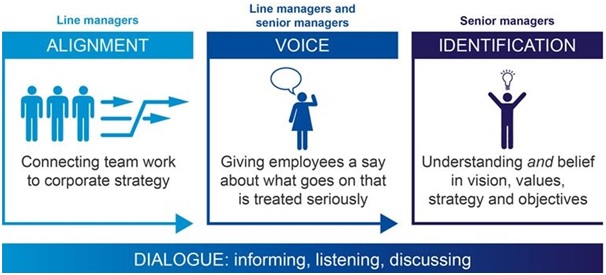
In my PhD research, I found that internal communication that is focused on keeping employees informed and employee voice is likely to lead to higher levels of organisational engagement, including what employees do to help the organisation succeed. Good internal communication is a strong enabler of an organisational culture that leads to engagement. And there’s little doubt that engagement and customer service are connected – as reviewed in an Engage for Success report in the UK. Organisations that adopt what I’ve called an AVID model of good internal communication practice (see below) are likely to develop a culture whereby employees trust senior managers and feel a strong sense of belonging. Feeling informed, feeling that it’s safe to voice opinions that are treated seriously and feeling that senior managers care about everyone makes employees feel valued. And this can, in turn, enable employees to bring their whole self to the work that they do – including the service provided to customers.
One employee said to me that she could tell when a senior manager was listening to her when she noticed that he ‘was smiling but not with his eyes’. In the same way customers can tell when an employee genuinely cares for you as a customer.
An AVID model of good internal communication
The AVID internal communication engagement model
Some CEOs, such as Vineet Nayar at HCL Technologies, go as far as to say that the best way to provide great customer service is to put employees first. As Nayar explains, ‘The first thing that you need to do is create an environment of trust where the employees believe what you are saying and are willing to follow you wherever you are going’.
This focus on employees is also highlighted in a new approach to leadership, known as ‘responsible leadership’ which incorporates four dimensions; sustainability and the environment, risk analysis, care for employees and monitoring of subcontractors (italics added).
So, great customer service can be generated through responsible leadership, communication and engagement. It requires systemic approaches to communication where senior managers take their communication role seriously. That’s why it is hard to achieve. But get it right and organisations will thrive in a 21st century service centred economy.
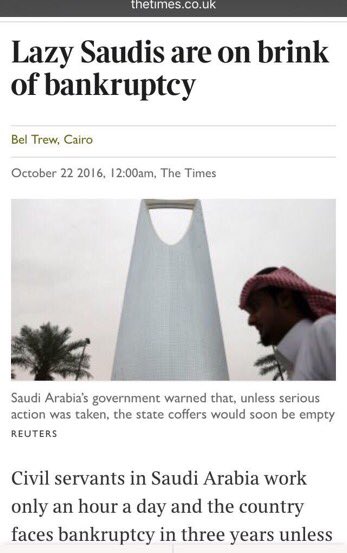
Saudi’s social media scene has been on fire over the past week due to a number of controversial issues regarding government officials. This is a news story from the Times on a comment made by a minister regarding Saudi inefficiency.
One of the campaigns began after a government document was leaked online, with personal details including name, position and salary. It’s only logical to assume that many government officials in the Kingdom are angry at seeing their pay cheques shrink; they’ll become even more angry when they see what they feel to be others not doing the same. In this environment, it wouldn’t be hard to also imagine officials being able to take a picture via their smartphone of a document which may reveal an embarrassing situation and then sharing it via social media (or, more likely, dark social).
I had the pleasure of listening to a senior Saudi journalist this week. He made a pertinent point when he said, “We can spend billions on consultants. We could have spent millions on a PR agency to convey the message behind the cuts and why they were necessary.”
In times of hardship, good communications becomes even more important. Saudi’s citizens need to understand the logic behind government decisions. They need to feel that they are engaged and are part of the debate. And they need to see government’s leadership doing just that, namely leading by example (as I’ve said before, actions are much more powerful than words in shaping perception).
We may see more issues coming to light in the Kingdom over the coming months, and more skeletons being revealed in government closets. When it comes to the government’s engagement and communication with its people, the transparency, clarity and consistency (or lack of) will either help get many Saudi citizens on board, or it may alienate them further. I for one hope it’s the former, rather than the latter.
I’ve been fortunate in my career to have worked with some amazing brands and organizations. In particular, the most forward-thinking have focused on the issue of sustainability. It’s become a passion for me, as I want my daughter to inherit a world that is better than ours.
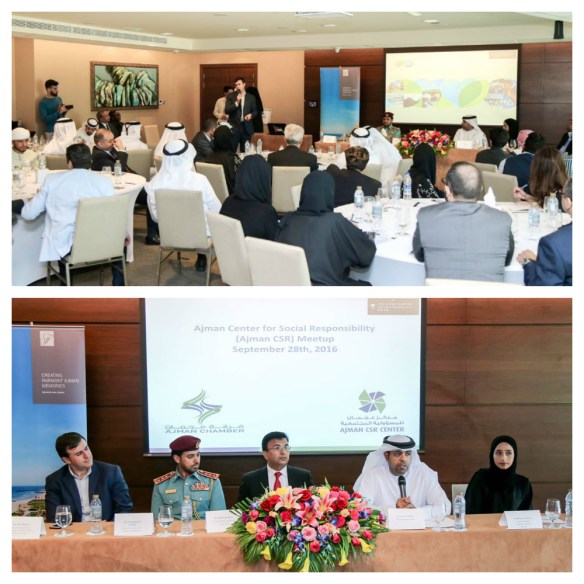
I’m often asked to support events on sustainability. One such initiative which I’m very proud of being able to help is that of the UAE’s Ajman Center for Social Responsibility. Launched by the Ajman Chamber this year, the Ajman Center for Social Responsibility aims to promote the concept of sustainability for both the public and private sectors as well as create a resource for sustainability across this emirate. Assisted by the consultancy firm Sustainable Square, the team at the Center have set for themselves a vision of becoming the regional and global reference for social responsibility and sustainability practices. And, judging by the energy they have, I feel they’ll reach this goal.
For many of us communicators in the Middle East region, we’ve taken on the mantle of championing sustainability. Sometimes it’s due to reputational reasons; the need to be seen to be doing good. For others, it’s been about the willingness to tackle an issue that isn’t going away. There’s some confusion around sustainability and the role of communications in the Middle East; I remember well one senior comms professional erroneously commenting during a public meeting that the function has always been with communications, despite all of the literature from the 1950s and 1960s by Bowen, Freeman and others which argues that organizations have a social obligation to “to pursue those policies, to make those decisions, or to follow those lines of action which are desirable in terms of the objectives and values of our society.” In short, when it comes to sustainability in the Middle East, we can come across as a confused bunch.
For me, sustainability should be at the heart of any organization – it should be a part of every person’s job function. So, what is the role that communicators should play? We are the change agents, the people whose job it is to tell stories around purpose, and who can best use engagement to win over various stakeholder groups, be they internal (employees, management or shareholders), or external (government, NGOs or the public) as to why there is a need to become more sustainable and how we should get there.
Examples of good sustainability communications work are both global and local in nature. Take for example the work done by Mars for its M&Ms brand. Mars reached out to the M&Ms consumer base in a smart way, by using the M&Ms characters everyone knows, to talk about initiatives around sustainable cocoa production and other CSR causes by telling the stories through the same M&M characters used to promote the brand.
On a local level, a good communications campaign can be something as simple as promoting safe driving, which environmental and engineering consulting services firm CH2M launched both globally as well as locally.
As communicators, our role is to understand our audience(s), know how to engage with them, and shape messaging that will impact both attitudes and behaviours. It’s never easy to change habits that have been ingrained for years, especially when it comes to sustainability (anyone who has worked on a recycling initiative will know how hard it can be to get people to recycle rather than throw materials into the trash).
However, that’s the beauty of our job as communicators. We’re the front line, the people who take a concept and make it happen with those groups whom we need to come on board. To quote from the United Nations Environmental Program:
Public communication has a key role to play to build on these emerging trends and to make sustainable development approachable and understandable. Informed, motivated and committed people can help us to achieve our sustainability goals. However, communicating effectively about sustainable lifestyles is a challenge. One needs to consider not only what to communicate, but how to communicate it.
Important factors of success include content, messenger, choice of media and tone. Experts are coming to realise that traditional messages from governments and green groups urging the public to adopt the environment into their day-to-day decisions need to be overhauled. Many of these messages are simply too patronising, guilt-laden or disapproving. Instead of turning people on to the environment, they risk switching
them off. The lesson to be learned is that communication styles have to be positive and tailored to different circumstances and cultural contexts.
If you want to know more about communicating sustainable issues, there are people who specialize in this issue. Sustainable Square’s Monaem Ben Lellahom is a great person to approach as he both understands the issue of sustainability as well as how to communicate around it; another person who focuses on sustainability is Stephen King, who focuses on the sustainable development goals. I’d urge you to reach out to either or myself to ask questions about how we can communicate sustainability better in this region.








 Alex of Arabia's Blog