Should executives say sorry? Just Falafel’s ‘we forgot about the food’

Do you agree or disagree with what  Mohamad Bitar did, and why?

Do you agree or disagree with what Mohamad Bitar did, and why?

Should we admit when things don’t go the way we planned? It’s a tough one. Few corporates hold up their hands when plans go awry (unless there’s a crisis of biblical proportions). US-based corporates such as Walmart are now taking on media outlets to argue their point (this post from Walmart is a remarkable example of fighting back).

Even fewer company bosses in the Gulf go off track and talk from the heart. However, as with everything there are exceptions. Just Falafel is often touted as a home-grown success story, a tale of how a local brand has become global. Founded in 2007 in Abu Dhabi, the falafel-focused outlet has approximately 52 stores in 18 countries according to its website.

However, the chain isn’t to everyone’s tastes. A news story on the English-language website Arabian Business which announced the reasons for the departure of the chain’s former CEO Fadi Malas was used as a comment board by readers to explain their reasons for not liking the brand’s falafel.

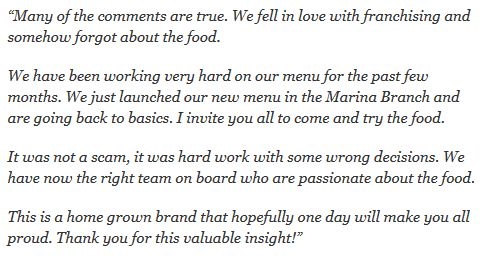
Fair enough you may say. But what followed was either inspirational or horrifying depending on which side of the open/control communications fence you’re on. The Just Falafel founder and MD, Mohamad Bitar, took to the site’s comments section to explain how the company had “forgot about the food”.

The comment as written by just Falafel's Bitar on ArabianBusiness.com

The comment as written by just Falafel’s Bitar on ArabianBusiness.com

The hacks at Arabian Business then took Bitar’s comments and span out a new story, to which readers took to explain what they believe went wrong and how Just Falafel can put it right.

For some consumers, an admission of error can be a powerful tool to reassess and re-engage with a brand. For others, it’s all about projecting an image that others can believe in, and not deviating from that message. Is Mohamad Bitar’s message a moment of genius (if we were in America, I’m sure we’d be calling his move crowd innovation), or does it signal a need for someone to crack the whip at the brand and get everyone on message?

Your thoughts?

Thinking of drinking and driving? @TimHortonsGCC criticized by Dubai Police for social media blunder

There’s a fine line between engaging and offending online. The popular Canadian coffee shop chain Tim Hortons got into trouble this week with a post which went on on its @TimHortonsGCC Twitter account and its Facebook page.

The post below went online on the 14th of this month. Almost immediately after posting, the picture was attacked by the brand’s followers as being inappropriate and encouraging dangerous driving.

Do you drink and drive? The image from Tim Hortons GCC was criticized both by fans and by the Dubai Police (image source: http://www.7daysindubai.com_

Even worse for the brand, drinking and eating whilst driving is deemed as an offense by Dubai Police. The social media team’s image was in contravention of the Emirate’s laws. You pretty much know you’ve boo-booed when the police tell you off.

Speaking to local English-language newspaper 7Days, Dubai Police’s Colonel Saif Muhair Al Mazroui explained following such advice could risk lives on the roads.

He said: “Any motorist who doesn’t pay attention to the road is endangering the lives of others. Eating or drinking inside the car while driving is prohibited as it might cause accidents when the motorist gets busy and doesn’t focus on the road.”

Tim Hortons GCC did pull down the advert after it was posted and the CEO issued an apology shortly afterwards. Santhosh Unni explained that the image “was meant to reflect a common consumer behaviour pattern. We do not promote reckless driving and request our customers to always be careful on the road.”

However, brands need to think twice particularly when the issue of safety is involved. The Tim Hortons GCC Twitter feed and Facebook pages haven’t been active since the posting, which may suggest the brand is having a second look at how it manages its social media. The next time you think of drinking and driving, remember Tim Hortons GCC.

#HappyDubai and the times when you need a good community manager

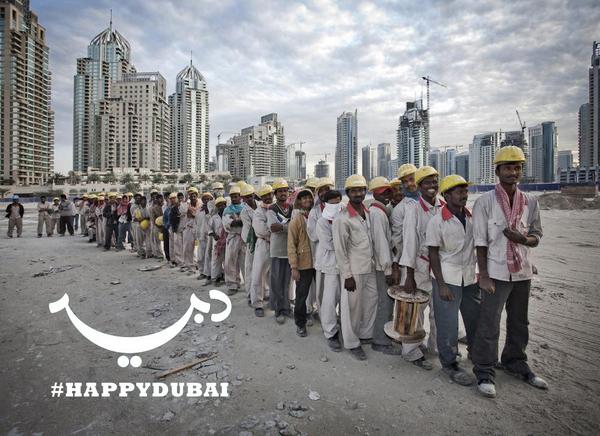
If you were working on #HappyDubai would you view this image positively or negatively?

If you were working on #HappyDubai would you view this image and the associated Tweet positively or negatively?

First we had the successful #MyDubai initiative. Now, we have #HappyDubai which was launched last week by Dubai Municipality.

According to an article in Gulf News residents can now share positive experiences regarding municipal services through the Happy Dubai initiative. They can post comments and pictures using the #HappyDubai social media hashtag. The feedback will spread through Twitter (@myhappydubai) and the happydubai.ae website. The feel-good initiative, launched on Tuesday, aims to highlight civic services of the Dubai Municipality and feedback from stakeholders.

“With the Happiness Map, we are aiming to track conversations around #HappyDubai and where they are coming from. In time, it will become an interesting reference point to identify areas in Dubai that are the favourite #HappyDubai places for residents,” the municipality told Gulf News.

“This phase of the campaign allows residents to send us their comments and feedback through the website. Residents can also get in touch with us via other touch points including Dubai Municipality’s social media presence, our 24-hour contact number 800900, e-mail us at info@dm.gov.ae or visit our centres around the emirate.”

Here’s where it gets more complicated. The beauty of the #MyDubai campaign is that its objective – the public are asked to share their own experiences of Dubai, without a spin and without a filter. #HappyDubai is subjective, and one of the aims of the Happy Dubai campaign is to make Dubai one of top 10 happiest cities in world by 2021. Dubai’s residents are being asked to share their happiness with Dubai Municipality and the city in general. Rather than engaging in a dialogue, they’re being asked to take a specific emotional stance which is a much riskier strategy.

Hussain Nasser Lootah, director-general of Dubai Municipality, said: “Various initiatives and the projects adopted and executed by Dubai Municipality in different fields give the emirate its unique style which makes it ‘stand out’ among the most developed cities in the world.

“The UAE has been ranked 14th in the happiness index set by the Global Initiative of the UN. Our goal is to spread happiness among the population of UAE and by 2021, Dubai would like to be one of the top ten happiest cities.”

The worst thing that can happen is for the campaign to be hijacked. This isn’t new, and even brands such as McDonalds have had to pull campaigns due to consumers not reacting as they’d hoped (a great example is #McDStories).

There’s a lot to love about Dubai and the campaign launched by Dubai Municipality (the microsite is a great feature, especially the #HappyDubai map), but not everyone feels as strongly about #HappyDubai as the people behind the campaign. One “David Brown” tweeted repeatedly about the issue facing labourers in the Emirate with the hashtag #HappyDubai. See the below for one Tweet, including a link to a site about alleged human rights abuses in the GCC and the image Photoshopped with the #HappyDubai logo.

Could it get worse? Well, yes it could do if your community manager misunderstands the point being made and then retweets the original message. The follow-up is even worse (unless I’m missing the irony).

The lesson is simple. Before a campaign is even launched whoever handles social media needs to understand the various viewpoints that may be coming his or her way, both positive and negative (the same is also true of the whole organization). There should be talking points and message tracks in place for any negative sentiment. This is especially true of a campaign such as #HappyDubai which takes a subjective stance on people’s emotions towards a specific issue.

And more than anything else, if you can’t spot a negative comment and you work in social media, you need to find a new industry to work in.

Will Huffington Post’s entry into the Gulf be a game-changer?

How will the Huffington Post affect the Gulf’s media landscape? We’ll find out early next year. (image source: http://www.aim.org)

Being in the Middle East’s media sector can often feel like waiting for a bus. You can wait for years for a new launch (post-2008 in any case) and then all of a sudden you have two of the world’s largest news portals announcing expansion plans. First we had Buzzfeed, and now we have the Huffington Post. The local site Doha News broke the story earlier this month. According to the piece, the site will be partnered by the former director general of the Al Jazeera Media Network Wadah Khanfar and his media firm Integral Media Strategies.

The site will be in Arabic and will launch early next year. HuffPost Arabi, as it will be known, will be based in London. HuffPo founder and editor-in-chief Arianna Huffington is quoted by Doha News as saying the site would “bring more Arab voices into the conversation and deepen the world’s understanding of life in the Arab world, from its problems to its accomplishments to its untapped potential.”

The site will include a combination of aggregation, blog posts from a wide variety of sources and original reporting from HuffPo reporters and Khanfar’s team.

Launched in 2005, the original Huffington Post redefined online media by working with bloggers to aggregate news. The site was the first online news portal to win a Pulitzer and was sold in 2011 for 315 million dollars to AOL. Besides English, the Huffington Post is published in French, Spanish, Italian, Japanese, German, Portuguese and Korean.

However, how will the Arabic be received? Firstly, Khanfar was one of the driving forces behind the success of Al Jazeera. However, with him at the helm HuffPost Arabi is likely to be persona non grata in many of the Gulf states due Al Jazeera’s implied support for Islamist groups and perceived interference in the internal politics of governments across the region.

In addition, much of the dialogue that the Huffington Post is looking to encourage in the region can already be found online on social media. With its base in London, five thousand kilometers from the Gulf, how will the HuffPost Arabi be able to distinguish itself in a crowded media landscape that is government controlled? I can’t wait to find out.

Changes in the Region’s Media Scene – BuzzFeed in, Dubai One is out, and we say goodbye to Iain Akerman

In the spirit of Ramadan, here’s a BuzzFeed cat meme to get us all excited! (image source: BuzzFeed)

The summer is traditionally a quiet period for the region; the same goes for Ramadan. This year seems to have been the exception to the rule. First, we had Gulf News reporting that BuzzFeed is considering opening an office in the Middle East. The website publisher, famous for its kitten memes and political coverage, apparently sees an opportunity in Arabic with a local audience, according to the piece written by Gulf News’ Alexander Cornwell.

BuzzFeed, the news and entertainment website best known for its pictures of cats, wants to expand into the Middle East with the launch of an Arabic website.

Launched in 2006, the United States website, which is steadily increasing its hard news content, has already launched UK, Australia, France, Brazil and Español (Spanish) editions. Since November 2013, the website has seen more than 130 million unique monthly visitors, of whom 30 per cent are from outside the United States.

Scott Lamb, Vice-President of International, BuzzFeed, told Gulf News in a phone interview that the Middle East is one of two regions where BuzzFeed is most interested in expanding to.

“There is nothing like BuzzFeed in the Arabic-speaking content,” he said…

Lamb said that there is no set date for the launch of the Arabic language website and that it would have to wait until next year after Germany and India, indicating that the finer details are yet to be worked out.

Asked where BuzzFeed would base its regional operations given that many major international media outlets have set up bureaus in Dubai in recent years while Beirut and Cairo are seen as more traditional regional hubs for news bureaus, Lamb said that it had not been decided.

“We’re not that far down the road,” he said, “We have a fairly big office in London. One possibility would be doing a lot of the coverage from there. But if we were to set up in the region, we would want a physical presence.”

BuzzFeed New York office produces much of its Spanish content.

BuzzFeed started producing hard news content in 2012 with coverage of the US presidential election. Since then it has hired Miram Elder, recruited from The Guardian, as its Foreign Editor.

Internationally, BuzzFeed has had reporters on the ground covering Syria, Iraq and Ukraine. Elder has also led coverage of two topics that are heavily discussed on social media, women’s rights and lesbian, gay, bisexual, and transgender (LGBT) issues.

“We saw this very vibrant conversation around the news in those two spheres [and so] we wanted a team to create original content,” Lamb said.

BuzzFeed plans to continue to increase the amount of hard news content, but Lamb said it would not be stepping away from the traditional social media friendly content of cute cats and quizzes that it is still best known for.

“Ideally, we are looking for a 50/50 mix … we try and keep it very balanced,” he said.

As if the thought of cat memes alongside Arabic-language LGBT news wasn’t enough, the second piece of news was the closure of Dubai One, the English-language television station run by Dubai Media Incorporated (DMI). The channel, best known for programmes like HerSay and Out and About, will lay off 80 percent of its staff as reported by Arabian Business.

Dubai One was created to cater to expatriates in Dubai and the wider region. The channel has fallen behind the likes of satellite provider OSN and the Saudi-owned giant MBC.

Sarah Ahmed Al Jarman, the general manager for Dubai One, told Arabian Business via email that “we have stopped our 4 locally produced shows”, without elaborating. Al Jarwan also referred any further questions to the DMI inhouse public relations team.

And last but not least, we have to say a sad farewell to the Editor of Campaign Middle East, Iain Akerman. Iain was spoken of by those in the creative and media sectors as a journalist to be both feared and respected – he’d chase his sources for breaking news and he’d often champion investigative journalism. I once remember talking to one agency head who referred to Iain with a pained expression. Iain, I wish there were more like you here. You will be truly missed.

What communications lessons can we learn from Arabtec’s leadership and stock crises?

No investor wants to go through a crisis, but by letting others fill the information vacuum with their facts and thoughts you’ll be prolonging the stock market collapse (image source: http://www.people.opposingviews.com)

For those based in the Gulf and with an interest in communications, the last couple of weeks has been a remarkable story. We’ve watched as the region’s largest construction firm by market value has staggered from one crisis to the next. In less than two months, Arabtec lost over two-thirds of its value – the company’s stock price hit a peak of 7.4 Dirhams on May the 14th and fell to a nadir of 2.61 Dirhams on June the 30th – as well as its CEO and a number of high-profile executives. Where did it go wrong for a company that stated it wanted to be one of the top ten builders in the world?

Undoubtedly, the company’s strategy of transforming from a contractor to a developer and of geographic and sector-based expansion hasn’t paid off during the reign of its previous CEO, the 37 year-old Jordanian Hasan Abdullah Ismaik, who looked to expand the company into the oil and gas and transportation sectors. Ismaik oversaw a US$40 billion dollar agreement with the Egyptian government to build homes in Egypt, and, in a strange move for a Gulf-based contractor, a regional sponsorship agreement with Abu Dhabi-owned Manchester City.

Things began to go drastically awry when rumours spread that Arabtec’s largest shareholder, Abu Dhabi’s Aabar Investments, had reduced its stake in the company. At the same time, the CEO Ismaik had built his stake in the company from 8 per cent all the way up to 28.8 per cent. The story is best told by two reporters at The National, Frank Kane and Hadeel Al Sayegh.

There are some obvious communications lessons to be learned from the Arabtec story, which I hope other companies in the Gulf region will study long and hard.

1) Communicate proactively, stop the rumours: Information on share ownerships seemed to have been leaked out to the market before any announcement by Arabtec itself. While Arabtec didn’t break any rules in terms of non-disclosure, the company could and should have taken a much more proactive stance to explain the share movements made by Aabar Investments, an Abu Dhabi government-owned investment vehicle, and the CEO himself. What was inexcusable was a lack of clarity following a “temporary system glitch” at the Dubai Financial Market, which erroneously reported a drop in Aabar’s stake in Arabtec from 18.85 percent to 14.32 percent. The rumours took over, and filled the void left by a lack of information and analysis.

2) Use the right channels to communicate: As Arabtec’s share price dropped, the CEO announced he was quitting his role. With the stock still heading south, Ismaik announced his resignation. However, this wasn’t announced by the company through a statement to the media or to the stock exchange, but rather by an interview with a newspaper. Again, while Ismaik or Arabtec didn’t break any of the Dubai Financial Market’s rules (which must be reviewed after this sorry debacle), the fact that he announced it himself struck the wrong tone and sent out signals to investors that something was wrong. No information has been forthcoming on his own 28 percent stake in Arabtec, apart from he is willing to sell.

3) No matter the mess, get your story out there: As soon as Ismaik was out, so too were many of his executive management. The company’s head of mergers and acquisitions, Shohidul Ahad-Choudhury, was fired, as were hundreds of employees, including numerous managers. The only comments in the stories that followed were from analysts who were asking, quite rightly, what is going on. It would take eight days before Arabtec would respond to the media at a press conference.

4) Don’t lose your communications team: Whether you like their advice or not, your communications team are essential in a crisis. According to what I’ve been told, Arabtec lost both its head of communications as well as its agency during the past two months. Arabtec’s management should have moved to stem the rumours and controlled the narrative before taking any action re the communications setup, which I hope would have included a more active social media approach (Arabtec’s last tweet from its @ArabtecHolding account was in March).

Reputations that take years to build can be destroyed in a matter of moments in today’s era of information. There’s little excuse for any listed company for not sharing information with shareholders, especially during a crisis. Arabtec has since recovered some of its share value, but the company still has a long way to go if it is to win back investors. Communications is vital to this process. Let’s hope that Arabtec’s new leadership are able to learn some lessons from the past two months, and proactively engage through a systematic communications approach, with strong narratives that lead nothing to the imagination of their investors.

Getting the timing wrong when communicating – MBC’s NYT mishap

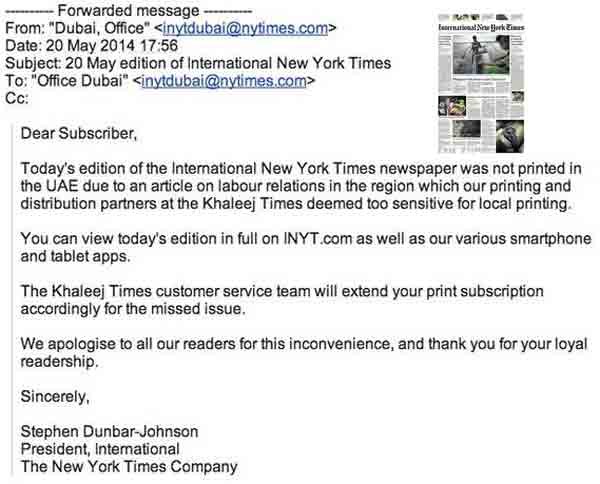
The timing of the decision not to print the New York Times in the UAE couldn't have been worse for MBC's Al Ibrahim

The timing of the decision not to print the New York Times in the UAE couldn’t have been worse for MBC’s Al Ibrahim in light of his comments on local press freedoms

Despite what you’ve been led to believe, there are lots of mischief makers in the Gulf – there’s even a handful in the United Arab Emirates. These naysayers were online last month and poking fun at the chief of the largest satellite broadcast group in the region, the Middle East Broadcasting Group, after he announced that Dubai offers “complete press freedom”.

Sheikh Waleed Al Ibrahim, chairman of MBC Group, told journalists at the Arab Media Forum that the Emirate offered complete press freedom in a region where the media is heavily regulated by government. To quote from Arabian Business.

“We launched the Middle East Broadcasting Centre (MBC) Group as a pan-Arab media in 1991 in London – to be able to exercise freedom of the press – as most Arab countries were not open to the idea of press freedom.”

“It was an uphill task initially. However, we remained committed to develop quality contents for the Middle East audiences. We tried to enter Egypt and the government did not let us enter to protect the local television channels. However, when an invitation came from Dubai, we started to engage with Dubai government. Initially, I was reluctant to relocate as we might have to compromise on the content – fearing that we might become subject to censorship and interference. Since then, we were never asked by the government how we run our business and why we do what we do. There has been no government interference on our programme.”

So far, so good. But, as pointed out by comments underneath the Arabian Business article the New York Times was pulled from the publishing presses in the UAE by its local, government-owned partner due to an article printed in the newspaper on labour rights at New York University Abu Dhabi.

While Al Ibrahim’s comments may be spot on, the timing of the New York University Abu Dhabi controversy and the halting of the printing of the New York Times said much more than Al Ibrahim’s comments. Actions do speak louder than words, and despite Al Ibrahim’s best intentions his words were undone by a decision which underlines how much press freedom we have in the region.

The silent expatriate guests – should we raise our voices or remain quiet on sensitive subjects?

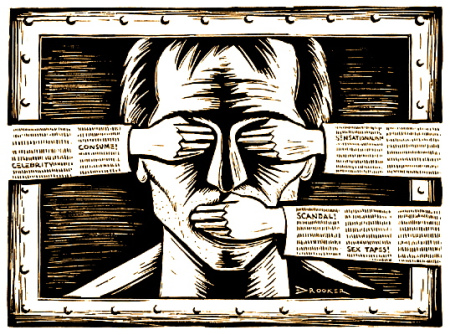
Should we as expatriates remain silent or speak up about issues which we feel are contrary to our beliefs? (image source: http://www.thewordontheword.blogspot.com/)

The past week has been an interesting one for foreign media junkies who follow affairs in the Gulf. Two articles were published in the English-speaking press which have proved to be controversial. The first was a damning piece in the New York Times on labor rights for workers hired from the Asian sub-continent to build the New York University Abu Dhabi. The second was a fine piece of investigative journalism from the Sydney Morning Herald on the subject of government subsidies for Etihad, the Abu Dhabi-owned airline.

The above criticisms in the foreign media shouldn’t surprise experienced communications professionals. Etihad is becoming a global brand with stakes in a number of airlines across Europe and Australia. Similarly, the report about labour issues relates to an American institution, New York University, and its Abu Dhabi campus. Qatar has similarly experienced negative publicity from abroad relating to the country’s labour practices following its winning of the rights to host the 2022 World Cup.

Recently, I attended a conference on the subject of corporate social responsibility. When asked about whether expatriates should tackle these issues with both governments and the national population, one of the most senior communications professionals in the region responded by saying ‘we’re the guests and so we shouldn’t tackle these issues.’

Unfortunately, the most common refrain to any comment which can be taken in a negative light is, ‘if you don’t like it, then leave.’ There’s a lack of moral courage shown by many expatriates to talk about issues which may offend, or which may get them into the bad books. Similarly, are many nationals willing to listen to the opinions of others? The concept of traditional Arabian hospitality is often talked about, a tradition that requires the host to listen to and honour the guest, but the reality on the ground is often different.

Modern societies are mature enough to take on board different voices, to learn from the opinions of others. As a person who has tried to do his part for the rights of others, I do find it embarrassing that as the people who live here in the region, we’re unable to raise these issues with our hosts in a civilized dialogue (and for those who say I’m looking to impose foreign, western standards there are many hadiths or sayings of the Prophet pbuh on issues such as workers’ rights).

Should we have the moral courage to speak on these issues, to benefit the communities and the countries with which and in which we live? Or should we remain silent? The answer, to me at least, is obvious. What do you say?

Has Coca Cola hit or missed the CSR mark with its Happiness Phone Booth labourer project?

Coca Cola is all about happiness. The soft drinks giant has been looking to associate itself with the concept of happiness for years, and these efforts regularly involve cause-related marketing activations. The latest effort by Coca Cola in the United Arab Emirates, named Happiness Phone Booth, gave laborers in the country an opportunity to make a call home. The special Hello booths didn’t accept coins but rather Coca-Cola bottle caps. Each bottle of Coca-Cola could be “turned into” a 3-minute free international phone call. Watch the clip below to understand the project in its entirety.

The controversy about this idea, which is clear in the comments underneath the video, is about the source of the bottle tops themselves. Are the labourers given Coca Cola bottles? If so, then why not make this clear on the video. If not, either the labourers have to spend two Dirhams out of their daily 18 Dirham salary on a bottle or find other means (which I’ll leave to your imagination).

So Coca Cola, shouldn’t you have targeted a group of the population who can afford your products for this cause-based marketing campaign?

What are your thoughts? Has Coca Cola done good? Or can it do better?