Blurring the lines? Publishers who become Content Creators and what it means for the PR sector

As publishers shift their business model to content creation for clients, how should the PR industry react? (image source: writemysite.co.uk)

As publishers shift their business model to content creation for clients, how should the PR industry react? (image source: writemysite.co.uk)

Who’d be a publisher right now? Revenues are dropping, print is going out of fashion (for most of the world), and people are no longer reading long form. So, what does one do? The answer may be to produce content for others.

Earlier this month Dubai-based publisher ITP announced the launch of ITP Live, a new division that would focus on five areas – creating a social media influencers’ agency, video content creation, digital sales representation, e-commerce, live events and training.

Another Dubai-based publisher, Motivate, works with companies to offer products such as video creation. To quote from Motivate’s own website, the firm is able to “conceptualise, storyboard, film, produce, host and share with our audience a beautifully crafted engaging video.”

Creating good content is only half of the battle. For firms seeking out content creation, the appeal of pre-existing media channels to distribute that content may be too good to resist. But, there’s the ethical question of boundaries. For a publisher which is offering a content creation service, should they also offer clients the opportunity to use their media vehicles to distribute that content? Would the usual editorial rules apply?

The Middle East’s publishing sector has been more fortunate than most when it comes to growth; with the exception of the downturn in 2008, relatively few publications have gone belly-up. However, the strain on budgets is telling. Many publications which had a roster of staff now only have one or two editors. With marketing budgets either shrinking due to the economy or being shifted to digital, will more publishers go down the content creation route? How will this affect their editorial policies and how will this affect the public relations industry?

For years, communications and marketing agencies have been the preferred option for companies needing either written or multimedia content. This content would have then been shared, either online or through traditional media channels. Will publishers now begin to compete with PR agencies? There’s lots of lines which are now being blurred. Where do you think we’re heading? I’d love to hear your views.


The need for clear communications – Saudi’s drive to balance the books

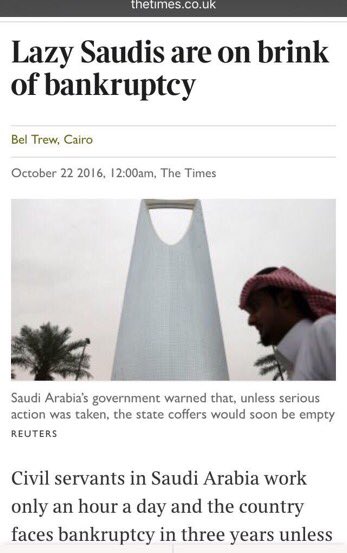
lazy-saudis

Saudi’s social media scene has been on fire over the past week due to a number of controversial issues regarding government officials. This is a news story from the Times on a comment made by a minister regarding Saudi inefficiency.

This week has been an interesting one for Social Media watchers in the Kingdom. Thousands of Saudi nationals have taken part in online campaigns/used popular hashtags relating to three high-level government officials who have either made controversial statements or who have been accused of using their influence on behalf of family members (you can see media coverage on two of the issues from Saudi Gazette here and Arab News here). The campaigns follow a decision a month ago to cut benefits for Saudi government employees. The decree, which was made in light of low oil prices and a rising Saudi budget deficit, is biting hard; this week Reuters reported that the Saudi central bank had asked retail banks to reschedule property loans for those affected by the cuts.

One of the campaigns began after a government document was leaked online, with personal details including name, position and salary. It’s only logical to assume that many government officials in the Kingdom are angry at seeing their pay cheques shrink; they’ll become even more angry when they see what they feel to be others not doing the same. In this environment, it wouldn’t be hard to also imagine officials being able to take a picture via their smartphone of a document which may reveal an embarrassing situation and then sharing it via social media (or, more likely, dark social).

I had the pleasure of listening to a senior Saudi journalist this week. He made a pertinent point when he said, “We can spend billions on consultants. We could have spent millions on a PR agency to convey the message behind the cuts and why they were necessary.”

In times of hardship, good communications becomes even more important. Saudi’s citizens need to understand the logic behind government decisions. They need to feel that they are engaged and are part of the debate. And they need to see government’s leadership doing just that, namely leading by example (as I’ve said before, actions are much more powerful than words in shaping perception).

We may see more issues coming to light in the Kingdom over the coming months, and more skeletons being revealed in government closets. When it comes to the government’s engagement and communication with its people, the transparency, clarity and consistency (or lack of) will either help get many Saudi citizens on board, or it may alienate them further. I for one hope it’s the former, rather than the latter.


The Best and Worst of Media in the UAE

The UAE’s media community has come together to support long-time radio and television host Jeff Price who needs surgery to help alleviate a rare brain condition.

There are days when you see the best in people, and there are days when you feel the opposite. The pas couple of weeks have shown the UAE’s media industry in both lights.

First, at the end of June, there came the news that the UAE’s Radio 1 and Radio 2 stations would close indefinitely. The decision to pull the plug was effectively made by Abu Dhabi Media which withdrew the frequency licences from Gulf News Broadcasting. I did occasionally listen to the channels, and I’ll miss them (I’m probably one of the few people in the industry which values radio’s reach and impact, especially considering how long people spend in their cars in the UAE).

The worst part of the story is the layoff of the production team and talent who worked on the two stations. Between 25 and 30 people have been let go. The below statement was the only public comment that I know of which made on the closures.

“Gulf News Broadcasting LLC is today announcing that with immediate effect it will no longer be managing the Radio One & Radio Two stations.

“This is as a result of unforeseen circumstances, which are beyond the control of Gulf News Broadcasting LLC.

“Gulf News Broadcasting LLC would like to thank all its employees, advertising partners and supporters for their contribution, effort and commitment for the successful management of Radio One & Radio Two stations over the last 10 years.

“No further comment will be made.”

And now for the better side of the media industry. Some of you may know Jeff Price. For those of you who don’t, I’ll quote the words from his own Go Get Funding site.

Jeff has been in the UAE for over 22 years and during that time has hosted numerous radio and TV shows, he helped launch City 7 TV, Radio 1 and 2 and was the voice of family entertainment for many of Dubai’s premium events Emirates Airline Dubai Rugby Sevens, Legends Rock Dubai Tennis, Dubai Duty Free Tennis and many more. He has lived a high profile life, achieving a huge amount.

What most people don’t know is the incredible amount he’s also done behind the scenes. Jeff has tirelessly championed just causes from repatriating Filipino workers who’ve become too ill to work and can’t get home to raising funds for charities helping construction workers families and those coping with crippling disabilities.Being the Jeff we know and love, he doesn’t mention these projects, causes and achievements, because that is his way.

Yes, he’s worked with everybody from Richard Branson to Chuck Berry, James Brown, and the Black Eyed Peas, and been instrumental in launching the careers of many of our favourite household names, but his passion has always been to help and fight for those unable to help themselves.

Now Jeff needs your help. Urgently.

Earlier this year after searing headaches, Jeff was diagnosed with a rare brain condition that leaks fluid into his skull. Whilst he does have medical insurance, this was not able to cover 2 life-saving operations. Jeff, along with our family, friends and generous colleagues got him through the first two surgeries, but now the money has run out. Jeff needs to raise more than 300,000 AED to have a valve fitted a third time to reduce the pressure on his brain and for further medical treatment required in this complex diagnosis.This is time sensitive as daily his sight is failing and the short–term memory and speech areas of his brain are being damaged.

It’s time to give back to Jeff.

He’s brought joy to countless millions over the years and been a true credit to the UAE expatriate dream, working hard, mentoring others and giving without hesitation to those less fortunate. All while bringing up the two children he adores – 13 year old Maddy and 3 year old CJ, who so many of you also know and love.

We are now asking for Jeff’s vast international family of friends to contribute if they possibly can. Jeff has never shied away from seeking help for those in need, but at a time when he needs that help himself, he feels unable to ask you himself, so we have to do it for him.

We are setting up a fully audited and transparent online contribution blog so that you can pay cash directly and contact others who can help too.

We all know from Jeff being a part of our lives, with his warmth, humour and compassion, that Jeff would help you in a heartbeat.

It’s his time now.

Please give what you can to help us get him the treatment he desperately needs as soon as possible.

Members of our community have helped Jeff reach half his target of 65 thousand pounds. Let’s show how good we are, by donating to Jeff during his hour of need. You can donate at his Go Get Funding page here.

Departing but not goodbye – Fida Chaaban and Frank Kane step down from The Entrepreneur and The National

Frank Kane (left), and Fida Chaaban have left their marks on the UAE's media scene.

Frank Kane (left), and Fida Chaaban have left their marks on the UAE’s media scene.

The UAE’s media scene can oft be described as a merry-go-round; journalists change roles almost as frequently as their colleagues in the public relations industry. Every so often, a journalist comes along whom I develop the utmost respect for, both in terms of their professionalism as well as their personality. They’re a pleasure to deal with.

Just like waiting for a bus, not one but two of my favorite media are leaving their roles this summer. The first is a lady who has redefined what it is to be an editor-in-chief of a publication. Fida Chaaban came to the UAE around about two and a half years ago to head up the newly-launched title Entrepreneur Middle East. During that time she’s built up a strong editorial team who aren’t afraid to publish news on its merit (and say no to ethically-inappropriate requests). Fida has gone beyond that and she’s lived the brand – she could be found at any and every event talking about entrepreneurship including the good, the bad, and the public relations. Fida was a pioneer in terms of engagement; in a region where many editors-in-chief are unapproachable, she’d always be online (when did she sleep?), and responding to anyone and everyone.

Fida announced the change and her stepping down in her own fashion by posting an article about it online (it’s well worth a read). She’ll be staying in Dubai, so I’m not saying goodbye but rather I hope to see her back in the media space soon.

The second person is Frank Kane. Few people in the regional PR industry worth their salt don’t know Frank, a man who has been reporting in London for decades and who moved to the UAE around a decade ago. If you want to learn about proper investigative journalism, Frank is the man to listen to. Frank has been with The National for almost seven years, and during that time his column has been a must read for anyone wanting to understand the nuances of business and culture in the country. Frank will be stepping down from The National at the end of this summer, but he’ll be staying in the UAE.

I could share many anecdotes about Frank, but I’ll do with just one. Back in 2008 I was working on a deal between the New York Stock Exchange and Qatar on a multi-million dollar investment. I was talking with the head of a major public relations firm from London and his experienced team, reviewing the media list. Such was the reverence (and apprehension) for Frank that when we got to his name the gentleman in question said, “I’ll deal with Frank”. When you’re equally respected and feared by public relations executives, that’s when you know you have made it as a true journalist.

I’ll miss dealing with both Fida and Frank, and I do hope that both will be back where they need to be (and where we need them to be), behind a desk working on copy that you can’t put down. We need more journalists like them.

PS do follow Fida and Frank on Twitter, at @fida and @frankkanedubai respectively.

What’s in a word? Coverage of Saudi oil minister Ali Al-Naimi’s departure by newswire media and social media reactions

Another week passes by and we witness more remarkable changes in Saudi Arabia. Over the past weekend Saudi King Salman announced a raft of changes which impacted the Kingdom’s government structure as well as those who were tasked with leading the changes.

The headline grabber, in more ways than one, was the departure of the longstanding oil minister Ali Al-Naimi. Al-Naimi had been an ever-present in government, serving as the oil minister for just over two decades. There had long been talk of Ali Al-Naimi, who is now 80, stepping down. When the time came, it was still a surprise to many.

Rather than talk about the man, who is a legend in the oil industry and is held in high regard by Saudis, I wanted to briefly look at the headlines from the AFP, Bloomberg, Reuters and the Wall Street Journal.

AFP used the word ‘sacked’ in their headline, but then reverted to replaced in the copy. Interestingly, the piece which was on the AFP site is no longer present. The below is from the cached version on Google.

AFP Naimi coverage

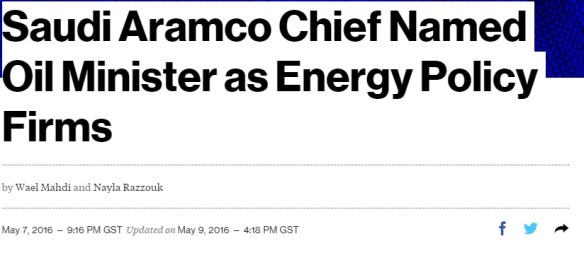
Bloomberg, which has scored a number of scoops in the Kingdom recently with its coverage of Deputy Crown Prince Mohammed Bin Salman, went for the below title which . The news piece was diplomatic in terms of the wording used about All Al-Naimi’s departure, including the use of the verb ‘replaced’ to describe the change in ministers (Ali Al-Naimi’s successor is the Chairman of Saudi Aramco Khalid Al-Falih).

Bloomberg Coverage

Reuters also focused on the incoming minister and used the word replaced.

Reuters coverage

Last but not least, Wall Street Journal initially opted for the word ‘fired’ in their title. After a firestorm on Twitter, including attacks against its Riyadh-based Saudi correspondent (and Saudi national) Ahmed Al-Omran, the title was changed from fired to dismissed (the word fired is still in the url as you can see from the below).

WSJ coverage

The argument that the WSJ team put forward is that the wording was correct – one is appointed to a minister’s post and then one is fired. Fired effectively means the same as replaced, dismissed or sacked. The nuance was lost on many who took offence and reached out directly to Ahmed via Twitter to complain. In a rare display of understanding, the WSJ changed the title. Ahmed Al-Omran also apologized for any offense taken.

https://twitter.com/ahmed/status/728955255883497479

https://twitter.com/ahmed/status/729002340628496385

In a region where the international media has rarely been given much attention by the national population, the Ali Al-Naimi story underlined a possible change in attitudes brought about by social media and the need to communicate what Gulf nationals feel is a correct story or narrative to the outside world. For these reasons, this will not be the last time that the foreign media comes under scrutiny for the wording they use to describe what is happening on the ground here in the Gulf.

Does the Bloomberg deal with ADGM impact its impartiality or not?

Does this deal with ADGM (pictured) mean something for Bloomberg's journalistic impartiality in the region?

Does this deal with ADGM (pictured) mean something for Bloomberg’s journalistic impartiality in the region?

The issue of impartiality is one which is seldom discussed in the Middle East – this probably isn’t a surprise when considering that much of the region’s press is owned by some form of government authority. However, when it comes to international media the issue of impartiality is a different story. Journalists from abroad, news wires in particular, often have to navigate the challenging waters of what to report on and how to report. They know that the consequences of their work can be dire, and I have known several brave journalists who have been asked to leave the country they were based in. For me, they’re often the most trusted source of information.

The deal between Bloomberg and Abu Dhabi Global Market (ADGM), the aspiring, brand new international financial centre located in the heart of the UAE’s capital city, was announced last week. The deal, which had been in the works for some time, will include the following details as reported by The National:

The partnership will involve major media initiatives from a new office on ADGM’s Al Maryah Island base, including a dedicated digital platform, new programming and an annual conference of global business leaders in the capital.

Tracy Alloway, Bloomberg’s executive editor of markets, based in New York, and a former Financial Times US correspondent, will lead the ADGM editorial operation.

The TV centrepiece of the new initiative will be a daily global markets programme, from new studios in the Dubai International Financial Centre, which will include editorial content from Ms Alloway broadcast live from ADGM.

A new “anchor” broadcaster will soon be named to present the show, which will seek to bridge the gap between Asian and European markets in Bloomberg’s global network.

There will also be a dedicated Middle East edition of the Bloomberg website, with original input from its 80-strong editorial team, headquartered in Dubai.

I heard about the deal some time back, and what was said to me was that ADGM would be financially supporting Bloomberg’s news organization in Abu Dhabi. It’s a great deal for ADGM, which was recently set up and which has aspirations to become a global hub for financial trading. Alongside the likes of Reuters and Dow Jones, Bloomberg is a global name when it comes to business reporting.

However, is impartiality impacted when money is involved? How will Bloomberg report bad news from ADGM? And how would ADGM respond? All of us who have worked in the media industry in the region know stories of how publishers will behave differently for advertisers, often not reporting negative pieces and instead pushing out good news.

Bloomberg is a different proposition to a local publication; its reporters do write everything, warts and all. Similarly, there’s been a major push to make ADGM a global player on the financial stage, with experienced executives brought in from Singapore and London.

For the sake of argument, let’s address the elephant in the room. As a matter of principle, should Bloomberg have said yes to the deal? Even if no reporting lines are broken, does the deal imply that there could be a measure of bias? Time will tell and each and every organization has its ups and downs. I’m looking forward to seeing Bloomberg’s new setup in ADGM and what it means for journalism and impartiality in the Middle East.

Rein in or let loose? How should an in-house communicator behave with media-friendly colleagues?

As an in-house communicator, would you reel an experienced colleague in or trust them to communicate well? (image source: http://www.questionpro.com/)

As an in-house communicator, would you reel an experienced colleague in or trust them to communicate well? (image source: http://www.questionpro.com/)

I had an interesting conversation today with a journalist (I still do that every now and then, as they’re a very fun bunch to be around). He was telling me about a recent event, of how a communications head for an organization came to him and asked about an award won by this person’s organization. It seems that the award nomination hadn’t been vetted by the communicator, and they wanted to know more about the nomination, including who specifically had submitted the nomination.

The journalist wasn’t particularly happy with what he saw interfering after the event. His viewpoint was clear, telling me that:

Yes, some journalists actually have relationships with people in organisations that don’t involve PR or comms, and while you can help that relationship, don’t mess around with it when it works so well!

As communicators, it is a natural instinct for us to control the message, especially when there’s an external party such as a journalist involved. However, does this always work? Does it make sense to rein in fellow staff members, especially when there’s potential to damage a relationship with your colleague or with the journalist whom your colleague has a relationship with.

For the journalist in question, much of his frustration comes from a feeling that when the marcomms team gets involved, the editorial process comes to a halt. In contrast, his source get to the point, he knows what to say and gives content that the journalist wants.

Would you rein in a colleague, especially one who is able to communicate well and who has a good relationship with a journalist? Or would you let them loose, albeit with some conditions and observations. You tell me, I’d love to hear your views.

And by the way, the award nomination won a top prize on the night.

Lessons on media relations and transparency from the World Government Summit

Dubai's World Government Summit has become a global event for government employees and is closely followed by the media (image source: Trade Arabia)

Dubai’s World Government Summit has become a global event for government employees and is closely followed by the media (image source: Trade Arabia)

This month was host to another mega event in Dubai, the World Government Summit. The conference, which even hosted an address by President Obama, aims to become the leading platform for governments, the private sector and the public to learn about and collaborate together for innovation in government.

Two areas caught my eye. The first was that of media relations. There’s been a good deal of talk about how the communications industry is changing and media relations will become less important. That isn’t the case, at least for the vast majority of us who spend most of our day pitching, preparing for media interviews, and following up.

There was a sizable media presence at the event, which is testament to the World Government Summit’s global reach. However, while there were dozens of international journalists – whose flights and accommodation were paid for – the story for the local journalists I knew was different. Few Dubai-based media were reached out to except by email, with no phone calls. And some didn’t receive an email to arrange for registration. One journalist I talked to spoke about his frustration on having to chase the agency to get his registration sorted out. He was particularly peeved by a lack of support or empathy from the agency about the issue, and not only him but his whole team being missed out. As he told me, ‘a sorry would have gone a long way when it comes to good will.’

While I understand the urge to engage globally – after all, the event is now the World Government Summit – not involving local media is a idea that will only sour the agency’s relationship with the local journalists in the short to medium term; and trust me, you don’t want to deal with an aggrieved journalist, let alone put them in front of a client. Plus, in today’s digital age, I don’t buy this concept of local and global media. Everything is online, and much of it is curated by services such as Google News. It’s now a case of getting that content seen by the relevant stakeholder, which can be done through increasing paid reach or seeding the content on other sites.

Transparency and its impact on credibility

The second insight is around the inaugural “World’s Best Minister” Award. According to the summit’s website, the “World’s Best Minister” Award was “thoroughly and independently managed by Thomson Reuters where the search for the nominees is conducted according to the established criteria”.

To quote from the Summit’s website, details on the criteria and judging panel are below:

The criteria of the Award were set by the organizer of the World Government Summit. The criteria for selecting the candidates WAs based on various financial and non-financial metrics, and their improvement over time. These are based on data disclosed by the World Bank, United Nations, Legatum institution and various other well known resources that provide data and statistics on economic information, social metrics and government services.

The primary focus for 2016 has been on initiatives in the healthcare, education, social and environmental services.

The judging panel consists of six judges from various backgrounds, who provide different perspectives on the candidates based on their experience, expertise and insights. They include senior executives from the World Bank, OECD, Ernst & Young, Strategy & Co and the Abraaj Group on their personal capacity.

From an initial selection of 100 ministers, the winner turned out to be Greg Hunt, Australia’s environment minister. This choice has proved to be highly controversial, particularly in Australia where the Australian government has been criticized for its approach to green issues.

My focus however is the response from Thomson Reuters who, I feel, have sought to distance themselves from the choice of the winner. To quote from the Guardian.

But Thomson Reuters said it was “not correct” to say that the company initiated the award or were responsible for designing the selection process.

“Thomson Reuters was solely responsible for assisting in the administration of the award, to a set of criteria approved by the World Government Summit organisers,” said Tarek Fleihan, head of corporate communications for the financial information company in the Middle East, Africa and Russia.

Transparency is key to credibility. And whilst I do love the idea of awarding government officials who innovate on behalf of their citizens, the controversial choice and the ensuing contradictions surrounding the process hasn’t helped to make the award as credible as it should be.

What are your thoughts? Were you at the event? I’d love to hear your views on these two points.

Executives promising to go naked on television, Cobone’s PR stunt, and The Address’ post-crisis crisis?

Paul Kenny's fake PR release for Cobone, Ziad El Chaar naked on TV and Emaar's ongoing issues following the Address fire made this week an interesting one for media in the UAE (image source: Arabian Gazette)

Paul Kenny’s fake PR release for Cobone, Ziad El Chaar naked on TV and Emaar’s ongoing issues following the Address fire made this week an interesting one for media in the UAE (image source: Arabian Gazette)

Media in the Middle East is rarely dull, and the past few days have proved that there’s some hilarity as well as serious questions about what people in our region do and then tell to the media.

Let’s start with the real estate brand which is developing a reputation for foot-in-mouth disease. Speaking to the Sunday Times, Damac’s Managing Director Ziad El Chaar told The Sunday Times he would “go on TV naked and resign” if the worst market projections are realised. Aside from the fact that any naked executive dance on television would be illegal in the UAE (at least without a VPN), his comment hasn’t been taken too well judging by the reaction on Arabian Business’ online portal. Maybe there’s some fans of naked real estate executives out there. If so, please do show yourselves so we can get you help…

Another bizarre piece from last week which wasn’t picked up widely. Speaking to an audience of entrepreneurs last week, the founder of discounting site Cobone Paul Kenny admitted that he used a PR stunt to kick-start his business. Shortly after founding the site, Kenny put out a press release claiming that 1,000 vouchers for a discounted pizza had been sold to Cobone consumers. That release, Kenny now claims, was a fake. Let’s quote Kenny from the Arabian Business story.

“We were second to market. GoNabit [an online group buying website founded by Dan Stuart and Sohrab Jahanbani] was first. When we launched, everyone was saying: ‘You are the same as GoNabit,’ which we were but I said we weren’t.

So I went to at Vapiano, which is an Italian restaurant, and bought a thousand pizzas at a huge discount and they sold out by 12pm. I put a big sold out sticker on the site and an hour later I released a press release saying ‘Cobone.com breaks e-commerce record in the Middle East.’

And the truth is that everyone started reading and asking ‘Who is this company Cobone.com?’ ‘What is e-commerce?’ ‘What’s a record?’ You know it created a lot of interest in the business and instantly people started recognising us as a different business.

I remember that a day after you could do a Google search to see we were on around 483,000 websites. First, e-commerce in the Middle East was never covered. Then what is an e-commerce record? What is Cobone.com?

So you got a ball rolling of media interest from that point.”

There’s a popular saying about the luck of the Irish. And there’s another saying about making one’s own luck. Luckily for Kenny, no asked if the news was real (or checked with the restaurant). If they had, his deception may not have worked so well.

And finally, another follow-on story about the New Year’s Eve fire at The Address, from The National in which one owner of property at the hotel lost 1.3 million Dirhams worth of art in the blaze.

Ramin Salsali spoke out this week urging The Address owner Emaar Properties to quickly process residents’ compensation claims as well as repair the property. To quote from the story.

“Until now, they [Emaar] have been very fair and have quickly reacted to accommodate people, put them in hotels, give them the first basic possibilities just to start to recover.”

He expected “a very unbureaucratic and pragmatic approach” from the developer in terms of how claims were handled – especially since a police report last week indicated that an electrical short-circuit from a spotlight caused the blaze.

“The whole world is now watching. The effect on real estate is unbelievable. People have pulled out of contracts where they don’t know about the fire safety of the cladding. It’s not good for Dubai.”

One of the greatest challenges any organization can face is not just the crisis itself, but the post-crisis reflection and learning. Emaar isn’t there yet in terms of dealing with any major grievances from those who lost property and items during the fire (and there’s been remarkably little negativity from any of the hotel’s residents so far), but the communication with this group of people needs to be both clear and quick to get these issues resolved. Otherwise, Salsali’s point about blow-back for the Emirate’s real estate sector may become true. Let’s hope not.

And for the next post I’ll be talking daddy issues again. It’s been a while since I posted any stories about my little princess, and I’m looking forward to it!

Innovation, Data and Control – Squaring the Circle in Dubai

Can governments in the Middle East find a way to balance control with innovation and access to data?

Can governments in the Middle East find a way to balance control with innovation and access to data?

Someone re-found their mojo this month. The English-language newspaper The National published a number of eye-opening pieces on two issues that are often discussed, but little understood.

The first was an investigative piece (yes, I know!) on the challenges that Dubai’s Road and Transport Authority (RTA) has faced with the disruption caused by app-based taxi providers such as Uber and its local rival Careem. To put the story into context, the RTA does not only regulate taxis in the Emirate of Dubai, but it also manages its own fleet of taxis.

The piece, which is a fascinating insight into how the Emirate is not only run but also how it is looking to balance control with innovation, poses the question of how a government which controls much of the business in the country promotes innovation whilst protecting its revenues. For me, the key paragraphs in the article, written by the newspaper’s business editor Mustafa Alrawi, are below.

In Dubai, The National understands, Uber and Careem have narrowly escaped a clampdown by the regulator that would have significantly curtailed their abilities to operate. The biggest issue has been the alleged failure to maintain prices above taxi fares. On its website Uber states that “ … in Dubai, regulations require our fares be 30 per cent higher than taxi fares”.

It is understood, however, that the regulator had been planning a far stronger response to the practices of private hire companies booked by smartphone app, ahead of new regulations to address the emergence of technology-led companies in the transport sector. These regulations are expected next year, according to previously reported comments from the RTA.

It is understood that the Dubai government stepped in before the row escalated to ensure that innovative companies such as Uber and Careem would not be hamstrung by any action by the RTA. The circular is understood to represent a kind of temporary truce between the regulator and the technology firms maintaining the status quo for now.

A second article the following day in The National touched on another important issue for the country – that of statistics and control over information. Here’s the introduction:

A new law that demands companies seek government approval before carrying out surveys in Dubai could damage the property sector and discourage research in the emirate, experts have warned.

The Dubai government announced a law late last month intended to help enable the Dubai Statistics Center “to establish an advanced statistics system”, according to a statement. But experts zoomed in on a provision in the new law that forbids private companies from “conducting any survey[s] without obtaining authorisation from the Dubai Statistics Center”.

As pointed out by one of those interviewed, there’s no such thing as a data vacuum. The lack of any official data will be filled by rumours, which can prove to be much more damaging.

Professor Joseph Kadane, chair of the American Statistical Association’s committee on scientific freedom, which produces reports for the United Nations on best practice in government statistics, warned that the new law would likely lead to the spread of “uninformed rumours and uncertainty about the extent of the downturn” in Dubai’s property market.

“This will do far more harm to Dubai’s economy than allowing private surveys to be conducted and published,” Mr Kadane said. “International investors, in particular, are sensitive to the quality of the information available to them in deciding where to invest.”

Both articles touch on fundamental issues relating to innovation and data. The underlying theme is control. Governments in the Middle East have long controlled everything around them, including their economies. In today’s digital world, where innovation can come out of nowhere and where data can be created and spread in an instant, governments need to understand that the control of yesterday is no longer possible and instead look to collaborate.

And, on a final note it’s great to see good local reporting. I hope The National keeps it up.