Innovation and the need to think simply

Innovation starts with the ability to ask a question

Innovation starts with the ability to ask a question

This week is a special one in the UAE – it’s officially Innovation Week and the country is full of activities extolling the virtues of innovation and all that this word entails (I admit, I’ve come to dislike this word, not because of what it stands for but rather its constant misuse).

As I’m a media junkie, two news pieces stuck out. The first was an effort by the Dubai Media Office to promote innovation through its Media Innovation Lab, a quarterly event that aims to promote a culture of innovation and creativity in media. To quote from Emirates 24/7, “the initiative seeks to share knowledge on media-related innovation among corporate communication and media professionals and media students. It is also in line with the UAE leadership’s directives to promote innovation in all sectors.”

The second is even more ambitious, and, quite literally, out of this world. I’ll let The National’s copy explain this innovation for you:

High school and university students from across the UAE have the chance to directly shape the future of space exploration.

Two competitions giving them the opportunity to watch their experiments blast off on a rocket to the International Space Station were announced on Tuesday at the launch of The National Space Programme in Abu Dhabi.

In the initial stages of the programme, The National, Abu Dhabi Media’s English-language newspaper, has linked up during Innovation Week with the UAE Space Agency, Boeing and other public and private organisations.

The National Space Programme contests are Genes in Space, challenging high school pupils to create a DNA analysis experiment, and the Satellite Launch project, in which a university team will build a satellite.

There’s a third strand I’d like to bring in here. I had the pleasure of talking to a university professor who teaches media here in the UAE. He was recalling the story of an occasion when the power failed at his academic institution. One of his students, a local, asked if she should cover the happening for the university student publication. He said yes and encouraged her to go and follow up with the operations department who look after issues relating to maintenance.

This student did just that and headed down to the operations department to understand more about the power cut. When she did meet someone, she asked what happened and explained why she was asking a question. And the response? “Why are you asking such questions? Who is your professor?”

While I love the ambitions of blasting into space or talking about creativity in the media, I’d love to see us put our feet on the ground and push for a climate where a question is welcomed, both from each of us as individuals as well as the media. As for the curious student, the brave lady did publish her story. She’s my innovator this week.

Me, my wife and our baby – a personal story of how the Gulf is letting down its women by denying their children the right to nationality


The children of Gulf women married to foreigners are not automatically granted nationality, unlike their male counterparts (image source http://www.flight965.com)

 
I promised I’d write on my experiences as a father and I’m having to start things off on a serious note. As some of you may know, my wife is from this region but I am not. We welcomed into our lives a little princess earlier this year.

The sad story is that in the Gulf region children born to Gulf women, in other words women with a nationality from the six GCC states, who are married to foreign men do not receive their mother’s nationality. This is in contrast to Gulf men who are married to foreign women. Their children do receive their father’s nationality.

It’s important to us that our little one cherishes both her cultures and that she’s recognized as both. She’s fortunate to have a European nationality through me, but, try as we might with visits to interior ministry offices and other government bodies, we realized that there is no formal process for our daughter to become a Gulf national like her mother. This is the same all over the Gulf, despite sporadic exemptions to the contrary.

I’ve heard countless reasons for this, such as the need for Gulf women to marry Gulf men, and the legal requirement that a Gulf national should have only one passport. To me, any discussion is bogus. If I was a Gulf male and my wife was a European foreigner our daughter would have qualified automatically for both nationalities.

I hear lots of news about progress being made it terms of women’s rights in the Gulf, which I applaud. However, until Gulf women are able to give their children everything that their male counterparts can, I cannot contend that women here are anywhere near to being equal to the men.

I hope for change, if not for my wife’s generation, then at least for my daughters. I hope you will join me in calling for a change to how Gulf women and their children are treated in the Gulf.

Snapchat and its attempts to win over the Middle East – #Mecca_Live and #WestBankLive

There’s two types of people in today’s digital world. Those internet users who are generally older who have never heard of Snapchat and who while away their hours on Facebook, and, when they’re feeling adventurous, get onto Instagram. And then there are those young people who can’t get enough of the video messaging app where photos and video shorts ‘disappear’ after being shared. For the half that doesn’t know, Snapchat would seem to be the fastest growing application in the Gulf. The application has proved incredibly popular with young audiences across the region.

Snapchat has also done itself a lot of good over the past couple of days by holding what it calls a live story event in Mecca, the spiritual home of Islam. According to Snapchat, Live Stories are a curated stream of user submitted Snaps from various locations and events. Users who have their location services on at the same event location will be given the option to contribute Snaps (videos to you and me) to the Live Story. The end result is a Story told from a community perspective with lots of different points view.

What this means in real English is that Snapchat curates lots of content from different users, brings that content together and combines it to tell a story. This week’s Live Story, which is usually 300 seconds long, took place in Mecca during the holy month of Ramadan. The ensuring Live Story of #Mecca_Live can be seen below.

The feedback for the #Mecca_Live event was nothing short of remarkable. By tapping into sentiment around Ramadan and telling the story of what it means to be in Mecca during the holiest month in the Islamic calendar through people who were there resonated not just with Muslims around the world, many of whom are tired of seeing their faith being associated with negativity, but also non-Muslims who were impressed by the faith and the devotion of those who were featured in the Live Story.

A sample of tweets around the #Mecca_Live hashtag

A sample of tweets around the #Mecca_Live hashtag

This isn’t the first Live Story in the Middle East however. The week before, Snapchat had curated a Live Story from the West Bank. Featuring Snaps from Palestinians, the piece aimed to tell the story of how ordinary people live in this beautiful part of the world. Palestinians gave glimpses into the cities of Bethlehem, Ramallah, and Nablus through 10-second tours of historic sites. They also talked about the wonderful world of Palestinian cooking (including some of my favorite dishes such as knafeh, qatayef and falafel. However, one aspect of life in the West Bank was left out. The allegation made by many was that it underplayed the Israeli occupation. The video is below.

The other allegation made about #WestBankLive was that it was a clumsy attempt to undo some of the damage done by a previous Live Story, #TelAvivLive. Shown the same week as #WestBankLive, this Live Story painted a picture of Tel Aviv, that, to quote the Mondoweiss website:

In the Tel Aviv story, young Israelis were represented as fun-loving, beach-going, peace-promoting people – a far cry from their roles as the occupying soldiers their Palestinian counterparts in the West Bank see on a daily basis. The story also included little in the way of representation of marginalized members of Israeli society such as Palestinian citizens or African refugees. Images of the historic Palestinian port city of Jaffa, referred to in the story by its Hebrew name, were depicted in a way that +972 Magazine says “reproduces the urbicide of this once-thriving Palestinian city in favor of a narrative that ‘keeps the peace.’” In addition, a few of the snaps presented foods like felafel and shawarma as typical Israeli meals, without any reference to their Arab origin. Israelis seemed to be using the Snapchat story as a way to show off appropriated Palestinian culture and locales, claiming them as their own without a second thought.

As Snapchat has found with both #WestBankLive and #TelAvivLive there are few stories that can be shared which are not controversial. Each group has their viewpoint, and, by attempting to be as inclusive as possible through its Live Stories, Snapchat will inevitably offend. Has #Mecca_Live helped to negate criticism of Snapchat? Possibly. But you can be sure that this app, which is already extraordinarily popular among the region’s youth, will continue to cause controversy as it tells the Live Stories of Snapchat users who see reality through their particular viewpoints, and smartphones.

A hijab, bacon and McDonalds’ breakfasts – the wonderful world of Ramadan advertising

Ramadan is a wonderful month, a time of spirituality for the world’s Muslims. It’s also the time of year when the advertising rules change as Muslims fast during the daylight hours and look to spend their nights either with family or in prayer.

In keeping with reaching out to Muslims, advertisers need to be ever-aware of religious sensitivities. Brands often feel the need to make a change to their ads. One such change, which was spotted by Dubai-based communications professional Mohammed Kharroubi (Twitter handle @mkdubai), involved the retailer Carrefour. Spot the change below.

Brands sometimes get things horrendously wrong. Another retailer, the UK retailer Tesco, made a huge faux-pas, when they promoted smokey bacon-flavor Pringles as part of a Ramadan promotion. For those who don’t know, any pork-related products are considered haraam in Islam and are not consumed by Muslims. The below image went viral and has resulted in masses of media coverage in the UK.

Tesco has been pilloried on social media for selling smokey bacon-flavoured Pringles as part of a Ramadan promotion

Tesco has been pilloried on social media for selling smokey bacon-flavoured Pringles as part of a Ramadan promotion

And then, there’s the bizarre. According to Dubai-based marketing consultant Hussein Dajani, McDonalds has been running advertising for its breakfasts this month on the radio on Dubai. Unfortunately, Muslims fast during the day, and most of the McDonalds restaurants serving breakfast will be closed.

With Ramadan, it really does seem that while some brands are able to adapt and thrive, others need to do their homework. What are your thoughts? And do you have your own examples of successful and unsuccessful Ramadan advertising?

Did @Khaleejtimes break the UAE’s defamation law with the Muwatana video?

And the viral video of the year goes to this amazing clip which was published by the Dubai-based English language daily Khaleej Times yesterday morning. The video is of a heated discussion between a UAE national female with an expatriate Arab female (possibly the Egyptian actress Abeer Sabry) about what the Arab expat is wearing. The discussion, which is only 1 minute 22 seconds long and is mainly in Arabic, is about the Emirati lady’s disagreement with what the expatriate Arab lady is wearing.

I’m not going to get into the pros and cons of this – there’s the Twitter hashtag #فيديو_المواطنة which tracks the debate – but the video has been a sensation. It was posted at 10am UAE time on the 12th of May, and within 24 hours it has already had over 1.7 million views.

The question is, does this video and its publishing on an open platform break the UAE’s defamation laws? The UAE does not allow for filming of a person without that person’s permission, which I am assuming was not given in this instance. The basics of the UAE’s defamation law are below:

1) It is publicly forbidden to take a picture of another person without their permission.
2) Verbal abuses or gestures (even without the presence of a witness) can also lead to a fine and/or sentence.
3) Defamation via libel (written) or slander (spoken) is dealt by a criminal court as opposed to a civil court, where punishments would only include a monetary fine.

In addition, following the outcry last year about the Ramadan YouTube incident the authorities stated that they would look into online content if it became a matter for ‘public opinion and concern.’ The person who filmed that clip was arrested for defamation and the videos were pulled from YouTube.

The law isn’t clear on what happens when people share content online, but judging by the interest in this video it’s going to be hard to remove the content which has been shared over 24,000 times.

So, the question stands. While there’s a strong possibility that whoever filmed the incident broke the UAE’s defamation law, did the Khaleej Times break the law by posting the video online without the consent of the persons being filmed? Whether yes or no, the muwatana video as it has been named by social media users will become a precedent for other media outlets who are looking to develop their distribution and reach through the use of content shot by their readers and the general public.

And if you haven’t seen the video, here it is below!

Learning about a local community – Humans of Bahrain

We’re bombarded by adverts on a daily basis, and unfortunately it seems that social media may be going the same way. What with all of the selfies, the food pictures and the holiday snaps it could be argued that there’s little in the way of meaningful insights into wider social communities. However, every now and then you come across a gem that’s worth shouting about.

My wife was the person who first told me about this one Instagram account. Humans of Bahrain aims to tell the story of people living in Bahrain, both local and expatriate. It’s an account that is frank and candid, and shares a personal view of each and every one of the people being profiled by the account (it’s similar to sites found in the US and Asia which profile local communities).

Each picture on the account includes a story told in text below the image, both in English and Arabic. Subjects covered include education, marriage, careers and employment, and good old-fashioned feelings and emotions.

So far, the account has posted 169 images and it has just over three and a half thousand followers. If you’re looking to learn more about culture and the people that make up Bahrain, this is an amazing site to follow. I wish more people would focus on what is around them to tell the story of their community and their home rather than simply themselves.

Educating the Gulf on our humanity through social video – examples from Bahrain, Saudi and the UAE

Here in the Gulf region we’re increasingly seeing the use of online video content, particularly to tackle issues that are both social and controversial. This week there have been media stories on three examples from three different countries.

The first video has been produced by the Saudi Human Rights Commission to Saudi nationals to be kinder to their domestic workers, most of whom have to leave behind a family of their own to earn a living and support them. The video is well shot, and aims to give humanity back to domestic workers, especially those from South East Asia, through concepts such as motherhood.

The second is from Bahrain, but shot by one social media influencer called Yousef Al Madani. The clip focuses on the treatment of white-collar workers in Bahrain, most of whom come from the Asian subcontinent. Yousef looks to take the place of one of these workers at a local grocery store, where they often have to rush out to take orders from customers who sit in their cars and wait for the items to be brought to them. The clip, which has been talked about in the media, has been viewed over half a million times. This video is dubbed into English as well.

The third and final clip is from a corporate, Cola Cola to be exact. To quote the National:

An online advertising campaign by Coca-Cola showing the company handing out excess baggage tags at the airport to travellers has been viewed almost one million times on YouTube.

The clip “Coca-Cola –Taking Home Happiness” begins by showing passengers checking in at Dubai International Airport to head off to various destinations to see family. By Thursday, the video had generated more than 987,000 hits since it was uploaded a month ago. According to the website for Campaign Middle East magazine, Coco-Cola shot the video on December 22 with the cooperation of the airport.

The campaign – which is available only in the UAE and Oman – is expected to expand with additional prizes like flight vouchers, TVs and mobile phones, the company said. The video follows a similar online campaign last year which showed labour camps with Coca-Cola phone booths, into which bottle tops rather than coins could be fed to pay for international calls.

The video, which is probably the best shot out of the three (this is Coca Cola after all), is also dubbed.

What are your thoughts on the above? Are these videos effective? Would they have been more effective on television as well, or less effective? And is one more effective than the other, possibly due to its topic, its producer, its intent as well as its authenticity? Do let me know your thoughts.

The Gulf’s new social media hybrids and the success of @maxofarabia

Living in a region which is known for diversity but which is still pervaded by barriers between all the cultures you’ll find in the Gulf, I’m fascinated by individuals who bring differing peoples together. One such person is Max, who goes by his online moniker maxofarabia. A British-American by background, Max has not only lived in the Gulf but he’s also taken the region to heart. Unlike many expats, Max has picked up Arabic and is fluent in the language (he has a strong Emirati accent).

By creating content in both English and Arabic about issues that are relevant to nationals, Max is opening up a new world for both expats as well as those outside of the region. Max prefers Instagram, but you can also find him on Twitter and Facebook (he’s also on Snapchat, but I’m way too old for that platform). His popularity among Emiratis is evident, and he regularly uploads videos about the UAE and its people to his Instagram account, where he is followed and watched by almost 190 thousand people. Max has become a social media ambassador for a number of projects in and around Dubai.

If you’re an expat and you’d like to know more about the Emirates in particular, then Max of Arabia is one to watch. Have a look at some of his posts below (apologies but Instagram’s embedding function is taking a day off today).

A good morning from Max's trip into the desert on the trails in the UAE

A good morning from Max’s trip into the desert on the trails in the UAE

Huge thanks to @hooralq for the invitation to @sharjahart - a great evening spent in one of my favorite cities, surrounded by creativity, with some of my favorite people - #Sharjah #SharjahArt

Huge thanks to @hooralq for the invitation to @sharjahart – a great evening spent in one of my favorite cities, surrounded by creativity, with some of my favorite people – #Sharjah #SharjahArt

Max even looks good in a thob - here at a wedding in Riyadh

Max even looks good in a thob – here at a wedding in Riyadh

Are you in need of a CreativeMorning? Dubai’s latest addition to the media industry

Creative Mornings Dubai is the latest (and greatest) addition to the creative industry in the city

Creative Mornings Dubai is the latest (and greatest) addition to the creative industry in the city

I just love meetups and networking, especially when there’s someone different and engaging out in front and talking about an issue I care about. While there often seems to be an excess of events in Dubai, there’s few that offer a real chance for us to learn something new, understand different perspectives, and engage in a meaningful conversation.

Supported by TECOM, the good people at Digital Ape and Dubai Eye Radio’s/Zayed University’s very own James Piecowye have come together to bring a global phenomenon to the region. Creative Mornings is a simple idea; you bring in an engaging speaker to talk to the local creative community in the morning. There’s lots of coffee and some great talks followed by fascinating question and answer sessions with the audience.

The Creative Morning formula is simple. There’s one every month and they’re held on the third Thursday of every month from 8am to 9am in the CNN building in Dubai Media City. So far, we’ve had four Creative Mornings in Dubai, each of whom has shared their particular insights on issues such as the climate of creativity, the challenges of success and following your own dreams (the session was imaginatively called It Might Get Ugly), the links between education & art, and taking chances & finding your passion.

As you’d imagine from a radio host, James is a wonderful MC (if you don’t know him, go and search Google for Hawaiian shirts in Dubai). The team at Digital Age, including Haifa, Paul, Alia’a and Maria are the people behind the cameras, who make everything happen in terms of supporting with speakers, with the on-site arrangements and the production work – they also work on the social media including the Facebook page. You can also follow their Twitter feed which is @CM_Dubai.

If you’re free on a Thursday morning next month, why don’t you come down and check out Creative Morning. Here’s to great conversations, thanks to James, Digital Ape, and Creative Morning.

The launch of LinkedIn Arabic – Did LinkedIn miss a messaging opportunity?

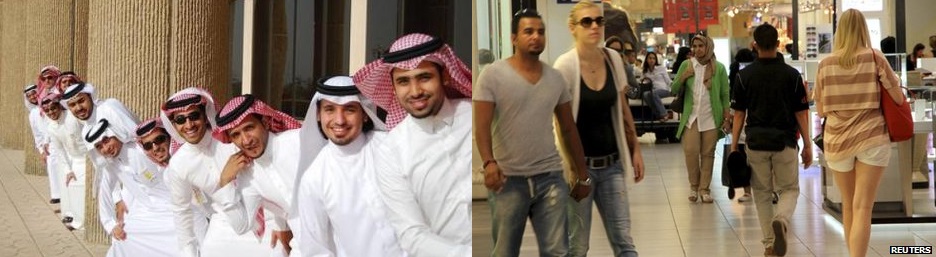
If you're going to launch in Arabic where would you choose? Dubai or Riyadh? (image source: Reuters)

If you’re going to launch in Arabic where would you choose? Dubai or Riyadh? (image source: Reuters)

I love LinkedIn. It’s possibly my favorite social media network. LinkedIn has transformed how professionals network (and get jobs) online. No recruiter could do without LinkedIn.

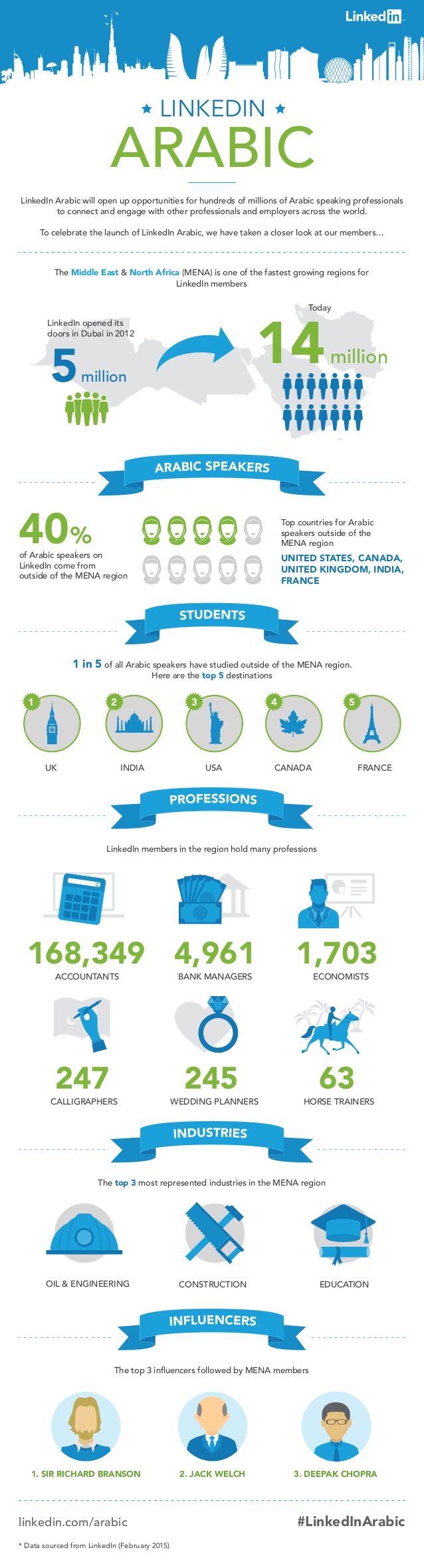
The network has grown steadily in the Middle East since it opened up an office in Dubai back in 2012. Over the past three years LinkedIn has grown its user base from five to fourteen million. The UAE is LinkenIn’s largest market with two million users according to The National. The two largest Arabic-speaking markets in the region are Egypt, with a population of just over 82 million, and Saudi.

The Kingdom is, or should be, LinkedIn’s largest potential market. Saudi doesn’t only have a sizable Arabic-speaking population (28 million and counting), but it also has the spending power. Saudi’s gross domestic product for 2013 was just under 750 billion dollars. Saudi is home to some of the region’s largest corporations, as well as a majority of the country under the age of 25. Add to the mix high internet penetration and smartphone usage, Saudi is LinkedIn’s Arabic-language market.

However, when LinkedIn launched its Arabic-language site last week the management team chose Dubai as the preferred location. There was a guest advocate, in the shape of Noura Al Kaabi, CEO of Abu Dhabi’s twofour54. Bizarrely, LinkedIn’s press materials also included a press statement from Saudi’s Minister of Labor, which was carried extensively in the Kingdom’s media (the quote in full is below and is sourced from Saudi Gazette).

Eng. Adel M. Fakeih, Saudi Arabia’s minister of labor, said: “LinkedIn has been working with us to match talent in the Kingdom with the right opportunity, and with Arabic, this benefit can be rolled-out to a much wider member base.

LinkedIn will continue to be a useful tool for us as we use technology to communicate the need for nationals to up-skill themselves and take advantage of the strong economic climate and significant job-creation in the Kingdom.

Being a part of a global network also helps youth identify the key demand areas, and build their qualifications accordingly.”

Would LinkedIn have been better served by launching Arabic in Saudi, rather than in the UAE (where it could be argued that the lingua franca is English). Would this activation have been more in line with the message that LinkedIn was trying to convey, namely that we are now in Arabic and we want Arabic speakers to use our service.

It’s a small observation, but it seems that LinkedIn missed an opportunity to push home a message through a launch that was misaligned with its target audience. Saudi isn’t the easiest country in terms of getting things right on the ground, but if you’re going to do something then, as the saying goes, if it is worth doing then do it right.

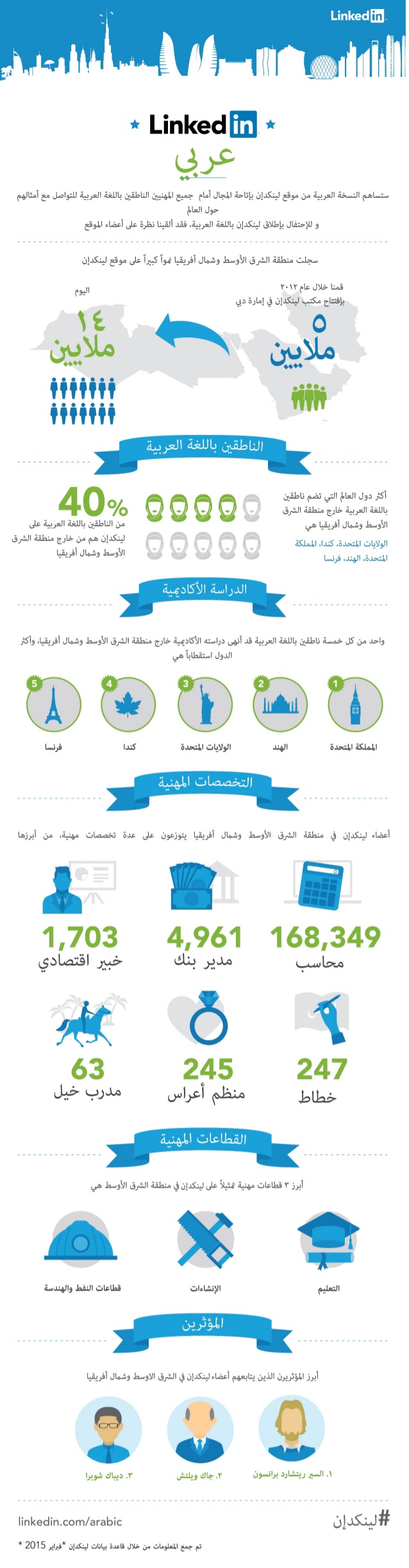
And for more details on LinkedIn in the Middle East have a look at the infographics below, which are in English and Arabic.