The pride of the Gulf: Kuwaitis and their determination to realize their civil rights

Kuwait has seen unprecedented levels of demonstrations over the past month

Kuwait isn’t a place one would naturally associate with freedom and democracy. The country and its nationals are often derided by other Gulf Arabs for a number of reasons (if you live in the Gulf you’ll understand what I’m talking about here).

When it comes to participation in government, there’s no doubt in my mind that the rest of the Gulf could learn a great deal from Kuwait. The country has always had, by GCC standards, a vibrant and active political scene. Kuwait’s Constitution guarantees democratic representation by virtue of Article 6, Part 1 which states that “the System of Government in Kuwait shall be democratic, under which sovereignty resides in the people, the source of all powers.”

When talking about civil protests in the Gulf area a common refrain has been to ask “why are there any protests at all?” The perception is that Gulf Arabs have money, and that they are looked after and provided with all that they may need by their respective governments. This may be true in some cases, but it misses the point entirely. Kuwaitis are demanding more say in their government and how the country is ruled.

The challenges in Kuwait are best summed up by Kuwaiti opposition leader Musallam Al-Barrak in his article for the Guardian newspaper. You can read the article here, but I will also quote from it below.

We are protesting against an unconstitutional change in the electoral law pushed forward by the emir. The electoral system divides Kuwait into five districts; 10 parliamentarians are elected from each district. Previously people could cast four votes per ballot, but the new law permits voters to cast only one. This change aims to quell the national assembly’s role, as it facilitates the governing authority’s control of electoral outcomes – which in turn undermines the country’s democratic legitimacy.

On a deeper level, however, the demonstrations are against individual rule, something Kuwaitis have long and actively refused. In 1962, when the current constitution – which limits the governing authority’s role – was issued, it established that the public has the right to impose its opinions on the emir through the elected national assembly – a right that the governing authority refuses to acknowledge. The current struggle is therefore a struggle for power. Is power – as stated in the constitution – for the public, or is it – contrary to the constitution – for the emir?

The majority of people also believe that the government, representing the ruling family, is not serious in its battle against corruption. In fact, people are convinced they are sponsoring it. This belief was one of the reasons behind the dissolution of the 2012 parliament and the recent changes in the electoral system, following the opposition’s exposure of evidence that state money was being transferred to private accounts in London, Geneva and New York, and of the previous government bribing parliamentarians in 2009.

I for one am proud of the Kuwaiti people for standing up for what they believe to be their rights and against the actions of Kuwait’s ruler. They’ve shown bravery, determination, and a belief in themselves despite the very real risks to themselves. Kuwait’s people, both men and women, clearly believe in themselves and their ability to take the country forward. Kuwaitis have proved that they are prepared to risk a great deal for the right to govern themselves and fight corruption.

In his article for the Guardian Al-Barrak writes that in the end the people of Kuwait will be triumphant. I would hope that any victory for democratic participation in Kuwait would be felt by others across the Gulf. Will we one day look back to Kuwait in 2012 and say this is where the Gulf’s Arab Spring began? Today Kuwait and its people should be seen as the pride of the Gulf.

While the country does seem to be going through an unprecedented crisis, I do also feel that the Emir of Kuwait should be recognized to an extent for allowing protests (or at the very least, not cracking down in the same/similar manner to his GCC neighbours). Maybe I’m wrong on this, but Kuwait would seem to be the one country in the Gulf which allows for its nationals to protest openly. While I have read about and been told of attempts to use force and arrests to dispel protestors I certainly couldn’t imagine these scenes being repeated in any other city in the Gulf as of today.

For more on what is happening in Kuwait watch the below report from Al Jazeera’s English channel which makes for fascinating viewing.

Paris Hilton and the holy city of Makkah – where’s the synergy?

This is one of the few images that I could find of Paris which would be suitable for this blog. This isn’t her attire for the store’s opening however.

Socialite and party-lover Paris Hilton. And the holiest city to all Muslims worldwide, Makkah. These two don’t often find themselves in the same magazine or TV programme, let alone in the same sentence.

However, all of that has changed with the launch of Paris Hilton’s fifth store in Saudi Arabia. And yes, you guessed right. The store will be in the holy city of Makkah.

Ms Hilton tweeted about the opening with a picture of the store. She also added that this was her fifth store in Saudi Arabia out of a total of 42 stores worldwide. Seems we just can’t get enough of Paris Hilton over here.

Unsurprisingly there’s been a fair amount of reaction within Saudi itself. The news was first covered in Saudi by the national newspapers and has quickly been picked up by international outlets including CNN. The CNN piece, which you can read here, neatly sums up the differing reactions to the store’s opening.

https://twitter.com/ParisHilton/status/268874585326354432

The commercialization of Makkah isn’t recent. For years the city has been transformed by a host of high-end shops, stores and malls. It’s very different in another city I love dearly. Most of the old city of Jerusalem (Al-Quds in Arabic) has resisted change, and is all the better for it in terms of its spirituality and warmth.

Returning back to Paris and Makkah, what does a woman who has been embroiled in a sex tape and enjoys her party lifestyle have to do with Makkah, the holiest city in the world to over a billion people. Dare I say, this is slightly different from a high-end brand such as Gucci in the sense that Paris Hilton the person (and her lifestyle) embodies the brand. Will the news engender a debate about what is happening to a city that means so much to so many people. Makkah should be cherished and conserved. I for one hope it does. In the meantime, if you are in Makkah and you’re in desperate need of a bag do remember Paris Hilton (and say astaghfirullah while you’re doing it).

Makkah is most associated with Islam, spirituality, belief and forgiveness

PS as a PR stunt I’d have to give Paris Hilton and her team top marks for the online reaction as well as the media coverage.

A Bentley and the Saudi pre-occupation with desert drives

A short but fun post for you. Saudis love their cars. And they love their desert driving. A typical weekend in Riyadh will involve a drive off the tarmac and into the desert.

Here’s what happens when two of Saudi’s favourite past times come together. Enjoy the video and remember, don’t drive the Bentley into the desert.

Going above and beyond: How IBM is supporting Sharjah through training and education (and all for free)

Corporations often about about giving back. The phrase corporate social responsibility is often uttered by executives. But how many companies really get their hands stuck in when it comes to providing knowledge, skills, and experience to local communities.

IBM’s remit has included encouraging ICT adoption among Sharjah’s youth

One company that I admire and respect for how it does things differently is IBM. IBM, or Big Blue as the company is also known, is a vendor to the Government of Sharjah for its e-government project. IBM did what few other vendors do, and sent a team of volunteers over to Sharjah to help develop a communications strategy that would promote Sharjah’s e-government services to the Emirate’s citizens and residents. Here’s a couple of bite-size quotes from IBM’s press memo.

An international team of 14 IBM employees chosen for the company’s Corporate Services Corps program has arrived in the United Arab Emirates to volunteer their expertise in support of e-literacy and social development in the Emirate of Sharjah. As part of the project, the team will work alongside the Sharjah e-Government Directorate, Sharjah University and the Supreme Council for Family Affairs Centers.

The team of 14 IBM experts from the United States, India, Austria, Italy, Belgium, Switzerland, Japan and Australia will be on the ground in Sharjah for a month. At the Sharjah e-Government Directorate, a team will help refine a national strategy for promoting e-services of the Sharjah government to residents.

At the Supreme Council of Family Affairs, an IBM team will help the council and its organizations realize an e-literacy program and move closer towards realizing its goals of helping Sharjah women and youth improve their IT skills.

IBM’s Corporate Service Corps are teams of subject matter experts who give their time free of charge for a month to help local economies, improve skills, and provide a foundation for success in a variety of disciplines to small businesses, educational institutions and non-profit organisations.

As a person who is passionate about communications, I find it interesting that IBM focused on working with Sharjah on how to promote e-services. In a sense it acknowledges the truth that having a good technical setup and list of services just isn’t enough. If you don’t know about the services and/or your habits are ingrained then you won’t use a new services. It’ll be interesting to see how IBM and the Sharjah Government will look to tackle the issue of change, to promote services that contrast with how government affairs have been traditionally run in the Gulf (think lots of office trips and paperwork).

In addition, how will the initiative have tackled internal change, to convince government employees who would have never thought about either using e-services or promoting electronic government.

I’d love to know if IBM considered the prospect of using traditional communication methods such as a majlis (usually a night-time gathering of several dozen men, or women, in one room discuss everything from personal issues to business) to talk about and listen to ideas on how to publicize e-services as well as demonstrate the ease with which one could complete a government transaction or service without having to talk to someone face to face or leave one’s house or office.

How will IBM and the Sharjah Government promote e-services to a society that is both traditional and conservative?

In a conservative society with many different cultures, nationalities and languages what tactics can be used to convey a message successfully? The thought of using centuries-old concepts and practices to make a success out of a cutting edge technology project to change how government services are requested and delivered is fascinating. Again, I wonder what IBM came up with on this project.

All in all, this is what CSR should be about. Supporting a government e-services project through communications? Providing advice and training for getting more women and youth into technology? And for free? I hope others follow in IBM’s footsteps. We all could do with more corporate love through such projects.

PS for more news on IBM’s Corporate Service Corps initiative have a look at the website http://www.ibm.com/ibm/responsibility/corporateservicecorps/ or follow the hashtag #ibmcsc!

Where’s the corporate response to #Sandy?

The response to tropical storm/hurricane Sandy online has been remarkable. There’s little anyone else is talking about, and even as far off as the Middle East people are sending their wishes to those caught in the storm’s path. To give you an idea about how Sandy has been trending on social media, have a look at the analytics graph from Hashtag.org for #sandy.

The graph, from hashtags.org, is from a one percent sample of Twitter traffic over the past 24 hours.

Everyone has been pitching in to provide help, support and comfort to those affected. According to thenextweb, Twitter has supported relief efforts by promoting the following twitter accounts @RedCross, @FEMA,@NYCMayorsOffice, and @MDMEMA. “Twitter is also listing government accounts and resources on its blog and giving #Sandy a custom page,” according to the piece by Harrison Weber on TNW.

Even celebrities have been taking to the social media space to talk about Sandy.

https://twitter.com/ABFalecbaldwin/status/263245395025600512

Aside from the danger to life posed by Sandy, the main talking points have been flooding and power outages. As a big fan of the likes of ABB (my former company) and GE, I was hoping that they and others would be talking about the disaster and lending a hand to get everything back on track. Estimations are that eight million people are without power right now in the Eastern seaboard of the US, and that utility company staffers are traveling from as far as California and Texas to help out in New York.

And what is on GE’s Facebook page?

This was GE’s latest post to their Facebook page, which is liked by over 900,000 people. There’s no mention of Sandy.

And ABB?

ABB’s latest Facebook post which was put up in the afternoon of October 30. Again, no mention of Sandy.

This isn’t exactly an empirical study, but it worries me that two of the world’s most respected electrical engineering companies are not lending their support or even making their support known by social media. While I understand that many corporates don’t want to be seen to be taking advantage of the situation, surely there’s a time and place for them to offer their support and advice publicly.

Not talking about what is affecting millions of people seems so out of place, especially when on social media and when the companies mentioned provide solutions that power our utilities.

After all, aren’t we supposed to be talking with each other via Facebook and Twitter. Or do we go on, ignoring global events? Hardly being socially responsibly on social media, is it?

A talented Khaleeji designer and her creative work – have a look!

Eid has already passed but I wanted to share a sample of her work which was done for me on the occasion of Eid Al-Adha. Jehan Abdulkarim is a marketing executive during the day, but she’s also an incredibly talented designer and photographer. I hope to share more of her work here with you, but for the meantime please do enjoy the below and let me know your thoughts!

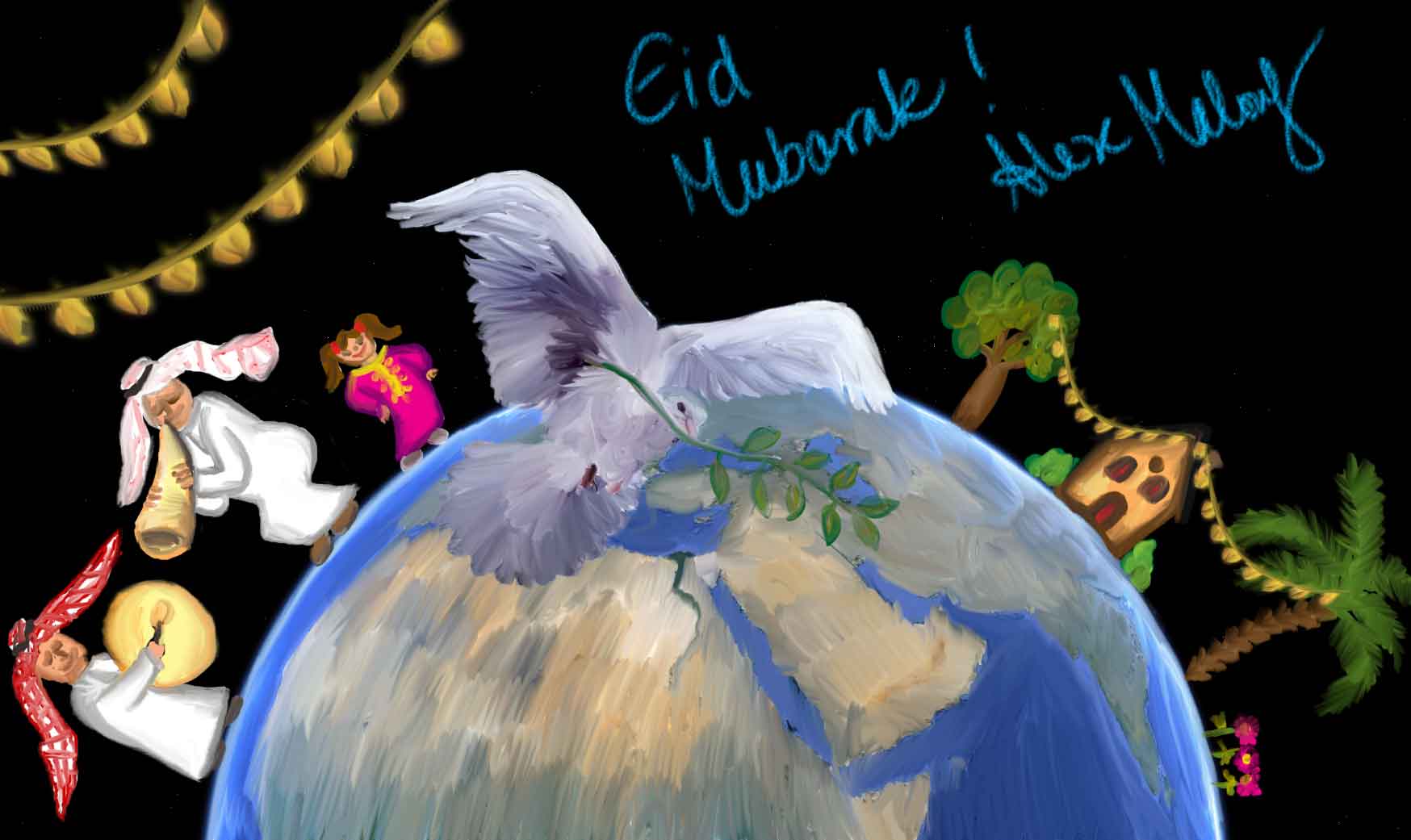
A greeting card for Eid created by my good friend Jehan Abdulkarim.

Al Maha Resort: A desert experience in need of nationals

After the hard work of the last couple of weeks before and during Gitex, I treated the missus to a weekend at what may be Dubai’s best weekend getaway. The Al Maha Desert Resort is one of those places which is good for the soul. For anybody who hasn’t been to the desert and experienced its deafening silence, the Al Maha is a must.

Al Maha was conceived over a decade back as one of the first nature reserves in the UAE. The resort has helped preserve a number of species which are unique to the Arabian desert, including the Orxy, the long-horned white antelope, and gazelle. Al Maha is designed to be both a conservation reserve as well as a luxury resort, and the guides at Al Maha are experts in the local wildlife. Guests can explore the desert within the vicinity of the hotel and learn about the UAE’s flora and fauna.

Our experiences during our stay at Al Maha were remarkable. We didn’t even mind the six am start for the desert wildlife trip. For a taster of the resort and all it has to offer have a peak at the below video.

There was only one disappointment for me. No matter how hard I tried I could not find any nationals working at Al Maha. I’d asked our guide who told me that this was not for the hotel’s trying; a couple of nationals had worked at the hotel but had left several years back. The Gulf is renowned for the generosity shown to guests.

I’ve experienced first-hand the warmth of the Bedouin and locals in places like Saudi Arabia’s Qassim province. Their stories and experiences made my own journey all the more remarkable. The local culture is part of what makes any trip to the desert so much fun and, dare I say it, educational.

Frankly it was disappointing for me that there were no Emiratis working at one of the first sites set up by the UAE’s government to preserve the desert environment and its wildlife. I would have enjoyed hearing the tales of the UAE’s own Bedouin about their lives in the desert.

I do very much hope that when we do go next time to Al Maha that we will meet with local guides as well as the team that took care of us so well the last time we visited (a BIG THANK You to Shane for all the effort you put into taking care of us). Our stay will be even more enjoyable and rewarding with a touch of local knowledge. After all, our history and culture makes us who we are. To have a true desert experience in the UAE you need to be hosted by the people who have lived the Bedouin life and who call the white sands and oases their home.

To repeat, Al Maha Resort is one of the best hotels I’ve ever been to. It’ll only get better with Emirati employees.

Forget the culture, what about your customers? Saudi Ikea and a no-women catalogue

Now you see her, now you don’t. Ikea’s Saudi franchise forgot about the half of the population that makes (most of) the decisions about what goes in the house.

Ikea has been in the news of late for all of the wrong reasons. If you haven’t seen, read, heard or been told about the ‘incident’, then read the below from NBC’s website.

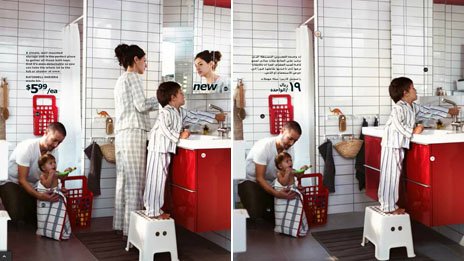
Scrubbing the bathroom got a whole new meaning in the Saudi Arabian Ikea catalog. The Swedish home and furnishings retailer faced criticism after reports surfaced that Ikea digitally erased women from pictures in the Saudi version of the catalog.

In one picture of a family in a bathroom, the mother standing at the sink with her son was removed. Even one of the retailer’s own designers, Clara Gausch, was erased from a photo featuring four of the brand’s designers.

Sweden’s trade minister Ewa Björling told the newspaper Metro the vanishing women were a “sad example” of gender inequality in Saudi Arabia, where women aren’t allowed to drive and must be covered in public.

In a statement to the BBC, the company said “excluding women from the Saudi Arabian version of the catalogue is in conflict with the Ikea Group values.” It blamed the missing women on the franchisee who runs Ikea’s Saudi operations and said, “We do not accept any kind of discrimination.”

While every media outlet around is poking fun at the Swedish furniture icon (and Swedes take their human rights and equality issues very, very seriously), the question I’d ask Ikea’s Saudi franchise is who do you think is buying your furniture? I’ve rarely seen any man in Ikea either in Riyadh or Jeddah deciding on what will go in the house.

So, how is getting rid of women in the catalogue going to help shift furniture? How does ignoring your target audience and not promoting your brand values with half of the population, the half that (mainly) look after domestic matters. So again, what was Saudi’s Ikea franchise thinking? Forget the women, let’s keep the conservatives happy. And yes, you can find women’s pictures being published in Saudi Arabia so why did the franchise take the risk?

Don’t be evil – Google, freedom of speech, corporate responsibility and that video

I’m a huge fan of Google. The company has defined the internet era. Google is the world’s most popular search engine. Youtube is more popular than television in many parts of the world. Google Maps has redefined how we get from A to B. I could go on and on, but you get the point. Google has even entered the common language as the term people use when they refer to searching on the internet: “Go Google it…”

Google has done all of this and more while living by its ‘don’t be evil’ corporate motto. While Google has been criticized before for bending and breaking this mantra (most notably with its operations in China), the last couple of weeks have been remarkable. There’s probably few of you out there who have not heard about the film, named ‘the Innocence of Muslims’. The film, which has caused a global uproar, was uploaded to Youtube at the start of July.

Since then, there have been riots and demonstrations worldwide. Dozens have been killed and injured. And yet, Google has refused to pull it off Youtube. According to an AP story from two weeks back:

“Google is refusing a White House request to take down an anti-Muslim clip on YouTube, but is restricting access to it in certain countries.

The White House said Friday that it had asked YouTube to review whether the video violated its terms of use. Google owns YouTube, the online video sharing site.

YouTube said in a statement Friday that the video is widely available on the Web and is “clearly within our guidelines and so will stay on YouTube.” (the full piece can be viewed here)

Google argues that only materials which are in clear violation of laws or that promote hate speech will be removed from Youtube.
Google says The Innocence of Muslims does not however breach YouTube guidelines. However, Google has blocked users from seeing the video in India, Indonesia, Libya and Egypt due to local laws and “the sensitive situation”. Youtube’s full statement from Friday 14 September is below.

“We work hard to create a community everyone can enjoy and which also enables people to express different opinions. This can be a challenge because what’s OK in one country can be offensive elsewhere. This video — which is widely available on the Web — is clearly within our guidelines and so will stay on YouTube. However, we’ve restricted access to it in countries where it is illegal such as India and Indonesia as well as in Libya and Egypt, given the very sensitive situations in these two countries. This approach is entirely consistent with principles we first laid out in 2007.”

For me, the video is the clearest indication yet that Google has given up on its ‘Don’t be evil’ mantra. Google had to pull down a video from Brazil after its resident of its Brazilian operations was arrested for breaking local laws.

Google constantly argues that Youtube is a channel and that it has no say in what should be on that platform for the sake of free speech. However, how many newspapers would accept advertising from Neo-Nazi groups? How many television channels would run an advert for euthanasia? Just like these media channels, Google has a responsibility to its audience. This cannot simply be about pure profit and driving up viewer numbers. Google sells products globally, it has to be responsible globally as well.

The fact that these videos are still on Youtube shames Google. I for one hope that the company I have admired for so long finally wakes up and does the right thing on this issue and others in the future by better defining and vetting what should go up on platforms such as Youtube and reacting to communities sooner rather than not at all.

Please Google, don’t be evil…

Google, please don’t be evil. Come back from the dark side.

Reflections on why we all should adapt to the cultures around us

How much do you understand about and live in harmony with the culture around you?

I was reading a short but poignant piece by Annabel Kantaria, the Daily Telegraph’s journalist in Dubai. The column was about Dubai’s Brits and how today’s British expats in the Emirate are a breed apart from their predecessors (have a look at the article here).

My take on culture and our settings may be different to most, partly cause of my background and partly due to my circumstances. As a child of two cultures, I’ve always been acutely aware of the importance of the need to adapt and become part of the community within which I am living. For years my family lived in Saudi Arabia, a country that has a very distinct set of cultures. I’ve married into another culture as has my sister.

For those that aren’t from a melting pot of genes, traditions and customs I can imagine that it isn’t easy to let go of what you know so well. Is there an urge to make others adapt, to conform? You could certainly say that the walls of a compound are a way to keep out external influences.

However, isn’t there more to living in a foreign location than just a job or a salary? How much more can we enrich ourselves through adapting to the local culture and becoming part of the local community?

It pains me when I meet with people who can’t utter a word of the local language despite having lived in the country for years, and whose only contact with their environment is the food (usually hummus). Admittedly exchanges do need to be two-way; a dialogue needs two or more people to talk and listen to each other. However, someone needs to make the first move and look beyond their boundaries to understand, learn and appreciate what is different.

Despite its reputation for being a harsh place to live, I loved my time in Saudi Arabia. Why? Because I became part of the community. I spoke the language, I developed friendships and spent time with locals talking about what is important to them.

I miss that cultural understanding, that bridging of the divide between me and them. The world will be a better place with more understanding. Adapt to your surroundings, thrive in your local environment rather than simply live there, and you’ll end up calling your foreign adventure your home rather than a ‘couple of years abroad.’