Unknown's avatar

About alexofarabia

I'm am obsessive compulsive communicator who has lived in the Gulf for almost a decade. Enjoying the challenge of working in a region where you've got to be innovative, patient and determined to make things happen. Miss being a full-time journalist! Miss family even more! Sometimes I mouth off, but more often I grit my teeth and try to encourage change through a smile (not as easy as you think). Despite now living in Dubai Bahrain is home for me.

Reflections on why we all should adapt to the cultures around us

How much do you understand about and live in harmony with the culture around you?

I was reading a short but poignant piece by Annabel Kantaria, the Daily Telegraph’s journalist in Dubai. The column was about Dubai’s Brits and how today’s British expats in the Emirate are a breed apart from their predecessors (have a look at the article here).

My take on culture and our settings may be different to most, partly cause of my background and partly due to my circumstances. As a child of two cultures, I’ve always been acutely aware of the importance of the need to adapt and become part of the community within which I am living. For years my family lived in Saudi Arabia, a country that has a very distinct set of cultures. I’ve married into another culture as has my sister.

For those that aren’t from a melting pot of genes, traditions and customs I can imagine that it isn’t easy to let go of what you know so well. Is there an urge to make others adapt, to conform? You could certainly say that the walls of a compound are a way to keep out external influences.

However, isn’t there more to living in a foreign location than just a job or a salary? How much more can we enrich ourselves through adapting to the local culture and becoming part of the local community?

It pains me when I meet with people who can’t utter a word of the local language despite having lived in the country for years, and whose only contact with their environment is the food (usually hummus). Admittedly exchanges do need to be two-way; a dialogue needs two or more people to talk and listen to each other. However, someone needs to make the first move and look beyond their boundaries to understand, learn and appreciate what is different.

Despite its reputation for being a harsh place to live, I loved my time in Saudi Arabia. Why? Because I became part of the community. I spoke the language, I developed friendships and spent time with locals talking about what is important to them.

I miss that cultural understanding, that bridging of the divide between me and them. The world will be a better place with more understanding. Adapt to your surroundings, thrive in your local environment rather than simply live there, and you’ll end up calling your foreign adventure your home rather than a ‘couple of years abroad.’

Why we all need some reflection in our lives – my journey back to Durham University

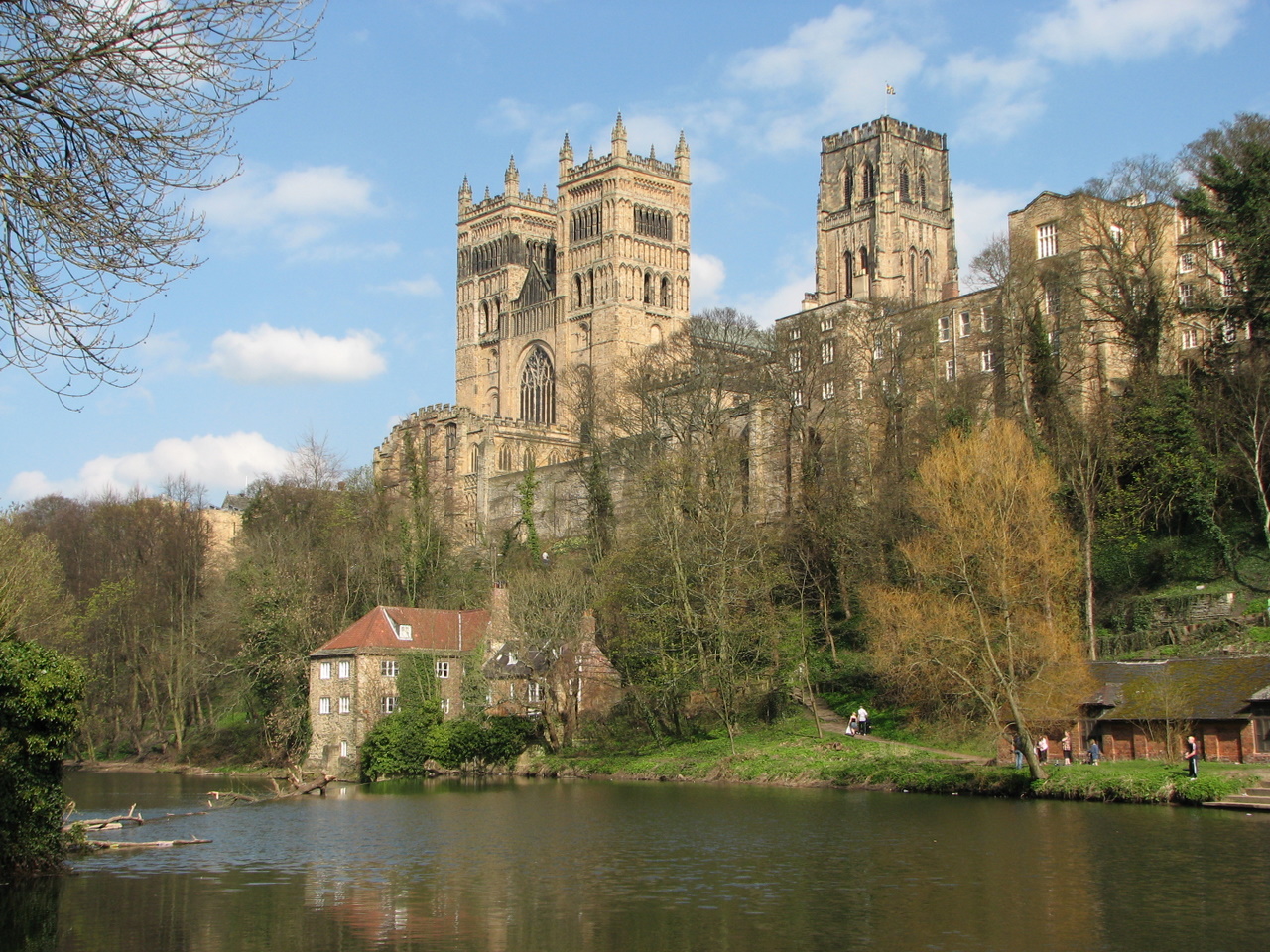
Many years ago I had the opportunity to spend three years at Durham, a small town in the North East of England. Those three years were spent studying my undergraduate degree. In some ways, I was a typical student. In others, I was not. Maybe due to my background as an Arab-European I was imbued with a hope that I could make a difference.

When I was at Durham, I had the chance to engage with others, to support good causes and promote a very special charity, the Durham Palestine Educational Trust (I will blog more about this very special cause soon).

Time has passed, and priorities seem to have changed. I’ve spent a decade in the Gulf, looking after family, getting married, and embarking on a career.

I took it upon myself to do a second Masters degree, in marketing, and I chose to study online with Durham University. This week I returned to Durham University, to study two residential modules. The six days I spent back in Durham were for me a chance to catch up with those student days, to meet with lecturers and old friends, and to remember. The experience has meant so much to me.

The visit to my Alma Mater has reminded me of memories, of hopes, and dreams. This may be optimistic of me, but I hope that it has awakened in me a belief that no matter who we are, what we may be doing or where we may be we can still carry those positives with us and be the difference that we want to see around us.

Think back, remember the time when you were young(er) and remember what was important. Think about how you’ve changed. And then think about how you can make that difference which you hoped to all those years back.

Thank you again Durham and all those people whom I knew and loved from my time there. You had such a profound effect on me and who I am today. I hope that this week will help me to reflect on what I need to do better.

The dangers of speaking your mind online – lessons from the Middle East

Kuwaiti graphic designer Mohammed Sharaf @MohammadRSharaf created the following image to support Nasser Abdul during his trial for tweeting offensive material

The internet is full of misconceptions. I often feel that most people think that the world wide web is a place where they can go to say anything, both positive and (most often) negative. The past 18 months and pending legislation should make anyone and everyone think twice about the above. Cases in Saudi Arabia, Bahrain, and Kuwait have cast aside the notion that cyberspace is a domain where anything and everything goes.

A number of trials and guilty verdicts both underline the importance of tempering what people say online as well as underscore what authorities do and do not deem as illegal. The first high-profile legal proceedings took place in Kuwait when in June of last year a Kuwaiti national was charged with slandering Bahrain’s royal family and a religious group.

Despite claiming that his Twitter account was hacked Nasser Abdul was found guilty and sentenced to three months in jail which he had already served by the time his sentence was pronounced. There have been other cases in Kuwait, including the prosecution and sentencing of Mubarak Al-Bathali to six years in jail (this was commuted to six months) for Tweets attacking certain religious groups.

The most famous case of jailing for tweeting is that of Hamza Kashgari, who published three tweets about an imaginary meeting between himself and the Prophet Mohammed. His comments drew an instant reaction from Saudis online; in the hours that followed over 30,000 tweets regarding Kashgari were published online. Kashgari was accused of apostasy and fled to Malaysia. He was deported back to Saudi Arabia and jailed. Kashgari is still in detention, despite pleas by his family for his release and his apology for his actions (the basic story and roundup can be read here on Wikipedia).

Bahrain’s authorities have also taken to court individuals for publishing their thoughts in online public forums. The most famous and most recent case is that of activist Nabeel Rajab who tweeted about the Prime Minister’s visit to Muharraq in June and was accused of publicly insulting Muharraq’s residents for their support of Sheikh Khalifa bin Salman al-Khalifa. According to Bahrain’s prosecutor Rajab had claimed that Muharraq’s residents had only welcomed the Prime Minister during a visit because he had offered them subsidies.

Bahrain’s Information Affairs Authority said his acquittal on defamation charges “was due to the judge’s uncertainty regarding the evidence submitted to support the lawsuit”. Rajab, who has spent two months in jail while awaiting the outcome of this and another case, had been faced with possible charges before for his use of Twitter, in 2011, in what would have been the first such case in the Middle East.

Clearly the Arab Spring, which has led to regime change in three Middle East countries and is still being felt across the region, has sharpened the thinking of numerous governments across the region. According to media reports in June of this year, Bahrain is introducing legislation to curb misuse of social media.

I am still trying to fully understand the full implications of Bahrain’s proposed social media law, but I am assuming that this would cover and make an illegal offense the publishing of any comments online or through social media that would appear to contradict government policy or government statements. Kuwait is also leaning in this direction, as this editorial by Reuters makes clear.

What is clear is that the Middle East’s online community is becoming increasingly politicized. I’d argue that many people, frustrated with the lack of political debate in traditional media, are going online to voice their issues and concerns. The Dubai School of Government has estimated that there are 1.3 million active users on Twitter in the region.

Switching tack slightly, how will the increase in political discourse affect online communication efforts/campaigns? Will communication professionals and agencies steer completely away from anything that could be construed as political or biased to one community? And will we see more people using online aliases? While many governments would like to regulate online activity, how are they going to force users to reveal their true identities when using services that are based in Europe or the US?

Would we even see sites such as Facebook or Twitter blocked by governments in the region (this did happen in Egypt during January 2011 when the authorities tried to stop any and all access to social networking sites)? That’s the logical conclusion, but how would you do this when these sites have become part of people’s everyday lives? As always, there seem to be many more questions than answers when it comes to the Middle East. The freedom to voice one’s thoughts online are no exception.

Do you need more bling in your life? Car painting and modding in Saudi…

As it’s almost the weekend, I thought I’d write a short blog before adding more content tomorrow and Saturday. Here’s two wonderful pictures of car designs/gratification in Riyadh. I should have more pictures (there’s an unbelievable car painting/modding scene here due to the money spent on cars and the lack of alternative entertainment for young men) but I’m often the one driving.

Enjoy the pictures below and I’ll upload more as and when I take/receive them.

Missing out on some love this Valentines Day when in Riyadh? Don’t worry, this Toyota has more than enough hearts to go round. I just hope they can outrun the religious authorities.

Or how about a Hummer H2 in gold?

Or if you prefer your rims and high suspension, you can always do this…

And if you’re wondering what people (sometimes) do with these cars, have a look at the below video.

And after that?

This is a famous roundabout sculpture in Jeddah. The image is taken from Susie of Arabia’s blog site, which can be accessed at http://susieofarabia.wordpress.com/

Twitter and politics in the Middle East – Arab political figures on Twitter

Following on from a previous post on the top religious figures in Saudi Arabia using Twitter I’m profiling a couple of the most prolific political and governmental officials and rulers in the Gulf.

If you’re looking for a good resource on global political movers and shakers then check out the Twiplomacy report by global PR agency Burson-Marsteller. There’s some interesting insights here, though I hope the below snapshot will give you a little more information on the Middle East region in particular.

So here’s the top five six countdown. I could add a lot more and I hopefully will do over time.

1. Jordan’s Queen Rania Al Abdullah.
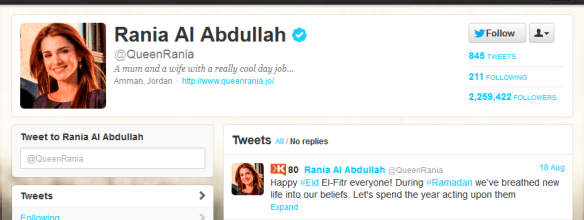
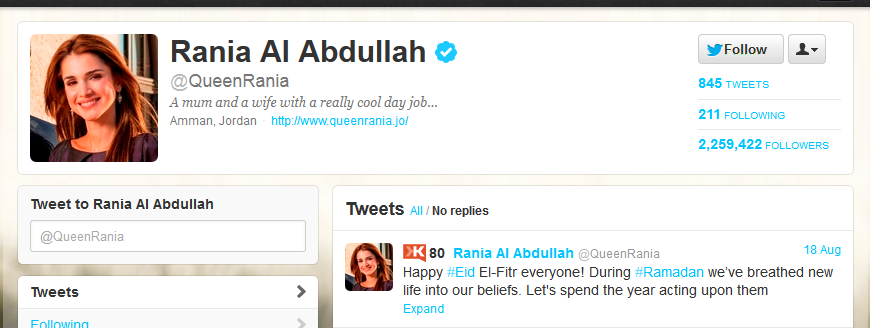
Jordan’s Queen Rania is the most popular political figure in the region with over two million followers.

The most popular political figure on Twitter is not based in the Gulf, but rather on the Arabian Peninsula’s periphery. Jordan’s Queen Rania Al Abdullah is without a doubt the most popular government-related figure in the Middle East (I saw government as her husband King Abdullah II is the head of state). To date she has amassed two and a quarter million Twitter followers. The Queen usually tweets about charitable issues which she is involved in or supports, such as education, healthcare, and youth-related schemes. Queen Rania also has a YouTube channel and Facebook site as well as her own website at http://www.queenrania.jo.

Queen Rania has used social media to engage in conversation. The best known example is a campaign launched in 2008 entitled Send me your Stereotypes. The Queen asked people to send her their questions about Islam and the Arab world. She talked about topics such as honour killings, terrorism and women in the Middle East.

Queen Rania started using Twitter in the Spring of 2009 and she has occasionally used the site to answer questions from followers. She is not a prolific user of Twitter (having sent 845 tweets her account averages less than a tweet a day), and her engagement and communications are spread across all of her social media channels. Queen Rania messages in English primarily rather than Arabic.

2. Sheikh Mohammed bin Rashid Al Maktoum

Sheikh Mohammed passed the one million mark on Twitter at the end of July 2012

The ruler of the Emirate of Dubai and the Vice President of the United Arab Emirates, Sheikh Mohammed bin Rashid Al Maktoum has a large following on Twitter through which he disseminates information on Dubai’s economic development, charitable initiatives, and (sometimes) religion.

Sheikh Mohammed often writes in Arabic to address issues which are important to UAE nationals. In addition to his twitter feed there’s a Facebook site which was set up in June 2009 and has over 600k likes and a more recent Youtube page which was set up in February of this year but which already has 580 thousand video views.

Sheikh Mohammed tweets on average less than once a day (he posts at approximately the same rate as Queen Rania and has posted to date 862 tweets) but he does retweet fairly often (once every 9.1 Tweets). An avid horse racer, the Sheikh does talk about his passion for racing as well as the environment.

3. Abdul Aziz Bin Fahd Al Saud

Abdul Aziz Bin Fahad is an avid user of Twitter and has written just under 5,500 tweets in 10 months.

The claimed twitter account of the youngest (and it’s always claimed the favourite) son of Saudi Arabia’s late King Fahd Bin Abdul Aziz Al Saud has only been active since November of last year but already has 637 thousand followers. The account, which hasn’t been verified by Twitter, is supposedly owned by Abdul Aziz Bin Fahd Al Saud (the account is his initials followed by his birth year).

While not in government, as a son of Saudi Arabia’s previous king Abdul Aziz Bin Fahd Al Saud wields considerable influence in the Kingdom both through his family as well as his various assets. He owns half of MBC, the Middle East’s largest broadcaster, as well as other investments both regionally and globally. Abdul Aziz was previously head of the Diwan of the Council of Ministers in the Saudi government.

Tweeting exclusively in Arabic Abdul Aziz Bin Fahd Al Saud talks about both the mundane (for example sending holiday greetings to followers) to voicing his support for the Saudi King (and his uncle) Abdullah. Abdul Aziz Bin Fahd Al Saud has written about controversial topics such as trying to stop the broadcasting of MBC’s latest Ramadan blockbuster Omar, which was based on the life of the Prophet’s companion Omar Bin Al-Khattab, as well as allegations of excess leveled against him by others using Twitter.

On average Abdul Aziz Bin Fahd Al Saud writes twenty tweets a day and regularly engages with followers.

4. Sheikh Abdullah ibn Zayed Al Nahayan

Abdullah ibn Zayed Al Nahayan engages more with followers on Twitter on a daily basis than any other minister in the region

The UAE’s Foreign Minister is another avid Twitterer. Despite only having joined the social media site in November 2011 Sheikh Abdullah ibn Zayed Al Nahayan has written over 7,600 tweets at a rate of 24 a day.

Writing in Arabic Sheikh Abdullah focuses on national and regional issues related to the UAE such as the Abu Mousa island dispute between the UAE and Iran as well as more general topics such as religion and culture.

Sheikh Abdullah often engages with his audience which is mainly UAE and GCC nationals and retweets every 2.5 tweets. Over half of Sheikh Abdullah’s tweets are replies to followers.

5. Doctor Walid Al-Tabtabai

Doctor Walid Al-Tabtabai is a controversial figure in Kuwaiti politics both for his views as well as his use of Twitter

One of Kuwait’s most colourful politicians, Doctor Walid Al-Tabtabai is a conservative Islamist (Salafist) member of parliament who has attracted controversy for many of his views (which he frequently expresses via his unverified Twitter account). Dr Al-Tabtabai talks most frequently about Kuwaiti and regional politics with his 227 thousand plus followers which he has built up since joining Twitter in November 2010.

Dr Al-Tabtabai was at the center of a legal case when he posted screenshots of a Kuwaiti national’s Twitter page and demanded the man be arrested for what were described as “insulting tweets of the Sunni sect and severe criticism and insults to the Saudi and Bahraini regimes for their stand against the Bahraini protests.”

The case was one of the first in the Gulf to see someone being prosecuted for airing their views on Twitter. However, as a parliamentarian Dr Al-Tabtabai enjoys immunity from public prosecution.

On average Dr Al-Tabtabai writes 7.3 tweets per day in Arabic and retweets every 2.2 Tweets.

6. Khalid ibn Ahmed Al Khalifa

Diplomat, Ambassador, Foreign Minister of Bahrain, Bon Vivant… Khalid Al khalifa is many things on Twitter

With possibly the best Twitter bio of any politician in the Middle East and over nine thousand tweets sent it’s maybe no surprise that Bahrain’s Foreign Minister has been so active on Twitter. Khalid Al Khalifa has had to contend with the diplomatic consequences of Bahrain’s security policies following a year and a half of demonstrations against the government.

The Foreign Minister is one of Bahrain’s most outspoken figures online and uses his Twitter feed to talk about government policy as well as to promote the Bahraini government’s point of view overseas as well as at home.

Khalid Al Khalifa also tweets on issues not related to Bahrain such as regional politics, and frequently talks about his travels and his meetings with other politicians. He also frequently uploads pictures to his Twitter account. The Minister retweets every 5.4 tweets and writes in both English and Arabic.
Eid Mubarak to you all!

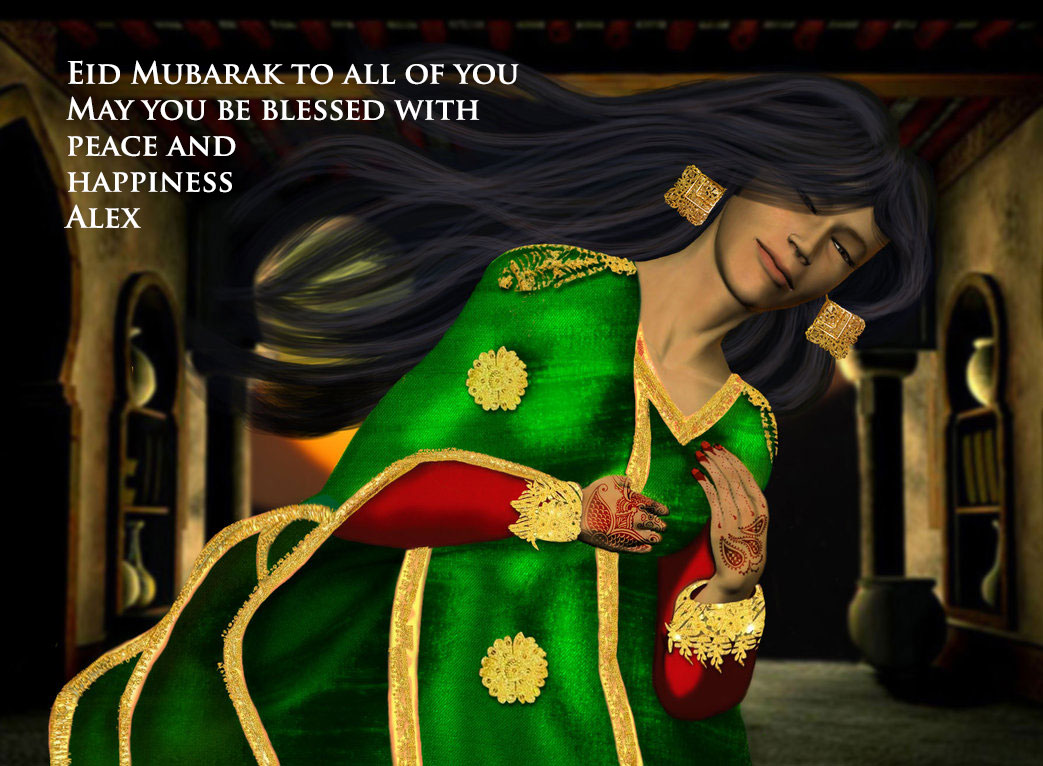
Ramadan is over and the Muslim world and the Middle East is celebrating the Islamic festival of Eid. My very talented and lovely wife did me a design for the occasion for you all (I’ll admit I’m a day late posting this due to Eid obligations and niece sitting yesterday!).

So, as we say here Eid Mubarak to you all. Kol ahm wa intum bkhayr, or may you enjoy peace, good health and prosperity for the year to come!

The image is of a Bahraini folklore dancer. My wife says its a work in progress but the image looks great to me (well, I’m biased anyways!)

AlBaik… The best fast food in the world? And it’s Saudi!

AlBaik. If you’ve been to Jeddah the name is unforgettable. AlBaik is delicious, jaw-dropping, explosion-in-the-mouth chicken. Either broasted or fried, AlBaik chicken is so popular that the restaurant chain does travel packs for plane-bound travelers.

The chain is Saudi-owned and based in the country’s Western Region (think Jeddah, Mecca and Medinah). Next to AlBaik no other fast food chain gets a look in. This place is so popular that when AlBaik raises its prices the news makes national headlines (and you can read it here if you don’t believe me).

Here’s two clips of AlBaik from Youtube. One is from the Travel Channel. The other is AlBaik opening after prayer time (trust me, this clip isn’t an exaggeration). I will start blogging more on Saudi culture so enjoy!

And again, trust me, the below isn’t a fake video.

Freshly Pressed and why it’s good for you and your WordPress blog!

I was Freshly Pressed last week by the good people at WordPress and all I can say is WOW, what an experience! Not just content in offering one of the best blogging tools and content management systems around, WordPress has a wonderful feature called Freshly Pressed.

Basically Freshly Pressed is a means by which WordPress promotes a handful of blogging sites on a daily basis through their home site (have a look here at http://wordpress.com/#!/fresh/). Freshly Pressed aims to bring to a wider audience some of the great content being produced and published in the blogosphere.

The team at WordPress have a great write-up as to why you should care about being Freshly Pressed and how to be noticed by their editorial team – you can access their tips and hints here at So You Want To Be Freshly Pressed.

To date there’s 425,657 bloggers on WordPress and 891,995 new posts being published daily, so there’s a lot of content to be read and reviewed by the editorial team at WordPress.

However, if you are one of the lucky ones to be featured on Freshly Pressed you are going to find yourself being viewed by a whole new audience of bloggers who will engage, read and follow you. It brings a whole new meaning to the concept of content distribution and is an example of the importance of promoting your content. No matter how good you are, if your words are comparable in quality, wit and style to Shakespeare, Chaucer, or Sophie Kinsella, you’re only good if you are read. Get out there, be read, and gain an audience!

My experience with Freshly Pressed was just remarkable. A hundred fellow bloggers liked the post, I had fifty insightful comments, and then there was the traffic. Put simply, it’s the blogging equivalent of Christmas Day.

Thank you once again you lovely people at WordPress, and all of you bloggers who engaged with me. You really do make all of the time, effort, energy and research that I put into blogging worthwhile.

A screen shot capture of my blog on Freshly Pressed. Once you’ve gone Freshly Pressed blogging will never be the same!

A timeless video of Wadi Rum. Don’t you wish you were here?

A diversion here from the norm, but this video is beautiful. The location is Wadi Rum in Jordan, where Lawrence of Arabia was shot. Just click play and enjoy!

Are journalists putting too much trust in social media sources?

The internet and digital communication has had a profound effect on the media industry. Media can be distributed globally in a matter of moments, and the ease with which journalists can find sources has been greatly aided by tools such as Twitter. Need a quote? Then search a hashtag on Twitter or for a blog via Google and find a credible source.

There’s no denying that social and digital media are shaping how journalists work. Rather than quoting in the traditional sense, news articles reference tweets.

There are risks in referring to sources in this manner. Can you trust that they person is who they say they are? Do they really represent those who they claim to be talking on behalf of? Do they know the subject well enough to be viewed as a credible source?

I can imagine that the Arab Spring has been both exciting and infuriating for media. Many countries have not taken too kindly to media entering their borders and reporting on goings-on. There have been some groundbreaking stories coming out of Syria in particular, with journalists putting themselves in harms way to report on the ground.

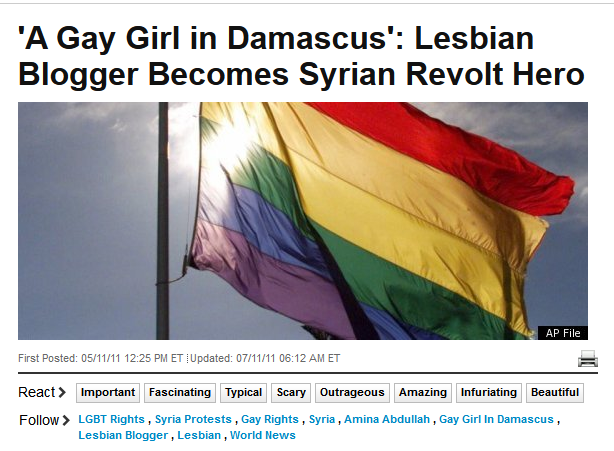
And then there has been instances of deception. The worst was the case of the Gay Girl in Damascus, who went from being a global source on what was going on in Syria through her blog to…

… an American graduate student named Tom MacMaster who was studying in Scotland.

The hoax may be the worst case example of what can go wrong when using online media for references. What concerns me more is when journalists and media outlets source speakers online. Unless they’re careful, the people who end up becoming the witnesses or the quoted experts are those with the biggest following online.

Of course, this doesn’t just happen online. I was listening to a post on the BBC World a week ago and heard a report about the first Saudi female Olympians. The person being interviewed was a female Saudi journalist residing in New York.

As I sat listening to the report, I could not help but ask myself why was the BBC interviewing a person sitting thousands of miles away from the country under focus. Would this person hold a mainstream opinion? Even some of her facts which she used to corroborate her arguments were flimsy (for example, she said there are no female gyms in Saudi Arabia, which is false).

Being a good journalist is one of the hardest jobs out there, especially in the Middle East where people can often be reticent around media and yet the editor still wants the story filed ASAP. However, I would like to ask my friends in the media to think before they quote from online, and ask themselves if they’re background checking that person, if they need to quote the same person for the Xth time, and if they should quote from online sources when alternatives are available.