Unknown's avatar

About alexofarabia

I'm am obsessive compulsive communicator who has lived in the Gulf for almost a decade. Enjoying the challenge of working in a region where you've got to be innovative, patient and determined to make things happen. Miss being a full-time journalist! Miss family even more! Sometimes I mouth off, but more often I grit my teeth and try to encourage change through a smile (not as easy as you think). Despite now living in Dubai Bahrain is home for me.

The launch of LinkedIn Arabic – Did LinkedIn miss a messaging opportunity?

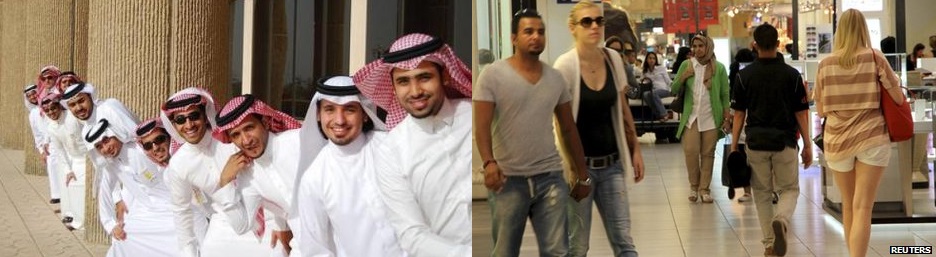
If you're going to launch in Arabic where would you choose? Dubai or Riyadh? (image source: Reuters)

If you’re going to launch in Arabic where would you choose? Dubai or Riyadh? (image source: Reuters)

I love LinkedIn. It’s possibly my favorite social media network. LinkedIn has transformed how professionals network (and get jobs) online. No recruiter could do without LinkedIn.

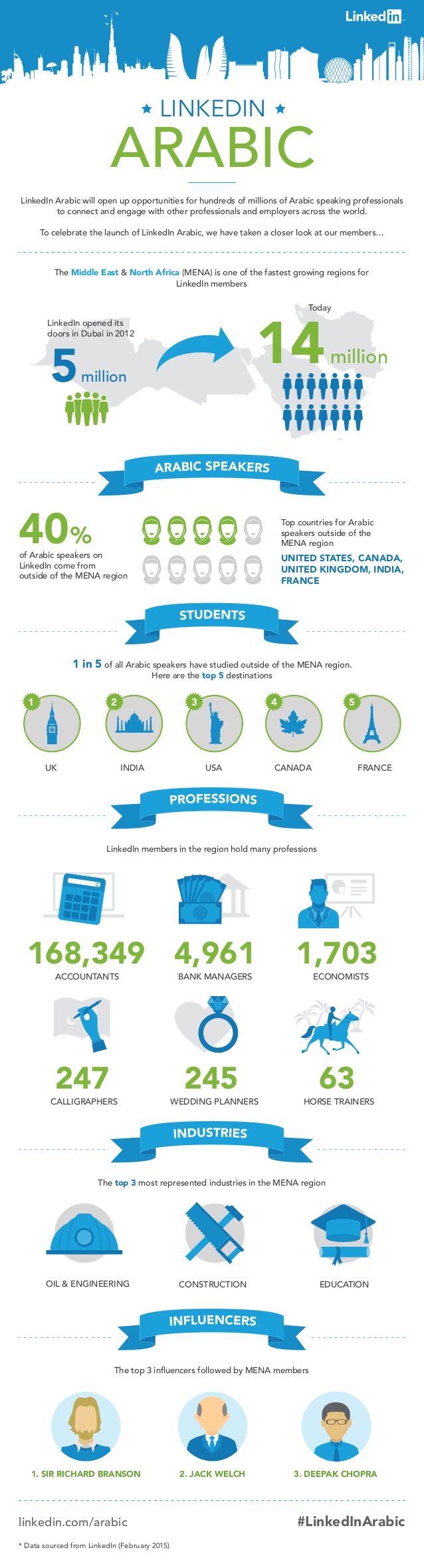
The network has grown steadily in the Middle East since it opened up an office in Dubai back in 2012. Over the past three years LinkedIn has grown its user base from five to fourteen million. The UAE is LinkenIn’s largest market with two million users according to The National. The two largest Arabic-speaking markets in the region are Egypt, with a population of just over 82 million, and Saudi.

The Kingdom is, or should be, LinkedIn’s largest potential market. Saudi doesn’t only have a sizable Arabic-speaking population (28 million and counting), but it also has the spending power. Saudi’s gross domestic product for 2013 was just under 750 billion dollars. Saudi is home to some of the region’s largest corporations, as well as a majority of the country under the age of 25. Add to the mix high internet penetration and smartphone usage, Saudi is LinkedIn’s Arabic-language market.

However, when LinkedIn launched its Arabic-language site last week the management team chose Dubai as the preferred location. There was a guest advocate, in the shape of Noura Al Kaabi, CEO of Abu Dhabi’s twofour54. Bizarrely, LinkedIn’s press materials also included a press statement from Saudi’s Minister of Labor, which was carried extensively in the Kingdom’s media (the quote in full is below and is sourced from Saudi Gazette).

Eng. Adel M. Fakeih, Saudi Arabia’s minister of labor, said: “LinkedIn has been working with us to match talent in the Kingdom with the right opportunity, and with Arabic, this benefit can be rolled-out to a much wider member base.

LinkedIn will continue to be a useful tool for us as we use technology to communicate the need for nationals to up-skill themselves and take advantage of the strong economic climate and significant job-creation in the Kingdom.

Being a part of a global network also helps youth identify the key demand areas, and build their qualifications accordingly.”

Would LinkedIn have been better served by launching Arabic in Saudi, rather than in the UAE (where it could be argued that the lingua franca is English). Would this activation have been more in line with the message that LinkedIn was trying to convey, namely that we are now in Arabic and we want Arabic speakers to use our service.

It’s a small observation, but it seems that LinkedIn missed an opportunity to push home a message through a launch that was misaligned with its target audience. Saudi isn’t the easiest country in terms of getting things right on the ground, but if you’re going to do something then, as the saying goes, if it is worth doing then do it right.

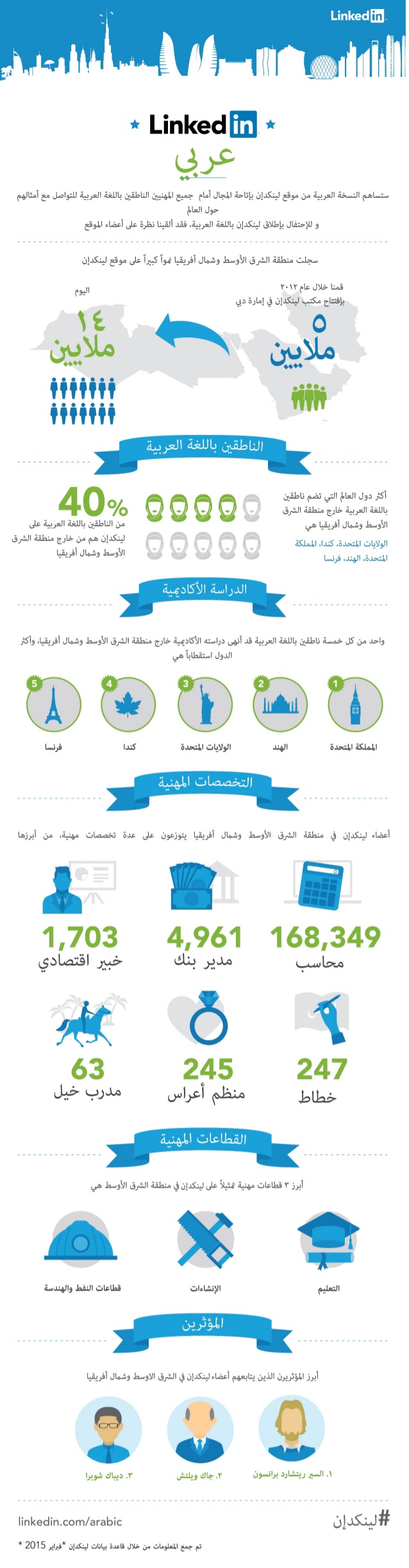
And for more details on LinkedIn in the Middle East have a look at the infographics below, which are in English and Arabic.

What not to say on live TV – Qatar Airway’s CEO and the bull**** comment on CNN Money

There’s few things worse to do on live television than swearing. Unless you’re a CEO that is. After being accused of treating foreign workers, especially female cabin crew, with disdain in an article published in the Washington Post (the article is entitled ‘The surprising ways in which some flight attendants are still made to live in the 1960s’), Akbar al-Baker did the media rounds to defend his airline’s position and dismiss the claims. Watch the video and the offending comment for yourselves.

To say Akbar al-Baker is gaffe-prone would be an understatement. He has led the airline since 1997 through a period of unparalleled growth. However, when does a leader become a liability? Is Akbar al-Baker, of which much has been said by former staff, a liability to the airline and to Qatar?

The #truthbetold – How Saudi’s UTURN and @omarhuss are tackling taboos through social media

By its very nature, a taboo can be difficult to talk about. Breaking a taboo is traditionally objected to by elements of a society. What we’re seeing in Saudi is an effort to tackle taboos through social media. One of the leading digital and social media agencies is Jeddah-based UTURN, and its founders and presenter Omar Hussein have taken it on themselves to tackle sensitive subjects. Their idea is simple – create scenarios whereby they provoke Saudis to respond to the situation through actors and staged behaviours, record their reactions, and package this for distribution over the internet.

Named #truthbetold or #الحق_ينقال in Arabic, Omar Hussein and UTURN have tackled several issues to date since they began their series at the end of November. The first, in partnership with Ikea Saudi Arabia, was the issue of Saudi women working as cashiers. An actor in the queue would begin cursing the female cashier to prompt a reaction from the audience around him. The video is below and is only in Arabic. However, it is worth watching just to understand the issue and the responses of those featured.

The second, launched a month after at the end of December, is on the issue of alleged racism towards foreign workers in Saudi Arabia, and was staged in the roast chicken chain Tazaj. Again, the video is in Arabic but the body language of those in the set and who are not aware of acting can be read by any person watching.

Released at the end of January, the third episode tackles the issue of child workers in Jeddah. Done in partnership with the Fatoor Faris restaurant, people are seen responding to a Saudi actor abusing a child actor who is pretending to sell him gum.

Each video has been watched over half a million times, and, even more importantly, UTURN is using Facebook as a means for Saudis to discuss these issues. The idea is so simple and yet so powerful. Thank you UTURN and Omar Hussein for doing this. I wish others were as creative and as brave as you.

And I wish that communicators would look at Saudi, a country which is viewed as the most traditional and conservative in the region, to understand how we can better use social media to change perceptions, attitudes and behaviours. You and others in the Kingdom are leading the rest of the Gulf in terms of how we use social media for change.

Is @Dubai_360 a work of genius or a Google Street View imitation?

There’s a fine line between inspiration and mimicry. At the beginning of the year, Dubai’s Tourism and Culture Marketing body launched Dubai 360, which it markets as the world’s largest and highest quality interactive city tour.

Launched with some amazing video shoots (one of which you can see below which featured local social media celebrity Max Of Arabia), Dubai 360 offers visitors a glimpse into some of Dubai’s most iconic locations such as Burj Khalifa and the Palm. The visuals contain 360° photos and videos and a range of different lens styles such as fisheye to give viewers a unique picture of Dubai wherever they may be.

While the site is very impressive, it is reminiscent of Google Street View. Launched in 2007, Google Street View provides panoramic views of both cities and notable tourist spots around the world. Google actually launched its Street View in Dubai in December 2014.

Dubai 360 has some stunning visuals and videos, and helps tourists understand Dubai from a variety of views. However, with both sites being launched only a month or so apart, would Dubai have been better placed to work with Google to create a co-branded/sponsored site? There’s enough to make the Dubai 360 site outstanding, but will viewers feel that there’s enough here to mark it out as a different experience to Google Street View?

Have a look at the images below, one of Burj Khalifa from Dubai 360 and the other of Burj Khalifa from Google View, and if you haven’t yet checked out Dubai 360 do so. Now.

Inauspicious Beginnings or PR Coup: Al Waleed’s Al-Arab TV station and how it was shut down on its opening day by Bahrain

Al Waleed’s Al-Arab is now known worldwide thanks to Bahrain’s closure of its operations on its first day of broadcasting (image source: http://www.bbc.com)

Have you heard of the saying, ‘There is no such thing as bad publicity’? If you’re a communications professional at BP or you work for Bill Cosby you may feel differently, but the quote, often attributed to the American self-publicist PT Barnum, still rings true in terms of brand awareness and familiarity.

One man who doesn’t lack for publicity is the Saudi Prince Al Waleed Bin Talal Al Saud. Al Waleed, who has long had an interest in the media (he owns stakes in News Corp, Fox and Saudi Research and Publishing Group), set out his own media vision for the region a couple of years back when he announced his intention to set up his own news channel. Named Al-Arab, the channel would compete with the likes of Al-Jazeera and MBC Al-Arabiya to shape the news agenda.

After years of planning, the channel went live this week. Al-Arab is based in Bahrain, ostensibly to allow the channel to benefit from Bahrain’s relative media freedoms and, as the channel’s general manager and Saudi journalist Jamal Khashoggi put it, to cover “all views” in the region.

On its first day of operations the channel was temporarily suspended by Bahrain’s information ministry. Akhbar al-Khaleej, a pro-government paper, reported that the suspension was due to the channel “not adhering to the norms prevalent in Gulf countries”.

The allegation is that Bahrain’s government took offense to an interview aired with Bahraini opposition activist and politician Khalil al-Marzooq, who was talking about Manama’s decision at the weekend to revoke the citizenship of 72 Bahrainis.

The closure has made headlines worldwide, and has guaranteed headlines for Al-Arab in capitals such as Washington, London, Paris and Berlin. While the closure may have been an operational nightmare, for a publicist it has been a coup. As Oscar Wilde put it, the only thing worse than being talked about is not being talked about. By this measure Al Waleed should be delighted with the launch of his television channel.

The stunt may have also have helped to cement Al-Arab’s position as a channel that will tackle any and all subjects. Before the channel’s launch, Khashoggi stated the need to be both bold in terms of talking about taboos as well as the need to discuss issues from a balanced perspective. “We are going to be neutral; we are not going to take sides,” he said. “We are going to bring in all sides in any conflict because right now we have a conflict in almost every Arab country.”

By setting down this marker from day one, will Al-Arab be able to set itself apart from other channels in the region which do have particular media biases. Will Al-Arab create a middle ground that wins over Arab audiences?

According to Al-Arab’s Twitter feed the station will be operational again soon. I for one can’t wait to watch its re-launch.

And if you want to see the alleged reason for why Al-Arab was shut down watch the clip below.

Baker & McKenzie Habib Al Mulla, Asdaa and OSN and when the client apologized before the agency

Have you ever heard of a client apologizing a week before the agency sends out a correction? (image source: http://www.tumblr.com)

There are few surprises left for veterans of the media, marketing and communications industry in the Middle East. However, every now and then something pops up that can raise a smile or cause a roll of the eyes.

One such story is the unusual case of the UAE-based Baker & McKenzie Habib Al Mulla. Through its public relations agency Asdaa, the law firm put out a release entitled ‘Mergers and acquisitions boom in Middle East’, which laid out the most notable M&A activity in 2014 and Baker & McKenzie Habib Al Mulla’s predictions that cross-border mergers and acquisitions would pick up pace in 2015. The original story is still online here at Khaleej Times.

All well and good we all may think. Except, there was a mistake in the release. And it wasn’t a simple typo or grammatical error. No, it was much more serious. Have a look at the below paragraph.

The Media and Entertainment sector was the largest recipient of inbound M&A activity in terms of value with almost 36 per cent share. This was driven by the $3.2 billion sale of Orbit Showtime Network Co, a Dubai-based owner and operator of TV station, to an undisclosed US private equity firm. This is also the largest deal since 2010.

There was a problem on the above information about OSN’s sale. It never happened. Dubai-based business monthly Trends Middle East was the first publication to point this glaring error out in a blog post. Trends’ editorial team did what any good bunch of journalists should do, and they verified the facts contained in the release. Unfortunately, a number of other publications didn’t (the list is on the Trends website).

The Trends team then reached out to all the parties involved, including Baker & McKenzie Habib Al Mulla, Asdaa and OSN. OSN issued a statement denying the information in the release. Baker & McKenzie Habib Al Mulla also put out a statement to Trends which you can read below.

“Baker & McKenzie Habib Al Mulla would like to clarify that our recent analysis regarding M&A activity in the Middle East was based on data from Thomson ONE Analytics, part of Thomson Reuters. “The data comprised announced deals as of December 14, 2014, including the proposed sale of OSN. Thomson Reuters’ criteria for announced deals include deals that are completed, intended, partially completed, pending and unconditional. We apologize for any unintended misunderstanding regarding the status of OSN’s proposed sale.”

However, despite reaching out to Trends and two days after the press release was issued, Asdaa hadn’t gotten back to Trends with a clarification (as per Trends’ own website). A statement was sent out to the media by Asdaa nine days after the incorrect release was published, and a week after Asdaa’s client had gotten back to Trends with the correction email. The correct as of January 6th is below.

“Baker & McKenzie Habib Al Mulla would like to clarify that our recent analysis regarding M&A activity in the Middle East, issued on 23 December 2014, was based on data from Thomson ONE Analytics, part of Thomson Reuters. The data comprised deals announced during 2014, including the reported approach by an un-named US private equity firm for the acquisition of OSN, which did not proceed. Please note the reference to the sale of OSN was incorrect.

Although an offer was announced in July 2014, the offer was rejected by OSN’s shareholders in August 2014 and OSN continues to be wholly owned by Panther Media Group Limited. We apologise for any unintended misunderstanding regarding the status of OSN’s ownership.”

I have to ask, is this the first time a law firm has apologized before its agency? It’s normally the communications and public relations firms who advocate for a quick and speedy apology. When it seems that a quick and speedy resolution could have brought this to a close, especially in a social media age where the recommended response time is literally 15 minutes, why did the client say sorry before the agency? If the communications industry is to consult and advise clients in a trusted manner, we really have to do better. Let’s hope that those involved have processes in place to both fact-check and, when something goes wrong, get back to media in as short an amount of time as possible.

What are your thoughts?

Lost in the fog – is Etihad’s social media crisis down to an operational failure?

For some passengers, the experience of the fog and resultant delays weren’t helped by Etihad’s social media support despite the best efforts of the social media team (image source: http://www.todayszaman.com)

I love challenges. I’m an even bigger fan of crises. They seem to bring out the best in us, pushing us to our limits and testing our abilities. While I admit to enjoying being put through the ringers, I do feel for Etihad’s social media team during a bout of fog at the beginning of January. On the first Saturday of the year, during a peak time of year for travel, think fog descended on the UAE’s capital and closed Abu Dhabi International Airport for just over an hour. The airport’ closure affected Etihad’s scheduling for several days.

Before I go further, let me brief you on the airline’s communications outreach. Etihad has a sophisticated social media set-up, including a dedicated Twitter account for Etihad’s customer service, at @EtihadHelp, as well as customer support on Facebook. Etihad’s response time is usually less than 20 minutes, and each and every customer correspondence from the team is signed off by the team member’s initials.

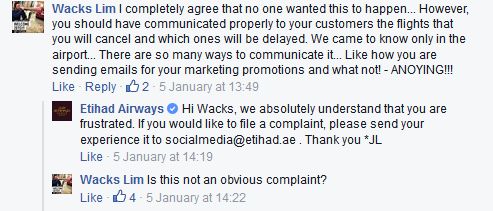
The fog literally consumed the social media team however. As people, the one instance that we can all agree on is that we hate anything going wrong when we travel, including travel delays and lost luggage. Stories of delays, including passengers stranded on the tarmac for half a day, without food or information, made headlines globally. Etihad’s social media channels were replete with angry passengers looking for a solution to their problems. Have a look at some of the exchanges below as well as media coverage.

This is one example of many of the discussions that took place on Facebook between Etihad and its customers following the fog

This is one example of many of the discussions that took place on Facebook between Etihad and its customers following the fog

https://twitter.com/ravaliareddy/status/551286654938251264

A number of thoughts come to mind. While Etihad has a stellar social media operation, how much leverage does the social media have over operations. Or to put it slightly differently, what accountability is there between operations and the social media team. Does the organizational structure, either formal or informal, help or hinder the social media team’s operations on behalf of customers? Etihad is a large organization of just under 15,000 employees; what can the social media team do on the customer’s behalf?

I’ll admit, these are special circumstances. Thousands of passengers were either stranded or had their luggage misplaced. However, we now live in a connected world where consumers’ expectations are amplified. While social media can speed up communications with consumers, is social media being set up to fail if operations cannot keep up? What are your thoughts?

Social Media trends for 2015 – Instagram hacking

We’re only a few days into 2015 and yet we’ve already seen one trend that is likely to become a major issue in the Middle East. Over the past two weeks a number of Instagram accounts of celebrities and well-known figures have been hacked. The first to be targeted, at the end of 2014, was the Lebanese singer Nancy Ajram.

Nancy Ajram’s account was hacked at the end of December

Ajram was only the first of a spate of hackings. Only this week the Crown Prince of Dubai, Sheikh Hamdan Bin Mohamed’s Instagram account was broken into by a hacker called @MRJL6H, who posted a number of images with text which can be translated as ‘we do not claim to be intelligent, but seek to destroy those who themselves claim to be intelligent.

Sheikh Hamdan Bin Mohamed's instagram account was hacked for only a short period but the hacker posted a number of images

Sheikh Hamdan Bin Mohamed’s instagram account was hacked for only a short period but the hacker posted a number of images

The hacker @MRJL6H posted several images highlighting his/her views on Sheikh Hamdan's Instagram account

The hacker @MRJL6H posted several images highlighting his/her views on Sheikh Hamdan’s Instagram account

Yesterday, a Bahrain-based actress and model Shaila Sabt was hacked in a similar manner to that above by @2h2, using presumably the same techniques used to hack into Sheikh Hamdan’s and Nancy Ajram’s accounts.

Bahrain-based actress Shaila Sabt had her Instagram account hacked by @2h2 in what seems to be a copycat of the hack on Sheikh Hamdan's account

Bahrain-based actress Shaila Sabt had her Instagram account hacked by @2h2 in what seems to be a copycat of the hack on Sheikh Hamdan’s account

There seems to be no reason to attack these Instagram celebrities, besides from the number of their followers. However, the compromising of these accounts is a reminder to everyone online to be aware of their security and initiate two step authentication where possible. If you’d like to know more about two step authentication read Google’s advice here.

My own feeling is that this trend will only grow during 2015. We’ve been fortunate to avoid hacking incidents, despite the popularity of social media in the Gulf. That may change over the coming 12 months, and we may see many more social media celebrities being hacked, either for fun or to spread a particular political or social message.

The curious case of the Dubai TV station which was fined for not airing an interview

Lights, camera, and no action! The Dubai-based station was found to be acting unprofessionally by a Dubai court for not showing an interview, and fined 100,000 Dirhams for its improper conduct (image source: http://www.dreamtek.wordpress.com)

Are you looking for a bizarre story to start off the year? If so, you’re in luck. Dubai’s English-language newspaper Emirates 24/7 reported on the case of a Dubai TV station which was fined over 25 thousand dollars for not airing an interview. Yes, you read it right. The station was fined by a court in the Emirate for not broadcasting a pre-recorded interview. You can read excerpts below.

A well-known guest won a court case and was compensated Dh100,000 by Dubai Court from a TV channel which did not broadcast his interview. A person sued a satellite channel after it hosted him in one of its programmes and did not broadcast the episode after broadcasting advertisement on the channel of his interview and instead broadcasting the interview of a different person.

The plaintiff said that the TV channel approached him for an interview and sent him air tickets and booked him into a hotel. It also recorded an interview with him and said that it will be broadcasted on a particular date.

The plaintiff added that on that day, the TV channel announced that the interview would be broadcasted at a particular time. However, on that time, the TV channel aired an interview with a different person and did not show his interview.

The plaintiff added that he got in touch with the TV channel and tried to find out their reason for not airing his interview, but the TV channel did not give him any answer.

He also said that he requested the TV channel to make an apology for not showing his interview, but there was no response from them.

This, according to the plaintiff, affected him and caused moral damages to him and he filed a lawsuit against the channel before the Dubai Court to compel the TV channel to pay him half-a- million dirhams.

The Dubai Court of First Instances ruled in favour of the plaintiff and that he was eligible of Dh100,000 as compensation for his subsequent psychological and moral damages.

According to Emirates 24/7 the case was reviewed by both the Court of Appeal as well as the the Court of Cassation. The Court of Cassation said in its ruling that the TV channel was guilty of misconduct, and that the station had failed to comply with professional ethics as well as the Press Code of Ethics.

The report doesn’t refer to a specific code of ethics document; in 2007 the UAE media adopted a code of conduct. However, this agreement was based on principles such as respect for the truth, freedom and integrity, fairness to all, transparency, rightful acquisition of information, accuracy in reporting, elimination or minimizing harm, especially in relation to children, credibility in reporting, and respect for personal privacy. The agreement did not seem to be a binding legal contract, and there is no mention of a scenario such as the one above in the reporting on the code of conduct.

I have to hold my hands up and say I’m dumbstruck by this news. For a legal professional to pass judgement on what is essentially a business decision by a news outlet is illogical. The channel did not breach any laws, and it is the right of any media outlet to decide what does construe and what does not construe news. The plaintiff was not out of pocket as his expenses were paid for. His only loss was his time.

The above sets a dangerous precedent for both the media and communicators in the region. While I’m all in favor of professional behaviour for journalists, I also understand and support the right of media outlets to air or publish news as they see fit. The judiciary stepping in to penalize media outlets for simply doing their job is a dangerous precedent for all of us. This is one precedent that I hope is not considered again in any repeated legislation.

How many followers have been lost by the Gulf’s Instagrammers?

Instagram has deleted millions of fake accounts, pulling down the follower numbers for many accounts in the Gulf (image source: http://cdn.slashgear.com)

This week, photo-sharing app Instagram removed millions of accounts believed to be posting spam. The action, which has been dubbed the “Instagram Rapture”, hasn’t spared Instagrammers in the Gulf. Instagram is popular in the Gulf, particularly in Kuwait, where some Instagrammers have become celebrities in their own right and have turned the application into a living.

Globally, many of the world’s top 100 Instagram accounts have been hard hit by Instagram’s move to delete fake accounts. Figures released by developer Zach Allia have revealed that celebrities such as Justin Bieber lost over 3,500,000 followers.

So, how did our own Instagrammers do? For Kuwait, stats compiled by the website Kuwaitiful compare numbers before and after. Have a look below at the top accounts in Kuwait (not all are Kuwaiti based, mind you).

Before and after the Instagram purge in Kuwait. Some accounts have hardly been affected, while others have seen their follower numbers fall drastically (source: www.http://kuwaitiful.com/)

Before and after the Instagram purge in Kuwait. Some accounts have hardly been affected, while others have seen their follower numbers fall drastically (source: www.http://kuwaitiful.com/)

For Saudi and the UAE, I’ve gone to Social Insider which also compiled the numbers before and after. Again, we’re seeing a similar picture, with some accounts hardly affected, while others have lost a double-digit percentage of followers (apologies for the image size, but you can zoom into the image to read the numbers).

This list of Instagram accounts from Saudi and the UAE includes the numbers from before and after the purge. One account lost 40% of its followers (source: www.http://social-insider.com)

This list of Instagram accounts from Saudi and the UAE includes the numbers from before and after the purge. One account lost 40% of its followers (source: www.http://social-insider.com)

The reaction from celebrities in the US hasn’t been kind. Rapper Ma$e, who lost more than a million followers, deleted his account after being accused for buying followers. How will those celebrities in our region respond, especially the accounts which have lost over ten percent of their total follower numbers? Also, will this affect how much these Instagrammers are charging for posting paid content? It’d be interesting to hear your thoughts on this one.