Unknown's avatar

About alexofarabia

I'm am obsessive compulsive communicator who has lived in the Gulf for almost a decade. Enjoying the challenge of working in a region where you've got to be innovative, patient and determined to make things happen. Miss being a full-time journalist! Miss family even more! Sometimes I mouth off, but more often I grit my teeth and try to encourage change through a smile (not as easy as you think). Despite now living in Dubai Bahrain is home for me.

A how-to on the UAE’s “Social Influencer” Licensing & three outstanding questions

It’s almost Ramadan, the time of year when we post and pray. This year’s Ramadan may be a little different, possibly more stressful for some. Under regulations introduced in March by the UAE’s National Media Council (NMC), those making money to promote brands will need to be signed up with an e-media license by June or else face fines and other sanctions.

In the rest of this post, I’ll share the definition of what is an influencer as per the NMC, the process to get certification, as well as three questions I have on issues which maybe aren’t addressed or which have not been talked about. Thank you to Lexis Nexis and Fiona Robertson at AlTamimi for the below.

Who is an “influencer”?

The legislation is straightforward as to who is covered. To quote from the National Media Council:

“Any person who practices the above-mentioned media activities on Social Media, on a commercial basis, shall obtain a prior license from the Council, provided that:
1. It shall have an account on the generally recognized Social Media;
2. Ads that are presented on Social Media shall be subject to the advertising standards that are applicable at the Council;
3. Social Media accounts’ owners who offer paid advertising services shall obtain a license from the National Media Council in accordance with the applicable regulations in this regard and hereunder.
4. The account owner is responsible for the content of the account.”


The resolution covers all electronic media across the country. And the NMC defines electronic advertising as “any paid or unpaid form of presentation or promotion of ideas, goods or services by electronic means or network applications”.
For a person to get an e-media license, they’ll also need a trade license. The cost of both will be a minimum 30,000 Dirhams depending on where you buy your trade license (the e-media license is 15,000AED).

How do you get a License?

Below are the requirements and the process to follow to apply for an e-media license:

e-media license

The three questions

I’m sure there’s lots of questions from people who work in the marketing and communications industry on this new legislation. My three are:

  1. How does this cover children? There are some child stars in the US who have made millions from social media. Think of “Toys Review for kids by a kid!, for example (the six year-old child and his family have made in excess of 10 million dollars). Does the legislation cover this? There are young social media players here such as Rashed Belhasa who I assume are putting out paid content.
  2. What happens to those pushing out content on behalf of employers? The definition of electronic advertising is wide enough to ask me this question. Many employees share content from their employers. I’m assuming this won’t come under the purview of the NMC, but it’d be good for them to explicitly say so.
  3. Is this a blow to the concept of micro-influencers? The idea of people with smaller followings online, say 20,000 on Twitter and Instagram, working with brands has become popular over the past year. Often these people don’t take much money in return for sharing any content or working with a brand. Would they be able to afford the licensing? In addition, would an influencer agency want to take them on board, and bevvy up the cash with the prospect of getting a lower return than working with someone more established, with stronger brand appeal and a greater number of followers?

I guess we’ll find out how this all plays out soon. In the meantime, Ramadan Kareem!

Dubai’s new volunteering law – the basics and what it means for you

Volunteering in the UAE has become more common, but it’s not clear what impact the law will have on volunteer numbers (image: Time Out Abu Dhabi)

Last month Dubai introduced for the first time legislation covering volunteering in the Emirate. The new law, which was passed a week ago, will impact both the public and organizations who want to donate their time and skills for free to local charities.

I’ll share information on the new law below from Gulf News, as well as analysis on the law at the bottom. As the law is now in effect, if you want the most up to date advice you will need to reach out to Dubai’s Community Development Authority (CDA) which is charged with its implementation.

Competencies 

The law grants the CDA a number of specialisations and jurisdictions regarding voluntary work, which include drawing up plans and public policies for voluntary work in Dubai and supervising their implementation, as well as encouraging public and private bodies and enterprises to launch voluntary work initiatives in Dubai.

The authority will also be responsible for approving the template for voluntary work agreements in coordination with bodies accepting volunteers, in addition to setting up a database to register volunteers in the emirate. (my emphasis here)

Analysis – All volunteering must be part of a wider agreement, and all volunteers must be logged into a database by the CDA.

Specialised volunteer work 

The law specifies that certain qualifications, expertise and conditions are required when it comes to specialised volunteer work, and specialised volunteers will need to have a license and the necessary permits from relevant bodies.

The CDA will issue licenses for specialised volunteer work when it ascertains that all conditions listed in this law have been met.

Analysis: If you’re a specialist (say a lawyer, or an accountant) then you’ll need to get permissions from the CDA (and other bodies) before volunteering. It’s not clear what other bodies the law is referring to here.

Volunteering teams 

Volunteers can set up teams, according to the law, on the condition that the team is registered in the official CDA database, and the nature of these teams, as well as terms and conditions that they should meet, will be set through a resolution issued by CDA’s Director-General.

Volunteers or volunteer teams are not allowed to collect donations or announce that donation will be collected until they have notified the CDA and have received the approval of concerned bodies.

As per the law, specific hours can be allocated during the official working hours of public and private employees in Dubai to participate in various volunteering activities, as long as it does not infringe on their vocational rights. The employers of the volunteering employees will have to coordinate with the bodies who are accepting the voluntary work prior to nominating any of its employees for carrying out institutional voluntary work. The public and private bodies will bear the responsibility for any consequences resulting from the voluntary work of the volunteers.

Analysis: If you’re a corporate or public sector body and you have a team donating their time, the full details will need to be logged by the CDA. No donation-collecting will be allowed (that’s already in practice at the moment). Plus, it looks as if the CDA is requesting corporates for employee volunteering to only happen during office hours. Any work done will be the responsibility of the organization which the volunteer employees work for.

Obligations of bodies accepting volunteers 

The law obliges government and private entities, including civil establishments licensed to work in Dubai, to set their voluntary standards and regulations and provide the Community Development Authority with these standards and controls, as well as to identify categories of volunteers and the nature of the work that each category can perform provided that the volunteer work shall be compatible with the volunteer’s qualifications and intellectual and physical abilities. 

The entities shall be obliged with training volunteers to carry out the tasks entrusted to them and helping them to highlight and foster their talents and ensure that their abilities are used properly.

The entities obligations include recording the volunteers’ data, the nature of voluntary work entrusted to them and the number of hours they volunteered in the database approved by the Community Development Authority, providing volunteers with necessary equipment, tools and information, and with insurance against injuries, infections and civil liability for harming others. 

Entities accepting volunteers shall be thereby responsible for all voluntary work expenses, including that of for the treatment of volunteers of any damage sustained while performing volunteer work, provided that such damage is caused due to the fault of the bodies in which they are volunteering with.

The entities obligations also include ensuring the safety of volunteers and beneficiaries of voluntary work against any damage that they may suffer from in the course of doing voluntary work, developing a preventive and safety system in coordination with the competent authorities, not to assign volunteer with more than (420) voluntary hours within one year, overseeing volunteers to verify that they are doing voluntary work as required, awarding the volunteers appreciation certificates once they complete the voluntary work perfectly.

Analysis: This seems to set out the need for all those entities involved in volunteering to have minimum written standards on the type of volunteering they’re offering/engaged in, who volunteers and whether the two are suited to each other. All volunteering needs to be logged and that information provided to the CDA. Charities will be liable for ensuring that volunteers are treated well (would this require insurance, I wonder?).

Voluntary work agreement

According to the law, the bodies accepting volunteers may seek help from volunteers as per the voluntary work agreement prepared by the CDA. The agreement shall contain all details regulating the relationship between the volunteer and the body they are volunteering in.

The law stipulates that the volunteers must not be less than 18 years old, otherwise, they need to get the approval of their guardians. Volunteers must be of good conduct and physically capable of undertaking voluntary work.

Analysis: The CDA will begin issuing voluntary work agreements to codify and professionalize volunteering. Volunteers will need to have clean records in order to be able to volunteer.

Rights and duties of volunteers 

The law stipulates that volunteers must abide by the voluntary work agreement and complete the voluntary work perfectly within the pre-determined time. Volunteers must respect the principles, goals and regulations of voluntary work set by bodies accepting volunteers. They also must respect the confidential information that they come across while carrying out voluntary work.

Volunteers must commit to the limits of the voluntary work, its goal and not to delve into the affairs of the bodies they are volunteering in. They must maintain the equipment and devices that they are given for voluntary work and to give it back to the bodies once the voluntary work is done.

Analysis: I’m not sure if any is needed here!

In conclusion, the law seeks to codify, measure and professionalize volunteering. However, there’s lots of questions still to be asked. How complex will volunteering become, and what other legislation or activities will the Government of Dubai undertake to promote volunteering. As the law has now been published, it’s already in effect. Charities, individuals and organizations involved in volunteering will have six months to ensure their full compliance.

You can download the full law here (in Arabic) – Dubai volunteering law

The Global Capability Framework and how it will raise awareness of our roles as communicators among our HR colleagues

The World Public Relations Forum took place last month in Oslo. The event, probably the world’s biggest gathering of international PR professionals, included an announcement by the University of Huddersfield and the Global Alliance on the launch of the Global Capability Framework (GCF).

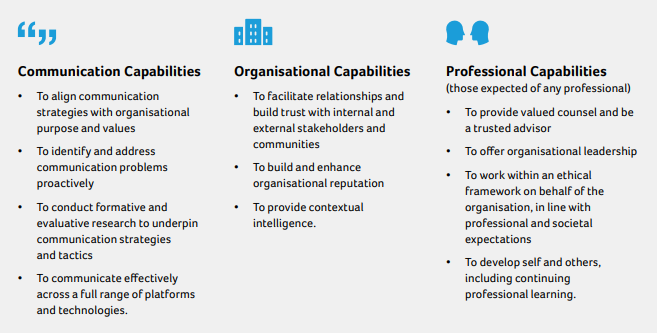
I’m more than just excited about the GCF. This project, which took two years to complete, defines the capabilities of PR professionals globally (there are country frameworks too for Argentina, Australia, Canada, Singapore, South Africa, Spain, Sweden, United Kingdom and United States). It’s a design that we can all use to better career plan, manage our teams and their development, recruit for the right skills and develop curricula that will help those practicing PR.

The 11 key capabilities identified by the GCF are of universal value to everyone in the profession (image source: Huddersfield Business School)

What’s more exciting is how the team behind the GCF are bringing this framework to life. They’re working with a team of software engineers to create a tool that’ll enable us to assess both individual and collective capabilities and set developmental goals. A sample visual is below.

I’ll admit that a shot of how the tool works doesn’t do it justice. I’ve seen the tool in action, and the possibilities it provides in terms of not only mapping skills and future development, but also transforming development goals into a training plan are inspiring.

What the Global Capability Framework and the tool also provide is an ability to engage with and educate our friends in HR what communications is. To paraphrase Dr Anne Gregory, Professor of Corporate Communication at the University of Huddersfield and director of the project, we have a capability framework that can be applied globally; reflects cultural and regional variations in public relations as a profession; and is forward looking in its approach which can be used by both global academic and practitioner communities.

What this means is that for the first time, our colleagues in HR have a resource that maps out everything they need to hire communicators, to train communicators, and to develop them over the long term. They also have a tool which will measure progress.

Why does this matter? I’ve often found that the functions we work with, such as Human Resources, don’t know what we do well enough. And yet they’re defining our function for us, they’re writing our job descriptions, they’re involved in hiring, and they’re measuring our success. We’re now talking their language, with a framework which has been developed both both academics and practitioners. The GCF will also help to standardize teaching for future generations of PR professionals.

It’s always been a tragic irony that the world’s community of communicators have struggled to explain exactly what they do and how they do it to their colleagues, particularly in HR and also in management. We now have the means to educate the people we work alongside in Human Resources. Our next challenge is how to educate those above us on our contributions to the organizations we work for.

Thank you to Professor Anne Gregory, Dr Johanna Fawkes, Dr Elizabeth Montoya-Martinez and Dr Royce Turner at the University of Huddersfield in the UK, to Argentina’s Professor Gabriel Sadi, Australia’s Dr Marianne Sison and Dr Katharina Wolf, Canada’s Dr Amy Thurlow and Dr Alex Sevigny, Singapore’s Professor Gregor Half, Spain’s Professor Elena Gutierrez-Garcia, South Africa’s Professor Ronel Rensburg, Sweden’s Professor Jesper Falkheimer and America’s Professor Katerina Tsetsura for all the work and time you’ve put into this. I believe the impact that this work will have on the industry is immense. I’m looking forward to using the GCF tool and helping others better understand what we do.

For more information on the GCF, you can download the complete capability framework and individual frameworks from the University of Huddersfield here.

Creatives, PR and Media – Where are the Gulf’s Faces to Watch?

There’s many young faces to watch in the Gulf’s creative, public relations and media industries, but if you’re looking for Gulf nationals on the agency side you’ll be sorely disappointed. The industry must find ways to solve this issue of diversity and inclusion.

I’ve enjoyed reading about the future of the region’s marcomms sector over the past couple of weeks in Campaign Middle East. The publication has listed the ‘ones to watch’ in the creative, public relations and media sectors. The people featured are an impressive bunch, and just reading about their abilities, potential and experiences at such a young age (they’re all 30 or under) is inspiring.

I was struck, however, by one detail. I didn’t see anyone I recognized as a Gulf national. There was so much talent from countries such as Egypt and Lebanon, but no one from Saudi or the UAE.

For anyone based over here, it’s probably not a surprise that there’s not enough diversity and inclusion in the marcomms industry/function, especially on the Agency side (this listing was Agency-focused). While there are Gulf nationals working agency-side, especially in Bahrain and Saudi, there’s certainly not enough.

How Can We Attract More Nationals?

The marcomms industry isn’t alone in struggling to attract enough young national talent – only one percent of the Emirati labor force is employed in the private sector, compared to 60 percent in government. But the landscape across the Gulf has shifted in a number of countries. Governments in Bahrain, Oman and Saudi Arabia are heavily promoting the idea of nationals applying to the private sector. More nationals are also eager to try new fields, particularly in the creative space. Here’s my suggestions on what each party must do to change perceptions and encourage diversity and inclusion.

The Industry and National Misconceptions

Let’s begin with the agencies and private sector firms who hire (the client side). We’ve got to break down the misconceptions and stereotypes around nationals, focusing on two key points. First, there’s the issue of work ethic; for far too long, there’s been a view that Gulf nationals don’t want to and won’t work the longer hours that the private sector asks of them (governments traditionally worked from 7 or 8am to early afternoon). Second, there’s compensation; Gulf nationals have often earned more working for the public sector.

I’m not going to be naive and pretend that these issues don’t exist. In Kuwait, Qatar and the UAE there’s a high differential between private and public sector pay for nationals, as well as additional benefits such as longer vacations.

However, we’ve already seen a shift in Bahrain, Oman and Saudi, where it’s common to find a national working in marketing or comms on the client side. To their credit, some agencies such as Gulf Hill and Knowlton have always looked to hire local in these markets (they had a large roster of Saudis some years back, and they’ve also hired a number of Bahrainis). In these markets governments are both telling their nationals to look towards the private sector and reducing the compensation differential.

For many in the private sector, they’ve not even put in the effort to test if the old stereotypes are true. There’s nowhere near enough engagement with universities across the region, not enough internships for nationals, and little in the way of mentoring. These are low-cost activities, which both agencies and clients should be undertaking. At the very least, they need to look for local talent, so they can benefit from insights that only nationals can bring to the table.

Governments and Talent Development

The private sector is only one half of the challenge. The other is governments.  Understandably, the region has long sought to develop its own talent. The number of nationals working in the marcomms function has risen rapidly, at least on the government side. It’s understandable that many nationals, particularly in Qatar and the UAE, would want to work in the public sector – pay in these two countries is, generally speaking, much higher. Plus, there’s a preference for locals, meaning there’s less competition for positions.This has become a double-edged sword. There’s more marketing and communications jobs in government, pay is better, and there’s less competition for these roles. What this has led to is young nationals being advanced into senior roles, often when they’re not yet ready or experienced enough.

If governments are serious about developing local talent, they’ve got to change this approach to public sector hiring and instead focus on long-term development, in partnership with private sector firms. This could include funded internships, either at home or abroad, as well as engagement with industry associations such as the IABC to promote certifications and long-term career mapping (I’ll share more about this soon). What’s clear is that national communicators who have worked only in one sector are missing out on all the potential learnings and development the other can offer, including the ability to work with and learn from other nationalities and culture (diversity and inclusion is also an issue on the government side).

Advice for Young Gulf Nationals

My advice for any young Gulf national is simple. Go and explore the private sector, understand the training and development it can offer you, and ensure you’ve tried every single option before you go into the public sector. If you’re after a challenge and you’re passionate about what you do, the money and position will follow. But if you want to be the very best you can be, and learn from a wider group of people from around the world, then moving into the private sector will be the best thing that you can do.

Likewise, we need you. We need the industry to be more diverse and inclusive (this equally applies to the public sector, where there aren’t enough expats working today), we need your insights and knowledge, and we need your understanding of the local culture, behavioral psychology, and awareness of how the Gulf’s local communities are changing. Today, we don’t have enough of this on the agency or client side. And it’s our loss. This scenario needs to change.

If you want to talk more, message me. I’m always giving my time to universities, to talk about the profession and help you understand your options. I’m happy to answer any question you may have, and point you in the right direction.

Shock and Awe: What is happening to the Gulf’s Media?

The Gulf is known for many things, but a controversial media isn’t one of them. The region’s media are known for not causing a stir, and for generally towing the line. There are exceptions – some local, Arabic-language radio stations in the Gulf host phone-in shows. One of them didn’t go so well. Here’s the story from The National newspaper.

It was a call for help from a man who couldn’t afford to provide for his family that was cruelly batted down by a prominent radio host.

But in the 24-hours that followed, Ali Al Mazrouei witnessed a justice of sorts when the radio jockey was suspended and his plight was heard in person by the leaders of the country.

The 56-year-old, a father of nine, spoke of his struggle to get by on a relatively low salary and a large family.

When he phoned Ajman Radio’s morning talk show Al Rabia Wal Nas on Thursday, he tried to highlight what rising living costs meant for families like his.

“The expensive prices are a big problem; everything is too expensive, including fuel, and the income is low,” he said.

“We want to provide for our children but we can’t buy anything; when one cannot make his children happy what is the point of living?”

When he spoke of inflation and the cost of basic goods, the show’s co-host Yaqoub Al Awadhi interrupted him to say there “there are retired people whose salaries are Dh10,000 and even used to be Dh7,000″ before the government raised payments.

The anchor went on to suggest that someone who could not live on that amount must have poor skills in managing finances and does not appreciate what he has.

Mr Al Mazrouei responded to say he does not spend money on anything other than his basic needs…

“We want to do good, when we see someone like us, we pray for him and we try to help when we find someone poor like us,” he said.

The radio host replied: “Don’t give anyone anything, just hold your tongue.”

“I don’t accept that you defame my country and say the people are all suffering.

“The salary you receive is from where? Where do you feed your children from? This all doesn’t deserve gratitude?”.

Mr Al Mazrouei responded that “I am an original national of this country, I am a Mazrouei,” as the host started to mumble, “where did you appear in front of me now from?” an expression in Arabic indicating an unpleasant encounter with someone.

The ill-tempered exchange continued for some time.

When news of the argument reached Sheikh Ammar bin Humaid Al Nuaimi, Crown Prince of Ajman, he ordered the suspension of host Yaqoub Al Awadhi.

On Tuesday, Mr Al Mazrouei was received by the Crown Prince and the Ruler of Ajman, Sheikh Humaid bin Rashid Al Nuaimi, while Sheikh Mohammed bin Rashid, Vice President and Ruler of Dubai, ordered that his situation be looked at immediately and his family helped.

Speaking to The National, the father-of-nine said: “This was the first time that I decided to raise this issue, because life was starting to close its doors in our faces. Instead of just worrying in vain every day I decided to take a proactive step.”

He said he does not want the host to lose his job.

“He jumped from topic to topic [when attacking me], it was so strange, but I say, may Allah guide him.

The second incident comes from Saudi, where a presenter on Bidaya TV told one of his guests live on air that his father had died (the video is below). The reaction was universal condemnation online, with a campaign that criticized the station for manipulating emotions for ratings. BBC Arabic has a full report on the story (it’s in Arabic, of course). A number of the station’s employees were suspended.

There’s been a great deal of change in the Gulf’s media over the past year. Is this an example of the change in sentiment which readers may feel on political issues seeping into other parts of the media? I’m not sure. But it cannot be coincidence for two events to happen in such a short space of time in a region which rarely sees such incidents.

As always, I welcome your thoughts.

Why I decided to #deletefacebook and why you need to think twice too

I’ve had enough of being the product for an unethical company. Hence I have decided to #deletefacebook (image source: http://www.beebom.com)

Like many of you, I’ve been reading the unraveling story of how Cambridge Analytica harvested and manipulated the data of 50 million Facebook users to build a system to predict and influence choices during the US Election in 2016. If you haven’t read about this yet, please watch the video below from the Guardian and The Observer media teams led by the remarkable Carole Cadwalladr.

This story is so remarkable that it seems more at home in Hollywood than in reality. But it is important to us all. Over 2.2 billion people use Facebook; that’s just under a third of the world’s population.

We are the Product

I’m not naive, I understand the trade-off when using any social site. To quote media theorist and writer Douglas Rushkoff, companies like Facebook sell us and our data to advertisers: “Ask yourself who is paying for Facebook. Usually the people who are paying are the customers. Advertisers are the ones who are paying. If you don’t know who the customer of the product you are using is, you don’t know what the product is for. We are not the customers of Facebook, we are the product. Facebook is selling us to advertisers.”

I’ve always been ok with that, and it was a trade-off that I’ve been willing to make. But the reporting around Cambridge Analytica and Facebook’s inaction concern me. As far as I’m concerned, Cambridge Analytica basically stole, with Facebook’s consent, 50 million user profiles. Facebook’s system gave Cambridge Analytica the ability to take from the 320,000 people or so who used it all of their friend contacts on the site. The 49 million people whose data was taken and then misused had no idea about what was happening and how their information was used to manipulate American voters in 2016. And I assume most of them still have no idea, because Facebook didn’t tell them.

Does Facebook care about us?

I have no intention of being manipulated online by firms like Cambridge Analytica, and I don’t want them to access data without my permission to reach my friends and family. Unfortunately, the best way for me to ensure this doesn’t happen is to not be on Facebook. I know many people who work at the firm, and they’re good individuals. But there’s something wrong at the top of the organization. Facebook knew about the Cambridge Analytica issue as far back as 2015. It took them three years to go public on this. Why?


Mark Zuckerberg may talk about connecting the world, but let’s be honest here. Facebook is a business, not an altruistic charity. It cares about revenues. And, sadly, that is leading Facebook’s leadership down a dark path with no care about me or my rights as a user. To quote the firm’s privacy policy on its collection of data, “We receive data whenever you visit a game, application, or website that uses Facebook Platform or visit a site with a Facebook feature … sometimes through cookies.”

What does Facebook care about more? Is it revenues or users? To me, the answer is obvious.

Facebook’s Lack of Ethical Leadership

Balancing what is profitable with what is right has never been easy, especially for publicly-listed companies. The expectation is that revenues will grow, quarter over quarter. While Facebook’s revenues may have grown, I’ve yet to see any ethical leadership from the company on pretty much anything. Facebook staggers from scandal to scandal. Take for example the story about how advertisers could target audiences by ethnicity, leading to the revelation that a brand could focus on users interested in antisemitic topics. Facebook’s leadership promised action, and little was taken.

And then there’s the story of how fake news producers have manipulated the site, most extensively during the US Presidential elections. What was Zuckerberg’s response (which has since come back to haunt Facebook)?

“Personally I think the idea that fake news on Facebook, which is a very small amount of the content, influenced the election in any way — I think is a pretty crazy idea. Voters make decisions based on their lived experience.”

The behavioral pattern hasn’t changed with Cambridge Analytica. Facebook’s executives remained silent for a week. Zuckerberg pledged that 2018 would be the year that he “fixed Facebook.” Maybe a more pertinent suggestion would be for him to finally admit that he’s out of his depth and that he hands over to a leader who can balance both ethics and business.


I’m no longer the Product

There are other reasons why I don’t love Facebook like I used to. It’s impact on the media industry, a profession that I started out in at the beginning of my career, has been disastrous. For all the above, I’ve decided that enough is enough. I don’t want to be the product any more. What I do want to do is share a message with Facebook that the company has to change. And as I’m the product, it won’t be able to sell my data, including all my likes and my posts, to advertisers. I’m still thinking over what this means for my presence on other sites such as Twitter and Instagram (which is owned by Facebook). But my taking a stand with others who have stepped away from the site, I hope that we’ll force the company to change for the better. There needs to be respect  and protection for us as users, which the company’s leadership has never shown through its actions. I’ve taken the decision to #deletefacebook. Maybe you should too.

Competing Media Motivations in the UAE’s Press (and what this means for communicators)

Communicators need to understand the competing agendas in the UAE’s press scene (image source: freepress.net)

I was once told, “to really understand a thing, you must know the reason for its purpose.” I don’t usually begin my posts so philosophically, but this quote seemed a fitting place to start when writing about the media in the United Arab Emirates.

An event caught my eye last month. The UAE’s National Media Council held a one day seminar, primarily for Emirati media professionals and communicators in the government sector. The event was entitled “The Future of Emirati Media”, and the below tweet from the National Media Council’s Chairman summarized a distinctly national view of the UAE media.

I’ve paraphrased below the key points from the above Arabic-language tweets and other material shared on the day:

  1. Work through the media to promote the national agenda.
  2. The media has a shared responsibility to work alongside state institutions and those present on social media to develop the sector.
  3. The media will contribute to the strengthening of the State’s leadership of the regional and global information sector.

The Foreign Perspective

In much of the West and East, the media is called the “fourth estate”, a group that is independent from government and which wields influence over society. Media seeks to report on issues of interest to its stakeholders (readers as well as owners), and will hold individuals, organizations and governments to account.

Essentially, the media has a number of roles, including to inform and by extension educate citizens on issues of importance, to act as a platform for different viewpoints and societal groups to share their own viewpoints and narratives, and to hold those in power to account.

In a country like the UAE, much of the English-language media consists of foreigners who have worked in other countries. Their view-point on what constitutes the media is often different to the national perspective.

What this means for Communicators

It goes without saying that for those working in communications, understanding both perspectives is vital for us to be able to engage effectively with different stakeholders. Media which are aligned with the first viewpoint are focused on the national perspective, especially as it relates to development and leadership. The media which is aligned to the second perspective is focused on sharing news that seeks to inform without the national development frame of reference.

These two viewpoints are also influencing where people work; many UAE nationals will explain that they’ve chosen to work in government communications as they believe it’s part of their contribution to the country’s development. Many foreigners in the media, particularly foreign outlets based in the UAE, will argue that sharing an independent perspective is important to truly understand what is happening in the country (and the wider region).

As always, context is key. Communicators and media need to understand each other’s motivations if we are to be in a position to engage and inform. Communicators and media need to understand these two basic perspectives and what it means for our work, be it talking within a national framework or sharing unique insights that are set within a governmental context. What’s essential here is that communicators appreciate both motivations, and they’re able to adapt as necessary to be able to interact with both media groups (and their respective audiences).

As always, I love to hear your inputs. Please do share!

Breaking Taboos – the issue of Sexual Discrimination in the Middle East’s Marcomms Industry

The #MeToo movement has rarely been discussed in the Middle East. It’s time we start talking seriously about sexual harassment in the region, especially in the marcomms industry (image source: http://www.alaraby.co.uk)

For all the impact that the online social movement #MeToo has brought to much of the world, there’s been little public talk of the challenges that women in the Middle East face when it comes to sexual discrimination. That changed this month, when ArabAd’s Iain Akerman published a piece detailing a recent case of allegations of sexual harassment at one global agency in the UAE.

The article is a must-read for all of us who work in marketing and communications (I was dismayed by a point of view shared by Ricarda Ruecker, vice-president of leadership and organisation development at MCN, that women could be to blame for any harassment they suffer due to their dress or behavior).

I want to applaud Iain and ArabAd for taking on this issue. The allegations are well known in Dubai, but they haven’t been published till now due to the nature of local defamation laws and the understandable reluctance of those women involved to talk about their ordeal publicly. Iain and ArabAd have taken a risk in publishing this piece.

Sadly, there’s so little straight talk on what women here have to deal with in the workplace. There’s lots of PR from certain quarters about the importance placed on women’s rights in certain parts of the region. And yet, I can’t help but ask one question; how does all the talk translate into action? Are companies asked, for example, to published pay scales for their male and female staff, as is now the case in Europe. The answer is no. Do we have enough female management in the industry? My answer would be not enough. And do women in the industry feel that they’re protected from harassment? I don’t feel that they do.

Small steps are being made when it comes to gender parity in the region’s marketing and communications industry. A group that I’m part of, the Advertising Business Group, is pushing to tackle gender stereotypes in the region’s advertising space. But it’s obvious that we need to do more. I’d argue that industry associations should play a larger role in talking about the issue and affording support to female members and organizations on both listening to their concerns in the case of the former, and helping put in place zero-tolerance policies for all types of harassment.

Ultimately, each and every one of us should not only pledge to fight discrimination and harassment, but we should also support anyone who feels that they have been wronged. Nothing justifies discrimination and harassment, and it’s time we started talking more about the issue openly and honestly.

The Six Essentials for Promoting Brand Building and Trust Among MENA Consumers (MEPRA/YouGov Research)

trust-in-blue-marker

Trust is one of those intangibles which we as communicators must always focus on. Trust, that notion of one person relying on and believing in a second person, is key to changing attitudes and behavior. But how do you build trust, and what channels should you focus on? These are the questions that we need to answer to be able to do our job of building and protecting reputations. So, where should one begin when looking to build trust?

Based on research by YouGov, which was commissioned by the Middle East Public Relations Association and which included a survey of across the six Gulf states (Bahrain, Kuwait, Oman, Qatar, Saudi Arabia and the United Arab Emirates), Egypt, Jordan, and Lebanon, the place to begin isn’t online, but rather face-to-face. Fake media, less impactful advertising, and third-party advocacy are also reshaping where consumers in the region put their trust.

I’ve written three blog posts on the issue which I’ve already published on the blog, to explore the findings country-by-country, but here’s the big picture headlines from the research, which surveyed 4,475 people across the region.

1. Face-to-Face with family/friends is key to influence

It should be obvious to us all, and here’s another reminder for anyone working in communications/marketing. If you want to build trust in a brand, its products and services, then look at how you can engage the public through word-of-mouth. Across the region, 85% of respondents trust product and service recommendations from their family and friends. Nothing else comes close to these positive statistics.

2. Online works if you focus on friends and family, less so on social influencers

Over the past couple of years we’ve shifted for an incessant focus on digital to idolizing anything social. As the first big finding shows, in-person interaction is still the most persuasive. Online engagement does work, but it’s not as effective; 52% of respondents trust online recommendations about products and services from family and friends (interestingly, the percentages are highest for the Gulf and lowest for the Levant).

When it comes to social influencers, consumers are conflicted – 34% do trust social influencers/people with large online followings on products and services, compared to 29% who find them untrustworthy. A lack of transparency re paid/sponsored content probably isn’t helping. What’s helping even less is a tendency for social influencers in the region to say little which is negative when reviewing products and services.

3. There’s not as much trust in the media as we PR people may think

I was surprised by how low the scores were when it came to trust in the media as a source of information on products and services. The top-rated media was a brand’s own website (which should make sense, but given how bad websites are in the region this is still surprising), which scored 46% for trustworthiness. Every other medium scored in the 30s, which is a surprise considering how much faith public relations professionals put in securing editorial coverage with media outlets (for many, it’s still the essence of their day jobs). Blogs scored the lowest, at 31% trustworthiness (they were rated as untrustworthy by 30% of respondents). Should brands invest more in their own online media? The answer would seem to be an obvious yes.

4. Advertising is trusted almost as much as the media (except when it’s online)

The research is a mixed bag for the advertising sector. Out-of-home advertising such as billboards seem to be the most trusted by consumers, with a trust rating of 36%. Television is close behind with 35% trust, followed by radio at 31%. Online comes in last, at 28%. There’s more mistrust than trust for online advertising, with 33% of those polled not believing product and services information they see when displayed as an online ad. This may be due to misleading advertising around product pricing and availability. Whatever the reason for the low trust levels (especially online), marketers need to do more to win the trust of consumers, especially with trust in advertising dropping; 61% of those polled agreed with a statement that they trust advertising less today than they did five years ago.

5. Social media is a popular news source, but it’s not trusted thanks to ‘fake news’ concerns

Social media is becoming/has become a key source of news for most people (58%) in the region when compared to five years back (and there’s no distinction either by age, which is surprising). However, there’s still a trust issue. Almost half (48%) agreed they they have low trust in social media, which isn’t that surprising given the amount of fake/incorrect information out there. Which goes to underline the need for brands to focus on their owned media channels even more so.

The research did hammer home the power of third-party advocacy. When asked if they have more trust in what a third party says about a good or a service than what a brand says about its own goods and services, 65% responded by saying yes. Brands need to focus on winning over trusted individuals/groups who can influence consumers.

6. When it comes to social media, Facebook is King

If you’re looking to find out about a product or service in the region, it seems that Facebook is the place to go. Over half (53%) said that they found Facebook to be the most useful platform as a source of information (this rose to 72% for Egypt). Nothing else came close. WhatsApp was a distant number two, at 12%, and Instagram third at 9%. There was no mention of Twitter, and it would have been good to have understood where Twitter and YouTube featured as sources of information on products and services for the public.

So that’s the big picture for you. Keep an eye on the blog in the coming few days as I put out country-by-country reports. If you need more specific information, please do reach out to me.

Brand Building and Trust in Egypt, Jordan and Lebanon, Based on YouGov/MEPRA Research (Part 3)

trust-in-blue-marker

This is the third and final post on the research by YouGov, which was commissioned by the Middle East Public Relations Association and looks into consumer trust, both online and offline, when it comes to advertising and media recommendations in goods and services.

This post covers Egypt, Jordan and Lebanon.

Egypt

1004 people were surveyed in Egypt, 97% of whom were Egyptian and 3% were expat. When it comes to gender, 51% were male, and 49% were female. Just over 40% were aged between 18 and 29, 21% were between the ages 30 and 39, and 39% were aged over 40.

In terms of geography, it’s no surprise that over a third were Cairo-based,  with 36% living in the capital. Of the remainder, 24% live in the Delta, 17% in Alexandria, 16% in Upper Egypt, and the remainder in the Canal Zone/outside of these areas.

In terms of salaries, 30% earn less than US$266 per month, 24% earn between US$266 and US$532, 17% earn between US$533 and US$1,065, 8% earn between US$1,066 and US$2,665, and 3% earn more than US$2,666. Approximately 18% of people refused to disclose their earnings.

Finally, 41% described themselves as single, 47% as married with children, and 6% were married but had no children. The remaining 6% were classed either as other or did not respond.

Family, Friends and Third Parties

When it comes to those closest to them, Egyptian respondents said they have an 85% level of trust in face-to-face conversations with friends and family about products and services. Only 3% of respondents said that they would not trust a face-to-face discussion. Those who displayed the highest levels of trust include respondents earning between US$533 and US$1,065 (90%), those living in the Canal Zone (96%), and those who are married with children (88%).

Trust in social media posts by friends and family about products and services averages at 51%; mistrust comes in at 14%. Trust is most pronounced in those earning above US$2,666 (62%).  Those who are between 18 and 24 are least likely to trust such posts (20%), as are those living in Alexandria (22%).

Egyptian respondents have a higher trust in third-party endorsements of products and services than most other countries in the region; 62% agreed that they trust third-party endorsements more than what a brand says about its own products and services, compared to 6% who don’t. The highest trust is among those who are earning less than 500 Egyptian Pounds and those who are earning over 10,0001 Egyptian Pounds (both 70%), as well as expats (76%).

Trust in Social Media

Egypt’s respondents were torn over social media posts by influencers and people with lots of followers on products and services; 32% said they found such posts trustworthy, and 31% said they found them untrustworthy. Men were much more likely to be trustworthy (37%) than women (27%). Those who are earning between US$1,600 and US$2,665 also had the most trust (51%) in such posts. The least trusting were expats (23% for, 43% against).

Unsurprisingly, social media has become a vital source of information for Egyptian respondents; 57% of respondents agreed that it has become more important to them as an information source today than five years back (12% disagreed). This is especially true of younger respondents between 18-24 (63%). However, almost half (45%) have low trust in what they see online.

When it comes to the most popular social media channels for information on goods and services, it may be no surprise that Facebook is the most popular by far (71%), followed by WhatsApp (8%). In third with 8% was the choice of none. It seems that if you want to do social media in Egypt, you have to be on Facebook.

Trust in Media & Advertising 

Only two media channels scored higher for being trustworthy than untrustworthy among those polled – they were brand websites (46% versus 18%), and website articles (35% to 24%). All other media scored higher for not being trustworthy, with television and blogs both at 27% (their untrustworthy scores were 41% and 35% respectively), and radio at 30% positive, compared to 35% negative. Respondents weren’t asked why, but it’s probably fair to say that Egyptians have a healthy skepticism of official media, given the events of the past seven years.

Levels of trust in advertising are approximately the same as the media, with billboards being the most trusted (34%), followed by television and radio (both 30%), and finally online at 28%. For online, radio, and television, they’re not trusted more than they are trusted, with negative scores of 32%, 31%, and 33% respectively.

When asked if they trust advertising less today than they did five years ago, 62% agreed and 8% disagreed. Those earning the least (500 Egyptian pounds) trust advertising the least, with a 70% rating. Over two-thirds of respondents (69%), agreed with the statement that so-called ‘fake news’ has lowered their trust in mainstream news media. Only 8% disagreed.

Jordan

503 people were surveyed in Jordan, 89% of whom were Jordanian and 11% were expat. There was a slight preference for males (52%), as opposed to females (48%). Age-wise, the largest group were between 18 and 29 (43%), 25% were between the ages 30 and 39, and 32% were aged over 40.

In terms of geography, the majority were based in Amman (59%), with the second and third largest geographies being Irbid (16%) and Zarqa (12%) respectively.

In terms of salaries, 9% earn less than US$266 per month, 24% earn between US$266 and US$532, 32% earn between US$533 and US$1,065, 17% earn between US$1,066 and US$2,665, and 5% earn more than US$2,666. Approximately 13% of people refused to disclose their earnings.

Finally, 47% described themselves as single, 42% as married with children, and 7% were married but had no children. The remaining 4% were classed either as other or did not respond.

Family, Friends and Third Parties

Jordan’s respondents are very trusting of their family and friends recommendations about services and products when they’re given face-to-face; 89% responded that they trust such interactions. In contrast, only 2% were distrustful. Those over 40 (93%), who earned between US$1,600 and US$2,665 (94%), and who are married with children (92%) are the most trusting.

When it comes to online product and service recommendations from family and friends, the trust percentage drops to 50%, while mistrust rises to 15%. Trust is highest among those who earn less than US$266 (58%), and those who are married but who have no children (64%).

When it comes to third party endorsements, Jordanian respondents score higher than any other country in the region bar one (hint, it’s below); 74% agreed that they trust third-party endorsements more than what a brand says about its own products and services, compared to 6% who don’t. The highest trust is among consumers who are above 30 (80%) and earners over US$2,666 (92%).

Trust in Social Media

Jordan’s respondents were even more split than Egypt’s; 32% said they found social media posts by influencers and people with lots of followers on products and services trustworthy, and 32% said they found such posts untrustworthy. Those who were most trusting were those over 40 (40%), and those earning between US$2,666 and US$5,332 (38%).  Men were much more likely to be trustworthy (37%) than women (27%). Those who are earning between US$1,600 and US$2,665 also had the most trust (51%) in such posts. The least trusting were women (37%), and those aged between 25 and 29 (40%).

Just under two-thirds of respondents said that social media has become a vital source of information for them (63%); this is especially true for 18-24 year-old respondents (69%). This is especially true of younger respondents between 18-24 (63%). Trust in online content is an issue, with 54% having low trust in what they see online (this rises to 65% for those aged between 30-34).

When it comes to the most popular social media channels for information on goods and services, Facebook tops the list with 63% of respondents saying it’s the most useful channel for information about products and services. Second choice was none (10%), followed by LinkedIn in third place with 7%. WhatsApp was fourth (6%), followed by Instagram (5%).

Trust in Media & Advertising 

When it comes to trust in the media, Jordanians don’t seem to prefer any particular medium. Radios, website articles and blogs scored a 33% trust rating when it comes to being a source of information about products and services. Television and newspapers scored 32% and 30% respectively. Brand websites scored the best, at 40%.

Levels of trust in advertising as a source of information are slightly lower; billboards were at 32%, TV advertising scored 30%, radio ads 25% and online advertising 21%. The only ad medium which scored higher positively than negatively was billboards (27%). For online advertising, the percentage for those who distrust the medium was 43%, over twice the number who said they did trust online ads as a source of information about products and services.

When asked if they trust advertising less today than they did five years ago, 68% agreed and 10% disagreed. Those who were above 40, earning a high salary and married with children were most likely to trust advertising less today than they did five years ago. Almost three-quarters of respondents (73%), agreed with the statement that so-called ‘fake news’ has lowered their trust in mainstream news media. Only 9% disagreed.

Lebanon

Last, but by no means least, Lebanon is the final country in this survey. 251 people were surveyed in the country, of which 48% were male and 52% female. In terms of age, 34% were aged between 18 and 29, 21% between 30 and 39, and 45% were over 40.

Income-wise, 63% earn less than US$1,600, 11% earn between US$1,600 and US$2,665, 8% earn between US$2,666 and US$5,332, and 6% earn over US$5,333. 12% didn’t disclose their salary.

Approximately 71% are Lebanese nationals, with 29% being expats. In term of geography, the largest number of people live in Beirut (43%), followed by non-named locations (37%) Tripoli (14%), and Jounieh (4%). Regarding the marital status, 38% were single, 51% were married with kids, and 7% were married with no children.

Due to the small survey size, I won’t be drilling down further by group.

Family, Friends and Third Parties

Lebanon’s respondents are highly trusting of their family and friends recommendations about services and products when they’re given face-to-face; 87% responded that they trust such interactions. In contrast, 3% were distrustful.

When it comes to online product and service recommendations from family and friends, the trust percentage drops to 46%; mistrust rises to 20%.

When it comes to third party endorsements, the Lebanese respondents scored the highest of any country in the region; 75% agreed that they trust third-party endorsements more than what a brand says about its own products and services, compared to 6% who don’t.

Trust in Social Media

When it comes to sourcing information on products and services from online influencers and those with large followings, the Lebanese are the least trusting and most distrusting. Only 26% said they found social media posts by influencers and people with lots of followers on products and services trustworthy, and 39% said they found such posts untrustworthy. Lebanese respondents do however mostly agree that social media has become a vital source of information for them (63%).

When it comes to the most popular social media channels for information on goods and services, Facebook again comes out tops with 60% of respondents saying it’s the most useful channel for information about products and services. Second choice was none (12%), followed by LinkedIn in third place with 7%. WhatsApp and Instagram were joint fourth (5%).

Trust in Media & Advertising 

Lebanon has always been a bastion for the region’s media sector, so I was keen to look at the levels of trust in the press. Unfortunately, there’s no anomalies here. The Lebanese don’t trust (or distrust) media more than anyone else.

No one source is preferred over another when it comes to product and service information. Brand websites are newspapers are the most trusted (both 34%), followed by radio, television, and website articles (all of which score 33%. Blogs are the least trusted, at 28%.

Advertising fared worse than the media; billboards were the most trusted medium (28%), followed by TV advertising (27%), radio (24%), and online in fourth place (21%). When asked if they trust advertising less today than they did five years ago, two-thirds agreed (67%) and 12% disagreed. In total, 73% agreed with the statement that so-called ‘fake news’ has lowered their trust in mainstream news media. Only 10% disagreed.

And that wraps up a brief overview of the research. If you’d like more details, please do let me know and I’ll share data with you.