Death, Arrests and Censorship: How the Middle East’s media has fared over 2013

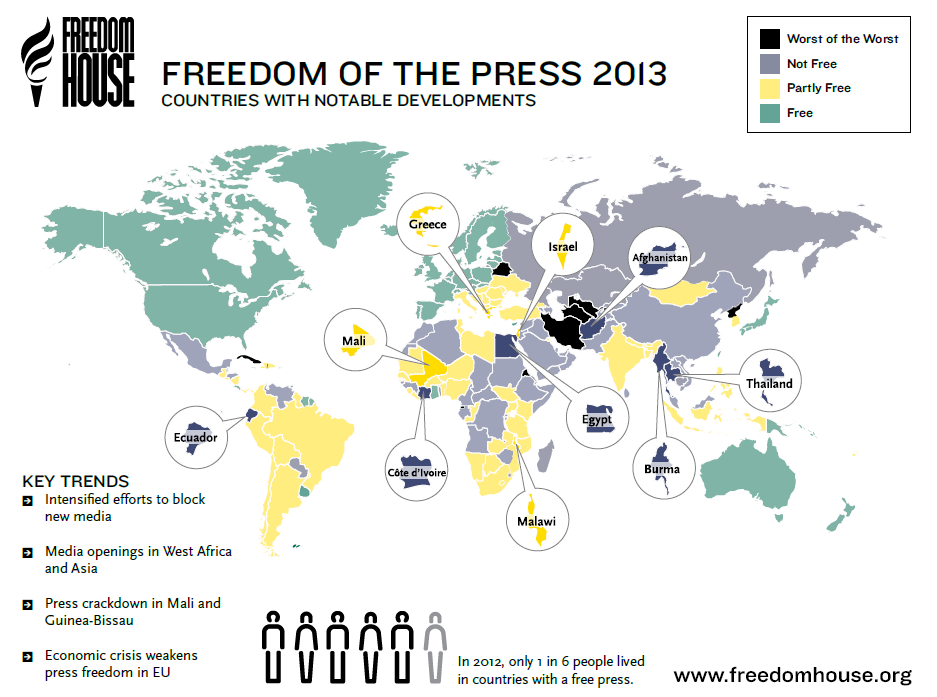
The Middle East's press freedoms have, on the whole, suffered in 2013 (image source: Freedom House)

The Middle East’s press freedoms have, on the whole, suffered in 2013 (image source: Freedom House)

The past twelve months haven’t been lacking in terms of seminal events across the Middle East – we’ve experienced war, coups/democratic/popular revolutions (choose/delete based on your bias), and economic revivals across this diverse region. However, it’s fair to say that 2013 hasn’t been a wonderful year for good quality and independent journalism in the Middle East and North Africa region.

Overall, 2013 recorded a grim milestone for global media. According to the Committee to Protect Journalists, the year documented the 1,000th journalist killed in relation to his/her work since the organization began documenting fatalities in 1992. Sky News cameraman Mick Deane was killed in Egypt in August of this year while covering the violence in Cairo.

Over half of the 70 journalists lost this year were killed in the Middle East trio of Syria, Iraq and Egypt. One of those whom we lost at the end of 2013 was Molhem Barakat, a young Syrian freelance photographer who submitted dozens of pictures of the bloody conflict in Aleppo to Reuters. Molhem was killed while covering fighting between government and opposition fighters on December 20th.

A full list of those who have laid down their lives to bring us the reality in war zones and areas of conflict can be seen here at the Committee to Protect Journalists.

Journalists working in safer climes across the MENA region have also faced serious challenges which has impeded their work. Media freedoms were curtailed across the region, with Lebanon being ranked by the US-based NGO Freedom House as the country with the most free press (Lebanon came in at number 112 globally and its press was rated as partly free).

I’m going to quote below from Freedom House’s Freedom of the Press report on the Middle East and North Africa. The report in full is available to download in pdf format here.

The Middle East and North Africa region continued to have the world’s poorest ratings in 2012, with no countries ranked in the Free category, 5 countries designated Partly Free, and 14 countries assessed as Not Free… Although new information platforms — including blogs, social media such as Twitter and Facebook, and smart phones — have had a positive impact, traditional media in much of the region were still constrained by emergency rule, state ownership and editorial directives, harsh blasphemy legislation, and laws against insulting monarchs and public figures.

While the concept of citizen journalism has been slow to take root in the Middle East, a number of countries have jailed persons who have uploaded information such as videos and photographs onto the internet on charges ranging from insulting the national image and harming the country’s reputation to defamation.

The over-riding trend over 2013 has been efforts to monitor, control and censor online debate. A number of countries in the Gulf and North Africa have enacted highly restrictive laws targeting online publishing including blogs and social media that hurts national interests. Even in Kuwait, which was ranked by Freedom House as the Gulf nation with the freest press, journalists have been jailed for reporting on opposition demonstrations. Journalists have been jailed and remain imprisoned in at least eight countries across the Middle East and North Africa according to the Committee to Protect Journalists.

Looking forward, there’s no reason to believe that 2014 will prove to be different to 2013. Civil disputes in Syria, Iraq and Egypt show no signs of being resolved, and sectarian issues seem to be growing in prominence across the region. One bright spot may be a thaw in relations between the West and Iran, following the election of President Rouhani and discussions over Iran’s nuclear programme. However, as social media becomes the most common form of communications across the Middle East the odds are that online censorship will become ever more prominent.

The Gulf, social media and its self-deprecating humour

The Gulf is known for many things but a sense of humour hasn’t traditionally been on the list, even less so self-deprecating humour. With the advent of social media, in particular YouTube, both the Gulf’s residents and nationals have started to develop content like there’s no tomorrow. The best is currently coming from Saudi Arabia. One example is La Yekthar, one of the most popular comedy shows on the net. The team regularly tackles and takes on stereotypes of Saudis, and one of their latest clips was a fantastic set-up of how Saudis are often perceived by foreigners. The video, which is below, also sends a not-so-subtle message to Saudis that this type of image, of arrogance and violence, isn’t the right thing to do.

Bahrain has also followed suit with a number of send-ups of the typical Bahraini stereotypes. The clips, which are common on the video-sharing site Keek, focus on a variety of stereotypes which are mainly based on geography (for example, Al-Riffa and Muharraq). I’m going to have to search for these but I’m going to upload as soon as I can.

Even Qatar is getting in on the act. The only local Qatari comedian I know, Hamad Al-Amari, routinely does stand-up routines poking fun at Qatari stereotypes before switching effortlessly into an Irish accent (he spent part of his childhood in Ireland). Have a look at one of his sets below.

And then there’s the UAE. While there are a number of local comedians here including the likes of Ali Al Sayed the country has arrested those, even nationals, who have poked fun at the country’s stereotypes. Emirati Salim Dahman and a group of young males who made a spoof YouTube video named the ‘The Deadly Satwa Gs’ were arrested after uploading the clip. No reason seems to have been given for their arrest, but the assumption would be that they’ve been detained for insulting national sensitivities.

To quote from 7Days, which featured the story yesterday, ‘The Deadly Satwa Gs’ video is a spoof of young people who try to act tough. At the martial arts school, the recruits learn how to throw a shoe and call for back-up on their mobile phones. When they graduate from the school, they are all given Barcelona football jerseys, supposedly matching a style worn by young men in Dubai.

The video, which is still available online, is hardly groundbreaking satire and is fairly tame when compared to the content coming out of the Magic Kingdom. However, comedy isn’t always a laughing matter depending on where you are in the Gulf.

PS If you want to know why I haven’t mentioned Kuwait ask any Gulf Arab about Kuwaitis and humour.

Is social media making the situation in Egypt better or worse?

Should we still be saying thank you to Facebook and other social media sites today? (image credit: http://www.straighterline.com)

We’ve all seen the horrid news coming out of Egypt over the past couple of days and weeks. The events have been broadcast worldwide. Thanks to social media, they’ve also featured prominently on Facebook, Twitter, YouTube and other channels. There’s been a noticeable trend; the content being shared online is becoming more radical and biased as things have gotten worse in Egypt.

There was a fascinating study by MIT, NYU and the Hebrew University of Jerusalem which suggested specific positive or negative influences create asymmetric herding effects – in plain English that means people are increasingly likely to follow the crowd online and agree with others when there’s a groundswell of opinion, especially when they share similar opinions or views.

There’s a famous English saying which seems apt for social media today, “birds of a feather flock together.” What we’re seeing on social media today is groups of individuals who share the same opinions coming together as groups. There’s less debate online of differing views and more support for and promotion of each others views.

The question is, how is this helping calm the situation on the ground? Are people thinking clearly when they post, share or comment? While Facebook was praised for its role in the 2011 revolution, my own views are that social media is now a key channel for fanning the flames of sectarian division in the country.

I’d hope people think more before they use social media to openly share their feelings on such emotional issues. It’s gotten to a point now where my timelines are split between the various groups who are constantly posting materials which reflect their own opinions. In contrast there’s little effort by either side to reach out to others. The social media world is just as polarized as opinions on the ground (maybe even more so). I’m hiding videos and pictures because I don’t want to see such open hatred on my timelines.

I sympathize with people’s views and I understand the passion on both sides. Hundreds have died and the country is in a state of emergency. On both sides, Egypt’s citizens want what they think is best for their country. But, for the sake of events on the ground, let’s pause before emotions kick in. We need more calm heads rather than hot heads, especially online and on social media.

Another Youtube Shocker – KFC and its Al-Ahsa Outlet’s Hygiene Standards

It seems no-one is safe from Youtube. After a video was uploaded to the world’s largest video-sharing site showing what purported to be an alleged road-rage incident in Dubai another video has been uploaded to the site but this time from Saudi Arabia. The video, which was uploaded on the 17th of July has been viewed 175,000 times in three days.

The video, featured below, allegedly shows what is described to be a scene in a kitchen of Kentucky Fried Chicken in the Saudi city of Al-Ahsa, in Othaim Mall. The person who took the video was apparently an employee who was fired after the video was taken. I’m not going to describe the video; rather, do watch the video itself which is two minutes long.

Social media crises for food chains aren’t new; anyone remember the infamous Youtube clip on Domino’s Pizza that went viral in 2009? However, while these issues aren’t new to US and European audiences and most food chains there have social media crisis plans how many local, Middle East franchises are ready for the same thing here? It’ll be interesting to see if or how KFC does respond to the allegation. In the meantime, as it’s Ramadan I’m enjoying home cooking.

Citizen journalist beware – the perils of shooting video in Dubai

Dubai’s social media was buzzing yesterday with chatter about a video uploaded to Youtube of a local apparently beating a van driver. The video, which was initially taken off Youtube and which can be viewed above, shows the national using his agal to hit the Indian driver who’d apparently clipped his four-wheel drive and who hadn’t stopped during the initial collision. Part of the incident, including the national’s car license plate were captured in the video, which was reposted several times on Youtube. According to media reports including one piece from the daily Gulf News, the issue became a police matter not due to the alleged assault itself but rather due to the video going viral and the attention that it attracted.

A video of a government official beating a van driver was posted on YouTube has generated a public outcry and urged police to take legal action, said a legal expert.
“Initially it was an ordinary assault case, yet as soon as it was posted on YouTube, it went viral on social media channels. Since then, the case became of public concern and incited public opinion — that was when Dubai Police intervened. They took the required legal action against the involved persons,” advocate Mohammad Abdullah Al Redha told Gulf News.

Sources from Dubai Public Prosecution confirmed to Gulf News that investigations started in the afternoon as soon as they received the case.

Al Redha said: “It became a case of disdain and disparagement and particularly that it’s Ramadan, the month of mercy and forgiveness. When such incidents develop into a matter of public opinion and concern, police have the right to refer the case to prosecutors. According to the Criminal Procedures Law’s article 10, the Public Prosecution [in its capacity as the legal representative of the public right] can order the police to open an official complaint against the government official even if the van driver doesn’t do so.”

The case took an interesting turn today with the news that the person who took the video, a fellow driver, was arrested. According to Gulf News, the alleged defendant’s son lodged the case citing defamation of his father and family.

Major General Al Mazeina, acting chief of Dubai Police, said the Asian man who posted the clip was arrested after the Emirati official’s son lodged a defamation complaint at Al Ghusais Police Station.

“We only arrested the man who took the video because of a complaint lodged by the family of the Emirati official,” said Major General Al Mazeina.

He said that no one had the right to take pictures or film anyone without permission and acknowledgment from the person who is pictured.

“The man who took the video was supposed to take the video to the police or to the concerned authority to report the incident and then the police for sure would take action but instead of that the man posted the video on YouTube,” said Major General Al Mazeina.

The son told police that the video had been seen by hundred of thousands of people worldwide, which had damaged the reputation of his father and the whole family.

Major General Al Mazeina said the Asian man admitted to police that he took the video and posted it on YouTube and that he also sent it to some of his friends. He said the Asian man happened to be passing by at the time the incident took place.

Under the UAE’s cybercrime laws, recording videos in public without the permission of those being filmed is illegal and constitutes defamation. Despite the uproar over the issue, it seems that the authorities may not be willing to drop the case against the person who took the video despite calls on social media to reward his decision to film and post the event online. The message is simple – don’t film anything that could be construed as negative and share it online. Or else you could be facing public charges.

A taste of Bahrain – Emmawash Restaurant

Bahrain has another local destination to head to if you’re looking for traditional fare. Check out this video by online channel MyBahrainME and I dare you not to lick your lips in anticipation!

Social media brand hijacking – Emirates and Etihad fakes and lessons for a corporate online presence

A story broke at the beginning of the month about a couple of campaigns out there in the social media universe. Both piggybacked on two of the UAE’s most established brands. Essentially, the two campaigns offered those who followed the chance to win free flights with Emirates Airline and Etihad Airways.

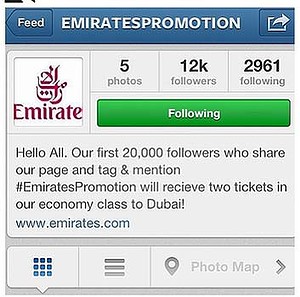
According to the UAE’s English-language newspaper The National which broke the story here in the UAE, the promotion launched on the picture-sharing site Instagram and stated that the first 20,000 people who would follow each account and would share the respective campaigns with a specific hashtag would receive free tickets for themselves plus one to Dubai or Abu Dhabi. The Emirates Instagram account was named EMIRATESPROMOTION while the Etihad campaign ran under the hashtag #EtihadPromotion.

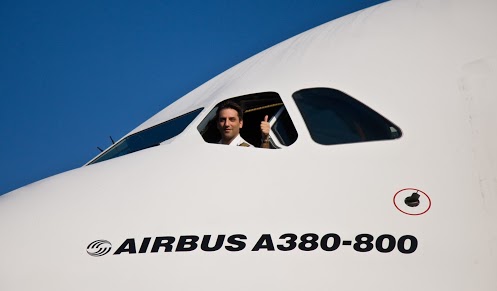
The branding is there, the name may be dodgy, but there's no official Emirates account. So why not believe it?

The branding is there, the name may be dodgy, but there’s no official Emirates account. So why not believe it?

Too good to be true you may think, and the campaigns were fake. That didn’t stop 10,000 people following the fake Emirates account which featured the company’s logo and photos skinned from the company’s website. I don’t know how long the fake competitions were up and running for, but both Emirates and Etihad put out statements warning people not to fall for the fake campaigns. The Emirates statement is below.

To all our fans, Emirates has three official social media channels which are:

http://www.facebook.com/emirates
http://www.google.com/+Emirates
http://www.youtube.com/Emirates

When we launch competitions or new social media channels, you will be the first to know via our Facebook, G+ or YouTube channels and on emirates.com.

Thank you for your continued support
Emirates”

Emirates also sent a statement to the Australian website The Vine stating that “Emirates Airline does not have an official Instagram account. Any Emirates-related accounts or promotions on Instagram do not belong to us.”

Similarly, Etihad wrote on its Twitter account that “Etihad Airways has no association with any accounts or promotions (such as #EtihadPromotion) competition currently running on Instagram as we don’t have an official Instagram account yet. Thanks for checking.”

How does this concept sound to you? There’s lots of random people out there on social media, and scams and the internet aren’t mutually exclusive. So why do brands focus on some social media channels and not others? For example, both Emirates and Etihad don’t have Instagram accounts. Emirates doesn’t even have a Twitter account. Wouldn’t it be best for a brand simply to park their presence on the major social media channels (no one can do everything on social media, there’s simply too many channels and sites out there).

And this point may be even more relevant albeit off on a tangent for Emirates, which spends several hundred million dollars on sports marketing (the most recent announcement being the tie-up with Formula One). Isn’t the airline missing out through not focusing on social media? Imagine how much Emirates could achieve in brand positioning and amplifying that sports marketing spend by promoting itself through social media. As I’ve said before, technology is a wonderful leveler. It’d seem a waste not to wring every single penny in return on investment from those mega-bucks sports sponsorships.

So next time you see a promotion which is too good to be true just send a Facebook message to the airlines and ask them if they’ve gotten round in Instagram (or Twitter in Emirates’ case). And, as they say in France bon chance!

This gentleman clearly feels Emirates would benefit from more social media presence. Do you?

This gentleman clearly feels Emirates would benefit from more social media presence. Do you?

What is the future of the internet in the Middle East?

The past week has thrown out a couple of fun and serious stories and news reports about the internet in the Middle East. The first was Iran reportedly deciding to create its own version of YouTube in order to filter out what it deems to be inappropriate content posted on the world’s largest video-sharing network. There’s a screenshot from the Mehr site, which loads remarkably slowly for a site which hosts videos for viewing and sharing, below.

Will Iran's version of Youtube be as big a hit as the original?

Will Iran’s version of Youtube be as big a hit as the original?

The second story wasn’t as funny. The International Telecommunications Union had gathered its member states in Dubai to discuss a number of issues at the World Conference on International Telecommunications. The one which hit the headlines was internet regulation. In short, a number of countries from the Middle East and other emerging regions submitted proposals that would have allowed member countries to monitor and control data flowing through their respective parts of the internet.

While this is already happening in many parts of the world, the proposed resolution would have basically made it legal and proper for all 190 or so of the ITU’s “member states” to have the power to regulate the Internet to promote security, fight spam, et cetera.

A number of opinions and views can be found online on the issue, including interesting posts by technology historian Peter Salus entitled The UN and your Business: Why ITU Dubai Loss is your Gain and Why the ITU is the wrong place to set Internet standards by Tech writer Timothy B. Lee.

I for one am concerned about the future of the internet and online access. While internet filtering and domain blocking isn’t new to the Middle East (the Gulf’s telecommunications bodies block material that they deems offensive including religious or pornographic material) it’s clear that the past two years have opened a Pandora’s box when it comes to control of the internet. Governments in Egypt and Tunisia tried to close off access to the internet to stop revolution. That didn’t work. Gulf countries have legislated against online threats. As I’ve pointed out above Iran is building its own country-wide internet whilst blocking access to foreign-hosted sites that pose a threat to the Islamic Republic.

So where are we headed to next? How far will governments in the Middle East go in order to secure their own national communications networks? And is there anybody or anyone out there who will bring some common sense to the issue of web regulation in the Middle East?

While I don’t expect multinationals like Google and Yahoo (or even Facebook) to step up to the plate and say to Arab governments we will not regulate the web for you (after all, Yahoo and Google didn’t say no to China), I am hopeful that the region’s populations will become more vocal about their online rights. Egyptians and Tunisians have proved that they will demand and protect their new-found rights. Let’s hope others, especially in the Gulf, will begin to seriously think about what their governments are doing online and asking:

  • Who is watching me online?
  • What online data do they want and why?
  • Can I be jailed for my online activities? Do I have to self-censor my thoughts and activities?

What is the future of the internet in the Middle East? Are we headed towards a patchwork of national or regional wide webs aka Iran? Or will sense prevail? Goodness knows we need commerce and entrepreneurship to flourish in this region to generate more jobs and an open internet is essential to both. Answers on an email, an online comment, or (if your connection is monitored) a postcard please!

Are you up for some (more) government censorship and online monitoring?

How Dubai’s Tamweel Tower fire and its aftermath has been shaped by social media

Dubai woke up Sunday morning to a horror story. In what seemed to me to be a throw-back to the movie the Towering Inferno a fire broke out on the roof/top floor of a 34-storey tower in the city’s Jumeirah Lakes Towers development at around 2am. Incredibly, no one was killed or seriously injured and the tower’s 600 residents were evacuated from the building.

The fire, which you can see a clip of below, took several hours to be brought under control. However, for the families who lived in the property which is owned by the Islamic mortgage company Tamweel, their ordeal has only just begun.

According to news releases and press statements Tamweel has been supporting those made homeless by providing them with hotel accommodation.

At Tamweel, our very highest priority is the safety and well-being of the owners and residents,” said Varun Sood, Acting Chief Executive Officer, Tamweel. “Our staff are on site and have provided transportation and hotel accommodation, in coordination with DMCC, to any resident who requires such assistance. We will continue to work with the Building’s Owners Association to assist all residents and we remain fully committed to ensuring their well-being.

It’s no exaggeration to say that many families lost everything in the fire. Radio interviews with Tamweel Tower residents spoke of people running out wearing only their underwear and having to borrow clothing from others after they’d assembled at the emergency evacuation points outside the building. A wonderful piece was written in the Khaleej Times, a piece that conveyed the feeling of loss and confusion. If you’re hoping to gain a sense of how much some people were going through on the morning of the fire then do click through and read.

The tragedy has been covered extensively in both traditional media and on Twitter, Facebook and Youtube. Residents were tweeting from the site pictures and uploading videos before the first stories had been published online (I read one Twitterer write in the early hours of the 18th that traditional media were yet to publish anything on the fire – if I can find his tweet I’ll publish here).

The morning of the tragedy companies and individuals started to reach out via community forums and other online media to offer their services and support as well as provide details for those who want to volunteer and donate.

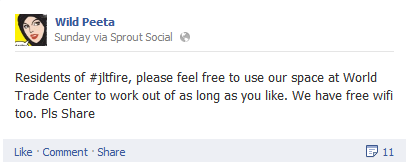
One Dubai restaurant chain offered to host residents and businesses based in Tamweel Tower at their premises

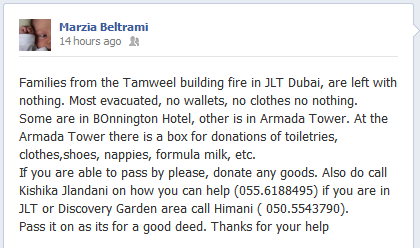
Many people posted details of people to get in touch with for donating items to those left homeless

These community charity efforts are ongoing, as is the support given by Tamweel, and will be some consolation for residents who have lost all of their belongings in the fire.

The speed with which social media has allowed people to express their support and rally others in the community to help the victims of the Tamweel Fire has been remarkable. How long would businesses or government bodies take to do the same? What is interesting to note is that Dubai Police also use Twitter to put out news alerts.

For me, what’s also been striking is that the owner of the building Tamweel doesn’t have a social media presence. I’m sure, after what has happened, that will change in a very short space of time.

Don’t be evil – Google, freedom of speech, corporate responsibility and that video

I’m a huge fan of Google. The company has defined the internet era. Google is the world’s most popular search engine. Youtube is more popular than television in many parts of the world. Google Maps has redefined how we get from A to B. I could go on and on, but you get the point. Google has even entered the common language as the term people use when they refer to searching on the internet: “Go Google it…”

Google has done all of this and more while living by its ‘don’t be evil’ corporate motto. While Google has been criticized before for bending and breaking this mantra (most notably with its operations in China), the last couple of weeks have been remarkable. There’s probably few of you out there who have not heard about the film, named ‘the Innocence of Muslims’. The film, which has caused a global uproar, was uploaded to Youtube at the start of July.

Since then, there have been riots and demonstrations worldwide. Dozens have been killed and injured. And yet, Google has refused to pull it off Youtube. According to an AP story from two weeks back:

“Google is refusing a White House request to take down an anti-Muslim clip on YouTube, but is restricting access to it in certain countries.

The White House said Friday that it had asked YouTube to review whether the video violated its terms of use. Google owns YouTube, the online video sharing site.

YouTube said in a statement Friday that the video is widely available on the Web and is “clearly within our guidelines and so will stay on YouTube.” (the full piece can be viewed here)

Google argues that only materials which are in clear violation of laws or that promote hate speech will be removed from Youtube.
Google says The Innocence of Muslims does not however breach YouTube guidelines. However, Google has blocked users from seeing the video in India, Indonesia, Libya and Egypt due to local laws and “the sensitive situation”. Youtube’s full statement from Friday 14 September is below.

“We work hard to create a community everyone can enjoy and which also enables people to express different opinions. This can be a challenge because what’s OK in one country can be offensive elsewhere. This video — which is widely available on the Web — is clearly within our guidelines and so will stay on YouTube. However, we’ve restricted access to it in countries where it is illegal such as India and Indonesia as well as in Libya and Egypt, given the very sensitive situations in these two countries. This approach is entirely consistent with principles we first laid out in 2007.”

For me, the video is the clearest indication yet that Google has given up on its ‘Don’t be evil’ mantra. Google had to pull down a video from Brazil after its resident of its Brazilian operations was arrested for breaking local laws.

Google constantly argues that Youtube is a channel and that it has no say in what should be on that platform for the sake of free speech. However, how many newspapers would accept advertising from Neo-Nazi groups? How many television channels would run an advert for euthanasia? Just like these media channels, Google has a responsibility to its audience. This cannot simply be about pure profit and driving up viewer numbers. Google sells products globally, it has to be responsible globally as well.

The fact that these videos are still on Youtube shames Google. I for one hope that the company I have admired for so long finally wakes up and does the right thing on this issue and others in the future by better defining and vetting what should go up on platforms such as Youtube and reacting to communities sooner rather than not at all.

Please Google, don’t be evil…

Google, please don’t be evil. Come back from the dark side.