The launch of LinkedIn Arabic – Did LinkedIn miss a messaging opportunity?

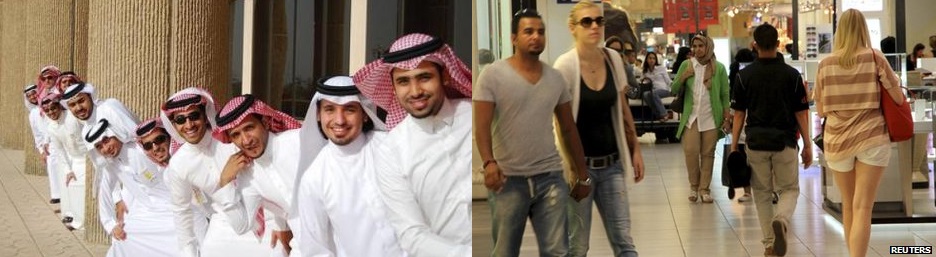
If you're going to launch in Arabic where would you choose? Dubai or Riyadh? (image source: Reuters)

If you’re going to launch in Arabic where would you choose? Dubai or Riyadh? (image source: Reuters)

I love LinkedIn. It’s possibly my favorite social media network. LinkedIn has transformed how professionals network (and get jobs) online. No recruiter could do without LinkedIn.

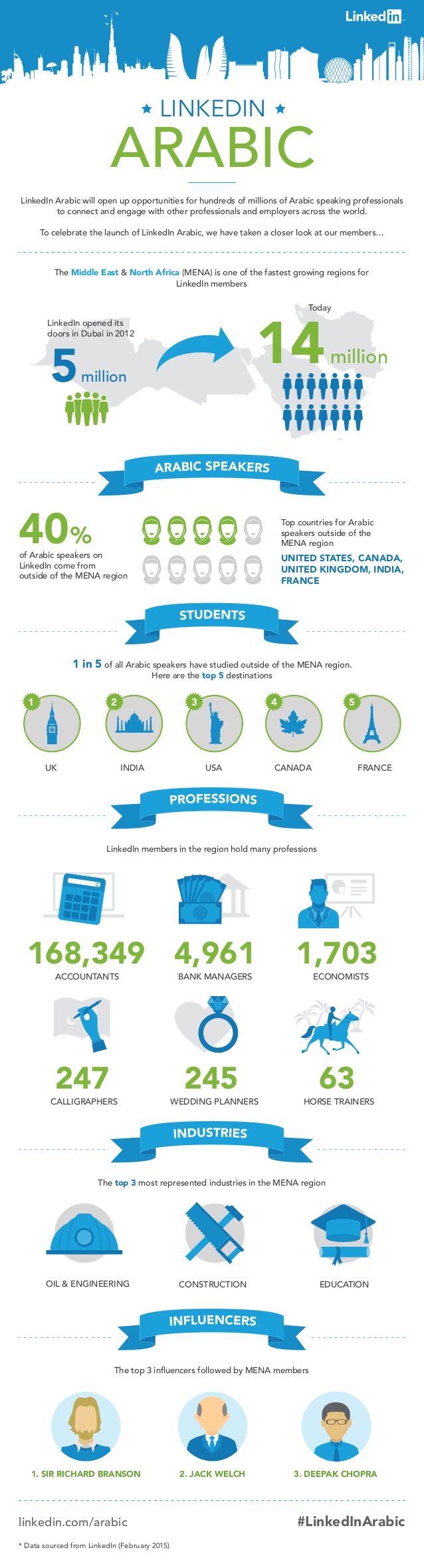
The network has grown steadily in the Middle East since it opened up an office in Dubai back in 2012. Over the past three years LinkedIn has grown its user base from five to fourteen million. The UAE is LinkenIn’s largest market with two million users according to The National. The two largest Arabic-speaking markets in the region are Egypt, with a population of just over 82 million, and Saudi.

The Kingdom is, or should be, LinkedIn’s largest potential market. Saudi doesn’t only have a sizable Arabic-speaking population (28 million and counting), but it also has the spending power. Saudi’s gross domestic product for 2013 was just under 750 billion dollars. Saudi is home to some of the region’s largest corporations, as well as a majority of the country under the age of 25. Add to the mix high internet penetration and smartphone usage, Saudi is LinkedIn’s Arabic-language market.

However, when LinkedIn launched its Arabic-language site last week the management team chose Dubai as the preferred location. There was a guest advocate, in the shape of Noura Al Kaabi, CEO of Abu Dhabi’s twofour54. Bizarrely, LinkedIn’s press materials also included a press statement from Saudi’s Minister of Labor, which was carried extensively in the Kingdom’s media (the quote in full is below and is sourced from Saudi Gazette).

Eng. Adel M. Fakeih, Saudi Arabia’s minister of labor, said: “LinkedIn has been working with us to match talent in the Kingdom with the right opportunity, and with Arabic, this benefit can be rolled-out to a much wider member base.

LinkedIn will continue to be a useful tool for us as we use technology to communicate the need for nationals to up-skill themselves and take advantage of the strong economic climate and significant job-creation in the Kingdom.

Being a part of a global network also helps youth identify the key demand areas, and build their qualifications accordingly.”

Would LinkedIn have been better served by launching Arabic in Saudi, rather than in the UAE (where it could be argued that the lingua franca is English). Would this activation have been more in line with the message that LinkedIn was trying to convey, namely that we are now in Arabic and we want Arabic speakers to use our service.

It’s a small observation, but it seems that LinkedIn missed an opportunity to push home a message through a launch that was misaligned with its target audience. Saudi isn’t the easiest country in terms of getting things right on the ground, but if you’re going to do something then, as the saying goes, if it is worth doing then do it right.

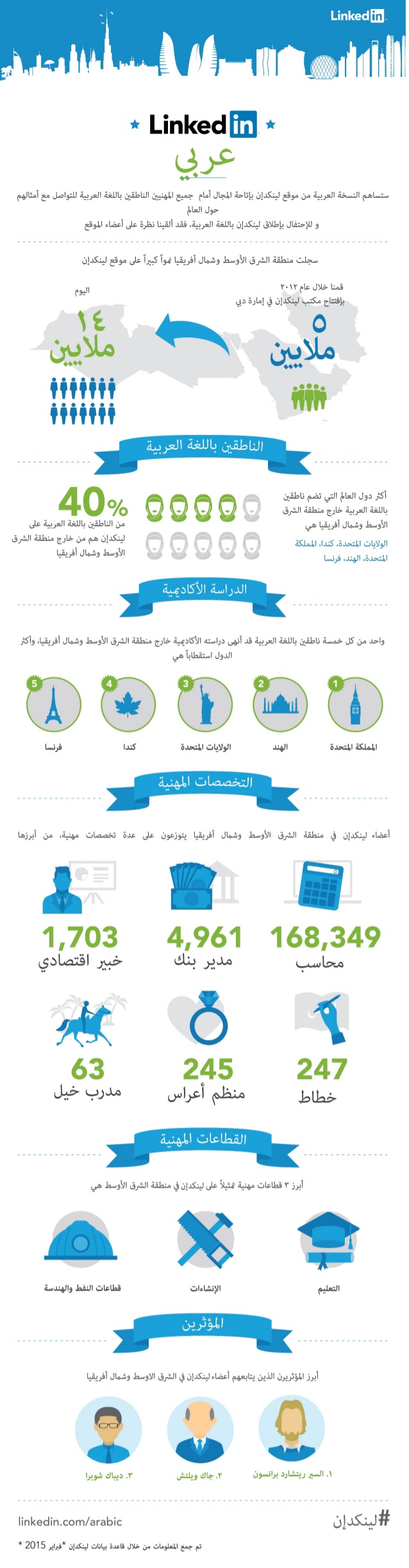
And for more details on LinkedIn in the Middle East have a look at the infographics below, which are in English and Arabic.

The Abu Dhabi Reem Island Murder Video – the ethical and moral considerations

The past week was witness to a tragic incident in the UAE’s capital. On the first of December a women, a US national, was fatally stabbed by a suspect wearing an abaya and niqab, the traditional cloak worn by women and a full face covering. You can read the full background here at The National.

This incident is unique; the country is known for its safety for both nationals and expatriates. A major operation was launched by Abu Dhabi police to locate and capture the suspect(s). Two days following the killing, Abu Dhabi Police shared with the media and via their YouTube channel CCTV footage from the mall of the suspect entering and leaving the location. The video has been seen more than two million times in the space of 48 hours.

The next day, on the 4th of December and 48 hours after the murder, the Ministry of Interior made the announcement that everyone was waiting for. The suspect had been caught. The Ministry shared more details of events on that day, including how the suspect had placed an explosive device outside the flat of another American national.

But that wasn’t all. Abu Dhabi Police shared a video, which was an edit of the CCTV footage along with video from the raid on the house where the suspect was arrested. Do watch the video, which is posted below.

Personally, I’ve never seen such footage broadcast before a trial has begun. The video, which runs for over six minutes and has now been watched almost two million times, plays music for dramatic effect on top of the footage.

I have a number of questions and issues, which I’d like your opinion on. Firstly, was the timing right? The video sends out the message that we will catch the perpetrators of such crimes as soon as is possible, but how will this affect a family which is still grieving? Secondly, does this prejudice the defence’s case and the right to be considered innocent until proven guilty?

Most importantly, the video doesn’t answer why the crime was committed. If certain individuals hold views that are anti-foreigner, how are these views to be addressed?

For me, there’s more questions than answers about this case. I’d love to hear your feedback.

Goodbye Dr Taryam, Hello Al Otaiba – Changes in the UAE’s Media Landscape

Mohammed Al Otaiba has taken up the top job at The National, despite having no prior media experience (image source: The National)

The past couple of days have been one of loss and change for the UAE’s newspapers. On the same day, news pieces announced the passing of Dr Taryam, the co-founder of the largest Arabic-language newspaper Al Khaleej, and the appointment of Mohammed Al Otaiba as the editor-in-chief of Abu Dhabi’s English-language daily, The National.

Dr Abdullah Taryam was one of the founders of the country’s Arabic media industry; He established Al Khaleej newspaper with his brother, the late Taryam Omran Taryam in Sharjah in 1970. After initial difficulties – the paper wasn’t printed for eight years during 1972 and 1980 due to funding – Al Khaleej grew to become what is the Dar Al Khaleej newspaper group which includes English-language daily The Gulf Today, Arabic-language weekly political magazine Al Shuruq and the Arabic-language family magazine Kol Al Usra. With a PhD in modern history from Exeter University Dr Taryam also held the posts of Minister of Education and Minister of Justice for the UAE. Gulf News wrote an extensive obituary on Dr Taryam which can be read here.

On the morning of the 30th The National announced its own change at the top, namely the appointing of Mohammed Al Otaiba as the editor-in-chief. I’m going to lift the text from The National’s piece rather than summarize.

“We are pleased to announce the appointment of Mohammed Al Otaiba as editor-in-chief of The National and are confident that his well-rounded experience in media, foreign policy and diplomacy will add a valuable global perspective to The National,” said Saif Saeed Ghobash, the acting chief executive officer of Abu Dhabi Media, which publishes The National.

Mr Al Otaiba said: “I am delighted to join The National newspaper and to be granted the opportunity to be part of a true success story for English journalism in the UAE. Writing has been a strong passion of mine for years and I look forward to being part of such a dynamic team of journalists.”

Mr Al Otaiba has a background in diplomacy and media, including 10 years representing the UAE at the UN in New York, Beijing and London.

He recently served as head of Image Nation Abu Dhabi, a division of Abu Dhabi Media. After being appointed head of the organisation in October 2011 he helped develop Abu Dhabi’s film industry.

Mr Al Otaiba’s appointment comes at a time when the newspaper is strengthening its local news coverage, Abu Dhabi Media said in a statement on Thursday.

It has recently supplemented its coverage with focus pages and a larger national news section, “boosting its reputation as a key English-language newspaper of record reflecting and supporting the country’s development and achievements,” the company said.

Abu Dhabi Media manages 18 broadcast, publishing and digital media brands and is considered among the fastest growing organisations in the region.

Mr Al Otaiba holds a bachelor’s degree in mechanical engineering from the American University in Cairo, and a master’s degree in administrative studies from Boston University, with a concentration in multinational commerce.

The reaction to the news has been interesting to watch, with observers noting Al Otaiba’s lack of newspaper and media experience.

The piece in The National does seem to be contradictory, with Al Otaiba’s international experience praised and then noting The National’s increased focus on local reporting. Al Otaiba’s appointment may be an attempt to ensure that The National is fully aligned with the official line. The paper, which was ostensibly founded to promote a free local press, has suffered over the past couple of years as it has attempted to promote a higher quality of journalism whilst ensuring that it doesn’t upset the national authorities and its owner, the Abu Dhabi Government.

It’ll be interesting to see how Al Otaiba does and how The National’s newsroom responds to the change. On the 30th January we’ve lost one renowned local media figure; have we been given another one in his stead?

#MyDubai and the issue of whether to pay the public for content

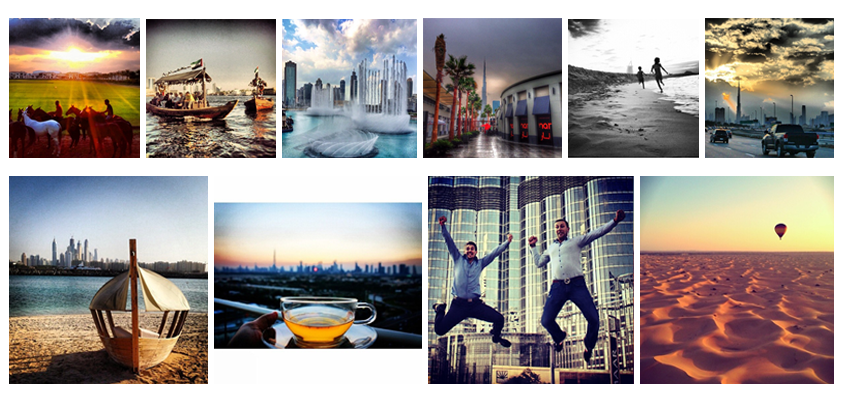
The first images from #MyDubai's initiative provided for free by Dubai residents (image source: www.facebook.com/DefinitelyDubai)

The first images from #MyDubai’s initiative provided for free by Dubai residents (image source: http://www.facebook.com/DefinitelyDubai)

To pay or not to pay? That’s the question. The city-state has launched an interesting project based on social media, dubbed as a social-media autobiography of Dubai to be written by its residents and visitors. To quote The National newspaper:

The year-long project will bring together people in the emirate through Twitter, Instagram, and Facebook. A call has gone out to share pictures and videos using the hashtag #MyDubai.

According to The National the project will tell the real and human stories of the city through residents’ contributions which are posted onto Facebook, Twitter and Instagram (there’s no mention of YouTube and Pinterest which is a shame).

The National followed up today with a second piece on the initiative. Tourism bosses from Dubai’s Department of Tourism and Commerce Marketing (DTCM) will select the best photographs and videos from the Emirate’s residents and showcase them in exhibitions and roadshows as part of the year-long #MyDubai project. The public’s images will be used to promote Dubai throughout the year.

What isn’t mentioned is if the public are going to be paid for their images which are going to be used for advertising the Emirate. As any content producer knows, photography and videography are expensive. While those lucky few whose images get chosen – to quote The National, “more than 25,000 images and videos were uploaded to Instagram using #MyDubai just 12 hours after the campaign was launched” – will be referenced and have been so far online on DTCM’s Definitely Dubai Facebook site is it right to use images provided by the public for free (even if it is with their consent).

And on another note, who owns the copyright to the images? Are the images commissioned by DTCM for their explicit use or do the copyright owners of the images, have the ability to pull the images as and when they please if they object to how the images are portrayed?

I love the concept of #MyDubai but should the public be paid for images that are used, even if only a token amount? If it’s for corporate usage, then I think they should do.

The End of the Fattah Era at Abu Dhabi’s The National

How will The National change following Fattah’s departure to the world of Public Relations? (image source: http://www.capitalnewyork.com)

As they say, all things must come to an end. This month in the United Arab Emirates we witnessed a rare occurrence, the departure of an editor-in-chief at one of the national newspapers. After five years Hassan Fattah stepped down. The news wasn’t surprising to most of us media watchers when it was officially announced by The National on the 2nd of October. The news had been unofficially published by Capital New York on the 19th of September after personal emails had been leaked to The National staffers (one email apparently contained an employment contract from Fattah’s new employers).

Fattah’s time at The National hasn’t been without controversy. The paper, which was once dubbed “The New York Times of the Middle East”, once held aloft the ideals of freedom of the press and professional journalism in a region that suffers from a lack of both. Today, while The National is a quality read it hasn’t lived up to the goals that its founders and editorial team strived for at the paper’s launch.

Instead, judging by the number of pieces that have been written about The National by blogs and other online news outlets the paper has been riven by leadership issues at the top by people who have had to juggle the demands of producing good quality editorial alongside keeping the newspaper’s owners, Abu Dhabi Media Company, happy. The nadir was reached when disgruntled employees started a Facebook site with the aim of highlighting their unhappiness at how the newspaper was run.

Fattah has moved on to the dark side, to the world of public relations. He’ll be heading up communications for a company that is not much loved in the UAE – GEMS, the ‘world’s largest private education company’. It’ll be interesting to see how he copes with the move; public relations isn’t the easiest profession at the best of times but trying to prove that paying more per year for a child’s education than one would pay for an MBA in a top UK University is good value for money would be a stretch for even the most experienced communications spin doctor. How will Fattah cope with keeping his employer happy and the press onside whilst trying to convince a skeptical public about GEMS’ altruism and the value for money provided by its services for example?

However, my gaze will remain firmly on The National. The paper is still one of my favourites and I believe that despite all of the events of the last couple of years there remains the promise of a publication which can raise journalistic standards in the Gulf. Call me naive, simple or whatever else you want, but I’d rather live in hope that The National can return to the vision spelt out by Abu Dhabi Media chairman Mohamed Khalaf Al Mazrouei on the eve of its inauguration, of “a free, professional and enlightened press” that will play a key role in the development of the country. Am I asking too much? Let’s hope not.

Getting the communications balance right – Ras al-Khaimah, beaches and modesty

This slideshow requires JavaScript.

I do feel for anyone who has to communicate on behalf of a government body in the Gulf. That’s especially so in places where there’s conflicting, divergent views resulting from a strong cultural diversity and significant business interests with the outside world. I remember the late Yasser Arafat often getting away with making one point in Arabic and then saying the exact opposite in English (there’s many other examples out there too). With the advent of the internet, social media, and a horde of citizen journalists out there in cyberspace it’s no longer possible to say explicitly different things to different constituents.

In this week’s The National newspaper in the UAE there was a great example of the above. On the 22nd of April police from the Emirate of Ras al-Khaimah announced a bikini ban for the area’s beaches. Ras al-Khaimah is a beautiful part of the United Arab Emirates. With a population of just over a quarter of a million people Ras al-Khaimah is known for its pristine beaches, and also for its rapidly growing tourism sector and free trade zone. However, the Emirate is also conservative. Trying to balance the two interests, tourism and tradition, isn’t easy as the below quotes from The National’s article on the 22nd April illustrates.

Bikinis have been banned from public beaches in the emirate as police urge residents to “use common sense” and dress modestly.

The municipality and police have put up signs on public beaches that state: “All coastgoers should commit to public morality and modest clothing”.

Offenders will be given a warning and after a second warning, they could face an unspecified fine.

The two most popular beaches in Ras Al Khaimah are located next to hotels where swimmers sunbathe in thong bikinis or trunks alongside women in burkinis, a modest full-body swimsuit designed for Muslim women.

On weekends and at sunsets, RAK’s public beaches fill with women in full hijab, who come with their families. Women in swimwear are a rare sight at these beaches and there are no women-only beaches in RAK.

In a plea to the public, police urged beachgoers to comply with “public morality and dressing modestly” to respect the country’s traditions and culture.

The move followed complaints by families about tourists who attended public beaches wearing indecent clothing.

The public have greeted the ban in Ras Al Khaimah, a conservative emirate with a large Emirati population. In RAK, it is common for women to dress for the beach by putting on more clothing so that they do not attract attention from men.

“I totally agree with that [ban] for us because it’s not a respectful thing to have on our beaches,” said Hessa Ahmed, a 31-year-old Emirati mother-of-two.

Many people, like Ms Ahmed, would like tourists to cover up but are too shy or polite to approach them. Her last visit to the beach ended abruptly when a man and woman in revealing swimwear sat near her family.

“I wasn’t sure about what she was going to do,” said Ms Ahmed. “I was afraid she would take off her top. So I preferred just to drive away just in case anything was going to happen, so I would just be away and my kids wouldn’t see them.

“There was no sign or board to inform these people you shouldn’t wear this, you shouldn’t wear that.”

Ras Al Khaimah has adopted a lenient approach to public dress in hotels but customs remains overwhelmingly conservative in public spaces, such as shopping malls.

The above was a great piece and insight into the challenges facing a country that is looking to adapt culture with business. And then came the follow-up article the next day in The National.

Police have backtracked over their statement that bikinis and tight trunks are banned from public beaches.

Revealing swimwear is not officially outlawed but strongly discouraged because of cultural sensitivities, police clarified.

“We respect the rights for people. We follow UAE law,” said Maj Marwan Al Mansoori, the head of public relations and moral guidance for RAK Police.

“Our campaign is not about catching people. We just want to tell people about our culture and our community.”

“You should respect our culture and our community rights but you have your rights,” said Maj Al Mansoori. “If it is under our law, you can do it.

“We wanted to tell people what we are thinking. It is communication between cultures. We want to explain this to people.”

It’s worth reading both articles in full, and to put this in its full context few Westerners will use a public beach in Ras al-Khaimah; all the hotels have private beaches which are fully equipped and only for the use of guests. However, such communications outreach isn’t going to help draw foreigners to a part of the country and world that has everything to offer. Perception is everything, especially online when social media is involved. The more people who talk about an issue, the more that issue or perspective is believed no matter its veracity.

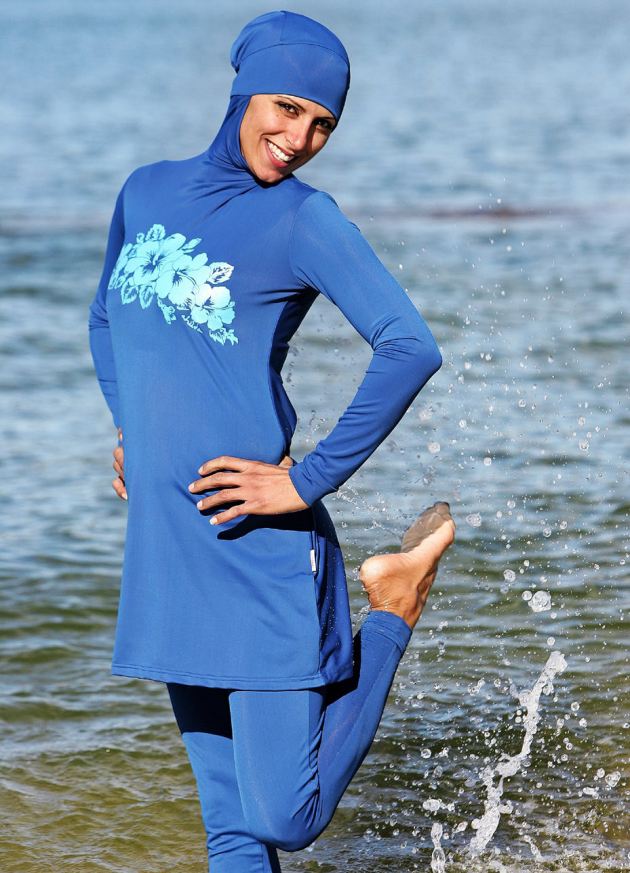
This is a reminder about the challenges of trying to get the communications balance right in today’s connected world, where a tourism can view such news pieces while booking their vacation just as easily as a local sitting for a tea and reading the morning newspaper. Media relations is a tough job and I do hope that lessons are learned from this and that the right balance is found, both in terms of educating foreigners coming in (can you really tell someone what to wear after they’ve seen the glossy brochure/website, booked, traveled and arrived) and in preserving local cultural norms. And remember, if nothing else works there’s always the burkini!

The burkini! Foot flicking and hands on hips are optional (credit alrasub.com)

Trials and Tribulations at Abu Dhabi’s The National

The National, Abu Dhabi’s English-language newspaper, hasn’t had a quiet week. First comes a blog post which The National admitted was ‘one of the most controversial ever’ in the paper’s five year history. The blog, which was written by an intern journalist named Ayesha Al-Khoori, was pilloried for its description of her driving habits and speeding even though she herself was attempting to argue that lowering the UAE’s driving minimum driving age from 18 would be a mistake. This blog, which garnered hundreds of responses and mentions on the comments section as well as on social media sites, was followed by an attempt at an apology which for me seemed to miss the point (Ayesha claimed her message was lost, but I’d argue that there was no consistency in her initial message).

For a review of the blog and The National’s editorial guidelines including how it reviews and edits work (which didn’t seem to be the case with Ayesha’s blog) then read this piece by Mita56 which sums everything up nicely.

To top off a bad start to the week, someone made a serious error when writing The National’s daily electronic newsletter (have a shufty below).

Have a look and spot the boo-boo. It's a big one.

Have a look and spot the boo-boo. It’s a big one.

If you didn’t spot the mistake, I’ll give you a hint. The late person referred to in the photo-caption should be the founder of the country (Allah yurhamu) rather than HRH his son who is very much alive and is the President of the United Arab Emirates.

The National has been stung recently by a couple of tell-all pieces by ex-journalists. One of the most recent was Tom OHara, who wrote a warts-and-all account of his two years in Abu Dhabi in the American Journalism Review in December 2012/January 2013. You can read his revealing piece here.

I was at the launch party for The National in 2008 and remember the roster of journalists on display. There was a Pulitzer-prize winner reporting for the paper even. Hopes were high that we’d have a newspaper with the temerity to tell it like it was, which is still a rarity in the Middle East. Over the years I’ve looked forward to reading The National’s copy from a group of journalists whom I have dealt with and whom I think very highly of.

As a former journalist I respect and admire good journalism. In today’s Gulf we need more quality content to explain the why behind the what. My hope is that The National’s management steer the paper back to what it aimed to be five years back, to “establish an institution on par with some of the greatest newspapers in the world.” Trials and tribulations are all well and good (unless you’re the person behind the drama), but The National needs to raise its standards and focus our attention back on the quality of its content. The National, we need you more than ever.

Hello, hello??? Skype, the VoIP fiascos and the UAE’s telcos (oh, and also the TRA)

Skype may be finally available by accident in the UAE but I doubt that Du took action after listening to the consumer. In fact, does anyone in the UAE’s telco sector listen to what consumers want? (Credit: Blakeandkaty.com)

Who hasn’t heard of VoIP, or voice-over-IP for those of us who are allergic to abbreviations. Or, put in a different way, who has not heard of Skype? The software, which allows users to call other users for free over the internet or call phone lines for (usually) lower fees than it’d cost to use a telecommunications operator, is the most popular VoIP software on the market today. Skype is free, it can be downloaded in a matter of minutes, and it’s incredibly handy. Skype and other software products have been out for what seems like an eternity (Skype was released in 2003 and I’ve been using it since 2004) but all of this malarkey might have passed you by if you lived in the UAE. Why? Well, let’s put it this way, Skype may cost the UAE’s two telecommunication companies quite a bit of cash and so it and other VoIP products designed for public consumption have been banned in the country.

The UAE’s telcos, Du and Etisalat, and the country’s official body for the industry, the Telecommunications Regulatory Authority, have played a merry dance with consumers to sidestep the issue. In a series of flip-flops that would make any politician proud the TRA took the lead in terms of banning Skype only to change its stance in 2010 when the body claimed that the country’s telco operators were free to license VoIP solutions.

Of course the telcos didn’t take any action, Skype’s website remained blocked and while people could download the software via third-party providers you wouldn’t be able to charge your account and make net-to-phone calls without a friend loading our account from outside of the UAE (the exception used to be the Free Zones where Skype was for a time in 2004-2006 unblocked – of course this changed in due course).

After years of talk and no action, something strange was spotted by the hawks at the National newspaper this week. Skype’s website was accessible for people who used the internet service provided by Du; they could open accounts and load money onto the service. The original article is here and is worth a read. The country’s other ISP Etisalat is still blocking Skype.

The mystery deepened the next day after the media rushed to Du for a quote. While initially tight-lipped Du did release a statement as follows:

“There has been no change in the treatment of VoIP traffic, including Skype, on our networks.”

So, Skype is available from Du. It can be used to make calls and yet there’s been no change. No, it doesn’t make sense to me either. I’m sure the confusion over the issue will continue for some time. Microsoft, Skype’s owner, claims to not know what is going on. And there’s no suggestion that Etisalat, the other larger ISP, will unblock the service any time soon. If anything is a lesson in bad communications then this should be it.

Let me contrast this with the rest of the region, where Skype is freely available and not blocked. And don’t even get me started on Apple’s Facetime which is also not available in the UAE and yet accessible across the rest of the GCC.

A decade after its release and we’re still no closer to understanding when VoIP software will be freely available to use in the UAE. Even the launch of Blackberry’s Z10, which uses a solution called BBM Voice to make and receive calls over data networks (ala VoIP), was apparently delayed by the UAE’s refusal to allow use of the programme in the country. And I quote:

On Sunday afternoon, BlackBerry announced that the phone would still go on sale, but it was confirmed that the BBM Voice would not be available when the device was launched.

“We are currently in talks with BlackBerry on launch of BBM Voice and Video services,” Farid Faraidooni, chief commercial officer of Du, said in an emailed statement. “We shall soon commence testing phase to assure the right consumer experience. We remain committed towards launching new and innovative services that add value to customers in the UAE marketplace.”

Etisalat could not be reached for comment.

For a country that prides itself on being a hub for the region’s tech sector I’ve always found this issue embarrassing. It smacks of greed, of protectionism, and of not wanting to adapt to today’s technology where it will impact revenues. In other markets such as Bahrain and Saudi Arabia the regulatory body acts on behalf of the consumer. Unfortunately, we’re some way off that concept here. So for now, I’ll be using my Skype as much as possible. I’m hoping that all of you good people in the UAE will join me online and on Skype sooner rather than later.

Middle East journalists you must follow – Caryle Murphy @CaryleM

I’ve long thought about and planned to write on journalists who have been based in Saudi Arabia and the wider Gulf and who write about the realities of life in the Arabian Peninsula.

A journalist both by profession and by passion, Caryle Murphy

The first person I’m writing about is a woman I have admired for years and whose reporting is still a lesson to all of us in the media industry on both how to write both objectively and arouse the reader’s interest. Caryle Murphy is a multiple award-winning journalist, author and scholar. She’s devoted herself to her profession and her recognitions, including a Pulitzer, hardly do her talents and impact on the profession justice.

Before I start here’s a brief biography on Caryle from the Washington-based Woodrow Wilson International Center for Scholars where she was a Middle East Program Public Policy Scholar up until July of this year.

An independent, freelance journalist, Caryle Murphy was a long-time reporter for the Washington Post, covering both domestic and international affairs for the paper. She also is the author of Passion for Islam (Scribner 2002), which explains Islam’s contemporary revival and the roots of religious extremism in the Middle East.

From 2008-2011 she worked in Riyadh, Saudi Arabia, where she reported for GlobalPost, the Christian Science Monitor, and the National in Abu Dhabi. Murphy has been appointed a public policy scholar at the Woodrow Wilson International Center for Scholars in Washington for the last quarter of 2011.

She was awarded the Pulitzer Prize for International Reporting (1991) and the George Polk Award for Foreign Reporting for her coverage of Iraqi-occupied Kuwait from inside the emirate. She was also a recipient of the Courage in Journalism Award from the International Women’s Media Foundation and the 1991 Edward Weintal Diplomatic Reporting prize. In 1994-1995, she was the Edward R. Murrow Fellow at the Council on Foreign Relations in New York.

I had the privilege of meeting Caryle for the first time when she moved over to Riyadh in 2008. I’d been at the launch event for the English-language The National newspaper in Abu Dhabi and had been watching a video made by all of their foreign correspondents. The person who stuck out the most was this American blonde lady who had the Faisaliah Tower behind her and confidently proclaimed that she was The National’s Saudi correspondent based in Riyadh.

Intrigued by the thought of an American female reporting from the heart of the Kingdom, I fired off an email to Caryle asking to meet with her. What you’ll first notice about Caryle is how sharp she is as an interviewer. She’ll have done meticulous reading on a subject and she’ll get to the crux of the matter in no time.

Having seen her do numerous interviews I know that Caryle isn’t afraid to ask about any subject, no matter its sensitivity. However, she’ll always be aware of cultural taboos and will frame questions in such a way that her interviewees would not feel offended, insulted, or unable to answer.

During her time in Saudi Caryle has written on women’s rights, the issues surrounding 9/11, religion and state, and the role that tradition plays in this deeply conservative country. For me, what has stood her apart has been the way in which she has crafted her writing, and how she asks questions of her readers. Caryle humanizes a story in a way few others are capable of.

The sad news is that Caryle is no longer based in the Middle East. She’s still writing on the region from the US however. You can follow her on Twitter at @CaryleM and also read her archive of work for The National here. Carlye also has her own website which is http://www.carylemurphy.com but this is undergoing a sprucing up at the moment and so may not be viewable.

However, do check out the below video from the beginning of 2012. Caryle is talking at USC Annenberg School of Journalism about Islam and Saudi Arabia. And if you’re reading this Caryle, I can’t wait to read your next piece of work on the Kingdom and the Middle East!