Jailed for switching identities for access to an event – What PR practitioners need to be aware of

Seven people working in or for PR agencies were jailed for three years for switching security cards during WFES.

Seven people working in or for PR agencies were jailed for three years for switching security cards during WFES.

Having been in the region for a fair period of time (my family’s history in the Gulf goes back over half a century), I’ve seen and experienced many a situation. These recollections have helped me to grow, metaphorically speaking, a fairly thick skin. But every now and then, a story emerges that still has the power to shock.

A friend shared the below story with me which is from the local rag 7Days. As a PR professional and a former journalist, I know that the below is common practice. But I’ve never heard of such a punishment.

Seven people have been sentenced to three years in jail for swapping security access to attend an energy summit in Abu Dhabi.

The criminal court handed down the sentences to the men and women from Philippines, India, China and Canada after they were found guilty of misusing official documents and access badges and allowing unauthorised people into the World Future Energy Summit on January 18 of this year.

Official documents stated that the defendants, who included expat employees and visitors, exchanged security access badges to allow others who had not registered to enter the conference.

The court heard this not acceptable as the summit was attended by top local government officials and international dignitaries.

Prosecutors said that in one of the cases, a Public Relations official from a local firm gave her access badge to a male photographer who had been sent by their client to take some pictures of the event.

Security officials spotted the Filipina with a woman’s access badge and he was arrested along with the PR official who offered him the access badge. In court the PR woman admitted to giving him the access badge issued in her name.

“I gave it to him so he could access the area and take photos for one of our clients participating in the exhibition at the summit,” said the PR official.

“I just wanted to facilitate the work of our client.”

She told the judge that she had no idea giving her access badge to another person was illegal or that it could jeopardise security at the summit.

The key speakers at the conference included United Nations Secretary-General Ban Ki-Moon.

The defendants can appeal their sentences within 14 days after the ruling was issued

.

With the number of events that are held in the UAE and the cost of entry, it’s not uncommon for photographers and even junior PR professionals from the agency side to resort to borrowing someone else’s badge. While it’s not the best or most ethical route to take, when you’re on a deadline and when you don’t have an hour or two to wait to get a new entry badge, it’s understandable that someone may take another’s badge to get access to do their job as quickly as possible. I’ve seen this countless times with big events. And I’ve seen people getting caught, which usually involves a ticking off from security for having (and using) someone else’s badge.

However, being jailed for three years in prison (which will presumably be followed by deportation for those expats who are involved) is something else entirely; I’ve never seen the like before. In future, just be careful when faced with a similar situation. Seven people from our industry being bars is hard to countenance. I’d hate to see anyone I know going to prison for the same reason.

What does Authenticity mean in the Gulf?

Are you being authentic? And what does authenticity mean to us in the Gulf?

Are you being authentic? And what does authenticity mean to us in the Gulf?

The notion of authenticity, that feeling of genuineness, has long been an issue to us communicators. The theory goes that the more authentic we (or our clients) are, the more people will believe us and like us. Even the use of the word authentic has grown; in the US, the word’s use has grown 74.5% since 2012 according to the Holmes Report, to 8,069 press releases and 20,471 media stories.

Well, you’d think that being in a world where everything is online it’d be harder than ever to fake it. Well, an Australian teen with over half a million followers on Instagram has put the sword to that theory. Here’s an excerpt from The Guardian on Essena O’Neill and how she strived to be perfect online:

An Australian teenager with more than half a million followers on Instagram has quit the platform, describing it as “contrived perfection made to get attention”, and called for others to quit social media – perhaps with help from her new website.

Essena O’Neill, 18, said she was able to make an income from marketing products to her 612,000 followers on Instagram – “$2000AUD a post EASY”. But her dramatic rejection of social media celebrity has won her praise.

On 27 October she deleted more than 2,000 pictures “that served no real purpose other than self-promotion”, and dramatically edited the captions to the remaining 96 posts in a bid to to reveal the manipulation, mundanity, and even insecurity behind them.

At a recent event I was chairing, one of the speakers told an anecdote about a Saudi youngster who claimed to be an entrepreneur, partly because it is the popular thing to do and also because he was unemployed. The experience also reminded me of comments left on a popular website about two local entrepreneurs who have set up their own business. Three of the comments were negative, and called into question the ‘authenticity’ of the two young gentlemen. One person wrote, “I have also noticed many so called ‘Entrepreneurs’ are only ‘Instagram-perneurs'”.

The question then comes to mind – who is being genuine and how can we tell if they’re genuine? Will the media challenge people on their achievements? Will the public call out these people? We live in a region where social media is all pervasive and yet, due to various barriers such as culture, language and traditions, it can be truly difficult to know if someone is being genuine or not. For me, the best way to understand the true meaning of authenticity is to grasp its meaning – one who does things himself/herself.

What are your thoughts on authenticity and the Gulf? Do people live to a certain image, or are they true to themselves? And what does this mean for how we communicate? I’d love to hear your thoughts on the issue.

Is Mugabe’s DMCC visit a PR coup or disaster?

Image

There’s few people who have been more vilified in the Western media than the President of Zimbabwe for events in the African country over the past couple of decades. Robert Mugabe is a pariah in the West. But he’s been over in Dubai, and his government is set to open up a ‘diamond embassy’ in Dubai. Dubai Multi Commodities Centre (DMCC), where the embassy will be based, put out a press release and photo op. I’ll leave it to you to answer the title question, namely was chasing media coverage the right or wrong thing for DMCC to do when it comes to Mugabe?

Will the press release and the above image of the visit backfire on DMCC and erode public trust in the organization? Or it is a sign of pragmatism and a coup for the country’s diamond business (image source: arabianbusiness.com)

Five tips on how to survive and thrive during Gitex

It’s here, the region’s most manic event. Gitex, the Gulf Information Technology Exhibition, is to public relations and media people what Christmas is to parents of little children who believe in Father Christmas; a ruthless, insane, once-in-a-year event where everyone wants what’s on their wish list and you have to deliver.

From someone who’s done his fair share of Gitex exhibitions both as a journo, a PR person and as one of the organizers, here’s my five top tips on how not just to survive Gitex but thrive despite all of the noise, confusion, and occasional tantrums (you know whom these executives and organizers are). So here we go!

1) A phone with an endless battery

At Gitex your phone will be ringing incessantly. No one has died, there’s no new births to report, and the world is not coming to an end. But if you’re a journalist you’ll be every PR person’s best friend for five days (especially if you work for the official publisher ITP). And if you’re a PR person the pressure to deliver interviews will quickly build to a crescendo. Every single journalist within a four-hour flight will be on your quick dial list. Just don’t let the phone die.

Make sure your phone battery never, ever dies during Gitex. Or else you’ll never be forgiven. (image source: Daily Mail)

2) Lots and lots and lots of caffeine

You will not eat or sleep during Gitex. What you will live on is caffeine and taurine. You will drink coffee, tea, and Red Bull like its water. Gitex veterans will normally lug around with them a couple of cans of energy drinks. And for those new to Gitex, bring lots of small change. The venue doesn’t sell cheap beverages (there is however a supermarket around the corner in the DWTC residences, besides the metro station and opposite Pizza Express).

The above is one way to carry your Red Bull during Gitex, though it’s not recommended. (image source: wikimedia)

3) Ear Plugs

Gitex is noisy. Actually that’s wrong. Gitex is deafening. Exhibitors assume that the higher the wattage from their surround sound system, the more people will stop and watch the models… ahem, executives talking about their business. Gitex is the exhibition equivalent of a Tuesday night club which is hosting a drum and bass session combined with a ladies free-entry policy. If you want to ensure that you leave with your hearing intact then take ear plugs with you. Just don’t forget to take them out when you’re interviewing/arranging for interviews.

Pillows won’t help with the noise pollution at Gitex. Get some ear plugs. (image source: http://www.alpinehearingprotection.com)

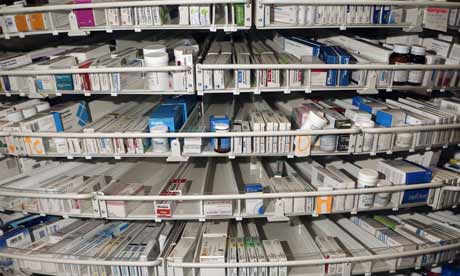
4) Panadol, Ibuprofen, Vicodin…

You get the point. At some time during Gitex, you’re going to be hit by the mother of all headaches. Be prepared, take lots of meds with you. And if you don’t have any and the dreaded throbbing and pain strikes then head on down to the pharmacy on the concourse to grab your pain killer of choice.

Bring drugs, lots of drugs! You will need them. (image source: The Guardian)

5) The Patience of a Saint

At some point you’re going to be surrounded by screaming, nagging executives who are behaving like a bunch of toddlers/prima donnaa. There’s really thing that you can do, apart from swallow your pride, paint a smile on your face, and remain calm. Gitex would test the patience of the Dalai Lama, so remember you’re not alone in your frustrations. For the week however, you will have to suffer in silence. Remember that patience is a virtue so stay calm!

Keep calm, take a deep breath. Gitex will soon be over. (image source: http://www.keepcalm-o-matic.co.uk)

What’s your top tips for Gitex? Share and share alike. Remember, we’re in this together!

The End of the Fattah Era at Abu Dhabi’s The National

How will The National change following Fattah’s departure to the world of Public Relations? (image source: http://www.capitalnewyork.com)

As they say, all things must come to an end. This month in the United Arab Emirates we witnessed a rare occurrence, the departure of an editor-in-chief at one of the national newspapers. After five years Hassan Fattah stepped down. The news wasn’t surprising to most of us media watchers when it was officially announced by The National on the 2nd of October. The news had been unofficially published by Capital New York on the 19th of September after personal emails had been leaked to The National staffers (one email apparently contained an employment contract from Fattah’s new employers).

Fattah’s time at The National hasn’t been without controversy. The paper, which was once dubbed “The New York Times of the Middle East”, once held aloft the ideals of freedom of the press and professional journalism in a region that suffers from a lack of both. Today, while The National is a quality read it hasn’t lived up to the goals that its founders and editorial team strived for at the paper’s launch.

Instead, judging by the number of pieces that have been written about The National by blogs and other online news outlets the paper has been riven by leadership issues at the top by people who have had to juggle the demands of producing good quality editorial alongside keeping the newspaper’s owners, Abu Dhabi Media Company, happy. The nadir was reached when disgruntled employees started a Facebook site with the aim of highlighting their unhappiness at how the newspaper was run.

Fattah has moved on to the dark side, to the world of public relations. He’ll be heading up communications for a company that is not much loved in the UAE – GEMS, the ‘world’s largest private education company’. It’ll be interesting to see how he copes with the move; public relations isn’t the easiest profession at the best of times but trying to prove that paying more per year for a child’s education than one would pay for an MBA in a top UK University is good value for money would be a stretch for even the most experienced communications spin doctor. How will Fattah cope with keeping his employer happy and the press onside whilst trying to convince a skeptical public about GEMS’ altruism and the value for money provided by its services for example?

However, my gaze will remain firmly on The National. The paper is still one of my favourites and I believe that despite all of the events of the last couple of years there remains the promise of a publication which can raise journalistic standards in the Gulf. Call me naive, simple or whatever else you want, but I’d rather live in hope that The National can return to the vision spelt out by Abu Dhabi Media chairman Mohamed Khalaf Al Mazrouei on the eve of its inauguration, of “a free, professional and enlightened press” that will play a key role in the development of the country. Am I asking too much? Let’s hope not.

PR Buzzwords that we (often) could do without – Innovation and Social Responsibility

The concept of communicating through the written word is a remarkable thing – we have the ability to educate, engage and persuade through a well-written, thoroughly thought-out piece of work. And then, there’s the other end of the spectrum, when buzzwords and phrases are used without reason and with little understanding of their meaning in the context in which they’re used.

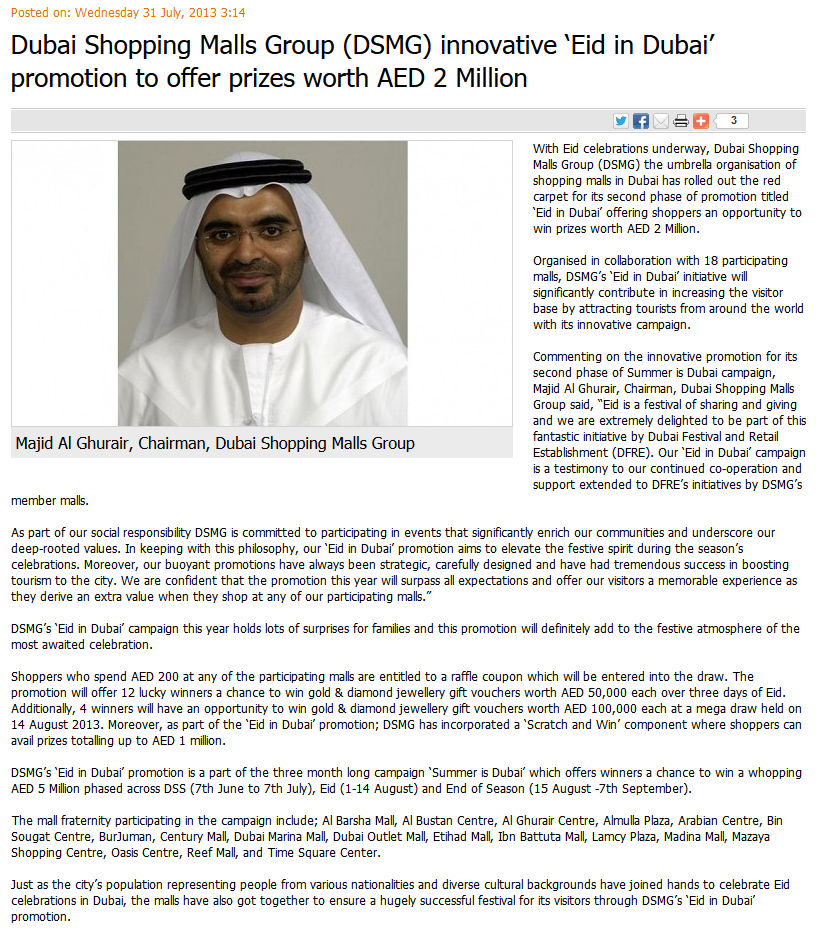
I came across one such example this week. A press release was sent out for a shopping promotion in Dubai. I’m going to post a screenshot below but you can also see the original article here.

How do the concepts of innovation and social responsibility work for a cash-based shopping promotion?

How do the concepts of innovation and social responsibility work for a cash-based shopping promotion?

I’m going to let you draw your own conclusions but let’s call a spade a spade and realize the power of words when properly used, in a setting that underlines their real meaning. Innovation is such a powerful term, as is social responsibility. But where’s the connection with this activity?

Anyone who works in public relations and communications will have been guilty of throwing in the odd ‘leading’, ‘global’ or award-winning every now and then. I’ve done it. However, is this habit becoming more commonplace within the Middle East’s communications sector.? When I have time, I’m going to do a keyword search to identify the worst offenders, the most overused phrases and buzzwords in regional press releases.

For the meantime, I’d like to ask you this. Which words are most overused and which turn your toes and make you cringe when you read them?

Fifty Three Million and Counting – Facebook’s hold on the Middle East

Based on the latest statistics shared at the Studio Edge event Facebook is the one network to rule them all (unless you’re a keen bird watcher that is)

Facebook came to town last week, and they brought lots of numbers with them. I was lucky enough to be invited along to the first Studio Edge event in the Middle East region. And I was astounded by the numbers that the team kept on rolling out. I’ve summarized these numbers below for you.

According to Facebook’s own research there are fifty three million active Facebook users in the region who use the service at least once a month. Egypt is Facebook’s largest market, followed by Saudi Arabia and then the United Arab Emirates.

Fifty two percent of Facebooks users access the site solely through their desktops and laptops; thirty eight percent use both mobile phones and computers, and ten percent only use their mobiles updating their profile and other Facebook activities. Twenty million people in the Middle East and North Africa are using Facebook today through their smart phones.

The average age of Facebook users in the region is 27 years and 64 percent of MENA users are male. That’s in contrast to the global split of male to female users which is currently 50/50. MENA Facebookers spend approximately seven hours on Facebook a month (that’s double the global average). And fifty two percent of Facebookers in the UAE use Facebook whilst watching television.

Middle East Facebook users like 84 pages compared to the global average of 51, and they view approximately 550 pages a month. Over forty percent of their time is spent on the news feed section of Facebook.

And to top off all of that, Facebook’s user base is growing in excess of 20 percent in the region.

With all of this information above, I’m hoping that we’re going to see more businesses online using the site. But if there was ever any doubt that Facebook is a first-tier consumer communications channel then please do re-evaluate how you use the network and start using the site properly.

One other interesting observation from the Facebook event. Most of the attendees were from advertising and creative agencies. I only spotted one public relations company. And yet, Facebook is all about content. Shouldn’t the Middle East’s PR industry be getting in on the act and promoting the quality of its social media services more?

Forget the culture, what about your customers? Saudi Ikea and a no-women catalogue

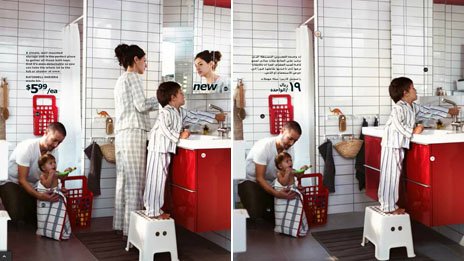
Now you see her, now you don’t. Ikea’s Saudi franchise forgot about the half of the population that makes (most of) the decisions about what goes in the house.

Ikea has been in the news of late for all of the wrong reasons. If you haven’t seen, read, heard or been told about the ‘incident’, then read the below from NBC’s website.

Scrubbing the bathroom got a whole new meaning in the Saudi Arabian Ikea catalog. The Swedish home and furnishings retailer faced criticism after reports surfaced that Ikea digitally erased women from pictures in the Saudi version of the catalog.

In one picture of a family in a bathroom, the mother standing at the sink with her son was removed. Even one of the retailer’s own designers, Clara Gausch, was erased from a photo featuring four of the brand’s designers.

Sweden’s trade minister Ewa Björling told the newspaper Metro the vanishing women were a “sad example” of gender inequality in Saudi Arabia, where women aren’t allowed to drive and must be covered in public.

In a statement to the BBC, the company said “excluding women from the Saudi Arabian version of the catalogue is in conflict with the Ikea Group values.” It blamed the missing women on the franchisee who runs Ikea’s Saudi operations and said, “We do not accept any kind of discrimination.”

While every media outlet around is poking fun at the Swedish furniture icon (and Swedes take their human rights and equality issues very, very seriously), the question I’d ask Ikea’s Saudi franchise is who do you think is buying your furniture? I’ve rarely seen any man in Ikea either in Riyadh or Jeddah deciding on what will go in the house.

So, how is getting rid of women in the catalogue going to help shift furniture? How does ignoring your target audience and not promoting your brand values with half of the population, the half that (mainly) look after domestic matters. So again, what was Saudi’s Ikea franchise thinking? Forget the women, let’s keep the conservatives happy. And yes, you can find women’s pictures being published in Saudi Arabia so why did the franchise take the risk?

What do #brands do with #franchises when consumers get #socialmedia angry?

A couple of recent events, both personal as well as public, have highlighted the challenges facing brands when it comes to franchises and customer service. Social media has given consumers the ability to interact directly with brands in ways which were never before possible. Today’s consumers expect a response from brands’ social media feeds, be it on Twitter or Facebook.

So what do brands do when they’re not in full control? How do brand communication teams deal with a consumer who is angry at a franchise? It’s an interesting question, especially for us consumers and comms professionals here in the Middle East.

A number of high profile examples have brought to light the limited scope for communications between consumers here in the Middle East and brands from locations outside of this region. The best case study would be the #noshaya Twitter-led campaign against the Kuwaiti-based retailer M.H. AlShaya. The call to boycott the company’s stores back in December was a response to AlShaya’s decision to stop providing cash refunds to customers throughout its stores.

AlShaya owns tens of franchises across the Gulf, including Top Shop, BHS, and H&M. It’s by far the largest retailer in the Middle East and thousands of Saudi consumers took to social media to vent their anger at AlShaya’s decision (for the full reasons behind the boycott please see this previous blog post).

After only a couple of hours of the campaign going live online activists started messaging the retail brands directly.

https://twitter.com/#!/hindkz/status/143315760419323904

https://twitter.com/#!/Maialshareef/status/143021336778903553

Activists sent hundreds of messages to the official Twitter accounts of retailers who had franchise agreements with M.H.AlShaya. While I may be wrong (and I hope I am) I didn’t see a single response from these retailers. These retailers weren’t helped by promoting their own refund policies on their websites, most of which were much more generous that AlShaya and included cash refunds on returned products – the activists’ key demand.

Another consumer-led campaign which hit the headlines this week relates to a nightmare incident in Saudi involving a Toyota Landcruiser which was stuck in cruise control at a speed of 210 kilometers per hour. For those Arabic readers out there check out this harrowing news piece from Al-Hayat newspaper. #ToyotaCruiseFailSa has been a top trending hashtag in Saudi for the past two days.

Out of all the car brands in Saudi Toyota probably has the best reputation for reliability and customer care. Does Toyota rely on its distributor Abdul Lateef Jameel to step in a repair the public relations damage done (so far, there’s been little word from the distributor) or do they step in themselves to reassure Saudi drivers? The response of one Toyota Landcruiser owner is typical of those trending the topic on Twitter.

https://twitter.com/#!/m_alshwaier/statuses/155276831241666560

The Arabic translates as, “I haven’t used the cruise control since buying the car because of this story.”

To ask again, when do brands step in to protect their brand value? How or what do they agree with their franchise and distributor partners as to who is responsible for what? Social media has changed the communications sector in ways that few could have envisaged. One short but interesting article online has found that consumers who contact the brand via social media are much more likely to expect a response to their queries. Check out The State of Social Marketing 2011 – 2012 by Brian Solis

I wonder how many of us in communications are taking note of what is happening around us before the same thing happens to the brands that we are entrusted with?

Shaping awareness on breast cancer in Saudi – how a local firm won globally for its communications approach

There’s nothing better than getting recognized for good work. What’s even better is to make a difference through your actions. We don’t often get to celebrate our local, Saudi-based public relations industry either because everything comes out of Dubai or our local agencies and companies believe that communications with the media and public begins and ends with a press release.

That doesn’t have to be the case any more in Saudi Arabia. One agency has been looking to change how communications is viewed in the Kingdom. That agency’s name is Adalid, and the founders are Saudi nationals who understand and know not only how the media works but also what communications is capable of.

They’ve notched up a series of impressive wins and campaigns locally since founding the agency two years ago. However, Yahya and Sohaib’s crowning glory is an event that has earned them global recognition. To quote directly from the piece in this summer’s edition of Gulf Marketing Review which can be found here.

“Saudi PR agency takes home two SABRE awards for breast cancer awareness campaign

Jeddah-based Adalid has beaten out 2,000 entries to become the first Saudi-managed and owned public relations firm to win a platinum and gold SABRE award for the one campaign. The much-coveted trophies, which were handed to Adalid’s top executives during the Holmes Group EMEA SABRE Awards ceremony in Prague this May, was in recognition for the success of A Woman’s Stand, a public relations campaign designed to raise awareness of breast cancer among females in Saudi Arabia.

The program, conducted by Adalid Public Relations on behalf of HRH Princess Reema Bint Bandar Al Saud and the Zahra Breast Cancer Association was the unanimous first choice of the SABRE judges…

The campaign, which aimed at raising awareness of breast cancer among women in Saudi Arabia through attempting to create the world’s largest human pink ribbon, worked with traditional media channels such as MBC, women’s magazine Sayidati, and Saudi’s Al-Watan newspaper.

Adalid also utilized social media to both spread awareness of the event as well as mobilize supporters to attend the record-breaking attempt. Thousands of people subscribed to the campaign’s Facebook page and Twitter feeds.

“While this was a professional campaign, it is also one where the benefits reflect directly on my mother, sisters and every single woman, not only Saudi Arabia but across the world,” said Adalid PR’s Managing Director, Yahya Hamidaddin. “Now the Kingdom has demonstrated that there is enough concern to establish a world record and been recognised for its efforts to bring concern over breast cancer out into the open, I am sure we can move forward in the battle to overcome this deeply distressing affliction.”

Adalid was founded in 2009 in Jeddah by a number of Saudi nationals with experience in the public relations industry. The agency extended its geographic reach following the opening of an office in Riyadh last year.

SABRE awards are bestowed annually by The Holmes Group in recognition of a company’s superior achievement in branding and reputation. They are awarded to those public relations, reputation management and brand building campaigns that exemplify a strategic approach in research and planning, innovative thinking, integrity and effectiveness. Gold SABREs recognize the best programmes in specific brand-building and reputation management categories. Only one platinum SABRE is awarded by the judging panel for the best campaign in the Europe, Middle East and Africa region. ”

Just for good measure the boys and their team of dedicated PR professionals not only won the European SABRE award in May, but topped it off with a global award for the best public stunt of 2011. Adalid’s A Woman’s Stand campaign also made the shortlist for the Holmes Report best global public relations campaign of 2011.

What’s amazing about this campaign is that it’s opened the doors for a comprehensive debate on breast cancer in Saudi. The disease, or more to the point discussion about the condition, is often considered a taboo in this conservative country. Since the campaign there have been calls for more initiatives from the public and private sector, and even an order for breast cancer to be a lead topic during Friday sermons (I still cannot imagine how most Muslim preachers would react to this, to discussing a topic that they’d most likely never thought about before, let alone preaching to their followers).

Thank you Yahya, Sohaib and the rest of the team for making this campaign possible, for promoting breast cancer awareness and for showing how good public relations can be in Saudi Arabia. You and the client have I believed made a huge difference to the women of the country and you’ve been awarded for that. Long may your success continue. I just hope the rest of the public relations industry in Saudi as well as Dubai takes note that we can do more than just send out a press release.