The Gulf’s new social media hybrids and the success of @maxofarabia

Living in a region which is known for diversity but which is still pervaded by barriers between all the cultures you’ll find in the Gulf, I’m fascinated by individuals who bring differing peoples together. One such person is Max, who goes by his online moniker maxofarabia. A British-American by background, Max has not only lived in the Gulf but he’s also taken the region to heart. Unlike many expats, Max has picked up Arabic and is fluent in the language (he has a strong Emirati accent).

By creating content in both English and Arabic about issues that are relevant to nationals, Max is opening up a new world for both expats as well as those outside of the region. Max prefers Instagram, but you can also find him on Twitter and Facebook (he’s also on Snapchat, but I’m way too old for that platform). His popularity among Emiratis is evident, and he regularly uploads videos about the UAE and its people to his Instagram account, where he is followed and watched by almost 190 thousand people. Max has become a social media ambassador for a number of projects in and around Dubai.

If you’re an expat and you’d like to know more about the Emirates in particular, then Max of Arabia is one to watch. Have a look at some of his posts below (apologies but Instagram’s embedding function is taking a day off today).

A good morning from Max's trip into the desert on the trails in the UAE

A good morning from Max’s trip into the desert on the trails in the UAE

Huge thanks to @hooralq for the invitation to @sharjahart - a great evening spent in one of my favorite cities, surrounded by creativity, with some of my favorite people - #Sharjah #SharjahArt

Huge thanks to @hooralq for the invitation to @sharjahart – a great evening spent in one of my favorite cities, surrounded by creativity, with some of my favorite people – #Sharjah #SharjahArt

Max even looks good in a thob - here at a wedding in Riyadh

Max even looks good in a thob – here at a wedding in Riyadh

Social Media trends for 2015 – Instagram hacking

We’re only a few days into 2015 and yet we’ve already seen one trend that is likely to become a major issue in the Middle East. Over the past two weeks a number of Instagram accounts of celebrities and well-known figures have been hacked. The first to be targeted, at the end of 2014, was the Lebanese singer Nancy Ajram.

Nancy Ajram’s account was hacked at the end of December

Ajram was only the first of a spate of hackings. Only this week the Crown Prince of Dubai, Sheikh Hamdan Bin Mohamed’s Instagram account was broken into by a hacker called @MRJL6H, who posted a number of images with text which can be translated as ‘we do not claim to be intelligent, but seek to destroy those who themselves claim to be intelligent.

Sheikh Hamdan Bin Mohamed's instagram account was hacked for only a short period but the hacker posted a number of images

Sheikh Hamdan Bin Mohamed’s instagram account was hacked for only a short period but the hacker posted a number of images

The hacker @MRJL6H posted several images highlighting his/her views on Sheikh Hamdan's Instagram account

The hacker @MRJL6H posted several images highlighting his/her views on Sheikh Hamdan’s Instagram account

Yesterday, a Bahrain-based actress and model Shaila Sabt was hacked in a similar manner to that above by @2h2, using presumably the same techniques used to hack into Sheikh Hamdan’s and Nancy Ajram’s accounts.

Bahrain-based actress Shaila Sabt had her Instagram account hacked by @2h2 in what seems to be a copycat of the hack on Sheikh Hamdan's account

Bahrain-based actress Shaila Sabt had her Instagram account hacked by @2h2 in what seems to be a copycat of the hack on Sheikh Hamdan’s account

There seems to be no reason to attack these Instagram celebrities, besides from the number of their followers. However, the compromising of these accounts is a reminder to everyone online to be aware of their security and initiate two step authentication where possible. If you’d like to know more about two step authentication read Google’s advice here.

My own feeling is that this trend will only grow during 2015. We’ve been fortunate to avoid hacking incidents, despite the popularity of social media in the Gulf. That may change over the coming 12 months, and we may see many more social media celebrities being hacked, either for fun or to spread a particular political or social message.

How many followers have been lost by the Gulf’s Instagrammers?

Instagram has deleted millions of fake accounts, pulling down the follower numbers for many accounts in the Gulf (image source: http://cdn.slashgear.com)

This week, photo-sharing app Instagram removed millions of accounts believed to be posting spam. The action, which has been dubbed the “Instagram Rapture”, hasn’t spared Instagrammers in the Gulf. Instagram is popular in the Gulf, particularly in Kuwait, where some Instagrammers have become celebrities in their own right and have turned the application into a living.

Globally, many of the world’s top 100 Instagram accounts have been hard hit by Instagram’s move to delete fake accounts. Figures released by developer Zach Allia have revealed that celebrities such as Justin Bieber lost over 3,500,000 followers.

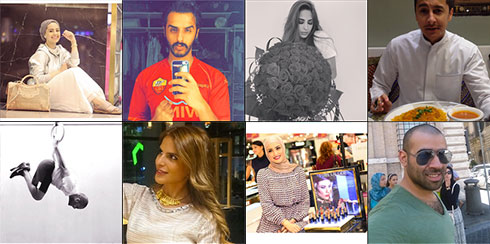
So, how did our own Instagrammers do? For Kuwait, stats compiled by the website Kuwaitiful compare numbers before and after. Have a look below at the top accounts in Kuwait (not all are Kuwaiti based, mind you).

Before and after the Instagram purge in Kuwait. Some accounts have hardly been affected, while others have seen their follower numbers fall drastically (source: www.http://kuwaitiful.com/)

Before and after the Instagram purge in Kuwait. Some accounts have hardly been affected, while others have seen their follower numbers fall drastically (source: www.http://kuwaitiful.com/)

For Saudi and the UAE, I’ve gone to Social Insider which also compiled the numbers before and after. Again, we’re seeing a similar picture, with some accounts hardly affected, while others have lost a double-digit percentage of followers (apologies for the image size, but you can zoom into the image to read the numbers).

This list of Instagram accounts from Saudi and the UAE includes the numbers from before and after the purge. One account lost 40% of its followers (source: www.http://social-insider.com)

This list of Instagram accounts from Saudi and the UAE includes the numbers from before and after the purge. One account lost 40% of its followers (source: www.http://social-insider.com)

The reaction from celebrities in the US hasn’t been kind. Rapper Ma$e, who lost more than a million followers, deleted his account after being accused for buying followers. How will those celebrities in our region respond, especially the accounts which have lost over ten percent of their total follower numbers? Also, will this affect how much these Instagrammers are charging for posting paid content? It’d be interesting to hear your thoughts on this one.

#ChallengeBahrain, an island in gridlock and a social media backlash

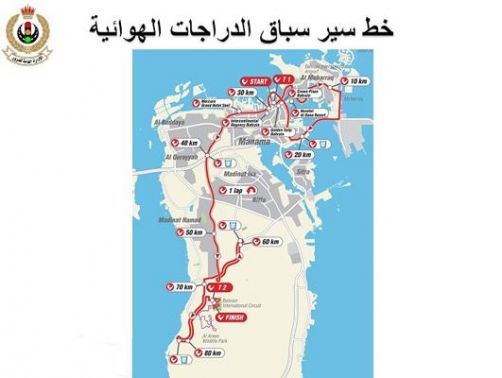
If you were planning to enjoy a quiet weekend in Bahrain this weekend, you’ll have been disappointed. Most likely, you’ll have also spent your Saturday stuck in traffic. The island kingdom was host to Challenge Bahrain, a professional triathlon with a $500,000 prize purse. Most importantly, for the smallest country in the Gulf (which measures a whopping 765.3 km²), the Challenge Bahrain triathlon covered a total of 113 kilometers.

The size of the triathlon meant that many of the roads around Bahrain were closed for most of Saturday, including the island’s key highways such as King Faisal Highway, and Sheikh Isa Bin Salman Causeway. Unfortunately, most of Bahrain’s residents seemed to be unaware that there was 1) a race, and 2) that the race would mean traffic chaos during the weekend.

To give you an idea of how much the race affected the island, this is a map of the race's path across Bahrain

To give you an idea of how much the race affected the island, this is a map of the race’s path across Bahrain

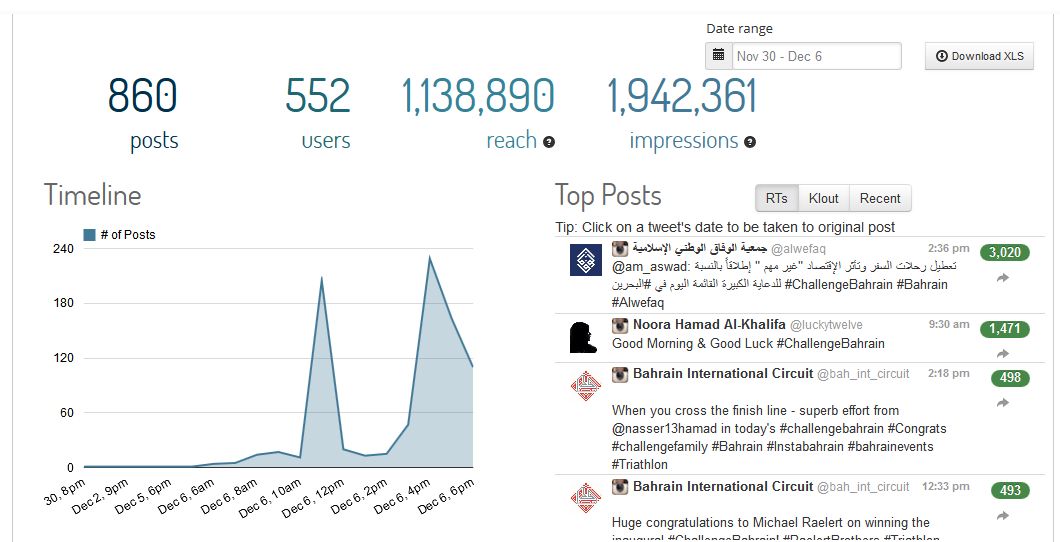
The ensuing disruption to traffic meant that most people decided to stay at home. Instead, they vented their annoyance online, on social media. To give you an idea of how popular the topic became, have a look at the below analysis from Keyhole, and remember that the total population of Bahrain is just over 1.3 million people.

An analysis of the #ChallengeBahrain hashtag by Keyhole

An analysis of the #ChallengeBahrain hashtag by Keyhole

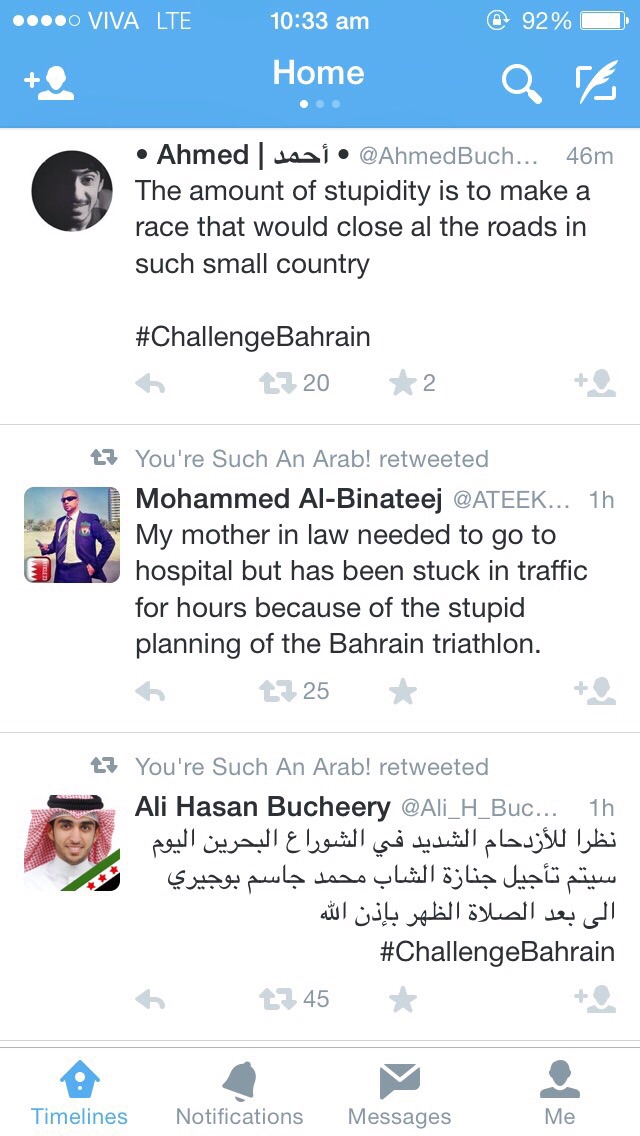
Tweeting and messaging with the hashtags #ChallengeBahrain and #ترايثلون_البحرين Bahrainis showed their feelings about the race and its planning. They let the race organizers know of their displeasure.

A small selection of the Twitter posts using the hashtag #ChallengeBahrain

A small selection of the Twitter posts using the hashtag #ChallengeBahrain

More tweets from yesterday's #ChallengeBahrain

More tweets from yesterday’s #ChallengeBahrain

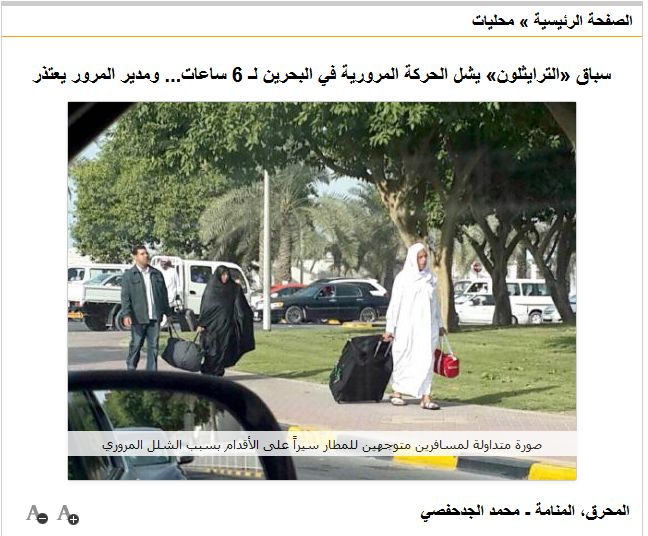
For those heading to the airport it was even worse. As many of the roads to Bahrain International Airport were closed people had to walk for kilometers just to make it to the terminal.

Images of the traffic from Al-Deir and Samaheej near to the Bahrain International Airport. People had to walk for miles to reach the terminal building.

Images of the traffic from Al-Deir and Samaheej near to the Bahrain International Airport. People had to walk for miles to reach the terminal building.

Unfortunately, Bahrain’s Gulf Air was one of the sponsors. Forty two flights were delayed due to transportation in and around the Airport; hardly the type of brand association any airline would need.

The traffic was so bad that even Bahrain’s chief traffic cop had to apologize publicly for the mess.

Bahrain's top traffic cop apologizes for the gridlock during #ChallengeBahrain

Bahrain’s top traffic cop apologizes for the gridlock during #ChallengeBahrain

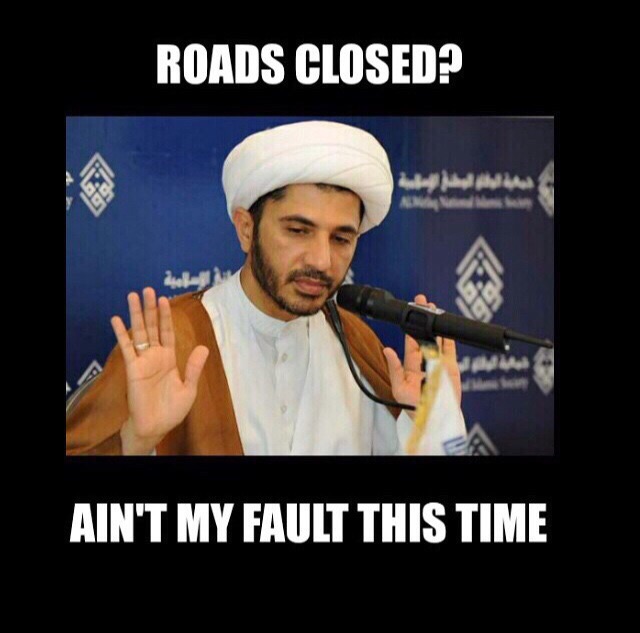
Some Bahrainis did see the funny side. Many created and shared memes, particularly on dark social sites such as Whatsapp, hinting at how successful the event had been in shutting down Bahrain, a feat which even Bahrain’s main political opposition couldn’t achieve.

A meme of AlWefaq's leader and #ChallengeBahrain

A meme of AlWefaq’s leader and #ChallengeBahrain

While the event came to a close on the same day, many of the organizers are looking ahead to 2015 and the second edition of Challenge Bahrain. For most Bahrainis, their hope is that someone will be listening to their social media and that whatever happens next year will not impact the island on the scale as they saw yesterday. If it takes several months to get in shape for a triathlon, I can’t wait to see what the island’s residents have in store for next year’s gridlock as they prepare over the next 12 months for Challenge Bahrain 2015.

The cost, and ethics, of paying Instagrammers in Kuwait

Kuwait is known for its love of Instagram and local Instagrammers (image source: http://www.248am.com)

A fascinating blog post by Mark of TwoFortyEightAM has me focusing on not just the cost of using Instagrammers, but the ethics of advertising through influencers in this region. In his post last week, Mark published a list of how much Kuwaiti Instagrammers get paid per post by advertisers. To quote from Mark’s blog, here’s a sample of some Kuwaiti Instagrammers and how much they/their agencies charge (note: prices are in Kuwaiti Dinars and one KD is just under 3.5 US Dollars).

@ahmad_asb (134,700 followers) KD450
@alimubarak1 (68,152 followers) KD450
@ameralshaibani (204,455 followers) KD450
@ascia_akf (1,005,559 followers) KD850
@azizbader (497,708 followers) KD850
@basharnoo (342,316 followers) KD400
@batoul_alkandari (224,233 followers) KD450
@bb_alabdulmohsen (59,123 followers) KD350
@dalalid (866,687 followers) KD850
@daneeda_t (358,396 followers) KD450
@dr_shammat (887,156 followers) KD750
@elham_alfedhalah74 (1,758,795 followers) KD900
@faisalalbasri (474,132 followers) KD850
@fawaz_alfahad (111,874 followers) KD400
@groupwanasah_ (444,647 followers) KD350
@hayaalshuaibi_79 (814,972 followers) KD700
@kaftanusman (516,835 followers) KD500
@nohastyleicon (811,541 followers) KD850
@omaralothman (92,482 followers) KD500
@thedietninja (351,952 followers) KD550
@therealfouz (216,096 followers) KD500
@theveeview (631,973 followers) KD500
@yousif_alblooshi (171,520 followers) KD350

You can see pricing lists for one agency, Ghaliah, here.

What fascinates me more than the pricing (and the analytics) is that of the ethics associated with influencers such as the above. In the US, if an influencer is taking money for a post they’ll have to make this known to their audience – it’s a legal requirement to ensure that their audience understands what they’ve just posted online is paid-for and therefore is an advert.

However, there are few Instagrammers here who do the same. As mentioned by one of Mark’s visitors, one of the Instagrammers above does use a * to denote a paid-for ad. But as for the others, there’s no suggestion as to what is paid-for and not paid-for.

Is this right? As a follower, I’d like to know if someone is paid for promoting another brand. It’s honest and forthright. Unfortunately, we will have to keep on guessing whether or not these posts are free or paid-for. Maybe this is one area where we need more government legislation to help consumers know what is really going on.

As for the costs of these Instagrammers, it’d be interesting to know how advertisers track their return-on-investment for sponsoring these paid-for posts. While Kuwait is one of the largest markets for Instagram in this region, it’s still difficult to know what percentage of followers is real and what percentage is fake. Similarly, when you’re spending over $2k USD on an Instagram post what are your intended outcomes as an advertiser?

I’d love to hear your thoughts on the above, as well as how much Instagrammers get paid in the rest of the region. Ta for now!

Coca Cola’s #OpenUp campaign to promote sharing and caring in the Middle East

Coca Cola has hit upon an interesting initiative for its latest digital campaign, with the aim of promoting openness between families. Released with the hashtag #OpenUp on YouTube, Coca Cola has developed two videos over the past eight days. The first, and for me the most moving, is that of Saudi chef Badr. Badr left behind the family tradition of architecture to study and become a cook, which is a rarity in Saudi society. The video and story are both well conceived and directed.

The second video features a social media star from Kuwait, named Ascia. Ascia recounts the challenges she has had to overcome in society as she has pioneered her ideas through Instagram. She thanks her husband Ahmed for the support he has shown her.

What do you think? Are the concepts powerful enough for you to share your #OpenUp story? Do you find them sincere or too scripted? Let me know your thoughts on the content and on Coca Cola’s work here. I’ll keep you posted on any additional videos that Coca Cola posts for this campaign.

The Chicago Tribune and how to get audience participation right through social media

I wanted to highlight this remarkable site from the Chicago Tribune. The blog, which will be hosted for a year and has the hashtag #trib2014, hosts reader photos from Instagram and enables participation through developing weekly themes. The newspaper’s staff are curating the site, but the visuals and captions are stunning. The weekly themes allow for a higher level of audience participation and give readers something to focus on rather than asking for their own images of a generic subject. Have a look at the below images from the blog. I can’t wait for someone to do this type of thing in the Gulf (just so you know, I’m extremely patient).

http://instagram.com/p/jHZ9XpuLdG/

http://instagram.com/p/jMbI0duLfo/

http://instagram.com/p/i1eLDLuLX3/

#MyDubai and the issue of whether to pay the public for content

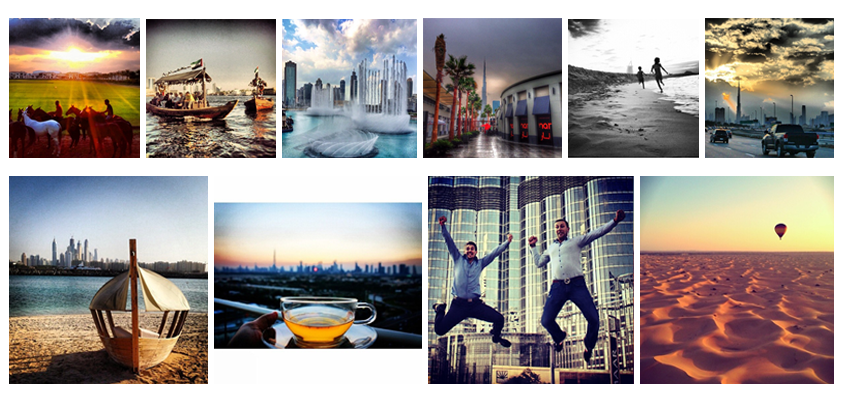
The first images from #MyDubai's initiative provided for free by Dubai residents (image source: www.facebook.com/DefinitelyDubai)

The first images from #MyDubai’s initiative provided for free by Dubai residents (image source: http://www.facebook.com/DefinitelyDubai)

To pay or not to pay? That’s the question. The city-state has launched an interesting project based on social media, dubbed as a social-media autobiography of Dubai to be written by its residents and visitors. To quote The National newspaper:

The year-long project will bring together people in the emirate through Twitter, Instagram, and Facebook. A call has gone out to share pictures and videos using the hashtag #MyDubai.

According to The National the project will tell the real and human stories of the city through residents’ contributions which are posted onto Facebook, Twitter and Instagram (there’s no mention of YouTube and Pinterest which is a shame).

The National followed up today with a second piece on the initiative. Tourism bosses from Dubai’s Department of Tourism and Commerce Marketing (DTCM) will select the best photographs and videos from the Emirate’s residents and showcase them in exhibitions and roadshows as part of the year-long #MyDubai project. The public’s images will be used to promote Dubai throughout the year.

What isn’t mentioned is if the public are going to be paid for their images which are going to be used for advertising the Emirate. As any content producer knows, photography and videography are expensive. While those lucky few whose images get chosen – to quote The National, “more than 25,000 images and videos were uploaded to Instagram using #MyDubai just 12 hours after the campaign was launched” – will be referenced and have been so far online on DTCM’s Definitely Dubai Facebook site is it right to use images provided by the public for free (even if it is with their consent).

And on another note, who owns the copyright to the images? Are the images commissioned by DTCM for their explicit use or do the copyright owners of the images, have the ability to pull the images as and when they please if they object to how the images are portrayed?

I love the concept of #MyDubai but should the public be paid for images that are used, even if only a token amount? If it’s for corporate usage, then I think they should do.

Social media brand hijacking – Emirates and Etihad fakes and lessons for a corporate online presence

A story broke at the beginning of the month about a couple of campaigns out there in the social media universe. Both piggybacked on two of the UAE’s most established brands. Essentially, the two campaigns offered those who followed the chance to win free flights with Emirates Airline and Etihad Airways.

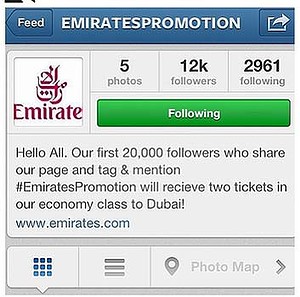
According to the UAE’s English-language newspaper The National which broke the story here in the UAE, the promotion launched on the picture-sharing site Instagram and stated that the first 20,000 people who would follow each account and would share the respective campaigns with a specific hashtag would receive free tickets for themselves plus one to Dubai or Abu Dhabi. The Emirates Instagram account was named EMIRATESPROMOTION while the Etihad campaign ran under the hashtag #EtihadPromotion.

The branding is there, the name may be dodgy, but there's no official Emirates account. So why not believe it?

The branding is there, the name may be dodgy, but there’s no official Emirates account. So why not believe it?

Too good to be true you may think, and the campaigns were fake. That didn’t stop 10,000 people following the fake Emirates account which featured the company’s logo and photos skinned from the company’s website. I don’t know how long the fake competitions were up and running for, but both Emirates and Etihad put out statements warning people not to fall for the fake campaigns. The Emirates statement is below.

To all our fans, Emirates has three official social media channels which are:

http://www.facebook.com/emirates
http://www.google.com/+Emirates
http://www.youtube.com/Emirates

When we launch competitions or new social media channels, you will be the first to know via our Facebook, G+ or YouTube channels and on emirates.com.

Thank you for your continued support
Emirates”

Emirates also sent a statement to the Australian website The Vine stating that “Emirates Airline does not have an official Instagram account. Any Emirates-related accounts or promotions on Instagram do not belong to us.”

Similarly, Etihad wrote on its Twitter account that “Etihad Airways has no association with any accounts or promotions (such as #EtihadPromotion) competition currently running on Instagram as we don’t have an official Instagram account yet. Thanks for checking.”

How does this concept sound to you? There’s lots of random people out there on social media, and scams and the internet aren’t mutually exclusive. So why do brands focus on some social media channels and not others? For example, both Emirates and Etihad don’t have Instagram accounts. Emirates doesn’t even have a Twitter account. Wouldn’t it be best for a brand simply to park their presence on the major social media channels (no one can do everything on social media, there’s simply too many channels and sites out there).

And this point may be even more relevant albeit off on a tangent for Emirates, which spends several hundred million dollars on sports marketing (the most recent announcement being the tie-up with Formula One). Isn’t the airline missing out through not focusing on social media? Imagine how much Emirates could achieve in brand positioning and amplifying that sports marketing spend by promoting itself through social media. As I’ve said before, technology is a wonderful leveler. It’d seem a waste not to wring every single penny in return on investment from those mega-bucks sports sponsorships.

So next time you see a promotion which is too good to be true just send a Facebook message to the airlines and ask them if they’ve gotten round in Instagram (or Twitter in Emirates’ case). And, as they say in France bon chance!

This gentleman clearly feels Emirates would benefit from more social media presence. Do you?

This gentleman clearly feels Emirates would benefit from more social media presence. Do you?

How to reach an audience through #SocialMedia and #influencers

Social media is the latest and greatest thing at the moment in the world of marketing and communications but how do we in an emerging market make the most out of what we’d call influencers, people on the web who are followed and listened to by others. The challenge that we face in a market is the Middle East is a lack of the mainstream online influencers, bloggers. Compared to Europe and the US, there are fewer bloggers in the Middle East, especially in countries such as Saudi Arabia. For those interested in pioneer bloggers, have a look at this list compiled by commentator Sultan Al-Qassemi or the Arab Media and Society’s portal on blogs.

Despite the challenges social media is an incredibly powerful way of reaching out to an audience, partly due to directness as well as its credibility. But how do you find the right influencers to reach out to? There’s a couple of very simple ways to do this and tools to use. Klout is probably the best known site for analyzing social media influence across a variety of sites such as Twitter, Facebook, Google+, LinkedIn, FourSquare, Youtube, Instagram, and WordPress.

Klout trawls social media network data and creates profiles on individuals and assigns them a “Klout score.” The higher the Klout score the more influence a person has online. Klout claims to have built more than 100 million profiles from crawling social media sites. While the site is far from perfect, it’s probably the most widely used tool to rate someone’s social media influence. You can search on Klout’s website either by topic or by the influencer’s name. Klout will give you three lists – one for top influencers, one for top +k recipients (basically people who have been rated highly by other Klout users rather than Klout’s own ratings system), and one for best content. Try a search on Dubai using Klout and see whom the website recommends.

The Klout profile for Mashable journalist Brian Hernandez

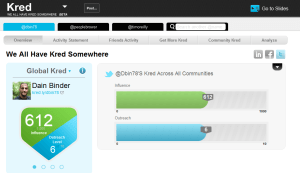
There are a number of other social ranking sites. The one which is gaining the most interest is kred.ly. At the moment Kred.ly is limited to analyzing people’s Twitter feeds only. However, Kred.ly may become very useful as it’s linked into a website called peoplebrowsr. Peoplebrowsr aims to give marketers and communicators access to influencers. The idea goes that you’d be able to identify people who are specialized in a certain topic and then pay them to promote your company or service. I’d love to hear from anyone who has used kred.ly and peoplebrowsr, especially in the Middle East.

Screenshot from social media analytics site kred.ly for blogger Dain Binder

So let’s give an example of what I’d be looking to do if I was working in tech. First thing would be to identify people with a big enough audience and enough credibility to influence others. One such user may be a prolific twitter user and the founder of saudimac.com Khaled Abdulrahman. Tweeting with the handle @khaled Khaled has over 13,000 followers and regularly updates his web site.

http://twitter.com/#!/khaled/status/153421180550922241

Khaled is a great example of an influence as he uses multiple sites to engage with an audience.

The challenge I have now is how to work with or influence Khaled. Traditional marketing would have meant paying the influencer. This is common for celebrity social media endorsements. However, this doesn’t always have to be the case with bloggers and topic specialists. Many may be willing to support you if they believe in the cause that you are promoting or if the content you give them is relevant or interesting.

The beauty of Klout, kred.ly and other tools is that they’re either free or fairly cheap to use. So when you’re next looking for people to help you communicate to an intended audience you’ve got no excuse for not finding the right influencers on the world wide web.