What does Instagram’s UAE communications remit say about how outsiders understand the region?

Instagram has been a huge hit in Saudi, especially among the Kingdom's youth. How will Instagram's comms team reach out to these groups? (image source: http://sustg.com/)

Instagram has been a huge hit in Saudi, especially among the Kingdom’s youth. How will Instagram’s comms team reach out to these groups? (image source: http://sustg.com/)

Client wins can often make interesting reading, especially when the brand is a household name. Last week was no exception, with the Dubai-based House of Comms winning a brief to represent Instagram in the UAE.

The news caught my attention for a couple of reasons. Firstly, House of Comms is enjoying remarkable success; the agency which was founded in 2012 has expanded rapidly, picked up a host of big name clients and won numerous awards for its work. The agency’s growth reminds me of the rapid rise enjoyed by Dabo & Co (which was eventually bought by Edelman). House of Comms does have an affiliate network across the region, including in the Gulf.

What struck me was Instagram’s choice of market to enter into. While the UAE is the regional public relations hub of the wider Middle East region, I would have thought that the company would have taken a more regional approach to public outreach (Editor’s Note: the agreement with House of Comms is for the UAE, but also includes advisory work for other markets). For instance, the first market to embrace paid influencer marketing, particularly on Instagram, was Kuwait. In terms of numbers on the platform, Saudi is the largest country in the region by far, with a greater number of users than the UAE. Egypt is another key market for the picture and video service. If you’re looking for details on Instagram usage, have a look at the stats below from the second quarter of 2015 from an earlier blog.

In terms of the Gulf, it’s no surprise that Saudi leads the way – there are 10.7 million monthly active users in the Kingdom (just over a third of the population). The UAE follows with 2.2 million monthly users. And, to the West, Egypt has 3.2 million monthly active users. What’s even more impressive is daily active users – a whopping 6.1 million for Saudi, 1.2 million for the UAE, and 1.1 million for Egypt.

In addition, there’s the parent brand to think of. Instagram is owned by Facebook, which has its own PR agency in the region (which is regional). Up until recently, that agency was supporting Instagram. So, why the change? Would having two agencies for the two brands help or hinder media outreach, especially when Instagram is known as a Facebook product?

While the agreement is only for the UAE, I hope that Instagram, one of the most popular social platforms in the Middle East, expands its regional approach to engagement. The Instagram team should have oodles of data to look at when it comes to usage in each and every different country, and they’d be smart to look at Twitter’s model of engaging with influencers to get them onto the platform. Let’s hope that as a digital business, Instagram takes a data-based approach to engagement in an emerging market and work in key markets, rather than follow the much traveled path of using a hub to work remotely instead of actually doing the hard work and going in-country.
The Fire, the Selfie and Prison – why you should care about what your friends say online

Was this inappropriate? Most certainly. But what could get you jailed is not just a picture that is in poor taste, but rather the comments your friends make on that post.

Was this inappropriate? Most certainly. But what could get you jailed is not just a picture that is in poor taste, but rather the comments your friends make on that post.

We all do stupid things, and we unfortunately then post these acts of idiocy online. Combine that with a situation like we had during New Year’s Eve, and you’ve got a situation that could at best be described as combustible.

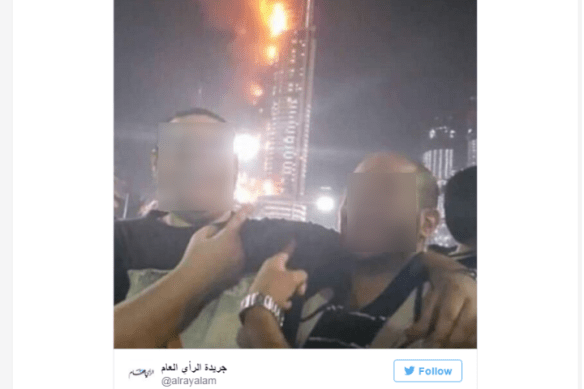
As the flames ravaged Dubai’s The Address Hotel on New Year’s Eve, some people decided to take selfies. A few posted these selfies online, to Instagram and Facebook. At least two people, two young men, were arrested for their selfie (pictured above) while the Emirate’s Public Prosecution investigated their case.

There’s been much speculation online as to why the men were arrested, with many commentators arguing that the action defamed the country and its image – let’s remember that defamation is a criminal offense in the Gulf, with a minimum fine of 500,000 Dirhams and jail time in the UAE (as well as deportation for expatriates). Many have posted selfies at the same location, with smiles, grins and laughs, and such expressions of emotion may have been considered a case of schadenfreude by the authorities.

However, according to the English-language newspaper 7Days which spoke to the lawyer of the two accused, they were investigated not for the image per se, but rather for the comments made about the image. The argument goes that the person who posts content is also responsible for the comments on that post, even if those comments are not written by the same person but his or her friends, family (or anyone who wants to get you jailed).

Luckily for them, the two were released from prison after a couple of days with no charge after investigators found that there was “no evidence of criminal intent”. However, remember that in future it’s not just your stupidity that could land you in jail, but that of your online contacts as well. Their comments could cross the legal line of what is defined as defamation, so don’t post images or any other type of post that could get you into trouble. Just don’t…

A look into how online behaviour is changing in Saudi from The Online Project

For many of us in communications in the Middle East, it’s hard to remember a time before social media (I still fondly remember receiving floppy disks with press releases, back in 2006). Social media agency agency The Online Project has dipped its toes into the Kingdom’s digital world to look at how social media behaviours are changing.

The agency, which undertook a similar exercise two years ago, went back to revisit some of its findings from 2013. The report, named Reintroducing Social Saudis, is an incredibly insightful look into what Saudis are doing online. Please do download the report and read it in full (it’s 18 pages in length).

Some of the findings include:

    1. Facebook remained the largest social platform in terms of number of users. However, Twitter growth surpassed Facebook by 25% in the past two years.
    2. Saudi preferences towards social entertainment have been changed through emerging platforms like Instagram and Snapchat.
    3. Online video has become a key channel for consuming content on all platforms, especially Facebook and Instagram.
    4. Comedy TV shows and sports are the most popular categories of online watched videos.
    5.While YouTube remained the main video sharing website Facebook and Instagram’s video growth has shifted the online video scene towards more exposure. Video content is no longer a YouTube exclusive.
    6. Hashtags usage on Instagram is just as popular on Twitter. Most used hashtags on Instagram shows how the platform is gradually turning into a female community.

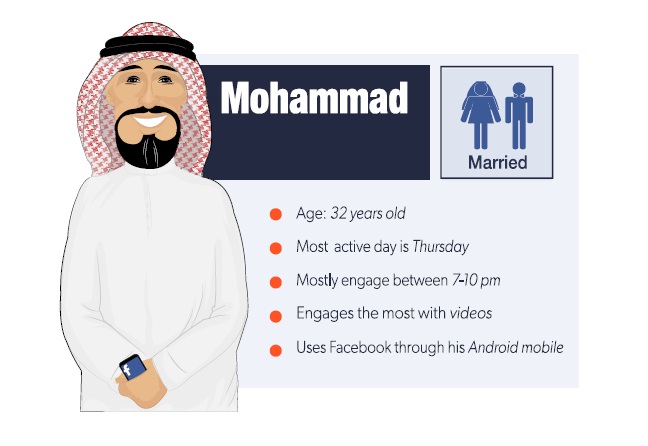
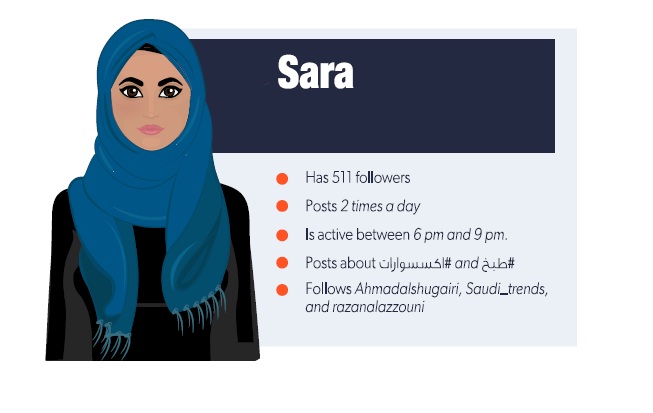
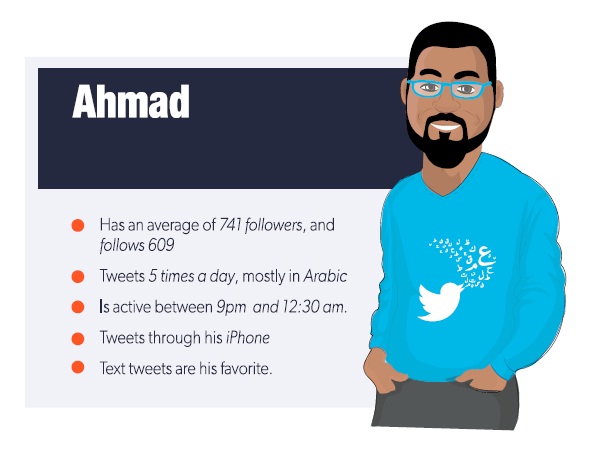
The team have also produced simple visuals and a video telling the stories of Mohamed, Ahmed and Sara, your typical Saudi social media users. You can see both below.

Based on The Online Project's research Mohamed is your average Saudi Facebook user

Based on The Online Project’s research Mohamed is your average Saudi Facebook user

Your average Saudi Instagram user is female and enjoys following social issues as well as fashion

Your average Saudi Instagram user is female and enjoys following social issues as well as fashion

Your average Saudi Tweeter is most active at night and engages most with text Tweets

Your average Saudi Tweeter is most active at night and engages most with text Tweets

If you’d like more info about social behaviour in Saudi, start reading the report and do reach out to the good people at The Online Project.

The Middle East’s love for Instagram (including its adverts)

Here in the Gulf we just love our pictures and photos. We love it so much that you’ll be hard pressed to find many in the Gulf who aren’t on the social media app. Only yesterday and in a period of less than five years Instagram announced that it had crossed the 400 million user mark (the app added 100 million users in the last 10 months alone). Seventy five percent of those 400 million users live outside the US, and the Gulf in particular has taken to the photo and video-sharing application.

In terms of the Gulf, it’s no surprise that Saudi leads the way – there are 10.7 million monthly active users in the Kingdom (just over a third of the population). The UAE follows with 2.2 million monthly users. And, to the West, Egypt has 3.2 million monthly active users. What’s even more impressive is daily active users – a whopping 6.1 million for Saudi, 1.2 million for the UAE, and 1.1 million for Egypt.

This all makes good news for Facebook, Instagram’s owner, which introduced advertising to the platform this month in the MENA region. Facebook rolled out advertising for select partners this month. The launch earlier this month included both regional brands such as telcos Saudi Telecom and Zain and retailers Souq and AlShaya, as well as global advertisers such as Unilever, P&G, Nestle, Mondelez, Visa, L’oreal and Pepsi. The first ad to go live was Souq’s, which you can see below.

Souq's Instagram advert was the first to be seen by Middle East users of the app

Souq’s Instagram advert was the first to be seen by Middle East users of the app

So far, from what I’ve been told, engagement with the adverts has been far higher than expected and much more than these advertisers are used to on Facebook. While there’ll be some negative sentiment from consumers who aren’t used to seeing advertising on their Instagram feeds, it seems that both Facebook and advertisers are onto a winner when it comes to Instagram advertising.

And for those of you curious people out there, the country with the highest penetration, is Bahrain which is closely followed by Kuwait. Both enjoy over 50 percent usage for Instagram; Bahrain’s penetration rate is over seventy five percent. The below visual was shared by social media expert Khaled El-Ahmed, and while the numbers may be slightly off from the above in terms of users, they’re still valid in terms of percentages.

PS For disclosure, I’m a P&G employee.

The definition of ‘Nobness’ – the UAE, social media defamation and differing views from the Gulf

It’s that time of year again. I don’t mean Ramadan of course, the month of charity and kindness, but rather the time of year when we read about a case of defamation. Over the past week there was an outcry in Australia following the arrest of an Australian national in the UAE following comments she put up on Facebook. To quote from the Australian Broadcasting Corporation’s website:

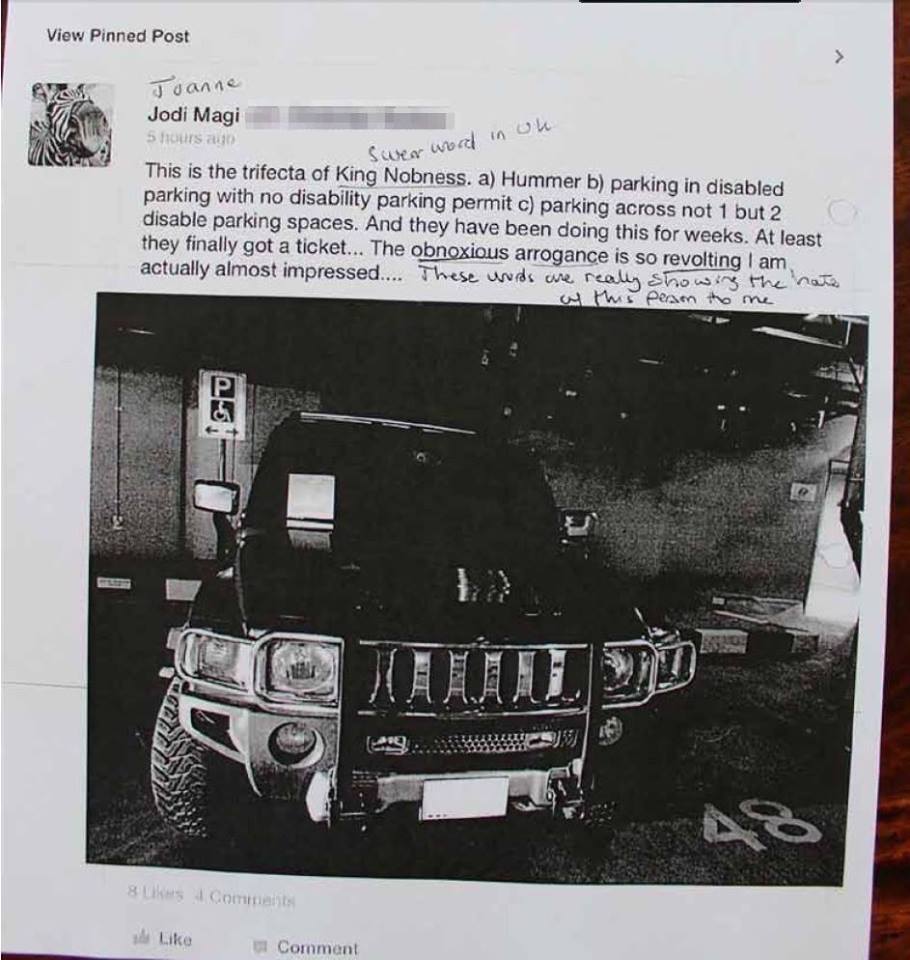
In February, Jodi Magi, 39, took a photo of a car in her Abu Dhabi apartment block that was parked across two disabled parking spaces, without any disability stickers.

She blacked out the number plate and put the photo on Facebook, drawing attention to the seemingly selfish act, but not providing any identifying details or names.

However, someone in the apartment block complained to police and the case went to an Abu Dhabi court in June.

Ms Magi, who has lived in Abu Dhabi since 2012, said she was forced to sign multiple documents in Arabic without any translation.

Two weeks ago (at the beginning of July) she was found guilty of “writing bad words on social media about a person” and told she would be deported.

Magi was deported this week from the UAE following intense media coverage. Her argument was that she didn’t know what she’d done wrong in her Facebook post (which you can see below). Her words were considered to be insulting by the complainant, who wasn’t mentioned in the post, and the court agreed with the complainant and, based on the country’s defamation laws (which I’ve written about here), found Magi guilty, fined her, and sentenced her to be deported.

This is the post which got Magi deported. Magi claimed that nobness referred to an Australian term for the elite, rather than the English insult (image source: Facebook)

This is the post which got Magi deported. Magi claimed that nobness referred to an Australian term for the elite, rather than the English insult (image source: Facebook)

While I’m not going to share my views on this (there’s plenty of comments both for and against the issue, but the law is the law), I will share views and thoughts from the rest of the Gulf where double parking is all too common and where the issue is being raised on social media. First up is Bahrain, where there is an Instagram account called Bahrainidiots. Bahrain’s residents are encouraged to share their images of cars which are double-parked for publication on the account’s Instagram feed – for some pictures have a look below.

Similarly, Saudi social media users often share such images, especially on Twitter using the handle #برج_الكلب. Some recent images are below.

https://twitter.com/Dr_MoNassif/status/618500070267355136

https://twitter.com/dr_attar/status/618503839998607361

The most interesting comments about the issue of defamation came from Doha. Speaking to the English-language news site Doha News, criminal attorney and Qatar’s former justice minister Dr. Najeeb Al Nuaimi said it was “highly unlikely” that an expat or Qatari would be arrested for posting a similar picture as Qatar and the UAE differ in their definitions of defamation. To quote:

“In the UAE, this (incident) is seen as ‘you’re showing someone in a bad light’ or that you’re questioning the duty of the police. They didn’t do their job well, and have let this happen, and now you’re posting it and offending them,” he said.

Here, however, the local government would regard sharing such a photo as a “a mark of public service,” he added, continuing:

“We have Qataris posting all over Facebook, Twitter and Instagram (about) things that they don’t like, or wrong things that they see…Here, it’s seen as doing something good.”

One of the publications which wrote about the case, the Abu Dhabi-based English-language daily The National quoted senior Abu Dhabi prosecutor Mohammed Al Dhanhani who explained that Magi was guilty under the 2012 Federal Anti-Information Technology Crimes Law No 5.

“She captured the picture without the consent of the (car’s) owner. She then published the pictures on the web and added insulting phrases.”

Each of these three actions is subject to prosecution under the law, which punishes all violators with a fine and/or jail, and deportation for all expatriates without exceptions, he said.

In an irony not lost on this blogger, while Magi’s state of affairs was playing out The National started its own photo gallery on bad parking in the UAE and posted images on its own website. Based on Al Dhanhani’s own interpretation of the law, is The National also guilty of the same offense under which Magi was sanctioned by capturing pictures without the consent of the car’s owner and then publishing these on the web?

For any lawyers out there, am I right or wrong?

Has Social Media Overtaken the News Cycle? The Story of the Kuwait Mosque Bombing

Last Friday was one of bloodshed and horror in Kuwait. The country, which has not been affected by regional sectarian issues in the same manner as its neighbours Iraq and Saudi Arabia, experienced something truly terrible. During Friday prayers, when men gather to pray together in the mosque, a suicide bomber entered one such mosque with the intent to kill as many of those inside as possible. To date, twenty seven people inside the Imam Sadiq Mosque, a place of worship for Shia Muslims. Two hundred people were injured.

Apart from the horror of this atrocity, which Islamic State claimed responsibility for, what is telling is the speed and amount of information which spread via social media, particularly WhatsApp, in the Gulf.

I was receiving messages about the bombing two hours before the news had made it onto websites such as Al Jazeera English. Not only was the information written down, but people were sharing both images and video thanks to the proliferation of smartphones as well as the availability of high-speed mobile data services.

Below is just a selection of the images that I received on that day.

What’s fascinating is not just the speed of information, but also the accuracy of that information. When Al Jazeera Arabic made a mistake with the name and picture of the suspected bomber an image was shared on social media of the correct suspect.

In addition, the amount of information was remarkable. While global networks provided a couple of minutes of coverage about the bombing, the images and video shared via Whatsapp built up a comprehensive picture of the incident, including video footage of the scene as well as interviews with witnesses and survivors. Unlike the news networks, many of whom don’t have correspondents in Kuwait, this was amazing, in-depth reportage of the Imam Sadiq bombing. Just two of the videos I received are below.

What was missing from all of this was context. On the same day there were terrorist incidents in both Tunisia and France, one of which was claimed by ISIS. Due to the local interest in Kuwait on my Whatsapp channels, no news on these two events was shared. This was a different story on the news networks where the three stories came together into one coherent piece on ISIS and its aim to spread terror across the Middle East and Europe.

Is the Imam Sadiq mosque bombing an example of citizen journalism working at its best in the Gulf? If so, how can media outlets catch up to ensure they have access to this information at the same time as its distribution through both private messaging networks such as WhatsApp as well as open platforms such as Instagram and Twitter? Twitter is looking to bring in a head of media partnerships for the MENA region, to work with publishers. It’ll be interesting to see how this and other efforts to get news outlets to work through social media impacts their ability to tell the story accurately in real time.

On a final note, my thoughts are with those who experienced this terrible incident. May all of those who were injured make a speedy recovery, and those who died always be remembered.

Did Skydive Dubai do enough communications following the tragic death of skydiver Majed Al Shuaiby?

There are days I love my job as a communicator. And then there are days when my heart breaks. One of those days was last week, with the tragic news of a death at Skydive Dubai. Majed Al Shuaiby was an experienced skydiver – he had over 700 dives under his belt according to the local media. On April the 30th Majed took to the skies. Unfortunately, his parachute did not open and he died on impact.

This news, as sad as it is, is also newsworthy. We have a young man, who is only 35 years old, who perished whilst undertaking a sport which is often thought of as high risk. The accident made the news, with coverage nationally and regionally (Majed was a Saudi national). Unsurprisingly, the news first appeared on social media, on the evening of the 30th, the day of the accident.

In a tribute Majed’s name trended on Twitter in Saudi with the hashtag #ماجد_الشعيبي.

Many of those who were online and who knew of the accident started to reach out to Skydive Dubai. The initial reaction was, to put it mildly, disappointing.

https://twitter.com/ammorsy/status/593784283237457921

What Skydive Dubai did, a day after the accident, was put up a post on its Facebook Desert Campus page and push users there. There’s no separate post on Skydive Dubai’s main Facebook page and no posts on Twitter.

The holding statement above has been used for media attribution as well, as can be seen from The National’s story.

Was the statement from Skydive Dubai enough or could they have done more?

Was the statement from Skydive Dubai enough or could they have done more?

While the investigation is still under way to determine what happened, could Skydive Dubai have done more to publicly address the incident and offer their condolences to the family, whilst also addressing concerns around the safety of skydiving?

No one wants to go through a crisis, especially when people are injured or there’s a fatality. However, we as communicators are on the front line to advise our employers and communicate in a way that is respectful, that comforts, and that shows we are also human. As we say, perception is reality and Skydive Dubai’s initial response, to block users, would seem entirely at odds with what communicators should do in a crisis. Going beyond that, is a holding statement enough? We need to present both the facts and show our emotion. We should never simply ignore bad news, and block conversations. Could Skydive Dubai have done more? Do let me know your thoughts.

On a final note, I’d like to convey my condolences to Majed’s family. Allah yurhamu and may god bless his soul.

Do you want to know more about social media in the Middle East? Download the TNS ArabSMIS report here

Do you not know where to start when it comes to social media and the Middle East? This report may be your answer (image source: http://blue16media.com)

Do you not know where to start when it comes to social media and the Middle East? This report may be your answer (image source: http://blue16media.com)

We have our fair share of big events in Dubai and this week was no exception. The past two days has seen the Emirate become the place to be for social media influencers. Whilst we found ourselves invaded by all types of beautiful people (and others) waving their selfie sticks and pouting for the camera, there were some handy takeaways for an audience looking to learn more about how to use social media to build brands for themselves, their companies or their countries. Oh, and Twitter has finally decided to open an office in the MENA region, obviously in Dubai.

The most impressive part of the Arab Social Media Influencers Summit was the report. Coming in at a whopping sixty seven pages, the report by research house TNS covers a whole host of areas of social media interest across the MENA region. The study combines both qualitative research with a quantitative survey of more than 7200 users of social media spread evenly
across 18 Arab countries.

If you’re looking to know which channels are used across MENA, then look no further. The report includes stats on LinkedIn, Facebook, Twitter, Instagram, Whatsapp, Google+, and YouTube. It also includes social media usage habits, including time of use, duration of use and devices used. Most importantly, the report looks into attitudes about social media across the region and what people are doing online.

If you’re doing anything online in the MENA region, download this report and start dissecting. You can thank me later, on social media.

The ASMIS Social Media MENA Report

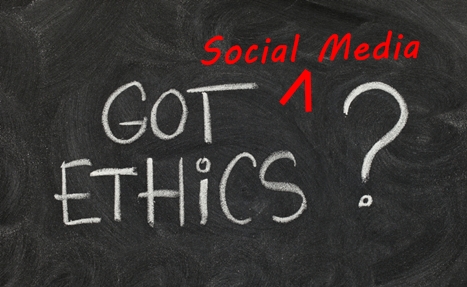
When it comes to social media, advertising and the Middle East, why don’t we have any ethics?

The region loves social media, but its influencers and advertisers are less keen to say when a post is paid for (image source: www.business2community.com)

The region loves social media, but its influencers and advertisers are less keen to say when a post is paid for (image source: http://www.business2community.com)

Who needs ethics right? Ethics are boring, they’re dry, and they mean we have to use disclaimers. Ethics really aren’t fun. But you know what, without them we’d be in a fair amount of trouble. With the Arab Social Media Influencers Summit happening this week in Dubai, and a fair few social media influencers being in town (including quite a few from Kuwait who don’t make it clear that they accept money for posting on their social media channels), I want to reprint this post which I shared with the Media Network Middle East last month. I’d love to hear your views on ethics, or the lack thereof, when it comes to social media and advertising in our region.

While European and American consumers are benefiting from crystal clear regulations on sponsored social media content, there’s little to no clarity here on the same.

We’re awash with social media in our region. Everywhere you go, you’ll see people sliding their fingers left and right, pushing up and pulling down on their smartphone screens. We’re all at it, checking our Instagram accounts, refreshing our Twitter feeds, and posting Facebook updates.

Today we have social media celebrities, people who have become famous through their online activities. There are Instagrammers in Kuwait with over a million followers, Facebookers in the UAE with hundreds of thousands of likes, and Saudi Tweeters with followings equal to the population of Bahrain.

Alongside these social media celebrities we have witnessed the rise of paid posts. Those of you with a keen eye will have noticed how many celebrities online have become more commercial, and have begun to share updates, images and videos promoting brands.

There’s nothing wrong with promotional advertising. Using paid influencer marketing is a common tactic to spread awareness, promote a brand, and to engage social media users across the globe. Online advertising can be more cost effective in terms of measurement and reach.

However, there’s no distinction between an advert and paid-for content. Both involve a payment of some kind by a company for a promotion of its brand or services. Regulators across Europe and the United States have essentially ruled that if money is changing hands, obvious disclosure must occur in-ad. Their reasoning is simple; consumers have a right to know what is an advert and what is not an advert.

While European and American consumers are benefiting from crystal clear regulations on sponsored social media content, there’s little to no clarity here on the same. Consumers here have no authority to turn to or no regulations to guide them on what is and what isn’t sponsored.

There seems to be little eagerness for brands or social media celebrities to advertise what is paid-for content either. This is understandable, as their followers may be less inclined to engage with a post if they know it is sponsored, or even follow a person who they know accepts money for posts.

While this lack of disclosure may appeal in the short term and help to maximise revenues (paid-for posts in Kuwait can fetch up to three thousand dollars per posting), it does nothing to building goodwill and trust with consumers across the region. A lack of honesty and transparency on what social media celebrities are paid to post will negatively affect trust in both the sponsoring brand as well as the celebrity who is accepting the payment in return for sharing the content.

In the US the burden is on brands to ensure that their endorsers, such as bloggers and online influencers) are in compliance in terms of disclosure. Paid-for posts have to include language such as #Ad, Ad: or Sponsored. Even brand posts and shares by a company’s employees have to be clearly labeled to account for the bias.

Either brands can take action and begin to self-regulate, or they can wait for regulators to finally step in and possibly take a harder-line approach to sponsored influencer endorsements. Is risking a reputation and trust, built up over years of marketing, worth risking over a lack of disclosure? I hope the answer is no.

Learning about a local community – Humans of Bahrain

We’re bombarded by adverts on a daily basis, and unfortunately it seems that social media may be going the same way. What with all of the selfies, the food pictures and the holiday snaps it could be argued that there’s little in the way of meaningful insights into wider social communities. However, every now and then you come across a gem that’s worth shouting about.

My wife was the person who first told me about this one Instagram account. Humans of Bahrain aims to tell the story of people living in Bahrain, both local and expatriate. It’s an account that is frank and candid, and shares a personal view of each and every one of the people being profiled by the account (it’s similar to sites found in the US and Asia which profile local communities).

Each picture on the account includes a story told in text below the image, both in English and Arabic. Subjects covered include education, marriage, careers and employment, and good old-fashioned feelings and emotions.

So far, the account has posted 169 images and it has just over three and a half thousand followers. If you’re looking to learn more about culture and the people that make up Bahrain, this is an amazing site to follow. I wish more people would focus on what is around them to tell the story of their community and their home rather than simply themselves.