How did Facebook fail with its Safety Check in emerging markets?

  
There are some times you really shouldn’t be making a distinction. Last week two tragedies took place, the first in Beirut and the second in Paris.

Others have written, much more eloquently than myself, on the raw emotion they felt after the two acts of terrorism – Beiruti blogger Elie Fares was one of the first to write about his anguish at Lebanons’s suffering being ignored by the West.

What is telling with the decision to activate the Facebook Safety Check was a comment by Alex Schultz, Facebook’s VP for Growth, who said:

In the middle of a complex, uncertain situation affecting many people, Facebook became a place where people were sharing information and looking to understand the condition of their loved ones. We talked with our employees on the ground, who felt that there was a need to fill. So we made the decision to try something that we’ve never done before: activating Safety Check for something other than a natural disaster. There has to be a first time for trying something new, even in complex and sensitive times, and for us that was Paris.

While Facebook’s intentions were to help those in need, the appearance to many in emerging markets such as Africa and the Middle East was that of bias. In effect, it was as if a life in Paris was worth more than a life in Beirut, or in Kenya or in Nigeria. This was compounded by Facebook’s decision to provide users with the option to upload the French flag over their profile picture.

Schultz’s comments that it was a human decision to activate Safety Check for Paris lead me to lose this question. Who at Facebook should have put forward the idea to use this service anywhere or everywhere where there is a crisis? My answer would be the communications and policy teams.

Communications in particular is the function that should act as the bridge between the outside world and the corporation, the part of the business that brings the outside in. That’s why, for example, Comms leads on issues and crisis management. Comms should have a robust understanding of the different stakeholder groups and how they impact the organization.

However, my take on Comms goes further. Comms should act as the conscience of the organization, and the Comms team should be able to advise when something is not right ethically. Unfortunately, Facebook’s team missed this opportunity here and instead turned what should have been an opportunity to play a vital role in helping inform families and friends re the safety oftheir loved ones into an example of unintended double standards (this was compounded by the Safety Check being used for residents of a Western capital rather than an Arab or African one, which in the context of colonialism also doesn’t look good).

Mark has said that Facebook’s policies will change and rightly so. Facebook is considered by many in emerging markets to be a tool for good, which is helping to promote positive change. It’d be a shame to see that opinion shift due to a lack of cultural awareness.
A look into how online behaviour is changing in Saudi from The Online Project

For many of us in communications in the Middle East, it’s hard to remember a time before social media (I still fondly remember receiving floppy disks with press releases, back in 2006). Social media agency agency The Online Project has dipped its toes into the Kingdom’s digital world to look at how social media behaviours are changing.

The agency, which undertook a similar exercise two years ago, went back to revisit some of its findings from 2013. The report, named Reintroducing Social Saudis, is an incredibly insightful look into what Saudis are doing online. Please do download the report and read it in full (it’s 18 pages in length).

Some of the findings include:

    1. Facebook remained the largest social platform in terms of number of users. However, Twitter growth surpassed Facebook by 25% in the past two years.
    2. Saudi preferences towards social entertainment have been changed through emerging platforms like Instagram and Snapchat.
    3. Online video has become a key channel for consuming content on all platforms, especially Facebook and Instagram.
    4. Comedy TV shows and sports are the most popular categories of online watched videos.
    5.While YouTube remained the main video sharing website Facebook and Instagram’s video growth has shifted the online video scene towards more exposure. Video content is no longer a YouTube exclusive.
    6. Hashtags usage on Instagram is just as popular on Twitter. Most used hashtags on Instagram shows how the platform is gradually turning into a female community.

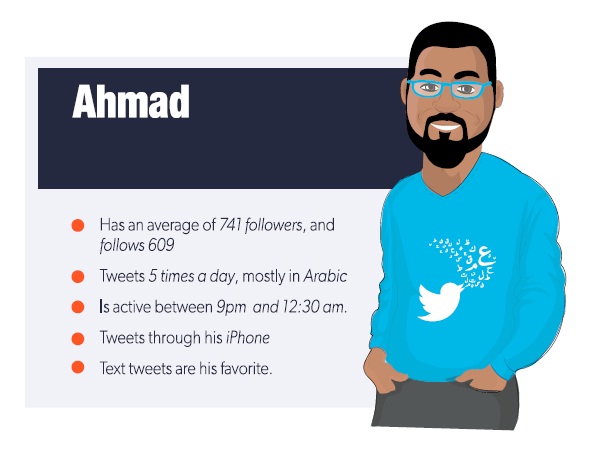
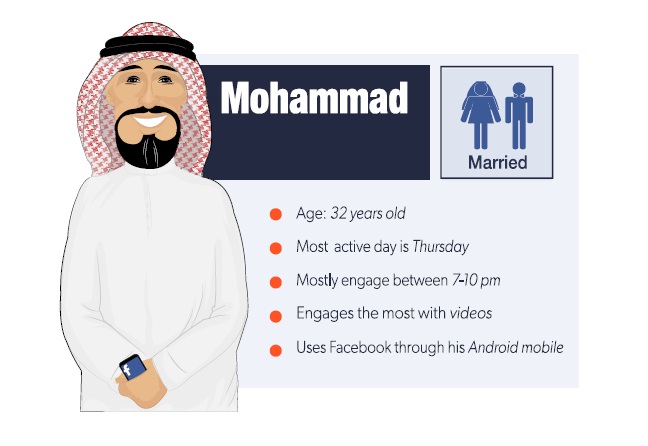
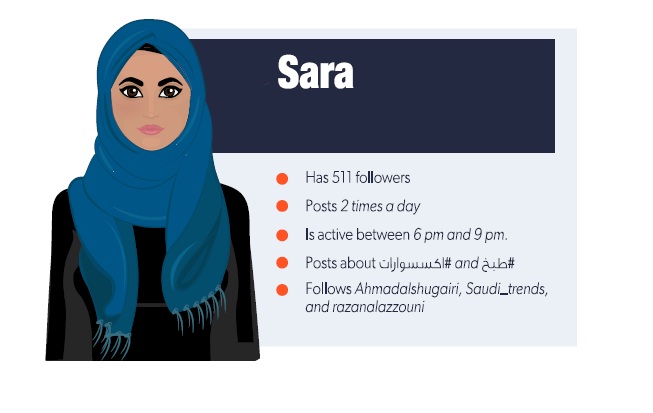
The team have also produced simple visuals and a video telling the stories of Mohamed, Ahmed and Sara, your typical Saudi social media users. You can see both below.

Based on The Online Project's research Mohamed is your average Saudi Facebook user

Based on The Online Project’s research Mohamed is your average Saudi Facebook user

Your average Saudi Instagram user is female and enjoys following social issues as well as fashion

Your average Saudi Instagram user is female and enjoys following social issues as well as fashion

Your average Saudi Tweeter is most active at night and engages most with text Tweets

Your average Saudi Tweeter is most active at night and engages most with text Tweets

If you’d like more info about social behaviour in Saudi, start reading the report and do reach out to the good people at The Online Project.

The Middle East’s love for Instagram (including its adverts)

Here in the Gulf we just love our pictures and photos. We love it so much that you’ll be hard pressed to find many in the Gulf who aren’t on the social media app. Only yesterday and in a period of less than five years Instagram announced that it had crossed the 400 million user mark (the app added 100 million users in the last 10 months alone). Seventy five percent of those 400 million users live outside the US, and the Gulf in particular has taken to the photo and video-sharing application.

In terms of the Gulf, it’s no surprise that Saudi leads the way – there are 10.7 million monthly active users in the Kingdom (just over a third of the population). The UAE follows with 2.2 million monthly users. And, to the West, Egypt has 3.2 million monthly active users. What’s even more impressive is daily active users – a whopping 6.1 million for Saudi, 1.2 million for the UAE, and 1.1 million for Egypt.

This all makes good news for Facebook, Instagram’s owner, which introduced advertising to the platform this month in the MENA region. Facebook rolled out advertising for select partners this month. The launch earlier this month included both regional brands such as telcos Saudi Telecom and Zain and retailers Souq and AlShaya, as well as global advertisers such as Unilever, P&G, Nestle, Mondelez, Visa, L’oreal and Pepsi. The first ad to go live was Souq’s, which you can see below.

Souq's Instagram advert was the first to be seen by Middle East users of the app

Souq’s Instagram advert was the first to be seen by Middle East users of the app

So far, from what I’ve been told, engagement with the adverts has been far higher than expected and much more than these advertisers are used to on Facebook. While there’ll be some negative sentiment from consumers who aren’t used to seeing advertising on their Instagram feeds, it seems that both Facebook and advertisers are onto a winner when it comes to Instagram advertising.

And for those of you curious people out there, the country with the highest penetration, is Bahrain which is closely followed by Kuwait. Both enjoy over 50 percent usage for Instagram; Bahrain’s penetration rate is over seventy five percent. The below visual was shared by social media expert Khaled El-Ahmed, and while the numbers may be slightly off from the above in terms of users, they’re still valid in terms of percentages.

PS For disclosure, I’m a P&G employee.

How to control the message Egyptian style

Us communications professionals think that we  control the message. In Egypt, that couldn’t be farther from the truth.

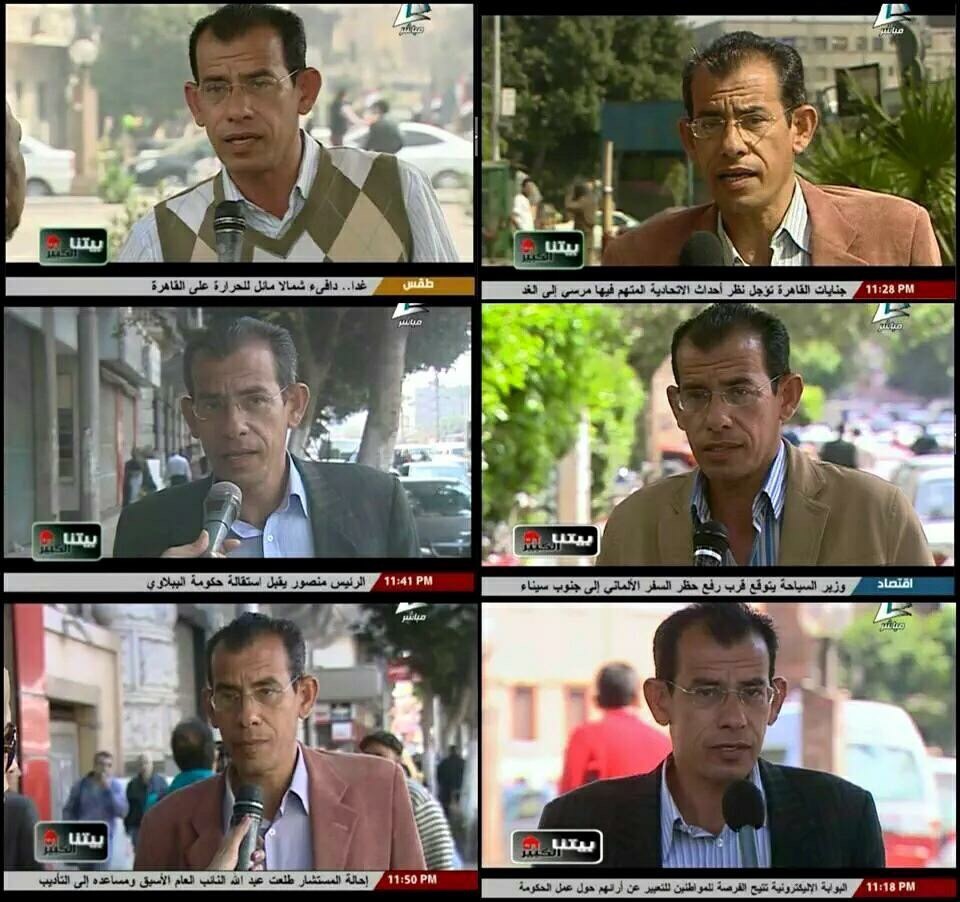
The below image has been circulating on Facebook for a couple of days now. It’s supposedly clips from random street interviews with Egyptians for one TV station in Cairo. But, as you sharp-eyed lot may have noticed, this is either the same man or Egyptian men all look the same.

As the saying goes, if you want something doing right then do it yourself. And this channel obviously doesn’t want the wrong message getting out.


Social media crises – Lebanon’s Fransabank and the email banning employees from attending Friday prayers

A second post this week focusing on social media and the digital world. And, similarly to the STC story, this article is also about a crisis. However, the background to what happened with Lebanon’s Fransabank is different to that of the public backlash against STC and its alleged poor customer service.

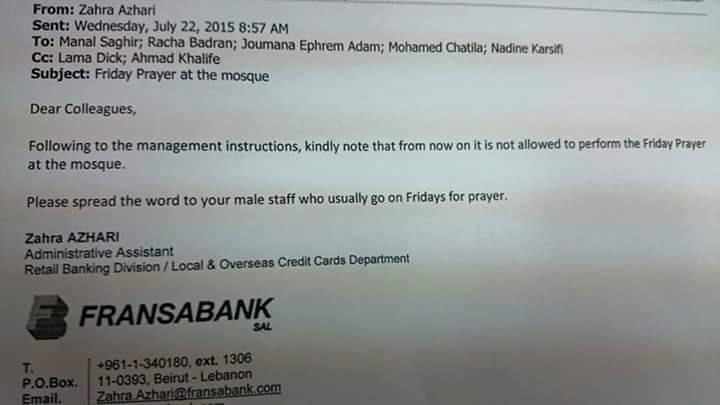
On the 22nd of July a picture began to circulate on social media channels of an email allegedly sent from an administration assistant banning male employees at Fransabank from going to Friday Prayers. A little context here for those who don’t know Lebanon. Unlike in the rest of the Middle East, Lebanon’s weekend is Saturday and Sunday and not Friday. For Muslims, the weekly communal prayer is held on a Friday at noon, and according to Lebanon’s constitution regarding freedom of religion all Muslim employees have the right to attend Friday prayers during their working day.

The connotation behind the alleged email was that male Muslim employees were not returning back to work after their prayers. You can see a screenshot of the email below.

This is a copy of the email allegedly written by a Fransabank employee and then leaked to the net

This is a copy of the email allegedly written by a Fransabank employee and then leaked to the net

As with many other religious issues in Lebanon, a country that is home to a complex mixture of religions and ethnicities, the email set off a storm of commentary on Facebook in particular. The issue reached back to Fransabank and their communications team acted to take control of the situation.

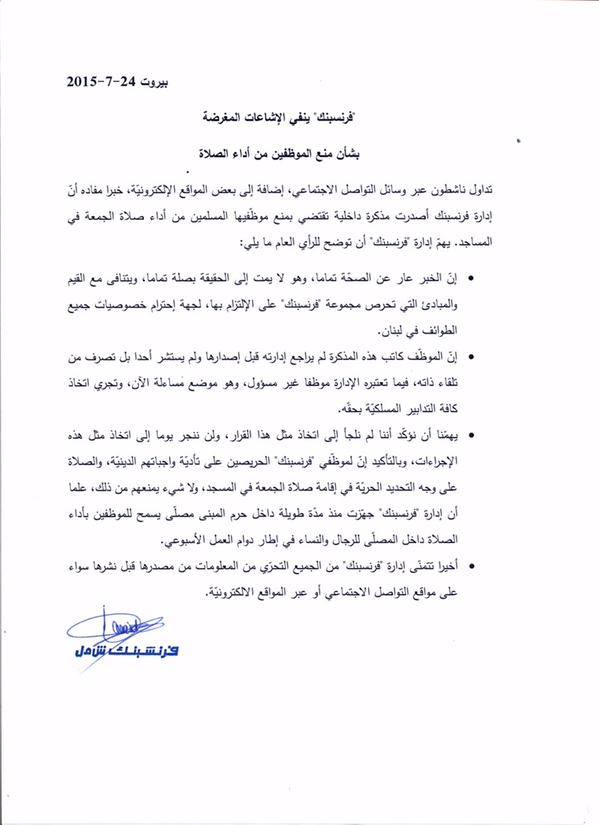
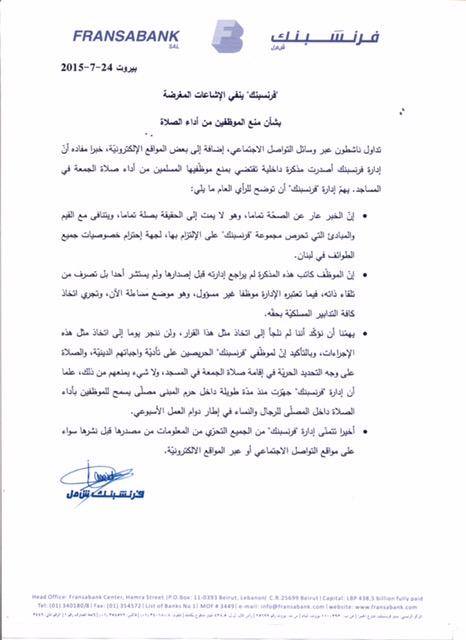
On the same day they issued a statement, in the form of a letter in Arabic, reaffirming respect for all of their employees and their religious duties. In addition, the letter (which is a fairly long crisis statement), also noted that the email was not authorized to be sent by the Bank (which would imply that the email was sent by an actual employee).

This was the first response from Fransabank on the email leak.

This was the first response from Fransabank on the email leak.

All well and good you’d think, but it didn’t stop there. Unfortunately, the first statement was signed but no one knows by whom as there was no name underneath the signature. Secondly, the letter was printed on a plain piece of A4 rather than a Fransabank letterhead. Cue the second letter, which you can see below.

Which was followed by a second statement from Fransabank, this time on an official letterhead

Which was followed by a second statement from Fransabank, this time on an official letterhead

There are obvious lessons here for all of us in communications. Firstly, get your internal communications right and make sure that your employees are aware of your values and your obligations. Legally, no employee should have shared an email regarding stopping their colleagues from performing their religious duties. From the perspective of values, would any Muslim employee want to work at an institution that doesn’t respect their right to pray on a Friday? While there were allegations of employees not returning to work after prayer, was such a response the right reaction? If values and compliance were communicated internally well and the issue of non-attendance handed in a different manner, maybe the email would never ever have been written, let alone leaked via social media.

Secondly, the response. Kudos to the Fransabank team for responding promptly on the same day after becoming aware of the issue (one question I have is how did they come across the original email post). But was the response adequate? Was a letter the right way to do it, especially a letter with no name attached and which is not printed on the bank’s letterhead? Could the team have responded differently, through a video message from a senior executive or a briefer holding statement that goes to the core of the issue about respect for religion and respect for their employees’ right to pray on a Friday?

The Fransabank story is another reminder that social media can bite you at any time. Every employee will have access to the internet, if not on their company computers, then through their mobile phones. Every employee will also have access to a camera, thanks to those same internet-enabled phones. Any content can be uploaded which can harm a person’s reputation. Was Fransabank ready for the crisis? And are you ready if something similar leaks online?

The definition of ‘Nobness’ – the UAE, social media defamation and differing views from the Gulf

It’s that time of year again. I don’t mean Ramadan of course, the month of charity and kindness, but rather the time of year when we read about a case of defamation. Over the past week there was an outcry in Australia following the arrest of an Australian national in the UAE following comments she put up on Facebook. To quote from the Australian Broadcasting Corporation’s website:

In February, Jodi Magi, 39, took a photo of a car in her Abu Dhabi apartment block that was parked across two disabled parking spaces, without any disability stickers.

She blacked out the number plate and put the photo on Facebook, drawing attention to the seemingly selfish act, but not providing any identifying details or names.

However, someone in the apartment block complained to police and the case went to an Abu Dhabi court in June.

Ms Magi, who has lived in Abu Dhabi since 2012, said she was forced to sign multiple documents in Arabic without any translation.

Two weeks ago (at the beginning of July) she was found guilty of “writing bad words on social media about a person” and told she would be deported.

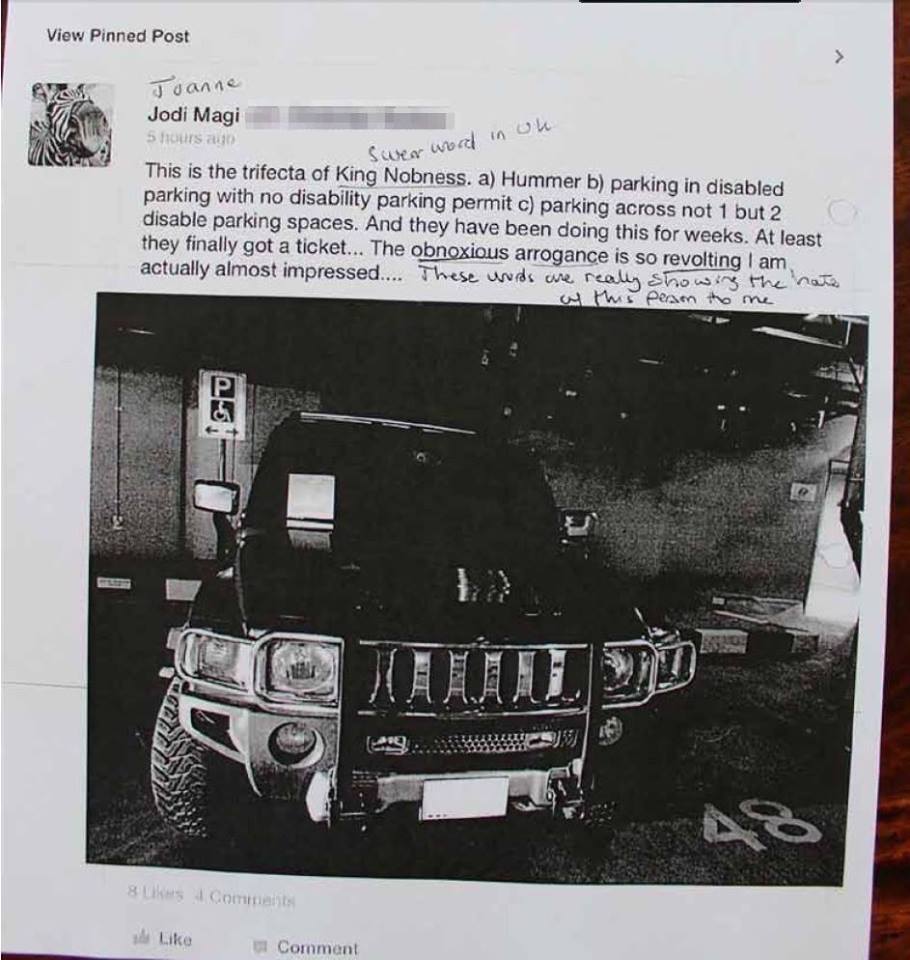
Magi was deported this week from the UAE following intense media coverage. Her argument was that she didn’t know what she’d done wrong in her Facebook post (which you can see below). Her words were considered to be insulting by the complainant, who wasn’t mentioned in the post, and the court agreed with the complainant and, based on the country’s defamation laws (which I’ve written about here), found Magi guilty, fined her, and sentenced her to be deported.

This is the post which got Magi deported. Magi claimed that nobness referred to an Australian term for the elite, rather than the English insult (image source: Facebook)

This is the post which got Magi deported. Magi claimed that nobness referred to an Australian term for the elite, rather than the English insult (image source: Facebook)

While I’m not going to share my views on this (there’s plenty of comments both for and against the issue, but the law is the law), I will share views and thoughts from the rest of the Gulf where double parking is all too common and where the issue is being raised on social media. First up is Bahrain, where there is an Instagram account called Bahrainidiots. Bahrain’s residents are encouraged to share their images of cars which are double-parked for publication on the account’s Instagram feed – for some pictures have a look below.

Similarly, Saudi social media users often share such images, especially on Twitter using the handle #برج_الكلب. Some recent images are below.

https://twitter.com/Dr_MoNassif/status/618500070267355136

https://twitter.com/dr_attar/status/618503839998607361

The most interesting comments about the issue of defamation came from Doha. Speaking to the English-language news site Doha News, criminal attorney and Qatar’s former justice minister Dr. Najeeb Al Nuaimi said it was “highly unlikely” that an expat or Qatari would be arrested for posting a similar picture as Qatar and the UAE differ in their definitions of defamation. To quote:

“In the UAE, this (incident) is seen as ‘you’re showing someone in a bad light’ or that you’re questioning the duty of the police. They didn’t do their job well, and have let this happen, and now you’re posting it and offending them,” he said.

Here, however, the local government would regard sharing such a photo as a “a mark of public service,” he added, continuing:

“We have Qataris posting all over Facebook, Twitter and Instagram (about) things that they don’t like, or wrong things that they see…Here, it’s seen as doing something good.”

One of the publications which wrote about the case, the Abu Dhabi-based English-language daily The National quoted senior Abu Dhabi prosecutor Mohammed Al Dhanhani who explained that Magi was guilty under the 2012 Federal Anti-Information Technology Crimes Law No 5.

“She captured the picture without the consent of the (car’s) owner. She then published the pictures on the web and added insulting phrases.”

Each of these three actions is subject to prosecution under the law, which punishes all violators with a fine and/or jail, and deportation for all expatriates without exceptions, he said.

In an irony not lost on this blogger, while Magi’s state of affairs was playing out The National started its own photo gallery on bad parking in the UAE and posted images on its own website. Based on Al Dhanhani’s own interpretation of the law, is The National also guilty of the same offense under which Magi was sanctioned by capturing pictures without the consent of the car’s owner and then publishing these on the web?

For any lawyers out there, am I right or wrong?

Did @Khaleejtimes break the UAE’s defamation law with the Muwatana video?

And the viral video of the year goes to this amazing clip which was published by the Dubai-based English language daily Khaleej Times yesterday morning. The video is of a heated discussion between a UAE national female with an expatriate Arab female (possibly the Egyptian actress Abeer Sabry) about what the Arab expat is wearing. The discussion, which is only 1 minute 22 seconds long and is mainly in Arabic, is about the Emirati lady’s disagreement with what the expatriate Arab lady is wearing.

I’m not going to get into the pros and cons of this – there’s the Twitter hashtag #فيديو_المواطنة which tracks the debate – but the video has been a sensation. It was posted at 10am UAE time on the 12th of May, and within 24 hours it has already had over 1.7 million views.

The question is, does this video and its publishing on an open platform break the UAE’s defamation laws? The UAE does not allow for filming of a person without that person’s permission, which I am assuming was not given in this instance. The basics of the UAE’s defamation law are below:

1) It is publicly forbidden to take a picture of another person without their permission.
2) Verbal abuses or gestures (even without the presence of a witness) can also lead to a fine and/or sentence.
3) Defamation via libel (written) or slander (spoken) is dealt by a criminal court as opposed to a civil court, where punishments would only include a monetary fine.

In addition, following the outcry last year about the Ramadan YouTube incident the authorities stated that they would look into online content if it became a matter for ‘public opinion and concern.’ The person who filmed that clip was arrested for defamation and the videos were pulled from YouTube.

The law isn’t clear on what happens when people share content online, but judging by the interest in this video it’s going to be hard to remove the content which has been shared over 24,000 times.

So, the question stands. While there’s a strong possibility that whoever filmed the incident broke the UAE’s defamation law, did the Khaleej Times break the law by posting the video online without the consent of the persons being filmed? Whether yes or no, the muwatana video as it has been named by social media users will become a precedent for other media outlets who are looking to develop their distribution and reach through the use of content shot by their readers and the general public.

And if you haven’t seen the video, here it is below!

Obama and Netanyahu reach out to the masses – how the net helps as well as hinders the message

Politicians who use digital for their messaging need to remember that once it's online, it's there forever (image source: YouTube)

Politicians who use digital for their messaging need to remember that once it’s online, it’s there forever (image source: YouTube)

Politicians love to talk, at least those in the West do. Some politicians talk with a purpose, while others talk for the sake of rhetoric. We’ve had plenty of talk over the past couple of weeks, thanks in part to both global and regional political campaigns.

The net has completely changed how leaders communicate with their audiences. For example, leaders can now directly reach out to whole nations directly and without the need for a medium or intermediary such as the media. Two examples come to mind this week. The first is that of Benyamin Netanyahu, who went over the heads of Israeli media to directly address the Jewish Israeli public to exhort them to vote. In his address, which was posted to his Facebook page, he warned of the Israeli Arab threat. You can have a look at the video below.

While the demagoguery may have worked with the right-wing voters, this and other responses to questions such as the possibility of there being a two-state solution are not helping Netanyahu internationally. In a day and age where everything is on the internet and can be translated by a machine, there’s little to no opportunity for politicians to say one thing to one audience and then do a 180 with a different audience. Netanyahu’s media assertions that his words were misinterpreted are difficult to understand for anyone with an internet connection who can watch his words directly online.

Obama has also been using video this week, to address Iranians on the eve of Nowruz, the Iranian New Year. Using the opportunity to reach out directly and talk about the opportunity for an agreement over their nuclear ambitions, Obama’s message is simple and sincere. He’s stepped over the Ayatollahs and the government-controlled media to appeal to Iranians, who can access his speech online (the video is not recorded in high definition, for faster loading for Iranians). I’ve included both the comments and the video below.

“This moment may not come again soon. I believe that our nations have an historic opportunity to resolve this issue peacefully — an opportunity we should not miss. The days and weeks ahead will be critical. Our negotiations have made progress, but gaps remain. And there are people, in both our countries and beyond, who oppose a diplomatic resolution. My message to you — the people of Iran — is that, together, we have to speak up for the future we seek. This year, we have the best opportunity in decades to pursue a different future between our countries.”

There’s no doubt the power of digital to step over the media and appeal directly to the masses. What our leaders need to remember is that whatever is put on this medium is immutable. For politicians who are known for changing their position based on whom they’re talking to such as Netanyahu, digital may come back to haunt them. For others who are trying to reach out and build bridges, such as Obama, video represents the best medium to send a message out to as big an audience as possible.

What do you think? Do you agree or disagree? I’d love to hear your thoughts.

Do you want to know more about social media in the Middle East? Download the TNS ArabSMIS report here

Do you not know where to start when it comes to social media and the Middle East? This report may be your answer (image source: http://blue16media.com)

Do you not know where to start when it comes to social media and the Middle East? This report may be your answer (image source: http://blue16media.com)

We have our fair share of big events in Dubai and this week was no exception. The past two days has seen the Emirate become the place to be for social media influencers. Whilst we found ourselves invaded by all types of beautiful people (and others) waving their selfie sticks and pouting for the camera, there were some handy takeaways for an audience looking to learn more about how to use social media to build brands for themselves, their companies or their countries. Oh, and Twitter has finally decided to open an office in the MENA region, obviously in Dubai.

The most impressive part of the Arab Social Media Influencers Summit was the report. Coming in at a whopping sixty seven pages, the report by research house TNS covers a whole host of areas of social media interest across the MENA region. The study combines both qualitative research with a quantitative survey of more than 7200 users of social media spread evenly
across 18 Arab countries.

If you’re looking to know which channels are used across MENA, then look no further. The report includes stats on LinkedIn, Facebook, Twitter, Instagram, Whatsapp, Google+, and YouTube. It also includes social media usage habits, including time of use, duration of use and devices used. Most importantly, the report looks into attitudes about social media across the region and what people are doing online.

If you’re doing anything online in the MENA region, download this report and start dissecting. You can thank me later, on social media.

The ASMIS Social Media MENA Report

When it comes to social media, advertising and the Middle East, why don’t we have any ethics?

The region loves social media, but its influencers and advertisers are less keen to say when a post is paid for (image source: www.business2community.com)

The region loves social media, but its influencers and advertisers are less keen to say when a post is paid for (image source: http://www.business2community.com)

Who needs ethics right? Ethics are boring, they’re dry, and they mean we have to use disclaimers. Ethics really aren’t fun. But you know what, without them we’d be in a fair amount of trouble. With the Arab Social Media Influencers Summit happening this week in Dubai, and a fair few social media influencers being in town (including quite a few from Kuwait who don’t make it clear that they accept money for posting on their social media channels), I want to reprint this post which I shared with the Media Network Middle East last month. I’d love to hear your views on ethics, or the lack thereof, when it comes to social media and advertising in our region.

While European and American consumers are benefiting from crystal clear regulations on sponsored social media content, there’s little to no clarity here on the same.

We’re awash with social media in our region. Everywhere you go, you’ll see people sliding their fingers left and right, pushing up and pulling down on their smartphone screens. We’re all at it, checking our Instagram accounts, refreshing our Twitter feeds, and posting Facebook updates.

Today we have social media celebrities, people who have become famous through their online activities. There are Instagrammers in Kuwait with over a million followers, Facebookers in the UAE with hundreds of thousands of likes, and Saudi Tweeters with followings equal to the population of Bahrain.

Alongside these social media celebrities we have witnessed the rise of paid posts. Those of you with a keen eye will have noticed how many celebrities online have become more commercial, and have begun to share updates, images and videos promoting brands.

There’s nothing wrong with promotional advertising. Using paid influencer marketing is a common tactic to spread awareness, promote a brand, and to engage social media users across the globe. Online advertising can be more cost effective in terms of measurement and reach.

However, there’s no distinction between an advert and paid-for content. Both involve a payment of some kind by a company for a promotion of its brand or services. Regulators across Europe and the United States have essentially ruled that if money is changing hands, obvious disclosure must occur in-ad. Their reasoning is simple; consumers have a right to know what is an advert and what is not an advert.

While European and American consumers are benefiting from crystal clear regulations on sponsored social media content, there’s little to no clarity here on the same. Consumers here have no authority to turn to or no regulations to guide them on what is and what isn’t sponsored.

There seems to be little eagerness for brands or social media celebrities to advertise what is paid-for content either. This is understandable, as their followers may be less inclined to engage with a post if they know it is sponsored, or even follow a person who they know accepts money for posts.

While this lack of disclosure may appeal in the short term and help to maximise revenues (paid-for posts in Kuwait can fetch up to three thousand dollars per posting), it does nothing to building goodwill and trust with consumers across the region. A lack of honesty and transparency on what social media celebrities are paid to post will negatively affect trust in both the sponsoring brand as well as the celebrity who is accepting the payment in return for sharing the content.

In the US the burden is on brands to ensure that their endorsers, such as bloggers and online influencers) are in compliance in terms of disclosure. Paid-for posts have to include language such as #Ad, Ad: or Sponsored. Even brand posts and shares by a company’s employees have to be clearly labeled to account for the bias.

Either brands can take action and begin to self-regulate, or they can wait for regulators to finally step in and possibly take a harder-line approach to sponsored influencer endorsements. Is risking a reputation and trust, built up over years of marketing, worth risking over a lack of disclosure? I hope the answer is no.