Bahrain, Saudi and the UAE use Facebook to Announce Ambassador Pullout

It’s pretty remarkable – I’m not just referring to the withdrawal of the Bahraini, Emirati and Saudi ambassadors from Doha but also the way the news was announced. I, like many others, saw the news first not on traditional news channels but via Twitter. And where was the original announcement? On the Facebook page of the Saudi Ministry of Foreign Affairs. It’s pretty remarkable to see social media being used to release such information, especially considering the medium is designed with dialogue in mind. If you read Arabic have a look at the comments on the Ministry’s page.

The original announcement, which was later carried in the region’s papers, is below.

The Saudi Ministry of Foreign Affairs announced the pullout of the three ambassadors via its Facebook page before the story broke in the traditional media

The Saudi Ministry of Foreign Affairs announced the pullout of the three ambassadors via its Facebook page before the story broke in the traditional media

What a difference a day makes – the media shift in Bahrain and public perception

It’s often said that 24 hours in the newsroom is a unique experience and Bahrain’s media is no different. The island nation’s media has been reporting on the difficult situation the country is going through for the past couple of years. Wednesday the 15th of January was no different from the past couple of months in that the Kingdom’s English-language media were reporting on government efforts to keep the country safe (much of the focus was on social media and Twitter in particular. The below is a shot of the front page.

The Front Page of Bahrain's Gulf Daily News for the 15 January 2014

The Front Page of Bahrain’s Gulf Daily News for the 15 January 2014

That night, news leaked about national reconciliation talks between Bahrain’s Crown Prince and the largest opposition party Al-Wefaq. As expected, the local media carried the news on their front pages.

The front page of Gulf Daily News from the 16 January. Notice a change in tone?

The front page of Gulf Daily News from the 16 January. Notice a change in tone?

While I won’t discuss the politics of the issue, what I do find interesting is the remarkable shift in position over 24 hours and how groups are described by the media from the one issue to the other. While it may be easy to control the dialogue and the messaging for one of the parties in Bahrain, it’s not so easy to shift public perception. Time will tell what difference this particular 24 hours have made, not only to the media’s take on affairs but also how the public perceives the situation as reported in the media.

The Gulf, social media and its self-deprecating humour

The Gulf is known for many things but a sense of humour hasn’t traditionally been on the list, even less so self-deprecating humour. With the advent of social media, in particular YouTube, both the Gulf’s residents and nationals have started to develop content like there’s no tomorrow. The best is currently coming from Saudi Arabia. One example is La Yekthar, one of the most popular comedy shows on the net. The team regularly tackles and takes on stereotypes of Saudis, and one of their latest clips was a fantastic set-up of how Saudis are often perceived by foreigners. The video, which is below, also sends a not-so-subtle message to Saudis that this type of image, of arrogance and violence, isn’t the right thing to do.

Bahrain has also followed suit with a number of send-ups of the typical Bahraini stereotypes. The clips, which are common on the video-sharing site Keek, focus on a variety of stereotypes which are mainly based on geography (for example, Al-Riffa and Muharraq). I’m going to have to search for these but I’m going to upload as soon as I can.

Even Qatar is getting in on the act. The only local Qatari comedian I know, Hamad Al-Amari, routinely does stand-up routines poking fun at Qatari stereotypes before switching effortlessly into an Irish accent (he spent part of his childhood in Ireland). Have a look at one of his sets below.

And then there’s the UAE. While there are a number of local comedians here including the likes of Ali Al Sayed the country has arrested those, even nationals, who have poked fun at the country’s stereotypes. Emirati Salim Dahman and a group of young males who made a spoof YouTube video named the ‘The Deadly Satwa Gs’ were arrested after uploading the clip. No reason seems to have been given for their arrest, but the assumption would be that they’ve been detained for insulting national sensitivities.

To quote from 7Days, which featured the story yesterday, ‘The Deadly Satwa Gs’ video is a spoof of young people who try to act tough. At the martial arts school, the recruits learn how to throw a shoe and call for back-up on their mobile phones. When they graduate from the school, they are all given Barcelona football jerseys, supposedly matching a style worn by young men in Dubai.

The video, which is still available online, is hardly groundbreaking satire and is fairly tame when compared to the content coming out of the Magic Kingdom. However, comedy isn’t always a laughing matter depending on where you are in the Gulf.

PS If you want to know why I haven’t mentioned Kuwait ask any Gulf Arab about Kuwaitis and humour.

The Middle East and its addiction to Facebook – 2013 stats and figures

Yes, we Arabs have adopted Facebook as our own (image source: muslimscrisisgroup.wordpress.com)

Most of us in the region already know how effective and powerful Facebook is. The social media site played a prominent role in the Arab Spring, particularly in Egypt, and its popularity has endured in the face of challenges from other services such as Twitter and YouTube (I’m not even going to mention Google+ in the same sentence).

Facebook released some figures this week about the site’s usage in the Middle East. According to Facebook’s head of MENA Jonathan Labin over twenty eight million people in the Middle East and North Africa are using Facebook every day. Fifty six million use the site every month and of those thirty three use a phone or tablet device to check their profile. Fifteen million people access the site on a daily basis from their mobiles.

I’m going to give you a little more insight into a couple of different regions: Saudi Arabia; Egypt; the GCC; North Africa, and the Levant. The below figures, which were compiled last month, give a good deal of insight into gender split, age, marriage status, number of friends and page likes, access methods, and interface usage. If you’re a marketer in this region and you’re not using or leveraging Facebook (especially on mobile) then start rethinking your advertising and communications approach.

Social media and diplomacy – @IsraelintheGCC, Israel’s virtual embassy in the Gulf

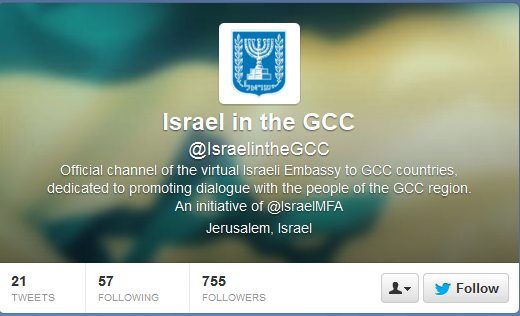
The launch of the @IsraelintheGCC twitter account is a cheap but potentially effective media channel for the Israeli government

The launch of the @IsraelintheGCC twitter account is a cheap but potentially effective media channel for the Israeli government

No matter your political persuasion, you have to admit that the Israelis are an ingenious bunch. Their latest idea is a simple concept, a virtual embassy for a part of the world where there’s little/no Israeli State presence, the Gulf. Israel, which doesn’t enjoy official diplomatic relations with any of the Gulf states, has launched a ‘virtual embassy in the Gulf’ through Twitter. The account, which is named @IsraelintheGCC, aims to “open lines of dialogue” with people living in the Gulf according to a report by the UAE-based English-language daily Gulf News. According to the Israeli daily Haaretz, the person behind the idea is Yoram Morad, Director of the Department of Digital Diplomacy at the Ministry of Foreign Affairs of Israel.

Not unsurprisingly, Israel has always faced challenges when trying to communicate its point of view to its Arab neighbours. However, that hasn’t stopped the State from engaging various mediums to argue for its policies. Israel launched an Arabic-language television channel in 1994 following the announcement of the Israeli-Palestinian peace process. The establishment of the @IsraelintheGCC twitter account follows news of a potential re-engagement between the Israelis and Palestinians as well as mounting pressure on Iran to halt its nuclear enrichment programme.

It could be argued that Israel has been much more active than the Arab states in terms of communicating its key messages – there were plans to launch a Hebrew-language channel in Egypt as of last year according to the Christian Science Monitor, but I haven’t heard much in the way of an actual launch.

The messaging employed by @IsraelintheGCC, which is being run by the Twitter account of the Israeli Foreign Ministry, would appear to be aimed at propagating a more diplomatic tone than that of Israel’s internal politics. The account, which has tweeted 21 times to date, has only quoted the country’s Prime Minister twice (its fair to say that Bibi Netanyahu wouldn’t win many popularity contests in the Gulf), but it has talked about social media in the Arab world, sustainability issues, and wished followers a Ramadan Kareem. The one time Netanyahu has been quoted was in relation to European sanctions on the Lebanese organization Hizbollah which isn’t well liked in the Gulf due to its pro-Iranian stance. There are tweets in Arabic too. Have a look at some of the posts below.

Over the past couple of years social media has allowed companies, politicians and celebrities to directly bypass the media and reach out directly to anyone that wants to listen. Now the same can be said of social media for States who, for diplomatic reasons, cannot establish a physical presence. I’ll be following the account, and am looking forward to seeing how long this project lasts, how much dialogue it generates and how successful it becomes for the Israeli government.

A taste of Bahrain – Emmawash Restaurant

Bahrain has another local destination to head to if you’re looking for traditional fare. Check out this video by online channel MyBahrainME and I dare you not to lick your lips in anticipation!

Bahrain’s hidden pearl – Zaafaran Cafe

Bahrain is a wonderful place; it’s a country that is always full of pleasant surprises. My wife and her family told me about a restaurant called Zaafaran, a small place in the heart of Souq Muharraq that is known for its traditional Bahraini dishes. We headed down to Muharraq on a Friday morning and I had to keep my eyes open when looking for the place (Zaafaran is just after Souq Al Qaiseriya a right hand turn after all of the sweet shops on the main road for those who know Muharraq).

After spotting the place and finding a parking spot, which is no mean feat in Muharraq, we headed to Zaafaran. The restaurant itself is tiny, with seating for no more than 30 people. The decor is traditional, and the staff are also dressed to match in traditional Bahraini attire. The setting is almost as impressive as the food, with (comfy) wooden benches to plump yourself down on.

The breakfast menu is set, with a selection of small dishes that include balaleet or sweetened vermicelli with egg, nakhi which is a Bahraini twist on chick peas, mahiawa bread or bread cooked in fish sauce, fuul, spicy tomato beans, and Bahraini kebab sandwiches (which are vegetarian for anyone who’s interested). It’s most fun to eat with your hands and the bread basket which comes as standard.

I wouldn’t be doing justice to Zaafaran by saying that this place is remarkable both for the food and the setting. If you’re looking for both a wonderful eat as well as an amazing time out then head down to Zaafaran. It’s right next to Souq Al Qaiseriya which is one of the oldest markets in Bahrain and an amazing spectacle in itself. And as for the cost? It’s a whole lot cheaper than Dubai’s Biker Cafe’s breakfast for the best local breakfast in the Arabian Gulf and costs about 50 to 60 Dirhams a person including all the chai kerak tea you can woof down. Just down measure your cholesterol levels for a good few days after!

Enjoy the pictures and get down to Zaafaran while there’s still space left at this remarkable restaurant-cafe.

How communities are turning to social media when traditional media fails them: #Thx_Tom_Collins and Bahrain

Professor Tom Collins was the subject of a public campaign on the social media site Twitter. Supporters thanked him via the hashtag #Thx_Tom_Collins for his political stance and decision to resign (credit: Irish Times)

As the Middle East’s media channels have become polarized over the past 24 to 30 months, communities who find that they have little if any representation in these traditional media channels have made social media their medium of choice when spreading and disseminating their viewpoints and opinions.

A great example from Bahrain this week was a campaign organized to thank the Professor Tom Collins, the president of the Bahrain campus of the Royal College of Surgeons in Ireland (RCSI), for his decision to resign from his post after the cancellation of a major conference on medical ethics in island. The RCSI had hoped to facilitate the event at its Bahrain campus but the key organizer Médecins Sans Frontières cancelled the event shortly before it was to be held.

Professor Collins resigned after the news of the conference’s cancellation broke. He has been roundly condemned in Bahrain’s national media for his decision which he said was done “in protest over the cancellation of the two-day event which was to examine “medical ethics and dilemmas in situations of political discord or violence.” The conference’s themes were sensitive in Bahrain following widespread arrests of medics in early 2011 at the country’s main hospital and their subsequent trials, a number of which are still ongoing.

The Twitter-based campaign was launched on Thursday 28th March at 8pm Bahrain time and was organized primarily by many of the medical community in Bahrain who were arrested over the course of the two years.Their message was clear and I’ll post some of the most popular tweets below.

What I find fascinating about the above is the role of the media during a time of crisis. For me, media such as newspapers can have a viewpoint but journalists should (theoretically) report the facts. When you’re disenfranchising such a large proportion of the population what happens to that newspaper not only during a crisis but after the crisis has passed, when agreements are made and a compromise is drawn up. With traditional media suffering globally due to a loss of public trust should editors be fighting the demand to be so overtly biased? What are your thoughts?

Understanding the Gulf’s psyche through social media (well, mainly Twitter)

What are the religious police up to now? Didn’t they learn from #Dammam-Hayaa-Closes-Dinosaur-Show? (credit: expo2020)

I’m endlessly fascinated by social media and how people interact online. For me, online interactions tend to shed light on people’s off-line personalities. In this post I hope to share my own observations about how each of the Gulf’s nationals deals and interacts online.

Let’s start with Bahrain. Bahrain possibly has the highest concentration of social media users in the Gulf. Bahrainis are very media-savvy and that shows in their effective use of social media channels. The country’s polarization following the events of February and March 2011 is evident online, with the two sides doing their utmost to ensure that their voices are heard. Bahrain has some of the most-followed Twitter users in the Gulf but they inevitably relate to the political and human rights situation on the island. There’s a lot of trolls out there as well, so be aware that if you’re going to delve into any issue relating to Bahrain you’re going to draw attention to yourself.

Emiratis are fiercely patriotic and proud of their country’s achievements over the past 41 years. Emiratis speak in unison when it comes to politics and are the most supportive nationality in terms of the country’s leadership. Unlike Saudi, Kuwait, or Bahrain you’ll find little debate on the country and its long-term direction but more insight into social issues particularly those which affect the national community. You’ll find royal family members online, members of the Federal National Council, a police chief and lots of UAE-based expats.

Kuwaitis are known for many things, including being opinionated. This is no different online. The Gulf country with the most blogs per person Kuwait is all about politics and disagreement. Kuwait’s politics is just as vibrant online as it is in the country’s parliament, and when you mix in other electrifying issues such as the Bidoon, the country’s rulers, the Arab Spring and religion you’re going to come up with an incendiary cocktail. Some of the most interesting Tweeters are Kuwaiti bloggers and parliamentarians. Just handle with care!

The Qataris are a mischievous bunch. When they’re not commenting on Qatar’s latest attempt to buy a path across the globe (what next after Marks and Spencers?) they’re making the most out of their sense of fun with raucous commentary on the latest goings on in their country. Their musings on Qtel’s attempts to rebrand itself to Ooredoo were biting, as was the boycott against the very same company for its poor customer service (is anyone in the UAE and Etisalat listening?). The Qataris are a wonderful bunch to follow. And one or two of them love their Dunkin’ Donuts coffee!

Saudis, yes you cannot avoid them online just as you cannot avoid them in the physical world. I love Saudis and I love them just as much in cyberspace. They’re open, they’re diverse and they talk about everything. Saudis are not afraid to poke fun at themselves and they’re just at home talking about social issues, politics, arrange boycotts (aka AlShaya and Al-Marai) and even debate religion. There’s some remarkable Saudis online, from preachers to royals and ministers. Saudi is one of Twitter’s fastest growing markets. And they watch more Youtube than any other country worldwide. They are officially living online. And yes, one of them owns (a bit of) Twitter.

And finally, there’s the Omanis (I’m skipping the alphabetic sequencing on this one). I’ve rarely come across Omanis on social media, possibly because I’m not close to issues that they write about or follow. Omanis are known to be kind, courteous and have a fun sense of humour. Which means I really should go and find some Omani tweeters to detox from all of the politics and debate in the rest of the region.
How much variety and discrimination is there in the Gulf?

The GCC is as diverse and complicated as any other part of the globe (credit: rasheedsworld.com)


Looking on in from the outside, most expatriates see the Arabian Peninsula as one monotonous geography. The women wear black (unless they’re Kuwaiti) and the mean wear white. The language is the same, and everyone is a Muslim. And that’s the Gulf.

Well, hardly. Each country is unique, and offers a wealth of diversity in terms of culture, history and opinions. The range of accents in Bahrain is so prominent that a local will be able to tell where a compatriot may be from how the greeting alone.

Saudi is the most diverse country in the region. Its twenty million nationals come from all four corners of the world, and don’t be surprised to meet a Saudi whose roots trace back to Indonesia, China, or Western Africa. The Kingdom’s Western Region is the richest melting pot you’ll come across, thanks to hundreds of years of pilgrimage to the two holy cities of Makkah and Madinah. Often foreigners think that Dubai or Doha are the two cities that offer the greatest contrast of cultures and groups, but they don’t come close to what Jeddah has to offer.

And Christians in Kuwait and Bahrain? And a Jewish community in Manama? Yes, they’re locals (but there’s not many of them).

And of course, with variety comes discrimination. There’s a good deal of nepotism across the Gulf mainly due to the tribal, bedouin nature. It’s not uncommon to find a certain group dominating in one company – it’s not so much where a person is from as often as what their tribal name is. Many Saudis don’t use their tribal names any more. And there’s also discrimination based on region (Jeddah versus Riyadh, Dubai versus Abu Dhabi etc), on the history behind the family name (in other words how far back can the family’s genealogy be traced), and on religion (which mathab or religious affiliation a person adheres to).

While this isn’t unique to the Gulf (tell me a place where there isn’t any discrimination) what I do find interesting is the institutionalized discrimination in certain parts of the GCC. Some states, most notably Saudi Arabia, Kuwait, Bahrain and Oman count GCC nationals as locals when it comes to hiring and nationalization quotas. The UAE and Qatar do not – when they say local they mean local. For a European the difference in policy between the two groups is hard to fathom (especially when considering the relatively small populations of both Qatar and the UAE when compared to Saudi Arabia).

So, the next time you’re sitting in the coffee ship and sipping on your coffee do remember to ask yourself where the gentleman in white is from. You may be surprised at how much you can learn about a region that is full of culture and contrast.