Old News, New News: The strange tale of how the ten-year old drowning daughter story was reported as recent news

The Daily Mail was one of several UK-based publications to fail to fact-check the original story which was published in Emirates 24/7

The Daily Mail was one of several UK-based publications to fail to fact-check the original story which was published in Emirates 24/7

One could be forgiven for thinking it’s funny news season here in the Gulf. One story from Dubai’s shores went global this week, the tale of how an Asian father who prevented Dubai lifeguards from saving his drowning daughter, claiming she would be dishonoured if she was touched by strange men, has been arrested and prosecuted by authorities after his actions led to the death of the 20-year-old girl.

The piece was reported by the UAE’s English-language portal Arabian Business, after a post in the English daily Emirates 24/7. The story, a harrowing tale of how a young woman drowned because her father would not let the male lifeguards touch her, made headlines around the world, and was carried by the UK’s the Daily Mail, the Telegraph, the Metro and Sky News. Here’s the piece from Arabian Business.

An Asian father who prevented Dubai lifeguards from saving his drowning daughter, claiming she would be dishonoured if she was touched by strange men, has been arrested and prosecuted by authorities after his actions led to the death of the 20-year-old girl, Emirates 24/7 reported.

“The Asian father took his wife and kids to the beach for picnic and fun. The kids were swimming in the beach when suddenly, the 20-year-old girl started drowning and screaming for help,” Lt. Col Ahmed Burqibah, Deputy Director of Dubai Police’s Search and Rescue Department, told the website as he recounted the incident, which took place on a Dubai public beach.

“Two rescue men were at the beach, and they rushed to help the girl…. The father was a tall and strong man. He started pulling and preventing the rescue men and got violent with them. He told them that he prefers his daughter being dead than being touched by a strange man.”

“This is one of the incidents which I cannot forget. It shocked me and many others who were involved in the case,” he added.

The actions of the father resulted in the death of the young woman. The father was subsequently arrested for preventing the lifeguards from doing their job and aiding in the death of his daughter.

“He was prosecuted and sued by the concerned authorities,” Lt. Col. Burqibah confirmed.

Unfortunately, whoever picked up the piece from Emirates 24/7 didn’t see one small but pertinent piece of information from the original story.

Speaking to Emirates 24|7, Lt. Col Ahmed Burqibah, Deputy Director of Dubai Police’s Search and Rescue Department, recounting some of the worst incidents he had encountered in his tenure, said that this incident took place at a beach in Dubai.

The mistake was first picked up by the Guardian’s Media Monkey blog. The blog’s writer delighted in having a dig at the publications which had failed to fact check and republish the story as if it were a recent event.

When news editors across the land facing a slow news day on Monday saw the story of a father who let his daughter drown in Dubai because he “didn’t want strange men touching her”, they surely couldn’t believe their luck.

The Mail, Telegraph, Metro and even Sky News all jumped on the story, which came via Agence France Press.

However, Monkey is told that classifying the story as “news” might be stretching it a little.

Apparently the article – which originated on the website Emirates 24/7 – was from an interview in which lifeguards were asked to recount the strangest things that had happened to them. As someone who bothered to check out where it came from tells Monkey: “They mentioned this case of the Asian man who prevented his daughter’s rescue, but, and here’s the catch – it was from 1996.”

Perhaps it’s a case of any old news will do … at least when there isn’t much news at all.

The Gulf’s media is often criticized for not getting the facts right or forgetting to fact-check. But, it seems that even media outlets which are supposed to operate to a different standard can often fail to properly do their homework in the chase for a story which confirms their stereotypes of the region.

I’m now waiting for some journalist looking for a heart-wrenching scoop to pick up on the Cops save boy… villagers kill him with ‘love’ piece, again from Emirates2 4/7.

PS I’m not even going to go into the piece written by Arabian Business which poses the question ‘Does Dubai need more female lifeguards, in light of recent beach tragedy?’ How is this still online?

Did Arabian Business get hoodwinked by the Arab World’s most intelligent person?

Did Arabian Business fully fact check Dr Manahel's credentials before publishing this interview?

Did Arabian Business fully fact check Dr Manahel’s credentials before publishing this interview?

I just love obscure words, and hoodwinked is one of those phrases that we just don’t use enough. The term’s original meaning was to blindfold; its contemporary connotation is to deceive. I’ve finally got a reason to use this phrase in a question which I have on the cover story of the latest edition from Arabian Business.

For those of you who don’t know, Arabian Business is the most widely-distributed English-language weekly business magazine in the Gulf. The publication regularly breaks exclusives and its editorial team are among the most respected journalists in the business regionally.

This last issue was an interesting one. The cover was headlined by a lady called Dr Manahel Thabet, the founder of a business consultancy firm called Smart Tips. According to the Arabian Business piece, Dr Manahel Thabet has an IQ of more than 168, putting her in the top 0.1 percent of the world. Impressed? There’s more (and I’m now quoting from Arabian Business).

Arguably the smartest living Arab, Thabet has three PhDs. The latter, which she received a few days after our interview, suggests how education systems should cater to gifted and talented students to ensure they reach their greatest potential, a subject she is passionate about given her own experience as a gifted child.

Thabet considers herself a polymath — someone who is passionate in many areas — similar to Leonardo di Vinci, who was as great a scientist as he was an artist and engineer. Far from her latest thesis topic, her first PhD — which she obtained at the astonishing age of 25 — is in financial engineering and goes a long way to explain interest rate behaviour. She became the youngest person ever and only Arab to receive such a PhD magna cum laude (with great distinction).

The second is a 350-page groundbreaking formula that scientists and space researchers believe could help them measure distances in space without using the speed of light. The likes of Nasa and the French space agency have been competing for access to it.

All this has been achieved while running her own financial advisory firm and contributing to numerous organisations and boards.

All of this is remarkable, but the more people claim, the more I want to see and understand their credentials. And, this is where it gets interesting thanks to the internet, Google and a wonderful service called Reddit.

A number of Reddit users have taken it upon themselves to discuss Dr Thabet’s credentials, and they’ve taken a sledgehammer to a number of those qualifications.

At the end of the day, this isn’t about a person but more about a process. How do journalists in the region verify their sources? This isn’t the first time I have been left questioning a piece of journalism due to a lack of credibility (does anyone remember the fake press release on a non-melting ice concept for Dubai which was published in AMEInfo, Al Bayan, Al Khaleej and Gulf Today). But if there’s any doubt at all as to what a source is saying or their credentials, shouldn’t the journalist call it out?

Thoughts anyone?

The definition of ‘Nobness’ – the UAE, social media defamation and differing views from the Gulf

It’s that time of year again. I don’t mean Ramadan of course, the month of charity and kindness, but rather the time of year when we read about a case of defamation. Over the past week there was an outcry in Australia following the arrest of an Australian national in the UAE following comments she put up on Facebook. To quote from the Australian Broadcasting Corporation’s website:

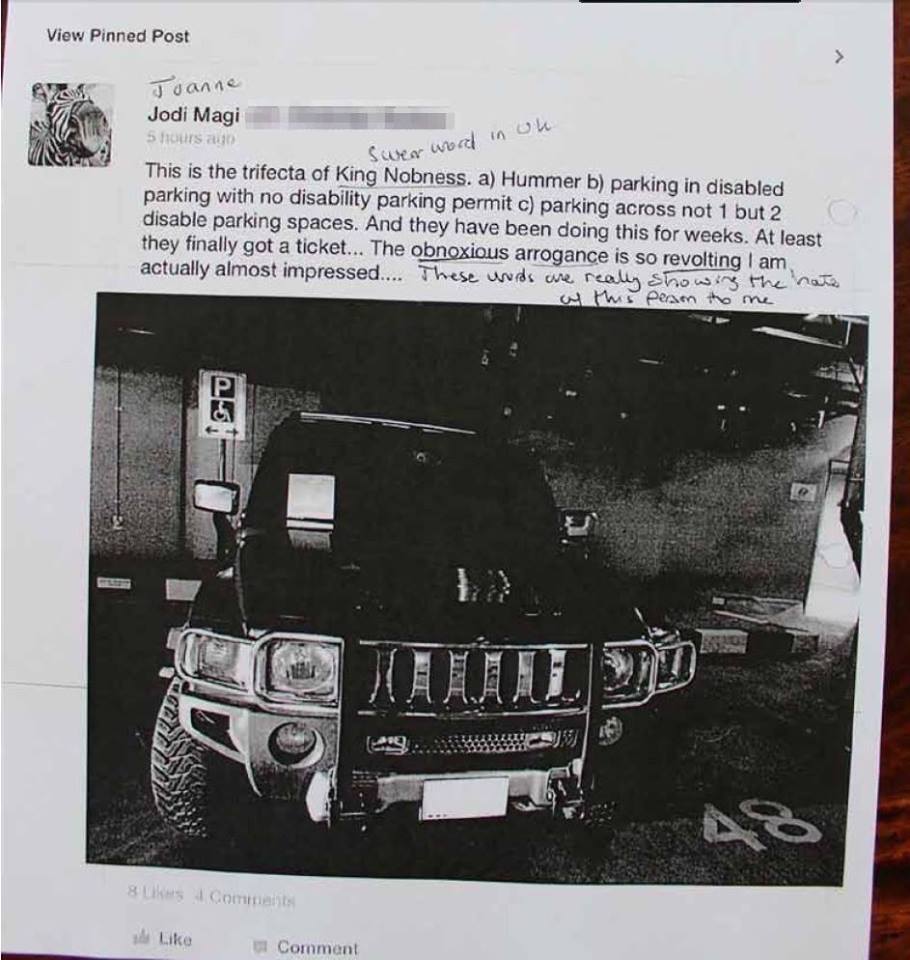
In February, Jodi Magi, 39, took a photo of a car in her Abu Dhabi apartment block that was parked across two disabled parking spaces, without any disability stickers.

She blacked out the number plate and put the photo on Facebook, drawing attention to the seemingly selfish act, but not providing any identifying details or names.

However, someone in the apartment block complained to police and the case went to an Abu Dhabi court in June.

Ms Magi, who has lived in Abu Dhabi since 2012, said she was forced to sign multiple documents in Arabic without any translation.

Two weeks ago (at the beginning of July) she was found guilty of “writing bad words on social media about a person” and told she would be deported.

Magi was deported this week from the UAE following intense media coverage. Her argument was that she didn’t know what she’d done wrong in her Facebook post (which you can see below). Her words were considered to be insulting by the complainant, who wasn’t mentioned in the post, and the court agreed with the complainant and, based on the country’s defamation laws (which I’ve written about here), found Magi guilty, fined her, and sentenced her to be deported.

This is the post which got Magi deported. Magi claimed that nobness referred to an Australian term for the elite, rather than the English insult (image source: Facebook)

This is the post which got Magi deported. Magi claimed that nobness referred to an Australian term for the elite, rather than the English insult (image source: Facebook)

While I’m not going to share my views on this (there’s plenty of comments both for and against the issue, but the law is the law), I will share views and thoughts from the rest of the Gulf where double parking is all too common and where the issue is being raised on social media. First up is Bahrain, where there is an Instagram account called Bahrainidiots. Bahrain’s residents are encouraged to share their images of cars which are double-parked for publication on the account’s Instagram feed – for some pictures have a look below.

Similarly, Saudi social media users often share such images, especially on Twitter using the handle #برج_الكلب. Some recent images are below.

https://twitter.com/Dr_MoNassif/status/618500070267355136

https://twitter.com/dr_attar/status/618503839998607361

The most interesting comments about the issue of defamation came from Doha. Speaking to the English-language news site Doha News, criminal attorney and Qatar’s former justice minister Dr. Najeeb Al Nuaimi said it was “highly unlikely” that an expat or Qatari would be arrested for posting a similar picture as Qatar and the UAE differ in their definitions of defamation. To quote:

“In the UAE, this (incident) is seen as ‘you’re showing someone in a bad light’ or that you’re questioning the duty of the police. They didn’t do their job well, and have let this happen, and now you’re posting it and offending them,” he said.

Here, however, the local government would regard sharing such a photo as a “a mark of public service,” he added, continuing:

“We have Qataris posting all over Facebook, Twitter and Instagram (about) things that they don’t like, or wrong things that they see…Here, it’s seen as doing something good.”

One of the publications which wrote about the case, the Abu Dhabi-based English-language daily The National quoted senior Abu Dhabi prosecutor Mohammed Al Dhanhani who explained that Magi was guilty under the 2012 Federal Anti-Information Technology Crimes Law No 5.

“She captured the picture without the consent of the (car’s) owner. She then published the pictures on the web and added insulting phrases.”

Each of these three actions is subject to prosecution under the law, which punishes all violators with a fine and/or jail, and deportation for all expatriates without exceptions, he said.

In an irony not lost on this blogger, while Magi’s state of affairs was playing out The National started its own photo gallery on bad parking in the UAE and posted images on its own website. Based on Al Dhanhani’s own interpretation of the law, is The National also guilty of the same offense under which Magi was sanctioned by capturing pictures without the consent of the car’s owner and then publishing these on the web?

For any lawyers out there, am I right or wrong?

How the World’s Media was Pranked by Paris Hilton, Ramez Galal and that Plane Crash Stunt

Was Paris in on the prank? Or did she have no idea what was going on?

Was Paris in on the prank? Or did she have no idea what was going on?

If you’ve been catching some television in between fasting, praying, breaking the fast, and trying to work during the holy month of Ramadan, you may have come across a series on MBC One channel called Ramez Wakel Al Jaw (quite literally Ramez eats the air). The idea behind the show is simple – take up a celebrity in a scenic flight above Dubai, pretend that the plane is going down, and film the ensuing chaos. Each show, which is aired on a daily basis, would feature a different celebrity.

The big draw for the show, which is only being aired during Ramadan (which is essentially the prime time for TV viewership in the Middle East), was Paris Hilton, the hotel chain heiress and Hollywood socialite. Paris was the only non-Arab celebrity to be featured on the show, and she was used extensively in the ad campaign leading up to the show’s launch (in fact, she was the only celebrity to be featured in the aforementioned ads).

Now, we come to the Paris episode itself. To quote from the UAE’s English-language The National:

It began last Sunday when Hilton’s episode was broadcast as part of Galal’s latest MBC ­comedy series.

The set-up involved the stars boarding a light plane for a leisurely, aerial tour over the emirate, only for the situation to escalate — or should we say, descend — into terror: the aircraft suddenly nosedived after a simulated technical failure. The video clip, which went viral after it was uploaded on YouTube, shows Hilton getting anxious, then panicking as skydivers masquerading as passengers open the cabin door and leap out.

Only after the plane returned to the ground was the celebrity told the truth. Taking it surprisingly well, a shaky Hilton goes on to praise Galal for “taking it to the next level. I have seen Punk’d [American prank reality show hosted by Ashton Kutcher] but you have taken me on a plane and nearly killed me”.

For a more visual explanation, CNN’s report sums up the story wonderfully.

Paris’ response to the episode being aired was swift. She intended to sue, according to TMZ.com which broke the news.

Paris Hilton is telling business associates … she will sue the people responsible for putting her on a plane that appeared to be in crash mode … just to get a rise out of her.

We’re told Paris is furious over the stunt … in which a TV crew got the pilot to pretend to shut down the engines in her plane, and then nose-dive to the ground. Paris says she was in mortal fear for her life … something the video pretty clearly shows.

Our sources say she’s “totally freaked out” over flying anywhere … something she’s required to constantly do. She’s already called her lawyers to find out who’s responsible, and they told her she has a solid case for emotional distress.

Paris tells them she had absolutely no clue this was a prank … she wasn’t in on it. She also doesn’t believe anyone in her camp was involved.

The episode and the reaction of Paris to sue Ramez Galal made headlines the world over, despite no one outside of the region having heard of the show. The idea of a global celebrity having been pranked in such an abhorrent stunt with her life seemingly at risk was enough to garner hundreds of pages worth of media attention.

But if we step back a moment, let’s talk through what happened and why this was obviously planned from the get-go:

1) The timings – the show was pre-shot; in other words, it wasn’t live. Paris was used extensively to promote the show, and one would have thought that Paris would have looked to sue immediately after her episode was shot several weeks before Ramadan. This wasn’t the case.
2) The payment – no celebrity worth their salt does anything for free, and Paris is no different. If you want her, you have to pay. If TMZ.com is to be believed, Paris was apparently paid over a million dollars to take part in the stunt. She’d have known beforehand what was going to happen. Nevertheless, she pulls off the acting (unlike in her movie roles).
3) The publicity – both Paris and Ramez benefited from the media coverage of the show. Paris comes off as someone we can feel for and empathize with, which isn’t usually the case. And Ramez gets global coverage for the show which boosts the ratings, and for himself. The threat to sue amplifies the media coverage.

The question is, who got scammed? Paris, the viewers or the media? No matter what, everyone seems to have been entertained.

In the irony of ironies, a SkyDive Dubai plane crash-landed in the desert this week. The incident, which closely resembled the prank scenario, was widely reported by the media.

This emergency landing wasn’t a prank…

Whilst there were fortunately no injuries, none of the media made the connection between Ramez Galal and his show, which is based at SkyDive Dubai’s site, and the plane coming down in a similar scenario. It’s just as well for Ramez – one lawsuit is more than enough this Ramadan. But you tell me, is life imitating art, or is art imitating life?

A hijab, bacon and McDonalds’ breakfasts – the wonderful world of Ramadan advertising

Ramadan is a wonderful month, a time of spirituality for the world’s Muslims. It’s also the time of year when the advertising rules change as Muslims fast during the daylight hours and look to spend their nights either with family or in prayer.

In keeping with reaching out to Muslims, advertisers need to be ever-aware of religious sensitivities. Brands often feel the need to make a change to their ads. One such change, which was spotted by Dubai-based communications professional Mohammed Kharroubi (Twitter handle @mkdubai), involved the retailer Carrefour. Spot the change below.

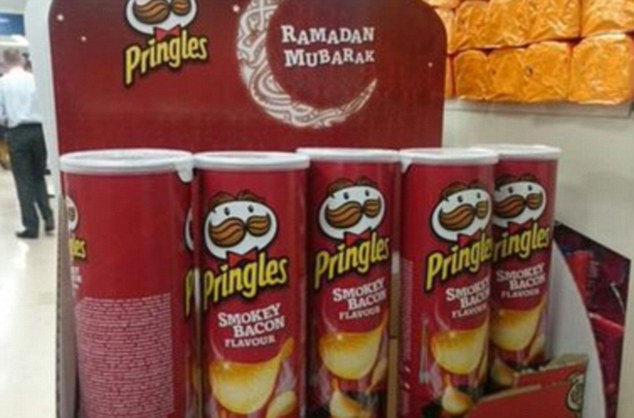
Brands sometimes get things horrendously wrong. Another retailer, the UK retailer Tesco, made a huge faux-pas, when they promoted smokey bacon-flavor Pringles as part of a Ramadan promotion. For those who don’t know, any pork-related products are considered haraam in Islam and are not consumed by Muslims. The below image went viral and has resulted in masses of media coverage in the UK.

Tesco has been pilloried on social media for selling smokey bacon-flavoured Pringles as part of a Ramadan promotion

Tesco has been pilloried on social media for selling smokey bacon-flavoured Pringles as part of a Ramadan promotion

And then, there’s the bizarre. According to Dubai-based marketing consultant Hussein Dajani, McDonalds has been running advertising for its breakfasts this month on the radio on Dubai. Unfortunately, Muslims fast during the day, and most of the McDonalds restaurants serving breakfast will be closed.

With Ramadan, it really does seem that while some brands are able to adapt and thrive, others need to do their homework. What are your thoughts? And do you have your own examples of successful and unsuccessful Ramadan advertising?

Will Etihad’s use of Twitter for Premium customer communications take off?

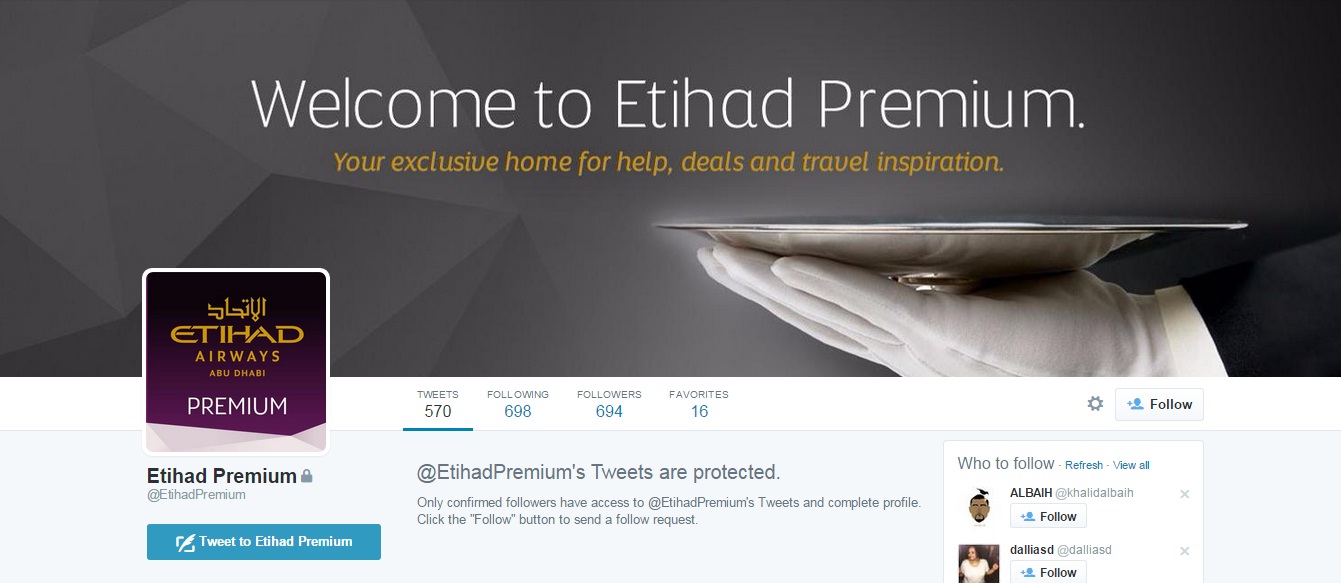
Etihad's Premium Twitter account is an exclusive account just for Etihad's Gold customers. Is Twitter the right channel for reaching out to premium customers however?

Etihad’s Premium Twitter account is an exclusive account just for Etihad’s Gold customers. Is Twitter the right channel for reaching out to premium customers however?

Excuse the pun in the title, but Etihad caught my eye this week with the news that it has set up a new Twitter account to communicate exclusively with Etihad Guest Gold members. The account, named @EtihadPremium, was launched at the beginning of May and Etihad Guest Gold members, Etihad customers who have flown 50,000 tier miles or 40 tier segments in one 12 month period, received emails on the new service. Below is the text of the email that Etihad sent out to its Etihad Guest Gold members over a month ago (courtesy of www.flyertalk.com).

We’ve launched a Twitter Channel to better serve you! We value your loyalty and have created a new channel that delivers a range of benefits with you, our guest, in mind.

Etihad Guest Gold members can now follow us on http://www.twitter.com/EtihadPremium and enjoy the following exclusive benefits:

Five minute response times
Dedicated service
Retro mileage claims
Exclusive deals

To sign up, please:

Email us at socialmedia@etihad.ae with: a photocopy of your Etihad Guest Card, Date of Birth, Post Code, Twitter Handle.
Please allow 24 hours for review and verification.
Post-verification, our team will follow you on Twitter and send a confirmation email.
Follow us back at http://www.twitter.com/EtihadPremium

The choice of Twitter has sparked some debate online. Hussein Dajani, a UAE-based social media commentator, listed on his LinkedIn profile some of the reasons why he thought Etihad’s use of Twitter didn’t make sense.

1- Etihad already has many existing Twitter accounts (Etihad Airways, Etihad Deals, Etihad Help, etc). Do people (Premium or not) really need one more account to follow?
2- Most of the “Premium” users are high profile people, how many of those are actually on Twitter or would use Twitter when having an inquiry or a complaint?
3- Will Etihad block a person if he / she no longer remains as a Premium customer?
4- How is Etihad being transparent and “fair” to all its customers when treating them differently?
5- Can’t Etihad identify who are its Premium customers from non Premium customers and get their Twitter handles?

Etihad’s social media lead Asif Khan shared his opinion as well. According to Asif, the reasons why Etihad went with Twitter for this concept were the customers themselves.

Etihad has public Twitter accounts and pretty tight SLAs for them – all users (Premium and non-Premium). This is an additional Twitter account for Premium members because there was massive demand – we have done proper research and tried to fulfill appetite – not just another channel launch. You’d be surprised to know how many Premium inquiries we receive. It’s just having a unique key number of managing first class and business class guests on a contact centre – different is its a Twitter account.

Just to clarify, this is an additional channel for communication with our high-valued guests – not the ONLY channel. There are other traditional channels that are being used – dedicated contact centre number, email address, etc. etc. Not sure if I entirely agree with your one-many concept because end of the day we’re not broadcasting information on this channel (one-many) because the intent is to have meaningful personalised conversation with each premium customer with contextual information available to us.

With premium customers, personalization is key. They want a one-to-one conversation, and they want the best possible support. Talking to a Facebook executive recently, she told me that Whatsapp was the sleeping giant of the Middle East’s digital sector. Back in March, Whatsapp was named the region’s most popular means of online communication by a survey commissioned by the Dubai Government.

But let’s go further. Whatsapp is one-to-one communication, through which one can share images, video, and recorded audio messages (we can’t use Whatsapp Call in the UAE as it’s blocked on a national level). Whatsapp can also share the user’s location or a contact, and its secure. Unlike a Twitter handle, I can’t communicate with another Whatsapp user unless I know their mobile number – and, let’s face it, how many premium customers will be flying around the world without a mobile?

The other concern I have is about Twitter and its security. What will Etihad do if the Twitter account is hacked? How can it safeguard the information of these premium customers?

The response to Etihad’s initiative has been mixed on travel websites such as OneMileAtATime and FlyerTalk, with some premium passengers praising the move, others saying they don’t have a Twitter account, and some going so far as to say that Etihad needs to improve its overall customer service levels available through its existing social media accounts.

I’d be fascinated to see how this works for Etihad. The initiative is bold, but with the choice of communications being Twitter will it work as Etihad hopes?

A McLaren and Bentley for the masses in the UAE? Should luxury go mainstream?

The beauty about luxury is that it isn’t for everyone. Luxury is exclusive, it’s a statement of position. Luxury isn’t about function but form and beauty. Luxury automotives can cost more than a decent-sized house, and when you consider that the likes of Rolls-Royce only sold 3,630 cars in 2013 (which was a record year for them fyi), then one gets to truly understand how exclusive luxury is.

So imagine my surprise when I saw a couple of weeks ago adverts for Bentley with copy that read a Flying Spur could be mine for only AED11,514.00 per month – that’s about US$3,000). Few people would be able to afford a car worth about US$200,000 when new. While the payment option, spread over several years, makes sense financially, what harm does it do to the brand for those wealthy enough not to need financing? Would they want to see the car driven by the masses?

What does this sort of offer do to a brand such as Bentley? Does it help or harm the brand in the eyes of Bentley's original target audience?

What does this sort of offer do to a brand such as Bentley? Does it help or harm the brand in the eyes of Bentley’s original target audience?

It gets better. The same dealer in the UAE who sells Bentley also has the rights to McLaren. And what do you do with a supercar which costs over US$220,000? You offer it on installment at AED9,300 a month.

Do you have a spare 10,000 Dirhams to spare a month? Why not buy a McLaren supercar?

Do you have a spare 10,000 Dirhams to spare a month? Why not buy a McLaren supercar?

While brands nee to make money to survive and grow, what is the reputational cost and the impact on brand equity of such offers which change both a product’s positioning as well as its target audience? What are your thoughts? Is this a creative, original idea to build a brand? Or does it do more harm than good?

Did @Khaleejtimes break the UAE’s defamation law with the Muwatana video?

And the viral video of the year goes to this amazing clip which was published by the Dubai-based English language daily Khaleej Times yesterday morning. The video is of a heated discussion between a UAE national female with an expatriate Arab female (possibly the Egyptian actress Abeer Sabry) about what the Arab expat is wearing. The discussion, which is only 1 minute 22 seconds long and is mainly in Arabic, is about the Emirati lady’s disagreement with what the expatriate Arab lady is wearing.

I’m not going to get into the pros and cons of this – there’s the Twitter hashtag #فيديو_المواطنة which tracks the debate – but the video has been a sensation. It was posted at 10am UAE time on the 12th of May, and within 24 hours it has already had over 1.7 million views.

The question is, does this video and its publishing on an open platform break the UAE’s defamation laws? The UAE does not allow for filming of a person without that person’s permission, which I am assuming was not given in this instance. The basics of the UAE’s defamation law are below:

1) It is publicly forbidden to take a picture of another person without their permission.
2) Verbal abuses or gestures (even without the presence of a witness) can also lead to a fine and/or sentence.
3) Defamation via libel (written) or slander (spoken) is dealt by a criminal court as opposed to a civil court, where punishments would only include a monetary fine.

In addition, following the outcry last year about the Ramadan YouTube incident the authorities stated that they would look into online content if it became a matter for ‘public opinion and concern.’ The person who filmed that clip was arrested for defamation and the videos were pulled from YouTube.

The law isn’t clear on what happens when people share content online, but judging by the interest in this video it’s going to be hard to remove the content which has been shared over 24,000 times.

So, the question stands. While there’s a strong possibility that whoever filmed the incident broke the UAE’s defamation law, did the Khaleej Times break the law by posting the video online without the consent of the persons being filmed? Whether yes or no, the muwatana video as it has been named by social media users will become a precedent for other media outlets who are looking to develop their distribution and reach through the use of content shot by their readers and the general public.

And if you haven’t seen the video, here it is below!

When is a brand-celebrity engagement toxic? The Etihad and Landmark stories

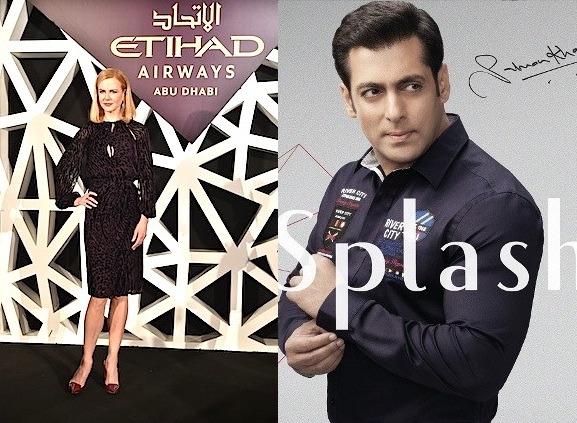
Have brand associations between Kidman and Etihad and Khan and Splash helped or hindered their respective brands?

Have brand associations between Kidman and Etihad and Khan and Splash helped or hindered their respective brands?

We just love celebrity endorsements. They’re useful for building brand equity, for improving ad recall, they convey celebrity status to the brand, and help brands stand out from the pack. When done right, celebrity engagements work wonders for the brand. Think Michael Jordan and Nike or Beyonce and Pepsi.

And then there’s what we do in the Middle East, specifically the Gulf. I’ve had a number of views come my way, particularly in relation to two deals which were done recently. The first is for the Abu Dhabi-based airline Etihad. In March Etihad signed up Hollywood actress Nicole Kidman to front up its latest advertising push which focused on Etihad’s redefinition of luxury travel. You can see the video below.

A global name, Kidman is Etihad’s fourth brand ambassador from Australia (can you name the other three, or the airline’s one Frenchman and German sports stars?). The discussion comes in around Etihad’s customer groups and how much the airline’s brand ambassadors actually resonate with these groups. Despite being Abu Dhabi-based and owned by the UAE’s capital, Etihad doesn’t have a single Arabic-speaking or Arab national as a brand ambassador. It’s hard to know how much Kidman would resonate with audiences in the Gulf, but Etihad hasn’t done much to find and leverage off brand ambassadors who’d appeal to Arabs in and around the Gulf (particularly those who are likely to travel in first class).

For Kidman, the association with Etihad has brought its own risks. Just a couple of weeks after the deal with Etihad, Kidman was criticized by a flight attendants’ union, the Association of Professional Flight Attendants, following her appearance in an advert for an airline it claims treats female employees “deplorably” and operates using “discriminatory labour practices”.

While there’s always a risk of being targeted, and criticized, by a specific interest group as in the case of Kidman, there’s even more risk to a brand’s equity when a celebrity misbehaves (think Tiger Woods and affairs with adult film stars) or does something which consumers may consider to be unethical.

One such example is Bollywood filmstar Salman Khan. Khan, who is an A-list film star in India, is the face of Dubai-based clothing retailer Splash. However, over the past week Khan was found guilty of committing manslaughter in a hit-and-run accident back in 2002 (Khan was allegedly drunk and lost control of his car, which slammed into a group of homeless people sleeping on a pavement).

The editor of Arabian Business, Anil Bhoyrul, penned a strongly-worded opinion piece on the issue only this week. The piece has gone on to become one of the most commented-on pieces in the history of the online news portal.

On a roll, Arabian Business published a piece about a public backlash against Splash for their support of Khan. You can read excerpts below.

Dubai-based Landmark Group is facing a public backlash, after the CEO of one of its leading brands described convicted Bollywood killer Salman Khan as a “great man.”

Bollywood star Salman Khan, who is a brand ambassador for Splash, was sentenced to five years in jail after being found guilty of killing a homeless man while driving under the influence of alcohol. He is currently on bail pending an appeal.

Khan was appointed as a brand ambassador for Splash in 2013, and is currently featured in a number of advertising campaigns for the retailer’s products. His face appears in several large billboards across Dubai, promoting clothing ranges.

But despite the conviction, Splash CEO Raza Beig said last week: “At Splash we love Salman Khan and we will support him through every up & down. My heart breaks to find out about the verdict but as they say every great man in history has gone through some struggle to achieve greater heights so probably this is his calling. We cannot comment on the judgement and do not believe he deserves it but Allah’s will it is.”

Will this brand association and the support of Splash’s CEO for Khan turn toxic and lead to a public boycott? What’s certain is that the Splash brand will not be helped by the current association with Khan, and the CEO’s stance would appear to be at odds with the opinion of many Splash customers. There is one truth all brands need to bear in mind – the consumer is boss. What matters is not what is important to us as people who manage the brand(s), but rather what is important to them.

What do you think of these celebrity endorsements? Are they flying high or are they a damp squib (excuse the puns). Share your thoughts. I’d love to hear from you.