Arab News, Molouk Ba-Isa, the Axact scandal and how the Arab media lost a world exclusive in 2009

Molouk Ba-Isa broke the Axact story five years before the New York Times. And then her story was pulled by the management of Arab News two weeks after it was published (image source: Saudi Gazette)

Molouk Ba-Isa broke the Axact story five years before the New York Times. And then her story was pulled by the management of Arab News two weeks after it was published (image source: Saudi Gazette)

While there’s plenty of media titles in the Middle East region – by all accounts the Gulf is the one part of the world where print is still making a profit – there’s few occasions I can remember where the region has had a world exclusive.

There’s always an exception to the rule, and unsurprisingly the person who has been in the limelight recently is a Saudi-based journalist called Molouk Ba-Isa. For those who know her, Molouk is a no-nonsense reporter who often tackles items of interest to her readers and who produces original news rather than copying and pasting news releases.

Molouk’s name was mentioned in the New York Times, as the journalist who first broke the Axact fake diploma scandal. To quote from the first piece the New York Times wrote on the story, in which it broke news of the scandal:

Heavy scrutiny by investigators, politicians and the fractious Pakistani media sector has mounted over the past week for Axact, a Karachi-based software company that has made millions selling fake degrees through a sprawling empire of school websites.

Axact, which has its headquarters in Karachi, Pakistan, ostensibly operates as a software company. Axact runs hundreds of websites, many of which purport to be online universities and high schools based in the United States.

Axact has thrived for more than a decade on its ability to hide links between its operation in Karachi and hundreds of fictitious online schools, many of them claiming to be American. But more such links are coming to light in the days since The New York Times published a detailed account of the company’s operations.

The Axact story wasn’t broken by the New York Times, but rather by Molouk Ba-Isa, who was writing for the Arab News back in 2009. Again, to quote from the New York Times:

For years, former employees said, Axact’s diploma certificates were shipped to customers across the globe through a courier service in Dubai, to give the impression of being based in that city’s free trade zone. But that facade nearly collapsed in 2009, when a technology journalist from Saudi Arabia started looking more closely.

The journalist, Molouk Ba-Isa, was following up on a report that Rochville University had awarded a master’s in business administration to an American pug named Chester. Although Rochville’s physical location was a mystery, Ms. Ba-Isa learned from a courier company official in Dubai that the degree originated from Axact’s office in Karachi.

But when The Arab News published her report, naming Axact, she said her editors received a strongly worded legal threat from company lawyers, and the article was removed from the Internet. This week, Ms. Ba-Isa said in an email that she felt vindicated.

In her weekly article for the Saudi Gazette, Molouk wrote about her Axact story which was published both in print and, even more importantly for a company which sells degrees via the internet, online.

On October 7, 2009, I received an email from Abdul Karim Khan & Company with a subject line “Cease and Desist.” The email was sent from akkc2005@yahoo.com, copied to legal@axact.com.

Abdul Karim Khan & Company, claimed to be “Advocates, Attorneys and Legal Consultants,” located at Suite No. 1108, 11th Floor, Kashif Centre, Sharah-e-Faisal, Karachi.

The email stated that the lawyers represented Axact (Pvt.) Ltd and they were putting forward a Cease and Desist Letter authored by Fahim ul Karim.

The letter demanded that the article published on October 6 be removed from arabnews.com or prosecution would proceed. Arab News was also included and threatened in the Cease and Desist Letter.

Immediately, I was asked by senior Arab News staff to provide evidence for all allegations in my report. I turned over my notes and the taped interview with Vicky Phillips, the founder of GetEducated.com, whose dog had been awarded the degree.

I provided telephone numbers for the shippers in Dubai and images of the shipping label. Within a week of the first email, the legal documents arrived from Pakistan to Jeddah by courier.

Once the article had been up on the website for two weeks, senior management at the newspaper made the decision to take the report down to stop any lawsuit.

However, no apology was issued and my report was never retracted. I continued to dig for information about Axact’s illegal activities.

While Molouk should be praised for her pioneering work, why didn’t the management at Arab News and its publisher defend her reporting and keep it online? Did they really fear a court case? Do they bear responsibility for those who have been defrauded by Axact in the five years since that initial piece was published by Molouk? And what does this say about investigative journalist in the Middle East?

A global scoop which never was… Molouk, you did a fantastic job. If only our publishers are as brave as our journalists, maybe this piece would have had a different ending. Ultimately, I’ll leave the last word to Molouk.

My thanks go out to all those who have helped to publicize Axact’s alleged malfeasance. Keep up the good work.

Did Skydive Dubai do enough communications following the tragic death of skydiver Majed Al Shuaiby?

There are days I love my job as a communicator. And then there are days when my heart breaks. One of those days was last week, with the tragic news of a death at Skydive Dubai. Majed Al Shuaiby was an experienced skydiver – he had over 700 dives under his belt according to the local media. On April the 30th Majed took to the skies. Unfortunately, his parachute did not open and he died on impact.

This news, as sad as it is, is also newsworthy. We have a young man, who is only 35 years old, who perished whilst undertaking a sport which is often thought of as high risk. The accident made the news, with coverage nationally and regionally (Majed was a Saudi national). Unsurprisingly, the news first appeared on social media, on the evening of the 30th, the day of the accident.

In a tribute Majed’s name trended on Twitter in Saudi with the hashtag #ماجد_الشعيبي.

Many of those who were online and who knew of the accident started to reach out to Skydive Dubai. The initial reaction was, to put it mildly, disappointing.

https://twitter.com/ammorsy/status/593784283237457921

What Skydive Dubai did, a day after the accident, was put up a post on its Facebook Desert Campus page and push users there. There’s no separate post on Skydive Dubai’s main Facebook page and no posts on Twitter.

The holding statement above has been used for media attribution as well, as can be seen from The National’s story.

Was the statement from Skydive Dubai enough or could they have done more?

Was the statement from Skydive Dubai enough or could they have done more?

While the investigation is still under way to determine what happened, could Skydive Dubai have done more to publicly address the incident and offer their condolences to the family, whilst also addressing concerns around the safety of skydiving?

No one wants to go through a crisis, especially when people are injured or there’s a fatality. However, we as communicators are on the front line to advise our employers and communicate in a way that is respectful, that comforts, and that shows we are also human. As we say, perception is reality and Skydive Dubai’s initial response, to block users, would seem entirely at odds with what communicators should do in a crisis. Going beyond that, is a holding statement enough? We need to present both the facts and show our emotion. We should never simply ignore bad news, and block conversations. Could Skydive Dubai have done more? Do let me know your thoughts.

On a final note, I’d like to convey my condolences to Majed’s family. Allah yurhamu and may god bless his soul.

The Gulf’s Communications Sector and the Challenge for Authenticity

Is the communications industry in the Gulf authentic enough?

Is the communications industry in the Gulf authentic enough?

I am, sometimes, allowed to get out by my better half. And this month has been replete with communications events. Two in particular come to mind. The first was an anniversary for a well-known communications consultancy firm which was celebrating a milestone for its UAE-based operations. The second was for a social media network which was talking about the largest advertising period in the region, namely Ramadan.

Both events struck me, but probably for the reasons that the organizers hadn’t intended for. At the first event, for the consultancy anniversary, I’d have expected to have seen a couple of nationals. After all, a number of the company’s clients were government bodies and we were in the capital where the ratio of nationals is much higher than in Dubai. But, unfortunately, there was only one national. Instead, the audience was western, English-speaking and middle-aged.

The second event was just as perplexing. Despite Ramadan being a part of Islam (Ramadan is the Islamic month of fasting), I didn’t see a single Arab or Muslim talk about the event. At both events I was left asking myself, where are the personal insights, where’s the local understanding which I can either learn from or relate to?

In truth, these occasions are a microcosm of the communications and marketing industry in the Gulf region. We’re facing an issue with sustainability – there are far too few nationals and Arabic-language speakers in the industry, especially in high-level positions. To me this essentially means that, as we don’t accurately represent the audience we are trying to communicate with, that we’re not able to do our jobs properly.

I often get asked if I can suggest or recommend good talent, both by agencies and clients. Instead, let me offer a different suggestion. Let’s go straight to the source. Do you know how many young, talented nationals and children of expats who have grown up in the UAE are studying communications? We’re talking about at least 3,000 communications students between institutions such as Zayed University, Canadian University in Dubai, Abu Dhabi University, the American University of Sharjah, the American University of Dubai and Middlesex University. And then there’s the Saudis, the Bahrainis and others in the Gulf.

There’s enough talent out there, particularly Arabic-speaking youth, who want to get into the industry. However, we need to engage with them. The below are just a couple of ideas to get us all engaged on making the communications industry sustainable:

1) Get on campus! There are so many on-site events at universities and both agencies and companies need to step in, to both understand how much talent is out there as well as to educate students on what career opportunities are out there for them, especially for nationals who prefer a government job.

2) Mentor, mentor, mentor – the second option is to engage with students over a longer period. Mentoring allows students to learn from middle to senior-level professionals in the industry and for both to exchange their views. In a time where social media dominates, mentors can also learn a great deal from Arab youth on digital trends.

3) Bring in the interns – the longest-lasting and the most meaningful of the three engagements, an internship will allow students to get on-the-job experience with, hopefully, a view to joining the organization they’re interning with. An internship is the closest thing a student will get to a real-life job and will enable them to complement their in-class learnings with hands-on experience.

Organizations such as the Middle East Public Relations Association are promoting all of the above, in the hope that the industry becomes more representative of the communities in which we live. If we’re hoping to communicate as well as we can to all of the audiences that make up the Gulf, we have to take a different approach to hiring and promoting talent. Bringing in the expat with no local experience or understanding is no longer the right thing to do. We have to be authentic if we are going to be relevant. Are you up to the challenge?

Do you want to know more about social media in the Middle East? Download the TNS ArabSMIS report here

Do you not know where to start when it comes to social media and the Middle East? This report may be your answer (image source: http://blue16media.com)

Do you not know where to start when it comes to social media and the Middle East? This report may be your answer (image source: http://blue16media.com)

We have our fair share of big events in Dubai and this week was no exception. The past two days has seen the Emirate become the place to be for social media influencers. Whilst we found ourselves invaded by all types of beautiful people (and others) waving their selfie sticks and pouting for the camera, there were some handy takeaways for an audience looking to learn more about how to use social media to build brands for themselves, their companies or their countries. Oh, and Twitter has finally decided to open an office in the MENA region, obviously in Dubai.

The most impressive part of the Arab Social Media Influencers Summit was the report. Coming in at a whopping sixty seven pages, the report by research house TNS covers a whole host of areas of social media interest across the MENA region. The study combines both qualitative research with a quantitative survey of more than 7200 users of social media spread evenly
across 18 Arab countries.

If you’re looking to know which channels are used across MENA, then look no further. The report includes stats on LinkedIn, Facebook, Twitter, Instagram, Whatsapp, Google+, and YouTube. It also includes social media usage habits, including time of use, duration of use and devices used. Most importantly, the report looks into attitudes about social media across the region and what people are doing online.

If you’re doing anything online in the MENA region, download this report and start dissecting. You can thank me later, on social media.

The ASMIS Social Media MENA Report

Educating the Gulf on our humanity through social video – examples from Bahrain, Saudi and the UAE

Here in the Gulf region we’re increasingly seeing the use of online video content, particularly to tackle issues that are both social and controversial. This week there have been media stories on three examples from three different countries.

The first video has been produced by the Saudi Human Rights Commission to Saudi nationals to be kinder to their domestic workers, most of whom have to leave behind a family of their own to earn a living and support them. The video is well shot, and aims to give humanity back to domestic workers, especially those from South East Asia, through concepts such as motherhood.

The second is from Bahrain, but shot by one social media influencer called Yousef Al Madani. The clip focuses on the treatment of white-collar workers in Bahrain, most of whom come from the Asian subcontinent. Yousef looks to take the place of one of these workers at a local grocery store, where they often have to rush out to take orders from customers who sit in their cars and wait for the items to be brought to them. The clip, which has been talked about in the media, has been viewed over half a million times. This video is dubbed into English as well.

The third and final clip is from a corporate, Cola Cola to be exact. To quote the National:

An online advertising campaign by Coca-Cola showing the company handing out excess baggage tags at the airport to travellers has been viewed almost one million times on YouTube.

The clip “Coca-Cola –Taking Home Happiness” begins by showing passengers checking in at Dubai International Airport to head off to various destinations to see family. By Thursday, the video had generated more than 987,000 hits since it was uploaded a month ago. According to the website for Campaign Middle East magazine, Coco-Cola shot the video on December 22 with the cooperation of the airport.

The campaign – which is available only in the UAE and Oman – is expected to expand with additional prizes like flight vouchers, TVs and mobile phones, the company said. The video follows a similar online campaign last year which showed labour camps with Coca-Cola phone booths, into which bottle tops rather than coins could be fed to pay for international calls.

The video, which is probably the best shot out of the three (this is Coca Cola after all), is also dubbed.

What are your thoughts on the above? Are these videos effective? Would they have been more effective on television as well, or less effective? And is one more effective than the other, possibly due to its topic, its producer, its intent as well as its authenticity? Do let me know your thoughts.

The launch of LinkedIn Arabic – Did LinkedIn miss a messaging opportunity?

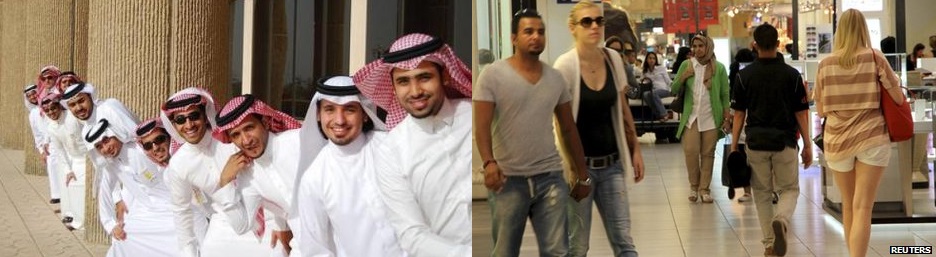
If you're going to launch in Arabic where would you choose? Dubai or Riyadh? (image source: Reuters)

If you’re going to launch in Arabic where would you choose? Dubai or Riyadh? (image source: Reuters)

I love LinkedIn. It’s possibly my favorite social media network. LinkedIn has transformed how professionals network (and get jobs) online. No recruiter could do without LinkedIn.

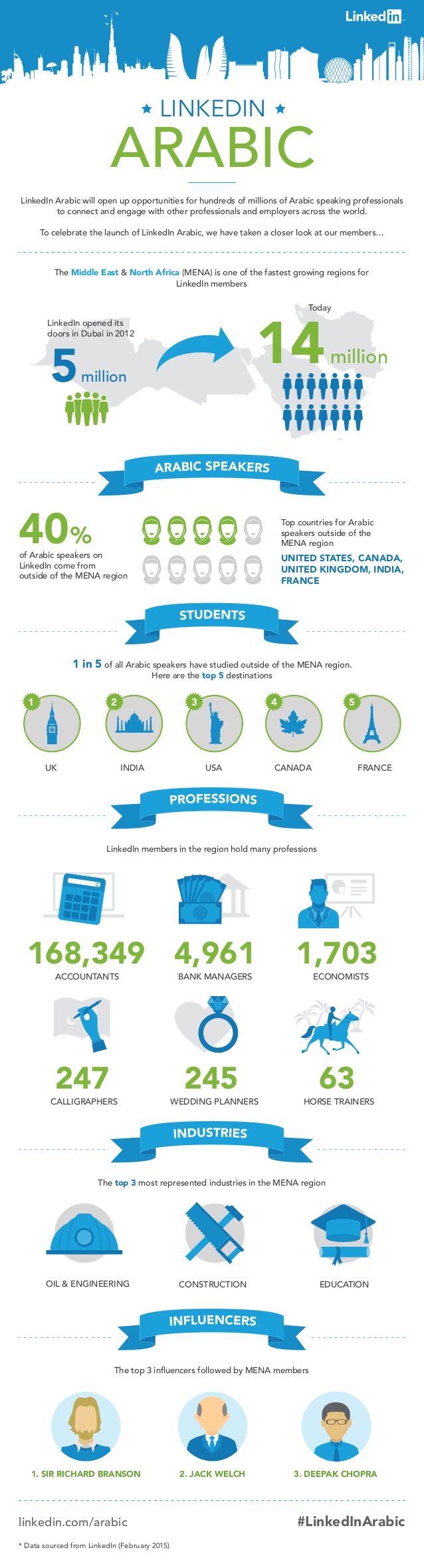
The network has grown steadily in the Middle East since it opened up an office in Dubai back in 2012. Over the past three years LinkedIn has grown its user base from five to fourteen million. The UAE is LinkenIn’s largest market with two million users according to The National. The two largest Arabic-speaking markets in the region are Egypt, with a population of just over 82 million, and Saudi.

The Kingdom is, or should be, LinkedIn’s largest potential market. Saudi doesn’t only have a sizable Arabic-speaking population (28 million and counting), but it also has the spending power. Saudi’s gross domestic product for 2013 was just under 750 billion dollars. Saudi is home to some of the region’s largest corporations, as well as a majority of the country under the age of 25. Add to the mix high internet penetration and smartphone usage, Saudi is LinkedIn’s Arabic-language market.

However, when LinkedIn launched its Arabic-language site last week the management team chose Dubai as the preferred location. There was a guest advocate, in the shape of Noura Al Kaabi, CEO of Abu Dhabi’s twofour54. Bizarrely, LinkedIn’s press materials also included a press statement from Saudi’s Minister of Labor, which was carried extensively in the Kingdom’s media (the quote in full is below and is sourced from Saudi Gazette).

Eng. Adel M. Fakeih, Saudi Arabia’s minister of labor, said: “LinkedIn has been working with us to match talent in the Kingdom with the right opportunity, and with Arabic, this benefit can be rolled-out to a much wider member base.

LinkedIn will continue to be a useful tool for us as we use technology to communicate the need for nationals to up-skill themselves and take advantage of the strong economic climate and significant job-creation in the Kingdom.

Being a part of a global network also helps youth identify the key demand areas, and build their qualifications accordingly.”

Would LinkedIn have been better served by launching Arabic in Saudi, rather than in the UAE (where it could be argued that the lingua franca is English). Would this activation have been more in line with the message that LinkedIn was trying to convey, namely that we are now in Arabic and we want Arabic speakers to use our service.

It’s a small observation, but it seems that LinkedIn missed an opportunity to push home a message through a launch that was misaligned with its target audience. Saudi isn’t the easiest country in terms of getting things right on the ground, but if you’re going to do something then, as the saying goes, if it is worth doing then do it right.

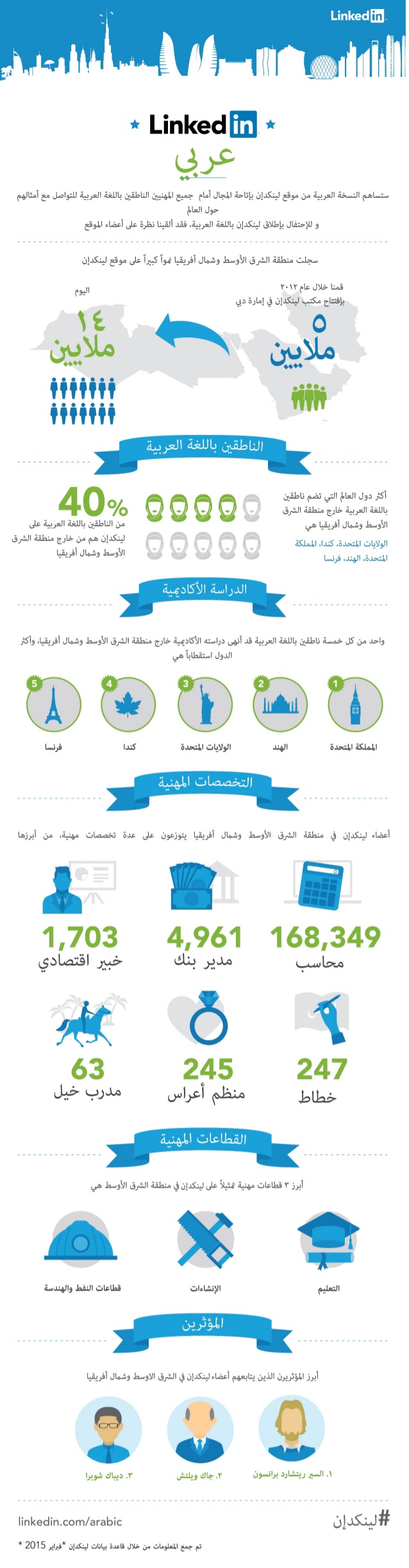
And for more details on LinkedIn in the Middle East have a look at the infographics below, which are in English and Arabic.

The #truthbetold – How Saudi’s UTURN and @omarhuss are tackling taboos through social media

By its very nature, a taboo can be difficult to talk about. Breaking a taboo is traditionally objected to by elements of a society. What we’re seeing in Saudi is an effort to tackle taboos through social media. One of the leading digital and social media agencies is Jeddah-based UTURN, and its founders and presenter Omar Hussein have taken it on themselves to tackle sensitive subjects. Their idea is simple – create scenarios whereby they provoke Saudis to respond to the situation through actors and staged behaviours, record their reactions, and package this for distribution over the internet.

Named #truthbetold or #الحق_ينقال in Arabic, Omar Hussein and UTURN have tackled several issues to date since they began their series at the end of November. The first, in partnership with Ikea Saudi Arabia, was the issue of Saudi women working as cashiers. An actor in the queue would begin cursing the female cashier to prompt a reaction from the audience around him. The video is below and is only in Arabic. However, it is worth watching just to understand the issue and the responses of those featured.

The second, launched a month after at the end of December, is on the issue of alleged racism towards foreign workers in Saudi Arabia, and was staged in the roast chicken chain Tazaj. Again, the video is in Arabic but the body language of those in the set and who are not aware of acting can be read by any person watching.

Released at the end of January, the third episode tackles the issue of child workers in Jeddah. Done in partnership with the Fatoor Faris restaurant, people are seen responding to a Saudi actor abusing a child actor who is pretending to sell him gum.

Each video has been watched over half a million times, and, even more importantly, UTURN is using Facebook as a means for Saudis to discuss these issues. The idea is so simple and yet so powerful. Thank you UTURN and Omar Hussein for doing this. I wish others were as creative and as brave as you.

And I wish that communicators would look at Saudi, a country which is viewed as the most traditional and conservative in the region, to understand how we can better use social media to change perceptions, attitudes and behaviours. You and others in the Kingdom are leading the rest of the Gulf in terms of how we use social media for change.

How many followers have been lost by the Gulf’s Instagrammers?

Instagram has deleted millions of fake accounts, pulling down the follower numbers for many accounts in the Gulf (image source: http://cdn.slashgear.com)

This week, photo-sharing app Instagram removed millions of accounts believed to be posting spam. The action, which has been dubbed the “Instagram Rapture”, hasn’t spared Instagrammers in the Gulf. Instagram is popular in the Gulf, particularly in Kuwait, where some Instagrammers have become celebrities in their own right and have turned the application into a living.

Globally, many of the world’s top 100 Instagram accounts have been hard hit by Instagram’s move to delete fake accounts. Figures released by developer Zach Allia have revealed that celebrities such as Justin Bieber lost over 3,500,000 followers.

So, how did our own Instagrammers do? For Kuwait, stats compiled by the website Kuwaitiful compare numbers before and after. Have a look below at the top accounts in Kuwait (not all are Kuwaiti based, mind you).

Before and after the Instagram purge in Kuwait. Some accounts have hardly been affected, while others have seen their follower numbers fall drastically (source: www.http://kuwaitiful.com/)

Before and after the Instagram purge in Kuwait. Some accounts have hardly been affected, while others have seen their follower numbers fall drastically (source: www.http://kuwaitiful.com/)

For Saudi and the UAE, I’ve gone to Social Insider which also compiled the numbers before and after. Again, we’re seeing a similar picture, with some accounts hardly affected, while others have lost a double-digit percentage of followers (apologies for the image size, but you can zoom into the image to read the numbers).

This list of Instagram accounts from Saudi and the UAE includes the numbers from before and after the purge. One account lost 40% of its followers (source: www.http://social-insider.com)

This list of Instagram accounts from Saudi and the UAE includes the numbers from before and after the purge. One account lost 40% of its followers (source: www.http://social-insider.com)

The reaction from celebrities in the US hasn’t been kind. Rapper Ma$e, who lost more than a million followers, deleted his account after being accused for buying followers. How will those celebrities in our region respond, especially the accounts which have lost over ten percent of their total follower numbers? Also, will this affect how much these Instagrammers are charging for posting paid content? It’d be interesting to hear your thoughts on this one.

#Hajjselfie, Whatsapp and smartphones – how is technology changing Islam and Muslims?

We’re a funny bunch in how we can change so quickly and then justify how we’ve changed 180 degrees. I remember how up until ten years back, camera phones were banned in Saudi Arabia. And today, the hot topics are #Hajjselfie and how modern technology is making its mark on Saudi society.

The beginning of October was the timing for the annual Hajj pilgrimage, a mandatory religious duty for Muslims. During Hajj Muslims are to abstain from all temptations which may lead to sin; in essence, the pilgrimage is a time for renewal for the two million plus Muslims who take the rite of passage annually.

This year, one of the major stories which broke at Hajj was the #hajjselfie. You’ll probably know of the selfie, a self-portrait photograph, typically taken with a hand-held digital camera or camera phone and then shared online via social networking services. This year, the selfie was introduced en-mass to Hajj. To quote from Saudi Gazette and AFP.

Raising his arm, Yousef Ali hugs his elderly father near the Grand Mosque in Makkah as they grin for a selfie — a craze that has hit this year’s Haj. But not everyone is happy about young pilgrims from around the world constantly snapping “selfie”, photographs taken of one’s self, as they carry out Haj rights.

From Tawaf — circumambulating the Holy Kaaba — to prayers atop Mount Mercy in Arafat, and stoning of the “devil” in Mina, the key stages of Haj have all been recorded on cameras and smartphones for posterity, and for instant sharing through social media.

“As this is my first pilgrimage, it is important for me to document all the events taking place around me,” Ali, 24, told AFP, snapping a picture of himself with a green sign reading “Big Jamarah”, which refers to a wall where pilgrims ritually stone the Satan.

“Wherever I go, I take pictures, especially since nowadays we have these little cameras… that offer a full view of the area,” the bearded Kuwaiti said with a smile.

The increasingly popular phenomenon has sparked controversy among conservatives, however, with some taking to Twitter to criticize pilgrims who take selfies.

“When we went for Umrah in the mid-90s, Dad nearly had his camera confiscated to shouts of ‘haram!’ Now, #HajjSelfie is A Thing. What a world,” wrote one Tweeter.

Another user named Kahwaaa wrote: “It’s a time to connect to Allah and purify my soul. #hajjselfies selfies shouldn’t be taken.”

But others said the issue was being blown out of proportion.

“People creating a huge issue about #hajjselfies. If photos are allowed during Haj then what is wrong with selfies?,” asked Abdul Mufeez Shaheed.

Nothing at all, says Ali’s father Mohammed Ali, 65.

“A person taking such pictures is documenting a rare event”, a once-in-a-lifetime experience for many Muslims, he said, wearing a traditional white robe.

“This is a symbolic place representing history,” Mohammed Ali added, pointing to the three sites which pilgrims began stoning on Saturday at the start of the Eid Al-Adha feast of sacrifice, which is celebrated by Muslims worldwide.

Two women covered in traditional black abayas and veils hurried toward the Big Jamarah wall, but not without stopping for a quick self-portrait along the way.

“My daughter and I are taking selfies to show our Haj pictures to our family in Paris. It’s also a nice memento,” said one of the women, a Saudi pilgrim from Jeddah who gave her name only as Umm Abdallah, 44.

Her daughter Wafaa Ahmed, 19, said: “I love taking many selfies wherever I go to keep them for myself, as well as to show them to my friends and brothers.”

Speaking to AFP by telephone, a professor of Islamic Shariah law Riyadh said that “if photographs are only for personal memory and not for disseminating, then no problem.

“But if they were for the purpose of showing off, then they are prohibited, such as the photography that takes place at the (Haj) rites.”

The scholar requested anonymity.

“It is better for Muslims to avoid them,” he said of selfies.

For the teenage pilgrim Wafaa Ahmed, “this is not a convincing view” because taking selfies “has nothing to do with religion”.

The elderly pilgrim Mohammed Ali also discounts the scholar’s opinion.

He says the camera “is a tool such as mobiles, used even by religious scholars who have not prohibited them, so why prohibit another tool of the modern era?”

As he speaks, a group of young Saudi men gather for a group selfie in front of a Jamarah wall before they stone the “devil”.

Analytics of #Hajjselfie by Topsy. The trend peaked on October the 4th.

Analytics of #Hajjselfie by Topsy. The trend peaked on October the 4th.

The #hajjselfie wasn’t the only social media story coming out of Saudi Arabia this month. A recent piece in Saudi Gazette bemoaned the erosion of traditions surrounding the vacation among Saudi nationals.

“Take for instance the recent Haj holidays where it was common practice to visit relatives but several people did not do so,” said Omar Yousif Tobbal, a senior projects manager in a government firm.

He said that these occasions allow families to spend time together but people are increasingly resorting to calling or texting their relatives to extend their greetings instead of actually visiting them.

“If it hadn’t been for modern technology, families would meet, dress up and generally enjoy themselves,” he said, adding that before the advent of technology, Saudis had more time for each other and talked for hours on common themes of interest. However, there are some who still observe the occasion in accordance with tradition, he noted.

It’s not all for the worse however. One positive which came out of the combination of social media and Hajj this year was the appreciation show to the security teams who were working to ensure the safety of the two million pilgrims through the use of the hashtag #thanks_security_men. This time from Arab News.

Photos and videos of security officers from various military sectors assisting and providing services to pilgrims during the Haj season have been trending across social networking sites, such as Twitter. A number of religious leaders and media personnel have devoted their pages to discussing the positive role of security authorities in Saudi Arabia in the success of this year’s Haj season.

Active users on social networking sites produced various hashtags, notably #thanks_security_men, to express their gratitude and appreciation for their humanitarian efforts and positive representation of Saudi Arabia.

What are your thoughts on the above? Do you think #Hajjselfie is halal or haraam? Let me know your thoughts, especially if you were on Hajj. And have a look over the #hajjselfie images below from BuzzFeed, from what is one of the most amazing spectacles on earth.

https://instagram.com/p/tiNN9gykKn

https://instagram.com/p/tTIH6ZEPEs

https://instagram.com/p/thiGdlANFk

@saudigazette’s reader voices and does the Kingdom have an image problem?

Saudi Gazette's new Voices column aims to give readers an opportunity to share their own opinions

Saudi Gazette’s new Voices column aims to give readers an opportunity to share their own opinions

Saudi Gazette has launched a fascinating project to give its readers an opportunity to write more than a letter to the editor, but rather pen a guest column. The first column, named Voices, features the thoughts of former Saudi journalist and doctoral candidate Najah Al-Osaimi. The piece by Najah looks at Saudi’s image and how it is perceived abroad. It makes for an interesting read, even more so when considering its publishing in Saudi Arabia.

Let me know your thoughts on Saudi Arabia and its image problem abroad. And thank you Saudi Gazette for another wonderful idea. If you are interested in writing a column for the Saudi Gazette then email your contribution, no less than 300 words, to voices@saudigazette.com.sa.