Clients, Non-Payments and Slow Growth – Is it time for the Middle East’s PR Industry to work together?

A couple of stories broke over the past couple of weeks in the Middle East’s PR industry. This wouldn’t be unusual if it weren’t summer, when little happens. The first piece was the news of additional job losses at Edelman Middle East. The second was the restructuring of FleishmanHillard in Saudi Arabia due to final losses. And the third, which didn’t register in the media, was the closure of a one-person PR agency in Dubai.

There are two issues at play here. The first is management. Edelman’s layoffs aren’t a one-off; the company has made repeated redundancies over the past couple of years, and I feel for all those who joined what is the world’s largest independent PR agency, only for this to happen. Edelman has struggled in the UAE and the wider region, even after the purchase of one of the country’s largest privately-owned agencies, Dabo & Co, in 2015.

The second issue is payment, or a lack of. To quote from the Gulf News piece on FleishmanHillard:

The non-payment of fees, apparently due to a lack of invoicing clients, has impacted their operations forcing the company to reduce their headcount in Riyadh.

The issue also caught the eye of the head of one of the largest agencies in the region. Writing on his LinkedIn feed, Sunil John shared his view on the need for cross-industry action to address non-payment, particularly by governments.

SunilJohn

Slow to No Growth

Let’s give a little context to the PR industry across the Middle East. Over the past two years economies in the Gulf have struggled. Saudi has been in recession for a number of quarters. The UAE’s economy is growing slowly. The fastest growing economy over 2017 was Qatar, with a GDP growth of just over 2 percent. While this may not look particularly bad for those in Europe, many of us in the region can remember a time a decade back when economies were growing double-digit. Slow to no growth is the new norm in the region, and we (and management outside of the region) have got to get used to this, and budget accordingly.

Government Spending Grows

Ironically given lower government spending over the past two years on the back of falling oil prices, the driver of PR spending has been government. Saudi in particular has been spending heavily to transform its reputation globally. I’ve seen a host of medium and large agencies flock to Riyadh to work on Saudi’s Vision 2030, as well as other projects. Political circumstances have resulted in significant sums being spent in both London and Washington. For agencies starved of growth from business, government spending has been a boon.

Payment Terms and Governments

The challenge with government accounts is payment – both payment terms and collection. Government accounts are rarely small, and I’ve heard of terms that can be as long as six months. That’s a long time to wait for payment. And then, there’s the issue of payments being made on time. In my knowledge, it’s rare for a government to pay a bill on time. And if they don’t, what’s the recourse? There’s no higher authority to appeal to, no court you can go to. You chase and chase and chase. And hope you get paid, sooner rather than later.

Is Industry Action Going to Happen?

Sunil John’s call to action is interesting, but it’s not new. I and others have discussed the idea of having non-payment lists with industry bodies such as the Middle East Public Relations Association several years back. My heart desperately wants the large agency heads to come together to agree on what action to take when it comes to black-listing accounts (the WPP agencies could easily take the lead, given the size of their business here). But, despite the hurt the industry is going through, my head say this won’t happen. For every agency that drops a non-paying account, there are ten lining up to pitch. Everyone thinks they can do better on payment.

Sadly, I think there’s a bigger issue at play which doesn’t just affect the PR industry (to give you an example, Saudi’s construction industry has faced payment delays of up to 18 months). The answer is collective action. And it’ll require true leadership from everyone on the agency side, as well as leaders on the client side calling out this behavior. Is anyone ready to make the first move?

Lessons we can learn from Marriott’s Anti-Islam Tweet and Nike’s Iran Boycott Crises

It’s rare for brands to deal with a reputational crisis so openly in the Middle East. Last week, we had two issues happening at once. First up was Dubai’s JW Marriott Hotel, which took the decision to part ways with celebrity chef Atul Kochhar after he wrote a tweet that offended many Muslims (the offending tweet is below, and you can read the back story here at the Khaleej Times). The hotel terminated Kocchar’s deal with its well regarded Rang Mahal restaurant.

“Following the recent comments made by Chef Atul Kochhar, we have taken the decision to end our agreement with him for Rang Mahal. With the termination of our agreement, Chef Atul will no longer be associated with the restaurant,” Bill Keffer, general manager of the hotel, told Gulf News.

Atul tweet

Atul’s tweet was highly criticized, both by individuals as well as the Marriott itself.

The second reputational issue was faced by Nike. Days before the beginning of the World Cup, Nike announced that it would not be providing equipment (think boots) to the Iranian football team.

“U.S. sanctions mean that, as a U.S. company, Nike cannot supply shoes to players in the Iranian national team at this time,” a company statement said.  “Sanctions applicable to Nike have been in place for many years and are enforceable by law.”

Unsurprisingly, the decision hasn’t gone down well with fans of the Iranian football team, as well as the team’s coach, Carlos Queiroz, who criticized the timing of the announcement.

There are two basic lessons that we can take from the situations Nike and Marriott found themselves in.

1. Do/Continue your Due Diligence – While the Marriott moved quickly to tackle the crisis, the question must be asked of the due diligence undertaken on Atul Kochhar’s views. Every time an agreement is undertaken, the in-house team/agency must check the influencer’s/celebrity’s background, including their social media. And they must ensure that they’re on top of anything which may be perceived as being controversial. Many have pointed to Atul Kochhar’s social media posts prior to last week’s outburst, posts which could be seen as being Islamophobic (the below is just one example of this). While hindsight is a wonderful thing, the Marriott team could have developed an insight into Atul Kochhar’s views through monitoring his social media posts before he wrote something that would have caused the brand reputational damage. This month’s crisis may have been averted.

https://twitter.com/ibrownlad/status/1006604505075605505

2. Foresee issues and tackle them proactively – Our role as communicators is to understand what is happening in the outside world, and bring those insights to senior management. We have to be social and political analysts, and we have to be able to monitor issues and foresee the outcomes that will impact our organizations, and work proactively to ensure that an issue doesn’t become a crisis. How Nike’s communications team didn’t foresee what could have happened re Iran and US sanctions is beyond me, as is the possibility for Nike to apply for a permission to be able to supply the team with equipment (boots). It was a major miss, and handed rival Adidas an open goal.

Do you have any additional insights from these two issues? What are your thoughts? As always, I’m happy to hear them. Till then, take care!

Lessons from Cannes (and other awards) on what makes for great PR campaigns

There’s an art to creating great communications campaigns (image source: Cannes Lions)

I’ve just finished judging hundreds of entries for the Cannes Lions. The experience has been overwhelming, not just due to the amount of work submitted but also due to the work’s quality. I’ve judged for years, and there are few competitions that come close to the overall level of excellence (I’d say the Effies, the IABC Gold Quills, and the Holmes Report’s Sabres).

Throughout all of my judging experiences, there’s a couple of simple lessons that communication professionals need to bear in mind. These four steps will help create powerful campaigns that should be worthy of putting into any top-tier awards competition.

1. The Why – Is What you Want to Say Powerful Enough?

First of all, why do you want to communicate. Are you launching a new product, or do you want to improve your company’s reputation. The clearer you are on why you want to engage, the simpler it will be to come up with a narrative that your audience will understand. There’s got to be a strong purpose to your communications, which then links into the second step.

2. The Insight – Listen to your Audience

You know why you want to communicate, but how does your narrative tie into the interests of your audience? Far too often communicators don’t take the time to listen and observe their publics, and simply go out, all guns blazing, with messages that don’t resonate. Powerful insights connect your audience with your narrative in a way that engages them and makes them want to listen to you. If you don’t do this well, your campaign won’t cut through the thousands of messages that we process on a daily basis, and you’ll have made no impact whatsoever. Take your time, do your research, and get out of the office (and off the Powerpoint presentations) to understand what your audience cares about and how you can tap into those emotions. In other words, bring the outside in.

Bold communicators are also ready to tie in their narrative with social issues. This isn’t always easy, and can alienate certain groups if your target audience is the public. However, as business becomes more politicized, I expect communicators (and organizational leaders) to realize that companies can’t shy away from taking a stand on issues that matter both to them and their stakeholders.

3. The Strategy & Execution – Go Personal or Go Mass, Blend Online with Offline

Now we get to the fun part, which can make or break a campaign. No matter how good your planning and research is, all your audience will see is the execution of your strategy. Effectively, what do you want your communications to achieve and how are you bringing it to life?

There’s a couple of themes I’ve noticed of late. Either campaigns go as big as possible during their execution, and include as many people from the target audience during the execution itself (this is different from sharing the campaign’s content). Or, they execute an execution with a handful of people, and use that content to tell a person narrative. Both can work very well if tied in well enough with the brand/product narrative and with the audience insight.

What’s also not surprising is how the best campaigns are using both online and offline mediums to amplify the narrative. Print, radio and television plays a role in engaging an audience, whilst digital keeps the engagement alive and allows for dialogue. Some of the most recent campaigns I’ve seen also use dark social; one smart team were creating content solely to be shared on WhatsApp. I expect this trend to gather pace as communicators realize the power of one-to-one or one-to-a-few messaging platforms.

Another noticeable trend is the use of paid media to boost the reach of content. The social media platforms have become masterful at ensuring we have to spend money to reach our audience, no matter how good the content. Influencers help to mitigate the anti-viral nature of social media platforms. Either way, it’s going to cost more to reach your target audience today online than it would have done a couple of years ago. At the very least, creating content has never been easier (or cheaper).

4. The Measurement – Use Indicators that Align with the Business (not AVEs)

Finally, how do you prove your success? The most common measurement was AVEs or advertising value equivalency. Communicators are dropping this measure, but at a rate which is slower than I’d like. Most of the work I’ve judged this year uses AVEs. Another common measure is impressions, basically the number of people exposed to the message.

Smart communicators are shifting to more meaningful indicators. A simple one which does crop up more frequently is sentiment, either in traditional media or online. Communicators are also borrowing from their marketing colleagues, and are using some digital metrics (engagement, CTRs etc), as well as brand measurements focusing on reach and response. Brand measurement helps us understand if the campaign has won viewers’ selective attention and leave a brand-associated impression and if the campaign has triggered a change in behavior or attitudes favorable to the brand.

The ultimate measures are those which are tangible. Has the campaign helped sales, has it raised more money? Has the campaign resulted in a behavioral shift, has it resulted in new regulations? Some communicators are capturing and sharing this, but it’s still only a small percentage (I’d say single digits). This needs to change, especially if communications is to be seen as a strategic function within organizations.

Here’s my four pointers to what makes for an award-winning campaign. As always, I look forward to hearing your inputs. Please do share your thoughts with me.

And best wishes for all those who have entered this year’s Cannes Lions! There’s some outstanding work.

A how-to on the UAE’s “Social Influencer” Licensing & three outstanding questions

It’s almost Ramadan, the time of year when we post and pray. This year’s Ramadan may be a little different, possibly more stressful for some. Under regulations introduced in March by the UAE’s National Media Council (NMC), those making money to promote brands will need to be signed up with an e-media license by June or else face fines and other sanctions.

In the rest of this post, I’ll share the definition of what is an influencer as per the NMC, the process to get certification, as well as three questions I have on issues which maybe aren’t addressed or which have not been talked about. Thank you to Lexis Nexis and Fiona Robertson at AlTamimi for the below.

Who is an “influencer”?

The legislation is straightforward as to who is covered. To quote from the National Media Council:

“Any person who practices the above-mentioned media activities on Social Media, on a commercial basis, shall obtain a prior license from the Council, provided that:
1. It shall have an account on the generally recognized Social Media;
2. Ads that are presented on Social Media shall be subject to the advertising standards that are applicable at the Council;
3. Social Media accounts’ owners who offer paid advertising services shall obtain a license from the National Media Council in accordance with the applicable regulations in this regard and hereunder.
4. The account owner is responsible for the content of the account.”


The resolution covers all electronic media across the country. And the NMC defines electronic advertising as “any paid or unpaid form of presentation or promotion of ideas, goods or services by electronic means or network applications”.
For a person to get an e-media license, they’ll also need a trade license. The cost of both will be a minimum 30,000 Dirhams depending on where you buy your trade license (the e-media license is 15,000AED).

How do you get a License?

Below are the requirements and the process to follow to apply for an e-media license:

e-media license

The three questions

I’m sure there’s lots of questions from people who work in the marketing and communications industry on this new legislation. My three are:

  1. How does this cover children? There are some child stars in the US who have made millions from social media. Think of “Toys Review for kids by a kid!, for example (the six year-old child and his family have made in excess of 10 million dollars). Does the legislation cover this? There are young social media players here such as Rashed Belhasa who I assume are putting out paid content.
  2. What happens to those pushing out content on behalf of employers? The definition of electronic advertising is wide enough to ask me this question. Many employees share content from their employers. I’m assuming this won’t come under the purview of the NMC, but it’d be good for them to explicitly say so.
  3. Is this a blow to the concept of micro-influencers? The idea of people with smaller followings online, say 20,000 on Twitter and Instagram, working with brands has become popular over the past year. Often these people don’t take much money in return for sharing any content or working with a brand. Would they be able to afford the licensing? In addition, would an influencer agency want to take them on board, and bevvy up the cash with the prospect of getting a lower return than working with someone more established, with stronger brand appeal and a greater number of followers?

I guess we’ll find out how this all plays out soon. In the meantime, Ramadan Kareem!

The Global Capability Framework and how it will raise awareness of our roles as communicators among our HR colleagues

The World Public Relations Forum took place last month in Oslo. The event, probably the world’s biggest gathering of international PR professionals, included an announcement by the University of Huddersfield and the Global Alliance on the launch of the Global Capability Framework (GCF).

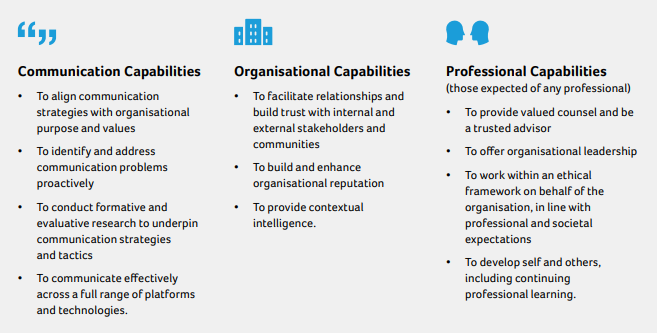
I’m more than just excited about the GCF. This project, which took two years to complete, defines the capabilities of PR professionals globally (there are country frameworks too for Argentina, Australia, Canada, Singapore, South Africa, Spain, Sweden, United Kingdom and United States). It’s a design that we can all use to better career plan, manage our teams and their development, recruit for the right skills and develop curricula that will help those practicing PR.

The 11 key capabilities identified by the GCF are of universal value to everyone in the profession (image source: Huddersfield Business School)

What’s more exciting is how the team behind the GCF are bringing this framework to life. They’re working with a team of software engineers to create a tool that’ll enable us to assess both individual and collective capabilities and set developmental goals. A sample visual is below.

I’ll admit that a shot of how the tool works doesn’t do it justice. I’ve seen the tool in action, and the possibilities it provides in terms of not only mapping skills and future development, but also transforming development goals into a training plan are inspiring.

What the Global Capability Framework and the tool also provide is an ability to engage with and educate our friends in HR what communications is. To paraphrase Dr Anne Gregory, Professor of Corporate Communication at the University of Huddersfield and director of the project, we have a capability framework that can be applied globally; reflects cultural and regional variations in public relations as a profession; and is forward looking in its approach which can be used by both global academic and practitioner communities.

What this means is that for the first time, our colleagues in HR have a resource that maps out everything they need to hire communicators, to train communicators, and to develop them over the long term. They also have a tool which will measure progress.

Why does this matter? I’ve often found that the functions we work with, such as Human Resources, don’t know what we do well enough. And yet they’re defining our function for us, they’re writing our job descriptions, they’re involved in hiring, and they’re measuring our success. We’re now talking their language, with a framework which has been developed both both academics and practitioners. The GCF will also help to standardize teaching for future generations of PR professionals.

It’s always been a tragic irony that the world’s community of communicators have struggled to explain exactly what they do and how they do it to their colleagues, particularly in HR and also in management. We now have the means to educate the people we work alongside in Human Resources. Our next challenge is how to educate those above us on our contributions to the organizations we work for.

Thank you to Professor Anne Gregory, Dr Johanna Fawkes, Dr Elizabeth Montoya-Martinez and Dr Royce Turner at the University of Huddersfield in the UK, to Argentina’s Professor Gabriel Sadi, Australia’s Dr Marianne Sison and Dr Katharina Wolf, Canada’s Dr Amy Thurlow and Dr Alex Sevigny, Singapore’s Professor Gregor Half, Spain’s Professor Elena Gutierrez-Garcia, South Africa’s Professor Ronel Rensburg, Sweden’s Professor Jesper Falkheimer and America’s Professor Katerina Tsetsura for all the work and time you’ve put into this. I believe the impact that this work will have on the industry is immense. I’m looking forward to using the GCF tool and helping others better understand what we do.

For more information on the GCF, you can download the complete capability framework and individual frameworks from the University of Huddersfield here.

Creatives, PR and Media – Where are the Gulf’s Faces to Watch?

There’s many young faces to watch in the Gulf’s creative, public relations and media industries, but if you’re looking for Gulf nationals on the agency side you’ll be sorely disappointed. The industry must find ways to solve this issue of diversity and inclusion.

I’ve enjoyed reading about the future of the region’s marcomms sector over the past couple of weeks in Campaign Middle East. The publication has listed the ‘ones to watch’ in the creative, public relations and media sectors. The people featured are an impressive bunch, and just reading about their abilities, potential and experiences at such a young age (they’re all 30 or under) is inspiring.

I was struck, however, by one detail. I didn’t see anyone I recognized as a Gulf national. There was so much talent from countries such as Egypt and Lebanon, but no one from Saudi or the UAE.

For anyone based over here, it’s probably not a surprise that there’s not enough diversity and inclusion in the marcomms industry/function, especially on the Agency side (this listing was Agency-focused). While there are Gulf nationals working agency-side, especially in Bahrain and Saudi, there’s certainly not enough.

How Can We Attract More Nationals?

The marcomms industry isn’t alone in struggling to attract enough young national talent – only one percent of the Emirati labor force is employed in the private sector, compared to 60 percent in government. But the landscape across the Gulf has shifted in a number of countries. Governments in Bahrain, Oman and Saudi Arabia are heavily promoting the idea of nationals applying to the private sector. More nationals are also eager to try new fields, particularly in the creative space. Here’s my suggestions on what each party must do to change perceptions and encourage diversity and inclusion.

The Industry and National Misconceptions

Let’s begin with the agencies and private sector firms who hire (the client side). We’ve got to break down the misconceptions and stereotypes around nationals, focusing on two key points. First, there’s the issue of work ethic; for far too long, there’s been a view that Gulf nationals don’t want to and won’t work the longer hours that the private sector asks of them (governments traditionally worked from 7 or 8am to early afternoon). Second, there’s compensation; Gulf nationals have often earned more working for the public sector.

I’m not going to be naive and pretend that these issues don’t exist. In Kuwait, Qatar and the UAE there’s a high differential between private and public sector pay for nationals, as well as additional benefits such as longer vacations.

However, we’ve already seen a shift in Bahrain, Oman and Saudi, where it’s common to find a national working in marketing or comms on the client side. To their credit, some agencies such as Gulf Hill and Knowlton have always looked to hire local in these markets (they had a large roster of Saudis some years back, and they’ve also hired a number of Bahrainis). In these markets governments are both telling their nationals to look towards the private sector and reducing the compensation differential.

For many in the private sector, they’ve not even put in the effort to test if the old stereotypes are true. There’s nowhere near enough engagement with universities across the region, not enough internships for nationals, and little in the way of mentoring. These are low-cost activities, which both agencies and clients should be undertaking. At the very least, they need to look for local talent, so they can benefit from insights that only nationals can bring to the table.

Governments and Talent Development

The private sector is only one half of the challenge. The other is governments.  Understandably, the region has long sought to develop its own talent. The number of nationals working in the marcomms function has risen rapidly, at least on the government side. It’s understandable that many nationals, particularly in Qatar and the UAE, would want to work in the public sector – pay in these two countries is, generally speaking, much higher. Plus, there’s a preference for locals, meaning there’s less competition for positions.This has become a double-edged sword. There’s more marketing and communications jobs in government, pay is better, and there’s less competition for these roles. What this has led to is young nationals being advanced into senior roles, often when they’re not yet ready or experienced enough.

If governments are serious about developing local talent, they’ve got to change this approach to public sector hiring and instead focus on long-term development, in partnership with private sector firms. This could include funded internships, either at home or abroad, as well as engagement with industry associations such as the IABC to promote certifications and long-term career mapping (I’ll share more about this soon). What’s clear is that national communicators who have worked only in one sector are missing out on all the potential learnings and development the other can offer, including the ability to work with and learn from other nationalities and culture (diversity and inclusion is also an issue on the government side).

Advice for Young Gulf Nationals

My advice for any young Gulf national is simple. Go and explore the private sector, understand the training and development it can offer you, and ensure you’ve tried every single option before you go into the public sector. If you’re after a challenge and you’re passionate about what you do, the money and position will follow. But if you want to be the very best you can be, and learn from a wider group of people from around the world, then moving into the private sector will be the best thing that you can do.

Likewise, we need you. We need the industry to be more diverse and inclusive (this equally applies to the public sector, where there aren’t enough expats working today), we need your insights and knowledge, and we need your understanding of the local culture, behavioral psychology, and awareness of how the Gulf’s local communities are changing. Today, we don’t have enough of this on the agency or client side. And it’s our loss. This scenario needs to change.

If you want to talk more, message me. I’m always giving my time to universities, to talk about the profession and help you understand your options. I’m happy to answer any question you may have, and point you in the right direction.

Competing Media Motivations in the UAE’s Press (and what this means for communicators)

Communicators need to understand the competing agendas in the UAE’s press scene (image source: freepress.net)

I was once told, “to really understand a thing, you must know the reason for its purpose.” I don’t usually begin my posts so philosophically, but this quote seemed a fitting place to start when writing about the media in the United Arab Emirates.

An event caught my eye last month. The UAE’s National Media Council held a one day seminar, primarily for Emirati media professionals and communicators in the government sector. The event was entitled “The Future of Emirati Media”, and the below tweet from the National Media Council’s Chairman summarized a distinctly national view of the UAE media.

I’ve paraphrased below the key points from the above Arabic-language tweets and other material shared on the day:

  1. Work through the media to promote the national agenda.
  2. The media has a shared responsibility to work alongside state institutions and those present on social media to develop the sector.
  3. The media will contribute to the strengthening of the State’s leadership of the regional and global information sector.

The Foreign Perspective

In much of the West and East, the media is called the “fourth estate”, a group that is independent from government and which wields influence over society. Media seeks to report on issues of interest to its stakeholders (readers as well as owners), and will hold individuals, organizations and governments to account.

Essentially, the media has a number of roles, including to inform and by extension educate citizens on issues of importance, to act as a platform for different viewpoints and societal groups to share their own viewpoints and narratives, and to hold those in power to account.

In a country like the UAE, much of the English-language media consists of foreigners who have worked in other countries. Their view-point on what constitutes the media is often different to the national perspective.

What this means for Communicators

It goes without saying that for those working in communications, understanding both perspectives is vital for us to be able to engage effectively with different stakeholders. Media which are aligned with the first viewpoint are focused on the national perspective, especially as it relates to development and leadership. The media which is aligned to the second perspective is focused on sharing news that seeks to inform without the national development frame of reference.

These two viewpoints are also influencing where people work; many UAE nationals will explain that they’ve chosen to work in government communications as they believe it’s part of their contribution to the country’s development. Many foreigners in the media, particularly foreign outlets based in the UAE, will argue that sharing an independent perspective is important to truly understand what is happening in the country (and the wider region).

As always, context is key. Communicators and media need to understand each other’s motivations if we are to be in a position to engage and inform. Communicators and media need to understand these two basic perspectives and what it means for our work, be it talking within a national framework or sharing unique insights that are set within a governmental context. What’s essential here is that communicators appreciate both motivations, and they’re able to adapt as necessary to be able to interact with both media groups (and their respective audiences).

As always, I love to hear your inputs. Please do share!

Breaking Taboos – the issue of Sexual Discrimination in the Middle East’s Marcomms Industry

The #MeToo movement has rarely been discussed in the Middle East. It’s time we start talking seriously about sexual harassment in the region, especially in the marcomms industry (image source: http://www.alaraby.co.uk)

For all the impact that the online social movement #MeToo has brought to much of the world, there’s been little public talk of the challenges that women in the Middle East face when it comes to sexual discrimination. That changed this month, when ArabAd’s Iain Akerman published a piece detailing a recent case of allegations of sexual harassment at one global agency in the UAE.

The article is a must-read for all of us who work in marketing and communications (I was dismayed by a point of view shared by Ricarda Ruecker, vice-president of leadership and organisation development at MCN, that women could be to blame for any harassment they suffer due to their dress or behavior).

I want to applaud Iain and ArabAd for taking on this issue. The allegations are well known in Dubai, but they haven’t been published till now due to the nature of local defamation laws and the understandable reluctance of those women involved to talk about their ordeal publicly. Iain and ArabAd have taken a risk in publishing this piece.

Sadly, there’s so little straight talk on what women here have to deal with in the workplace. There’s lots of PR from certain quarters about the importance placed on women’s rights in certain parts of the region. And yet, I can’t help but ask one question; how does all the talk translate into action? Are companies asked, for example, to published pay scales for their male and female staff, as is now the case in Europe. The answer is no. Do we have enough female management in the industry? My answer would be not enough. And do women in the industry feel that they’re protected from harassment? I don’t feel that they do.

Small steps are being made when it comes to gender parity in the region’s marketing and communications industry. A group that I’m part of, the Advertising Business Group, is pushing to tackle gender stereotypes in the region’s advertising space. But it’s obvious that we need to do more. I’d argue that industry associations should play a larger role in talking about the issue and affording support to female members and organizations on both listening to their concerns in the case of the former, and helping put in place zero-tolerance policies for all types of harassment.

Ultimately, each and every one of us should not only pledge to fight discrimination and harassment, but we should also support anyone who feels that they have been wronged. Nothing justifies discrimination and harassment, and it’s time we started talking more about the issue openly and honestly.

The Six Essentials for Promoting Brand Building and Trust Among MENA Consumers (MEPRA/YouGov Research)

trust-in-blue-marker

Trust is one of those intangibles which we as communicators must always focus on. Trust, that notion of one person relying on and believing in a second person, is key to changing attitudes and behavior. But how do you build trust, and what channels should you focus on? These are the questions that we need to answer to be able to do our job of building and protecting reputations. So, where should one begin when looking to build trust?

Based on research by YouGov, which was commissioned by the Middle East Public Relations Association and which included a survey of across the six Gulf states (Bahrain, Kuwait, Oman, Qatar, Saudi Arabia and the United Arab Emirates), Egypt, Jordan, and Lebanon, the place to begin isn’t online, but rather face-to-face. Fake media, less impactful advertising, and third-party advocacy are also reshaping where consumers in the region put their trust.

I’ve written three blog posts on the issue which I’ve already published on the blog, to explore the findings country-by-country, but here’s the big picture headlines from the research, which surveyed 4,475 people across the region.

1. Face-to-Face with family/friends is key to influence

It should be obvious to us all, and here’s another reminder for anyone working in communications/marketing. If you want to build trust in a brand, its products and services, then look at how you can engage the public through word-of-mouth. Across the region, 85% of respondents trust product and service recommendations from their family and friends. Nothing else comes close to these positive statistics.

2. Online works if you focus on friends and family, less so on social influencers

Over the past couple of years we’ve shifted for an incessant focus on digital to idolizing anything social. As the first big finding shows, in-person interaction is still the most persuasive. Online engagement does work, but it’s not as effective; 52% of respondents trust online recommendations about products and services from family and friends (interestingly, the percentages are highest for the Gulf and lowest for the Levant).

When it comes to social influencers, consumers are conflicted – 34% do trust social influencers/people with large online followings on products and services, compared to 29% who find them untrustworthy. A lack of transparency re paid/sponsored content probably isn’t helping. What’s helping even less is a tendency for social influencers in the region to say little which is negative when reviewing products and services.

3. There’s not as much trust in the media as we PR people may think

I was surprised by how low the scores were when it came to trust in the media as a source of information on products and services. The top-rated media was a brand’s own website (which should make sense, but given how bad websites are in the region this is still surprising), which scored 46% for trustworthiness. Every other medium scored in the 30s, which is a surprise considering how much faith public relations professionals put in securing editorial coverage with media outlets (for many, it’s still the essence of their day jobs). Blogs scored the lowest, at 31% trustworthiness (they were rated as untrustworthy by 30% of respondents). Should brands invest more in their own online media? The answer would seem to be an obvious yes.

4. Advertising is trusted almost as much as the media (except when it’s online)

The research is a mixed bag for the advertising sector. Out-of-home advertising such as billboards seem to be the most trusted by consumers, with a trust rating of 36%. Television is close behind with 35% trust, followed by radio at 31%. Online comes in last, at 28%. There’s more mistrust than trust for online advertising, with 33% of those polled not believing product and services information they see when displayed as an online ad. This may be due to misleading advertising around product pricing and availability. Whatever the reason for the low trust levels (especially online), marketers need to do more to win the trust of consumers, especially with trust in advertising dropping; 61% of those polled agreed with a statement that they trust advertising less today than they did five years ago.

5. Social media is a popular news source, but it’s not trusted thanks to ‘fake news’ concerns

Social media is becoming/has become a key source of news for most people (58%) in the region when compared to five years back (and there’s no distinction either by age, which is surprising). However, there’s still a trust issue. Almost half (48%) agreed they they have low trust in social media, which isn’t that surprising given the amount of fake/incorrect information out there. Which goes to underline the need for brands to focus on their owned media channels even more so.

The research did hammer home the power of third-party advocacy. When asked if they have more trust in what a third party says about a good or a service than what a brand says about its own goods and services, 65% responded by saying yes. Brands need to focus on winning over trusted individuals/groups who can influence consumers.

6. When it comes to social media, Facebook is King

If you’re looking to find out about a product or service in the region, it seems that Facebook is the place to go. Over half (53%) said that they found Facebook to be the most useful platform as a source of information (this rose to 72% for Egypt). Nothing else came close. WhatsApp was a distant number two, at 12%, and Instagram third at 9%. There was no mention of Twitter, and it would have been good to have understood where Twitter and YouTube featured as sources of information on products and services for the public.

So that’s the big picture for you. Keep an eye on the blog in the coming few days as I put out country-by-country reports. If you need more specific information, please do reach out to me.

Brand Building and Trust in Egypt, Jordan and Lebanon, Based on YouGov/MEPRA Research (Part 3)

trust-in-blue-marker

This is the third and final post on the research by YouGov, which was commissioned by the Middle East Public Relations Association and looks into consumer trust, both online and offline, when it comes to advertising and media recommendations in goods and services.

This post covers Egypt, Jordan and Lebanon.

Egypt

1004 people were surveyed in Egypt, 97% of whom were Egyptian and 3% were expat. When it comes to gender, 51% were male, and 49% were female. Just over 40% were aged between 18 and 29, 21% were between the ages 30 and 39, and 39% were aged over 40.

In terms of geography, it’s no surprise that over a third were Cairo-based,  with 36% living in the capital. Of the remainder, 24% live in the Delta, 17% in Alexandria, 16% in Upper Egypt, and the remainder in the Canal Zone/outside of these areas.

In terms of salaries, 30% earn less than US$266 per month, 24% earn between US$266 and US$532, 17% earn between US$533 and US$1,065, 8% earn between US$1,066 and US$2,665, and 3% earn more than US$2,666. Approximately 18% of people refused to disclose their earnings.

Finally, 41% described themselves as single, 47% as married with children, and 6% were married but had no children. The remaining 6% were classed either as other or did not respond.

Family, Friends and Third Parties

When it comes to those closest to them, Egyptian respondents said they have an 85% level of trust in face-to-face conversations with friends and family about products and services. Only 3% of respondents said that they would not trust a face-to-face discussion. Those who displayed the highest levels of trust include respondents earning between US$533 and US$1,065 (90%), those living in the Canal Zone (96%), and those who are married with children (88%).

Trust in social media posts by friends and family about products and services averages at 51%; mistrust comes in at 14%. Trust is most pronounced in those earning above US$2,666 (62%).  Those who are between 18 and 24 are least likely to trust such posts (20%), as are those living in Alexandria (22%).

Egyptian respondents have a higher trust in third-party endorsements of products and services than most other countries in the region; 62% agreed that they trust third-party endorsements more than what a brand says about its own products and services, compared to 6% who don’t. The highest trust is among those who are earning less than 500 Egyptian Pounds and those who are earning over 10,0001 Egyptian Pounds (both 70%), as well as expats (76%).

Trust in Social Media

Egypt’s respondents were torn over social media posts by influencers and people with lots of followers on products and services; 32% said they found such posts trustworthy, and 31% said they found them untrustworthy. Men were much more likely to be trustworthy (37%) than women (27%). Those who are earning between US$1,600 and US$2,665 also had the most trust (51%) in such posts. The least trusting were expats (23% for, 43% against).

Unsurprisingly, social media has become a vital source of information for Egyptian respondents; 57% of respondents agreed that it has become more important to them as an information source today than five years back (12% disagreed). This is especially true of younger respondents between 18-24 (63%). However, almost half (45%) have low trust in what they see online.

When it comes to the most popular social media channels for information on goods and services, it may be no surprise that Facebook is the most popular by far (71%), followed by WhatsApp (8%). In third with 8% was the choice of none. It seems that if you want to do social media in Egypt, you have to be on Facebook.

Trust in Media & Advertising 

Only two media channels scored higher for being trustworthy than untrustworthy among those polled – they were brand websites (46% versus 18%), and website articles (35% to 24%). All other media scored higher for not being trustworthy, with television and blogs both at 27% (their untrustworthy scores were 41% and 35% respectively), and radio at 30% positive, compared to 35% negative. Respondents weren’t asked why, but it’s probably fair to say that Egyptians have a healthy skepticism of official media, given the events of the past seven years.

Levels of trust in advertising are approximately the same as the media, with billboards being the most trusted (34%), followed by television and radio (both 30%), and finally online at 28%. For online, radio, and television, they’re not trusted more than they are trusted, with negative scores of 32%, 31%, and 33% respectively.

When asked if they trust advertising less today than they did five years ago, 62% agreed and 8% disagreed. Those earning the least (500 Egyptian pounds) trust advertising the least, with a 70% rating. Over two-thirds of respondents (69%), agreed with the statement that so-called ‘fake news’ has lowered their trust in mainstream news media. Only 8% disagreed.

Jordan

503 people were surveyed in Jordan, 89% of whom were Jordanian and 11% were expat. There was a slight preference for males (52%), as opposed to females (48%). Age-wise, the largest group were between 18 and 29 (43%), 25% were between the ages 30 and 39, and 32% were aged over 40.

In terms of geography, the majority were based in Amman (59%), with the second and third largest geographies being Irbid (16%) and Zarqa (12%) respectively.

In terms of salaries, 9% earn less than US$266 per month, 24% earn between US$266 and US$532, 32% earn between US$533 and US$1,065, 17% earn between US$1,066 and US$2,665, and 5% earn more than US$2,666. Approximately 13% of people refused to disclose their earnings.

Finally, 47% described themselves as single, 42% as married with children, and 7% were married but had no children. The remaining 4% were classed either as other or did not respond.

Family, Friends and Third Parties

Jordan’s respondents are very trusting of their family and friends recommendations about services and products when they’re given face-to-face; 89% responded that they trust such interactions. In contrast, only 2% were distrustful. Those over 40 (93%), who earned between US$1,600 and US$2,665 (94%), and who are married with children (92%) are the most trusting.

When it comes to online product and service recommendations from family and friends, the trust percentage drops to 50%, while mistrust rises to 15%. Trust is highest among those who earn less than US$266 (58%), and those who are married but who have no children (64%).

When it comes to third party endorsements, Jordanian respondents score higher than any other country in the region bar one (hint, it’s below); 74% agreed that they trust third-party endorsements more than what a brand says about its own products and services, compared to 6% who don’t. The highest trust is among consumers who are above 30 (80%) and earners over US$2,666 (92%).

Trust in Social Media

Jordan’s respondents were even more split than Egypt’s; 32% said they found social media posts by influencers and people with lots of followers on products and services trustworthy, and 32% said they found such posts untrustworthy. Those who were most trusting were those over 40 (40%), and those earning between US$2,666 and US$5,332 (38%).  Men were much more likely to be trustworthy (37%) than women (27%). Those who are earning between US$1,600 and US$2,665 also had the most trust (51%) in such posts. The least trusting were women (37%), and those aged between 25 and 29 (40%).

Just under two-thirds of respondents said that social media has become a vital source of information for them (63%); this is especially true for 18-24 year-old respondents (69%). This is especially true of younger respondents between 18-24 (63%). Trust in online content is an issue, with 54% having low trust in what they see online (this rises to 65% for those aged between 30-34).

When it comes to the most popular social media channels for information on goods and services, Facebook tops the list with 63% of respondents saying it’s the most useful channel for information about products and services. Second choice was none (10%), followed by LinkedIn in third place with 7%. WhatsApp was fourth (6%), followed by Instagram (5%).

Trust in Media & Advertising 

When it comes to trust in the media, Jordanians don’t seem to prefer any particular medium. Radios, website articles and blogs scored a 33% trust rating when it comes to being a source of information about products and services. Television and newspapers scored 32% and 30% respectively. Brand websites scored the best, at 40%.

Levels of trust in advertising as a source of information are slightly lower; billboards were at 32%, TV advertising scored 30%, radio ads 25% and online advertising 21%. The only ad medium which scored higher positively than negatively was billboards (27%). For online advertising, the percentage for those who distrust the medium was 43%, over twice the number who said they did trust online ads as a source of information about products and services.

When asked if they trust advertising less today than they did five years ago, 68% agreed and 10% disagreed. Those who were above 40, earning a high salary and married with children were most likely to trust advertising less today than they did five years ago. Almost three-quarters of respondents (73%), agreed with the statement that so-called ‘fake news’ has lowered their trust in mainstream news media. Only 9% disagreed.

Lebanon

Last, but by no means least, Lebanon is the final country in this survey. 251 people were surveyed in the country, of which 48% were male and 52% female. In terms of age, 34% were aged between 18 and 29, 21% between 30 and 39, and 45% were over 40.

Income-wise, 63% earn less than US$1,600, 11% earn between US$1,600 and US$2,665, 8% earn between US$2,666 and US$5,332, and 6% earn over US$5,333. 12% didn’t disclose their salary.

Approximately 71% are Lebanese nationals, with 29% being expats. In term of geography, the largest number of people live in Beirut (43%), followed by non-named locations (37%) Tripoli (14%), and Jounieh (4%). Regarding the marital status, 38% were single, 51% were married with kids, and 7% were married with no children.

Due to the small survey size, I won’t be drilling down further by group.

Family, Friends and Third Parties

Lebanon’s respondents are highly trusting of their family and friends recommendations about services and products when they’re given face-to-face; 87% responded that they trust such interactions. In contrast, 3% were distrustful.

When it comes to online product and service recommendations from family and friends, the trust percentage drops to 46%; mistrust rises to 20%.

When it comes to third party endorsements, the Lebanese respondents scored the highest of any country in the region; 75% agreed that they trust third-party endorsements more than what a brand says about its own products and services, compared to 6% who don’t.

Trust in Social Media

When it comes to sourcing information on products and services from online influencers and those with large followings, the Lebanese are the least trusting and most distrusting. Only 26% said they found social media posts by influencers and people with lots of followers on products and services trustworthy, and 39% said they found such posts untrustworthy. Lebanese respondents do however mostly agree that social media has become a vital source of information for them (63%).

When it comes to the most popular social media channels for information on goods and services, Facebook again comes out tops with 60% of respondents saying it’s the most useful channel for information about products and services. Second choice was none (12%), followed by LinkedIn in third place with 7%. WhatsApp and Instagram were joint fourth (5%).

Trust in Media & Advertising 

Lebanon has always been a bastion for the region’s media sector, so I was keen to look at the levels of trust in the press. Unfortunately, there’s no anomalies here. The Lebanese don’t trust (or distrust) media more than anyone else.

No one source is preferred over another when it comes to product and service information. Brand websites are newspapers are the most trusted (both 34%), followed by radio, television, and website articles (all of which score 33%. Blogs are the least trusted, at 28%.

Advertising fared worse than the media; billboards were the most trusted medium (28%), followed by TV advertising (27%), radio (24%), and online in fourth place (21%). When asked if they trust advertising less today than they did five years ago, two-thirds agreed (67%) and 12% disagreed. In total, 73% agreed with the statement that so-called ‘fake news’ has lowered their trust in mainstream news media. Only 10% disagreed.

And that wraps up a brief overview of the research. If you’d like more details, please do let me know and I’ll share data with you.