
Unknown's avatar

About alexofarabia

I'm am obsessive compulsive communicator who has lived in the Gulf for almost a decade. Enjoying the challenge of working in a region where you've got to be innovative, patient and determined to make things happen. Miss being a full-time journalist! Miss family even more! Sometimes I mouth off, but more often I grit my teeth and try to encourage change through a smile (not as easy as you think). Despite now living in Dubai Bahrain is home for me.

The Billion Dollar(s) Business of Social Media Trolling in the Philippines, and what it means for Public Relations globally

Social media trolling is big business in the Philippines. And that business is about to go global (image source: When in Manila)

If there’s one article you should read today, it’s this piece in the Washington Post by Shibani Mahtani and Regine Cabato. Titled “Why crafty Internet trolls in the Philippines may be coming to a website near you”, the article explains what has happened over the past couple of years in the Philippines in relation to the business of social media troll farms.

If you’re not familiar with the idea, I’ll explain. A troll farm is described as an organization whose employees or members attempt to create conflict and disruption in an online community by posting deliberately inflammatory or provocative comments. Traditionally, troll farms were state-led/sponsored (think Russia in the 2016 US elections). This has also happened in other countries. In the article by Mahtani and Cabato, they describe the rise of social media manipulation as an extension of Filipino politics (another great article to read is here, from Buzzfeed’s Davey Alba).

As I’ve mentioned, the concept of social media manipulation isn’t new. We’ve had countless reports into what state actors such as Russia, Iran and others have tried to do online, through mass social media manipulation. What’s fascinating about the Washington Post article is how the Philippines is redefining this concept and turning it into an industry (there’s now both negative and positive trolling), how those who provide the troll farm services are now looking not just to politics but to business as well, and, most worryingly for everyone who works in our industry, is how PR firms are quietly offering the service to their clientele.

It doesn’t surprise me that the Philippines is leading the way in the area of troll farming. The country has a young, English-speaking population, a large service industry, and a tough economy. And Facebook is everywhere, controlling what people read and think when it comes to news, politics and business. To quote from Buzzfeed’s Davey Alba:

If you want to know what happens to a country that has opened itself entirely to Facebook, look to the Philippines. What happened there — what continues to happen there — is both an origin story for the weaponization of social media and a peek at its dystopian future. It’s a society where, increasingly, the truth no longer matters, propaganda is ubiquitous, and lives are wrecked and people die as a result — half a world away from the Silicon Valley engineers who’d promised to connect their world.

Facebook launched “Free Facebook” in the Philippines in 2013. The idea was to partner with a local carrier to offer a portal of free, basic internet services (Free Basics) that would fuel Facebook’s aggressive global expansion. To Zuckerberg, at least, the experiment was successful. “What we’ve seen in the Philippines is … a home run,” he said in a speech at a 2014 conference in Barcelona. Last November, Facebook partnered with the Duterte government to build an undersea cable system that would connect Philippine internet systems to the rest of Asia and the US.

In 2012, 29 million Filipinos used Facebook. Today, 69 million people — two-thirds of the population — are on Facebook. The remaining one-third does not have access to the internet. In other words, virtually every Filipino citizen with an internet connection has a Facebook account. For many in one of the most persistently poor nations in the world, Facebook is the only way to access the internet.

Social media trolling took off in the Philippines during the 2016 Presidential campaign. And many saw the business opportunity. Washington Post spoke to one PR executive who claims his agency is paid anywhere from about $38,000 to $57,000 — “depending on their needs” — on a month-long retainer for up to eight months.

Others are seeing the possibilities too. The authors of the Washington Post article claimed that “several paid troll farm operations and one self-described influencer say they have been approached and contracted by international clients, including from Britain, to do political work. Others are planning to expand overseas, hoping to start regionally”. One opinion quoted in the story claims that social media trolling in the country is a billion dollar business.

There’s no doubt in my mind that social media trolling will have an impact not just on politics in every democracy around the world (if it hasn’t already), but that these services will be turned towards business, especially the notion of positive trolling, of using fake accounts to talk up a business and their activities. I am also in no doubt that Facebook and the other internet giants will do nothing to stop this (Facebook’s efforts to stop what’s going on in the Philippines have been derisory at best).

So, what can we do as PR practitioners? There’s not that many options on the table. The most obvious one is to both act ethically, and speak up publicly about why ethics matters. We’re not vocal enough about this issue, and we need to change that. Another way to push back is to be more vocal about what we want the tech firms to do. We’ve got to stop treating the likes of Facebook and Google as champions of public relations, and rather as companies who are not doing enough to fight for and on behalf of our publics online.

If you have any ideas on the above, please do share them. This is an issue that’ll affect us all. And we have to take collective action to fight back. The real me is signing out for now…
Has the PRCA become MENA’s industry association for communicators?

I’m going to start this post with me eating my own words, and those words were written in 2016. The London-headquartered Public Relations and Communications Association (PRCA) had just started its operations in Dubai, and I’d criticized them for not engaging with the local association, the Middle East Public Relations Association, and for not being in tune with what the local market needed.

Three years later, I’m happy to say I was wrong. The PRCA MENA chapter has launched a number of big, inspirational initiatives, such as the MENA awards, the Cannes Young Lions for aspiring communicators in the region to present at the world’s biggest marketing event, and even Arabic-language initiatives such as NextGen Arabia to mentor local talent.

What has surprised me about the PRCA MENA has been its ability to expand into the region’s key markets. The organization has chapters both in Egypt and Lebanon, two countries which are the feeders of markets like the United Arab Emirates. The PRCA has moved quickly to establish itself as an entity that is locally based across the region. What has also impressed me is the PRCA’s willingness to reach out and work with other groups.

Where does this leave MEPRA?

For a decade, the Middle East Public Relations Association was the only representative body for communicators in the region. When the PRCA opened up shop in Dubai, my hope was that competition would drive MEPRA forward.

At that time, I was on the MEPRA board and was pushing for geographic growth and more partnerships. Back then, there was a chapter in Qatar, and my hope was that we’d open up in Saudi and Jordan or Lebanon.

Three years later, there’s no chapters outside of the UAE (the Qatar chapter closed down). There are partnerships in place with the CIPR, which is benefiting MEPRA members with additional training options. However, I’d have liked to have seen wider agreements with other organizations to promote certification and best practice sharing (there’s an agreement with the Arthur W. Page Society, but I don’t see how this benefits the mass membership, given Arthur Page is focused on senior practitioners).

I have full confidence in MEPRA’s chair and vice-chair, and I was glad to hear of their plans to do more in Saudi this year. But it’s also clear to me that decisions made to make MEPRA stronger after the PRCA MENA launched in 2016 haven’t resulted in more agility and the ability to get things done quickly.

The region needs a strong local body, and I hope that MEPRA becomes a regional association that is present in the major markets across the region. At the moment, the PRCA seems to have become a membership body that is present where most of the region’s communicators are. And that can only be a good thing as we look to bring the industry together and raise the standard of our profession.

“Spoiled Journalists” – Why Communicators Should Support MENA’s Declining Media Sector

The Gulf’s media has had a shocking year so far, with a series of journalist layoffs in the UAE. Is there anything that communicators can do to support the journalists they work with?

I’ve been around the block, and I’ve read, seen and done so many bizarre things in my profession that I’m rarely phased. But there’s a moment once in a blue moon when I have one of these moments where I’m reliving Arsenio Hall.

What set me off was a piece published by PR Week Middle East. The journalist had interviewed a Dubai-based public relations practitioner. The title was “Journalists and Social Media Influencers are too spoiled.” I’ll share just one quote from the piece, which you can read after subscribing to PR Week.

Social media influencers and journalists are being so spoilt and most brands raise the bar very high because they send expensive gifts and also, they have been bombarded by hundreds of pitches a day. This will make it near enough impossible for our brand stories to get noticed in the sea of emails flooding to their inbox – as well as the number of gifts they receive.”

Firstly, I don’t understand how any PR person can lay the blame on the media when the gifts are being sent by the PR people (Santa, why did you bring me so many presents this year?). And secondly, at least for much of the media, this just isn’t happening.

The Media is Collapsing

Over the past month I’ve heard first hand about three dozen journalists being fired from two of the largest publishers in Dubai, the Gulf’s media hub. They’re either being offered salaries which are up to a third lower than what they’re currently making, or they’re being laid off because the ad money is being put into digital (read Facebook and Google).

Why does this matter to communicators? Firstly, the expertise of these journalists is invaluable; they know their beat given their local experience (most journalists are expats, and new journalists often come from outside of the Gulf) and they’re able to put stories into context (one journalist who was laid off from Gulf News is probably the best investigative journalist in the Gulf today). Secondly, like in other parts of the world, the number of public relations people is increasing, and the number of journalists is decreasing. Publishers are increasingly turning to freelancers, not just to provide copy to but actually run publications (they’re cheaper, as their direct and indirect costs are lower – think no medical insurance, no end-of-service benefits etc).

What is different in the Gulf is that without employment, expats must leave. There’s no gig economy to speak of, as individuals aren’t free to take on multiple roles/jobs (unless they’re nationals), and few ex-journos are willing to set up content shops given the costs of visas and setting up business licences. In addition, those journalists who remain are frequently finding themselves overextended, and they’re being asked to take up non-editorial activities, be it supporting on sales pitches, or arranging events.

How Can Communicators Help?

While I’d like to think that the global decline in print media is reversible, I’m not that naive. However, as communicators we have to play a part in supporting the journalists we work with (I’ll always have a soft spot for the media, partly because I respect what they do and partly because I don’t want my job simply to be about working with influencers).

Firstly, we’ve got to clearly state why earned media makes sense to our clients. In an age where trust in other media types is falling, much of the public still believes what they read in their newspapers and magazines. We’ve got to go further than this, and start looking at how we can work with media outlets on concepts such as native publishing. If media engagement matters to us, we have to think how we can support these outlets financially whilst ensuring that editorial and sales lines don’t blur (much of what we do with influencers is paid).

Secondly, I think many of us would benefit from spending a day on the media side. The person quoted in the PR Week article is right in one respect – there’s far too many pitches being made, pitches which aren’t relevant and which add little value to the audiences we’re trying to engage with and influence. We’ve got to move away from the mass-blast press release, and start thinking more critically about how we can create content that is both right for a publication in terms of its audience, and is of a high enough quality for the editor to say, “I’d like to run this piece.”

What I feel will eventually happen is that regional brands will start to move in the direction of organizations in Europe and the US by hiring former journalists as in-house content heads. A part of me would welcome this (the quality of content put out in this region needs to be drastically improved), but a part feels that we’ve got to think long and hard as to how we can work with the media industry to explain why they matter and how they should be considered a critical piece of both communications and advertising strategies for organizations in the region.

Given that last thought, I do hope that the Middle East Public Relations Association (MEPRA) will also step up and support the media sector; MEPRA shared the PR Week story without any comments on its own stated view for or against the “spoiled journalist” opinion. We need leadership in this space, and it’s got to come from industry bodies.

As always, I’d welcome your views.

Netflix, the Jinn controversy, cultural mistakes and how to win over a tough audience

Jinn was the first Netflix production in Jordan. The backlash against Jinn could have been foreseen and proactively tackled, if Netflix executives had better understood the Jordanian public and not made basic errors with filming ad the script

You may not know about Jinn, the supernatural creatures of early Islamic mythology. They’re the inspiration for what would later become Genies. Jinn are full of mischief, and are frequently represented as those behind troubles. They may have been behind what happened in Jordan this month.

This month Netflix released its first original series in the Arabic language. Named Jinn, the story is based between Amman and Petra, where a group of teenagers battle a Jinn they’ve unwittingly released. The production was initially touted as a badge of pride for the country as it seeks to build a local media production industry. However, those feelings soon turned after the first episode was aired on the 13 June. Many Jordanians were incensed about kissing scenes and swearing.

While such behaviors may not be unusual for a Western audience, the reaction of many in Jordan hasn’t surprised me. “This will encourage teenagers to use indecent language in the streets, with their families,” Laith al-Tantawi, a 31-year-old Amman resident, told Fortune.

The public response snowballed. Five days after its release, dozens of Jordanian women signed a statement online that called the series “an offense against Jordan’s moral fiber. We strongly refuse the superficiality of this series, as well as [its scenes] that are offensive to public decency and that exploit minors. It reflects an inappropriate image of Jordan, as it was shot in Petra. The historical city was depicted as a hub for the jinn and a place of deviance.”

Jordanians may be used to seeing American fare on their TV sets in and in their cinemas, but watching actors who look and sound like their own children kissing and swearing is a taboo for many.

Are Cultural Missteps To Blame?

For a company which has become a global producer of content, Netflix made a number of basic mistakes before Jinn was even screened. Firstly, the director is Lebanese, not Jordanian. As was the filming crew. Beirut may only be 300 kilometers from Amman, but the two cultures are very different. What may be acceptable to a Lebanese audience (or parts of it), may not be to a Jordanian audience. And Netflix didn’t have an Arabic-speaking executive who is knowledgeable of the region to supervise the production. Both were simple mistakes to mistake, and simple to rectify.

Did Netflix Overreach With Jordanian Culture

Tackling cultural taboos is never easy. The creators of Jinn didn’t just focus on the supernatural (which many are still superstitious of in the region, just ask any Saudi about Madain Saleh), but they also wanted to portray Jordanian youth differently. Brave as this may have been initially, did the creators/Netflix overreach by seeking to do things so differently? Would taking out the scenes which would have caused so much offense have had such a major impact on the story?

Changing cultures is never easy, and there’ll always be push-back. But what did Netflix achieve with Jinn? Has it promoted debate about the challenges of youth, of their growing pains? Is Jinn equivalent to a Juno, or an Akeelah and the Bee? Will Jinn help to explain how Jordan’s young are struggling to come to terms with an ever-changing society? I don’t think it has. In fact, it may prove harder to faithfully depict Jordanian teenagers again on the big/small screen in the short term.

Would Getting Influencers On Board Helped Deflect Criticism?

For its first Arabic-language original production, Netflix did work to promote Jinn prior to its launch. The series was hailed by Bassel Ghandour of Jordan’s first Oscar-nominated film Theeb, as a “real turning point” for Jordanian representation. Jinn was officially premiered at an upscale Amman golf course flocked by media.

Were these influencers enough? I’m not talking about people with a social media presence, but individuals with standing in society, whose opinion is listened to, respected, and will change minds.

Following the initial outcry, a number of Jordanian governmental bodies put out statements that sought to deflect criticism. Jordan’s Royal Film Commission, which had granted Jinn producers approval to shoot, sidestepped responsibility. “[We neither] condone or approve or encourage the content of a film or series,” the Commission wrote in a statement. “[Jinn is the result of] divergent opinions that reflect the diversity of Jordanian society.”

Jordan’s Tourism Ministry had initially welcomed the show as a means to promote Petra and Jordan to a wider Middle East audience, also sought to sidestep the issue, taking aim at the show’s “lewd scenes” as “a contradiction of national principles… and Islamic values.”

Arguably the most influential people in Jordan are the country’s Royal Family. Prince Ali Bin Hussein, chairman of Jordan’s Royal Film Commission, did seek to draw a line on the controversy in a series of tweets on June 16. He called for respecting people and their differences, writing that, “This is a series, not a documentary. Let us respect people and their differences. Jordan embraces people of all categories, beliefs and lifestyles as long as they are peaceful. Enough is enough. Let’s put an end to this.”

How Should Have Netflix Responded?

Unsurprisingly, Netflix has defended Jinn. The firm put out a media statement that, “Jinn seeks to portray the issues young Arabs face as they come of age, including love, bullying, and more. We understand that some viewers may find it provocative but we believe it will resonate with teens across the Middle East and around the world.”

Netflix also responded to those on social media who were attacking the cast and crew, by saying that it would not tolerate bullying and personal attacks and that it’d continue to provide a safe space for those who love good content.

There’s little that Netflix can do here to assuage the public outrage. It could pull the series, as it did with an episode of Hassan Minhaj’s Patriot Act which criticized Saudi Arabia’s Crown Prince last year. However, given the money sunk into Jinn, as well as the precedent this would set (if every broadcaster only aired what the majority of the public approved, television would be a very boring place indeed), this really wasn’t an option.

In this case, I’ll borrow from the medical lexicon and say that prevention is better than cure. if Netflix had better understood local cultural issues, it may have been able to amend the script to avoid any fallout. A first impression matters, and everyone must have been hoping that Jinn would have been both a resounding success, as well as a stepping stone to a local film industry. Given what the response was, from both the public and the government, neither goal has been achieved

The State of Sustainability in MENA – A Podcast with Monaem Ben Lellahom

The research undertaken by Monaem’s team at Sustainable Square gives us the first comprehensive picture into sustainability practices across the region.

Sustainability is such an important part of the work of many firms today, and yet there’s never been a piece of research that seeks to give us a sense of how the practice is doing in the MENA region. That’s no longer the case, thanks to the work undertaken by Sustainable Square. I sat down with the co-founder Monaem Ben Lellahom to talk about what’s happening in the sustainability space and how firms are doing when it comes to alignment with the SDGs, across industries and by regions.

You can read the full report here. In the meantime, enjoy the podcast and let me know if you have any questions for Monaem!

Zain and the art of values-based branding in Ramadan

The Kuwait-based telco Zain has led the way on integrating societal messages into its Ramadan advertising campaigns. When will other firms follow suit?

I’ve often talked about the importance of telling a story through values, be it in advertising or through narrative-building. And yet, it still surprises me how few brands in the Middle East are looking to move beyond simple product marketing to embrace a bigger cause. Think of your Nikes, your Ikeas and all of those FMCG firms who are engaging on big societal issues such as race, gender and the environment. Every single big idea I saw when judging Cannes last year was built around the premise that brands need to take a stand on an issue that consumers care about.

There’s one Gulf-based company which understands this. For the past couple of years, the Kuwait-based telecommunications firm Zain has released adverts that are all about a big issue. They’ve tackled terrorism in 2017, the issue of refugees in 2018, and this year they’re tackling the subject of tolerance.

There’s lots to read into this advert, from the messaging around how religion is twisted by those who hold intolerant beliefs, to the issue of the bombing of peoples and places due to their religious affiliation. Even the choice of singers is interesting; one of the singers is Najwa Karam, a Christian Lebanese who has been accused of holding anti-Muslim views. At a time when the issue of tolerance and acceptance is on the agenda of many, including governments, Zain’s team have used their Ramadan budgets to create another values-based advert that people have been talking about (the video is currently #39 on YouTube’s trending list).

I’ll leave the video to do the talking. I wish others would have the marketing bravery to follow in Zain’s footsteps and tackle big societal issues. As marketers, we have the chance to shape societies for the better. Let’s make ads that make people watch to the end as they think over the message, rather than make people click on the skip button after three seconds.

Westernizing the Middle East? Another success for the PR industry…

Remember the last time someone talked about Westernizing the Middle East?

I’m a PR person and former journalist with a long memory. Recent days and talk of tensions in the Gulf have reminded me of a time prior to 2003, when those wise and experienced neo-cons in the West (who know the region much better than those who are from the region) asserted that the invasion of Iraq would transform the Middle East for the better.

The PR industry is responsible for many things. We’ve helped promote transparency, and occasionally gotten our senior leadership to open up to the media and general public. We’ve also been responsible for negating some of the worst crises you’ve never ever heard of. Well, now we’re also responsible for bringing enlightenment to the nether regions of this planet called Earth.

I’m not sure if the BCW CEO Donna Imperato meant to follow in the footsteps of such luminaries as Dick Cheney or John Bolton when she spoke the following words which were quoted by PR Week. But that’s what I pictured when I read the below.


“It’s important to help Westernize the Middle East. It’s good if Western companies are investing there. It will help modernize the governments and culture if you bring Western ideas, thinking and products into that part of the world. Scolding them is not going to help them modernize and make their people freer. I would take on education, destination, and tourism assignments in the Middle East. We’re particularly proud of the Ford ‘Women in the Driving Seat’ work in Saudi Arabia where women got to drive for the first time.”

It’s usually us clients who are putting our foot in our mouths, and our agency partners who rush in to help us. But making such a statement isn’t only reminiscent of colonialism, but also of what happened a decade and a half back (as well as more recently with tensions over Iran).

As communicators our job is to promote understanding. We’re best doing this by seeking to understand our diverse audiences. Donna, I’m always up for a chat as to why the Middle East needs many things, such as more respect for human rights and transparency. However, the last thing we need is more ideas like this which demean the region. And if you’re too busy for a chat, then how about grabbing a copy of Edward Said’s Orientalism. We can then talk about how we can encourage more American school children to learn Arabic numerals in school.

Impartiality in the Middle East – Is Facebook’s Content Plan Doomed to Fail?

Even Lady Justice would struggle with Facebook’s latest idea to moderate content

I love the idea of impartiality, that notion of fairness above all, of equal treatment of all rivals or disputants. The notion of impartiality is difficult to define in practice; we all have our biases. And then there’s the politics of any given situation. It’s fair to say that, given global events, impartiality is becoming increasingly hard to come by. This is especially the case in the Middle East, where the number of conflicts and disputes is sadly increasing between neighbors and nations. It’s becoming increasingly difficult to be perceived as impartial.

Of course, social media hasn’t helped. Social media is the metaphorical can of kerosene that makes disputes explode across cyberspace. But now, the social media companies want to start cracking down on content that fuels hatred and extremism. What is Facebook’s idea? To introduce “an independent oversight board of experts to review its content decisions.”

In a fairly wide-ranging interview with Abu Dhabi’s The National, Brent C Harris, Director for Global Affairs and Governance at Facebook, spoke about Facebook’s plans to reach out to stakeholders who’d play a role on this oversight board. I’ll quote from him.


The company is embracing a wider set of approaches for how it operates. Our CEO Mark [Zuckerberg] had a comment on the earnings call recently where he talked about how, for when we launch products now that touch societal issues, we are going to go out and consult on them and think in advance about how to build them.

We had discussions pretty much every week internally, and one of the ideas that was proposed was that we should create some board to do a review of really difficult content decisions. I think there was an emerging consensus that it was something worth trying and worth building.

There was a growing sense that the [content] decisions we were taking are ones that we shouldn’t make alone and I don’t think that speaks to any single issue. It is about a growing belief that we don’t believe the decisions should sit solely inside Facebook.

A lot of the matters that will go before the board are the hard questions of trade-offs between those principles and trying to figure out for a specific piece of content, where do you set that line? That line is a hard one at times to figure out.

There has also been fairly consistent set of feedback that the people who should serve [on the board] should be folks who are deeply deliberative and who are impartial.

While I usually applaud any social media firm for opening up and engaging with more transparency, this suggestion of an “impartial board” is also dangerous. Who decides who and what is impartial? Given what is happening in many regions, including my own, how will Facebook ensure that politics doesn’t seep into discussions? Many state actors have manipulated social media for their own ends, and Facebook itself has a terrible track record of sustaining partners with external stakeholders (mainly because it doesn’t seem to listen, just ask Snopes). And, how do you define impartiality in a region which has never been so afflicted by political and sectarian differences?

If they’re going to be transparent about this issue, then Facebook needs to go all in and clearly state who they’re meeting and why (particularly in regions where there’s little to no independent civil society). Otherwise, it just strikes me as another public relations exercise rather than a workable plan which will produce the intended results (and given trust in Facebook is probably at an all-time low, this is not what they need).

And, speaking as a person who cares deeply about the notion of impartiality and fairness on social media, the last thing we need is more news columns on bad ideas which won’t deliver in practice. Facebook, prove me wrong.

Saudi Gazette and the end of print for the Gulf’s papers

The Saudi Gazette has been a print paper for four decades. Going forward, the paper will be digital only.

It’s started. The first major paper in the Gulf has shifted to digital only. Last week, the English-language daily Saudi Gazette announced that it’d be printing a paper copy for the last time. You can see the full announcement here. I’m also quoting from the article.


This is the last hard copy of your favorite newspaper.

No, this is not a requiem for Saudi Gazette. We are not saying Adieu.

We are greeting you with “Hello tomorrow!”

This, in fact, is a new dawn for the newspaper.

Change is the law of nature. Those who do not keep pace with change lag behind.

The newspaper industry has also undergone a sea change in recent years. News no longer breaks on the pages of newspapers.

The reading habits of readers have also changed. They scan headlines on the go and read what interests them at the time and place of their convenience.

While journalism will not die, print is definitely in its death throes. Many big banner newspapers have ceased publication.

In the US more than 500 local newspapers closed between 2004 and 2019. In the UK, some 245 newspapers have ceased publication since 2005. In Canada some 27 dailies have stopped printing.

These include big names like The Independent, The News of the World to name a few.

So in keeping with the times, Saudi Gazette too is going totally digital. This will give us a better and faster platform to keep you abreast of the developments taking place around you and around the world.

We are no longer restricted by column length and width. Now the canvas is wide open.

As we focus on digital dissemination of news, we assure you of exclusive quality content.

The references to Western media who have gone online only are, to me at least, misleading. We’re in a different market, where advertisers are spending less online than their counterparts in the UK or the US. Consumers here are increasingly wanting digital offerings, but they’re not paying for these services, unlike papers such as The Times or the Washington Post. And would the region’s readers pay for the content that the local papers are producing?

For the majority of newspaper publishers in the Gulf, print still makes up the majority of their revenues. And print matters as well when it comes to recognition. No self-deserving publisher in the Gulf would forego print if they had the choice (there’s long been talk of that number of UAE-based publications would go digital only).

I wonder who is next. Now that the Saudi Gazette’s publisher Okaz has crossed the Rubicon of announcing that they’re dropping print, who will be the next print to go online only. And what will this mean for their editorial. If a Gulf newspaper can’t make ends meet with a paper edition, there’s no way they can afford the same editorial staff with digital-only sales offerings.

My feeling is that this also reflects the views of certain individuals in government, who want to invest primarily in a single publication as a means to get their message out. While there’s still plenty of money which is being invested in publishing by these individuals, there’s less interest in media plurality. It’s neither helpful to promoting certain narratives, nor is it lucrative.

What does it mean for the PR industry? At its best, more focus on improving online media outlets, including more accurate numbers when it comes to readership and reach. At its worst, it means fewer journalists to work with as online-only publications slim down and focus on translating news from Arabic to English and vice-versa.

I love the Saudi Gazette, and I’ve worked with many of its staff. I hope that they are able to find a way to thrive in this new environment, both editorially and financially. As for the rest of the media industry, expect more digital-only announcements sooner rather than later.

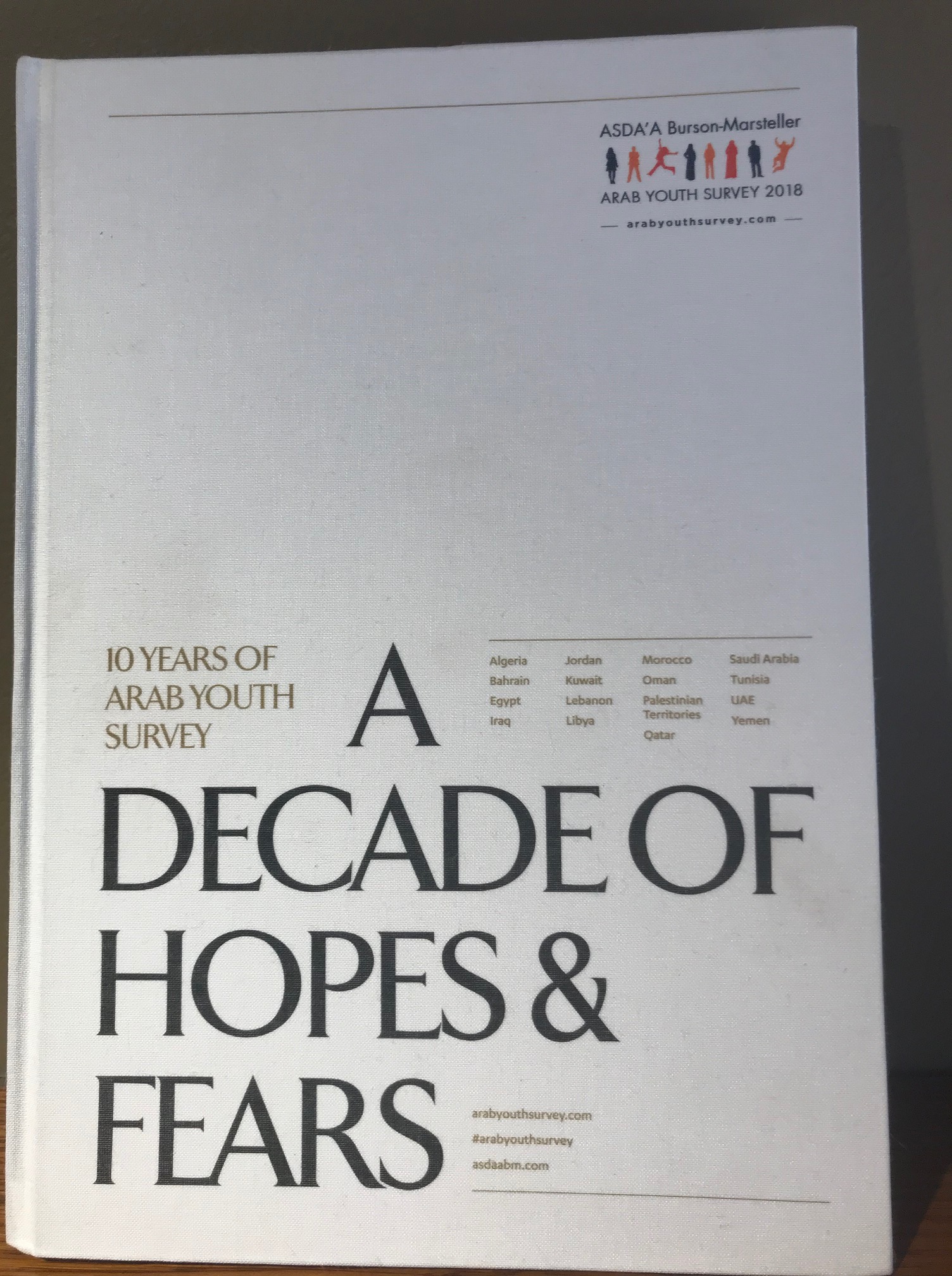
Taking Sides – Questions on and about the Arab Youth Survey

This year’s survey raised a host of questions about not just Arab youth, but whether PR agencies should become part of political disputes in the region

There’s so much which is good about communications in the Middle East – there’s the fast-paced environment, the ability to work across cultures, and an increasing awareness among management that comms matters. However, one area of weakness has always been a paucity of data, which means we’re often left wondering what our audiences are doing and thinking.

Now running for 11 years, the Arab Youth Survey was an initiative by Dubai-headquartered ASDA’A BCW to better understand the largest demographic across the Middle East. The idea was simple – ask people under 30 about their hopes, fears and aspirations. The results of the research could be used to shape government policy, create insights for the private sector and more…

The Methodology

For me, there were two big issues from the survey. The first was who was actually in the survey. For the first time, Qatar was not included. There was no explanation that I’ve seen as to why this happened – given that there’s few issues in traveling to and accessing the country, I can only assume that this was a political decision given everything that has happened between Qatar and the four Arab countries which are in dispute with the country. ASDA’A BCW is headquartered in Dubai, and has substantial business in countries which are in dispute with Qatar. The question I have is this – did ASDA’A BCW not include Qatar for business reasons, or was ASDA’A BCW not allowed to undertake the survey in Qatar by the government (there’s a host of permissions needed to undertake research in many countries across the MENA region). I’ll come back to this issue later on.

They’re not the only questions I have on the issue of how the survey was conducted. My jaw dropped when looking at Yemen; supposedly 50 people were surveyed in Ta’izz and 50 people in Al Hodaydah. How this was possible given both are war zones is beyond me, especially as Syria was excluded also (my assumption is Syria wasn’t included due to the physical risk of undertaking any survey there outside of Damascus).

The other questions I have, I’ve raised before. There’s no description of how the questions were asked (were they structured, semi-structured etc… and who was asking them as well). It goes without saying that this research, presented as is, wouldn’t make it through a single academic peer review. The more transparency there is when it comes to research, the more trust there’ll be in the fairness of the research and the actual findings.

The Insights

This year’s research revealed a number of big insights. One was media consumption.

It may be unsurprising that most young Arabs get their news from social media. What’s not clear is what the actual sources are for their news. I’m going to state this very simply for all those, including media, who simply reshared this insight – social media is a platform, a channel. Facebook doesn’t magically create news. What I’d like to know, and what wasn’t answered, was which are the most popular sources for news on these social platforms. Are they looking to traditional media with digital platforms, digital-only media, or other media outlets (even fake ones). This wasn’t asked, and this was a huge miss as far as I’m concerned.

The other big insight is the issue of religion. Based on the research, young Arabs believe that “religion plays too big of a role in the Middle East.” For me, the statement is too simple (binary choices often are, hence the need for focus groups and open-ended questioning). Why do they feel that this is the case, and what do they mean by reform? Seeing as nearly all the religious institutions are under the control of governments, is this an implied criticism of governments? It’s simply not clear how best to interpret this data apart from they want change.

There’s a host of other insights, such as the youth wanting regional conflicts to end, the demand of the Gulf’s youth that governments continue to subsidize their lifestyles, and how these people are driving e-commerce (that shouldn’t be surprising, given they’re the majority of the population. I was very pleased to see a section on mental health, a topic which has long been a taboo, as well as the impact of drugs, and perceptions towards the quality of education (this is an area which needs drastic reform).

The Issue of Balance

I want to come back to the issue of excluding Qatar, as this is what concerns me the most. For me, communicators are problem-solvers. They are also people who should bring different groups together. By being seen to take sides, we stop being seen as fair and trusted. I keep hearing from regional leaders on the client and agency side about the need to speak truth to power, and the importance of transparency. It’s often harder to see these concepts being put into practice.

What I’m saying is possible to do. I work in the business world, and our aim is to serve our consumers, no matter who they are. We don’t allow politics to get in the way. Once your objectivity is questioned, it’s hard to believe what you say. And, we are the builders of reputations. I hope to see ASDA’A BCW giving a voice to every Arab country next year in the 2020 edition of the Arab Youth Survey. That’s my definition of leadership in the communications space, and that’s what we need more of in the region.

You can read more about the survey here.

Update: I’ve been told that permissions were not given to conduct the research in Doha, based on a response at the press conference. If this is true, it may reflect a drop in trust/a belief that an agency in Dubai can’t be fair towards Doha. Honestly, I don’t know which sentiment worries me more.