Unknown's avatar

About alexofarabia

I'm am obsessive compulsive communicator who has lived in the Gulf for almost a decade. Enjoying the challenge of working in a region where you've got to be innovative, patient and determined to make things happen. Miss being a full-time journalist! Miss family even more! Sometimes I mouth off, but more often I grit my teeth and try to encourage change through a smile (not as easy as you think). Despite now living in Dubai Bahrain is home for me.

Snapchat and its attempts to win over the Middle East – #Mecca_Live and #WestBankLive

There’s two types of people in today’s digital world. Those internet users who are generally older who have never heard of Snapchat and who while away their hours on Facebook, and, when they’re feeling adventurous, get onto Instagram. And then there are those young people who can’t get enough of the video messaging app where photos and video shorts ‘disappear’ after being shared. For the half that doesn’t know, Snapchat would seem to be the fastest growing application in the Gulf. The application has proved incredibly popular with young audiences across the region.

Snapchat has also done itself a lot of good over the past couple of days by holding what it calls a live story event in Mecca, the spiritual home of Islam. According to Snapchat, Live Stories are a curated stream of user submitted Snaps from various locations and events. Users who have their location services on at the same event location will be given the option to contribute Snaps (videos to you and me) to the Live Story. The end result is a Story told from a community perspective with lots of different points view.

What this means in real English is that Snapchat curates lots of content from different users, brings that content together and combines it to tell a story. This week’s Live Story, which is usually 300 seconds long, took place in Mecca during the holy month of Ramadan. The ensuring Live Story of #Mecca_Live can be seen below.

The feedback for the #Mecca_Live event was nothing short of remarkable. By tapping into sentiment around Ramadan and telling the story of what it means to be in Mecca during the holiest month in the Islamic calendar through people who were there resonated not just with Muslims around the world, many of whom are tired of seeing their faith being associated with negativity, but also non-Muslims who were impressed by the faith and the devotion of those who were featured in the Live Story.

A sample of tweets around the #Mecca_Live hashtag

A sample of tweets around the #Mecca_Live hashtag

This isn’t the first Live Story in the Middle East however. The week before, Snapchat had curated a Live Story from the West Bank. Featuring Snaps from Palestinians, the piece aimed to tell the story of how ordinary people live in this beautiful part of the world. Palestinians gave glimpses into the cities of Bethlehem, Ramallah, and Nablus through 10-second tours of historic sites. They also talked about the wonderful world of Palestinian cooking (including some of my favorite dishes such as knafeh, qatayef and falafel. However, one aspect of life in the West Bank was left out. The allegation made by many was that it underplayed the Israeli occupation. The video is below.

The other allegation made about #WestBankLive was that it was a clumsy attempt to undo some of the damage done by a previous Live Story, #TelAvivLive. Shown the same week as #WestBankLive, this Live Story painted a picture of Tel Aviv, that, to quote the Mondoweiss website:

In the Tel Aviv story, young Israelis were represented as fun-loving, beach-going, peace-promoting people – a far cry from their roles as the occupying soldiers their Palestinian counterparts in the West Bank see on a daily basis. The story also included little in the way of representation of marginalized members of Israeli society such as Palestinian citizens or African refugees. Images of the historic Palestinian port city of Jaffa, referred to in the story by its Hebrew name, were depicted in a way that +972 Magazine says “reproduces the urbicide of this once-thriving Palestinian city in favor of a narrative that ‘keeps the peace.’” In addition, a few of the snaps presented foods like felafel and shawarma as typical Israeli meals, without any reference to their Arab origin. Israelis seemed to be using the Snapchat story as a way to show off appropriated Palestinian culture and locales, claiming them as their own without a second thought.

As Snapchat has found with both #WestBankLive and #TelAvivLive there are few stories that can be shared which are not controversial. Each group has their viewpoint, and, by attempting to be as inclusive as possible through its Live Stories, Snapchat will inevitably offend. Has #Mecca_Live helped to negate criticism of Snapchat? Possibly. But you can be sure that this app, which is already extraordinarily popular among the region’s youth, will continue to cause controversy as it tells the Live Stories of Snapchat users who see reality through their particular viewpoints, and smartphones.
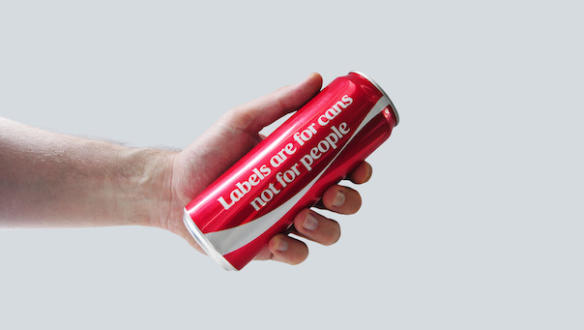

Coca-Cola, tackling prejudice & swapping television advertising for digital and CSR this Ramadan

Is Coca-Cola's anti-prejudice message a winner this Ramadan?

Is Coca-Cola’s anti-prejudice message a winner this Ramadan?

A global icon and the brand that defined Christmas has been making waves this Ramadan. Coca-Cola, which spent $3.3 billion on advertising globally in 2013, made a surprise announcement this Ramadan through its Egyptian subsidiary. Instead of spending sizable sums of money on television spots during Ramadan, which is the peak viewing season, the Egyptian operation would only spend money on paid digital spots on Facebook and YouTube. To quote from the company’s press release (please do excuse the hyperbole, the writer was probably on a sugar rush whilst penning this):

This festive season Coca Cola is giving back to the Egyptian community by replacing their always hotly-anticipated television ads with a unique campaign against prejudice rolling out exclusively on digital media. Their TV ad budget is instead being poured into their project of developing 100 villages. In recent days they have also galvanised Egypt’s digital population, pledging that for every post featuring a finger raised against prejudice (symbolising one extra second) they will donate one additional pound to their project.

While the idea of saving advertising money by pulling television ads and using that budget to spend on CSR is different to say the least, especially for a household brand such as Coca-Cola (and, which, in any case isn’t true as Coca-Cola has spent heavily on pan-Arab television advertising), the notion of tackling prejudice is an interesting angle for Coca-Cola to take.

Coca-Cola has launched a number of video shorts for YouTube and Facebook about prejudice, with the key tag line that we should look beyond the seven seconds it takes to form an opinion about others. Have a look at the below (unfortunately, they’re only in Arabic).

Coca-Cola Middle East is taking a similar approach to its Ramadan messaging, by promoting a world without labels through abandoning its own labeling.

To quote from Coca-Cola’s own website:

“A limited-edition run of red Coca-Cola cans features the brand’s white dynamic ribbon, but not its signature scripted logo. The backs of the cans include the anti-prejudice, pro-tolerance message: “Labels are for cans, not people.”

“Coca-Cola Middle East also released a video documenting a unique social experiment that highlights stereotyping in society. The short film shows how Coke invited six strangers to an iftar – the nightly fast-breaking meal during the holy month of Ramadan, which runs through July 17 – in the dark. The guests conversed without forming prejudices about their fellow diners based on physical appearance.”

Coca-Cola’s approach to Ramadan has been both welcomed as well as questioned. Dubai-based public relations professional and blogger Alexander McNabb posted a list of hilarious thoughts which he shared with Coca-Cola’s media agency about the announcement. Go have a read, and let me know what you think about what Coca-Cola is doing this Ramadan.

How the World’s Media was Pranked by Paris Hilton, Ramez Galal and that Plane Crash Stunt

Was Paris in on the prank? Or did she have no idea what was going on?

Was Paris in on the prank? Or did she have no idea what was going on?

If you’ve been catching some television in between fasting, praying, breaking the fast, and trying to work during the holy month of Ramadan, you may have come across a series on MBC One channel called Ramez Wakel Al Jaw (quite literally Ramez eats the air). The idea behind the show is simple – take up a celebrity in a scenic flight above Dubai, pretend that the plane is going down, and film the ensuing chaos. Each show, which is aired on a daily basis, would feature a different celebrity.

The big draw for the show, which is only being aired during Ramadan (which is essentially the prime time for TV viewership in the Middle East), was Paris Hilton, the hotel chain heiress and Hollywood socialite. Paris was the only non-Arab celebrity to be featured on the show, and she was used extensively in the ad campaign leading up to the show’s launch (in fact, she was the only celebrity to be featured in the aforementioned ads).

Now, we come to the Paris episode itself. To quote from the UAE’s English-language The National:

It began last Sunday when Hilton’s episode was broadcast as part of Galal’s latest MBC ­comedy series.

The set-up involved the stars boarding a light plane for a leisurely, aerial tour over the emirate, only for the situation to escalate — or should we say, descend — into terror: the aircraft suddenly nosedived after a simulated technical failure. The video clip, which went viral after it was uploaded on YouTube, shows Hilton getting anxious, then panicking as skydivers masquerading as passengers open the cabin door and leap out.

Only after the plane returned to the ground was the celebrity told the truth. Taking it surprisingly well, a shaky Hilton goes on to praise Galal for “taking it to the next level. I have seen Punk’d [American prank reality show hosted by Ashton Kutcher] but you have taken me on a plane and nearly killed me”.

For a more visual explanation, CNN’s report sums up the story wonderfully.

Paris’ response to the episode being aired was swift. She intended to sue, according to TMZ.com which broke the news.

Paris Hilton is telling business associates … she will sue the people responsible for putting her on a plane that appeared to be in crash mode … just to get a rise out of her.

We’re told Paris is furious over the stunt … in which a TV crew got the pilot to pretend to shut down the engines in her plane, and then nose-dive to the ground. Paris says she was in mortal fear for her life … something the video pretty clearly shows.

Our sources say she’s “totally freaked out” over flying anywhere … something she’s required to constantly do. She’s already called her lawyers to find out who’s responsible, and they told her she has a solid case for emotional distress.

Paris tells them she had absolutely no clue this was a prank … she wasn’t in on it. She also doesn’t believe anyone in her camp was involved.

The episode and the reaction of Paris to sue Ramez Galal made headlines the world over, despite no one outside of the region having heard of the show. The idea of a global celebrity having been pranked in such an abhorrent stunt with her life seemingly at risk was enough to garner hundreds of pages worth of media attention.

But if we step back a moment, let’s talk through what happened and why this was obviously planned from the get-go:

1) The timings – the show was pre-shot; in other words, it wasn’t live. Paris was used extensively to promote the show, and one would have thought that Paris would have looked to sue immediately after her episode was shot several weeks before Ramadan. This wasn’t the case.
2) The payment – no celebrity worth their salt does anything for free, and Paris is no different. If you want her, you have to pay. If TMZ.com is to be believed, Paris was apparently paid over a million dollars to take part in the stunt. She’d have known beforehand what was going to happen. Nevertheless, she pulls off the acting (unlike in her movie roles).
3) The publicity – both Paris and Ramez benefited from the media coverage of the show. Paris comes off as someone we can feel for and empathize with, which isn’t usually the case. And Ramez gets global coverage for the show which boosts the ratings, and for himself. The threat to sue amplifies the media coverage.

The question is, who got scammed? Paris, the viewers or the media? No matter what, everyone seems to have been entertained.

In the irony of ironies, a SkyDive Dubai plane crash-landed in the desert this week. The incident, which closely resembled the prank scenario, was widely reported by the media.

This emergency landing wasn’t a prank…

Whilst there were fortunately no injuries, none of the media made the connection between Ramez Galal and his show, which is based at SkyDive Dubai’s site, and the plane coming down in a similar scenario. It’s just as well for Ramez – one lawsuit is more than enough this Ramadan. But you tell me, is life imitating art, or is art imitating life?

The Hulk, Cairo Living and a Mountain View – The Unique World of Egyptian Advertising

Anyone who has experienced life in Cairo will be able to understand this copy

Anyone who has experienced life in Cairo will be able to understand this copy

To me, Egyptian advertising is like Marmite. I either love it or hate it. To most of us raised in the region who used to watch lots of Arabic TV, we’ll often know where a commercial is conceptualized and produced. The accents obviously play a part, but it’s more about the humor being used and how the actors communicate with each other.

Recently, I came across one advert which had me in stitches. For anyone who has ever lived in Cairo and who has experienced the trials and tribulations of getting anything done in the city which is nicknamed the mother of the world will understand the point behind these adverts. Mind you, I doubt that they got licensing from Marvel to use the Hulk character in the ads.

There’s not just one advert by this company (what they do and the implied benefits are obvious at the end of the adverts), but a series of different copies which all run on the same theme which were developed for last Ramadan. They’ve recently been airing on MBC. Watch, enjoy and let me know if it passes your Marmite test.

Has Social Media Overtaken the News Cycle? The Story of the Kuwait Mosque Bombing

Last Friday was one of bloodshed and horror in Kuwait. The country, which has not been affected by regional sectarian issues in the same manner as its neighbours Iraq and Saudi Arabia, experienced something truly terrible. During Friday prayers, when men gather to pray together in the mosque, a suicide bomber entered one such mosque with the intent to kill as many of those inside as possible. To date, twenty seven people inside the Imam Sadiq Mosque, a place of worship for Shia Muslims. Two hundred people were injured.

Apart from the horror of this atrocity, which Islamic State claimed responsibility for, what is telling is the speed and amount of information which spread via social media, particularly WhatsApp, in the Gulf.

I was receiving messages about the bombing two hours before the news had made it onto websites such as Al Jazeera English. Not only was the information written down, but people were sharing both images and video thanks to the proliferation of smartphones as well as the availability of high-speed mobile data services.

Below is just a selection of the images that I received on that day.

What’s fascinating is not just the speed of information, but also the accuracy of that information. When Al Jazeera Arabic made a mistake with the name and picture of the suspected bomber an image was shared on social media of the correct suspect.

In addition, the amount of information was remarkable. While global networks provided a couple of minutes of coverage about the bombing, the images and video shared via Whatsapp built up a comprehensive picture of the incident, including video footage of the scene as well as interviews with witnesses and survivors. Unlike the news networks, many of whom don’t have correspondents in Kuwait, this was amazing, in-depth reportage of the Imam Sadiq bombing. Just two of the videos I received are below.

What was missing from all of this was context. On the same day there were terrorist incidents in both Tunisia and France, one of which was claimed by ISIS. Due to the local interest in Kuwait on my Whatsapp channels, no news on these two events was shared. This was a different story on the news networks where the three stories came together into one coherent piece on ISIS and its aim to spread terror across the Middle East and Europe.

Is the Imam Sadiq mosque bombing an example of citizen journalism working at its best in the Gulf? If so, how can media outlets catch up to ensure they have access to this information at the same time as its distribution through both private messaging networks such as WhatsApp as well as open platforms such as Instagram and Twitter? Twitter is looking to bring in a head of media partnerships for the MENA region, to work with publishers. It’ll be interesting to see how this and other efforts to get news outlets to work through social media impacts their ability to tell the story accurately in real time.

On a final note, my thoughts are with those who experienced this terrible incident. May all of those who were injured make a speedy recovery, and those who died always be remembered.

A hijab, bacon and McDonalds’ breakfasts – the wonderful world of Ramadan advertising

Ramadan is a wonderful month, a time of spirituality for the world’s Muslims. It’s also the time of year when the advertising rules change as Muslims fast during the daylight hours and look to spend their nights either with family or in prayer.

In keeping with reaching out to Muslims, advertisers need to be ever-aware of religious sensitivities. Brands often feel the need to make a change to their ads. One such change, which was spotted by Dubai-based communications professional Mohammed Kharroubi (Twitter handle @mkdubai), involved the retailer Carrefour. Spot the change below.

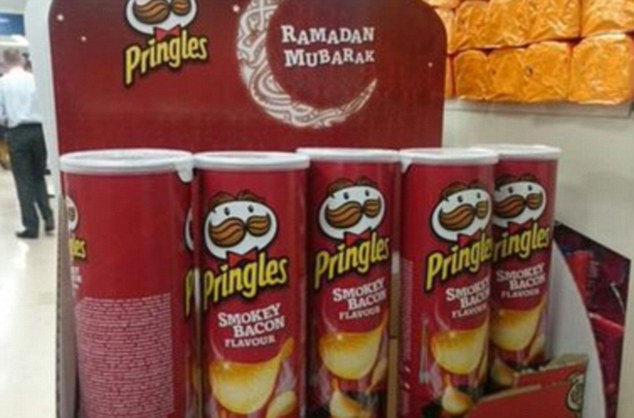
Brands sometimes get things horrendously wrong. Another retailer, the UK retailer Tesco, made a huge faux-pas, when they promoted smokey bacon-flavor Pringles as part of a Ramadan promotion. For those who don’t know, any pork-related products are considered haraam in Islam and are not consumed by Muslims. The below image went viral and has resulted in masses of media coverage in the UK.

Tesco has been pilloried on social media for selling smokey bacon-flavoured Pringles as part of a Ramadan promotion

Tesco has been pilloried on social media for selling smokey bacon-flavoured Pringles as part of a Ramadan promotion

And then, there’s the bizarre. According to Dubai-based marketing consultant Hussein Dajani, McDonalds has been running advertising for its breakfasts this month on the radio on Dubai. Unfortunately, Muslims fast during the day, and most of the McDonalds restaurants serving breakfast will be closed.

With Ramadan, it really does seem that while some brands are able to adapt and thrive, others need to do their homework. What are your thoughts? And do you have your own examples of successful and unsuccessful Ramadan advertising?

First the Kama Sutra pictures, and then the 2022 GCC media resolution – what is happening to Qatar’s media scene?

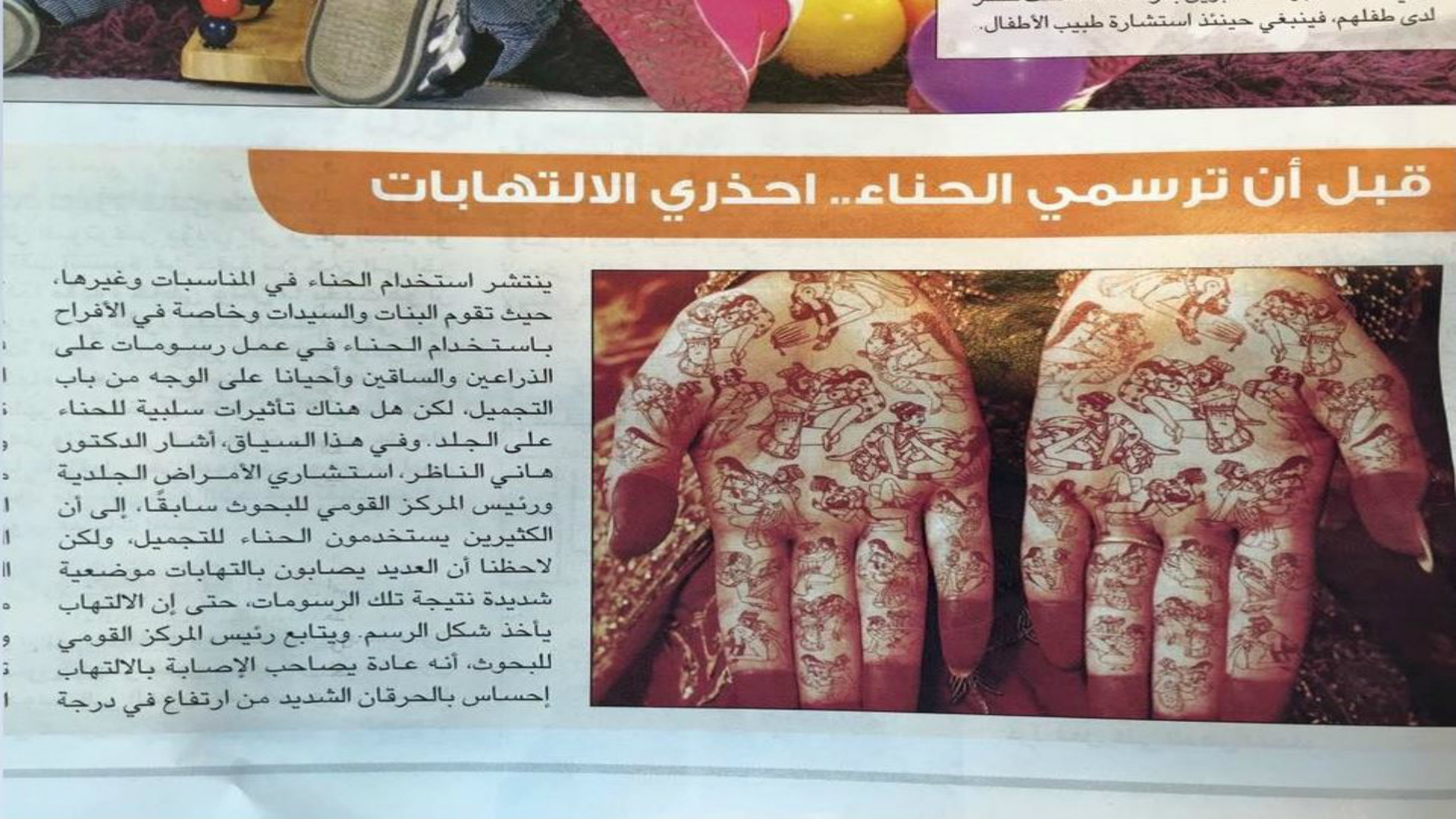
It’s not been the best of summers for Qatar’s media scene. First, there was a slip at the Arabic-language daily Al-Sharq. It wasn’t so much a slip-up as a huge !@#$-up. The paper’s long-time editor-in-chief Jaber Al Harmi was forced to resign after the publication of a photograph depicting sex scenes from the Kama Sutra. The story was best told by the Associated Press. But before that, the offending image is below.

Al Sharq's choice of imagery  for henna tattoos really couldn't have been worse. But where did they find the image?

Al Sharq’s choice of imagery for henna tattoos really couldn’t have been worse. But where did they find the image?

The image showed the woman’s palms decorated in numerous tiny tattoos showing a couple engaged in sexual intercourse.

Harmi took to the paper’s website to describe the incident as “a completely unintended mistake” and the “worst” he had known in his 25-year career in journalism and said he took full responsibility for what happened.

He said he “offered my resignation out of moral responsibility”.

It is not yet known if the resignation has been accepted by the paper’s bosses.

“All apologies are not enough for such a serious mistake, which occurred by publishing morally inappropriate images,” wrote Harmi.

“Our values and principles provide a red line that cannot be breached and so I presented my resignation to the board.”

He added: “This tragic incident revealed to us the extent of the adherence of our community to religion, values and morals.”

On Twitter, he wrote that “all those behind this mistake” have been fired.

But it got better. Following on from the unfolding crisis at FIFA, Qatar has been looking to tackle the corruption allegations surrounding its winning of the 2022 World Cup. As part of this plan, Qatar lobbied the Gulf to request media support. What they got was a call by the Gulf’s governments for all regional media to support Qatar. More from the Doha News website.

In an effort to “counter” media criticism of Qatar’s preparations for the 2022 World Cup, the GCC is calling on journalists in the Gulf to publish stories that support the country’s right to host the international football tournament.

The directive was released following a meeting of GCC information ministers in Doha this week. In a joint statement carried by state news agency QNA late last night, they said:

“GCC information ministers renewed their call for the media to counter all those who seek to question the right of the State of Qatar to host the 2022 World Cup, stressing GCC states full solidarity with the State of Qatar and encouraged media in the GCC to continue countering these campaigns at home and abroad.”

As we say, the media should report the news and not make the news. However, with all that is happening in Qatar, expect more media machinations soon.

Will Etihad’s use of Twitter for Premium customer communications take off?

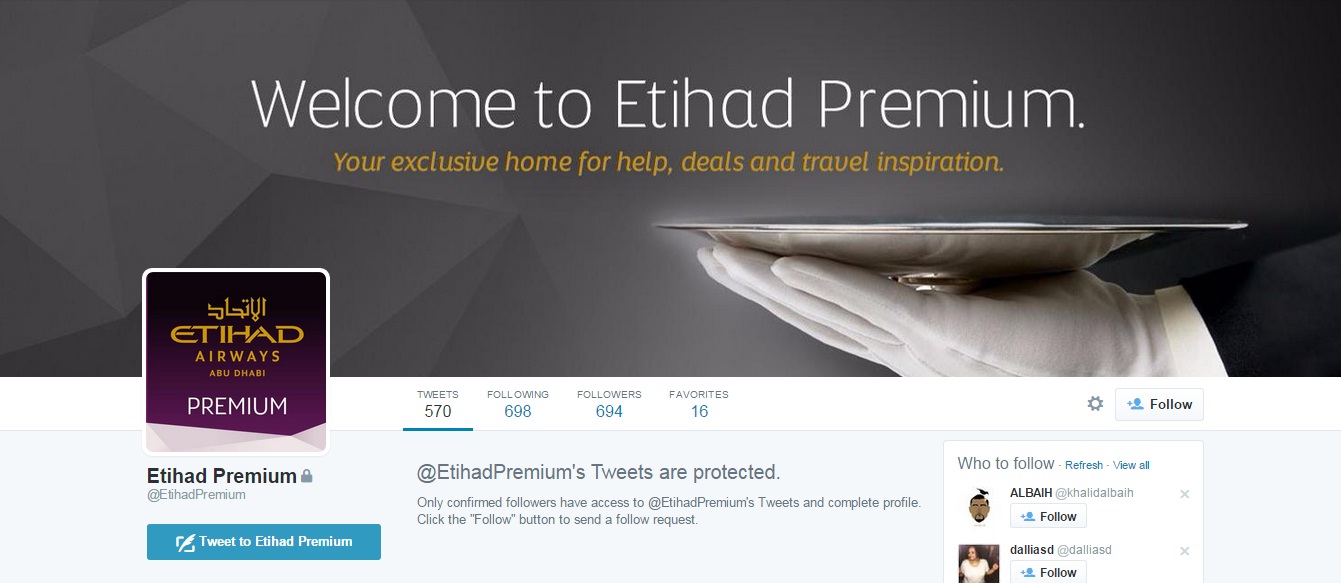
Etihad's Premium Twitter account is an exclusive account just for Etihad's Gold customers. Is Twitter the right channel for reaching out to premium customers however?

Etihad’s Premium Twitter account is an exclusive account just for Etihad’s Gold customers. Is Twitter the right channel for reaching out to premium customers however?

Excuse the pun in the title, but Etihad caught my eye this week with the news that it has set up a new Twitter account to communicate exclusively with Etihad Guest Gold members. The account, named @EtihadPremium, was launched at the beginning of May and Etihad Guest Gold members, Etihad customers who have flown 50,000 tier miles or 40 tier segments in one 12 month period, received emails on the new service. Below is the text of the email that Etihad sent out to its Etihad Guest Gold members over a month ago (courtesy of www.flyertalk.com).

We’ve launched a Twitter Channel to better serve you! We value your loyalty and have created a new channel that delivers a range of benefits with you, our guest, in mind.

Etihad Guest Gold members can now follow us on http://www.twitter.com/EtihadPremium and enjoy the following exclusive benefits:

Five minute response times
Dedicated service
Retro mileage claims
Exclusive deals

To sign up, please:

Email us at socialmedia@etihad.ae with: a photocopy of your Etihad Guest Card, Date of Birth, Post Code, Twitter Handle.
Please allow 24 hours for review and verification.
Post-verification, our team will follow you on Twitter and send a confirmation email.
Follow us back at http://www.twitter.com/EtihadPremium

The choice of Twitter has sparked some debate online. Hussein Dajani, a UAE-based social media commentator, listed on his LinkedIn profile some of the reasons why he thought Etihad’s use of Twitter didn’t make sense.

1- Etihad already has many existing Twitter accounts (Etihad Airways, Etihad Deals, Etihad Help, etc). Do people (Premium or not) really need one more account to follow?
2- Most of the “Premium” users are high profile people, how many of those are actually on Twitter or would use Twitter when having an inquiry or a complaint?
3- Will Etihad block a person if he / she no longer remains as a Premium customer?
4- How is Etihad being transparent and “fair” to all its customers when treating them differently?
5- Can’t Etihad identify who are its Premium customers from non Premium customers and get their Twitter handles?

Etihad’s social media lead Asif Khan shared his opinion as well. According to Asif, the reasons why Etihad went with Twitter for this concept were the customers themselves.

Etihad has public Twitter accounts and pretty tight SLAs for them – all users (Premium and non-Premium). This is an additional Twitter account for Premium members because there was massive demand – we have done proper research and tried to fulfill appetite – not just another channel launch. You’d be surprised to know how many Premium inquiries we receive. It’s just having a unique key number of managing first class and business class guests on a contact centre – different is its a Twitter account.

Just to clarify, this is an additional channel for communication with our high-valued guests – not the ONLY channel. There are other traditional channels that are being used – dedicated contact centre number, email address, etc. etc. Not sure if I entirely agree with your one-many concept because end of the day we’re not broadcasting information on this channel (one-many) because the intent is to have meaningful personalised conversation with each premium customer with contextual information available to us.

With premium customers, personalization is key. They want a one-to-one conversation, and they want the best possible support. Talking to a Facebook executive recently, she told me that Whatsapp was the sleeping giant of the Middle East’s digital sector. Back in March, Whatsapp was named the region’s most popular means of online communication by a survey commissioned by the Dubai Government.

But let’s go further. Whatsapp is one-to-one communication, through which one can share images, video, and recorded audio messages (we can’t use Whatsapp Call in the UAE as it’s blocked on a national level). Whatsapp can also share the user’s location or a contact, and its secure. Unlike a Twitter handle, I can’t communicate with another Whatsapp user unless I know their mobile number – and, let’s face it, how many premium customers will be flying around the world without a mobile?

The other concern I have is about Twitter and its security. What will Etihad do if the Twitter account is hacked? How can it safeguard the information of these premium customers?

The response to Etihad’s initiative has been mixed on travel websites such as OneMileAtATime and FlyerTalk, with some premium passengers praising the move, others saying they don’t have a Twitter account, and some going so far as to say that Etihad needs to improve its overall customer service levels available through its existing social media accounts.

I’d be fascinated to see how this works for Etihad. The initiative is bold, but with the choice of communications being Twitter will it work as Etihad hopes?

A McLaren and Bentley for the masses in the UAE? Should luxury go mainstream?

The beauty about luxury is that it isn’t for everyone. Luxury is exclusive, it’s a statement of position. Luxury isn’t about function but form and beauty. Luxury automotives can cost more than a decent-sized house, and when you consider that the likes of Rolls-Royce only sold 3,630 cars in 2013 (which was a record year for them fyi), then one gets to truly understand how exclusive luxury is.

So imagine my surprise when I saw a couple of weeks ago adverts for Bentley with copy that read a Flying Spur could be mine for only AED11,514.00 per month – that’s about US$3,000). Few people would be able to afford a car worth about US$200,000 when new. While the payment option, spread over several years, makes sense financially, what harm does it do to the brand for those wealthy enough not to need financing? Would they want to see the car driven by the masses?

What does this sort of offer do to a brand such as Bentley? Does it help or harm the brand in the eyes of Bentley's original target audience?

What does this sort of offer do to a brand such as Bentley? Does it help or harm the brand in the eyes of Bentley’s original target audience?

It gets better. The same dealer in the UAE who sells Bentley also has the rights to McLaren. And what do you do with a supercar which costs over US$220,000? You offer it on installment at AED9,300 a month.

Do you have a spare 10,000 Dirhams to spare a month? Why not buy a McLaren supercar?

Do you have a spare 10,000 Dirhams to spare a month? Why not buy a McLaren supercar?

While brands nee to make money to survive and grow, what is the reputational cost and the impact on brand equity of such offers which change both a product’s positioning as well as its target audience? What are your thoughts? Is this a creative, original idea to build a brand? Or does it do more harm than good?

Arab News, Molouk Ba-Isa, the Axact scandal and how the Arab media lost a world exclusive in 2009

Molouk Ba-Isa broke the Axact story five years before the New York Times. And then her story was pulled by the management of Arab News two weeks after it was published (image source: Saudi Gazette)

Molouk Ba-Isa broke the Axact story five years before the New York Times. And then her story was pulled by the management of Arab News two weeks after it was published (image source: Saudi Gazette)

While there’s plenty of media titles in the Middle East region – by all accounts the Gulf is the one part of the world where print is still making a profit – there’s few occasions I can remember where the region has had a world exclusive.

There’s always an exception to the rule, and unsurprisingly the person who has been in the limelight recently is a Saudi-based journalist called Molouk Ba-Isa. For those who know her, Molouk is a no-nonsense reporter who often tackles items of interest to her readers and who produces original news rather than copying and pasting news releases.

Molouk’s name was mentioned in the New York Times, as the journalist who first broke the Axact fake diploma scandal. To quote from the first piece the New York Times wrote on the story, in which it broke news of the scandal:

Heavy scrutiny by investigators, politicians and the fractious Pakistani media sector has mounted over the past week for Axact, a Karachi-based software company that has made millions selling fake degrees through a sprawling empire of school websites.

Axact, which has its headquarters in Karachi, Pakistan, ostensibly operates as a software company. Axact runs hundreds of websites, many of which purport to be online universities and high schools based in the United States.

Axact has thrived for more than a decade on its ability to hide links between its operation in Karachi and hundreds of fictitious online schools, many of them claiming to be American. But more such links are coming to light in the days since The New York Times published a detailed account of the company’s operations.

The Axact story wasn’t broken by the New York Times, but rather by Molouk Ba-Isa, who was writing for the Arab News back in 2009. Again, to quote from the New York Times:

For years, former employees said, Axact’s diploma certificates were shipped to customers across the globe through a courier service in Dubai, to give the impression of being based in that city’s free trade zone. But that facade nearly collapsed in 2009, when a technology journalist from Saudi Arabia started looking more closely.

The journalist, Molouk Ba-Isa, was following up on a report that Rochville University had awarded a master’s in business administration to an American pug named Chester. Although Rochville’s physical location was a mystery, Ms. Ba-Isa learned from a courier company official in Dubai that the degree originated from Axact’s office in Karachi.

But when The Arab News published her report, naming Axact, she said her editors received a strongly worded legal threat from company lawyers, and the article was removed from the Internet. This week, Ms. Ba-Isa said in an email that she felt vindicated.

In her weekly article for the Saudi Gazette, Molouk wrote about her Axact story which was published both in print and, even more importantly for a company which sells degrees via the internet, online.

On October 7, 2009, I received an email from Abdul Karim Khan & Company with a subject line “Cease and Desist.” The email was sent from akkc2005@yahoo.com, copied to legal@axact.com.

Abdul Karim Khan & Company, claimed to be “Advocates, Attorneys and Legal Consultants,” located at Suite No. 1108, 11th Floor, Kashif Centre, Sharah-e-Faisal, Karachi.

The email stated that the lawyers represented Axact (Pvt.) Ltd and they were putting forward a Cease and Desist Letter authored by Fahim ul Karim.

The letter demanded that the article published on October 6 be removed from arabnews.com or prosecution would proceed. Arab News was also included and threatened in the Cease and Desist Letter.

Immediately, I was asked by senior Arab News staff to provide evidence for all allegations in my report. I turned over my notes and the taped interview with Vicky Phillips, the founder of GetEducated.com, whose dog had been awarded the degree.

I provided telephone numbers for the shippers in Dubai and images of the shipping label. Within a week of the first email, the legal documents arrived from Pakistan to Jeddah by courier.

Once the article had been up on the website for two weeks, senior management at the newspaper made the decision to take the report down to stop any lawsuit.

However, no apology was issued and my report was never retracted. I continued to dig for information about Axact’s illegal activities.

While Molouk should be praised for her pioneering work, why didn’t the management at Arab News and its publisher defend her reporting and keep it online? Did they really fear a court case? Do they bear responsibility for those who have been defrauded by Axact in the five years since that initial piece was published by Molouk? And what does this say about investigative journalist in the Middle East?

A global scoop which never was… Molouk, you did a fantastic job. If only our publishers are as brave as our journalists, maybe this piece would have had a different ending. Ultimately, I’ll leave the last word to Molouk.

My thanks go out to all those who have helped to publicize Axact’s alleged malfeasance. Keep up the good work.