Will Etihad’s use of Twitter for Premium customer communications take off?

Etihad's Premium Twitter account is an exclusive account just for Etihad's Gold customers. Is Twitter the right channel for reaching out to premium customers however?

Etihad’s Premium Twitter account is an exclusive account just for Etihad’s Gold customers. Is Twitter the right channel for reaching out to premium customers however?

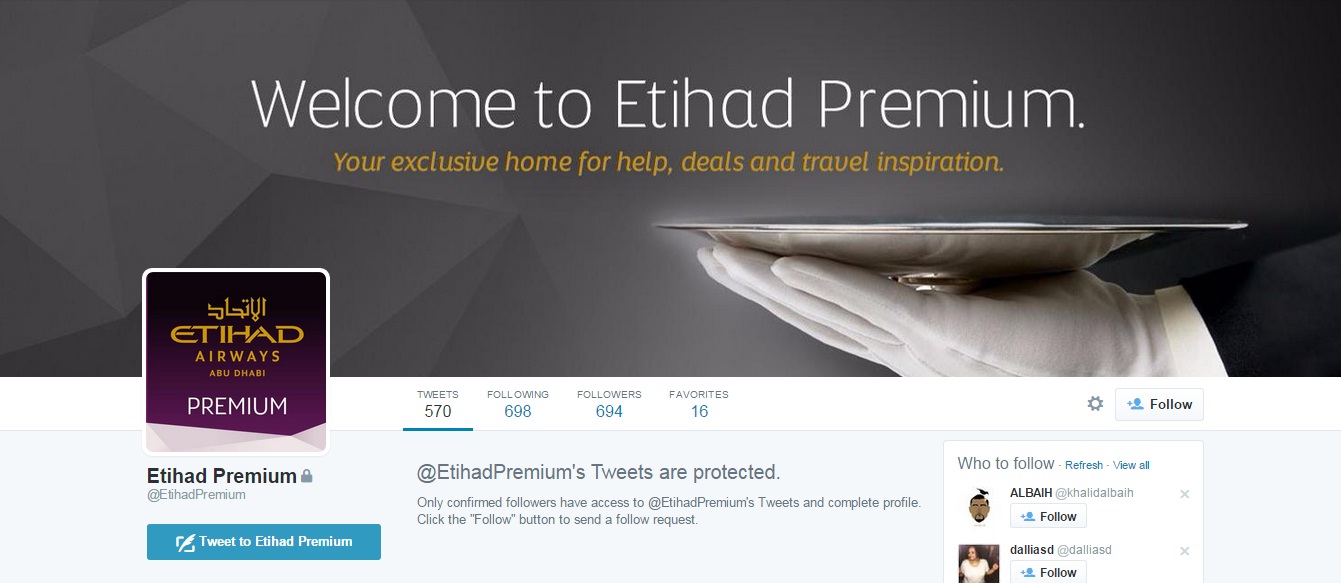
Excuse the pun in the title, but Etihad caught my eye this week with the news that it has set up a new Twitter account to communicate exclusively with Etihad Guest Gold members. The account, named @EtihadPremium, was launched at the beginning of May and Etihad Guest Gold members, Etihad customers who have flown 50,000 tier miles or 40 tier segments in one 12 month period, received emails on the new service. Below is the text of the email that Etihad sent out to its Etihad Guest Gold members over a month ago (courtesy of www.flyertalk.com).

We’ve launched a Twitter Channel to better serve you! We value your loyalty and have created a new channel that delivers a range of benefits with you, our guest, in mind.

Etihad Guest Gold members can now follow us on http://www.twitter.com/EtihadPremium and enjoy the following exclusive benefits:

Five minute response times
Dedicated service
Retro mileage claims
Exclusive deals

To sign up, please:

Email us at socialmedia@etihad.ae with: a photocopy of your Etihad Guest Card, Date of Birth, Post Code, Twitter Handle.
Please allow 24 hours for review and verification.
Post-verification, our team will follow you on Twitter and send a confirmation email.
Follow us back at http://www.twitter.com/EtihadPremium

The choice of Twitter has sparked some debate online. Hussein Dajani, a UAE-based social media commentator, listed on his LinkedIn profile some of the reasons why he thought Etihad’s use of Twitter didn’t make sense.

1- Etihad already has many existing Twitter accounts (Etihad Airways, Etihad Deals, Etihad Help, etc). Do people (Premium or not) really need one more account to follow?
2- Most of the “Premium” users are high profile people, how many of those are actually on Twitter or would use Twitter when having an inquiry or a complaint?
3- Will Etihad block a person if he / she no longer remains as a Premium customer?
4- How is Etihad being transparent and “fair” to all its customers when treating them differently?
5- Can’t Etihad identify who are its Premium customers from non Premium customers and get their Twitter handles?

Etihad’s social media lead Asif Khan shared his opinion as well. According to Asif, the reasons why Etihad went with Twitter for this concept were the customers themselves.

Etihad has public Twitter accounts and pretty tight SLAs for them – all users (Premium and non-Premium). This is an additional Twitter account for Premium members because there was massive demand – we have done proper research and tried to fulfill appetite – not just another channel launch. You’d be surprised to know how many Premium inquiries we receive. It’s just having a unique key number of managing first class and business class guests on a contact centre – different is its a Twitter account.

Just to clarify, this is an additional channel for communication with our high-valued guests – not the ONLY channel. There are other traditional channels that are being used – dedicated contact centre number, email address, etc. etc. Not sure if I entirely agree with your one-many concept because end of the day we’re not broadcasting information on this channel (one-many) because the intent is to have meaningful personalised conversation with each premium customer with contextual information available to us.

With premium customers, personalization is key. They want a one-to-one conversation, and they want the best possible support. Talking to a Facebook executive recently, she told me that Whatsapp was the sleeping giant of the Middle East’s digital sector. Back in March, Whatsapp was named the region’s most popular means of online communication by a survey commissioned by the Dubai Government.

But let’s go further. Whatsapp is one-to-one communication, through which one can share images, video, and recorded audio messages (we can’t use Whatsapp Call in the UAE as it’s blocked on a national level). Whatsapp can also share the user’s location or a contact, and its secure. Unlike a Twitter handle, I can’t communicate with another Whatsapp user unless I know their mobile number – and, let’s face it, how many premium customers will be flying around the world without a mobile?

The other concern I have is about Twitter and its security. What will Etihad do if the Twitter account is hacked? How can it safeguard the information of these premium customers?

The response to Etihad’s initiative has been mixed on travel websites such as OneMileAtATime and FlyerTalk, with some premium passengers praising the move, others saying they don’t have a Twitter account, and some going so far as to say that Etihad needs to improve its overall customer service levels available through its existing social media accounts.

I’d be fascinated to see how this works for Etihad. The initiative is bold, but with the choice of communications being Twitter will it work as Etihad hopes?
Do you want to know more about social media in the Middle East? Download the TNS ArabSMIS report here

Do you not know where to start when it comes to social media and the Middle East? This report may be your answer (image source: http://blue16media.com)

Do you not know where to start when it comes to social media and the Middle East? This report may be your answer (image source: http://blue16media.com)

We have our fair share of big events in Dubai and this week was no exception. The past two days has seen the Emirate become the place to be for social media influencers. Whilst we found ourselves invaded by all types of beautiful people (and others) waving their selfie sticks and pouting for the camera, there were some handy takeaways for an audience looking to learn more about how to use social media to build brands for themselves, their companies or their countries. Oh, and Twitter has finally decided to open an office in the MENA region, obviously in Dubai.

The most impressive part of the Arab Social Media Influencers Summit was the report. Coming in at a whopping sixty seven pages, the report by research house TNS covers a whole host of areas of social media interest across the MENA region. The study combines both qualitative research with a quantitative survey of more than 7200 users of social media spread evenly
across 18 Arab countries.

If you’re looking to know which channels are used across MENA, then look no further. The report includes stats on LinkedIn, Facebook, Twitter, Instagram, Whatsapp, Google+, and YouTube. It also includes social media usage habits, including time of use, duration of use and devices used. Most importantly, the report looks into attitudes about social media across the region and what people are doing online.

If you’re doing anything online in the MENA region, download this report and start dissecting. You can thank me later, on social media.

The ASMIS Social Media MENA Report

#Hajjselfie, Whatsapp and smartphones – how is technology changing Islam and Muslims?

We’re a funny bunch in how we can change so quickly and then justify how we’ve changed 180 degrees. I remember how up until ten years back, camera phones were banned in Saudi Arabia. And today, the hot topics are #Hajjselfie and how modern technology is making its mark on Saudi society.

The beginning of October was the timing for the annual Hajj pilgrimage, a mandatory religious duty for Muslims. During Hajj Muslims are to abstain from all temptations which may lead to sin; in essence, the pilgrimage is a time for renewal for the two million plus Muslims who take the rite of passage annually.

This year, one of the major stories which broke at Hajj was the #hajjselfie. You’ll probably know of the selfie, a self-portrait photograph, typically taken with a hand-held digital camera or camera phone and then shared online via social networking services. This year, the selfie was introduced en-mass to Hajj. To quote from Saudi Gazette and AFP.

Raising his arm, Yousef Ali hugs his elderly father near the Grand Mosque in Makkah as they grin for a selfie — a craze that has hit this year’s Haj. But not everyone is happy about young pilgrims from around the world constantly snapping “selfie”, photographs taken of one’s self, as they carry out Haj rights.

From Tawaf — circumambulating the Holy Kaaba — to prayers atop Mount Mercy in Arafat, and stoning of the “devil” in Mina, the key stages of Haj have all been recorded on cameras and smartphones for posterity, and for instant sharing through social media.

“As this is my first pilgrimage, it is important for me to document all the events taking place around me,” Ali, 24, told AFP, snapping a picture of himself with a green sign reading “Big Jamarah”, which refers to a wall where pilgrims ritually stone the Satan.

“Wherever I go, I take pictures, especially since nowadays we have these little cameras… that offer a full view of the area,” the bearded Kuwaiti said with a smile.

The increasingly popular phenomenon has sparked controversy among conservatives, however, with some taking to Twitter to criticize pilgrims who take selfies.

“When we went for Umrah in the mid-90s, Dad nearly had his camera confiscated to shouts of ‘haram!’ Now, #HajjSelfie is A Thing. What a world,” wrote one Tweeter.

Another user named Kahwaaa wrote: “It’s a time to connect to Allah and purify my soul. #hajjselfies selfies shouldn’t be taken.”

But others said the issue was being blown out of proportion.

“People creating a huge issue about #hajjselfies. If photos are allowed during Haj then what is wrong with selfies?,” asked Abdul Mufeez Shaheed.

Nothing at all, says Ali’s father Mohammed Ali, 65.

“A person taking such pictures is documenting a rare event”, a once-in-a-lifetime experience for many Muslims, he said, wearing a traditional white robe.

“This is a symbolic place representing history,” Mohammed Ali added, pointing to the three sites which pilgrims began stoning on Saturday at the start of the Eid Al-Adha feast of sacrifice, which is celebrated by Muslims worldwide.

Two women covered in traditional black abayas and veils hurried toward the Big Jamarah wall, but not without stopping for a quick self-portrait along the way.

“My daughter and I are taking selfies to show our Haj pictures to our family in Paris. It’s also a nice memento,” said one of the women, a Saudi pilgrim from Jeddah who gave her name only as Umm Abdallah, 44.

Her daughter Wafaa Ahmed, 19, said: “I love taking many selfies wherever I go to keep them for myself, as well as to show them to my friends and brothers.”

Speaking to AFP by telephone, a professor of Islamic Shariah law Riyadh said that “if photographs are only for personal memory and not for disseminating, then no problem.

“But if they were for the purpose of showing off, then they are prohibited, such as the photography that takes place at the (Haj) rites.”

The scholar requested anonymity.

“It is better for Muslims to avoid them,” he said of selfies.

For the teenage pilgrim Wafaa Ahmed, “this is not a convincing view” because taking selfies “has nothing to do with religion”.

The elderly pilgrim Mohammed Ali also discounts the scholar’s opinion.

He says the camera “is a tool such as mobiles, used even by religious scholars who have not prohibited them, so why prohibit another tool of the modern era?”

As he speaks, a group of young Saudi men gather for a group selfie in front of a Jamarah wall before they stone the “devil”.

Analytics of #Hajjselfie by Topsy. The trend peaked on October the 4th.

Analytics of #Hajjselfie by Topsy. The trend peaked on October the 4th.

The #hajjselfie wasn’t the only social media story coming out of Saudi Arabia this month. A recent piece in Saudi Gazette bemoaned the erosion of traditions surrounding the vacation among Saudi nationals.

“Take for instance the recent Haj holidays where it was common practice to visit relatives but several people did not do so,” said Omar Yousif Tobbal, a senior projects manager in a government firm.

He said that these occasions allow families to spend time together but people are increasingly resorting to calling or texting their relatives to extend their greetings instead of actually visiting them.

“If it hadn’t been for modern technology, families would meet, dress up and generally enjoy themselves,” he said, adding that before the advent of technology, Saudis had more time for each other and talked for hours on common themes of interest. However, there are some who still observe the occasion in accordance with tradition, he noted.

It’s not all for the worse however. One positive which came out of the combination of social media and Hajj this year was the appreciation show to the security teams who were working to ensure the safety of the two million pilgrims through the use of the hashtag #thanks_security_men. This time from Arab News.

Photos and videos of security officers from various military sectors assisting and providing services to pilgrims during the Haj season have been trending across social networking sites, such as Twitter. A number of religious leaders and media personnel have devoted their pages to discussing the positive role of security authorities in Saudi Arabia in the success of this year’s Haj season.

Active users on social networking sites produced various hashtags, notably #thanks_security_men, to express their gratitude and appreciation for their humanitarian efforts and positive representation of Saudi Arabia.

What are your thoughts on the above? Do you think #Hajjselfie is halal or haraam? Let me know your thoughts, especially if you were on Hajj. And have a look over the #hajjselfie images below from BuzzFeed, from what is one of the most amazing spectacles on earth.

https://instagram.com/p/tiNN9gykKn

https://instagram.com/p/tTIH6ZEPEs

https://instagram.com/p/thiGdlANFk

#GazaUnderAttack – using Whatsapp to begin a social media campaign

As you’re on the internet reading this, I’m assuming that you’re aware of the events unfolding in Gaza and Israel. Social media has become part of the campaign on both sides to raise awareness for what is happening.

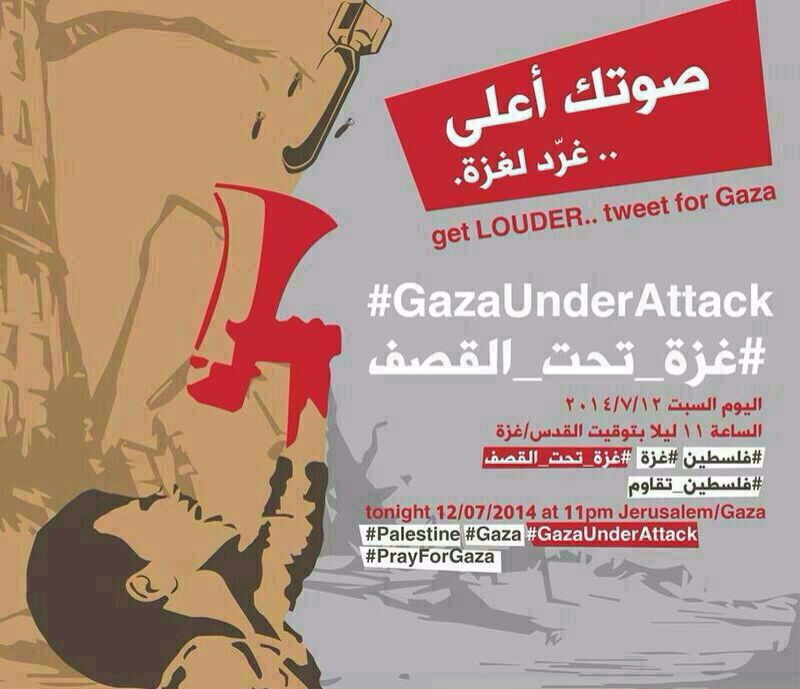
As of 11pm Gaza time, a campaign has begun on Twitter to talk about what is happening in Gaza and spread the word, using the hashtags #GazaUnderAttack and #PrayForGaza. What’s fascinating is that those behind the campaign have used Whatsapp to spread graphics on the campaign a couple of hours before it began. The tactic should have allowed the organizers to spread the awareness as quickly and as quietly as possible, to group their supporters and get them active on Twitter all at the same time. In essence, you’re creating a wave of support online, without anyone on the other side being forewarned.

I’ll be watching this intently, in the hope that that the two sides call a ceasefire as soon as possible. I for one hope that #GazaUnderAttack can be a force for good, to stop the suffering.

The #GazaUnderAttack image was spread via Whatsapp before the campaign was launched on Twitter

The #GazaUnderAttack image was spread via Whatsapp before the campaign was launched on Twitter