Is the Middle East’s Communications Business now 24/7 due to #SocialMedia?

There have been a slew of articles coming out from the US and Europe on social media and when to communicate to ensure that a message gets heard by a maximum number of people. Blogs from Bitly and other social media tools have highlighted the issue of timing and its importance in terms of how content goes viral.

The When Should I Post this Infographic by digital agency Raka was based on Bitly’s data for social media content distribution

I hadn’t heard of anything along those lines in the Middle East until recently, when one agency told me they’d won a contract to promote a national sports league via social media. The agency in question claimed that they had an ace up their sleeve during the pitch; they’d guaranteed the client that they would communicate in the evenings during the matches themselves, rather than promoting the games during office hours.

The thinking was simple. The target audience would be most focused on the sport an hour or two before, during and an hour or two after the games.

By that logic, wouldn’t the same also ring true for a variety of other audiences across the region? For example, for non-alcoholic drinks such as Barbican one of the prime times for selling is during football games. Similarly, wouldn’t restaurants and other venues which do most of their business in the evening do well to communicate afternoons and evenings rather than in the morning?

It’s an interesting one to think about for marketing and communications professionals. I’d love to see someone coming up with similar studies to the bitly blog and Infographic above, particularly for the GCC region. But I’m guessing most business and brand-related social media communications in the Middle East are being posted during office hours.

Everyone I know in the marcomms industry has a smartphone, a laptop, a tablet, and a 3G mobile connection. Connectivity doesn’t seem to be the issue to communicating outside of office hours, so then what is? Is it all down to the permissions and approvals processes that companies here have in place?

There are a myriad of tools which can help measure responses and even suggest the optimal time to post messages on social media based on previous data. One to look at is Crowdbooster. This online tool is free to use and you can use it to schedule messages to Twitter and Facebook. If you’re looking for a basic but useful tool to work out when to post to social media, try out Crowdbooster.

Crowdbooster is a great tool to use when you need to know the best timings for posting messages

But do remember, don’t sleep and tweet or Facebook! Or else you might end up writing something that you will regret.

Got sacked? On Twitter? #Maradona and #AlWasl

The Argentinian footballer and manager Maradona has always be a figure of controversy. A media scum has followed his every move. Maradona’s move to and time at the UAE football club AlWasl has been filled full of incidents. The last headline for the Argentinian may be one of the strangest I have seen for some time.

His fourteen month stint in charge of the football team came to an abrupt end last week when Maradona was fired. This may not be too much of a surprise based on the club’s performances and results. However, how did Maradona first learn he was given the boot? By Twitter.

Can you imagine getting fired? By Twitter? Article from Mashable

There’s been countless articles written and published on Maradona’s claim that he was let go by Twitter (the original goal.com article is here and another one by the UAE’s Gulf News is here.

How did this happen? And legal implications does this have? Needless to say, Maradona’s time at AlWasl has ended with a bang. I for one will miss him in the Gulf.

Why I love @AJStream – Al Jazeera’s the Stream shows how to build dialogue through an online audience

I’ve got to admit. There’s no other mainstream show quite like it. For those of you who haven’t experienced Al Jazeera’s the Stream, what are you waiting for?

In brief, Al Jazeera describes the Stream as a web community and daily television show powered by social media and citizen journalism. What this means in practice is that viewers take part in the show in real time, through tweeting with the hashtag #AJStream or talking with the @AJStream twitter profile. Viewers can also record their thoughts, which are often broadcast live on the show or are promoted via the Stream’s website or on its Facebook and Youtube pages. The program doesn’t stop after thirty minutes; the Stream continues broadcasting via the web for viewers to follow the topics under discussion.

Have a look for yourself at one of the Stream’s most powerful programs, on Bahrain’s social media confrontations. And ask yourself, why aren’t more broadcasters engaging their viewers this way? For me, this is the future of media. That’s why I love the Stream.

#Religion, #Ramadan and #SocialMedia – a case study with Du, AlSayegh Media and Shaikh Al Oraifi

We’re coming round once again to Ramadan, and I wanted to take the chance to write about one case study from last year’s holy month which underlines how much the media landscape is changing.

AlSayegh Media is a UAE-based agency headed by Abdullatif Al Sayegh, the former CEO of Dubai Media Incorporated. While AlSayegh Media is only a couple of years old some of its campaigns have, for me, been groundbreaking in terms of their use of content and social media to reach out to diverse audiences and build communities.

One of the hardest demographics out there to crack for any company in the Middle East is traditional/conservative/religious individuals. Firstly, because there’s a possibility that they may be more sensitive to marketing due to their beliefs. Secondly, there are relatively few religious media channels through which to communicate effectively and which may be receptive to conveying a message on behalf of a company when compared to more mainstream media. Even if a company has a message that they’d like to promote and which would appeal to this target audience, how do they reach this demographic?

The UAE telecoms operator Du decided to be different last year. The telco turned to AlSayegh Media to come up with a unique and original campaign for Ramadan that would by association promote Du and its services.

Rather than me saying how they did it, I’ll let AlSayegh Media’s own write up speak for itself.

15,000+ unique Facebook fans in just 4 weeks for a Ramadan campaign with Sheikh Dr Mohammed al Oraifi and Du. Now that is impressive.

As if that wasn’t enough here’s some more stats for you. Over 500 participants took part in the accompanying Khatim Al Qur’an competition. Over 9,600 calls were made to Sheikh Dr Mohammed al Oraifi. And there was an increase of 300% plus in fan engagement on Du’s Facebook page.

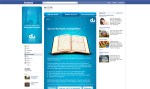
AlSayegh Media developed a series of Tabs for Du’s Facebook site which facilitated interaction with the intended demographic (these tabs aren’t live at the moment, but I’m assuming they’ll come back online next week for the start of Ramadan). However, here’s a clip of how the tabs looked last year below.

What to me is more impressive than anything else is the success that AlSayegh Media achieved for Du despite all of the noise during Ramadan. The Holy Month is a communications nightmare due to all of the religious programming that is aired over the four weeks. That AlSayegh Media was able to cut through the chatter and connect with such a hard-to-reach audience (this campaign was only UAE-focused, and aimed at Arabic and English speaking Muslims) speaks volumes about the agency’s strategy, Du’s activation marketing, and the impact of social media.

And the best thing? It was achieved at a fraction of what the same concept would have cost if televised. I’ve been told that even Du didn’t expect the volume of callers that the campaign attracted. Low cost, high return on investment, and community engagement? What’s better than that?

Let’s hope that AlSayegh Media’s Du Ramadan campaign this year will outdo 2011. According to the firm’s CEO Sheikh Dr Mohammed al Oraifi has agreed to the concept once again, and that they’re looking to expand the scope by which Muslims can reach out to the Sheikh. I’d love to see his question and answer sessions being streamed live and then posted onto Youtube, as well as a live Twitter Q&A session which would also help generate discussion between Du and the Muslim community in the UAE.

If you’re curious about Sheikh Dr Mohammed al Oraifi you can follow him on Twitter at @MohamadAlarefe or here for Facebook. The good Sheikh has almost three million followers on Twitter and 13,578 likes on Facebook and is one example of how Islamic scholars are taking to social media to communicate with their followers (I’ll blog more about this soon as well as the amount of fake accounts set up in his name).

And in case you’re curious to hear more about the founder of the company Abdullatif Al Sayegh here’s a clip of him talking at Tedx Ajman last year.

A female Saudi #graffiti artist? In Jeddah?

Jeddah is a remarkable place, a city of seven million souls which is the most diverse city in the Middle East bar none. There’s a phrase which is often used when talking about Jeddah, which is Jeddah ghrayr, or Jeddah is different/unique. Here’s one video which I spotted on my Tweetdeck from BBC journalist Gabriela Pomeroy (@gabrielapomeroy). The video, which has made the official selection for the Sheffield International Documentary Film Festival 2012, gives us a brief insight into one young female Saudi artist who uses graffiti to express herself in Balad, the oldest part of Jeddah.

Did you ever think you’d be watching a video about a female Saudi graffiti artist who works in broad daylight, in Saudi Arabia? As they say, Jeddah ghrayr!

Paint The Way from Next Door Films on Vimeo.

And if you’re not enjoying your flight, just remember you’re not flying Middle East Airlines

If you’re really not enjoying that flight, if the in-flight service isn’t what you hoped for, or if your in-seat screen is not responding, just remember that you’re not flying on Middle East Airlines.

One traveler took on Middle East Airlines via social media. You can read about Hussein Dajani’s story here.

Or just watch the video, which is much more fun.

The one thing I will never understand is that while no one I know enjoys traveling on MEA, try and get a Lebanese national to fly anything else (if you’re flying from Saudi the choice is understandable). If you’re that unhappy, then show your displeasure by not using the airline.

Kudos to Hussein Dajani for taking on the airline and proving that consumers can make a difference through social media.

Fans and Opponents Praise and Target MBC on Twitter

Yin and Yang, Sweet and Sour, and now MBC on social media. It seems that the Middle East’s largest free-to-air satellite station had its hands full last week. The station’s most popular talent show, Arabs Got Talent, broadcast the season finale live. The show, which has attracted millions of viewers, has trended worldwide with the hashtag #arabsgottalent over the past couple of months.

Meanwhile, another hashtag was making the rounds last week. #قناة_الفتنة translates as the channel of chaos from the Arabic to English. This less accommodating hashtag was doing the rounds in Saudi. After doing a little digging (what time will allow), it seems that the hashtag is aimed at MBC’s Ramadan schedule, and is designed to make the point that rather than portraying the spiritual side of the holiest month in the Islamic calendar MBC is more concerned with advertising revenues. Have a look at the below graphic. While you may not understand the Arabic, the picture itself speaks a thousand words (on the left is MBC, on the right is the devil).

And incidentally, who won Arabs Got Talent? A group of thirteen young men named Khawater al-Zalam who perform stunts and dance sequences with ultraviolet props and costumes set against a black background. They’re from Saudi Arabia. Check out Khawater al-Zalam’s routine during the show here.

Let’s hope that MBC’s social media team enjoy their sweet and sour as much as the rest of us.

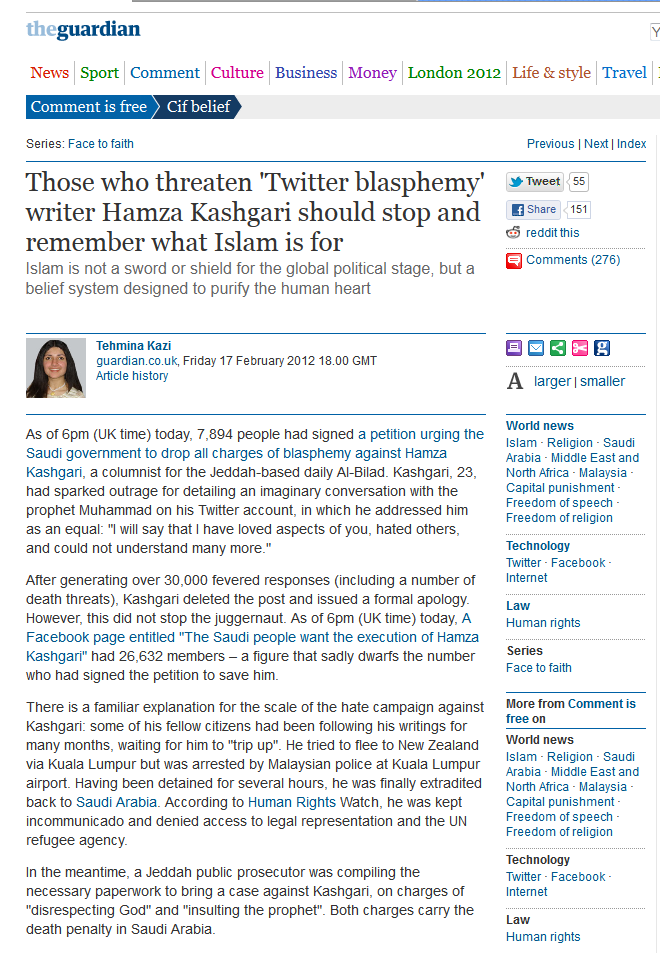
Twitter, censorship and Saudi’s Hamza Kashgari

Two months back Twitter introduced its new censorship policy, which would selectively block tweets on a country by country basis. In its blog, Twitter said it could “reactively withhold content from users in a specific country”.

A month later, that new policy was put to the test. A young Saudi national named Hamza Kashgari tweeted a number of thoughts which were to cause a national outcry not just in the Kingdom but across the Muslim world. Realizing what he’d done, Kashgari deleted his tweets, fled to Malaysia and then promptly get deported back to Saudi Arabia. The full story can be read here.

Twitter argued that the change to its censorship policy, from a global mechanism to delete tweets to one where they are censored at a country level, would allow for greater freedom of expression. However, were Twitter’s management team and legal counsel thinking of political or cultural issues where legislation is already in force? One could recount laws on Holocaust denial or incitement to racial hatred as issues where laws in such places as Europe are clear cut; if someone in Germany makes a public statement that denies the Holocaust they can be prosecuted. Twitter’s thinking here is clear. That Tweet can be deleted in Germany, but it could still be seen in another country where the statement does not break the law.

The Kashgari case is different, and less clear-cut. Kashgari’s Tweets may have been less incendiary in a Muslim country such as Turkey which follows a less conservative school of Islamic thought. However, it was not Twitter who censored Kashgari’s tweets but rather the man himself who deleted his messages after receiving death threats.

The question is, how useful is Twitter’s censorship policy on a country-by-country basis without people actively monitoring what is being said online? Even then, with all the traffic on Twitter would anyone be able to actively monitor Twitter? Even if the company was using algorithms would Twitter be able to pick up tweets such as Kashgari’s which are offensive to thousands but which may not explicitly break the law.

If people do tweet a message that is deemed to be illegal or offensive wouldn’t peer pressure and public opinion force them to delete their tweets, as Kashgari did? In which case, what is the point of Twitter’s new censorship player. I’d like to see how their new policy would work in practice, as I am sure many others would do too.

Don’t name yourself after a model. #SAGIA and its #SEO image antics

Before I write anything else thank you @Khaled and @TurkiSaudi for showing me this.

SAGIA or the Saudi Arabian General Investment Authority is tasked with bringing in foreign direct investment to Saudi Arabia. Obviously the organization has to have a pretty solid online presence. It’s previous governor Amr Dabbagh was known for his media outreach.

But my oh my, someone needs to work on their search engine optimization. Check out SAGIA on Google images. As @turkiSaudi says, that’s what happens when you name your organization after a model (Sagia Castaneda that is). @Khaled, I think you’re onto something when you say that she should be a spokeswoman.

https://twitter.com/#!/khaled/status/162105471296208897

When in doubt deny. Abdul Latif Jameel and its response to the #ToyotaCruiseFailSa story

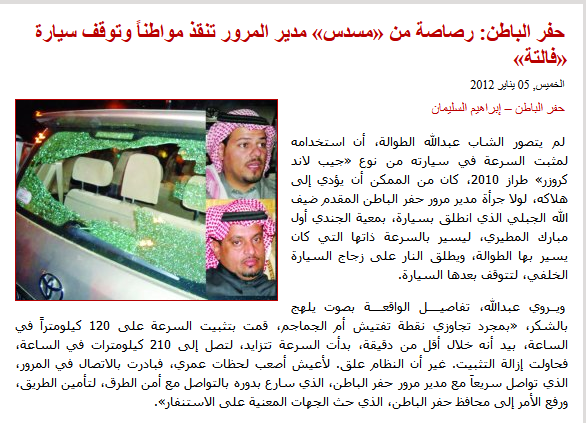
A storm was kicked up by a remarkable story about a Toyota Land Cruiser that apparently malfunctioned when on cruise control. I wrote briefly about the story a couple of weeks back, but to sum up the incident (you can find the original story here in Al Hayat newspaper in Arabic here) a Toyota Land Cruiser was stuck in cruise control at a speed of 210 kilometers per hour. The car was stopped by police who shot a number of live bullet rounds at the vehicle. Luckily no one was harmed, but the story rapidly went viral on social media and #ToyotaCruiseFailSa was a top trending hashtag in Saudi for days.

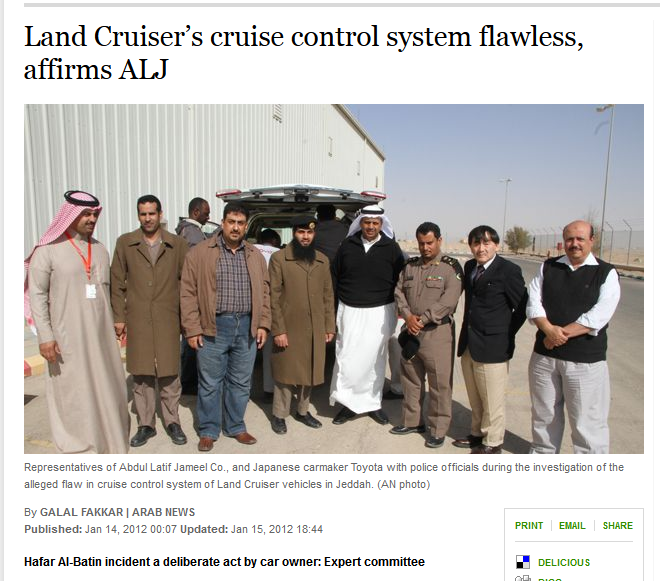
Toyota’s distributor Abdul Latif Jameel has crafted a sterling reputation as one of, if not, the best provider of automotive service in the Kingdom. Following the media reports of what happened in Hafr Al-Batin the company apparently tested the car along with several governmental bodies.

To cut the story short, Abdul Latif Jameel arranged a press conference to explain its findings and response to the incident. The seriousness of the incident and its brand implications was underlined by Abdul Latif Jameel’s decision to hold the event on a Friday, the weekend over here in the Kingdom.

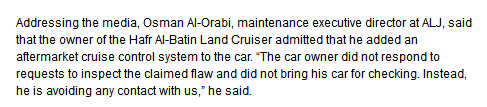
After a series of tests on the car and what was Abdul Latif Jameel’s explanation? Hafar Al-Batin incident a deliberate act by car owner: Expert committee (byline from the follow day’s Arab News which can be read here).

In summary, Abdul Latif Jameel came out fighting. It claimed that:
• the cruise control system in the Toyota Land Cruiser is flawless and working in the proper manner
• not a single incident of cruise control system defects had been reported from any Toyota vehicles sold in Saudi Arabia
• the company will never allow a flaw to go unreported

To paraphrase from the article, Abdul Latif Jameel laid the blame for the incident solely on the car’s owner.

I’m not going to jump in and get into the nitty gritty of car mechanics, but would anyone be surprised if a customer didn’t respond after having a near-death experience with your product? What concerned me was that the Saudi media didn’t reach out to the car’s owner to verify what Abdul Latif Jameel’s executives had said. Instead, they reported one side and not the other.

The above is pretty much a bog standard response from firms based in Saudi, to deny there’s a problem or that if something has happened that it is their problem. Would I want to buy a product from a company that shoves the blame onto the product owner? That doesn’t apologize, even if it isn’t their fault?

I had the pleasure to meet with Colin Hensley, Former General Manager of Corporate Affairs & Planning, Toyota Motor Europe, Belgium, at the Saudi Brand and Communications Forum last year. Toyota was put through the ringers in 2010 for all of their recalls. Then the largest car manufacturer in the world, Toyota recalled over 7.5 million cars. Colin told me how Toyota had learned valuable lessons from the incidents and was now putting those lessons into practice. I would have hoped that Toyota would have shared those lessons with Abdul Latif Jameel.

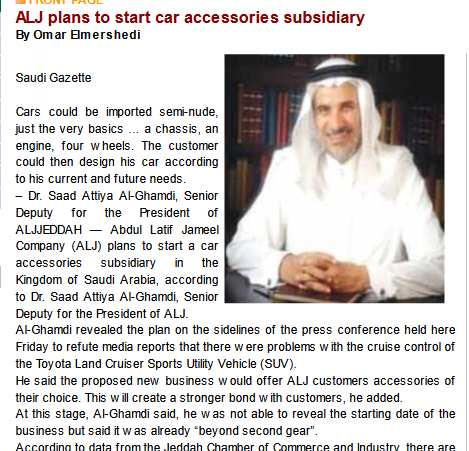
One day after the Abdul Latif Jameel press conference the distributor puts out another news story. Abdul Latif Jameel plans to start car accessories subsidiary. I’m not making this up unfortunately. Let’s hope someone sees the funny side of this, as I don’t.