Where’s the corporate response to #Sandy?

The response to tropical storm/hurricane Sandy online has been remarkable. There’s little anyone else is talking about, and even as far off as the Middle East people are sending their wishes to those caught in the storm’s path. To give you an idea about how Sandy has been trending on social media, have a look at the analytics graph from Hashtag.org for #sandy.

The graph, from hashtags.org, is from a one percent sample of Twitter traffic over the past 24 hours.

Everyone has been pitching in to provide help, support and comfort to those affected. According to thenextweb, Twitter has supported relief efforts by promoting the following twitter accounts @RedCross, @FEMA,@NYCMayorsOffice, and @MDMEMA. “Twitter is also listing government accounts and resources on its blog and giving #Sandy a custom page,” according to the piece by Harrison Weber on TNW.

Even celebrities have been taking to the social media space to talk about Sandy.

https://twitter.com/ABFalecbaldwin/status/263245395025600512

Aside from the danger to life posed by Sandy, the main talking points have been flooding and power outages. As a big fan of the likes of ABB (my former company) and GE, I was hoping that they and others would be talking about the disaster and lending a hand to get everything back on track. Estimations are that eight million people are without power right now in the Eastern seaboard of the US, and that utility company staffers are traveling from as far as California and Texas to help out in New York.

And what is on GE’s Facebook page?

This was GE’s latest post to their Facebook page, which is liked by over 900,000 people. There’s no mention of Sandy.

And ABB?

ABB’s latest Facebook post which was put up in the afternoon of October 30. Again, no mention of Sandy.

This isn’t exactly an empirical study, but it worries me that two of the world’s most respected electrical engineering companies are not lending their support or even making their support known by social media. While I understand that many corporates don’t want to be seen to be taking advantage of the situation, surely there’s a time and place for them to offer their support and advice publicly.

Not talking about what is affecting millions of people seems so out of place, especially when on social media and when the companies mentioned provide solutions that power our utilities.

After all, aren’t we supposed to be talking with each other via Facebook and Twitter. Or do we go on, ignoring global events? Hardly being socially responsibly on social media, is it?

The dangers of speaking your mind online – lessons from the Middle East

Kuwaiti graphic designer Mohammed Sharaf @MohammadRSharaf created the following image to support Nasser Abdul during his trial for tweeting offensive material

The internet is full of misconceptions. I often feel that most people think that the world wide web is a place where they can go to say anything, both positive and (most often) negative. The past 18 months and pending legislation should make anyone and everyone think twice about the above. Cases in Saudi Arabia, Bahrain, and Kuwait have cast aside the notion that cyberspace is a domain where anything and everything goes.

A number of trials and guilty verdicts both underline the importance of tempering what people say online as well as underscore what authorities do and do not deem as illegal. The first high-profile legal proceedings took place in Kuwait when in June of last year a Kuwaiti national was charged with slandering Bahrain’s royal family and a religious group.

Despite claiming that his Twitter account was hacked Nasser Abdul was found guilty and sentenced to three months in jail which he had already served by the time his sentence was pronounced. There have been other cases in Kuwait, including the prosecution and sentencing of Mubarak Al-Bathali to six years in jail (this was commuted to six months) for Tweets attacking certain religious groups.

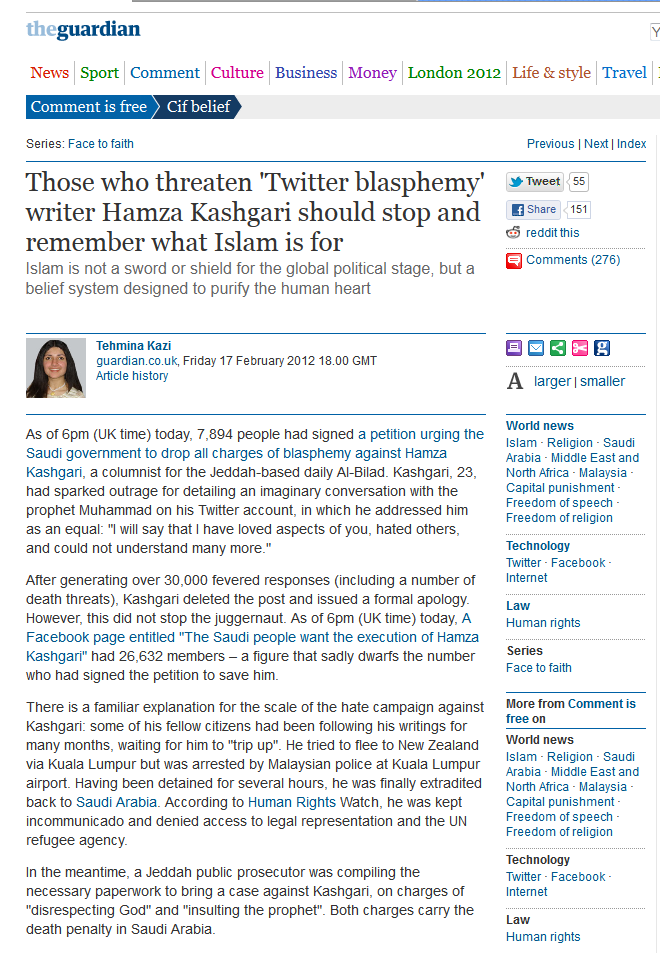
The most famous case of jailing for tweeting is that of Hamza Kashgari, who published three tweets about an imaginary meeting between himself and the Prophet Mohammed. His comments drew an instant reaction from Saudis online; in the hours that followed over 30,000 tweets regarding Kashgari were published online. Kashgari was accused of apostasy and fled to Malaysia. He was deported back to Saudi Arabia and jailed. Kashgari is still in detention, despite pleas by his family for his release and his apology for his actions (the basic story and roundup can be read here on Wikipedia).

Bahrain’s authorities have also taken to court individuals for publishing their thoughts in online public forums. The most famous and most recent case is that of activist Nabeel Rajab who tweeted about the Prime Minister’s visit to Muharraq in June and was accused of publicly insulting Muharraq’s residents for their support of Sheikh Khalifa bin Salman al-Khalifa. According to Bahrain’s prosecutor Rajab had claimed that Muharraq’s residents had only welcomed the Prime Minister during a visit because he had offered them subsidies.

Bahrain’s Information Affairs Authority said his acquittal on defamation charges “was due to the judge’s uncertainty regarding the evidence submitted to support the lawsuit”. Rajab, who has spent two months in jail while awaiting the outcome of this and another case, had been faced with possible charges before for his use of Twitter, in 2011, in what would have been the first such case in the Middle East.

Clearly the Arab Spring, which has led to regime change in three Middle East countries and is still being felt across the region, has sharpened the thinking of numerous governments across the region. According to media reports in June of this year, Bahrain is introducing legislation to curb misuse of social media.

I am still trying to fully understand the full implications of Bahrain’s proposed social media law, but I am assuming that this would cover and make an illegal offense the publishing of any comments online or through social media that would appear to contradict government policy or government statements. Kuwait is also leaning in this direction, as this editorial by Reuters makes clear.

What is clear is that the Middle East’s online community is becoming increasingly politicized. I’d argue that many people, frustrated with the lack of political debate in traditional media, are going online to voice their issues and concerns. The Dubai School of Government has estimated that there are 1.3 million active users on Twitter in the region.

Switching tack slightly, how will the increase in political discourse affect online communication efforts/campaigns? Will communication professionals and agencies steer completely away from anything that could be construed as political or biased to one community? And will we see more people using online aliases? While many governments would like to regulate online activity, how are they going to force users to reveal their true identities when using services that are based in Europe or the US?

Would we even see sites such as Facebook or Twitter blocked by governments in the region (this did happen in Egypt during January 2011 when the authorities tried to stop any and all access to social networking sites)? That’s the logical conclusion, but how would you do this when these sites have become part of people’s everyday lives? As always, there seem to be many more questions than answers when it comes to the Middle East. The freedom to voice one’s thoughts online are no exception.

Are journalists putting too much trust in social media sources?

The internet and digital communication has had a profound effect on the media industry. Media can be distributed globally in a matter of moments, and the ease with which journalists can find sources has been greatly aided by tools such as Twitter. Need a quote? Then search a hashtag on Twitter or for a blog via Google and find a credible source.

There’s no denying that social and digital media are shaping how journalists work. Rather than quoting in the traditional sense, news articles reference tweets.

There are risks in referring to sources in this manner. Can you trust that they person is who they say they are? Do they really represent those who they claim to be talking on behalf of? Do they know the subject well enough to be viewed as a credible source?

I can imagine that the Arab Spring has been both exciting and infuriating for media. Many countries have not taken too kindly to media entering their borders and reporting on goings-on. There have been some groundbreaking stories coming out of Syria in particular, with journalists putting themselves in harms way to report on the ground.

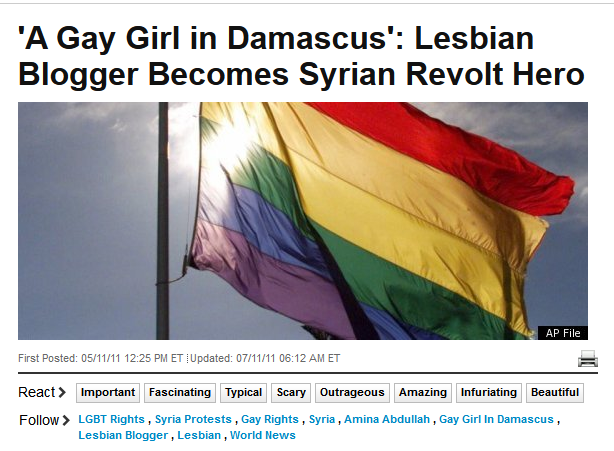
And then there has been instances of deception. The worst was the case of the Gay Girl in Damascus, who went from being a global source on what was going on in Syria through her blog to…

… an American graduate student named Tom MacMaster who was studying in Scotland.

The hoax may be the worst case example of what can go wrong when using online media for references. What concerns me more is when journalists and media outlets source speakers online. Unless they’re careful, the people who end up becoming the witnesses or the quoted experts are those with the biggest following online.

Of course, this doesn’t just happen online. I was listening to a post on the BBC World a week ago and heard a report about the first Saudi female Olympians. The person being interviewed was a female Saudi journalist residing in New York.

As I sat listening to the report, I could not help but ask myself why was the BBC interviewing a person sitting thousands of miles away from the country under focus. Would this person hold a mainstream opinion? Even some of her facts which she used to corroborate her arguments were flimsy (for example, she said there are no female gyms in Saudi Arabia, which is false).

Being a good journalist is one of the hardest jobs out there, especially in the Middle East where people can often be reticent around media and yet the editor still wants the story filed ASAP. However, I would like to ask my friends in the media to think before they quote from online, and ask themselves if they’re background checking that person, if they need to quote the same person for the Xth time, and if they should quote from online sources when alternatives are available.

Is the Middle East’s Communications Business now 24/7 due to #SocialMedia?

There have been a slew of articles coming out from the US and Europe on social media and when to communicate to ensure that a message gets heard by a maximum number of people. Blogs from Bitly and other social media tools have highlighted the issue of timing and its importance in terms of how content goes viral.

The When Should I Post this Infographic by digital agency Raka was based on Bitly’s data for social media content distribution

I hadn’t heard of anything along those lines in the Middle East until recently, when one agency told me they’d won a contract to promote a national sports league via social media. The agency in question claimed that they had an ace up their sleeve during the pitch; they’d guaranteed the client that they would communicate in the evenings during the matches themselves, rather than promoting the games during office hours.

The thinking was simple. The target audience would be most focused on the sport an hour or two before, during and an hour or two after the games.

By that logic, wouldn’t the same also ring true for a variety of other audiences across the region? For example, for non-alcoholic drinks such as Barbican one of the prime times for selling is during football games. Similarly, wouldn’t restaurants and other venues which do most of their business in the evening do well to communicate afternoons and evenings rather than in the morning?

It’s an interesting one to think about for marketing and communications professionals. I’d love to see someone coming up with similar studies to the bitly blog and Infographic above, particularly for the GCC region. But I’m guessing most business and brand-related social media communications in the Middle East are being posted during office hours.

Everyone I know in the marcomms industry has a smartphone, a laptop, a tablet, and a 3G mobile connection. Connectivity doesn’t seem to be the issue to communicating outside of office hours, so then what is? Is it all down to the permissions and approvals processes that companies here have in place?

There are a myriad of tools which can help measure responses and even suggest the optimal time to post messages on social media based on previous data. One to look at is Crowdbooster. This online tool is free to use and you can use it to schedule messages to Twitter and Facebook. If you’re looking for a basic but useful tool to work out when to post to social media, try out Crowdbooster.

Crowdbooster is a great tool to use when you need to know the best timings for posting messages

But do remember, don’t sleep and tweet or Facebook! Or else you might end up writing something that you will regret.

Why I love @AJStream – Al Jazeera’s the Stream shows how to build dialogue through an online audience

I’ve got to admit. There’s no other mainstream show quite like it. For those of you who haven’t experienced Al Jazeera’s the Stream, what are you waiting for?

In brief, Al Jazeera describes the Stream as a web community and daily television show powered by social media and citizen journalism. What this means in practice is that viewers take part in the show in real time, through tweeting with the hashtag #AJStream or talking with the @AJStream twitter profile. Viewers can also record their thoughts, which are often broadcast live on the show or are promoted via the Stream’s website or on its Facebook and Youtube pages. The program doesn’t stop after thirty minutes; the Stream continues broadcasting via the web for viewers to follow the topics under discussion.

Have a look for yourself at one of the Stream’s most powerful programs, on Bahrain’s social media confrontations. And ask yourself, why aren’t more broadcasters engaging their viewers this way? For me, this is the future of media. That’s why I love the Stream.

Who controls the message? The case of #Qatif and official Saudi policy

“May you live in interesting times”. That ancient Chinese proverb is a favourite, and never has it rung truer than today for anyone who lives in the Middle East.

The past 18 months has completely changed our region. Few have been immune to the changes that have swept the Middle East, including Saudi Arabia. During this time so many taboos have been broken. As a media junkie and former journalist what has been most striking is how people are now controlling the message themselves through the use of the internet.

For decades governments in the region controlled the news agenda. Saudi Arabia’s news channels, both television and newspapers, are all state-controlled. The use of satellite dishes was illegal (I can’t ever remember reading any official announcements legalizing satellite dishes in the country) and all foreign publications imported into the country were censored with a black pen. Anything that was critical was either black penned, ripped out of the magazine or newspaper, or, in the worst case, the publication would be banned.

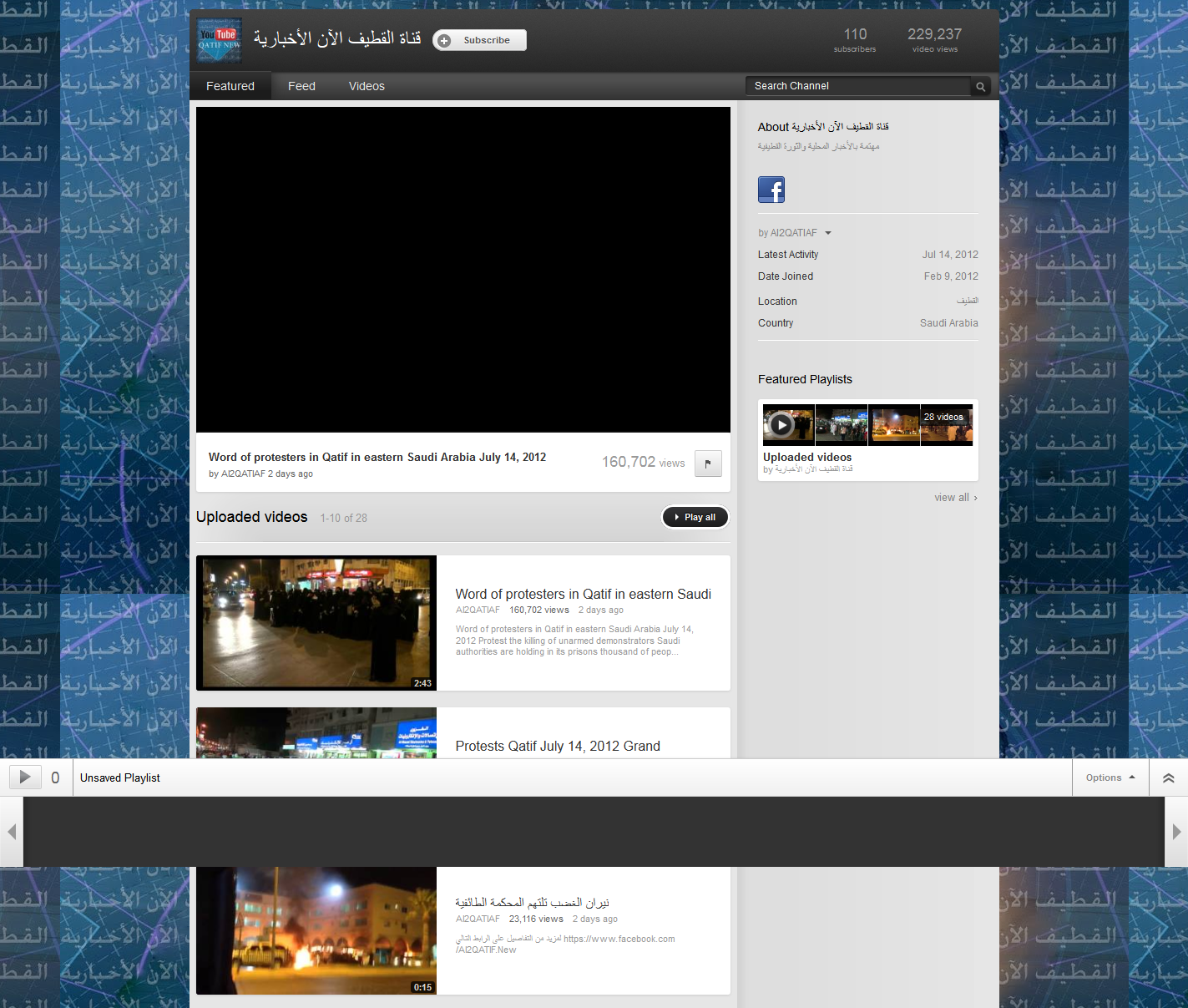
What has happened over the past 18 months has changed this perception. For reasons that I’m not going to go into on this blog post – I’m only focusing on the communications aspect rather than the politics – various events have taken place in Qatif, in Saudi Arabia’s Eastern Region. There have been several incidents of late in Qatif. What is remarkable is how those who are protesting in Qatif are using Youtube to spread their message. Previously, they never had any means to tell their story. To see how that has now changed, look at the below.

The above video has been viewed 160 thousand times in the space of two days. What is just as remarkable is the channel where this is hosted on Youtube. The channel’s name is Qatif News Channel, and videos are uploaded daily.

The Qatif News channel is hosted on Youtube and has been viewed over 200,000 times since it was set up on February 9th 2012.

This media is being used to tell a story that is feeding global media, such as this report by Al Jazeera.

Confronted with today’s ability to collect content, upload it to the internet and distribute that media, there’s little that official media or policy can do apart from run editorials condemning such actions. The below is from the English-language Saudi Gazette and sums up media reactions in the Saudi press.

Maintain public peace, Al-Qatif sheikhs tell youth was the standard line in many Saudi media publications.

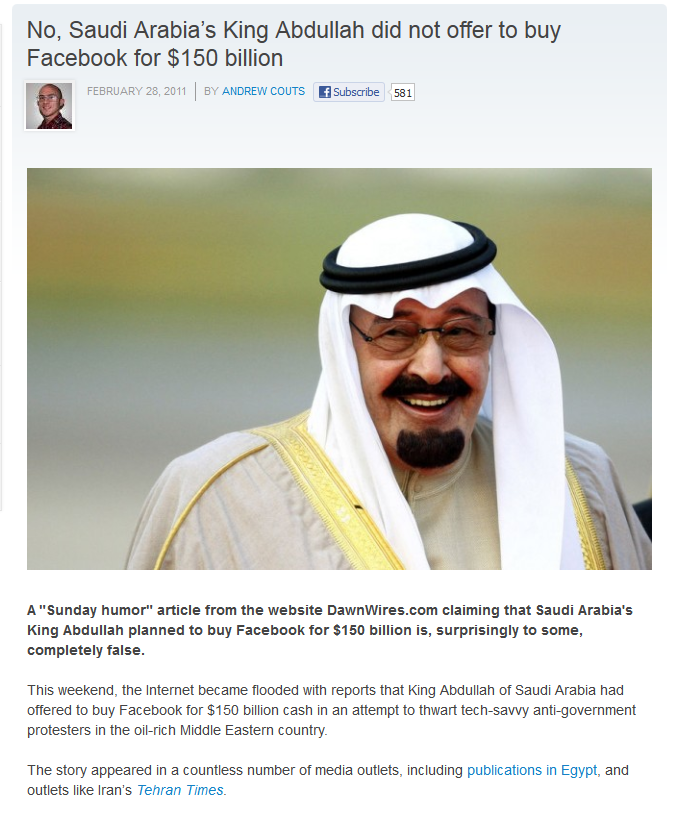
The question faced by governments is how do they regain control of media channels and ensure that their message is heard loud and clear? There’s no going back, there’s no closing down the internet (Egypt’s Mubarak tried and failed). Some governments have become media-savvy and are now creating their own content for distribution online. A rumour circulated last year that Saudi’s King Abdullah had bough Facebook to stop the Arab Spring. Maybe someone wasn’t joking when they suggested buying Facebook?

No, Saudi Arabia’s King Abdullah did not offer to buy Facebook for $150 billion.

#Religion, #Ramadan and #SocialMedia – a case study with Du, AlSayegh Media and Shaikh Al Oraifi

We’re coming round once again to Ramadan, and I wanted to take the chance to write about one case study from last year’s holy month which underlines how much the media landscape is changing.

AlSayegh Media is a UAE-based agency headed by Abdullatif Al Sayegh, the former CEO of Dubai Media Incorporated. While AlSayegh Media is only a couple of years old some of its campaigns have, for me, been groundbreaking in terms of their use of content and social media to reach out to diverse audiences and build communities.

One of the hardest demographics out there to crack for any company in the Middle East is traditional/conservative/religious individuals. Firstly, because there’s a possibility that they may be more sensitive to marketing due to their beliefs. Secondly, there are relatively few religious media channels through which to communicate effectively and which may be receptive to conveying a message on behalf of a company when compared to more mainstream media. Even if a company has a message that they’d like to promote and which would appeal to this target audience, how do they reach this demographic?

The UAE telecoms operator Du decided to be different last year. The telco turned to AlSayegh Media to come up with a unique and original campaign for Ramadan that would by association promote Du and its services.

Rather than me saying how they did it, I’ll let AlSayegh Media’s own write up speak for itself.

15,000+ unique Facebook fans in just 4 weeks for a Ramadan campaign with Sheikh Dr Mohammed al Oraifi and Du. Now that is impressive.

As if that wasn’t enough here’s some more stats for you. Over 500 participants took part in the accompanying Khatim Al Qur’an competition. Over 9,600 calls were made to Sheikh Dr Mohammed al Oraifi. And there was an increase of 300% plus in fan engagement on Du’s Facebook page.

AlSayegh Media developed a series of Tabs for Du’s Facebook site which facilitated interaction with the intended demographic (these tabs aren’t live at the moment, but I’m assuming they’ll come back online next week for the start of Ramadan). However, here’s a clip of how the tabs looked last year below.

What to me is more impressive than anything else is the success that AlSayegh Media achieved for Du despite all of the noise during Ramadan. The Holy Month is a communications nightmare due to all of the religious programming that is aired over the four weeks. That AlSayegh Media was able to cut through the chatter and connect with such a hard-to-reach audience (this campaign was only UAE-focused, and aimed at Arabic and English speaking Muslims) speaks volumes about the agency’s strategy, Du’s activation marketing, and the impact of social media.

And the best thing? It was achieved at a fraction of what the same concept would have cost if televised. I’ve been told that even Du didn’t expect the volume of callers that the campaign attracted. Low cost, high return on investment, and community engagement? What’s better than that?

Let’s hope that AlSayegh Media’s Du Ramadan campaign this year will outdo 2011. According to the firm’s CEO Sheikh Dr Mohammed al Oraifi has agreed to the concept once again, and that they’re looking to expand the scope by which Muslims can reach out to the Sheikh. I’d love to see his question and answer sessions being streamed live and then posted onto Youtube, as well as a live Twitter Q&A session which would also help generate discussion between Du and the Muslim community in the UAE.

If you’re curious about Sheikh Dr Mohammed al Oraifi you can follow him on Twitter at @MohamadAlarefe or here for Facebook. The good Sheikh has almost three million followers on Twitter and 13,578 likes on Facebook and is one example of how Islamic scholars are taking to social media to communicate with their followers (I’ll blog more about this soon as well as the amount of fake accounts set up in his name).

And in case you’re curious to hear more about the founder of the company Abdullatif Al Sayegh here’s a clip of him talking at Tedx Ajman last year.

And if you’re not enjoying your flight, just remember you’re not flying Middle East Airlines

If you’re really not enjoying that flight, if the in-flight service isn’t what you hoped for, or if your in-seat screen is not responding, just remember that you’re not flying on Middle East Airlines.

One traveler took on Middle East Airlines via social media. You can read about Hussein Dajani’s story here.

Or just watch the video, which is much more fun.

The one thing I will never understand is that while no one I know enjoys traveling on MEA, try and get a Lebanese national to fly anything else (if you’re flying from Saudi the choice is understandable). If you’re that unhappy, then show your displeasure by not using the airline.

Kudos to Hussein Dajani for taking on the airline and proving that consumers can make a difference through social media.

Twitter, censorship and Saudi’s Hamza Kashgari

Two months back Twitter introduced its new censorship policy, which would selectively block tweets on a country by country basis. In its blog, Twitter said it could “reactively withhold content from users in a specific country”.

A month later, that new policy was put to the test. A young Saudi national named Hamza Kashgari tweeted a number of thoughts which were to cause a national outcry not just in the Kingdom but across the Muslim world. Realizing what he’d done, Kashgari deleted his tweets, fled to Malaysia and then promptly get deported back to Saudi Arabia. The full story can be read here.

Twitter argued that the change to its censorship policy, from a global mechanism to delete tweets to one where they are censored at a country level, would allow for greater freedom of expression. However, were Twitter’s management team and legal counsel thinking of political or cultural issues where legislation is already in force? One could recount laws on Holocaust denial or incitement to racial hatred as issues where laws in such places as Europe are clear cut; if someone in Germany makes a public statement that denies the Holocaust they can be prosecuted. Twitter’s thinking here is clear. That Tweet can be deleted in Germany, but it could still be seen in another country where the statement does not break the law.

The Kashgari case is different, and less clear-cut. Kashgari’s Tweets may have been less incendiary in a Muslim country such as Turkey which follows a less conservative school of Islamic thought. However, it was not Twitter who censored Kashgari’s tweets but rather the man himself who deleted his messages after receiving death threats.

The question is, how useful is Twitter’s censorship policy on a country-by-country basis without people actively monitoring what is being said online? Even then, with all the traffic on Twitter would anyone be able to actively monitor Twitter? Even if the company was using algorithms would Twitter be able to pick up tweets such as Kashgari’s which are offensive to thousands but which may not explicitly break the law.

If people do tweet a message that is deemed to be illegal or offensive wouldn’t peer pressure and public opinion force them to delete their tweets, as Kashgari did? In which case, what is the point of Twitter’s new censorship player. I’d like to see how their new policy would work in practice, as I am sure many others would do too.

When in doubt deny. Abdul Latif Jameel and its response to the #ToyotaCruiseFailSa story

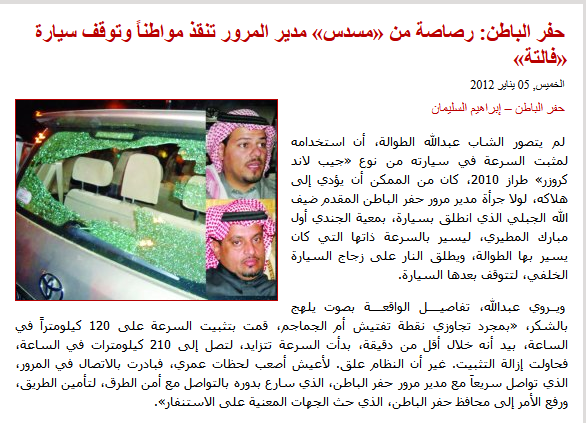
A storm was kicked up by a remarkable story about a Toyota Land Cruiser that apparently malfunctioned when on cruise control. I wrote briefly about the story a couple of weeks back, but to sum up the incident (you can find the original story here in Al Hayat newspaper in Arabic here) a Toyota Land Cruiser was stuck in cruise control at a speed of 210 kilometers per hour. The car was stopped by police who shot a number of live bullet rounds at the vehicle. Luckily no one was harmed, but the story rapidly went viral on social media and #ToyotaCruiseFailSa was a top trending hashtag in Saudi for days.

Toyota’s distributor Abdul Latif Jameel has crafted a sterling reputation as one of, if not, the best provider of automotive service in the Kingdom. Following the media reports of what happened in Hafr Al-Batin the company apparently tested the car along with several governmental bodies.

To cut the story short, Abdul Latif Jameel arranged a press conference to explain its findings and response to the incident. The seriousness of the incident and its brand implications was underlined by Abdul Latif Jameel’s decision to hold the event on a Friday, the weekend over here in the Kingdom.

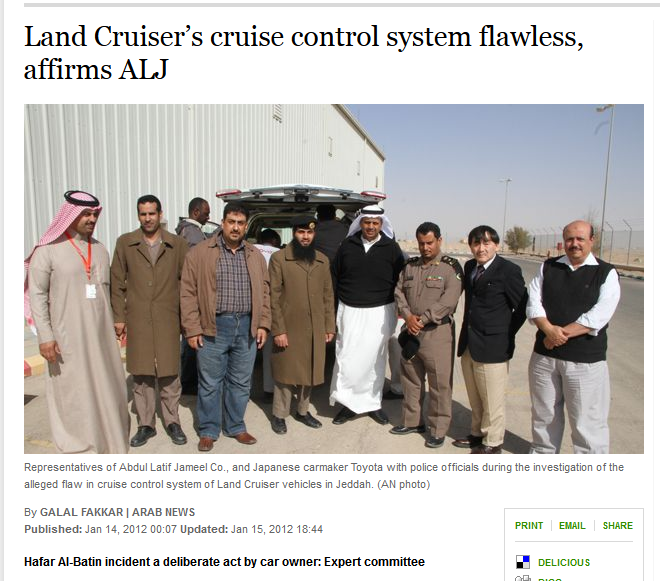
After a series of tests on the car and what was Abdul Latif Jameel’s explanation? Hafar Al-Batin incident a deliberate act by car owner: Expert committee (byline from the follow day’s Arab News which can be read here).

In summary, Abdul Latif Jameel came out fighting. It claimed that:
• the cruise control system in the Toyota Land Cruiser is flawless and working in the proper manner
• not a single incident of cruise control system defects had been reported from any Toyota vehicles sold in Saudi Arabia
• the company will never allow a flaw to go unreported

To paraphrase from the article, Abdul Latif Jameel laid the blame for the incident solely on the car’s owner.

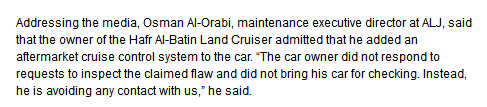
I’m not going to jump in and get into the nitty gritty of car mechanics, but would anyone be surprised if a customer didn’t respond after having a near-death experience with your product? What concerned me was that the Saudi media didn’t reach out to the car’s owner to verify what Abdul Latif Jameel’s executives had said. Instead, they reported one side and not the other.

The above is pretty much a bog standard response from firms based in Saudi, to deny there’s a problem or that if something has happened that it is their problem. Would I want to buy a product from a company that shoves the blame onto the product owner? That doesn’t apologize, even if it isn’t their fault?

I had the pleasure to meet with Colin Hensley, Former General Manager of Corporate Affairs & Planning, Toyota Motor Europe, Belgium, at the Saudi Brand and Communications Forum last year. Toyota was put through the ringers in 2010 for all of their recalls. Then the largest car manufacturer in the world, Toyota recalled over 7.5 million cars. Colin told me how Toyota had learned valuable lessons from the incidents and was now putting those lessons into practice. I would have hoped that Toyota would have shared those lessons with Abdul Latif Jameel.

One day after the Abdul Latif Jameel press conference the distributor puts out another news story. Abdul Latif Jameel plans to start car accessories subsidiary. I’m not making this up unfortunately. Let’s hope someone sees the funny side of this, as I don’t.