What is the future of the internet in the Middle East?

The past week has thrown out a couple of fun and serious stories and news reports about the internet in the Middle East. The first was Iran reportedly deciding to create its own version of YouTube in order to filter out what it deems to be inappropriate content posted on the world’s largest video-sharing network. There’s a screenshot from the Mehr site, which loads remarkably slowly for a site which hosts videos for viewing and sharing, below.

Will Iran's version of Youtube be as big a hit as the original?

Will Iran’s version of Youtube be as big a hit as the original?

The second story wasn’t as funny. The International Telecommunications Union had gathered its member states in Dubai to discuss a number of issues at the World Conference on International Telecommunications. The one which hit the headlines was internet regulation. In short, a number of countries from the Middle East and other emerging regions submitted proposals that would have allowed member countries to monitor and control data flowing through their respective parts of the internet.

While this is already happening in many parts of the world, the proposed resolution would have basically made it legal and proper for all 190 or so of the ITU’s “member states” to have the power to regulate the Internet to promote security, fight spam, et cetera.

A number of opinions and views can be found online on the issue, including interesting posts by technology historian Peter Salus entitled The UN and your Business: Why ITU Dubai Loss is your Gain and Why the ITU is the wrong place to set Internet standards by Tech writer Timothy B. Lee.

I for one am concerned about the future of the internet and online access. While internet filtering and domain blocking isn’t new to the Middle East (the Gulf’s telecommunications bodies block material that they deems offensive including religious or pornographic material) it’s clear that the past two years have opened a Pandora’s box when it comes to control of the internet. Governments in Egypt and Tunisia tried to close off access to the internet to stop revolution. That didn’t work. Gulf countries have legislated against online threats. As I’ve pointed out above Iran is building its own country-wide internet whilst blocking access to foreign-hosted sites that pose a threat to the Islamic Republic.

So where are we headed to next? How far will governments in the Middle East go in order to secure their own national communications networks? And is there anybody or anyone out there who will bring some common sense to the issue of web regulation in the Middle East?

While I don’t expect multinationals like Google and Yahoo (or even Facebook) to step up to the plate and say to Arab governments we will not regulate the web for you (after all, Yahoo and Google didn’t say no to China), I am hopeful that the region’s populations will become more vocal about their online rights. Egyptians and Tunisians have proved that they will demand and protect their new-found rights. Let’s hope others, especially in the Gulf, will begin to seriously think about what their governments are doing online and asking:

  • Who is watching me online?
  • What online data do they want and why?
  • Can I be jailed for my online activities? Do I have to self-censor my thoughts and activities?

What is the future of the internet in the Middle East? Are we headed towards a patchwork of national or regional wide webs aka Iran? Or will sense prevail? Goodness knows we need commerce and entrepreneurship to flourish in this region to generate more jobs and an open internet is essential to both. Answers on an email, an online comment, or (if your connection is monitored) a postcard please!

Are you up for some (more) government censorship and online monitoring?
How Dubai’s Tamweel Tower fire and its aftermath has been shaped by social media

Dubai woke up Sunday morning to a horror story. In what seemed to me to be a throw-back to the movie the Towering Inferno a fire broke out on the roof/top floor of a 34-storey tower in the city’s Jumeirah Lakes Towers development at around 2am. Incredibly, no one was killed or seriously injured and the tower’s 600 residents were evacuated from the building.

The fire, which you can see a clip of below, took several hours to be brought under control. However, for the families who lived in the property which is owned by the Islamic mortgage company Tamweel, their ordeal has only just begun.

According to news releases and press statements Tamweel has been supporting those made homeless by providing them with hotel accommodation.

At Tamweel, our very highest priority is the safety and well-being of the owners and residents,” said Varun Sood, Acting Chief Executive Officer, Tamweel. “Our staff are on site and have provided transportation and hotel accommodation, in coordination with DMCC, to any resident who requires such assistance. We will continue to work with the Building’s Owners Association to assist all residents and we remain fully committed to ensuring their well-being.

It’s no exaggeration to say that many families lost everything in the fire. Radio interviews with Tamweel Tower residents spoke of people running out wearing only their underwear and having to borrow clothing from others after they’d assembled at the emergency evacuation points outside the building. A wonderful piece was written in the Khaleej Times, a piece that conveyed the feeling of loss and confusion. If you’re hoping to gain a sense of how much some people were going through on the morning of the fire then do click through and read.

The tragedy has been covered extensively in both traditional media and on Twitter, Facebook and Youtube. Residents were tweeting from the site pictures and uploading videos before the first stories had been published online (I read one Twitterer write in the early hours of the 18th that traditional media were yet to publish anything on the fire – if I can find his tweet I’ll publish here).

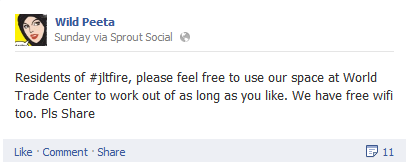
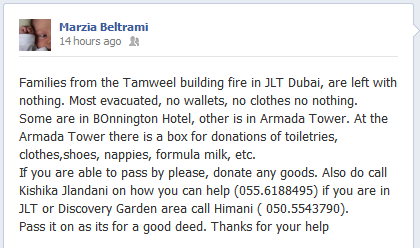
The morning of the tragedy companies and individuals started to reach out via community forums and other online media to offer their services and support as well as provide details for those who want to volunteer and donate.

One Dubai restaurant chain offered to host residents and businesses based in Tamweel Tower at their premises

Many people posted details of people to get in touch with for donating items to those left homeless

These community charity efforts are ongoing, as is the support given by Tamweel, and will be some consolation for residents who have lost all of their belongings in the fire.

The speed with which social media has allowed people to express their support and rally others in the community to help the victims of the Tamweel Fire has been remarkable. How long would businesses or government bodies take to do the same? What is interesting to note is that Dubai Police also use Twitter to put out news alerts.

For me, what’s also been striking is that the owner of the building Tamweel doesn’t have a social media presence. I’m sure, after what has happened, that will change in a very short space of time.

Where’s the corporate response to #Sandy?

The response to tropical storm/hurricane Sandy online has been remarkable. There’s little anyone else is talking about, and even as far off as the Middle East people are sending their wishes to those caught in the storm’s path. To give you an idea about how Sandy has been trending on social media, have a look at the analytics graph from Hashtag.org for #sandy.

The graph, from hashtags.org, is from a one percent sample of Twitter traffic over the past 24 hours.

Everyone has been pitching in to provide help, support and comfort to those affected. According to thenextweb, Twitter has supported relief efforts by promoting the following twitter accounts @RedCross, @FEMA,@NYCMayorsOffice, and @MDMEMA. “Twitter is also listing government accounts and resources on its blog and giving #Sandy a custom page,” according to the piece by Harrison Weber on TNW.

Even celebrities have been taking to the social media space to talk about Sandy.

https://twitter.com/ABFalecbaldwin/status/263245395025600512

Aside from the danger to life posed by Sandy, the main talking points have been flooding and power outages. As a big fan of the likes of ABB (my former company) and GE, I was hoping that they and others would be talking about the disaster and lending a hand to get everything back on track. Estimations are that eight million people are without power right now in the Eastern seaboard of the US, and that utility company staffers are traveling from as far as California and Texas to help out in New York.

And what is on GE’s Facebook page?

This was GE’s latest post to their Facebook page, which is liked by over 900,000 people. There’s no mention of Sandy.

And ABB?

ABB’s latest Facebook post which was put up in the afternoon of October 30. Again, no mention of Sandy.

This isn’t exactly an empirical study, but it worries me that two of the world’s most respected electrical engineering companies are not lending their support or even making their support known by social media. While I understand that many corporates don’t want to be seen to be taking advantage of the situation, surely there’s a time and place for them to offer their support and advice publicly.

Not talking about what is affecting millions of people seems so out of place, especially when on social media and when the companies mentioned provide solutions that power our utilities.

After all, aren’t we supposed to be talking with each other via Facebook and Twitter. Or do we go on, ignoring global events? Hardly being socially responsibly on social media, is it?

The dangers of speaking your mind online – lessons from the Middle East

Kuwaiti graphic designer Mohammed Sharaf @MohammadRSharaf created the following image to support Nasser Abdul during his trial for tweeting offensive material

The internet is full of misconceptions. I often feel that most people think that the world wide web is a place where they can go to say anything, both positive and (most often) negative. The past 18 months and pending legislation should make anyone and everyone think twice about the above. Cases in Saudi Arabia, Bahrain, and Kuwait have cast aside the notion that cyberspace is a domain where anything and everything goes.

A number of trials and guilty verdicts both underline the importance of tempering what people say online as well as underscore what authorities do and do not deem as illegal. The first high-profile legal proceedings took place in Kuwait when in June of last year a Kuwaiti national was charged with slandering Bahrain’s royal family and a religious group.

Despite claiming that his Twitter account was hacked Nasser Abdul was found guilty and sentenced to three months in jail which he had already served by the time his sentence was pronounced. There have been other cases in Kuwait, including the prosecution and sentencing of Mubarak Al-Bathali to six years in jail (this was commuted to six months) for Tweets attacking certain religious groups.

The most famous case of jailing for tweeting is that of Hamza Kashgari, who published three tweets about an imaginary meeting between himself and the Prophet Mohammed. His comments drew an instant reaction from Saudis online; in the hours that followed over 30,000 tweets regarding Kashgari were published online. Kashgari was accused of apostasy and fled to Malaysia. He was deported back to Saudi Arabia and jailed. Kashgari is still in detention, despite pleas by his family for his release and his apology for his actions (the basic story and roundup can be read here on Wikipedia).

Bahrain’s authorities have also taken to court individuals for publishing their thoughts in online public forums. The most famous and most recent case is that of activist Nabeel Rajab who tweeted about the Prime Minister’s visit to Muharraq in June and was accused of publicly insulting Muharraq’s residents for their support of Sheikh Khalifa bin Salman al-Khalifa. According to Bahrain’s prosecutor Rajab had claimed that Muharraq’s residents had only welcomed the Prime Minister during a visit because he had offered them subsidies.

Bahrain’s Information Affairs Authority said his acquittal on defamation charges “was due to the judge’s uncertainty regarding the evidence submitted to support the lawsuit”. Rajab, who has spent two months in jail while awaiting the outcome of this and another case, had been faced with possible charges before for his use of Twitter, in 2011, in what would have been the first such case in the Middle East.

Clearly the Arab Spring, which has led to regime change in three Middle East countries and is still being felt across the region, has sharpened the thinking of numerous governments across the region. According to media reports in June of this year, Bahrain is introducing legislation to curb misuse of social media.

I am still trying to fully understand the full implications of Bahrain’s proposed social media law, but I am assuming that this would cover and make an illegal offense the publishing of any comments online or through social media that would appear to contradict government policy or government statements. Kuwait is also leaning in this direction, as this editorial by Reuters makes clear.

What is clear is that the Middle East’s online community is becoming increasingly politicized. I’d argue that many people, frustrated with the lack of political debate in traditional media, are going online to voice their issues and concerns. The Dubai School of Government has estimated that there are 1.3 million active users on Twitter in the region.

Switching tack slightly, how will the increase in political discourse affect online communication efforts/campaigns? Will communication professionals and agencies steer completely away from anything that could be construed as political or biased to one community? And will we see more people using online aliases? While many governments would like to regulate online activity, how are they going to force users to reveal their true identities when using services that are based in Europe or the US?

Would we even see sites such as Facebook or Twitter blocked by governments in the region (this did happen in Egypt during January 2011 when the authorities tried to stop any and all access to social networking sites)? That’s the logical conclusion, but how would you do this when these sites have become part of people’s everyday lives? As always, there seem to be many more questions than answers when it comes to the Middle East. The freedom to voice one’s thoughts online are no exception.

Justice for Natalie: Using social media to rally the public and gain media support. #Justicefornatalie

Every once in a while, you come across a story that is heartbreaking. What happened to Natalie Creane is tragic. Four years ago Natalie and her new fiance celebrated their engagement by staying at the Emirates Palace Hotel in Abu Dhabi. After arriving she opened the wardrobe door and bent to put her shoes in the wardrobe. She looked up as a wooden panel fell from the front of the AV unit and hit her on the head, right on the temporal lobe.

According to a number of sites set up on her behalf Natalie was diagnosed with intractable refractory epilepsy and brain trauma. Since then she has been in four comas, she suffers from seizures which cause her to collapse suddenly and she has frequently sustained serious injuries during these seizures, including broken bones. Natalie has been on ventilators, had blood clots in her lung and leg, extreme blood toxicity, paralysis, temporary loss of sight, massive hair loss, severe debilitating headaches, temporary loss of speech, confusion, permanent memory loss, insomnia, constant infections due to suppressed immunity and has been admitted over 20 times to intensive care. Natalie suffers from Post Traumatic Intractable Refractory Epilepsy and Traumatic Brain Injury.

Despite all that has happened to her Natalie’s case with the Emirates Palace Hotel is still outstanding. The Emirates Palace Hotel initially referred the family to its insurance company. After talks with the company broke down, the family was faced with the hotel’s lawyers. Forced to take their case to court, a full two years after the accident, the family is still fighting for justice now – four years on from Natalie’s accident.

After four years of what I can imagine to be a living nightmare, including two years of litigation, Natalie’s family have finally gone public. They set up a Facebook page on the 9th of July which you can see here, and the family also set up two twitter handles, @JusticeForNatal and @JusticeForNat.

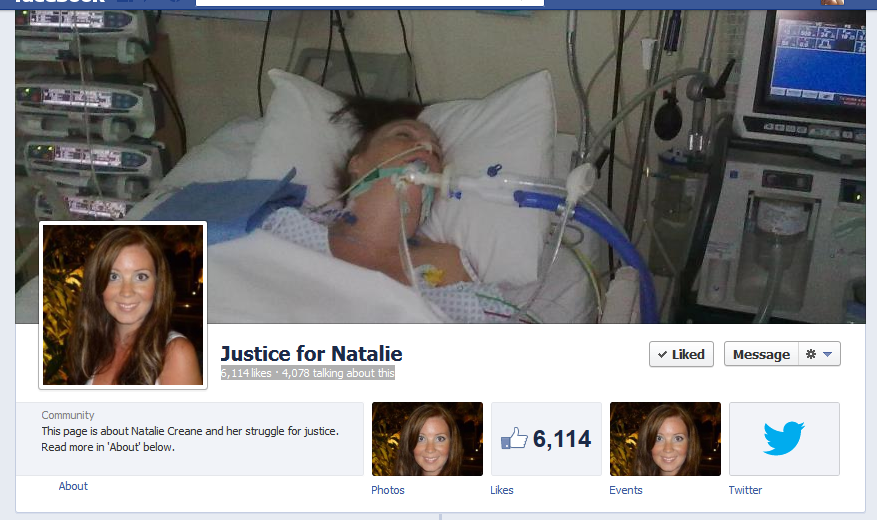
As of today, the Facebook page has 6,114 likes. Even more importantly when it comes to measuring influence and importance on Facebook 4,078 users are currently talking about Natalie. Here’s a screenshot of her page below.

The Justice for Natalie Facebook Page has only been live a few weeks but has already gone viral in the UAE and beyond

Her family have made use of Twitter to get her story noticed by media through retweets and mentions, posting pictures both via Twitter and Pinterest, and using the hashtag #justicefornatalie (there was some initial confusion online around the 20th when the Twitter handle switched from @justicefornatal to @justicefornat).

Ten days after setting up the social media channels Natalie’s story broke in mainstream media with a news piece in the UAE’s largest English circulation newspaper Gulf News followed by news pieces online at Albawaba and in print with another English-language UAE newspaper, 7Days. Natalie’s story has since been covered by global news outlets such as the BBC and the Huffington Post.

(Natalie’s story was first covered here last year by the National, but owing to the UAE’s defamation and libel laws newspapers use initials rather than full names when covering an active case).

Natalie’s family have also set up an online petition via Care2 where they’re aiming to gather 2,000 signatures (the petition is here and they’ve set up Team Natalie Marathon in Abu Dhabi for November (you can sign up here).

There’s even videos on Youtube, including the below which was put together by a supporter of the campaign.

Natalie’s family have stressed that the campaign has one aim, namely to raise her case’s profile and find some settlement so that Natalie can receive the support that she so desperately needs.

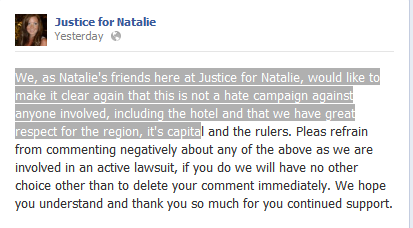
Rather than being a negative, hate campaign against the hotel the family are using human interest messages and regular updates on Natalie’s condition to attract attention and build a community online. In the space of two and a half weeks Natalie’s case has gotten more attention than it has done over four years. Understandably, the family have tried to get this issue resolved in a way that will not prejudice a court settlement, but with Natalie’s condition not improving it’s understandable that they feel the best way to ensure that their daughter has the care she needs is now through public relations.

Natalie is currently in a public hospital in Dubai, Rashid Hospital, where she is receiving palliative care. As her family write on Natalie’s Facebook page, “she urgently needs to receive specialist neurological help but the family has spent all they have over the past four years as they fought to get the hotel to step up and admit its liability for an incident which has resulted in such appalling consequences for Natalie.”

I for one hope that the Emirates Palace Hotel and the Kempinski Hotels group which manages the property settle this as soon as possible. They’re harming their own reputation. And, most importantly, they are denying their own responsibility to provide care for an incident which could be said to be a result of their own negligence.

How online communities have rallied round Natalie’s family is remarkable. And it goes to show how effective social media today can be in highlighting a worthy cause. Let’s all hope that Natalie finally gets justice and receives the support she needs to recover from all that has happened to her.

Supporting Saudi’s first female athletes. #London2012 #Olympics

Last night was a magical occasion. From James Bond to the Queen jumping out of a helicopter (admittedly, a double) and Mr Bean’s cameo with the London philharmonic orchestra. My own personal highlight was worth the wait. As the teams made their way into the arena three teams sent for the first time sent female athletes. The first was Brunei. Some time after Qatar’s first female athletes made their way into the arena. Finally, the wait was over. Saudi’s first female athletes appeared. Wodjan Shahrkhani and Sarah Attar walked with their heads held high and waved to the crowd. They were joined by Arwa Mutabagani, the female team manager, former professional show-jumper and mother of Saudi Arabian rider and Olympic hopeful Dalma Rushdi Malhas.

From left to right: Attar, Shahrkhani, and Mutabagani represent Saudi Arabia during the opening ceremony for London 2012

For anyone who has been following this little slice of history in the making, there’s been controversy and debate both inside Saudi Arabia and abroad about Saudi women taking part. I referred to this in a previous post. There’s still uncertainty as to whether Shahrkhani, who is supposed to be competing in judo, will be able to take part and still wear the hijab, the piece of clothing that covers her hair.

Sarah Attar will be the first Saudi woman to run in the Olympics when she competes in the 800 meters

The debate online outside Saudi Arabia has focused on women’s right and how the Kingdom is still not doing enough when it comes to promoting and protecting their equality. A good post that sums up the contrasting arguments found in yesterday’s and today’s media has been written by Huffington Post producer Ahmed Shihab-Eldin and can be accessed here.

Having lived in both Jeddah and Riyadh for years I’m proud to be able to call many Saudis, both male and female, good friends. There’s no simple answers in a country that could be said to be more diverse and varied than any other in the Middle East region.

I am however, even prouder of Attar and Shahrkhani. Whether or not people think that their participation is a symbolic gesture, they are there in London as athletes and they have set a first for their country and Saudi women. History has been made and Saudi Arabia no longer stands alone as the one country that didn’t send women to the Olympic games. The support for the ladies online and on social media forums has been overwhelming. There has been criticism as well, as this post by Amira Al Hussaini on the online portal Global Voices points out, but I would like to think that these people are a small, vocal minority (this is a great update story to the original Global Voices post by Bikaya Masr).

Their participation at London 2012 shows that change is possible – one could say it is inevitable – and that others will benefit from what Attar and Shahrkhani are doing at the London 2012 Olympics. I’ll be cheering them on during the games and I’m sure that millions of others will be behind them for all that they have and are achieving.

If anyone knows of a Twitter hashtag for supporting the ladies do let me know in the comments section.

The ladies will be flying the flag for their country during London 2012

PS you can support Sarah via her Facebook page here. I haven’t seen one for Wojdan yet, but if there is a site I’ll add it here.

Is the Middle East’s Communications Business now 24/7 due to #SocialMedia?

There have been a slew of articles coming out from the US and Europe on social media and when to communicate to ensure that a message gets heard by a maximum number of people. Blogs from Bitly and other social media tools have highlighted the issue of timing and its importance in terms of how content goes viral.

The When Should I Post this Infographic by digital agency Raka was based on Bitly’s data for social media content distribution

I hadn’t heard of anything along those lines in the Middle East until recently, when one agency told me they’d won a contract to promote a national sports league via social media. The agency in question claimed that they had an ace up their sleeve during the pitch; they’d guaranteed the client that they would communicate in the evenings during the matches themselves, rather than promoting the games during office hours.

The thinking was simple. The target audience would be most focused on the sport an hour or two before, during and an hour or two after the games.

By that logic, wouldn’t the same also ring true for a variety of other audiences across the region? For example, for non-alcoholic drinks such as Barbican one of the prime times for selling is during football games. Similarly, wouldn’t restaurants and other venues which do most of their business in the evening do well to communicate afternoons and evenings rather than in the morning?

It’s an interesting one to think about for marketing and communications professionals. I’d love to see someone coming up with similar studies to the bitly blog and Infographic above, particularly for the GCC region. But I’m guessing most business and brand-related social media communications in the Middle East are being posted during office hours.

Everyone I know in the marcomms industry has a smartphone, a laptop, a tablet, and a 3G mobile connection. Connectivity doesn’t seem to be the issue to communicating outside of office hours, so then what is? Is it all down to the permissions and approvals processes that companies here have in place?

There are a myriad of tools which can help measure responses and even suggest the optimal time to post messages on social media based on previous data. One to look at is Crowdbooster. This online tool is free to use and you can use it to schedule messages to Twitter and Facebook. If you’re looking for a basic but useful tool to work out when to post to social media, try out Crowdbooster.

Crowdbooster is a great tool to use when you need to know the best timings for posting messages

But do remember, don’t sleep and tweet or Facebook! Or else you might end up writing something that you will regret.

Why I love @AJStream – Al Jazeera’s the Stream shows how to build dialogue through an online audience

I’ve got to admit. There’s no other mainstream show quite like it. For those of you who haven’t experienced Al Jazeera’s the Stream, what are you waiting for?

In brief, Al Jazeera describes the Stream as a web community and daily television show powered by social media and citizen journalism. What this means in practice is that viewers take part in the show in real time, through tweeting with the hashtag #AJStream or talking with the @AJStream twitter profile. Viewers can also record their thoughts, which are often broadcast live on the show or are promoted via the Stream’s website or on its Facebook and Youtube pages. The program doesn’t stop after thirty minutes; the Stream continues broadcasting via the web for viewers to follow the topics under discussion.

Have a look for yourself at one of the Stream’s most powerful programs, on Bahrain’s social media confrontations. And ask yourself, why aren’t more broadcasters engaging their viewers this way? For me, this is the future of media. That’s why I love the Stream.

Who controls the message? The case of #Qatif and official Saudi policy

“May you live in interesting times”. That ancient Chinese proverb is a favourite, and never has it rung truer than today for anyone who lives in the Middle East.

The past 18 months has completely changed our region. Few have been immune to the changes that have swept the Middle East, including Saudi Arabia. During this time so many taboos have been broken. As a media junkie and former journalist what has been most striking is how people are now controlling the message themselves through the use of the internet.

For decades governments in the region controlled the news agenda. Saudi Arabia’s news channels, both television and newspapers, are all state-controlled. The use of satellite dishes was illegal (I can’t ever remember reading any official announcements legalizing satellite dishes in the country) and all foreign publications imported into the country were censored with a black pen. Anything that was critical was either black penned, ripped out of the magazine or newspaper, or, in the worst case, the publication would be banned.

What has happened over the past 18 months has changed this perception. For reasons that I’m not going to go into on this blog post – I’m only focusing on the communications aspect rather than the politics – various events have taken place in Qatif, in Saudi Arabia’s Eastern Region. There have been several incidents of late in Qatif. What is remarkable is how those who are protesting in Qatif are using Youtube to spread their message. Previously, they never had any means to tell their story. To see how that has now changed, look at the below.

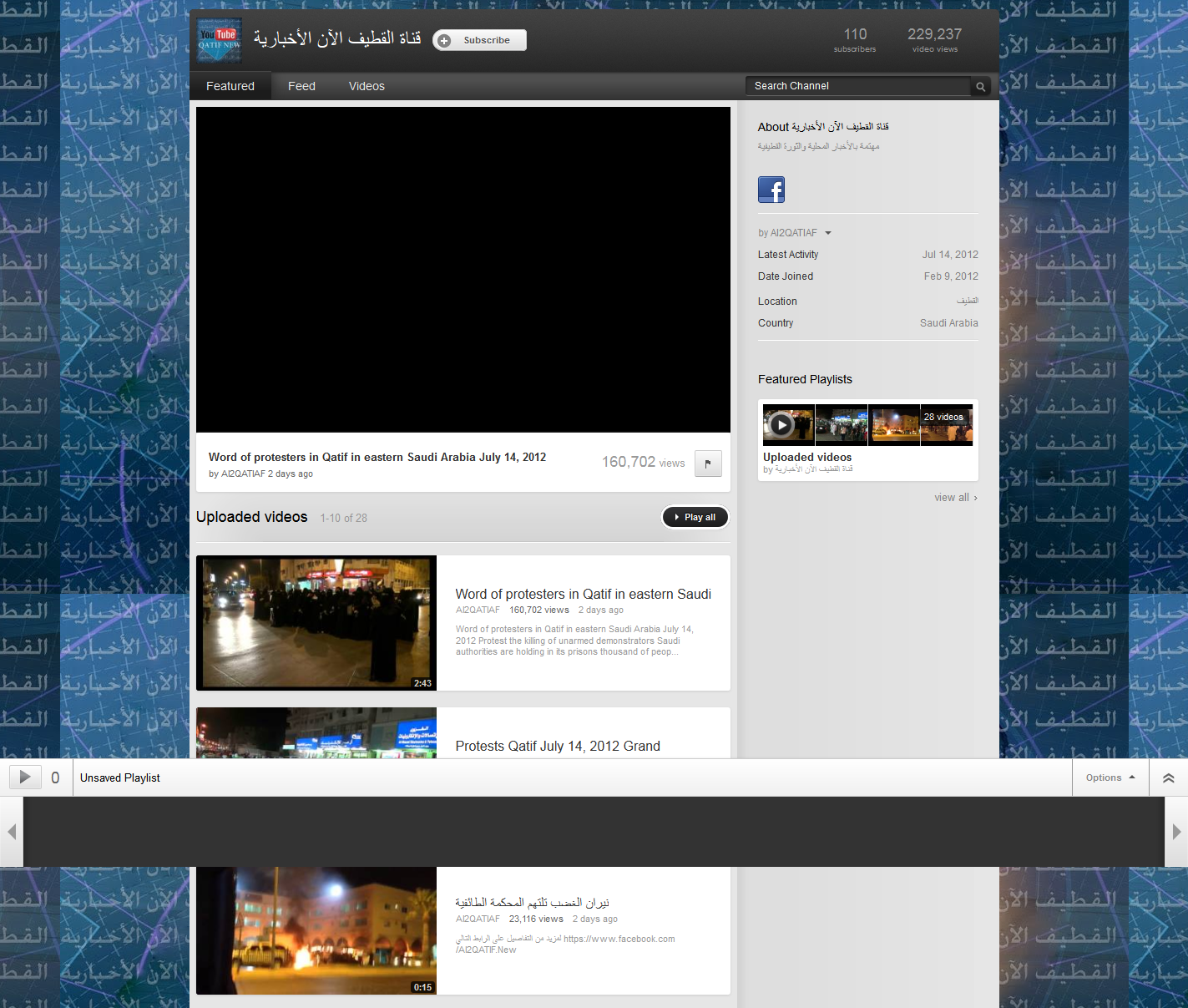
The above video has been viewed 160 thousand times in the space of two days. What is just as remarkable is the channel where this is hosted on Youtube. The channel’s name is Qatif News Channel, and videos are uploaded daily.

The Qatif News channel is hosted on Youtube and has been viewed over 200,000 times since it was set up on February 9th 2012.

This media is being used to tell a story that is feeding global media, such as this report by Al Jazeera.

Confronted with today’s ability to collect content, upload it to the internet and distribute that media, there’s little that official media or policy can do apart from run editorials condemning such actions. The below is from the English-language Saudi Gazette and sums up media reactions in the Saudi press.

Maintain public peace, Al-Qatif sheikhs tell youth was the standard line in many Saudi media publications.

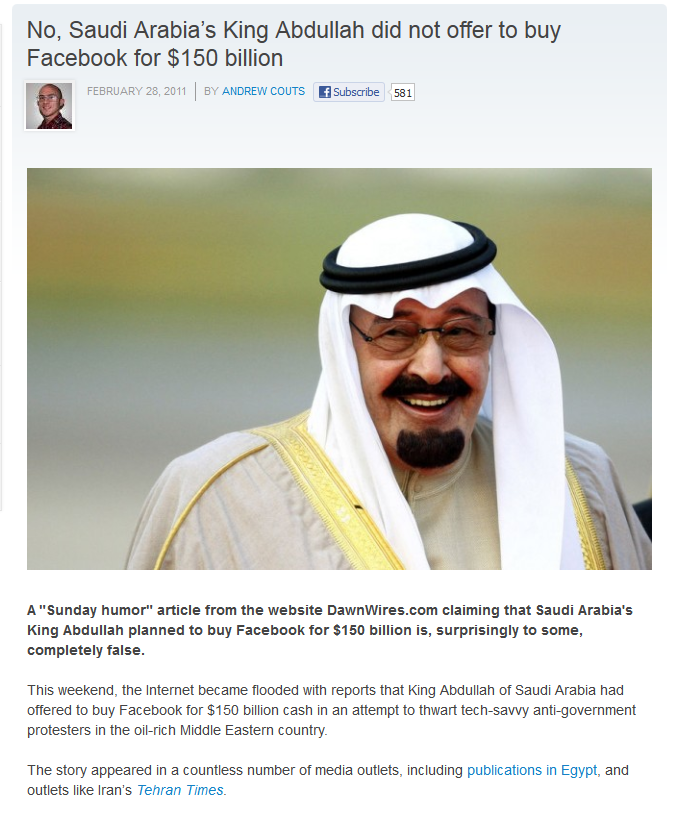
The question faced by governments is how do they regain control of media channels and ensure that their message is heard loud and clear? There’s no going back, there’s no closing down the internet (Egypt’s Mubarak tried and failed). Some governments have become media-savvy and are now creating their own content for distribution online. A rumour circulated last year that Saudi’s King Abdullah had bough Facebook to stop the Arab Spring. Maybe someone wasn’t joking when they suggested buying Facebook?

No, Saudi Arabia’s King Abdullah did not offer to buy Facebook for $150 billion.

#Religion, #Ramadan and #SocialMedia – a case study with Du, AlSayegh Media and Shaikh Al Oraifi

We’re coming round once again to Ramadan, and I wanted to take the chance to write about one case study from last year’s holy month which underlines how much the media landscape is changing.

AlSayegh Media is a UAE-based agency headed by Abdullatif Al Sayegh, the former CEO of Dubai Media Incorporated. While AlSayegh Media is only a couple of years old some of its campaigns have, for me, been groundbreaking in terms of their use of content and social media to reach out to diverse audiences and build communities.

One of the hardest demographics out there to crack for any company in the Middle East is traditional/conservative/religious individuals. Firstly, because there’s a possibility that they may be more sensitive to marketing due to their beliefs. Secondly, there are relatively few religious media channels through which to communicate effectively and which may be receptive to conveying a message on behalf of a company when compared to more mainstream media. Even if a company has a message that they’d like to promote and which would appeal to this target audience, how do they reach this demographic?

The UAE telecoms operator Du decided to be different last year. The telco turned to AlSayegh Media to come up with a unique and original campaign for Ramadan that would by association promote Du and its services.

Rather than me saying how they did it, I’ll let AlSayegh Media’s own write up speak for itself.

15,000+ unique Facebook fans in just 4 weeks for a Ramadan campaign with Sheikh Dr Mohammed al Oraifi and Du. Now that is impressive.

As if that wasn’t enough here’s some more stats for you. Over 500 participants took part in the accompanying Khatim Al Qur’an competition. Over 9,600 calls were made to Sheikh Dr Mohammed al Oraifi. And there was an increase of 300% plus in fan engagement on Du’s Facebook page.

AlSayegh Media developed a series of Tabs for Du’s Facebook site which facilitated interaction with the intended demographic (these tabs aren’t live at the moment, but I’m assuming they’ll come back online next week for the start of Ramadan). However, here’s a clip of how the tabs looked last year below.

What to me is more impressive than anything else is the success that AlSayegh Media achieved for Du despite all of the noise during Ramadan. The Holy Month is a communications nightmare due to all of the religious programming that is aired over the four weeks. That AlSayegh Media was able to cut through the chatter and connect with such a hard-to-reach audience (this campaign was only UAE-focused, and aimed at Arabic and English speaking Muslims) speaks volumes about the agency’s strategy, Du’s activation marketing, and the impact of social media.

And the best thing? It was achieved at a fraction of what the same concept would have cost if televised. I’ve been told that even Du didn’t expect the volume of callers that the campaign attracted. Low cost, high return on investment, and community engagement? What’s better than that?

Let’s hope that AlSayegh Media’s Du Ramadan campaign this year will outdo 2011. According to the firm’s CEO Sheikh Dr Mohammed al Oraifi has agreed to the concept once again, and that they’re looking to expand the scope by which Muslims can reach out to the Sheikh. I’d love to see his question and answer sessions being streamed live and then posted onto Youtube, as well as a live Twitter Q&A session which would also help generate discussion between Du and the Muslim community in the UAE.

If you’re curious about Sheikh Dr Mohammed al Oraifi you can follow him on Twitter at @MohamadAlarefe or here for Facebook. The good Sheikh has almost three million followers on Twitter and 13,578 likes on Facebook and is one example of how Islamic scholars are taking to social media to communicate with their followers (I’ll blog more about this soon as well as the amount of fake accounts set up in his name).

And in case you’re curious to hear more about the founder of the company Abdullatif Al Sayegh here’s a clip of him talking at Tedx Ajman last year.