If you don’t like it, then leave! Hey @Dutweets and how not to deal with customers online

One week, two social media blunders in the United Arab Emirates. First we had Subaru Emirates and now we have Du, the UAE’s second largest telecommunications company, getting everyone into a tizzy.

The background to the story, which has been covered by the UAE-based magazine Computer News Middle East, is an increase in charges for the company’s home user pricing plans. The price increases, which have risen by up to 37 percent, seem to have been posted on the company’s website rather than having being formally announced by the company.

Unsurprisingly, consumers haven’t taken to Du’s price increases (note – for data services the UAE operates a monopolistic system whereby you have to purchase from the sole telco who is licensed to operate in your area, which is either Du or Etisalat). Du’s twitter account, @Dutweets, has been inundated with tweets from aggrieved consumers who understandably don’t want to pay more for their existing service and don’t want Du’s offer of additional phone minutes in compensation for the higher prices. Have a look below:

Unfortunately, for the people in the company running the Du account (Du handles social media internally I believe) things have gone from bad to worse. One reply has gone viral and is receiving a swathe of negative feedback on Du and its social media efforts.

I do feel for @Dutweets as they’re having to face the fallout from a pricing decision which has been poorly executed and hasn’t been communicated in the right manner – from a customer perspective there’s no justification for a price rise for the same service, especially when Du’s customers have no other provider and when their existing contracts should be honored for the contracts’ duration. However, if a company isn’t willing to resolve issues through social media then what’s the point of entering into a dialogue with the community? And no matter the frustration levels you can’t respond to customers in a manner that seems unsympathetic. So please, no more Hey! messages @dutweets. Understand the concerns, pass on the message to the executives and wait for a positive message from upstairs. Don’t do a Subaru, because you’re only going to make things much, much worse for yourselves.

https://twitter.com/WildeTrude/status/364691859576061954

https://twitter.com/alextohme/status/364719579089485826

Subaru Emirates, Facebook, sexism, racism, and loss of life = a social media disaster

I’m a hardened comms person/journalist. I’ve seen a lot of materials which offends and much of that material doesn’t surprise me. However, this morning I was wincing at a post on Facebook, on the UAE page of the automotive brand Subaru. The post, which relates to a recent accident which claimed the lives of four people, offends both women and a specific nationality. While this isn’t enough, not a single positive piece of advice is given to drivers to help avoid such a tragedy in the future. The post is screen-captured below. And to ensure maximum shock value what would you title such a piece? ‘Women drivers at it again’.

For me, pretty much everything that could have been done wrong was done wrong with this post. Frankly, it's disgusting.

For me, pretty much everything that could have been done wrong was done wrong with this post. Frankly, it’s disgusting.

To fan the flames of outrage further, the admin person does not apologize but rather seeks to defend the comments against the criticism (sixty comments and counting and 58 shares within 21 hours). This has gone out to 15,000 accounts who have liked the page and has been distributed to hundreds more through the shares. Depending on Subaru Emirates’ advertising policy in the UAE this could have reached hundreds of thousands more. Stepping aside from the grotesqueness of the post, it’s a remarkable thought that the company could have alienated over half of its potential buyer base. As an aside, I doubt that the page has asked permission from the newspaper Emirates 24/7 to use this image in a commercial setting.

I’m not going to delve deeper into this as there’s little positive about this episode apart from to learn what not to do when promoting a brand through Facebook. Subaru, please do the right thing and apologize for the post and ensure that the admin person learns the error of their ways.

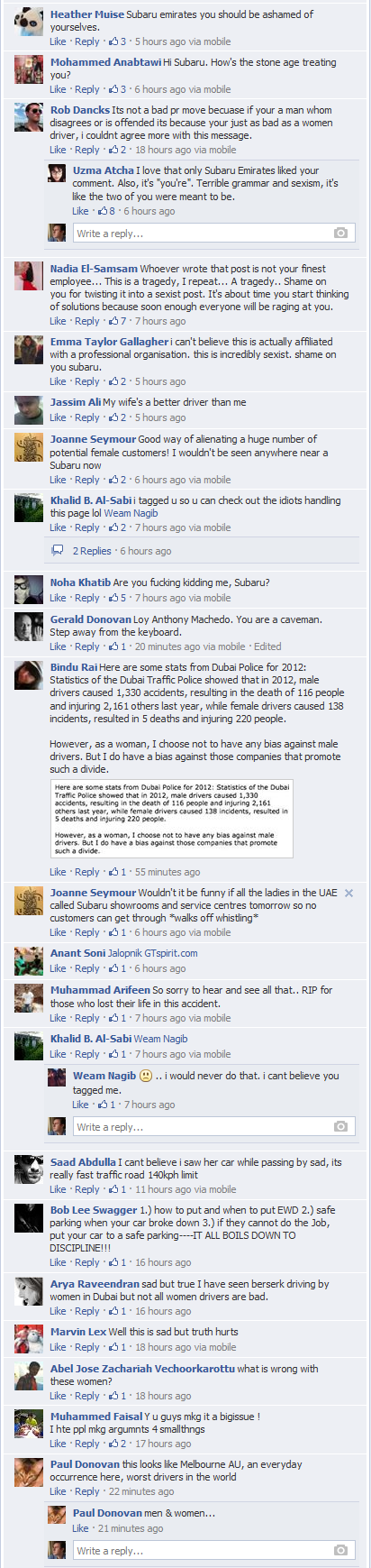
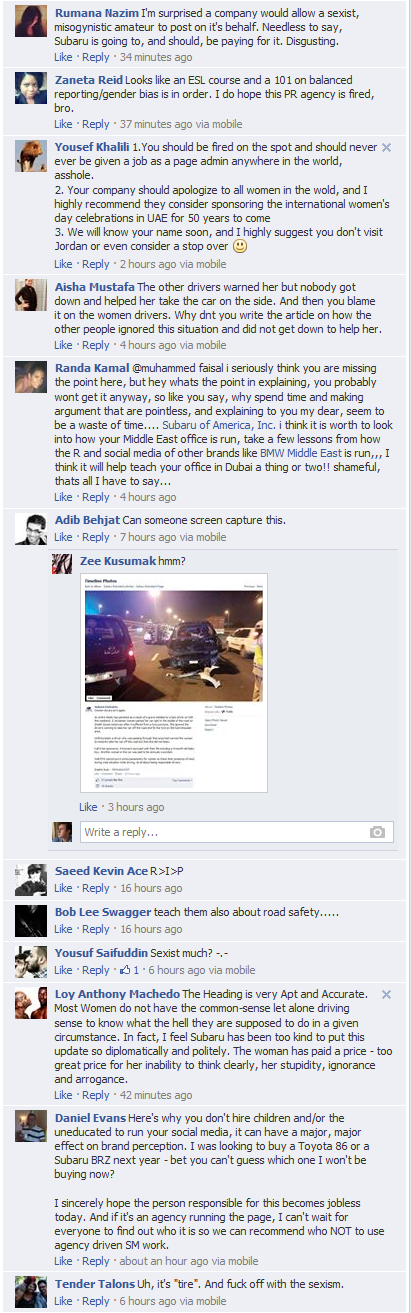
Comments are below for the post (apologies for the size but it’s easy to zoom in and view/read).

This is the first comments screen shot. Note the defensive post by Subaru Emirates and the anger of the responses.

This is the first comments screen shot. Note the defensive post by Subaru Emirates and the anger of the responses.

And it goes on...

And it goes on…

And on and on...

And on and on…

I’m sure that Subaru has guidelines for appropriate social media usage for its internal staff and agencies. They need to ensure that these guidelines are understood by all and that they are followed by their social media admin persons. I’ll be writing a how-to blog for how to use Facebook properly soon. As a responsible individual, we all need to understand the other. That’s even more true when you’re running someone else’s brand on their behalf.

Another Youtube Shocker – KFC and its Al-Ahsa Outlet’s Hygiene Standards

It seems no-one is safe from Youtube. After a video was uploaded to the world’s largest video-sharing site showing what purported to be an alleged road-rage incident in Dubai another video has been uploaded to the site but this time from Saudi Arabia. The video, which was uploaded on the 17th of July has been viewed 175,000 times in three days.

The video, featured below, allegedly shows what is described to be a scene in a kitchen of Kentucky Fried Chicken in the Saudi city of Al-Ahsa, in Othaim Mall. The person who took the video was apparently an employee who was fired after the video was taken. I’m not going to describe the video; rather, do watch the video itself which is two minutes long.

Social media crises for food chains aren’t new; anyone remember the infamous Youtube clip on Domino’s Pizza that went viral in 2009? However, while these issues aren’t new to US and European audiences and most food chains there have social media crisis plans how many local, Middle East franchises are ready for the same thing here? It’ll be interesting to see if or how KFC does respond to the allegation. In the meantime, as it’s Ramadan I’m enjoying home cooking.

GEMS foot-in-mouth syndrome and the curious case of the disappearing comments

Please don’t put your foot in your mouth. If you have to say something do mutter the words when the room is empty, or when you’re in the middle of the ocean. And it’s also advisable to stay away from media (image credit: http://www.ronedmondson.com)

There’s a condition that I like to name foot-in-mouth syndrome. Basically, foot-in-mouth happens when an executive talks to a journalist and doesn’t think before they speak. This results in classic ‘how did they say that’ quotes which often whip up a storm of protests from all and sundry.

This week we had one of the best foot-in-mouth moments I’ve read for some time. The chairman of GEMS Education, the UAE’s largest provider of primary and secondary education, gave an interview to Gulf Business. The story was rapidly picked up by Arabian Business and has provoked hundreds of comments from some very angry parents. The quotes which did the (most) damage were below.

Parents have no right to complain about fees if they choose a high school they cannot afford, GEMS Education chairman said of “grumbling” parents in an interview with Gulf Business.

“If you put your children in a school that you can’t afford then you can’t grumble,” Sunny Varkey said.
“You understand what I’m saying? You must choose a school that you can afford.

“It’s normal human behaviour [for parents] to defend fees. But parents can very well see which are the schools that are good, outstanding, fair, or not good. And, accordingly, they can choose a school.”

I love media sites on the internet, partly because of the ability to leave comments and the inevitable pearls of wisdom that readers leave. Varkey’s foot-in-mouth (and if you can’t see why this is a disaster of an interview for Varkey, you’re beyond the pale) was attacked from all sides by parents. Comments included such wonders as ‘It’s no wonder GEMS and HSBC (?) are the two most hated firms in the UAE’, and ‘If graduates from your schools are as arrogant as you are then your schools are definitely not worth the tuition. I would highly recommend getting media training before giving out interviews.’

I wish I could show you more comments; the last time I saw the piece with the comments section still live there were 98 printed which must be a record for the site. However, Arabian Business’ publisher ITP has taken off comments for this piece, either due to the severity of the comments or, more likely, someone possibly threatening legal action.

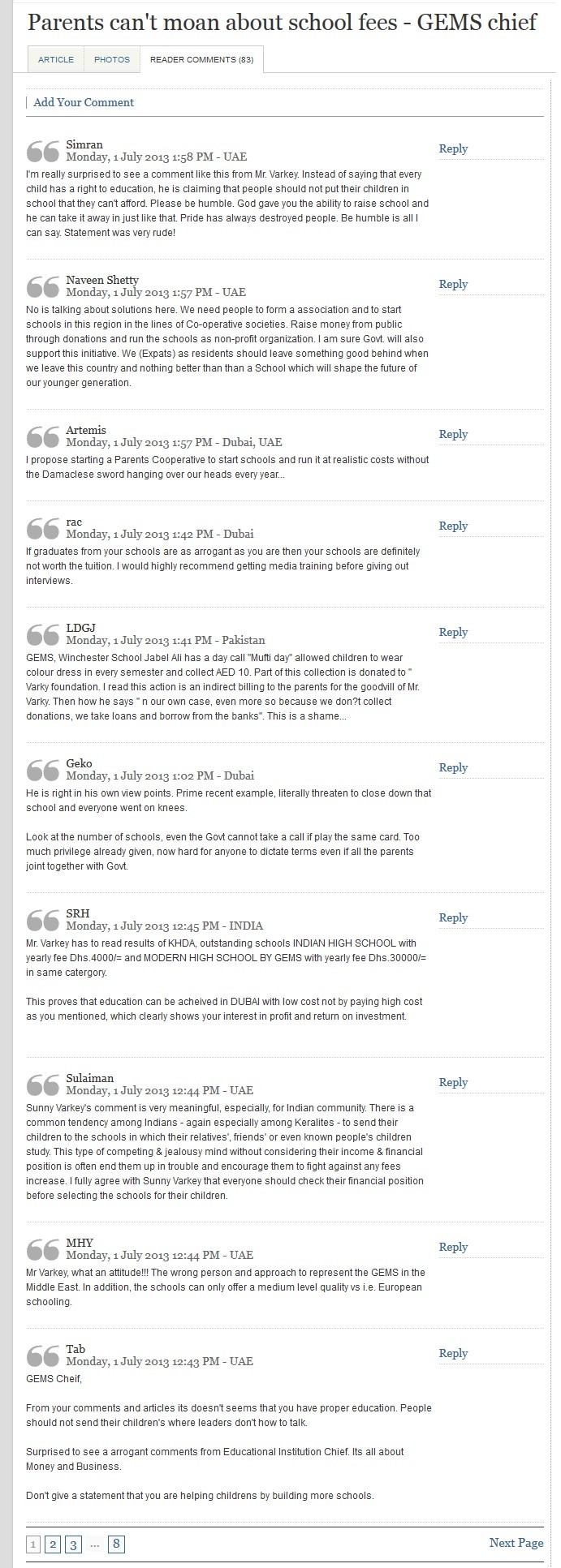
What happened to the comments on Sunny Varkey’s case of foot-in-mouth? I don’t know. But I can at least leave you this cached screen shot to show you that what goes on the internet can always be found!

Where did the comments go? Only ITP and GEMS will know!

Where did the comments go? Only ITP and GEMS will know!

Balancing the information load – Saudi’s Ministry of Health and the Coronavirus

Do images such as this reassure or panic the public? (picture credit: Arab News)

When it comes to many issues, be it driving or otherwise, religion, and long beards, the Kingdom has always made the headlines. However, Saudi Arabia has been in the news recently for what could be an emerging health pandemic. The disease, named the Coronavirus, was first discovered and identified in the summer of 2012. Since then at least 30 people have died in Saudi Arabia from the Coronavirus according to the World Health Organization as reported by Reuters on the 31 May.

The country’s Ministry of Healthy has been criticized over a number of issues related to the Coronavirus. First up was the issue of firing the doctor who discovered the first case in the Kingdom and reported the virus (for the full story click on the link here for the piece on the UK’s The Guardian.

However, recent criticism has focused on a lack of transparency when releasing information about the Coronavirus. An article yesterday published in the English-daily Arab News was particularly scathing (by Saudi standards). I’m linking the article here and will quote in full below.

A specialist in infectious diseases said that withholding information by the Ministry of Health about the spread of the coronavirus following the deaths of the infected patients is significantly damaging and provides no benefit.

The specialist spoke on the condition of anonymity. He said citizens and residents in Saudi Arabia have the right to accessible information about the disease.

“I do not know why the Ministry of Health discreetly hid the information of the first case of Coronavirus in Saudi Arabia, and the infection got to Al-Ahsa region where the disease has appeared and is starting to spread. They bear the responsibility for this,” he said.

The specialist suggested that the reality seems to be withheld from the domestic public opinion, and the public does not know if the ministry has detailed information about the spread of the virus and refuses to disclose it, or whether they have not reached any conclusion. He said the Ministry of Health looks at research centers in Saudi universities as competitors when the relationship with research centers at universities should be a complementary relationship, not competitive.

He added that MoH indeed prefers to discover the scientific research on diseases via universities abroad rather than Saudi universities, although there are a number of Saudi universities that enjoy a huge potential and have reference laboratories recognized by the World Health Organization (WHO).

However, the Ministry of Health refuses to cooperate with them because they perceive them as competitors in spite of their supportive work with the MoH, he said.

He said preventive measures taken by the Ministry of Health lacks transparency, with no announcement about where the spread of infection started and whether it originated in Al-Ahsa or came from abroad. He also noted that ministry did not give any scientific information or details about the reasons for the spread of the virus.

“Unfortunately there are no details and nothing was published except the number of cases and deaths. This is not enough. It does not allow us to investigate the causes of the disease.”

Today, he said, there are more than 30 cases, but there is no clear information about the source of the disease and we do not know the results of the investigations.

What’s prominent here is that the article is a translation of a piece from Al-Eqtisadiah newspaper. Both papers are owned by the Saudi Royal family and the fact that these opinions are now running in the local press doesn’t bode well for the Ministry of Health. There’s no name associated with the ‘specialist’ and no invitation to respond by the Ministry.

There’s a significant lack of information about the Coronavirus, and when there’s a lack of awareness about a public issue such as a suspected epidemic people will seek information from other sources, most especially social media. However, if a public body reveals too much information they will be open to criticism that they are creating an unnecessary panic. There’s an interesting take on this issue by one public health blog, the Avian Flu Diary, that I’m going to quote below (do read the article in full if you have time).

We may simply be seeing a public relations backfire created as a direct, and 100% foreseeable, consequence of an overly secretive Saudi risk communications policy.

If there’s one thing you can count on in a crisis, it’s that rumors and speculation will rush in to fill any information void.

The other possibility is that this outbreak is somehow substantially worse than we are being told. But if that’s true, it seems unlikely that they could keep it hidden for very long.

Which puts us in a watchful waiting mode, looking for any indication – one way or the other – of how this outbreak is playing out.

It’s hard to see how this case has brought to light any positives for any of the parties involved. However, if there’s anything to be learned my hope is that the Ministry hires a public affairs agency that is specialized in such crisis communications, as this issue has the capacity to become much bigger and at a pace that few communications people would be able to handle. Remember SARS anyone?

Getting the communications balance right – Ras al-Khaimah, beaches and modesty

This slideshow requires JavaScript.

I do feel for anyone who has to communicate on behalf of a government body in the Gulf. That’s especially so in places where there’s conflicting, divergent views resulting from a strong cultural diversity and significant business interests with the outside world. I remember the late Yasser Arafat often getting away with making one point in Arabic and then saying the exact opposite in English (there’s many other examples out there too). With the advent of the internet, social media, and a horde of citizen journalists out there in cyberspace it’s no longer possible to say explicitly different things to different constituents.

In this week’s The National newspaper in the UAE there was a great example of the above. On the 22nd of April police from the Emirate of Ras al-Khaimah announced a bikini ban for the area’s beaches. Ras al-Khaimah is a beautiful part of the United Arab Emirates. With a population of just over a quarter of a million people Ras al-Khaimah is known for its pristine beaches, and also for its rapidly growing tourism sector and free trade zone. However, the Emirate is also conservative. Trying to balance the two interests, tourism and tradition, isn’t easy as the below quotes from The National’s article on the 22nd April illustrates.

Bikinis have been banned from public beaches in the emirate as police urge residents to “use common sense” and dress modestly.

The municipality and police have put up signs on public beaches that state: “All coastgoers should commit to public morality and modest clothing”.

Offenders will be given a warning and after a second warning, they could face an unspecified fine.

The two most popular beaches in Ras Al Khaimah are located next to hotels where swimmers sunbathe in thong bikinis or trunks alongside women in burkinis, a modest full-body swimsuit designed for Muslim women.

On weekends and at sunsets, RAK’s public beaches fill with women in full hijab, who come with their families. Women in swimwear are a rare sight at these beaches and there are no women-only beaches in RAK.

In a plea to the public, police urged beachgoers to comply with “public morality and dressing modestly” to respect the country’s traditions and culture.

The move followed complaints by families about tourists who attended public beaches wearing indecent clothing.

The public have greeted the ban in Ras Al Khaimah, a conservative emirate with a large Emirati population. In RAK, it is common for women to dress for the beach by putting on more clothing so that they do not attract attention from men.

“I totally agree with that [ban] for us because it’s not a respectful thing to have on our beaches,” said Hessa Ahmed, a 31-year-old Emirati mother-of-two.

Many people, like Ms Ahmed, would like tourists to cover up but are too shy or polite to approach them. Her last visit to the beach ended abruptly when a man and woman in revealing swimwear sat near her family.

“I wasn’t sure about what she was going to do,” said Ms Ahmed. “I was afraid she would take off her top. So I preferred just to drive away just in case anything was going to happen, so I would just be away and my kids wouldn’t see them.

“There was no sign or board to inform these people you shouldn’t wear this, you shouldn’t wear that.”

Ras Al Khaimah has adopted a lenient approach to public dress in hotels but customs remains overwhelmingly conservative in public spaces, such as shopping malls.

The above was a great piece and insight into the challenges facing a country that is looking to adapt culture with business. And then came the follow-up article the next day in The National.

Police have backtracked over their statement that bikinis and tight trunks are banned from public beaches.

Revealing swimwear is not officially outlawed but strongly discouraged because of cultural sensitivities, police clarified.

“We respect the rights for people. We follow UAE law,” said Maj Marwan Al Mansoori, the head of public relations and moral guidance for RAK Police.

“Our campaign is not about catching people. We just want to tell people about our culture and our community.”

“You should respect our culture and our community rights but you have your rights,” said Maj Al Mansoori. “If it is under our law, you can do it.

“We wanted to tell people what we are thinking. It is communication between cultures. We want to explain this to people.”

It’s worth reading both articles in full, and to put this in its full context few Westerners will use a public beach in Ras al-Khaimah; all the hotels have private beaches which are fully equipped and only for the use of guests. However, such communications outreach isn’t going to help draw foreigners to a part of the country and world that has everything to offer. Perception is everything, especially online when social media is involved. The more people who talk about an issue, the more that issue or perspective is believed no matter its veracity.

This is a reminder about the challenges of trying to get the communications balance right in today’s connected world, where a tourism can view such news pieces while booking their vacation just as easily as a local sitting for a tea and reading the morning newspaper. Media relations is a tough job and I do hope that lessons are learned from this and that the right balance is found, both in terms of educating foreigners coming in (can you really tell someone what to wear after they’ve seen the glossy brochure/website, booked, traveled and arrived) and in preserving local cultural norms. And remember, if nothing else works there’s always the burkini!

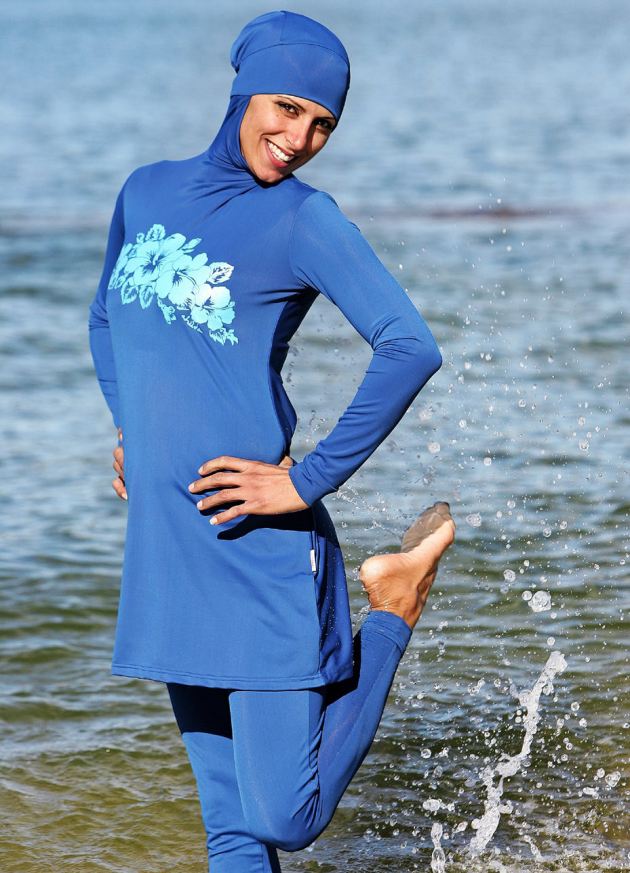
The burkini! Foot flicking and hands on hips are optional (credit alrasub.com)

Red Bull and a crisis in Kuwait that hasn’t hit the headlines

Surprisingly, Red Bull has not hit the headlines for what appears to be a number of major events in Kuwait. The company, best known worldwide for popularizing the energy drink concept, has apparently been embroiled in a crisis in Kuwait after a young Kuwaiti passed away after drinking too many cans of Red Bull. I’m going to continually use the word apparently as there’s no information out there in English and the only information in Arabic can be found on chat rooms.

According to Kuwait’s social media scene the Kuwaiti Ministry of Commerce has of the end of March banned all sales of Red Bull to those under 16 years of age. The below are a news piece from Kuwait’s news agency Kuna and an image shared over twitter of a Red Bull fridge with a sign in Arabic saying that Red Bull is not for sale to those under 16 years of age. Here is the same info on a discussion forum.

The article from Kuna on Kuwait’s decision to ban Red Bull sales to those under the age of 16. There’s no publishing date on this however (credit: Downtimes)

And a sign on top of a fridge which states that no sales of Red Bull are allowed to those under 16, which is supposedly from a Kuwaiti grocery store (credit: UAEwomen forum)

Kuwait’s Twitter community has also been focusing on the news, but surprisingly the topic hasn’t been trending outside of the country.

Whether this is all true or not, as it always the case with the internet the story is spreading especially in Arabic. The news can now be found on sites across the Gulf in Arabic. The fear may be that other GCC countries will follow Kuwait’s lead (such an action wouldn’t be unusual). However, it’d be fascinating to know what Red Bull has done to tackle this issue. There have been suggestions that Red Bull has upped its ad spending to tackle the issue, and that may explain why there’s little news of this in Kuwait’s vibrant media scene.

However, Red Bull has avoided the spotlight before. If you do read Arabic have a look at this piece on Red Bull apparently employing women to hand out cans in Riyadh back in December. Some would say brave, others would say silly.

Women walking outside of Riyadh’s Kingdom center apparently handing out Red Bull to passing motorists (credit: Murmur website)

Photo a pizza while on the move? 800Pizza’s Facebook Faux-Pas

It’s probably not a good idea to ask someone to take a picture while they’re driving. Taking this a step further, it’s probably even less of a good idea to spread that message via a social media platform such as Facebook. But that’s what one pizza company in Dubai did on Monday of last week.

Someone at 800Pizza (great name by the way) thought it’d be a good idea to ask its Facebook followers to take pictures of the company’s delivery drivers whilst on the road. Needless to say, apart from being illegal and downright dangerous the concept backfired and earned the chain a telling off both from a UAE-based road safety group as well as local newspaper 7Days. The article is a great read so do check it out here.

What did it for me (and made me write this) was the comment made by the founder of the firm to the newspaper, which I will quote verbatim below.

When contacted by 7DAYS, Alessandro D’ubaldo, founder of 800 PIZZA said: “I think this has been a bit of a misunderstanding and negative reaction.” Commenting on the edited post, the restaurant owner added: “We even changed the post and someone said ‘that’s just amending the wording, why don’t you remove the whole post?’

“But I don’t understand why they’re so upset – what is all this hate about?” D’ubaldo clarified: “We didn’t mean to tell people to go around and take photos with one hand while you drive with the other hand.”

D’ubaldo also said that he didn’t think the delivery bike drivers were aware of the campaign, adding: “They don’t need to be aware, it’s OK for people to just take pictures around in a public place.”

I’m thinking of launching a campaign to ask certain people to stay off social media. And it really would be for their own good.

You may strain to read this, but anyone encouraging drivers or passengers to take pictures while driving should be prepared for an online backlash

PS thanks Mita Srinivasan for pointing this piece out to me.

Oops. Time Out Dubai, Bars, Ramadan and #StopTimeOutDubai

Outrage, anger, and disapproval on today’s UAE Twitter feeds. There are times when you hold your head on your hands and wonder how anyone could have posted this or that online.

The veritable Time Out Dubai got itself into a pickle today with the below article which was published online.

The offending article on Time Out Dubai’s website today. The 5 to try: bars in Ramadan piece was pulled down earlier today

While Dubai does have its fair share of bars, the timing of the article wasn’t in the best possible taste. The holy month of Ramadan began last week. Ramadan is a time for reflection, abstinence and fasting for Muslims. While alcohol is not consumed by practicing Muslims it is freely available in Dubai. Places that serve alcohol during Ramadan do little to promote themselves during this month, and it’s beyond me why this article was even commissioned. Putting bar in the same sentence as Ramadan is bound to cause trouble and/or offense.

I don’t know for how long the article has been online but the tweets were rolling in thick and fast last evening and this morning. Here’s a couple of them below.

https://twitter.com/RoMaNiSta_8/status/227409821618536448

https://twitter.com/ShooshyDoll/status/227682853742329856

While there has been an angry reaction from many people online, there’s also been a good deal of messages defending Time Out Dubai (maybe not so much for the article per se, but for other reasons). Here’s a couple of examples.

I must give kudos to Time Out Dubai for their actions today. The magazine editors have taken down the offending article and they’ve apologized online and through social media. They moved quickly to undo the damage, promise that the incident won’t be repeated in the future and, most importantly, say sorry.

The only question now is, with this so much energy going into a campaign to preserving the sanctity of Ramadan will we see people online start rallying for other worthy causes? Famine in Yemen perhaps? Civil war in Syria? Let’s hope so.

And if you’re not enjoying your flight, just remember you’re not flying Middle East Airlines

If you’re really not enjoying that flight, if the in-flight service isn’t what you hoped for, or if your in-seat screen is not responding, just remember that you’re not flying on Middle East Airlines.

One traveler took on Middle East Airlines via social media. You can read about Hussein Dajani’s story here.

Or just watch the video, which is much more fun.

The one thing I will never understand is that while no one I know enjoys traveling on MEA, try and get a Lebanese national to fly anything else (if you’re flying from Saudi the choice is understandable). If you’re that unhappy, then show your displeasure by not using the airline.

Kudos to Hussein Dajani for taking on the airline and proving that consumers can make a difference through social media.