When is a brand-celebrity engagement toxic? The Etihad and Landmark stories

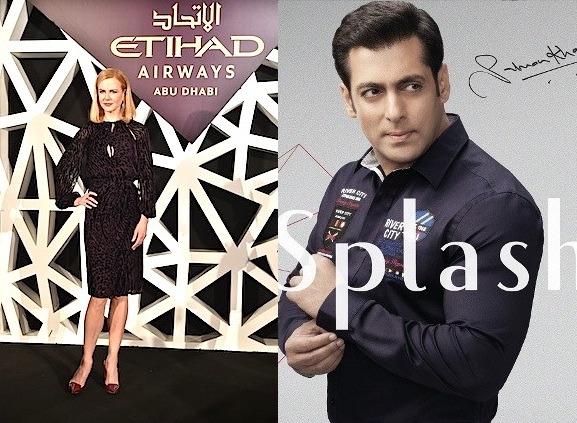
Have brand associations between Kidman and Etihad and Khan and Splash helped or hindered their respective brands?

Have brand associations between Kidman and Etihad and Khan and Splash helped or hindered their respective brands?

We just love celebrity endorsements. They’re useful for building brand equity, for improving ad recall, they convey celebrity status to the brand, and help brands stand out from the pack. When done right, celebrity engagements work wonders for the brand. Think Michael Jordan and Nike or Beyonce and Pepsi.

And then there’s what we do in the Middle East, specifically the Gulf. I’ve had a number of views come my way, particularly in relation to two deals which were done recently. The first is for the Abu Dhabi-based airline Etihad. In March Etihad signed up Hollywood actress Nicole Kidman to front up its latest advertising push which focused on Etihad’s redefinition of luxury travel. You can see the video below.

A global name, Kidman is Etihad’s fourth brand ambassador from Australia (can you name the other three, or the airline’s one Frenchman and German sports stars?). The discussion comes in around Etihad’s customer groups and how much the airline’s brand ambassadors actually resonate with these groups. Despite being Abu Dhabi-based and owned by the UAE’s capital, Etihad doesn’t have a single Arabic-speaking or Arab national as a brand ambassador. It’s hard to know how much Kidman would resonate with audiences in the Gulf, but Etihad hasn’t done much to find and leverage off brand ambassadors who’d appeal to Arabs in and around the Gulf (particularly those who are likely to travel in first class).

For Kidman, the association with Etihad has brought its own risks. Just a couple of weeks after the deal with Etihad, Kidman was criticized by a flight attendants’ union, the Association of Professional Flight Attendants, following her appearance in an advert for an airline it claims treats female employees “deplorably” and operates using “discriminatory labour practices”.

While there’s always a risk of being targeted, and criticized, by a specific interest group as in the case of Kidman, there’s even more risk to a brand’s equity when a celebrity misbehaves (think Tiger Woods and affairs with adult film stars) or does something which consumers may consider to be unethical.

One such example is Bollywood filmstar Salman Khan. Khan, who is an A-list film star in India, is the face of Dubai-based clothing retailer Splash. However, over the past week Khan was found guilty of committing manslaughter in a hit-and-run accident back in 2002 (Khan was allegedly drunk and lost control of his car, which slammed into a group of homeless people sleeping on a pavement).

The editor of Arabian Business, Anil Bhoyrul, penned a strongly-worded opinion piece on the issue only this week. The piece has gone on to become one of the most commented-on pieces in the history of the online news portal.

On a roll, Arabian Business published a piece about a public backlash against Splash for their support of Khan. You can read excerpts below.

Dubai-based Landmark Group is facing a public backlash, after the CEO of one of its leading brands described convicted Bollywood killer Salman Khan as a “great man.”

Bollywood star Salman Khan, who is a brand ambassador for Splash, was sentenced to five years in jail after being found guilty of killing a homeless man while driving under the influence of alcohol. He is currently on bail pending an appeal.

Khan was appointed as a brand ambassador for Splash in 2013, and is currently featured in a number of advertising campaigns for the retailer’s products. His face appears in several large billboards across Dubai, promoting clothing ranges.

But despite the conviction, Splash CEO Raza Beig said last week: “At Splash we love Salman Khan and we will support him through every up & down. My heart breaks to find out about the verdict but as they say every great man in history has gone through some struggle to achieve greater heights so probably this is his calling. We cannot comment on the judgement and do not believe he deserves it but Allah’s will it is.”

Will this brand association and the support of Splash’s CEO for Khan turn toxic and lead to a public boycott? What’s certain is that the Splash brand will not be helped by the current association with Khan, and the CEO’s stance would appear to be at odds with the opinion of many Splash customers. There is one truth all brands need to bear in mind – the consumer is boss. What matters is not what is important to us as people who manage the brand(s), but rather what is important to them.

What do you think of these celebrity endorsements? Are they flying high or are they a damp squib (excuse the puns). Share your thoughts. I’d love to hear from you.

How to destroy a brand through poor communications – the Nakheel example

Nakheel_flags

I’ll admit it. Every now and then I do get pangs of schadenfreude when I see brands being pulled up online by the media and the public. However, seeing a brand destroy itself is a different proposition.

I’ve been watching Nakheel for some time, and I’ve written about the company and its bad media habits before. The Dubai government-owned real-estate developer is responsible for some of the Emirate’s most iconic projects, including the Palm Jumeirah and The World. However, its customer service is, unfortunately, just as infamous as its successes are famous.

Last week, Sarah Townsend of Arabian Business wrote a scathing piece on Nakheel. Entitled ‘Nakheel PR: The toughest job in Dubai?’, she took a sledgehammer to Nakheel’s reputation The article is well worth a read, especially for those of us whom have spent long enough in the region to forget what quality journalism looks like.

If it were just one person taking aim at Nakheel, the issue would be manageable. However, due to our digital world reputation-bashing is a team sport. The article has gathered seventeen comments, all negative and some from disgruntled Nakheel owners. My favorite is the below.

A comment from a not-very-happy Nakheel property resident on the Palm

A comment from a not-very-happy Nakheel property resident on the Palm

On top of this, Nakheel is facing additional issues regarding its stalled Palm Jebel Ali project. However, it’s not the media which is causing trouble for Nakheel, but rather angry investors who have yet to see their properties take shape after years of delay. To quote from The National.

Hundreds of investors on Dubai’s Palm Jebel Ali have called on developer Nakheel to restart the project.

An estimated 400 to 450 people, most of whom made down payments during Dubai’s boom years between 2004 and 2008, find themselves in financial limbo.

All the units under the Palm Jebel Ali project, including its signature and garden villas and water homes, are “under cancellation”, according to Dubai’s Land Department.

In November, 74 homeowners wrote to Mohammed Al Shaibani, the head of the Ruler’s Court and Dubai Investment Authority, to look into the matter.

“The lack of certainty as to when our homes will be built has caused, and is causing, tremendous financial and emotional suffering for us and our families, and many of us continue to endure ongoing mortgage and rental costs while we are waiting,” the letter says. “Many of us have invested our life savings into the Palm Jebel Ali.”

Over a 100 Palm Jebel Ali owners have set up a group on Twitter with the handle @PJAOwners to lobby the government on their issue (bizarrely Nakheel doesn’t have an account on Twitter and there are several Facebook accounts, none of which seem to be legitimate).

For an organization which claims to be one of the largest and most successful property developers in the world, the media issues that Nakheel has gotten itself into are unforgivable (blacklisting the media doesn’t help). Having said that, many of the company’s issues are rather to do with how they operate. Public relations can never be used as a figleaf for unpopular or damaging actions. As Mark Twain said, “The public is the only critic whose opinion is worth anything at all.”

At the end of her article Townsend stated that Nakheel are looking for a PR exec to join their ranks. I could be even bolder and suggest that they look at how they do business and rebuild their reputation first. Anything else would be putting the cart before the horse and will continue to destroy what is left of Nakheel’s brand. I’m betting things will get worse for Nakheel in terms of its brand image and reputation. But I won’t take any pleasure from watching this sorry story of a brand being destroyed from within.

Educating the Gulf on our humanity through social video – examples from Bahrain, Saudi and the UAE

Here in the Gulf region we’re increasingly seeing the use of online video content, particularly to tackle issues that are both social and controversial. This week there have been media stories on three examples from three different countries.

The first video has been produced by the Saudi Human Rights Commission to Saudi nationals to be kinder to their domestic workers, most of whom have to leave behind a family of their own to earn a living and support them. The video is well shot, and aims to give humanity back to domestic workers, especially those from South East Asia, through concepts such as motherhood.

The second is from Bahrain, but shot by one social media influencer called Yousef Al Madani. The clip focuses on the treatment of white-collar workers in Bahrain, most of whom come from the Asian subcontinent. Yousef looks to take the place of one of these workers at a local grocery store, where they often have to rush out to take orders from customers who sit in their cars and wait for the items to be brought to them. The clip, which has been talked about in the media, has been viewed over half a million times. This video is dubbed into English as well.

The third and final clip is from a corporate, Cola Cola to be exact. To quote the National:

An online advertising campaign by Coca-Cola showing the company handing out excess baggage tags at the airport to travellers has been viewed almost one million times on YouTube.

The clip “Coca-Cola –Taking Home Happiness” begins by showing passengers checking in at Dubai International Airport to head off to various destinations to see family. By Thursday, the video had generated more than 987,000 hits since it was uploaded a month ago. According to the website for Campaign Middle East magazine, Coco-Cola shot the video on December 22 with the cooperation of the airport.

The campaign – which is available only in the UAE and Oman – is expected to expand with additional prizes like flight vouchers, TVs and mobile phones, the company said. The video follows a similar online campaign last year which showed labour camps with Coca-Cola phone booths, into which bottle tops rather than coins could be fed to pay for international calls.

The video, which is probably the best shot out of the three (this is Coca Cola after all), is also dubbed.

What are your thoughts on the above? Are these videos effective? Would they have been more effective on television as well, or less effective? And is one more effective than the other, possibly due to its topic, its producer, its intent as well as its authenticity? Do let me know your thoughts.

Should executives say sorry? Just Falafel’s ‘we forgot about the food’

Do you agree or disagree with what  Mohamad Bitar did, and why?

Do you agree or disagree with what Mohamad Bitar did, and why?

Should we admit when things don’t go the way we planned? It’s a tough one. Few corporates hold up their hands when plans go awry (unless there’s a crisis of biblical proportions). US-based corporates such as Walmart are now taking on media outlets to argue their point (this post from Walmart is a remarkable example of fighting back).

Even fewer company bosses in the Gulf go off track and talk from the heart. However, as with everything there are exceptions. Just Falafel is often touted as a home-grown success story, a tale of how a local brand has become global. Founded in 2007 in Abu Dhabi, the falafel-focused outlet has approximately 52 stores in 18 countries according to its website.

However, the chain isn’t to everyone’s tastes. A news story on the English-language website Arabian Business which announced the reasons for the departure of the chain’s former CEO Fadi Malas was used as a comment board by readers to explain their reasons for not liking the brand’s falafel.

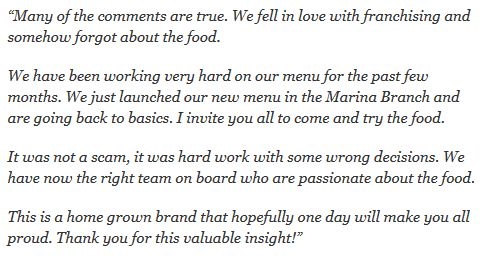
Fair enough you may say. But what followed was either inspirational or horrifying depending on which side of the open/control communications fence you’re on. The Just Falafel founder and MD, Mohamad Bitar, took to the site’s comments section to explain how the company had “forgot about the food”.

The comment as written by just Falafel's Bitar on ArabianBusiness.com

The comment as written by just Falafel’s Bitar on ArabianBusiness.com

The hacks at Arabian Business then took Bitar’s comments and span out a new story, to which readers took to explain what they believe went wrong and how Just Falafel can put it right.

For some consumers, an admission of error can be a powerful tool to reassess and re-engage with a brand. For others, it’s all about projecting an image that others can believe in, and not deviating from that message. Is Mohamad Bitar’s message a moment of genius (if we were in America, I’m sure we’d be calling his move crowd innovation), or does it signal a need for someone to crack the whip at the brand and get everyone on message?

Your thoughts?

Changes in the Region’s Media Scene – BuzzFeed in, Dubai One is out, and we say goodbye to Iain Akerman

In the spirit of Ramadan, here’s a BuzzFeed cat meme to get us all excited! (image source: BuzzFeed)

The summer is traditionally a quiet period for the region; the same goes for Ramadan. This year seems to have been the exception to the rule. First, we had Gulf News reporting that BuzzFeed is considering opening an office in the Middle East. The website publisher, famous for its kitten memes and political coverage, apparently sees an opportunity in Arabic with a local audience, according to the piece written by Gulf News’ Alexander Cornwell.

BuzzFeed, the news and entertainment website best known for its pictures of cats, wants to expand into the Middle East with the launch of an Arabic website.

Launched in 2006, the United States website, which is steadily increasing its hard news content, has already launched UK, Australia, France, Brazil and Español (Spanish) editions. Since November 2013, the website has seen more than 130 million unique monthly visitors, of whom 30 per cent are from outside the United States.

Scott Lamb, Vice-President of International, BuzzFeed, told Gulf News in a phone interview that the Middle East is one of two regions where BuzzFeed is most interested in expanding to.

“There is nothing like BuzzFeed in the Arabic-speaking content,” he said…

Lamb said that there is no set date for the launch of the Arabic language website and that it would have to wait until next year after Germany and India, indicating that the finer details are yet to be worked out.

Asked where BuzzFeed would base its regional operations given that many major international media outlets have set up bureaus in Dubai in recent years while Beirut and Cairo are seen as more traditional regional hubs for news bureaus, Lamb said that it had not been decided.

“We’re not that far down the road,” he said, “We have a fairly big office in London. One possibility would be doing a lot of the coverage from there. But if we were to set up in the region, we would want a physical presence.”

BuzzFeed New York office produces much of its Spanish content.

BuzzFeed started producing hard news content in 2012 with coverage of the US presidential election. Since then it has hired Miram Elder, recruited from The Guardian, as its Foreign Editor.

Internationally, BuzzFeed has had reporters on the ground covering Syria, Iraq and Ukraine. Elder has also led coverage of two topics that are heavily discussed on social media, women’s rights and lesbian, gay, bisexual, and transgender (LGBT) issues.

“We saw this very vibrant conversation around the news in those two spheres [and so] we wanted a team to create original content,” Lamb said.

BuzzFeed plans to continue to increase the amount of hard news content, but Lamb said it would not be stepping away from the traditional social media friendly content of cute cats and quizzes that it is still best known for.

“Ideally, we are looking for a 50/50 mix … we try and keep it very balanced,” he said.

As if the thought of cat memes alongside Arabic-language LGBT news wasn’t enough, the second piece of news was the closure of Dubai One, the English-language television station run by Dubai Media Incorporated (DMI). The channel, best known for programmes like HerSay and Out and About, will lay off 80 percent of its staff as reported by Arabian Business.

Dubai One was created to cater to expatriates in Dubai and the wider region. The channel has fallen behind the likes of satellite provider OSN and the Saudi-owned giant MBC.

Sarah Ahmed Al Jarman, the general manager for Dubai One, told Arabian Business via email that “we have stopped our 4 locally produced shows”, without elaborating. Al Jarwan also referred any further questions to the DMI inhouse public relations team.

And last but not least, we have to say a sad farewell to the Editor of Campaign Middle East, Iain Akerman. Iain was spoken of by those in the creative and media sectors as a journalist to be both feared and respected – he’d chase his sources for breaking news and he’d often champion investigative journalism. I once remember talking to one agency head who referred to Iain with a pained expression. Iain, I wish there were more like you here. You will be truly missed.

Reputational Issues and the Pressure from Outside to Change – Will the Gulf’s Firms Be Forced to Adopt More Worker-Friendly Policies

Smile for the media! Will Gulf-based airlines be forced to change their employment practices or will they risk possible reputational damage in the face of criticism from the foreign press? (image source: http://www.nycaviation.com)

First there was Qatar and now the UAE. I’m not talking GDPs, economic growth or any other metric that a government may promote in the public spotlight. Rather, I’m talking about media criticism, notably international media criticism of worker rights.

Over the past couple of weeks a series of articles have been written, mainly by the European media, critiquing the lack of rights for employees of Qatar Airways and Emirates. The pieces, in particular a lengthy series of allegations in Swedish newspaper Expressen, have shone a light on employment practices, many of which appear distasteful to those not used to working or living in the Gulf.

The article in Expressen entitled the Truth About the Luxury of Qatar Airways details the conditions under which Qatar Airways employees have to live. The report, which can be read here, tells of strict curfew times for air hostesses and pilots, constant surveillance, and instant terminations.

Others have run similar allegations. Even locally, we’re beginning to see these articles appear in the press; Arabian Business recently ran two pieces on the HR practices of both Qatar Airways and Emirates.

With a global presence comes greater media scrutiny. Similarly, global events on your doorstep can attract negative headlines (look no further than Brazil in the run up to this year’s World Cup or even Qatar, the 2022 World Cup andthe country’s labor camps).

In a sense, I’m surprised that this hasn’t happened sooner. The region’s three big airlines are global players who aim to capture transit traffic which they shuttle through their hubs in the Gulf. Similarly, the region’s sovereign wealth funds have been snapping up brands globally for some time now, but especially in Europe where trophy assets have become a staple for SWFs in Doha and Abu Dhabi.

So, how do the airlines react? Never one to be outdone for a quote, Qatar Airways’ CEO has furiously denied all of the allegations and has instead railed at the newspapers printing the articles and called them, in effect, racist. To quote from Arabian Business:

“Like any other organisation, we terminate nonperforming employees and these are allegations made by ex-QA staff.”

“This is not against Qatar Airways but against my home country. They are throwing stones at my country for no reason at all.”

Emirates has been more low-key in their response on the claim that they mistreat female employees by firing female cabin crew who become pregnant during the first three years of their employment.

In the long-term how should the airlines respond? If they continue to deny or ignore the allegations, will they face a backlash from consumers concerned about the airlines’ reputation? What’s certain is that the headlines are not going to go away; to the contrary, the deeper you dig, the more bodies you will find. It’s going to be fascinating to see if the negative media coverage from outside the region eventually forces a change in worker policies.

This is one theme I’m going to be following with increasing interest.

Why stonewalling the media is always a bad idea: Nakheel and Arabian Business

Another day, another flood. Nakheel’s attempts to stem the tide of negative PR by not talking to media simply won’t work (image source: arabianbusiness.com

For those that don’t know Nakheel, you’re in for a treat. The Dubai government-owned real estate developer and the name behind the world-famous Palm Jumeirah is a byword for customer relations fiascoes these days. The company has run into a number of public relations calamities over the past two year, including issues such as service fees, numerous floods, and, most recently, a new development with lakes forming from putrid water.

Like any other company, Nakheel has both fans and detractors. However, a recent story on Nakheel by popular Dubai-based news portal Arabian Business raised my interest. The piece, which was about the recent flooding at Nakheel’s Al Furjan development, included a significant paragraph at the end.

* Nakheel no longer responds to media enquiries from Arabian Business, nor does it grant this publication access to any of its media events or announcements.

When a company feels that it has to stonewall, restrict access to and stop all relations with a media outlet there’s something very wrong. Whatever the company expects to gain from this action, I can guarantee all that will result is more negative publicity and an inability to counter negative stories by providing comments from the company itself.

In these cases, my advice to any company facing a barrage of negative media is understand what is at the core is the issue and why there’s so much negativity surrounding the company’s public perception. For Nakheel, maybe their time would be better spent addressing customer service and engineering issues rather than duking it out with the media. In the meantime I’m looking forward to reading more stories about the company on Arabian Business.

GEMS foot-in-mouth syndrome and the curious case of the disappearing comments

Please don’t put your foot in your mouth. If you have to say something do mutter the words when the room is empty, or when you’re in the middle of the ocean. And it’s also advisable to stay away from media (image credit: http://www.ronedmondson.com)

There’s a condition that I like to name foot-in-mouth syndrome. Basically, foot-in-mouth happens when an executive talks to a journalist and doesn’t think before they speak. This results in classic ‘how did they say that’ quotes which often whip up a storm of protests from all and sundry.

This week we had one of the best foot-in-mouth moments I’ve read for some time. The chairman of GEMS Education, the UAE’s largest provider of primary and secondary education, gave an interview to Gulf Business. The story was rapidly picked up by Arabian Business and has provoked hundreds of comments from some very angry parents. The quotes which did the (most) damage were below.

Parents have no right to complain about fees if they choose a high school they cannot afford, GEMS Education chairman said of “grumbling” parents in an interview with Gulf Business.

“If you put your children in a school that you can’t afford then you can’t grumble,” Sunny Varkey said.
“You understand what I’m saying? You must choose a school that you can afford.

“It’s normal human behaviour [for parents] to defend fees. But parents can very well see which are the schools that are good, outstanding, fair, or not good. And, accordingly, they can choose a school.”

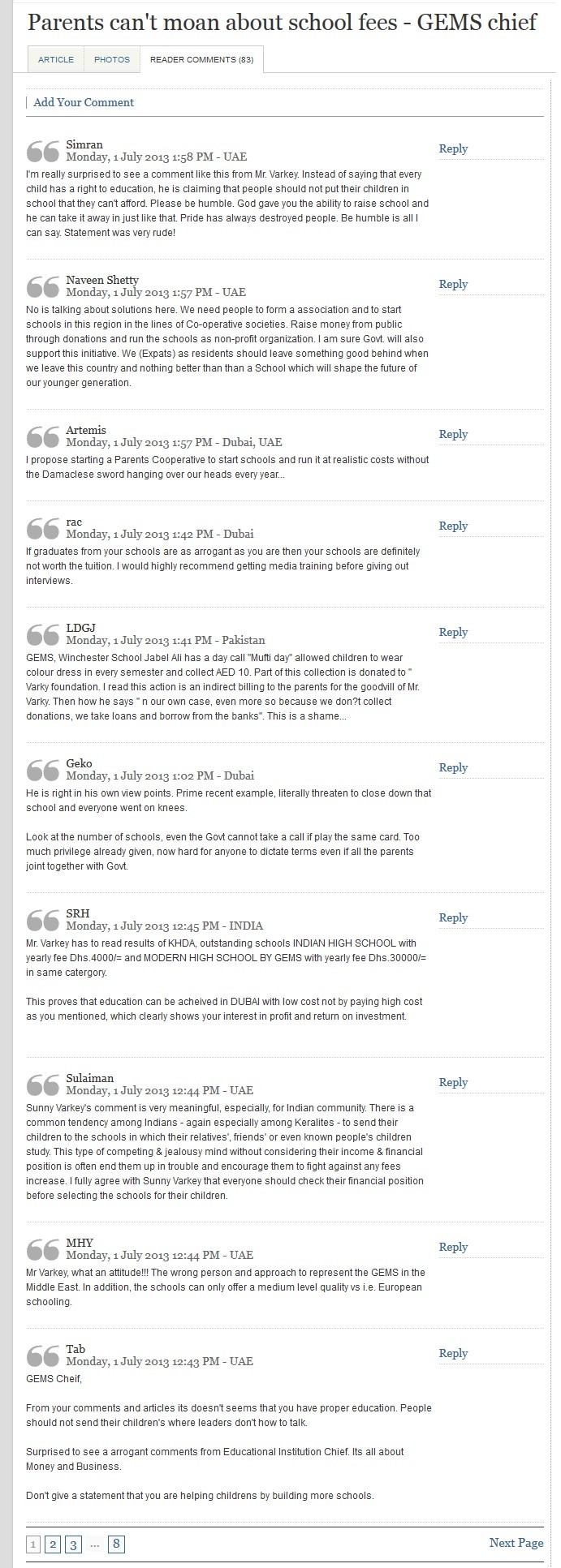
I love media sites on the internet, partly because of the ability to leave comments and the inevitable pearls of wisdom that readers leave. Varkey’s foot-in-mouth (and if you can’t see why this is a disaster of an interview for Varkey, you’re beyond the pale) was attacked from all sides by parents. Comments included such wonders as ‘It’s no wonder GEMS and HSBC (?) are the two most hated firms in the UAE’, and ‘If graduates from your schools are as arrogant as you are then your schools are definitely not worth the tuition. I would highly recommend getting media training before giving out interviews.’

I wish I could show you more comments; the last time I saw the piece with the comments section still live there were 98 printed which must be a record for the site. However, Arabian Business’ publisher ITP has taken off comments for this piece, either due to the severity of the comments or, more likely, someone possibly threatening legal action.

What happened to the comments on Sunny Varkey’s case of foot-in-mouth? I don’t know. But I can at least leave you this cached screen shot to show you that what goes on the internet can always be found!

Where did the comments go? Only ITP and GEMS will know!

Where did the comments go? Only ITP and GEMS will know!

Mission Impossible? Rehabilitating the image of the UAE’s expat education system…

The question used to be who’d be a teacher. Today it’s more likely be to who’d be a school owner in the UAE? The country’s private education system has been under attack recently for the cost of educating (mainly) expatriate children. There was a wonderful article written by Arabian Business Editor Courtney Trenwith about the issue of high school fees in the UAE, and an apt comparison was made between secondary education in the UAE and tertiary education back in the United Kingdom.

An Arabian Business investigation last month revealed the startling fact that it costs more to send a child to some Dubai schools than a British university.

Fees for a three-year old are as high as AED55,000 (US$15,000) per year, while they escalate to AED69,283 for a typical child aged six to nine, to AED79,733 for many ten to 13-year olds and as much as AED96,140 for the most expensive secondary schools.

Meanwhile, a year’s tuition at universities such as Cambridge and Oxford is less than AED53,000. Until recently, UK university fees were even cheaper.

One of the largest private education firms is GEMS, which claims to educate over 110,000 children and be the leading Kindergarten to Grade 12 private education operator in the world. In December of 2012 GEMS announced that it would close Westminster School in Dubai, which caters to 4,800 pupils from ages five to 18-years old.

The issue which has been covered extensively by the online portal and business publication Arabian Business has caused an uproar with parents who are naturally concerned about the disruption to their children’s education. In a letter sent to parents which was published by Arabian Business, GEMS said the Westminster School would shut in June 2014 with students being given priority placement in other GEMS institutions.

“In recent times our ability to invest the resources required to produce the improvements needed, both educationally and in infrastructure, have been severely restricted because of the current fee structure… We simply cannot offer a high quality education at this level that we see as our duty to provide. Indeed, salary increases during the same period have been at a level higher than any fee awards,” wrote GEMS executive director Dino Varkey to parents.

And now we come to the issue of communications. There are few subjects as sensitive as education, especially when it is for your own children. As the largest company in the industry and one which seems to be making the most headlines, GEMS should realize it needs to do more in terms of its messaging. The company is currently looking to hire a PR and communications manager in Dubai through LinkedIn (if you’re interested in Mission Impossible do click through here).

The question I’d pose to GEMS is how can anyone justify charging more for a year in high school than for a year in university? As there’s little to no public schooling system here for expatriates (in theory an expatriate child can go to a government school but fees will still apply) what are parents to do apart from swallow the bitter pill? But will that help GEMS and the other companies in the long-run? Isn’t the issue more than simply looking at how to spin the company line on high educational costs and school closures? Isn’t this more about the fundamentals of the business, which need reassessing?

The very same Dino Varkey told Arabian Business editor Anil Bhoyrul in an interview in March 2011 that:

“The ambition that we work towards is five million students by 2024. If we got to the five million number as a conservative [estimate] we would be a $60bn company; we would be employing 450,000 teachers, 55,000 senior leaders – that’s the size of organisation that we are trying to build. ”

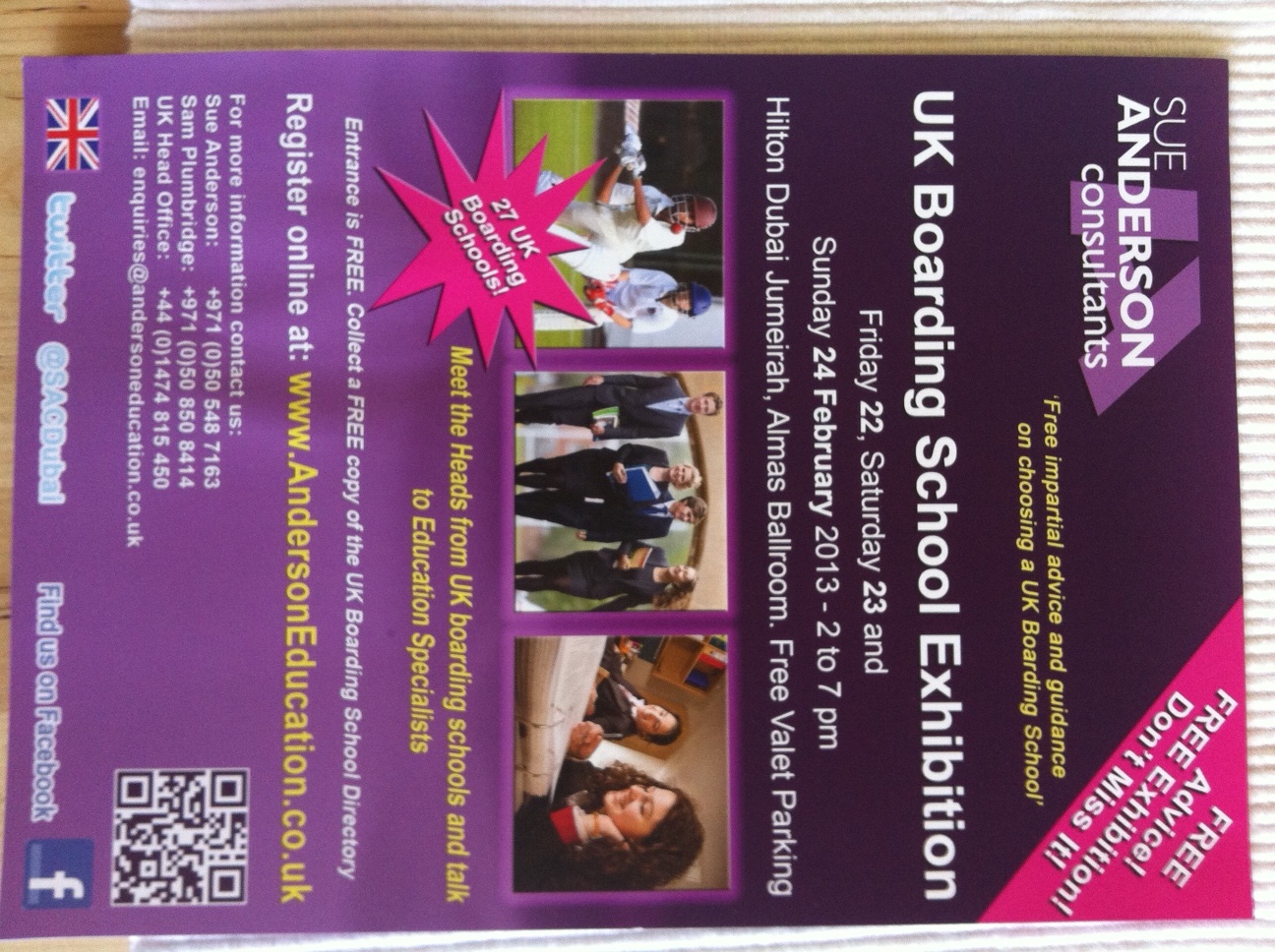
In the meantime I spotted this recently in a book store in Dubai. As always, if you don’t keep the customer happy someone else will muscle in and try to offer a better service at the same or a lower cost regardless of your communications strategy.

There's always an alternative but would your child be happier and better off boarding in the UK than going to school in Dubai? And would it be cheaper?

There’s always an alternative but would your child be happier and better off boarding in the UK than going to school in Dubai? And would it be cheaper?