Innovation and the need to think simply

Innovation starts with the ability to ask a question

Innovation starts with the ability to ask a question

This week is a special one in the UAE – it’s officially Innovation Week and the country is full of activities extolling the virtues of innovation and all that this word entails (I admit, I’ve come to dislike this word, not because of what it stands for but rather its constant misuse).

As I’m a media junkie, two news pieces stuck out. The first was an effort by the Dubai Media Office to promote innovation through its Media Innovation Lab, a quarterly event that aims to promote a culture of innovation and creativity in media. To quote from Emirates 24/7, “the initiative seeks to share knowledge on media-related innovation among corporate communication and media professionals and media students. It is also in line with the UAE leadership’s directives to promote innovation in all sectors.”

The second is even more ambitious, and, quite literally, out of this world. I’ll let The National’s copy explain this innovation for you:

High school and university students from across the UAE have the chance to directly shape the future of space exploration.

Two competitions giving them the opportunity to watch their experiments blast off on a rocket to the International Space Station were announced on Tuesday at the launch of The National Space Programme in Abu Dhabi.

In the initial stages of the programme, The National, Abu Dhabi Media’s English-language newspaper, has linked up during Innovation Week with the UAE Space Agency, Boeing and other public and private organisations.

The National Space Programme contests are Genes in Space, challenging high school pupils to create a DNA analysis experiment, and the Satellite Launch project, in which a university team will build a satellite.

There’s a third strand I’d like to bring in here. I had the pleasure of talking to a university professor who teaches media here in the UAE. He was recalling the story of an occasion when the power failed at his academic institution. One of his students, a local, asked if she should cover the happening for the university student publication. He said yes and encouraged her to go and follow up with the operations department who look after issues relating to maintenance.

This student did just that and headed down to the operations department to understand more about the power cut. When she did meet someone, she asked what happened and explained why she was asking a question. And the response? “Why are you asking such questions? Who is your professor?”

While I love the ambitions of blasting into space or talking about creativity in the media, I’d love to see us put our feet on the ground and push for a climate where a question is welcomed, both from each of us as individuals as well as the media. As for the curious student, the brave lady did publish her story. She’s my innovator this week.
More media launches in the Gulf – Newsweek Middle East and Inc.

Who wouldn’t want to be a publisher in the Gulf right now? While the industry is losing money left, right and center in the US (and in Europe), the Gulf is seeing a glut of publication launches. The newest titles are Newsweek Middle East and Inc. Newsweek Middle East was launched recently by ARY Digital Network, a Pakistani television company. Their first issue was launched in English at the end of October and an Arabic edition is also in the pipeline. The website is http://www.newsweekme.com. The publication’s two front pages are below, along with a short video from their Twitter feed (the team have accounts on Facebook and on Instagram, and for those of you young uns out there, they are also running a Snapchat account under the name @NewsweekME).

The second publication, which is yet to launch is Inc. magazine, a monthly publication focusing on fast-growth companies. To be based in Qatar, the publication has been hiring journalists from Dubai publishers and should launch by the turn of the year in both English and Arabic.

https://twitter.com/NewsweekME/status/659700459763015681

https://twitter.com/NewsweekME/status/662256194749390848

https://twitter.com/NewsweekME/status/659419348239446016

While the launches of local editions for two global titles is to be welcomed, especially the Arabic-language editions, the question is if/when will this region suffer the same slowdown in terms of ad sales (Newsweek stopped publishing in the US for sometime in 2012 and 2013 and went fully digital for a year). With the Gulf becoming a global pioneer in terms of digital firsts among consumers (for example smartphone penetration, social media usage), will advertisers realize there’s more ROI to be had in advertising online rather than in print? Let’s wait and find out.

Local Insights – the UAE’s Media Coverage of the Conflict in Yemen

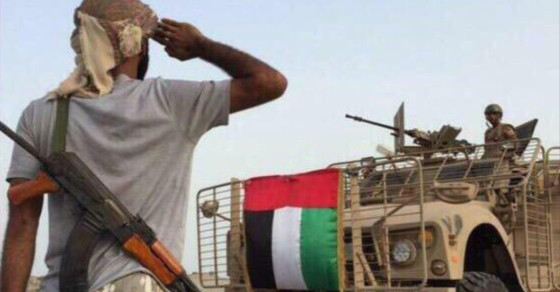
The conflict in Yemen and the UAE's involvement has helped to bring the community together, according to Emirati editors (image source: vocativ.com)

The conflict in Yemen and the UAE’s involvement has helped to bring the community together, according to Emirati editors (image source: vocativ.com)

I wanted to share a fascinating view into Arabic-language media opinions here in the UAE. This week saw the Emirati Media Forum here in Dubai. One of the topics up for discussion was the coverage of the conflict in Yemen. The conflict, which the UAE has been an active participant in since March of this year, has claimed the lives of approximately 70 Emirati combatants. The text below is from Gulf News and is a unique glimpse into how the conflict and those Emiratis who have died have helped to shape the Arabic-language media sector in the UAE and its coverage of the conflict.

The ability of Emiratis to transform tragedy into a sense of unity and national pride was the focal point of discussion at the second session at the Emirati Media Forum.

The session’s theme was ‘The UAE media’s responsible stance on the Yemen events’.

Mohammad Yousuf, president of the UAE Journalists Association, said the media was able to transform the sense of shock, tragedy and loss to positivity and pride.

Sami Al Riyami, Editor-in-Chief of Emarat Al Youm, said the Yemen war was a new experience for the UAE and for the people in the media sector.

“The news came as a shock to us too, as we are humans and Emiratis before we are media people. We were shaken by it as we were not used to seeing the bodies of our martyrs wrapped in the UAE flag — it’s an overwhelming sight. But we were able to turn the tragedy into love and pride for our country,” he said.

Explaining through various media channels why the UAE went to war, what the martyrs died for and what war entails helped in [achieving] this transformation, he said.

The media had no shortage of stories of heroism to write about, Al Riyami said, as the stories just presented themselves.

“It was not about scooping [from] other media outlets; we were all working together so we could get the information out to the people.” Al Riyami said.

In one instance, he said, one of their correspondents lost contact and they had no material to publish. Al Riyami said he called one of his contacts in another newspaper, who gave him the news material to fill the gap in coverage.

“It is our national duty, not a competition about who is getting exclusive content,” he said.

Ali Obaid Al Hameli, director of Dubai TV’s News Centre, said that with the loss of the first martyr on July 16 this year, media outlets felt a great sense of responsibility on how best to break this news to the people of the UAE and, more importantly, to the families of the martyrs.

“The UAE leaders’ engagement and stance and their heartfelt visits to the families of the martyrs and the wounded helped change people’s attitudes and made our job easier,” he said.

He said that they were shocked when they visited martyrs’ families, as the families were the ones consoling them and raising their spirits and not the other way round.

“Many of the families wished that they had more children — brothers and sons — to fight for the UAE,” Al Hamli said.

Abdul Hady Al Shaikh, executive director of Abu Dhabi TV, said that the media also shed light on the humanitarian efforts of the UAE in Yemen — and not just on the military intervention.

“We also wanted to show the Yemeni streets and people, not just coverage of our troops there,” he said.

On the topic of social media’s role, Al Riyami said it is every Emirati’s duty to offset rumours that surface on this platform, by giving correct information on the subject.

The Gulf’s push to improve its image – why actions speak louder than words

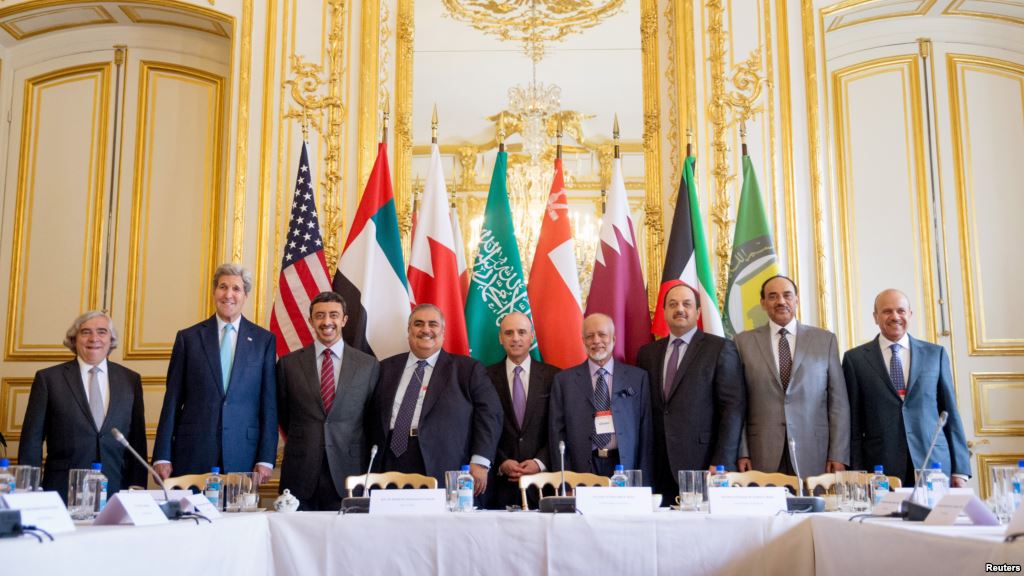
The Gulf's foreign ministers have worked hard to change perceptions of the region abroad. But is there a simpler solution?

The Gulf’s foreign ministers have worked hard to change perceptions of the region abroad. But is there a simpler solution?

I love a good read, especially fiction. But when living in the Gulf, fact can often feel more surreal than fiction. Last week the UAE’s English language daily Gulf News reported on efforts by the six-member Gulf Cooperation Council to improve its image abroad, most notably in Europe and the US. To quote from the newspaper:

Foreign media officials in the Gulf Cooperation Council (GCC) have stressed the need to formulate a common media strategy that will reflect the positive image of the six member countries abroad.

The officials, who were holding a meeting in the Qatari capital Doha, reviewed plans and suggestions for future actions in their communication drive with the international community.

The GCC, established in 1981, comprises Bahrain, Kuwait, Oman, Qatar, Saudi Arabia and the United Arab Emirates.

“The participants discussed several issues related to the progress of their work, including a common strategy to rectify the distorted image that some Western media have about the countries in the region,” Ahmad Al Buainain, the head of the foreign media department at Qatar News Agency (QNA) said.

“The meeting also discussed several papers and new ideas regarding the way forward for the GCC foreign media in European and Asian countries in order to convey the realities on the ground, he said, quoted by QNA.

Plans include holding seminars and meetings with research centres or organizing events at international functions in Europe and in which the GCC countries are participating, he added.

“This new drive is a continuation of the activities conducted by the foreign media officials at past events,” he said.

Ahmed Mussa Al Dhabyan, the head of media cooperation at the GCC Secretariat General, said that the GCC foreign media officials sought to build on their successful experience and formulate a new strategy that matched the latest developments in the communication field.

“The world has gone beyond the global village concept and has now become a single house,” he said. “The GCC has a significant political and economic weight and it has a special standing internationally, and therefore it needs to have a foreign media presence that matches its stature,” he said.

Earlier this month, reports surfaced from Washington D.C. that Saudi was hiring a variety of lobbying groups to bolster its public image in the US. Clearly, the Gulf cares about its reputation abroad, especially when the region’s governments see what they feel to be negative coverage.

On his Facebook account, political commentator (and Sharjah royal family member) Sultan Al-Qassemi gave his take on the article in the Gulf news with a list of suggestions to improve the Gulf’s image abroad.

1- Release activists.
2- Suspend capital punishment.
3- Allow political participation.
4- Eliminate Kafeel (sponsorship) system
5- Expand women’s rights.
6- Enact environmental protection.
7- Broaden citizen’s rights.
8- Bolster freedom of expression (yes within “limits”)

I’d make it even simpler. As any good and ethical public relations practitioner will tell you, your actions speak louder than your words. If the region is serious about tackling any negative perceptions or reputation issues abroad, then behaviour which is contradictory to accepted human norms in regions outside of the Gulf (read the West) must be tackled, and free(r) access should be given to the media. With social media and the internet, it is so much harder to hide anything or to spin information or events. Take for example the leaking of documents from Saudi’s Foreign Ministry recently.

The best way to been seen in a positive light is not more seminars or meetings in European capitals with research centers. Instead, one must behave in a positive light, followed by encouraging the media, both local and international, to report without bias.

While I’ve been in this region long enough to know better, I am still an optimist at heart. And I still believe we are capable of change for the better, as this region is magical in so many ways. However, a word of note. If my face turns shades of blue or purple, do please remind me to breathe.

The Real #EtisalatChallenge – Where are the eGlobe Cards?

Do you know about the eGlobe card and where to find it? Is this the real #EtisalatChallenge?

Do you know about the eGlobe card and where to find it? Is this the real #EtisalatChallenge?

It’s Gitex week, and its technology time. For those of you who don’t know Gitex, imagine tens of thousands of people talking about hardware, software and all things geeky. But I digress.

We’ve had our little bundle of joy and we’ve been lucky enough to have another addition to the family this month. To help her feel at home, we wanted to buy phone cards so that she could use the landline and she’d know how much she’d spend each time she’d call home (why not a mobile you ask? Well, landlines offer better voice quality, more stable connections and are usually cheaper).

After a little bit of research and a lot of shop visits, we realized that the VoIP calling cards which were being advertised at the start of the year by the two phone companies Etisalat and Du, Five and Hello! respectively, were no longer on sale (though you’d be hard pressed to find an announcement in the media).

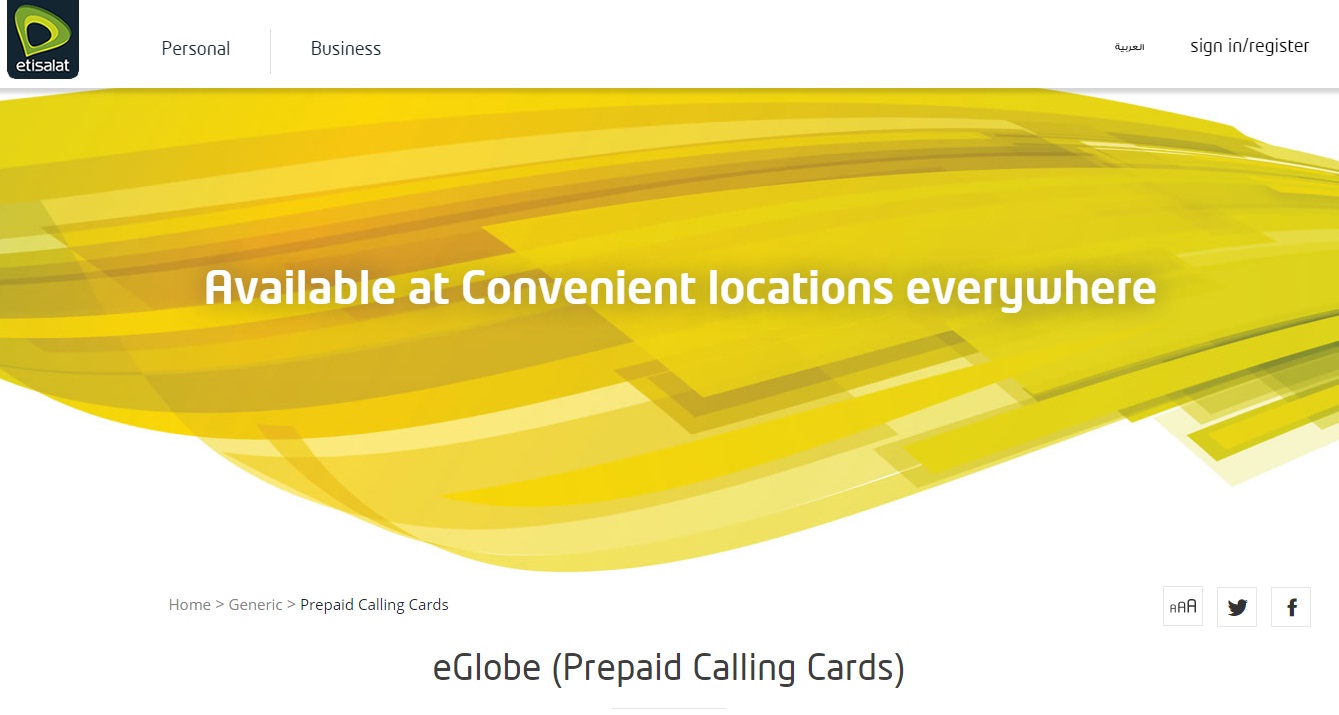
Instead, Etisalat, the UAE’s largest phone company, was offering on its website a solution called eGlobe. To quote:

Use your prepaid, disposable Calling Cards for services such as recharging and renewing your Landline Prepaid (Maysour) account, Home Country Direct calls, Prepaid Internet, eVision pay-per-view, Hotspots, and more, in addition to national and international calls from any phone.

All well and good. But where can one buy them?

Buy Prepaid Calling Cards at
• Your nearest Etisalat Business / Service Centres
• Supermarkets, grocery and convenience stores, other outlets

So off I went. To the first store, where the response was, “What?” Ok, it’s a small store. Maybe they’ll have the cards at the local Co-op here in Abu Dhabi. “No, sir. We only have mobile recharge cards.” And then, after calling up the help line and getting no where, I marched off to the Etisalat shop, where, after ten minutes, I finally spoke to someone who knew about the eGlobe cards. “We have them with a chain called Fatima Stores…” So, off I went to the Fatima Store behind Dana hotel in downtown Abu Dhabi.

After walking around for a while, I finally found the shop. And what happened? “No, I’ve never heard of eGlobe cards.”

As the Thursday afternoon and evening passed me by and having driven, walked and talked in circles all of the afternoon and the evening, it dawned on me. What I had written about a couple of months back was a hoax. You launch a product on your website, and yet you tell none of your staff about it or sell it through your traditional distribution channels. It’s almost like one of those impossible game shows where the odds are rigged forever against you. The eGlobe card is the original, the true Etisalat Challenge.

Are you up to the task of finding the eGlobe card?

Me, my wife and our baby – a personal story of how the Gulf is letting down its women by denying their children the right to nationality


The children of Gulf women married to foreigners are not automatically granted nationality, unlike their male counterparts (image source http://www.flight965.com)

 
I promised I’d write on my experiences as a father and I’m having to start things off on a serious note. As some of you may know, my wife is from this region but I am not. We welcomed into our lives a little princess earlier this year.

The sad story is that in the Gulf region children born to Gulf women, in other words women with a nationality from the six GCC states, who are married to foreign men do not receive their mother’s nationality. This is in contrast to Gulf men who are married to foreign women. Their children do receive their father’s nationality.

It’s important to us that our little one cherishes both her cultures and that she’s recognized as both. She’s fortunate to have a European nationality through me, but, try as we might with visits to interior ministry offices and other government bodies, we realized that there is no formal process for our daughter to become a Gulf national like her mother. This is the same all over the Gulf, despite sporadic exemptions to the contrary.

I’ve heard countless reasons for this, such as the need for Gulf women to marry Gulf men, and the legal requirement that a Gulf national should have only one passport. To me, any discussion is bogus. If I was a Gulf male and my wife was a European foreigner our daughter would have qualified automatically for both nationalities.

I hear lots of news about progress being made it terms of women’s rights in the Gulf, which I applaud. However, until Gulf women are able to give their children everything that their male counterparts can, I cannot contend that women here are anywhere near to being equal to the men.

I hope for change, if not for my wife’s generation, then at least for my daughters. I hope you will join me in calling for a change to how Gulf women and their children are treated in the Gulf.

The Middle East’s love for Instagram (including its adverts)

Here in the Gulf we just love our pictures and photos. We love it so much that you’ll be hard pressed to find many in the Gulf who aren’t on the social media app. Only yesterday and in a period of less than five years Instagram announced that it had crossed the 400 million user mark (the app added 100 million users in the last 10 months alone). Seventy five percent of those 400 million users live outside the US, and the Gulf in particular has taken to the photo and video-sharing application.

In terms of the Gulf, it’s no surprise that Saudi leads the way – there are 10.7 million monthly active users in the Kingdom (just over a third of the population). The UAE follows with 2.2 million monthly users. And, to the West, Egypt has 3.2 million monthly active users. What’s even more impressive is daily active users – a whopping 6.1 million for Saudi, 1.2 million for the UAE, and 1.1 million for Egypt.

This all makes good news for Facebook, Instagram’s owner, which introduced advertising to the platform this month in the MENA region. Facebook rolled out advertising for select partners this month. The launch earlier this month included both regional brands such as telcos Saudi Telecom and Zain and retailers Souq and AlShaya, as well as global advertisers such as Unilever, P&G, Nestle, Mondelez, Visa, L’oreal and Pepsi. The first ad to go live was Souq’s, which you can see below.

Souq's Instagram advert was the first to be seen by Middle East users of the app

Souq’s Instagram advert was the first to be seen by Middle East users of the app

So far, from what I’ve been told, engagement with the adverts has been far higher than expected and much more than these advertisers are used to on Facebook. While there’ll be some negative sentiment from consumers who aren’t used to seeing advertising on their Instagram feeds, it seems that both Facebook and advertisers are onto a winner when it comes to Instagram advertising.

And for those of you curious people out there, the country with the highest penetration, is Bahrain which is closely followed by Kuwait. Both enjoy over 50 percent usage for Instagram; Bahrain’s penetration rate is over seventy five percent. The below visual was shared by social media expert Khaled El-Ahmed, and while the numbers may be slightly off from the above in terms of users, they’re still valid in terms of percentages.

PS For disclosure, I’m a P&G employee.

The Ups and Downs of Periscope in the UAE

It was a case of down Periscope last week in the UAE

It was a case of down Periscope last week in the UAE

No pun intended with the title, but Periscope, the live video streaming app which is owned by Twitter, really has been through the wringer of late. The service, which only launched at the beginning of this year, was picking up steam in the UAE thanks to its purchase by Twitter.

However, the country’s users were left out in the cold after the government’s Telecommunications Regulatory Authority put a halt to its usage last week. The allegation made on social media was the Periscope users were sharing content that they shouldn’t have been sharing and which was not in keeping with the UAE’s culture.

But that’s only part of the story. According to the UAE’s Telecommunications Regulatory Authority there was no ban on the application, but rather a technical problem which was stopping users from accessing the application in the country.

As of Thursday and 48 hours after the initial blockage the app was up and running. However, the episode is another example of how easy it is for applications to be blocked in the region without notice. You’ve been warned.

How Investigative Journalism Encourages Debate – the Case of Apple and Bloomberg

Bloomberg's scoop on Apple's ownership structure in the UAE was an example of investigative journalism that we often sorely miss in the Gulf

Bloomberg’s scoop on Apple’s ownership structure in the UAE was an example of investigative journalism that we often sorely miss in the Gulf

There’s no limit to the respect I have for good journalists. These people can toil away for weeks and months on a story, digging for a piece of information or a lead that will result in the next big story. We aren’t blessed with a great deal of original breaking news in the Gulf region; much of what there is out there is, I’ll admit, news which companies want to release to the media.

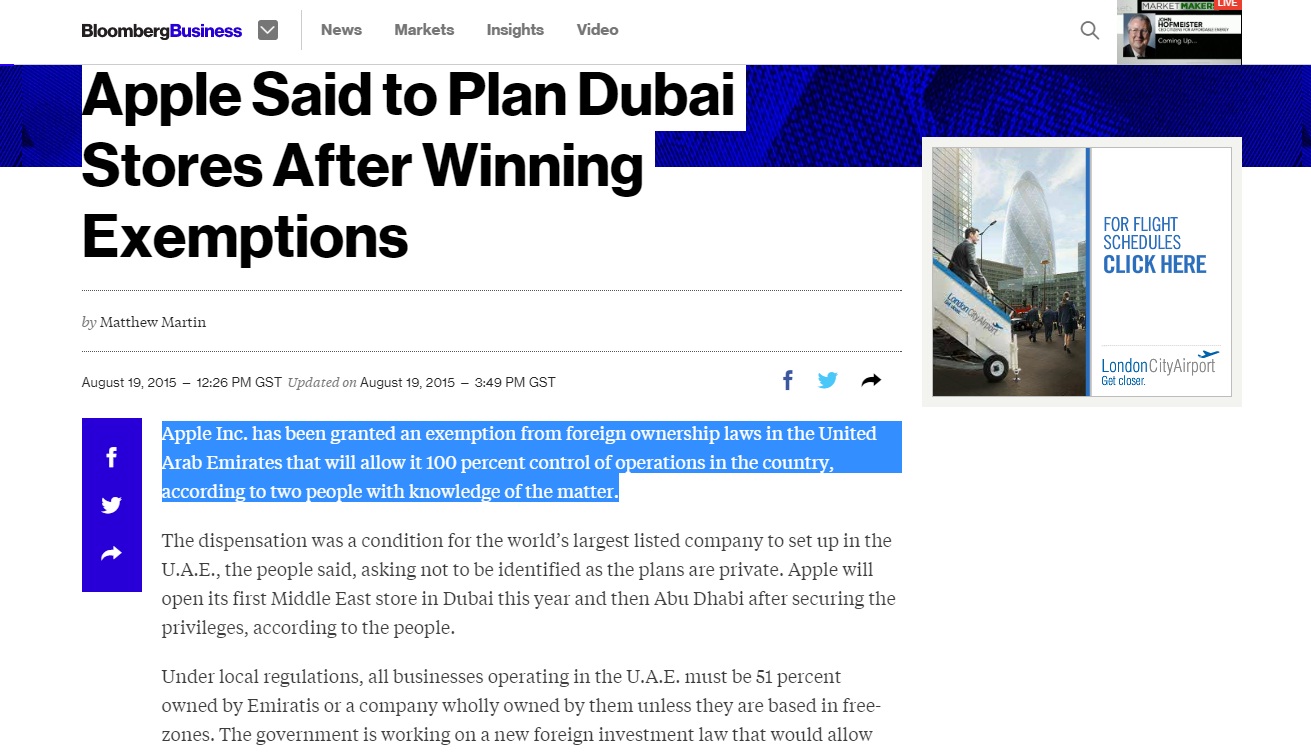
It’s refreshing to see news which isn’t essentially public relations, a story which has been diligently worked upon by an investigative journalist. One piece piqued my interest this week, the news of how the IT giant Apple has been granted an exemption from the UAE’s foreign ownership laws to fully own its operations in the UAE. The piece was written by Bloomberg’s Matthew Martin.

The piece is a public interest story which I’m sure Apple would not have wanted to be published and which, unsurprisingly, Apple didn’t respond to, though I’m told they had ample time to do so. As the doyen of modern journalism, Lord Northcliffe, said: “News is what people do not want you to print. All the rest is advertising.”

What I particularly like about such practices is the debate that it engenders, and how it gets people talking. For me, the story leaves me with a host of questions that Apple and the country’s authorities need to address for the benefit of the wider business community. Let’s hope we see more investigative journalism being practiced in the Gulf region. Goodness knows we need it.

Stepping into the Continent’s Political Minefield – Etihad’s Independence Day faux-pas

When I was growing up and in the Gulf, I was often told by my father, “don’t talk about three things.” Those three things were politics, religion and sex. One was to never go against this cardinal rule. Of course, rules are made to be broken. But there’s a difference between when an individual does this, and when a corporation gets it wrong.

The past couple of days are important for our friends from the Asian sub-continent. The 14th of August is the commemoration of Pakistan’s independence from the British Empire. The very next day, the 15th of August, is symbolic for Indians as the date of India’s independence. Both countries are neighbors, but due to history and politics their relationship hasn’t always been neighborly.

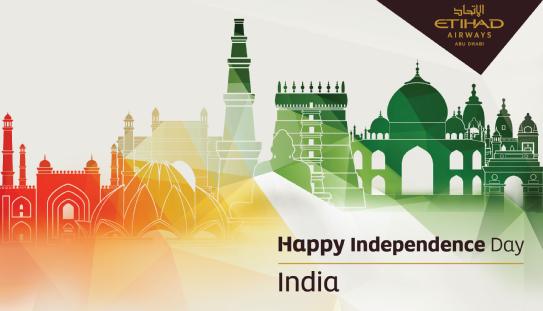
Etihad stepped into the political minefield yesterday. The national airline was ostensibly trying to do the right thing by reaching out to Indian nationals and wishing them a Happy Independence Day. Over and above the emotional aspect of the occasion, the move makes perfect sense – Etihad has a sizable stake in the Indian airline Jet Airways, and Indians make up over a third of the UAE’s population. The post, on Etihad’s LinkedIn page, should have been welcomed by all.

Etihad's Happy Independence Day message to India... It's a shame Etihad forgot to do the same for Pakistan the day before.

Etihad’s Happy Independence Day message to India… It’s a shame Etihad forgot to do the same for Pakistan the day before.

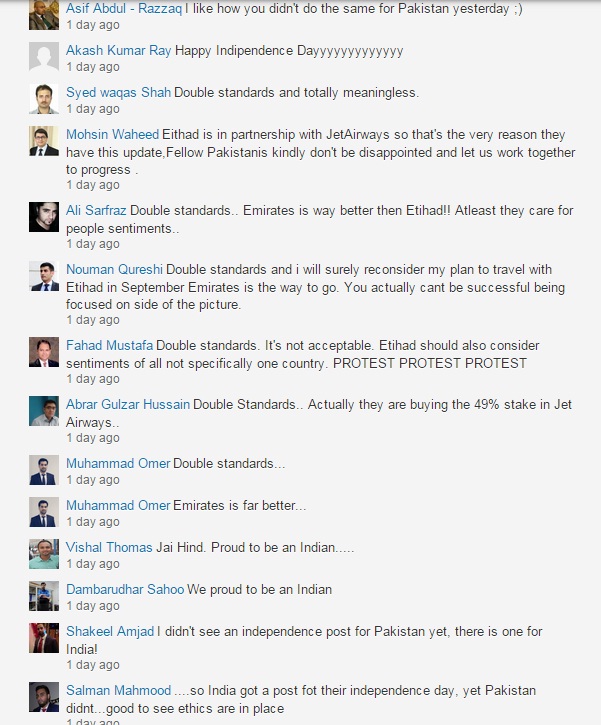
However, Etihad forgot one thing. They hadn’t posted the same for Pakistan the day before. Reading through the comments and it’s clear that the Pakistani nationals have found umbrage with Etihad’s faux-pas. While the majority of responses are positive, those from Etihad’s Pakistani national followers speak for themselves.

Etihad's move to wish well to India and not to Pakistan for their respective Independence Days didn't go down well with the airline's Pakistani fans

Etihad’s move to wish well to India and not to Pakistan for their respective Independence Days didn’t go down well with the airline’s Pakistani fans

It’s an easy mistake to make in a country which is home to over 130 different nationalities, but when you consider that Pakistani nationals make up a sizable percentage of the UAE’s population (probably 10 to 15 percent), plus the history between the two nations, maybe Etihad would have been best advised to either go all in or not wish anyone a Happy Independence Day. As is, a simple omission can lead to the loss of both business and reputation among a key segment of the population.