Digital Manipulation: How To Fight Back And Protect Your Firm

Not all digital manipulation is as easy to spot as this fake image from Benetton. The ability to fake high quality content is widespread, and you’ve got to be prepared.

You may not know it yet, but you’ve probably come across content that’s been faked today. It has never been easier to fake content, both visual and multimedia (have a read of this article from The Guardian to learn all you need about deepfakes, or take a look at https://www.thispersondoesnotexist.com/ to see how realistic fake imagery is today, thanks to Artificial Intelligence). Combine the tech with the desire to fool the public, as seen during the 2016 elections in the United States, or in the 2019 European elections, and we should be worried.

What’s more concerning is the inability of governments (or even their complicity) to counter fake news. Combine this with the willingness of many to offer digital manipulation as a service, not just to governments but also to businesses, and we’re in for trouble. Especially if you work in communications.

So, what can we do to protect our organizations from digital manipulation? Here’s a simple playbook as to what you can do to both prepare and fight back against the fakery.

Give Your Brand a Social Voice

It may seem obvious, but it needs to be said. Communicators need to ensure their organizations are online, they’re on social platforms, and that they’re not just active, but actively engaging with the public. Build up an audience of followers who know your brand, what your brand stands for, and who believe in your brand. When there’s a crisis, it’s these people who will support your brand and defend it against any claim.

Look to Owned Media

Too many organizations have bypassed owned media for social sites, where we lose control. We’ve got to roll this back, and create a portfolio of owned assets online, be they websites, blogs or podcasts, which we control and where the conversation is easier to curate. In other words, switch our focus away from just the big social media sites and to owned mediums where we have the ability to build a narrative that isn’t drowned out by fake accounts, trolls, bots or others who want to drown out our voice.

Take the Crisis Offline

The third element to fighting the fakes is taking the issue offline. If there’s a potential crisis, we have to develop ways to validate what’s going on. That means responding as quickly as possible to an issue online, and getting someone to physically respond, to check if the issue is true or false. This could be for a product defect, a reputational issue, or any other problem that we may face online. Ensure that your traditional complaint channels are integrated with your social media, so you know what’s going on at every touchpoint, and you know what’s real from what could be digital manipulation.

Monitor and Be Informed

The final step is to monitor as well as we can what is being said about the brand. If something is incorrect, step in and address the facts. Listen to what is being said about the brand, learn to spot trends, and look into issues/content which seems out of place. Understand your communities, both your advocates and your detractors, both online and offline. Digital manipulation is easier to spot if you know your online community’s routines and behavior. In addition, ensure you and your team are keeping pace with technology, and experiment where you can with rolling out new tech (one simple way to do this is to work with academia; they’ll be able to help you understand technological developments, and what tools you can use to protect yourself).

If you have any experience of fighting digital manipulation, please do share it. I’d love to hear, and share, your experiences.

The Billion Dollar(s) Business of Social Media Trolling in the Philippines, and what it means for Public Relations globally

Social media trolling is big business in the Philippines. And that business is about to go global (image source: When in Manila)

If there’s one article you should read today, it’s this piece in the Washington Post by Shibani Mahtani and Regine Cabato. Titled “Why crafty Internet trolls in the Philippines may be coming to a website near you”, the article explains what has happened over the past couple of years in the Philippines in relation to the business of social media troll farms.

If you’re not familiar with the idea, I’ll explain. A troll farm is described as an organization whose employees or members attempt to create conflict and disruption in an online community by posting deliberately inflammatory or provocative comments. Traditionally, troll farms were state-led/sponsored (think Russia in the 2016 US elections). This has also happened in other countries. In the article by Mahtani and Cabato, they describe the rise of social media manipulation as an extension of Filipino politics (another great article to read is here, from Buzzfeed’s Davey Alba).

As I’ve mentioned, the concept of social media manipulation isn’t new. We’ve had countless reports into what state actors such as Russia, Iran and others have tried to do online, through mass social media manipulation. What’s fascinating about the Washington Post article is how the Philippines is redefining this concept and turning it into an industry (there’s now both negative and positive trolling), how those who provide the troll farm services are now looking not just to politics but to business as well, and, most worryingly for everyone who works in our industry, is how PR firms are quietly offering the service to their clientele.

It doesn’t surprise me that the Philippines is leading the way in the area of troll farming. The country has a young, English-speaking population, a large service industry, and a tough economy. And Facebook is everywhere, controlling what people read and think when it comes to news, politics and business. To quote from Buzzfeed’s Davey Alba:

If you want to know what happens to a country that has opened itself entirely to Facebook, look to the Philippines. What happened there — what continues to happen there — is both an origin story for the weaponization of social media and a peek at its dystopian future. It’s a society where, increasingly, the truth no longer matters, propaganda is ubiquitous, and lives are wrecked and people die as a result — half a world away from the Silicon Valley engineers who’d promised to connect their world.

Facebook launched “Free Facebook” in the Philippines in 2013. The idea was to partner with a local carrier to offer a portal of free, basic internet services (Free Basics) that would fuel Facebook’s aggressive global expansion. To Zuckerberg, at least, the experiment was successful. “What we’ve seen in the Philippines is … a home run,” he said in a speech at a 2014 conference in Barcelona. Last November, Facebook partnered with the Duterte government to build an undersea cable system that would connect Philippine internet systems to the rest of Asia and the US.

In 2012, 29 million Filipinos used Facebook. Today, 69 million people — two-thirds of the population — are on Facebook. The remaining one-third does not have access to the internet. In other words, virtually every Filipino citizen with an internet connection has a Facebook account. For many in one of the most persistently poor nations in the world, Facebook is the only way to access the internet.

Social media trolling took off in the Philippines during the 2016 Presidential campaign. And many saw the business opportunity. Washington Post spoke to one PR executive who claims his agency is paid anywhere from about $38,000 to $57,000 — “depending on their needs” — on a month-long retainer for up to eight months.

Others are seeing the possibilities too. The authors of the Washington Post article claimed that “several paid troll farm operations and one self-described influencer say they have been approached and contracted by international clients, including from Britain, to do political work. Others are planning to expand overseas, hoping to start regionally”. One opinion quoted in the story claims that social media trolling in the country is a billion dollar business.

There’s no doubt in my mind that social media trolling will have an impact not just on politics in every democracy around the world (if it hasn’t already), but that these services will be turned towards business, especially the notion of positive trolling, of using fake accounts to talk up a business and their activities. I am also in no doubt that Facebook and the other internet giants will do nothing to stop this (Facebook’s efforts to stop what’s going on in the Philippines have been derisory at best).

So, what can we do as PR practitioners? There’s not that many options on the table. The most obvious one is to both act ethically, and speak up publicly about why ethics matters. We’re not vocal enough about this issue, and we need to change that. Another way to push back is to be more vocal about what we want the tech firms to do. We’ve got to stop treating the likes of Facebook and Google as champions of public relations, and rather as companies who are not doing enough to fight for and on behalf of our publics online.

If you have any ideas on the above, please do share them. This is an issue that’ll affect us all. And we have to take collective action to fight back. The real me is signing out for now…

Impartiality in the Middle East – Is Facebook’s Content Plan Doomed to Fail?

Even Lady Justice would struggle with Facebook’s latest idea to moderate content

I love the idea of impartiality, that notion of fairness above all, of equal treatment of all rivals or disputants. The notion of impartiality is difficult to define in practice; we all have our biases. And then there’s the politics of any given situation. It’s fair to say that, given global events, impartiality is becoming increasingly hard to come by. This is especially the case in the Middle East, where the number of conflicts and disputes is sadly increasing between neighbors and nations. It’s becoming increasingly difficult to be perceived as impartial.

Of course, social media hasn’t helped. Social media is the metaphorical can of kerosene that makes disputes explode across cyberspace. But now, the social media companies want to start cracking down on content that fuels hatred and extremism. What is Facebook’s idea? To introduce “an independent oversight board of experts to review its content decisions.”

In a fairly wide-ranging interview with Abu Dhabi’s The National, Brent C Harris, Director for Global Affairs and Governance at Facebook, spoke about Facebook’s plans to reach out to stakeholders who’d play a role on this oversight board. I’ll quote from him.


The company is embracing a wider set of approaches for how it operates. Our CEO Mark [Zuckerberg] had a comment on the earnings call recently where he talked about how, for when we launch products now that touch societal issues, we are going to go out and consult on them and think in advance about how to build them.

We had discussions pretty much every week internally, and one of the ideas that was proposed was that we should create some board to do a review of really difficult content decisions. I think there was an emerging consensus that it was something worth trying and worth building.

There was a growing sense that the [content] decisions we were taking are ones that we shouldn’t make alone and I don’t think that speaks to any single issue. It is about a growing belief that we don’t believe the decisions should sit solely inside Facebook.

A lot of the matters that will go before the board are the hard questions of trade-offs between those principles and trying to figure out for a specific piece of content, where do you set that line? That line is a hard one at times to figure out.

There has also been fairly consistent set of feedback that the people who should serve [on the board] should be folks who are deeply deliberative and who are impartial.

While I usually applaud any social media firm for opening up and engaging with more transparency, this suggestion of an “impartial board” is also dangerous. Who decides who and what is impartial? Given what is happening in many regions, including my own, how will Facebook ensure that politics doesn’t seep into discussions? Many state actors have manipulated social media for their own ends, and Facebook itself has a terrible track record of sustaining partners with external stakeholders (mainly because it doesn’t seem to listen, just ask Snopes). And, how do you define impartiality in a region which has never been so afflicted by political and sectarian differences?

If they’re going to be transparent about this issue, then Facebook needs to go all in and clearly state who they’re meeting and why (particularly in regions where there’s little to no independent civil society). Otherwise, it just strikes me as another public relations exercise rather than a workable plan which will produce the intended results (and given trust in Facebook is probably at an all-time low, this is not what they need).

And, speaking as a person who cares deeply about the notion of impartiality and fairness on social media, the last thing we need is more news columns on bad ideas which won’t deliver in practice. Facebook, prove me wrong.

Careem and Uber – Lessons on how to do Acquisition Communications

Uber’s acquisition of Careem was a masterclass in how to do M&A comms. Careem’s message (and who delivered that message) didn’t help to assuage unhappy customers

We’re a couple of weeks in, and the whole swell of media attention has gradually faded out. The mammoth US$3.1 billion deal by Uber to purchase Careem made headlines globally – it was the largest in the Middle East for a tech startup, and it focused the world’s media on a regional success story. The deal also comes before an IPO that will catapult Uber into the big leagues of the multi-billion dollar tech firms who have gone public. It’s unsurprising that so much attention was paid to the deal between the two dominant ride-hailing apps in the Middle East.

For those of us in the region, what’s also unsurprising is the feeling that many have for both brands. Uber and Careem are Marmite brands, with Middle Eastern consumers either loving or hating them. Some will swear by Careem, and refuse to take an Uber. Given the strength of brand loyalty, it was especially important that the two companies, communications functions and executive teams get the messaging right.

Lessons from Uber – Speed Matters, Keep It Simple and Engage Everyone

I’ve lost count of the number of times that a deal between Uber and Careem has been talked about. I’ve even joked with journalists who seem to get constantly misinformed by the comms teams at the firms. There were leaks, but many of us took the latest piece about any deal with a pinch of salt. When news of the deal was broken on the 24th March by Bloomberg, it seemed different. There were specifics in terms of numbers, on how the Careem brand would disappear into the Uber operation, and on how all shareholders needed to be informed.

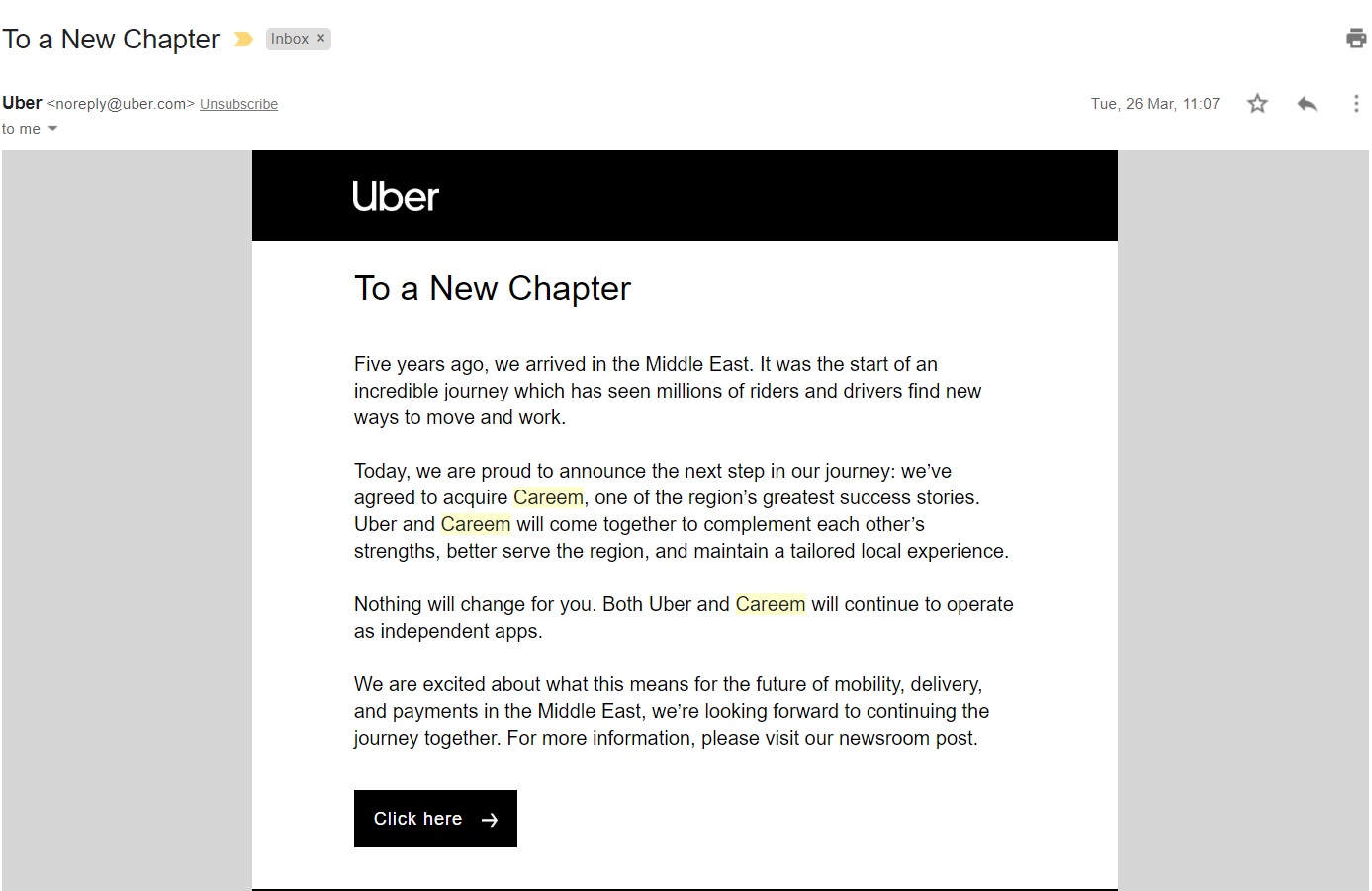
Two days later, the deal was confirmed. Uber announced the deal. The format was strange for many of us here, where social media dominates. Instead of a tweet, Uber sent out an email. The copy was short but succinct, with the option of clicking through to Uber’s website. The emailer can be seen in full below.

The email’s message was repeated throughout social media. Uber’s CEO
Dara Khosrowshahi has spent ample time here in Dubai, both giving media interviews to regional press as well as the global newswires, as well as meeting with government bodies to reinforce media interviews to reinforce the message, and government engagement as part of an engagement tour.

On a side note, Uber’s CEO is a dream executive for communicators. He’s composed on camera, he sticks to the message, and he leans in, showing respect for those he’s engaging with. It’s a stark contrast to how things used to be at Uber.

Lessons for Careem – The Messenger Matters

While Uber was straight out of the blocks with a coordinated message, Careem amplified that message through its own social media channels. However, the response was mainly negative, with many users fearing that Careem would become Uber. The Careem comms team understood this, and their messaging was focused on Careem remaining independent post merger.

While this approach makes sense, what they failed to do was personalize the message. They should have used their CEO Mudassir Sheikha to record a video message about the acquisition, focusing on why it made sense for Careem and how the company would be staying independent (they could have also turned to their Saudi co-founder Abdullah Elyas to record the same message in Arabic).

Personal messaging matters to the public – they need to see and hear a person they know, rather than a brand. Given the importance to Careem customers of independence from Uber, I ‘m not surprised that an email from Careem’s CEO to employees ‘was leaked’ to the media last week, which re-emphasized that the company will operate as a stand-alone entity (nothing leaks, unless you’re Julian Assange or the White House). The fact that Careem’s comms missed the mark on the independence message on the first day of the deal means that they’re going to have to repeat this message. The lesson here is get the message right the first time around.

What’s also fascinating is to see how Careem’s own users shared messaging the company put out in 2016, focusing directly on how it was better than Uber. The advertising wasn’t so subtle, as you can see from the video below which is still up on Careem’s Youtube site.

Consumers remember what a brand does, especially when it involves direct attacks on competitors. That’s why such activities are pretty rare. Now that Careem is part of Uber, I’m a little surprised these ads are still up on Careem’s social media. Maybe it’s time the team remember that they shouldn’t only look ahead in their messaging, but they should also look behind to what was done previously to see if it doesn’t impact their current messaging.

That’s it from me. If you have any insights you’d like to share, please do get in touch!

Five Insights from Bahrain

In case you missed it (and why I’ve been so quiet for three months), IABC help their first-ever major event in the Gulf. Over 180 attendees, 50 speakers and 40 presentations over two days make EMENAComm arguably the biggest, and, more importantly, the most impactful communications conference in the region. It also gave me the chance to look at the challenges and opportunities that the profession faces.

Here’s my five insights from Bahrain.

1. Why Not Dubai?

Even before we began, there was one issue people were talking about. Whenever I spoke about EMENAComm, there would be two lines of conversation. The first, mainly from friends and colleagues in the UAE, was “Why not do the event in Dubai?” The second was, “We’re so happy you’re doing this in Bahrain!”

Dubai has become the hub for the PR industry across not just MENA, but for much of the Indian Subcontinent, the Middle East and Africa. It’s easy to see why: the incredible transport infrastructure and ease of access, including visas on arrival; English being the country’s de-facto language, and relatively simple business ownership rules (for IMEA, that is) mean that Dubai is where many clients and agencies have their regional bases.

Dubai’s position as the PR hub is reflected in the number of events in Dubai – we have a marcomms event every other week in Dubai. This is great for anyone based in Dubai, but what about communicators based outside of Dubai? In one of the conversations I had with an attendee, she thanked IABC for choosing Bahrain, adding that “I can’t remember the last time we had a communications event in Bahrain.”

For agencies in particular, my view is that they’ve got to start looking outside of the UAE and invest locally. In one conversation this week, one agency head noted that Dubai has been saturated for some time with rival firms. In contrast, he added a market like Saudi is still full of PR opportunities, provided that agencies invest locally. It’s time we all – clients, agencies and PR associations – invest in talent and operations where our clients are across the region, including with events that help support talent development.

2. We’re Busy!

The event in Bahrain would have been bigger, had all of those who said they wanted to come actually turn up. Unsurprisingly, we had lots of drop-outs. The response was the standard, “we have too much work.” There’s a couple of points I want to raise here, some of which worry me, and others which may be a silver lining.

First up, whilst its good that we’re being trusted with more strategic work, this comes with a caveat. It seems we’re not willing to push back to our management (one of our speakers dropped out on the Thursday before the event, due to last-minute work commitments – this person had several months notice on the event).

Second, our workload is increasing as we’re being asked to do more by our management (the trust element is good), and yet we’re not being given additional resources to deal with our growing to-do list. What is also concerning is that many communicators, particularly those at a senior level, are not able to take time out to continue learning. We work in a fast-changing profession, and we’ve got to keep up with the latest research, trends and tech if we want to become better communicators.

3. We want to listen, but do we respect people who listen?

Listening was a constant topic of discussion at EMENAComm, and was referenced by speaker after speaker as a skill that we should both use and promote more. I heard rave reviews about the listening workshop conducted by Howard Krais, Kevin Ruck and Mike Pounsford. Attendees all agreed that listening is under-utilized, especially in a region such as the Gulf where management (and communication) is often top-down.

This was music to my ears. And yet there was one moment where I had to pinch myself. I received feedback from one meeting about a person who stated that their aim was to listen and learn during the meeting itself. Another attendee felt that this wasn’t a sign of leadership. To this second person, leadership is about talking. Despite all the buzz around concepts such as engagement and experience, in societies such as the Gulf the idea of a leader can often revolve around the person who is dominating the conversation. How can we promote listening to engage employees and others if we still cling to notions of leadership that prescribe the person at the front must talk (or, at the very least, dominate the conversation).

4. There’s a fascination with psychology

Those talks which got people talking were all about psychology, be it Monkeys and Psychopaths by Ogilvy’s Joe Lipscombe and Nick Driver or Dawn Metcalfe’s talk about creating a stand-up culture. It was great to see communicators delve into why we think the way we do, and look at how they can use those insights to develop better, more impactful campaigns that draw their stakeholders in. There’s much more communicators can do when it comes to understanding human psychology, and factoring in those learnings when we create and execute campaigns. But just seeing the interest in this area gave me so much hope that we are moving in the right direction.

5. Technology matters, but we’re still experimenting

One of the most popular tracks was on technology. Speakers such as Adrian Cropley, Jasna Suhadolc, and Fady Ramzy shared insights into automation, digital marketing and artificial intelligence. For a region that is obsessed with tech and digital (I dare you to find a coffee shop where there’s no one on their smartphone in the Gulf), we’ve yet to use technology as effectively in communications. This may partly be down to the need for comms heads to hire more people with analytical/science backgrounds, but it may also be due to organizational leaders wanting to control the mediums we use. In a question to Meltwater’s Laila Mousa, one attendee admitted he struggled to get his leadership to embrace social media. As digital natives take over organizational leadership roles, I hope our adoption of technology will pick up.

That’s my insights done for now. If you attended EMENAComm and want to share your views, please do drop me a note and write a guest blog for me (you can see all the images here).

That’s all for now. And I promise, I’ll be writing more frequently from now on.

Sondos AlQattan and how brands need to learn lessons from this self-made influencer crisis (part 2)

Sadly, the controversy around the Kuwaiti social media influencer Sondos AlQattan continues. As with her initial post, which she recorded two weeks back, her additional comments over the past week initially defending her views on Kuwait’s new laws protecting domestic workers from the Philippines have not helped in calming the situation. In her latest video, recorded and shared yesterday, she accuses Western media of anti-Muslim and anti-Arab/Gulf bias, adding that she’ll lead boycotts of brands she has worked with who have terminated their relationship over this incident.

I’ve been asked a number of times for my views on what is happening. I talked with the good people from the Gulf News business desk this week on the issue of when influencers go rogue (go on, have a listen). I’m including here a summary below, as well as additional inputs from what has happened this week.

  1. Influencers will cause more crises – Consumer brands are working with an increasing number of influencers. These people aren’t celebrities, who are often media-trained. All of us have the ability to go online in a matter of seconds. Add that to a significant following and brand endorsements, and you can except more situations will happen which will burn brands.
  2. Brands need to act quickly – The lack of response from some of the brands who have a relationship with Sondos AlQattan was striking. Despite both social media mentions and media inquiries, some brands just didn’t respond. I’d understand if the delay were a day or two, as this is the Middle East and regional offices often feel the need to go back to corporate HQ for advice and guidance. However, two weeks is inexcusable. It harms the brand, and in the eyes of consumers it makes companies look negligent at best, complicit at worst. There’s two words all communicators need to know – brand safety.
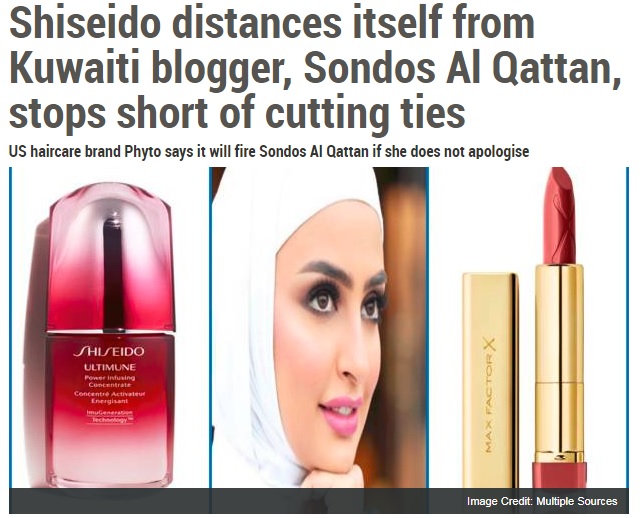
  3. Consumers want brand clarity – Some of the initial brand responses were wishy-washy. To quote one brand, a spokesperson said, “[the brand] does not support or align with the recent statements made by Sondos AlQattan.” What does this even mean? Will you stop working with the person, or not? That’s the question. I’ll repeat a simple mantra here – communications is 90% what you do, and 10% what you say. This was a fail, and it was reflected in the headline above. Is that really how the brand’s communications team wanted their stance to be perceived? I’m assuming not.
  4. Consumers care about brands working with Sondos AlQattan today – I was also asked about a brand that I work with, which had once worked with Sondos AlQattan. I can’t think of a beauty brand which hasn’t worked with her, given her 2.3 million followers and her focus on makeup. However, consumers online only care about those brands who are associated with Sondos AlQattan today.
  5. Brands can come out of this positively – I initially felt for those brands who were associated with Sondos AlQattan at this time. Even though I’ve talked about background checks, there was no way that any of them could have foreseen this crisis. However, what is memorable is that the brands who came out first with a clear position have been viewed positively by those who have been angered by the statements made by Sondos AlQattan. Consumers have felt as if these brands have listened to their concerns and acted upon them.
  6. Always remember your employees – One aspect of this which has been rarely mentioned is the internal communications aspect. May companies operating in the Gulf are diverse in their employee hiring, and I doubt any of the brands who are working with her don’t have Filipino nationals on their books. How do these employees feel about the stance their companies are taking? There’ll be a good deal of both anger and sadness among the employees of brands and distributors who are caught up in this sorry situation. I only hope that the internal communications is clearer than the external piece (the narrative should be the same here in any case, given that many employees will be following this story externally).

That’s it from me for now. I hope I’ll be able to resume blogging on another subject during the weekend. For now, good night!


Sondos Al-Qattan: Lessons from a social media star and a self-made crisis

Will brands continue to work with Sondos Alqattan after this outburst?

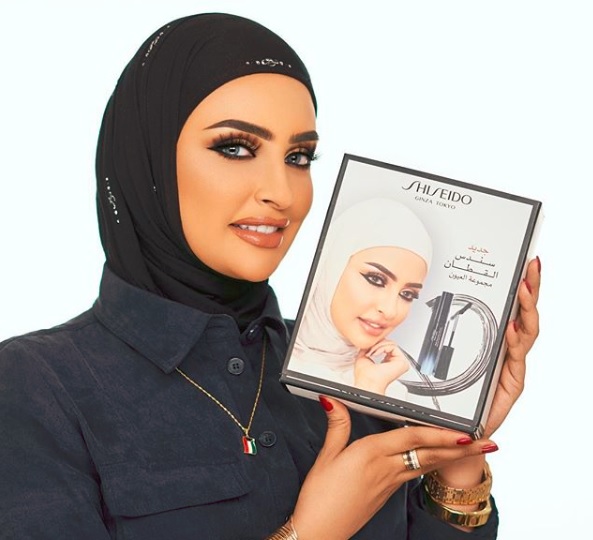
It’s news that has gone global, from CNN and Buzzfeed in the US all the way to Manila. No, it’s not movement on the Middle East peace process, or an update on the fight against extremism. Instead, the headlines are being made by a social media star and her views on a specific nationality. I’ve lost count of the number of articles and videos I’ve seen that have featured Sondos Al-Qattan, a Kuwaiti national and make-up tutorial social media star who has 2.3 million followers on Instagram. Sondos is one of the original social media stars; she’s worked numerous beauty brands, and she’s made significant money doing so.

Given this, you’d think she’d have some savvy when it comes to what she says online. This doesn’t seem to be the case. On the 14th of this month Sondos spoke against the new laws put in place by the Kuwaiti government governing the treatment of Filipino workers in the country. To put it mildly, Sondos wasn’t pleased. A video of her was shared where she criticized the new laws. To paraphrase:

“For people who want to get a Filipino domestic worker, what are these ridiculous work contracts you’ve got to sign? The woman I met with was reading out the rules to me and I was shocked. Put aside that they need to be given a break every five hours, that’s normal. But, how can you have a ‘servant’ in your house who gets to keep their passport with them? Where are we living? If they ran away back to their country, who’ll refund me? Even worse, is that they get a day off every single week! What’s left? Honestly, with this new contract, I just wouldn’t get a Filipino maid. She’d only work six days a week and get four days off a month.”

The condemnation was swift, both in the media and on social platforms despite the original clip being deleted. The video below is just one example of many of how she’s been criticized.

What’s telling about the case isn’t just how to get yourself in trouble online. The Sondos incident is a wealth of lessons, for both communicators and social media influencers.

  1. There is no Local – Sondos may have thought that she was addressing a local, Kuwaiti audience (she was speaking in Arabic on a local Instagram account). However, there is no local online. Her comments were widely shared, and translated. Once they were translated, her views went global.
  2. Audience is Authority – If this was a Gulf national with a couple of hundred followers, it’d have been dismissed. With a following of over two million, this would have never been the case with Sondos. Social media influencers (and brands) must understand that people are hanging on your every word, both good and bad.
  3. Brands will make a Choice – With her words, Sondos offended a whole nationality, a population of over 100 million who spent over 1.28 billion dollars on imported makeup in 2015. Brands who work with Sondos, the likes of Phyto, Max Factor and others) will quickly decide if they want to put their sales in danger (they should have already put out statements by now, especially given the number of calls for boycotts on her YouTube pages). Brands who are looking to work with social media influencers are increasingly understanding the need to do safety checks; if an influencer has said something negative, brands will simply not work with them.
  4. Stop Digging – Sondos has done pretty much everything she can to nullify criticism. She’s turned off comments on her Instagram page, her Twitter account is private, and she’s not responded to any media queries. A new video has been posted tonight by Kuwaiti newspaper Al-Qabas in Arabic, where she basically repeats her initial messages and adds that she sees the media coverage as a good thing as it’ll make the Kuwaiti government take action on behalf of those who hire Filipino maids. Some people just don’t learn.

This issue may go away in a couple of days – people have short attention spans. But in a world where there’s no concept of local, Sondos would have been best advised to listen to the criticism and apologize in English for her views. As it is, I don’t see how she can continue to work with global brands when she herself has become a toxic brand.

A how-to on the UAE’s “Social Influencer” Licensing & three outstanding questions

It’s almost Ramadan, the time of year when we post and pray. This year’s Ramadan may be a little different, possibly more stressful for some. Under regulations introduced in March by the UAE’s National Media Council (NMC), those making money to promote brands will need to be signed up with an e-media license by June or else face fines and other sanctions.

In the rest of this post, I’ll share the definition of what is an influencer as per the NMC, the process to get certification, as well as three questions I have on issues which maybe aren’t addressed or which have not been talked about. Thank you to Lexis Nexis and Fiona Robertson at AlTamimi for the below.

Who is an “influencer”?

The legislation is straightforward as to who is covered. To quote from the National Media Council:

“Any person who practices the above-mentioned media activities on Social Media, on a commercial basis, shall obtain a prior license from the Council, provided that:
1. It shall have an account on the generally recognized Social Media;
2. Ads that are presented on Social Media shall be subject to the advertising standards that are applicable at the Council;
3. Social Media accounts’ owners who offer paid advertising services shall obtain a license from the National Media Council in accordance with the applicable regulations in this regard and hereunder.
4. The account owner is responsible for the content of the account.”


The resolution covers all electronic media across the country. And the NMC defines electronic advertising as “any paid or unpaid form of presentation or promotion of ideas, goods or services by electronic means or network applications”.
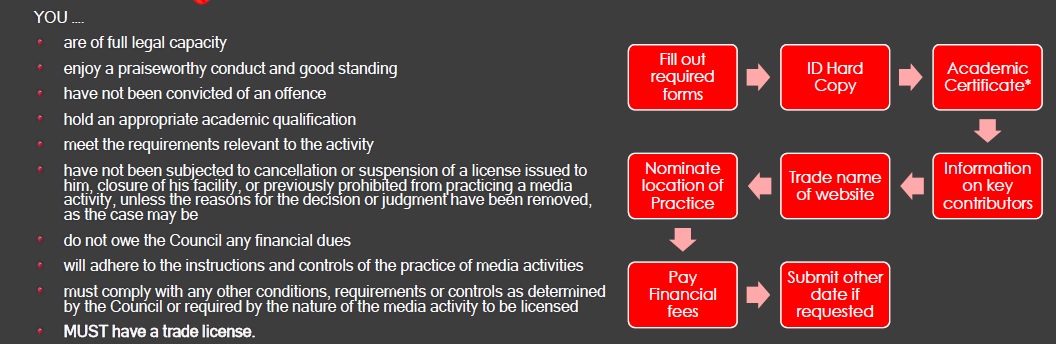
For a person to get an e-media license, they’ll also need a trade license. The cost of both will be a minimum 30,000 Dirhams depending on where you buy your trade license (the e-media license is 15,000AED).

How do you get a License?

Below are the requirements and the process to follow to apply for an e-media license:

e-media license

The three questions

I’m sure there’s lots of questions from people who work in the marketing and communications industry on this new legislation. My three are:

  1. How does this cover children? There are some child stars in the US who have made millions from social media. Think of “Toys Review for kids by a kid!, for example (the six year-old child and his family have made in excess of 10 million dollars). Does the legislation cover this? There are young social media players here such as Rashed Belhasa who I assume are putting out paid content.
  2. What happens to those pushing out content on behalf of employers? The definition of electronic advertising is wide enough to ask me this question. Many employees share content from their employers. I’m assuming this won’t come under the purview of the NMC, but it’d be good for them to explicitly say so.
  3. Is this a blow to the concept of micro-influencers? The idea of people with smaller followings online, say 20,000 on Twitter and Instagram, working with brands has become popular over the past year. Often these people don’t take much money in return for sharing any content or working with a brand. Would they be able to afford the licensing? In addition, would an influencer agency want to take them on board, and bevvy up the cash with the prospect of getting a lower return than working with someone more established, with stronger brand appeal and a greater number of followers?

I guess we’ll find out how this all plays out soon. In the meantime, Ramadan Kareem!

Brand Building and Trust in Egypt, Jordan and Lebanon, Based on YouGov/MEPRA Research (Part 3)

trust-in-blue-marker

This is the third and final post on the research by YouGov, which was commissioned by the Middle East Public Relations Association and looks into consumer trust, both online and offline, when it comes to advertising and media recommendations in goods and services.

This post covers Egypt, Jordan and Lebanon.

Egypt
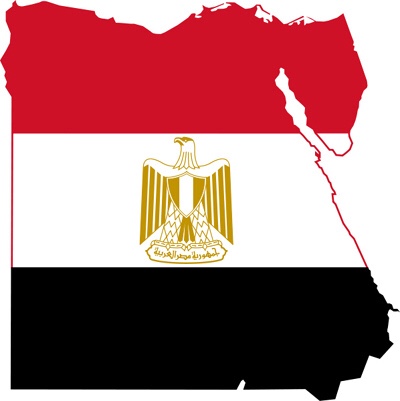
1004 people were surveyed in Egypt, 97% of whom were Egyptian and 3% were expat. When it comes to gender, 51% were male, and 49% were female. Just over 40% were aged between 18 and 29, 21% were between the ages 30 and 39, and 39% were aged over 40.

In terms of geography, it’s no surprise that over a third were Cairo-based,  with 36% living in the capital. Of the remainder, 24% live in the Delta, 17% in Alexandria, 16% in Upper Egypt, and the remainder in the Canal Zone/outside of these areas.

In terms of salaries, 30% earn less than US$266 per month, 24% earn between US$266 and US$532, 17% earn between US$533 and US$1,065, 8% earn between US$1,066 and US$2,665, and 3% earn more than US$2,666. Approximately 18% of people refused to disclose their earnings.

Finally, 41% described themselves as single, 47% as married with children, and 6% were married but had no children. The remaining 6% were classed either as other or did not respond.

Family, Friends and Third Parties

When it comes to those closest to them, Egyptian respondents said they have an 85% level of trust in face-to-face conversations with friends and family about products and services. Only 3% of respondents said that they would not trust a face-to-face discussion. Those who displayed the highest levels of trust include respondents earning between US$533 and US$1,065 (90%), those living in the Canal Zone (96%), and those who are married with children (88%).

Trust in social media posts by friends and family about products and services averages at 51%; mistrust comes in at 14%. Trust is most pronounced in those earning above US$2,666 (62%).  Those who are between 18 and 24 are least likely to trust such posts (20%), as are those living in Alexandria (22%).

Egyptian respondents have a higher trust in third-party endorsements of products and services than most other countries in the region; 62% agreed that they trust third-party endorsements more than what a brand says about its own products and services, compared to 6% who don’t. The highest trust is among those who are earning less than 500 Egyptian Pounds and those who are earning over 10,0001 Egyptian Pounds (both 70%), as well as expats (76%).

Trust in Social Media

Egypt’s respondents were torn over social media posts by influencers and people with lots of followers on products and services; 32% said they found such posts trustworthy, and 31% said they found them untrustworthy. Men were much more likely to be trustworthy (37%) than women (27%). Those who are earning between US$1,600 and US$2,665 also had the most trust (51%) in such posts. The least trusting were expats (23% for, 43% against).

Unsurprisingly, social media has become a vital source of information for Egyptian respondents; 57% of respondents agreed that it has become more important to them as an information source today than five years back (12% disagreed). This is especially true of younger respondents between 18-24 (63%). However, almost half (45%) have low trust in what they see online.

When it comes to the most popular social media channels for information on goods and services, it may be no surprise that Facebook is the most popular by far (71%), followed by WhatsApp (8%). In third with 8% was the choice of none. It seems that if you want to do social media in Egypt, you have to be on Facebook.

Trust in Media & Advertising 

Only two media channels scored higher for being trustworthy than untrustworthy among those polled – they were brand websites (46% versus 18%), and website articles (35% to 24%). All other media scored higher for not being trustworthy, with television and blogs both at 27% (their untrustworthy scores were 41% and 35% respectively), and radio at 30% positive, compared to 35% negative. Respondents weren’t asked why, but it’s probably fair to say that Egyptians have a healthy skepticism of official media, given the events of the past seven years.

Levels of trust in advertising are approximately the same as the media, with billboards being the most trusted (34%), followed by television and radio (both 30%), and finally online at 28%. For online, radio, and television, they’re not trusted more than they are trusted, with negative scores of 32%, 31%, and 33% respectively.

When asked if they trust advertising less today than they did five years ago, 62% agreed and 8% disagreed. Those earning the least (500 Egyptian pounds) trust advertising the least, with a 70% rating. Over two-thirds of respondents (69%), agreed with the statement that so-called ‘fake news’ has lowered their trust in mainstream news media. Only 8% disagreed.

Jordan
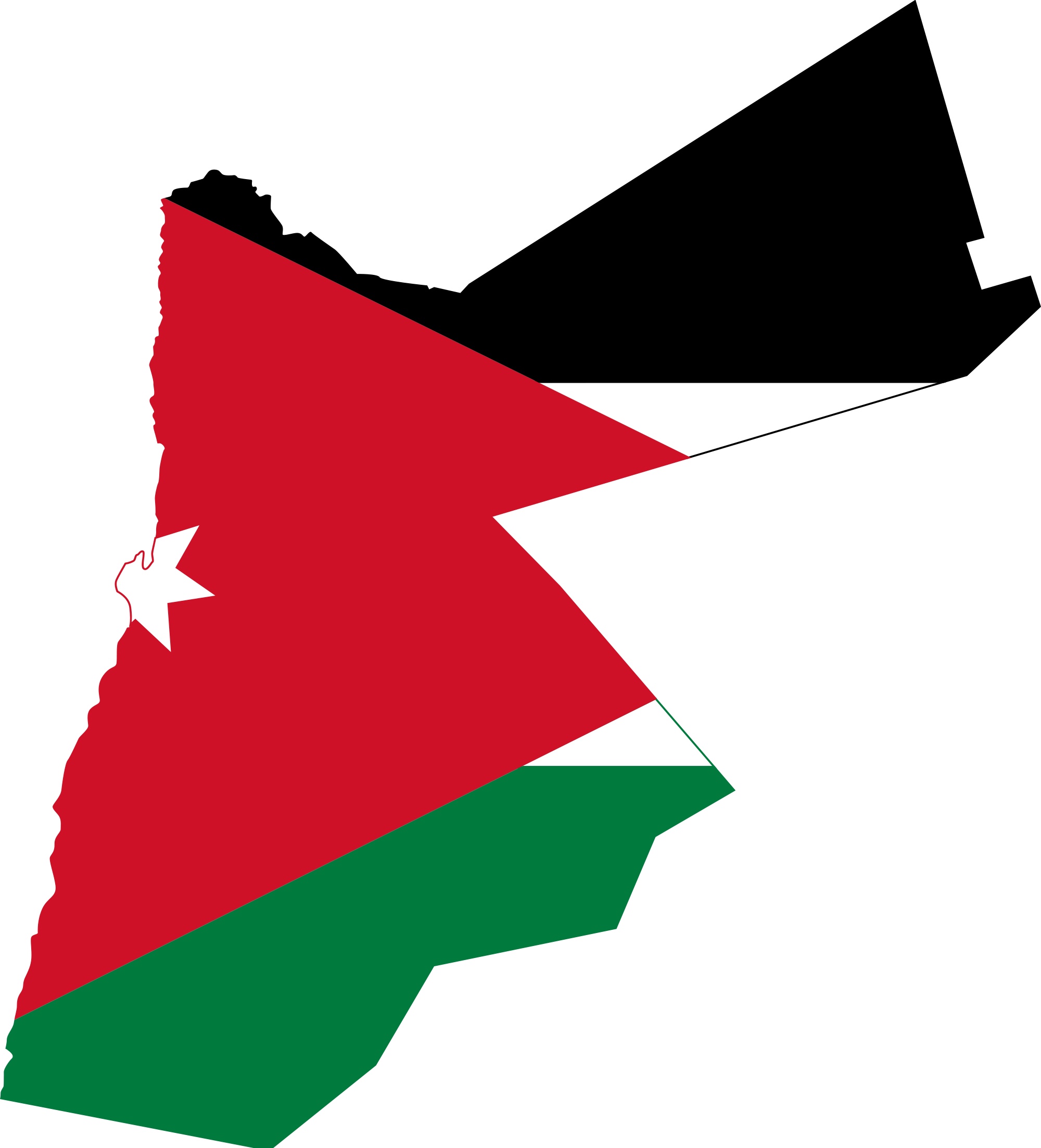
503 people were surveyed in Jordan, 89% of whom were Jordanian and 11% were expat. There was a slight preference for males (52%), as opposed to females (48%). Age-wise, the largest group were between 18 and 29 (43%), 25% were between the ages 30 and 39, and 32% were aged over 40.

In terms of geography, the majority were based in Amman (59%), with the second and third largest geographies being Irbid (16%) and Zarqa (12%) respectively.

In terms of salaries, 9% earn less than US$266 per month, 24% earn between US$266 and US$532, 32% earn between US$533 and US$1,065, 17% earn between US$1,066 and US$2,665, and 5% earn more than US$2,666. Approximately 13% of people refused to disclose their earnings.

Finally, 47% described themselves as single, 42% as married with children, and 7% were married but had no children. The remaining 4% were classed either as other or did not respond.

Family, Friends and Third Parties

Jordan’s respondents are very trusting of their family and friends recommendations about services and products when they’re given face-to-face; 89% responded that they trust such interactions. In contrast, only 2% were distrustful. Those over 40 (93%), who earned between US$1,600 and US$2,665 (94%), and who are married with children (92%) are the most trusting.

When it comes to online product and service recommendations from family and friends, the trust percentage drops to 50%, while mistrust rises to 15%. Trust is highest among those who earn less than US$266 (58%), and those who are married but who have no children (64%).

When it comes to third party endorsements, Jordanian respondents score higher than any other country in the region bar one (hint, it’s below); 74% agreed that they trust third-party endorsements more than what a brand says about its own products and services, compared to 6% who don’t. The highest trust is among consumers who are above 30 (80%) and earners over US$2,666 (92%).

Trust in Social Media

Jordan’s respondents were even more split than Egypt’s; 32% said they found social media posts by influencers and people with lots of followers on products and services trustworthy, and 32% said they found such posts untrustworthy. Those who were most trusting were those over 40 (40%), and those earning between US$2,666 and US$5,332 (38%).  Men were much more likely to be trustworthy (37%) than women (27%). Those who are earning between US$1,600 and US$2,665 also had the most trust (51%) in such posts. The least trusting were women (37%), and those aged between 25 and 29 (40%).

Just under two-thirds of respondents said that social media has become a vital source of information for them (63%); this is especially true for 18-24 year-old respondents (69%). This is especially true of younger respondents between 18-24 (63%). Trust in online content is an issue, with 54% having low trust in what they see online (this rises to 65% for those aged between 30-34).

When it comes to the most popular social media channels for information on goods and services, Facebook tops the list with 63% of respondents saying it’s the most useful channel for information about products and services. Second choice was none (10%), followed by LinkedIn in third place with 7%. WhatsApp was fourth (6%), followed by Instagram (5%).

Trust in Media & Advertising 

When it comes to trust in the media, Jordanians don’t seem to prefer any particular medium. Radios, website articles and blogs scored a 33% trust rating when it comes to being a source of information about products and services. Television and newspapers scored 32% and 30% respectively. Brand websites scored the best, at 40%.

Levels of trust in advertising as a source of information are slightly lower; billboards were at 32%, TV advertising scored 30%, radio ads 25% and online advertising 21%. The only ad medium which scored higher positively than negatively was billboards (27%). For online advertising, the percentage for those who distrust the medium was 43%, over twice the number who said they did trust online ads as a source of information about products and services.

When asked if they trust advertising less today than they did five years ago, 68% agreed and 10% disagreed. Those who were above 40, earning a high salary and married with children were most likely to trust advertising less today than they did five years ago. Almost three-quarters of respondents (73%), agreed with the statement that so-called ‘fake news’ has lowered their trust in mainstream news media. Only 9% disagreed.

Lebanon
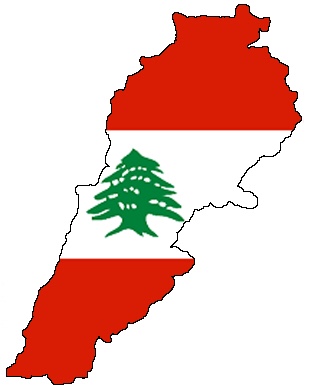
Last, but by no means least, Lebanon is the final country in this survey. 251 people were surveyed in the country, of which 48% were male and 52% female. In terms of age, 34% were aged between 18 and 29, 21% between 30 and 39, and 45% were over 40.

Income-wise, 63% earn less than US$1,600, 11% earn between US$1,600 and US$2,665, 8% earn between US$2,666 and US$5,332, and 6% earn over US$5,333. 12% didn’t disclose their salary.

Approximately 71% are Lebanese nationals, with 29% being expats. In term of geography, the largest number of people live in Beirut (43%), followed by non-named locations (37%) Tripoli (14%), and Jounieh (4%). Regarding the marital status, 38% were single, 51% were married with kids, and 7% were married with no children.

Due to the small survey size, I won’t be drilling down further by group.

Family, Friends and Third Parties

Lebanon’s respondents are highly trusting of their family and friends recommendations about services and products when they’re given face-to-face; 87% responded that they trust such interactions. In contrast, 3% were distrustful.

When it comes to online product and service recommendations from family and friends, the trust percentage drops to 46%; mistrust rises to 20%.

When it comes to third party endorsements, the Lebanese respondents scored the highest of any country in the region; 75% agreed that they trust third-party endorsements more than what a brand says about its own products and services, compared to 6% who don’t.

Trust in Social Media

When it comes to sourcing information on products and services from online influencers and those with large followings, the Lebanese are the least trusting and most distrusting. Only 26% said they found social media posts by influencers and people with lots of followers on products and services trustworthy, and 39% said they found such posts untrustworthy. Lebanese respondents do however mostly agree that social media has become a vital source of information for them (63%).

When it comes to the most popular social media channels for information on goods and services, Facebook again comes out tops with 60% of respondents saying it’s the most useful channel for information about products and services. Second choice was none (12%), followed by LinkedIn in third place with 7%. WhatsApp and Instagram were joint fourth (5%).

Trust in Media & Advertising 

Lebanon has always been a bastion for the region’s media sector, so I was keen to look at the levels of trust in the press. Unfortunately, there’s no anomalies here. The Lebanese don’t trust (or distrust) media more than anyone else.

No one source is preferred over another when it comes to product and service information. Brand websites are newspapers are the most trusted (both 34%), followed by radio, television, and website articles (all of which score 33%. Blogs are the least trusted, at 28%.

Advertising fared worse than the media; billboards were the most trusted medium (28%), followed by TV advertising (27%), radio (24%), and online in fourth place (21%). When asked if they trust advertising less today than they did five years ago, two-thirds agreed (67%) and 12% disagreed. In total, 73% agreed with the statement that so-called ‘fake news’ has lowered their trust in mainstream news media. Only 10% disagreed.

And that wraps up a brief overview of the research. If you’d like more details, please do let me know and I’ll share data with you.

Brand Building and Trust in Saudi and the UAE, Based on YouGov/MEPRA Research (Part 2)

trust-in-blue-marker

This is the second post on the research by YouGov, which was commissioned by the Middle East Public Relations Association and looks into consumer trust, both online and offline, when it comes to advertising and media recommendations in goods and services.

This second post covers Saudi Arabia and the United Arab Emirates, which follows the post from the first four countries yesterday.

Saudi Arabia

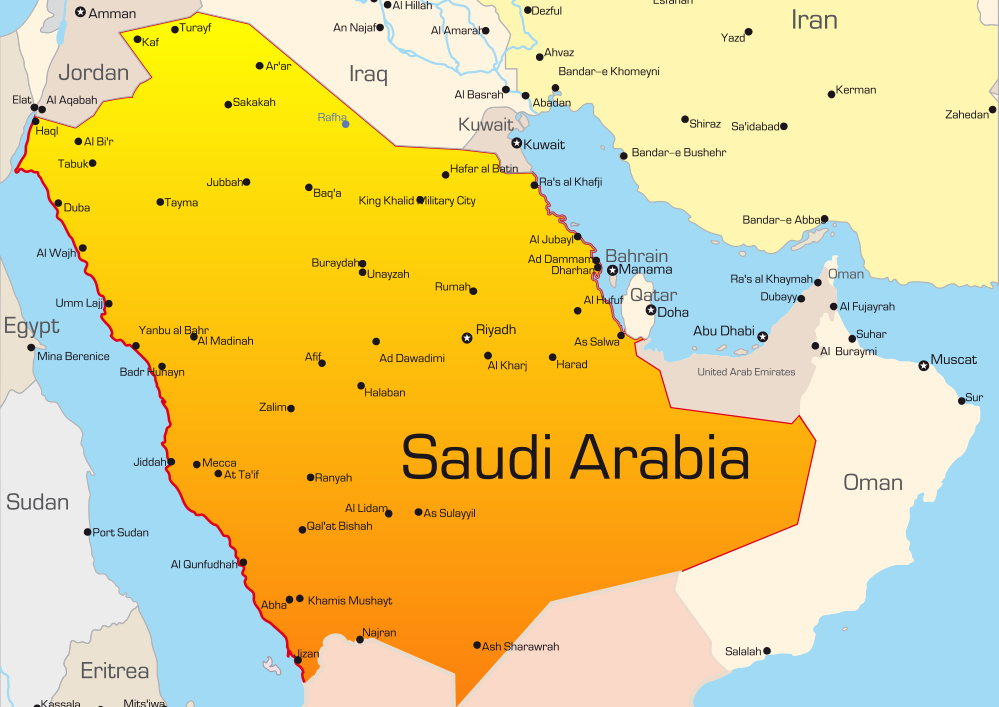
saudiarabiamap

1003 people were surveyed in Saudi Arabia, 64% of whom were Saudi nationals and 36% were expat. When it comes to gender, 56% were male, and 44% were female. Just under 47% were aged between 18 and 29, 31% were between the ages 30 and 39, and 22% were aged over 40.

In terms of geography, just over 30% live in Riyadh, 24% live in Jeddah, 7% in Mecca, 6% in Dammam and 5% in Madinah. The other 28% live outside of these areas.

Finally, 38% described themselves as single, 51% as married with children, and 7% were married but had no children. The remaining 4% were classed either as other or did not respond.

Family, Friends and Third Parties

When it comes to those closest to them, Saudi respondents scored the lowest in the Gulf; only 82% trust in face-to-face conversations with friends and family about products and services. Younger respondents showed the lowest trust; 79% of 18-24 year-olds, compared to 90% of 35-39 year-olds. Saudi nationals scored 79%, and Saudi-based expats 88%. The other large discrepancy was between singles (77%) and those who were married (85%).

When it comes to trust in social media posts by friends and family about products and services, the scores were much better; 54% found such posts trustworthy, compared to 13% who found them untrustworthy. There’s a seven percent difference between young respondents (18-24) who trust the least (52%), and respondents in the 30-34 age bracket, who trust the most (59%). Saudi nationals were also less trusting than expats, with scores of 52% and 59% respectively.

Those surveyed in Saudi did show higher levels of trust in third-party endorsements of products and services, in comparison to a brand’s own positioning; 59% trust third-party endorsements, compared to 7% who don’t. There’s a 15% differential between those working (67%), and those who aren’t working (52%).

Trust in Social Media

Overall, the Saudi respondents showed slightly higher levels of trust (37%) than mistrust (29%) in social media posts by influencers and people with lots of followers on products and services. Men were much more likely to be trustworthy (42%) than women (30%). And those who are working are also more trusting (41%) than those who aren’t (33%).

Social media has become a much more important source of information to the Saudi respondents than it was five years ago (53% agreed with this statement, opposed to 15% who disagreed). This is especially true of younger respondents and those on lower incomes. However, trust is still an issue with what people see online; 43% have low trust in what they see online (this jumps to 52% for those earning US$5333 and higher), compared to 17% who disagree.

When it comes to the most popular social media channels for information on goods and services, Facebook topped the list (28%), followed by WhatsApp (16%), Instagram (14%), and Snapchat (9%). One-tenth (11%) didn’t use any social media. Facebook was least popular among the youth (24%), who prefer visual applications and instant messaging. In contrast, Facebook was the most popular among expats, almost half (49%) of whom use the platform.

Trust in Media & Advertising 

Trust in media for Saudi respondents when it comes to products and service recommendations differed to the rest of the Gulf. Whilst branded websites scored top as the most trusted media (45%), television content, radio news and website articles also rated highly, with scores of 44, 39, and 39 percent respectively. Newspapers came second to last, at 36%, and blogs were the least trusted, at 33%.

When it comes to advertising, there’s a slight drop in trust among respondents. Television advertising is the most trusted, at 38%, followed by billboards at 37%, and radio at 31%. Online advertising is the least trusted, at 28%. A higher percent of respondents (32%) found online advertising untrustworthy than trustworthy.

When asked if they trust advertising less today than they did five years ago, 55% agreed and 13% disagreed. Men and those married with children were most likely to trust advertising less today than five years back. Saudis scored the lowest when it came to the impact of fake news on their trust in media sources. Only 58% agreed with the statement that so-called ‘fake news’ has lowered their trust in mainstream news media. In contrast, 11% disagreed.

United Arab Emirates

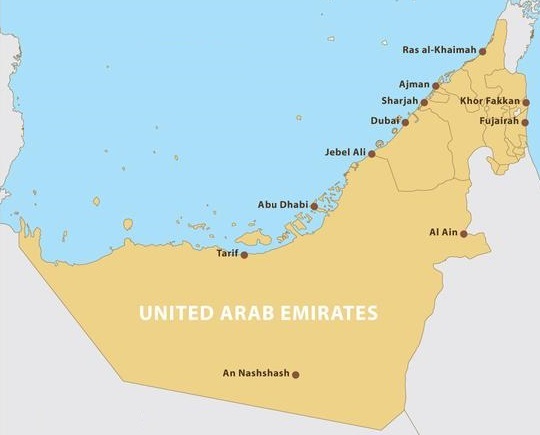
united-arab-emirates-map

At 1010, the respondent base for the UAE was the largest from all the countries surveyed. Of this total, 18% were Emirati nationals, 24% Arab expats, 55% Asian expats, and just under 3% Western.

When it comes to gender, 65% were male, and 35% were female. Just under 42% were aged between 18 and 29, 38% were between the ages 30 and 39, and 20% were aged over 40.

In terms of salary, 37% earned over US$2,666 a month, 18% earned between US$1,066 and $2,665, 12% earned between US$533 and US$1,065, 8% earned between US$266 and US$532, and 7% earned less than US$265. The remaining 18% didn’t give their salary.

In terms of geography, 33% live in Abu Dhabi, 41% live in Dubai, 17% in Sharjah, and the remaining 9% outside those three Emirates.

Finally, 35% described themselves as single, 52% as married with children, and 11% were married but had no children. The remaining 2% were classed either as other or did not respond.

Family, Friends and Third Parties

Approximately 84% of those polled said they trusted face-to-face recommendations of products and services from their friends and family. The groups which exhibited the highest levels of trust were Western nationals (96%) and those earning over US$2,666 a month. Those groups who exhibited the lowest trust were earners below US$266 (70%) and those people living in other Emirates (77%).

When asked the same question about online, social media-based recommendations from friends and family, that number dropped to 55%. Young people aged between 18 and 24 were most likely to trust such recommendations (60%), as were Emirati, Arab Nationals and Westerners (65%, 66%, and 64% respectively). Asian expats (48%) and those living in Sharjah (49%) recorded the lowest levels of trust.

Conversely, almost two-thirds of people (63%) have more trust in what a third party says about a good or a service than what a brand says about its own goods and services.

Trust in Social Media

Only 39% of respondents trusted online recommendations from social media influencers or people with large followings. Unsurprisingly, considering how much time they spend online, younger people aged between 18 and 24 years are more likely to trust such recommendations (45%), as are Emiratis (52%).

Social media has become the most important source of information for people; 57% said social media has become a key source of information about goods and services today compared to five years back. However, half of the respondents also said that they have little trust in what they see on social media.

On social media Facebook is by far the most useful source of information for goods and services, with 52% of respondents using the site to know more about brands. Whatsapp was second, at 17%, and LinkedIn was third, with 10%. Surprisingly, Asian nationals and Westerners are the major outliers here, with only 45% and 44% respectively using Facebook, and 21% of Asians using WhatsApp as their preferred social media platform (I’m still not convinced however that a messaging app can be defined as a social media platform).

Trust in Media & Advertising 

For advertising, the most trusted formats were television and billboards (both at 45%), followed by radio (41%), and online (37%). Over half of respondents (57%) said they trust advertising less today than they did five years ago. This was most noticeable among those who were married and didn’t have children (75%), and those earning over US$5333 (64%).

Brand websites scored higher than both media and advertising for trustworthiness; 53% of respondents said they trust corporate websites. Trust in print publications, in newspapers and magazines, was highest, at 48%, followed by radio and television, both of which scored a 44% trust rating. Blogs were the least trusted source of information, at 39%. When asked about fake news and their trust in the media, the UAE respondents polled like their Saudi counterparts. Only 59% agreed with the statement that so-called ‘fake news’ has lowered their trust in mainstream news media, with 10% disagreeing.