What is innovation? And what does it mean for Saudi Arabia?

I was reading over the news this week and came across an announcement by General Electric. The American engineering giant recently announced a one billion dollar investment in the Kingdom, including the establishment of an innovation center in Dhahran’s Techno-Valley in the country’s oil-producing Eastern Region (you can read about the announcement here).

The company showcased the facility last week to a select number of media, and gave a glimpse into how the center would be the focal point of the company’s engagement with local customers, Saudi-based researchers and universities and industry groups. More cryptic (to me) was the statement that the GE innovation center will act as a hub where “entrepreneurs and companies can incubate business ideas and pursue innovation in energy efficiency, aviation, healthcare, and elsewhere.”

I’m always thrilled to see investment into Saudi Arabia, particularly when it’s focused on knowledge transfer and supporting Saudi nationals in developing their skills and abilities. But one question has stuck in my head. What is innovation in this context? Will we see new technologies and products being developed by GE and its partners in Saudi? And why Saudi Arabia for an innovation center?

To be fair, the region is not known for developing world firsts, unlike the United States. In the 2011 there were two million patents filed worldwide. Of that number Saudi Arabia filed for 990. The Kingdom is primarily known for its consumption of goods rather than value creation through local entrepreneurship and knowledge creation.

Efforts have been made to introduce systems and concepts to foster more local innovation – the Kingdom’s Saudi Arabian General Investment Authority has set up various centers to support entrepreneurs establish new companies and increase the competitiveness of small to medium sized businesses. There are 120,000 plus Saudi nationals studying at universities abroad under the King Abdullah Scholarship Programme, whose knowledge will also make a major impact on the nation’s economy.

There is one area where Saudi Arabia innovates and that is in the oil and gas sector. Situated in the Eastern Region, King Fahd University of Petroleum and Minerals (KFUPM) is renowned for its academic research into the oil and gas industry. KFUPM has successfully partnered with the private sector to further its academic research and find practical applications for its academic output.

My hope is that GE’s new innovation center, which is located alongside KFUPM, will build on the wealth of oil and gas/energy knowledge that has been created in the Kingdom’s Eastern Region to create new applications that we will see being put into use in other parts of the Middle East.

For me, innovation is taking that (in many cases) latent ability and talent and nurturing it through mentoring, support and guidance. If GE can pull this off, and gradually benefit the many industries that GE has a hand in on a local level I’ll be delighted as will many others who understand how much Saudi and its people are capable off. Let’s hope others follow in GE’s footsteps and consider their own innovation investments in the Kingdom.

GE has committed to support Saudi innovation alongside KFUPM. When will other multinational companies follow?

Are Saudis the most open nation in the Gulf?

Saudi Arabia’s society is changing at a much faster rate than many of its neighbours

Hands up all those people who’ve heard of or been to the cosmopolitan Dubai. I’m sure that you’ll know about Qatar, the country that has made a name for itself by investing all over Europe and for winning the 2022 World Cup. And there’s Kuwait, probably best known for its role in the first and second Gulf wars. One of the most beautiful countries I’ve ever visited, one could say that Oman unfortunately isn’t as well known abroad as it should be.

And then there’s Saudi Arabia, a mysterious land which up until recently was spoken of in Chinese whispers. The Magic Kingdom was a country that was known for oil, religious and cultural conservatism. Despite the spread of the internet and the ensuing countless videos and other types of multimedia information hosted online Saudi Arabia is still an unknown to most people.

The country’s reputation, image and visa regime doesn’t help to educate foreigners, but I’ve been struck recently on a number of occasions how open today’s Saudis are. This is especially true of the younger generation. Many of the Saudis I know who are under the age of 40 will talk about anything and everything, especially in a closed environment. They’re knowledgeable, they’ll know much more about the workings of the country and national government than is written about or published in the news. And they’re not afraid to be blunt about what is right and what is wrong when it comes to public policy.

Having lived in Saudi for a fair few years I’ve always been fascinated by how Saudis are becoming ever more open to sharing their views with people they know and trust, especially in the setting of the Majlis where the men traditionally gather in the evening to discuss both personal and business issues.

The difference in openness between Saudis and other GCC nationals is becoming ever more noticeable. While traditionally the most open society in the Gulf, Bahrain has been transformed due to the events of the past two years. Both Qataris and Emiratis are very welcoming, but they’re less inclined than Saudis to talk at length with foreigners on the issues that are shaping their respective countries.

And then there’s the Kuwaitis, who are probably definitely the most outspoken people in the Gulf. But for me, today’s Saudis are more open because many will acknowledge both the positives and negatives of their country.

I’m not suggesting that the country is a bastion of diverse views which are aired in public by all and sundry. There are still many subjects that are taboo, but many barriers have been broken over the past two years partly thanks to the widespread adoption of social media by many young Saudis. Just think of any controversial topic in the Gulf, and you’re going to find it being discussed in Saudi by bloggers, on Twitter and Facebook.

Looking forward, I can only hope that this openness will be a blessing to the Kingdom as it looks to tackle issues such as unemployment, the changing role of women in the society, graft and governance. These subjects will be better dealt with if there’s an open dialogue between the country’s nationals. As always, I’m optimistic about where Saudi Arabia is headed and would like to hear if you agree with me or not about my thoughts.

Seizing the moment – the GCC’s energy subsidies and communicating a solution

Is energy a problem for the Gulf? At first thought one wouldn’t think so. However, the Gulf region is facing a ticking bomb. To put it as simply as possible, the cost of producing electricity is becoming unsustainable. Demand for electricity has reached a point where countries are burning up to a fifth of their daily oil production. Unfortunately electricity prices have barely risen over the past couple of decades.

I didn’t realize the scale of the problem of electricity subsidies and the growing demand for electricity in the Gulf region until I worked in the energy sector. The issue is slowly gaining the attention that it deserves. One of the most impressive public sector leaders I know, Dr Saleh Al Awaji, has been constantly working to highlight ways to reduce energy consumption in Saudi Arabia. Only last week the BBC’s Middle East analyst Bill Law wrote a compelling article on the subject, which should be read by everyone who is concerned about energy consumption in the Gulf.

Bill Law's article on electricity subsidies makes for a a compelling read.

Bill Law’s article on electricity subsidies makes for a a compelling read.

And this brings me to my argument. In marketing and communications we all hope to plan and work to a long-term plan. For me, what distinguishes the good from the great are those professionals who know when and how to seize the moment, take the initiative and weave these waves of interest in related subjects into the communications plan.

So, what would make sense within the context of the above issue of energy subsidies? Possibly a company’s vision and thoughts on how its technology can reduce residential energy consumption, or improve the efficiency of electricity distribution, or ways in which alternative energy can complement traditional fossil fuel energy production.

The idea is simple. But it’s all about timing and approach in order to gain the maximum coverage for a company and its thought leadership. I’d love to see how energy leaders such as GE and Siemens are aiming to help the Gulf’s utilities and governments in averting the electricity subsidy cliff.

Of course there are times when it may appear in bad taste to seize the moment and partake in tactical, opportunistic communications activities. For example, promoting armored backpacks days after the devastating school shooting in Newtown.

If you were a company producing armored backpacks for school children would you promote your product after a deadly shooting?

If you were a company producing armored backpacks for school children would you promote your product after a deadly shooting?

Has Nokia refound its mojo? And is Microsoft responsible?

Years ago, there was only one, the phone to rule all phones. No body ever asked for a phone. They asked for a Nokia. Saudi Arabia was the land of Nokia. And the rest of the Gulf wasn’t far behind. One tale I was told about the Finnish phone behemoth was that Saudi was the largest market worldwide for Nokia’s Communicator series of phones.

Saudi ten years back. Yes, Saudis loved their Nokia Communicators (this isn’t a Communicator but they’re about the same size).

And the came Apple, followed by Samsung, HTC, Blackberry and other mobile devices of all shapes and form. And Nokia was no longer the same company that it was before.

But then, there was a change. Nokia came together with Microsoft. And something new was born.

The Lumia 920 in all its glory. Yellow is optional.

The portents didn’t speak well for the partnership between the two companies. I remember owning a Windows-based SPV phone about ten years ago. While the phone did last, it wasn’t the easiest device to use. Microsoft hasn’t had a good track record when it comes to mobile operating systems. And Nokia’s Symbian has died a death. How would the two companies compete with Apple’s iOS software and Google’s Android platform?

As a reformed optimist and a gadget monster I took the plunge and ordered a new Nokia Lumia 920 on its release last month. I liked the look of the hardware – the Lumia has a 768 by 1280 pixel screen which is slightly larger than the iPhone 4, a 1.5GHz dual-core Qualcomm processor, 32Gb of storage, an eight megapixel Carl Zeiss lens camera, NFC, Bluetooth, HSDPA and HSUPA connectivity and all the Wi-Fi that you’d need. The phone is chunkier than most, weighing in at 185 grams and with a dimension of 130.3 by 70.8 and 10.7mm, but I like my phones chunky and plumpy.

Going beyond the hardware, what I liked most about the new Nokia Windows-based lineup was the software. The operating system is simple to use with tiles on the front page to heavily-used applications and functions. The front screen can be easily customized to meet the needs of the user, it’s intuitive and copying files to and from the phone is so simple (though Microsoft still needs to work on the Windows Phone app which tends to crash when copying music). I can also sync files to my desktop and laptop using Microsoft’s Skydrive. All in all, the phone’s operating system is a joy to use and Microsoft is heading in the right direction when it comes to usability (though I’d love to see more shortcut buttons or tiles.

But there’s more good stuff to come. Nokia has long been a leader in the maps space following its acquisition of Navteq in 2008. The maps on the Lumia 920 are rich with detail including 3D rendering, they’re simple to use and most importantly they’re full of detail. With Nokia Drive you can do away with any other GPS software and hardware you may use for driving. Again, the system is easy to use, the voice directions are clear and I haven’t found any glaring mistakes in terms of geography and topography.

The most fun thing about my Nokia 920 experience so far is the Nokia City Lens, which is the smartest use of augmented reality so far. Basically, the City Lens allows you to look at the screen and view what locations of interest are nearby (be they restaurants, hotel, museums, shops, or even famous sights). Once you click on a point of interest you’ll be able to view pictures, read reviews and be guided there by Nokia Maps. Much of the content on Nokia City Lens is consumer-generated, which is going to make the application even more interesting as time goes by. As my brief explanation hasn’t the app any justice have a look at the embedded video.

I have tried the camera and true to form Nokia’s cameras as wonderfully clear. There’s much more I need to play around with on the camera settings, but I leave the photography to my talented wife.

And the downside? The applications, or lack of, currently available for the phone. There’s no Instagram as of yet and no native Twitter application, Whatsapp is still unstable, and compared to the iPhone and Android-based phones Microsoft needs to do more to convince developers to create apps for Windows 8 Mobile.

Having tested the phone both at home and abroad I know that Nokia is onto a winner. The Windows 8 environment will grow and develop with time and Nokia has bet its future on the operating system (it’s only crashed twice, which is remarkable for a Microsoft device). I’d love to see Microsoft publicize the operating system more (they’ve been surprisingly quiet in talking about Windows 8 Mobile despite it being crucial to their vision of a connected PC-phone-tablet ecosystem).

The question is now, will Nokia pick itself up again in the Gulf? While Blackberry is dying a death globally, the Canadian manufacturer is still doing remarkably well in the Gulf due in part to its Blackberry Messenger Service. Apple retains bragging rights to the best smartphone around, despite (in my view) doing remarkably little with the device since the launch of the 3GS. And then there’s Google. Can anyone stop the search giant with its Android operating system?

I’m certainly hoping that Nokia comes back strong. The product is one to shout about. Will its marketing be strong and bold enough to cut through the disappointment and ambivalence that many people feel about Nokia today in the Gulf to rediscover the love affair that they once had with the Finnish giant? Toivotaan niin Nokia! Game on Apple!

Saudi-based journalists to follow – Reem Shamseddine

Following on from a recent post about one of my favourite journalists who covers issues related to the Kingdom, here’s a second piece for those interested in the media world of Saudi Arabia.

There are few newswires in the Kingdom (the most prominent are Bloomberg, Dow Jones, and Reuters) and the best established is Reuters. The venerable London-based news agency was the first to set up shop in Riyadh and has since expanded its bureaus to Jeddah and Al-Khobar.

Reuters has some stellar reporters working in and covering Saudi Arabia. For me, their star is the person who has been serving Reuters the longest in Saudi Arabia. Reem Shamseddine is Reuter’s main correspondent for Saudi Arabia’s energy sector and it’s a position that she has held for almost four years. During that time she’s broken every major energy story in Saudi Arabia, and in the process covering giants such as Aramco, SABIC, Dow Chemicals, Maaden etc…

Despite the size of the oil and gas industry and affiliated sectors in Saudi Arabia (the Kingdom is one of the largest oil exporters worldwide), there’s no more challenging assignment than trying to break through the myriad number of embedded public relations professionals to actually get to and report the actual story. Reem has consistently shown an ability to develop contacts and to understand the issues that are central to Saudi Arabia’s energy industry.

Reem is the type of journalist who will be thoroughly prepared for an interview and will question the interviewee on every subject. She’ll quite literally leave no stone unturned in her search for a story or piece of information.

If you’re eager to read more about Reem’s work, have a look at these articles online including interviews with the Deputy Minister for Electricity and Water and the Chairman of Saudi Electricity Company Dr Saleh Al-Awaji, an overview of Saudi Arabia’s mining sector, and of course numerous pieces with Aramco including this one on its production plans.

If you’re working in the energy or industrial sector there are a handful of journalists that you must know and deal with. Reem Shamseddine should be at the top of that list. Reem can be reached by email at Reem.Shamseddine(at)thomsonreuters.com and at Twitter on the handle @shamseddine_r

Reem Shamseddine has met with and interviewed the good and the great of Saudi Arabia’s oil and gas industry and energy sector such as the Minister for Oil Ali Al-Naimi

Paris Hilton and the holy city of Makkah – where’s the synergy?

This is one of the few images that I could find of Paris which would be suitable for this blog. This isn’t her attire for the store’s opening however.

Socialite and party-lover Paris Hilton. And the holiest city to all Muslims worldwide, Makkah. These two don’t often find themselves in the same magazine or TV programme, let alone in the same sentence.

However, all of that has changed with the launch of Paris Hilton’s fifth store in Saudi Arabia. And yes, you guessed right. The store will be in the holy city of Makkah.

Ms Hilton tweeted about the opening with a picture of the store. She also added that this was her fifth store in Saudi Arabia out of a total of 42 stores worldwide. Seems we just can’t get enough of Paris Hilton over here.

Unsurprisingly there’s been a fair amount of reaction within Saudi itself. The news was first covered in Saudi by the national newspapers and has quickly been picked up by international outlets including CNN. The CNN piece, which you can read here, neatly sums up the differing reactions to the store’s opening.

https://twitter.com/ParisHilton/status/268874585326354432

The commercialization of Makkah isn’t recent. For years the city has been transformed by a host of high-end shops, stores and malls. It’s very different in another city I love dearly. Most of the old city of Jerusalem (Al-Quds in Arabic) has resisted change, and is all the better for it in terms of its spirituality and warmth.

Returning back to Paris and Makkah, what does a woman who has been embroiled in a sex tape and enjoys her party lifestyle have to do with Makkah, the holiest city in the world to over a billion people. Dare I say, this is slightly different from a high-end brand such as Gucci in the sense that Paris Hilton the person (and her lifestyle) embodies the brand. Will the news engender a debate about what is happening to a city that means so much to so many people. Makkah should be cherished and conserved. I for one hope it does. In the meantime, if you are in Makkah and you’re in desperate need of a bag do remember Paris Hilton (and say astaghfirullah while you’re doing it).

Makkah is most associated with Islam, spirituality, belief and forgiveness

PS as a PR stunt I’d have to give Paris Hilton and her team top marks for the online reaction as well as the media coverage.

Middle East journalists you must follow – Caryle Murphy @CaryleM

I’ve long thought about and planned to write on journalists who have been based in Saudi Arabia and the wider Gulf and who write about the realities of life in the Arabian Peninsula.

A journalist both by profession and by passion, Caryle Murphy

The first person I’m writing about is a woman I have admired for years and whose reporting is still a lesson to all of us in the media industry on both how to write both objectively and arouse the reader’s interest. Caryle Murphy is a multiple award-winning journalist, author and scholar. She’s devoted herself to her profession and her recognitions, including a Pulitzer, hardly do her talents and impact on the profession justice.

Before I start here’s a brief biography on Caryle from the Washington-based Woodrow Wilson International Center for Scholars where she was a Middle East Program Public Policy Scholar up until July of this year.

An independent, freelance journalist, Caryle Murphy was a long-time reporter for the Washington Post, covering both domestic and international affairs for the paper. She also is the author of Passion for Islam (Scribner 2002), which explains Islam’s contemporary revival and the roots of religious extremism in the Middle East.

From 2008-2011 she worked in Riyadh, Saudi Arabia, where she reported for GlobalPost, the Christian Science Monitor, and the National in Abu Dhabi. Murphy has been appointed a public policy scholar at the Woodrow Wilson International Center for Scholars in Washington for the last quarter of 2011.

She was awarded the Pulitzer Prize for International Reporting (1991) and the George Polk Award for Foreign Reporting for her coverage of Iraqi-occupied Kuwait from inside the emirate. She was also a recipient of the Courage in Journalism Award from the International Women’s Media Foundation and the 1991 Edward Weintal Diplomatic Reporting prize. In 1994-1995, she was the Edward R. Murrow Fellow at the Council on Foreign Relations in New York.

I had the privilege of meeting Caryle for the first time when she moved over to Riyadh in 2008. I’d been at the launch event for the English-language The National newspaper in Abu Dhabi and had been watching a video made by all of their foreign correspondents. The person who stuck out the most was this American blonde lady who had the Faisaliah Tower behind her and confidently proclaimed that she was The National’s Saudi correspondent based in Riyadh.

Intrigued by the thought of an American female reporting from the heart of the Kingdom, I fired off an email to Caryle asking to meet with her. What you’ll first notice about Caryle is how sharp she is as an interviewer. She’ll have done meticulous reading on a subject and she’ll get to the crux of the matter in no time.

Having seen her do numerous interviews I know that Caryle isn’t afraid to ask about any subject, no matter its sensitivity. However, she’ll always be aware of cultural taboos and will frame questions in such a way that her interviewees would not feel offended, insulted, or unable to answer.

During her time in Saudi Caryle has written on women’s rights, the issues surrounding 9/11, religion and state, and the role that tradition plays in this deeply conservative country. For me, what has stood her apart has been the way in which she has crafted her writing, and how she asks questions of her readers. Caryle humanizes a story in a way few others are capable of.

The sad news is that Caryle is no longer based in the Middle East. She’s still writing on the region from the US however. You can follow her on Twitter at @CaryleM and also read her archive of work for The National here. Carlye also has her own website which is http://www.carylemurphy.com but this is undergoing a sprucing up at the moment and so may not be viewable.

However, do check out the below video from the beginning of 2012. Caryle is talking at USC Annenberg School of Journalism about Islam and Saudi Arabia. And if you’re reading this Caryle, I can’t wait to read your next piece of work on the Kingdom and the Middle East!

A Bentley and the Saudi pre-occupation with desert drives

A short but fun post for you. Saudis love their cars. And they love their desert driving. A typical weekend in Riyadh will involve a drive off the tarmac and into the desert.

Here’s what happens when two of Saudi’s favourite past times come together. Enjoy the video and remember, don’t drive the Bentley into the desert.

Finance and entrepreneurship goes digital with souqalmal.com

I love entrepreneurs, I really do. At their best they’re gutsy, bold, decisive, innovative, and they’re not afraid of risk. Frankly, we need more entrepreneurs in the Middle East.

I had the pleasure and the opportunity to meet the person behind the idea of souqalmal.com last week. After stints with GE, Mastercard and the consultancy firm Bain Ambareen Musa took the jump into the entrepreneurial space to found souqalmal.com.

Souqalmal.com is the first website I’ve come across in the region which provides a comprehensive view of a variety of financial products, including credit cards, personal finance, home and vehicle finance, insurance and personal banking accounts. In other words the portal is an Gulf-based version of money.co.uk (the site presently caters to Kuwait, Saudi Arabia, and the UAE) and is both incredibly easy to use as well as very handy when comparing different products in the market.

Souqalmal isn’t just about providing the basic data however. The site lets subscribers rate products, just as you would do on a Tripadvisor for a hotel or amazon.com for a book. As a consumer you get to rate that service and provide your input to hundreds and thousands of others who will be using the site. That consumer feedback element should raise the bar for the financial services industry in the region by highlighting what is both good and bad about the product and it services.

What I love most about what Ambareen is doing is that she’s established a business that is providing a much-needed public service. She’s dived in, she’s pushing ahead, and I do believe that she and souqalmal.com will improve what and how the financial sector offers and deals with the region’s consumers. I for one wish her all the success in the world, and can’t wait to start putting down my thoughts on souqalmal’s review sections!

Will Souqalmal.com and one person’s entrepreneurial spirit change the face of consumer banking in the Gulf? Let’s hope so!

Forget the culture, what about your customers? Saudi Ikea and a no-women catalogue

Now you see her, now you don’t. Ikea’s Saudi franchise forgot about the half of the population that makes (most of) the decisions about what goes in the house.

Ikea has been in the news of late for all of the wrong reasons. If you haven’t seen, read, heard or been told about the ‘incident’, then read the below from NBC’s website.

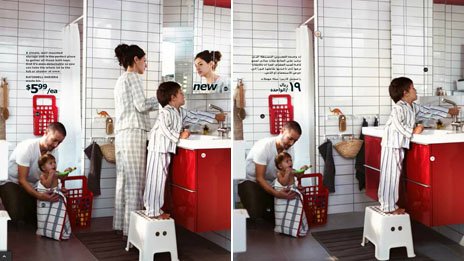
Scrubbing the bathroom got a whole new meaning in the Saudi Arabian Ikea catalog. The Swedish home and furnishings retailer faced criticism after reports surfaced that Ikea digitally erased women from pictures in the Saudi version of the catalog.

In one picture of a family in a bathroom, the mother standing at the sink with her son was removed. Even one of the retailer’s own designers, Clara Gausch, was erased from a photo featuring four of the brand’s designers.

Sweden’s trade minister Ewa Björling told the newspaper Metro the vanishing women were a “sad example” of gender inequality in Saudi Arabia, where women aren’t allowed to drive and must be covered in public.

In a statement to the BBC, the company said “excluding women from the Saudi Arabian version of the catalogue is in conflict with the Ikea Group values.” It blamed the missing women on the franchisee who runs Ikea’s Saudi operations and said, “We do not accept any kind of discrimination.”

While every media outlet around is poking fun at the Swedish furniture icon (and Swedes take their human rights and equality issues very, very seriously), the question I’d ask Ikea’s Saudi franchise is who do you think is buying your furniture? I’ve rarely seen any man in Ikea either in Riyadh or Jeddah deciding on what will go in the house.

So, how is getting rid of women in the catalogue going to help shift furniture? How does ignoring your target audience and not promoting your brand values with half of the population, the half that (mainly) look after domestic matters. So again, what was Saudi’s Ikea franchise thinking? Forget the women, let’s keep the conservatives happy. And yes, you can find women’s pictures being published in Saudi Arabia so why did the franchise take the risk?