Reflections on why we all should adapt to the cultures around us

How much do you understand about and live in harmony with the culture around you?

I was reading a short but poignant piece by Annabel Kantaria, the Daily Telegraph’s journalist in Dubai. The column was about Dubai’s Brits and how today’s British expats in the Emirate are a breed apart from their predecessors (have a look at the article here).

My take on culture and our settings may be different to most, partly cause of my background and partly due to my circumstances. As a child of two cultures, I’ve always been acutely aware of the importance of the need to adapt and become part of the community within which I am living. For years my family lived in Saudi Arabia, a country that has a very distinct set of cultures. I’ve married into another culture as has my sister.

For those that aren’t from a melting pot of genes, traditions and customs I can imagine that it isn’t easy to let go of what you know so well. Is there an urge to make others adapt, to conform? You could certainly say that the walls of a compound are a way to keep out external influences.

However, isn’t there more to living in a foreign location than just a job or a salary? How much more can we enrich ourselves through adapting to the local culture and becoming part of the local community?

It pains me when I meet with people who can’t utter a word of the local language despite having lived in the country for years, and whose only contact with their environment is the food (usually hummus). Admittedly exchanges do need to be two-way; a dialogue needs two or more people to talk and listen to each other. However, someone needs to make the first move and look beyond their boundaries to understand, learn and appreciate what is different.

Despite its reputation for being a harsh place to live, I loved my time in Saudi Arabia. Why? Because I became part of the community. I spoke the language, I developed friendships and spent time with locals talking about what is important to them.

I miss that cultural understanding, that bridging of the divide between me and them. The world will be a better place with more understanding. Adapt to your surroundings, thrive in your local environment rather than simply live there, and you’ll end up calling your foreign adventure your home rather than a ‘couple of years abroad.’

The dangers of speaking your mind online – lessons from the Middle East

Kuwaiti graphic designer Mohammed Sharaf @MohammadRSharaf created the following image to support Nasser Abdul during his trial for tweeting offensive material

The internet is full of misconceptions. I often feel that most people think that the world wide web is a place where they can go to say anything, both positive and (most often) negative. The past 18 months and pending legislation should make anyone and everyone think twice about the above. Cases in Saudi Arabia, Bahrain, and Kuwait have cast aside the notion that cyberspace is a domain where anything and everything goes.

A number of trials and guilty verdicts both underline the importance of tempering what people say online as well as underscore what authorities do and do not deem as illegal. The first high-profile legal proceedings took place in Kuwait when in June of last year a Kuwaiti national was charged with slandering Bahrain’s royal family and a religious group.

Despite claiming that his Twitter account was hacked Nasser Abdul was found guilty and sentenced to three months in jail which he had already served by the time his sentence was pronounced. There have been other cases in Kuwait, including the prosecution and sentencing of Mubarak Al-Bathali to six years in jail (this was commuted to six months) for Tweets attacking certain religious groups.

The most famous case of jailing for tweeting is that of Hamza Kashgari, who published three tweets about an imaginary meeting between himself and the Prophet Mohammed. His comments drew an instant reaction from Saudis online; in the hours that followed over 30,000 tweets regarding Kashgari were published online. Kashgari was accused of apostasy and fled to Malaysia. He was deported back to Saudi Arabia and jailed. Kashgari is still in detention, despite pleas by his family for his release and his apology for his actions (the basic story and roundup can be read here on Wikipedia).

Bahrain’s authorities have also taken to court individuals for publishing their thoughts in online public forums. The most famous and most recent case is that of activist Nabeel Rajab who tweeted about the Prime Minister’s visit to Muharraq in June and was accused of publicly insulting Muharraq’s residents for their support of Sheikh Khalifa bin Salman al-Khalifa. According to Bahrain’s prosecutor Rajab had claimed that Muharraq’s residents had only welcomed the Prime Minister during a visit because he had offered them subsidies.

Bahrain’s Information Affairs Authority said his acquittal on defamation charges “was due to the judge’s uncertainty regarding the evidence submitted to support the lawsuit”. Rajab, who has spent two months in jail while awaiting the outcome of this and another case, had been faced with possible charges before for his use of Twitter, in 2011, in what would have been the first such case in the Middle East.

Clearly the Arab Spring, which has led to regime change in three Middle East countries and is still being felt across the region, has sharpened the thinking of numerous governments across the region. According to media reports in June of this year, Bahrain is introducing legislation to curb misuse of social media.

I am still trying to fully understand the full implications of Bahrain’s proposed social media law, but I am assuming that this would cover and make an illegal offense the publishing of any comments online or through social media that would appear to contradict government policy or government statements. Kuwait is also leaning in this direction, as this editorial by Reuters makes clear.

What is clear is that the Middle East’s online community is becoming increasingly politicized. I’d argue that many people, frustrated with the lack of political debate in traditional media, are going online to voice their issues and concerns. The Dubai School of Government has estimated that there are 1.3 million active users on Twitter in the region.

Switching tack slightly, how will the increase in political discourse affect online communication efforts/campaigns? Will communication professionals and agencies steer completely away from anything that could be construed as political or biased to one community? And will we see more people using online aliases? While many governments would like to regulate online activity, how are they going to force users to reveal their true identities when using services that are based in Europe or the US?

Would we even see sites such as Facebook or Twitter blocked by governments in the region (this did happen in Egypt during January 2011 when the authorities tried to stop any and all access to social networking sites)? That’s the logical conclusion, but how would you do this when these sites have become part of people’s everyday lives? As always, there seem to be many more questions than answers when it comes to the Middle East. The freedom to voice one’s thoughts online are no exception.

Do you need more bling in your life? Car painting and modding in Saudi…

As it’s almost the weekend, I thought I’d write a short blog before adding more content tomorrow and Saturday. Here’s two wonderful pictures of car designs/gratification in Riyadh. I should have more pictures (there’s an unbelievable car painting/modding scene here due to the money spent on cars and the lack of alternative entertainment for young men) but I’m often the one driving.

Enjoy the pictures below and I’ll upload more as and when I take/receive them.

Missing out on some love this Valentines Day when in Riyadh? Don’t worry, this Toyota has more than enough hearts to go round. I just hope they can outrun the religious authorities.

Or how about a Hummer H2 in gold?

Or if you prefer your rims and high suspension, you can always do this…

And if you’re wondering what people (sometimes) do with these cars, have a look at the below video.

And after that?

This is a famous roundabout sculpture in Jeddah. The image is taken from Susie of Arabia’s blog site, which can be accessed at http://susieofarabia.wordpress.com/

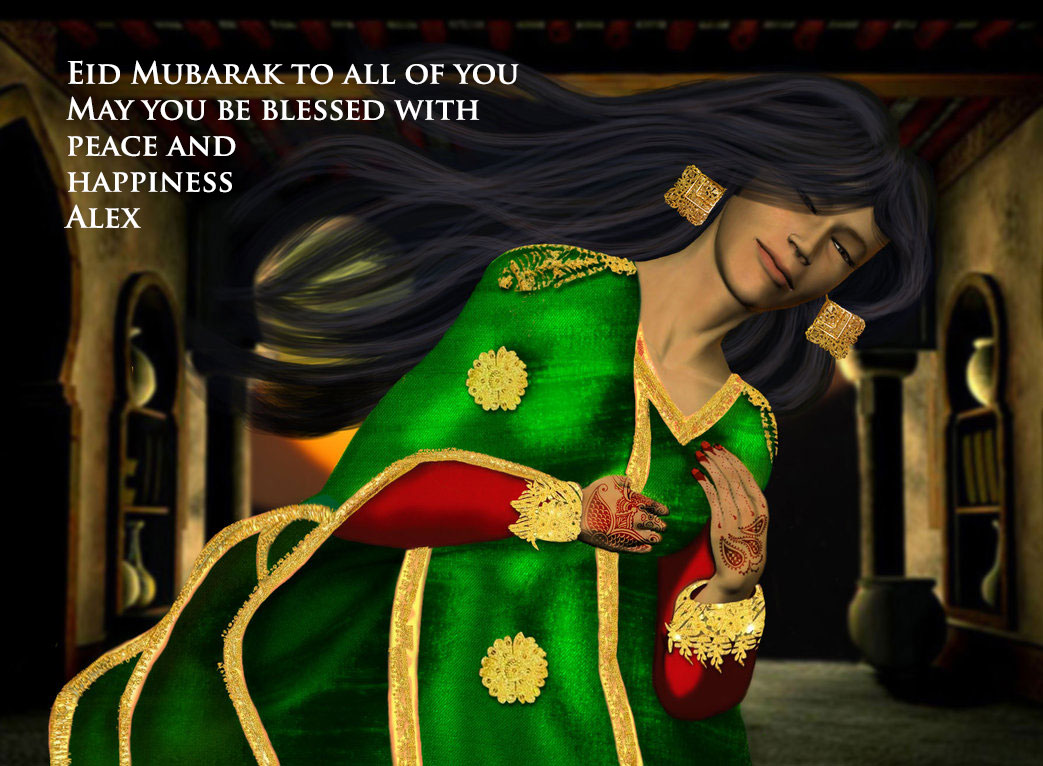
Eid Mubarak to you all!

Ramadan is over and the Muslim world and the Middle East is celebrating the Islamic festival of Eid. My very talented and lovely wife did me a design for the occasion for you all (I’ll admit I’m a day late posting this due to Eid obligations and niece sitting yesterday!).

So, as we say here Eid Mubarak to you all. Kol ahm wa intum bkhayr, or may you enjoy peace, good health and prosperity for the year to come!

The image is of a Bahraini folklore dancer. My wife says its a work in progress but the image looks great to me (well, I’m biased anyways!)

AlBaik… The best fast food in the world? And it’s Saudi!

AlBaik. If you’ve been to Jeddah the name is unforgettable. AlBaik is delicious, jaw-dropping, explosion-in-the-mouth chicken. Either broasted or fried, AlBaik chicken is so popular that the restaurant chain does travel packs for plane-bound travelers.

The chain is Saudi-owned and based in the country’s Western Region (think Jeddah, Mecca and Medinah). Next to AlBaik no other fast food chain gets a look in. This place is so popular that when AlBaik raises its prices the news makes national headlines (and you can read it here if you don’t believe me).

Here’s two clips of AlBaik from Youtube. One is from the Travel Channel. The other is AlBaik opening after prayer time (trust me, this clip isn’t an exaggeration). I will start blogging more on Saudi culture so enjoy!

And again, trust me, the below isn’t a fake video.

Islam, Politics and Activism – the most popular Saudi-based Muslim scholars on Twitter

It can be both fascinating and bizarre to compare regions and cultures through any lens. A couple of articles on the issue of Twitter, its users and the number of their followers caught my eye this week. The first was a piece entitled Our cleric and their Lady Gaga by Saudi media analyst Yasser Al-Ghaslan (Yasser can be followed on Twitter at @alghaslan).

I’m going to start providing brief profiles of the most popular (which I’m defining here as most followed) users of Twitter in Saudi Arabia and then profile users in other countries around the Gulf.

First up, let’s profile the most popular users in Saudi. It may be no surprise that religious figures are the top Tweeters in Saudi Arabia. The below is a top five list of Saudi religious figures.

1. Dr Mohammed Al-Arefe/@MohamadAlarefe – relatively young in comparison to his peers (he was born in 1970), Dr Mohammed Al-Arefe is possibly the most followed person in the Middle East on Twitter with 2.3 million followers. Dr Al-Arefe is a insatiable user of social media (there are several channels on Youtube named after him), and he’s been a pioneer in his use of social media including working with corporate sponsors such as Du to answer questions about religion through Twitter and other digital media channels.

Dr Al-Arefe involves himself in a number of political issues; he recently organized a fundraiser for Syrian refugees and tweeted about Arab Muslims in Iran. Dr Al-Arefe is generally considered to be a mainstream Saudi religious figure in terms of his outlook and views.

With over 2.3 million followers Dr Al-Arefe is the most popular Twitter user in the Middle East

2. Dr Ayed Al Qarnee/@Dr_alqarnee – Dr Ayed Al Qarnee is a well-known Islamic scholar who is best known outside of Saudi for his publications which include Don’t Be Sad (La Tahzan) and also Do Not Despair (La Tayass) which was blacklisted after Dr Al Qarnee admitted plagiarizing another author. Dr Al Qarnee has over 1.5 million followers on Twitter, and he’s also active on Facebook and Youtube.

Dr Al Qarnee is often viewed as a progressive in terms of his comments and thoughts. He was one of the first popular scholars in Saudi to rule that Islam does not prohibit women from driving. He has worked with corporations such as telco operator Zain Saudi to promote Islam through digital channels. Unthinkable for most scholars in Saudi, Dr Al Qarnee also collaborated with popular Saudi singer Mohammed Abdu. Dr Al Qarnee also uses Twitter to promote Muslim causes worldwide. He’s been prominent of his support for the Syrian people against the Syrian government and has recently been Tweeting about oppressed Muslim communities in Burma.

Dr Al Qarnee is one of the most outspoken and popular Islamic scholars on Twitter today.

3. Dr Salman Al Auda/@salman_alodah – Dr Al Auda is possibly the best known of the five religious figures on this list due to his media work and his jailing and subsequent rehabilitation. Born in 1955 or 1956 in Buraidah, Al-Qassim, Al Auda studied under a number of prominent conservative scholars including Abd al-Aziz ibn Abd Allah ibn Baaz and Muhammad ibn al Uthaymeen. Al Auda was jailed for five years for preaching against the Saudi government. Before his imprisonment Dr Al Auda was an ultraconservative; after his release Dr Al Auda became a different person. He preaches coexistence and tolerance with other religions. Dr Al Audah is the editor of website Islam Today, he regularly appeared on TV network MBC and he uses the internet to give lectures to his followers.

Dr Al Auda has a huge following on Twitter and to date he’s the most prominent user of the service having sent over 14 thousand messages to his fans

After Dr Al Audah it’s more difficult to discern who should make up the remainder of the list. If I’ve got this wrong then please do let me know and I’ll amend.

4. Dr Tareq AlSuwaidan/@TareqAlSuwaidan – While not a Saudi (Dr AlSuwaidan is Kuwaiti by nationality), Dr AlSuwaidan is an ever-present face on both traditional and social media channels. While Dr AlSuwaidan is the least orthodox of those on this list (his PhD was in petroleum engineering rather than religious studies), he was an early adopter of television with shows across a number of networks. A self-pronounced moderate, Dr AlSuwaidan has just under 700 thousand followers on Twitter and 460 thousand likes on his Facebook page. He has applications available through Apple’s iTunes online store.

Dr AlSuwaidan is a regular user of Twitter, where he generally preaches dialogue and tolerance. Dr AlSuwaidan is less involved in politics than the other preachers on the list. However, he has taken a strong stance on Syria to support activists opposed to the regime.

Dr AlSuwaidan is the most popular Kuwaiti scholar online and on social media with just under 700,000 followers

5. Adnan Al-Arour/@AdnanAlarour – The final person on the list is Sheikh Adnan Al-Arour. Riyadh-based but originally hailing from Hama in Syria, Al-Arour is a conservative cleric who studied under a number of prominent Saudi scholars including Abd al-Aziz ibn Abd Allah ibn Baaz. Al-Arour has had a number of books published and regularly appeared on Safa TV, an Islamic satellite channel based in Egypt. Al-Arour has just under 500 thousand followers on Twitter and over a 100 thousand likes on Facebook.

What marks Al-Arour out from his peers on the list is his involvement in the conflict in Syria. Most of Al-Arour’s online dialogue revolves around events in Syria and his vocal support for the ending of the country’s present regime.
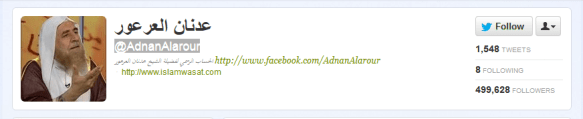
Riyadh-based Syrian religious figure Sheikh Adnan Al-Arour has just under half a million followers on Twitter. His main focus is on events in Syria

While nearly all of the messaging put out by those listed above is in Arabic, the Financial Times’ correspondent in Riyadh Abeer Allam wrote a sharp piece on the phenomenon which is well worth a read. The article can be viewed here.

As a final twist to the above Saudi-based newspaper Al Eqtisadiah wrote a piece about Saudi celebrities buying followers on Twitter. The article’s main points were reproduced here in English on Al Arabiya. Two of the five scholars listed above are mentioned in the article. If I ever have the time I may check out these allegations. If anyone else has done then please do drop me a line.
Supporting Saudi’s first female athletes. #London2012 #Olympics

Last night was a magical occasion. From James Bond to the Queen jumping out of a helicopter (admittedly, a double) and Mr Bean’s cameo with the London philharmonic orchestra. My own personal highlight was worth the wait. As the teams made their way into the arena three teams sent for the first time sent female athletes. The first was Brunei. Some time after Qatar’s first female athletes made their way into the arena. Finally, the wait was over. Saudi’s first female athletes appeared. Wodjan Shahrkhani and Sarah Attar walked with their heads held high and waved to the crowd. They were joined by Arwa Mutabagani, the female team manager, former professional show-jumper and mother of Saudi Arabian rider and Olympic hopeful Dalma Rushdi Malhas.

From left to right: Attar, Shahrkhani, and Mutabagani represent Saudi Arabia during the opening ceremony for London 2012

For anyone who has been following this little slice of history in the making, there’s been controversy and debate both inside Saudi Arabia and abroad about Saudi women taking part. I referred to this in a previous post. There’s still uncertainty as to whether Shahrkhani, who is supposed to be competing in judo, will be able to take part and still wear the hijab, the piece of clothing that covers her hair.

Sarah Attar will be the first Saudi woman to run in the Olympics when she competes in the 800 meters

The debate online outside Saudi Arabia has focused on women’s right and how the Kingdom is still not doing enough when it comes to promoting and protecting their equality. A good post that sums up the contrasting arguments found in yesterday’s and today’s media has been written by Huffington Post producer Ahmed Shihab-Eldin and can be accessed here.

Having lived in both Jeddah and Riyadh for years I’m proud to be able to call many Saudis, both male and female, good friends. There’s no simple answers in a country that could be said to be more diverse and varied than any other in the Middle East region.

I am however, even prouder of Attar and Shahrkhani. Whether or not people think that their participation is a symbolic gesture, they are there in London as athletes and they have set a first for their country and Saudi women. History has been made and Saudi Arabia no longer stands alone as the one country that didn’t send women to the Olympic games. The support for the ladies online and on social media forums has been overwhelming. There has been criticism as well, as this post by Amira Al Hussaini on the online portal Global Voices points out, but I would like to think that these people are a small, vocal minority (this is a great update story to the original Global Voices post by Bikaya Masr).

Their participation at London 2012 shows that change is possible – one could say it is inevitable – and that others will benefit from what Attar and Shahrkhani are doing at the London 2012 Olympics. I’ll be cheering them on during the games and I’m sure that millions of others will be behind them for all that they have and are achieving.

If anyone knows of a Twitter hashtag for supporting the ladies do let me know in the comments section.

The ladies will be flying the flag for their country during London 2012

PS you can support Sarah via her Facebook page here. I haven’t seen one for Wojdan yet, but if there is a site I’ll add it here.