Finance and entrepreneurship goes digital with souqalmal.com

I love entrepreneurs, I really do. At their best they’re gutsy, bold, decisive, innovative, and they’re not afraid of risk. Frankly, we need more entrepreneurs in the Middle East.

I had the pleasure and the opportunity to meet the person behind the idea of souqalmal.com last week. After stints with GE, Mastercard and the consultancy firm Bain Ambareen Musa took the jump into the entrepreneurial space to found souqalmal.com.

Souqalmal.com is the first website I’ve come across in the region which provides a comprehensive view of a variety of financial products, including credit cards, personal finance, home and vehicle finance, insurance and personal banking accounts. In other words the portal is an Gulf-based version of money.co.uk (the site presently caters to Kuwait, Saudi Arabia, and the UAE) and is both incredibly easy to use as well as very handy when comparing different products in the market.

Souqalmal isn’t just about providing the basic data however. The site lets subscribers rate products, just as you would do on a Tripadvisor for a hotel or amazon.com for a book. As a consumer you get to rate that service and provide your input to hundreds and thousands of others who will be using the site. That consumer feedback element should raise the bar for the financial services industry in the region by highlighting what is both good and bad about the product and it services.

What I love most about what Ambareen is doing is that she’s established a business that is providing a much-needed public service. She’s dived in, she’s pushing ahead, and I do believe that she and souqalmal.com will improve what and how the financial sector offers and deals with the region’s consumers. I for one wish her all the success in the world, and can’t wait to start putting down my thoughts on souqalmal’s review sections!

Will Souqalmal.com and one person’s entrepreneurial spirit change the face of consumer banking in the Gulf? Let’s hope so!

Going above and beyond: How IBM is supporting Sharjah through training and education (and all for free)

Corporations often about about giving back. The phrase corporate social responsibility is often uttered by executives. But how many companies really get their hands stuck in when it comes to providing knowledge, skills, and experience to local communities.

IBM’s remit has included encouraging ICT adoption among Sharjah’s youth

One company that I admire and respect for how it does things differently is IBM. IBM, or Big Blue as the company is also known, is a vendor to the Government of Sharjah for its e-government project. IBM did what few other vendors do, and sent a team of volunteers over to Sharjah to help develop a communications strategy that would promote Sharjah’s e-government services to the Emirate’s citizens and residents. Here’s a couple of bite-size quotes from IBM’s press memo.

An international team of 14 IBM employees chosen for the company’s Corporate Services Corps program has arrived in the United Arab Emirates to volunteer their expertise in support of e-literacy and social development in the Emirate of Sharjah. As part of the project, the team will work alongside the Sharjah e-Government Directorate, Sharjah University and the Supreme Council for Family Affairs Centers.

The team of 14 IBM experts from the United States, India, Austria, Italy, Belgium, Switzerland, Japan and Australia will be on the ground in Sharjah for a month. At the Sharjah e-Government Directorate, a team will help refine a national strategy for promoting e-services of the Sharjah government to residents.

At the Supreme Council of Family Affairs, an IBM team will help the council and its organizations realize an e-literacy program and move closer towards realizing its goals of helping Sharjah women and youth improve their IT skills.

IBM’s Corporate Service Corps are teams of subject matter experts who give their time free of charge for a month to help local economies, improve skills, and provide a foundation for success in a variety of disciplines to small businesses, educational institutions and non-profit organisations.

As a person who is passionate about communications, I find it interesting that IBM focused on working with Sharjah on how to promote e-services. In a sense it acknowledges the truth that having a good technical setup and list of services just isn’t enough. If you don’t know about the services and/or your habits are ingrained then you won’t use a new services. It’ll be interesting to see how IBM and the Sharjah Government will look to tackle the issue of change, to promote services that contrast with how government affairs have been traditionally run in the Gulf (think lots of office trips and paperwork).

In addition, how will the initiative have tackled internal change, to convince government employees who would have never thought about either using e-services or promoting electronic government.

I’d love to know if IBM considered the prospect of using traditional communication methods such as a majlis (usually a night-time gathering of several dozen men, or women, in one room discuss everything from personal issues to business) to talk about and listen to ideas on how to publicize e-services as well as demonstrate the ease with which one could complete a government transaction or service without having to talk to someone face to face or leave one’s house or office.
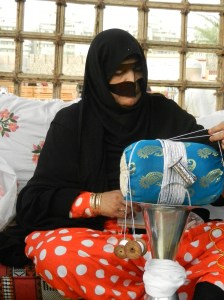
How will IBM and the Sharjah Government promote e-services to a society that is both traditional and conservative?

In a conservative society with many different cultures, nationalities and languages what tactics can be used to convey a message successfully? The thought of using centuries-old concepts and practices to make a success out of a cutting edge technology project to change how government services are requested and delivered is fascinating. Again, I wonder what IBM came up with on this project.

All in all, this is what CSR should be about. Supporting a government e-services project through communications? Providing advice and training for getting more women and youth into technology? And for free? I hope others follow in IBM’s footsteps. We all could do with more corporate love through such projects.

PS for more news on IBM’s Corporate Service Corps initiative have a look at the website http://www.ibm.com/ibm/responsibility/corporateservicecorps/ or follow the hashtag #ibmcsc!

Where’s the corporate response to #Sandy?

The response to tropical storm/hurricane Sandy online has been remarkable. There’s little anyone else is talking about, and even as far off as the Middle East people are sending their wishes to those caught in the storm’s path. To give you an idea about how Sandy has been trending on social media, have a look at the analytics graph from Hashtag.org for #sandy.

The graph, from hashtags.org, is from a one percent sample of Twitter traffic over the past 24 hours.

Everyone has been pitching in to provide help, support and comfort to those affected. According to thenextweb, Twitter has supported relief efforts by promoting the following twitter accounts @RedCross, @FEMA,@NYCMayorsOffice, and @MDMEMA. “Twitter is also listing government accounts and resources on its blog and giving #Sandy a custom page,” according to the piece by Harrison Weber on TNW.

Even celebrities have been taking to the social media space to talk about Sandy.

https://twitter.com/ABFalecbaldwin/status/263245395025600512

Aside from the danger to life posed by Sandy, the main talking points have been flooding and power outages. As a big fan of the likes of ABB (my former company) and GE, I was hoping that they and others would be talking about the disaster and lending a hand to get everything back on track. Estimations are that eight million people are without power right now in the Eastern seaboard of the US, and that utility company staffers are traveling from as far as California and Texas to help out in New York.

And what is on GE’s Facebook page?

This was GE’s latest post to their Facebook page, which is liked by over 900,000 people. There’s no mention of Sandy.

And ABB?

ABB’s latest Facebook post which was put up in the afternoon of October 30. Again, no mention of Sandy.

This isn’t exactly an empirical study, but it worries me that two of the world’s most respected electrical engineering companies are not lending their support or even making their support known by social media. While I understand that many corporates don’t want to be seen to be taking advantage of the situation, surely there’s a time and place for them to offer their support and advice publicly.

Not talking about what is affecting millions of people seems so out of place, especially when on social media and when the companies mentioned provide solutions that power our utilities.

After all, aren’t we supposed to be talking with each other via Facebook and Twitter. Or do we go on, ignoring global events? Hardly being socially responsibly on social media, is it?

Lessons on leadership… Apple, Bahrain and Dubai

It’s (hopefully) common sense that leadership can make or break any company or organisation. A leader, normally the CEO, will define the company’s direction, they will set the agenda, lead the execution and innovate.

Leaders like Steve Jobs define their organisation and create success on their own terms, much like Dubai’s Sheikh Mohammed Al Maktoum has done.

The late, great Steve Jobs has been acclaimed as one of the best CEOs in business. Jobs did it his way, he focused on the business and on creating works of art/technology that changed how we live our lives.

For me, the Apple of today is different to the Apple of yesterday. Nothing would go out of the door until Jobs was satisfied that the product was right and ready.

A simple example is cited by Mike Elgan in his recent article on Apple.

Apple had been developing the iPhone for years. After major arguments about materials, the team had decided to use reinforced plastic on the screens for the first version. That was the plan, and everybody spent more than a year working on it.

Just one month before the first iPhone shipped, Jobs summoned his team and issued an edict: The screen would be glass. He just didn’t like the plastic screen.

Of course, Job wasn’t perfect. He had his flaws. But I can’t imagine that Jobs would have let Apple Maps into the world without the solution being ready (the linked article here does make the point that Jobs himself was late to realize the importance of a maps application). As a leader could we imagine anyone else taking Apple forward better than Jobs? No. That is evident more so today when he’s missed.

So how is this relevant to us in the desert? I was talking to a work colleague, a well-respected Emirati, about the Gulf and how it has developed. He was talking about Bahrain, and commenting on how 20 to 30 years back Bahrain was where Emiratis would travel to shop and vacation.

What he was saying made sense to me; Bahrain had a well-developed economy at the time and Dubai was setting out on the journey to become one of the globe’s trading hubs. Bahrain was the GCC’s banking hub, Gulf Air was the airline of the region, and the island could do no wrong.

Fast-track to today, and it’s as if the roles have been reversed. Dubai is now the trading hub for the region, and it’s the one must-visit destination for business and tourism. Emirates is the world’s largest airline by passenger numbers, Dubai-owned Jumeirah is becoming a global brand for the hospitality sector, and, despite the credit crunch, Dubai is still thriving. As for Bahrain, it’s fair to say that the country isn’t doing as well as Dubai.

Countries are no different from companies. The leadership shown by the ruler, the prime minister or whoever at the top can be and often is the difference between success and failure. Nowhere is that more apparent than in today’s Gulf and in the vision set out by Dubai’s ruler Sheikh Mohammed Al Maktoum. Leadership is success, and a lack of leadership can be the opposite.

Al Maha Resort: A desert experience in need of nationals

After the hard work of the last couple of weeks before and during Gitex, I treated the missus to a weekend at what may be Dubai’s best weekend getaway. The Al Maha Desert Resort is one of those places which is good for the soul. For anybody who hasn’t been to the desert and experienced its deafening silence, the Al Maha is a must.

Al Maha was conceived over a decade back as one of the first nature reserves in the UAE. The resort has helped preserve a number of species which are unique to the Arabian desert, including the Orxy, the long-horned white antelope, and gazelle. Al Maha is designed to be both a conservation reserve as well as a luxury resort, and the guides at Al Maha are experts in the local wildlife. Guests can explore the desert within the vicinity of the hotel and learn about the UAE’s flora and fauna.

Our experiences during our stay at Al Maha were remarkable. We didn’t even mind the six am start for the desert wildlife trip. For a taster of the resort and all it has to offer have a peak at the below video.

There was only one disappointment for me. No matter how hard I tried I could not find any nationals working at Al Maha. I’d asked our guide who told me that this was not for the hotel’s trying; a couple of nationals had worked at the hotel but had left several years back. The Gulf is renowned for the generosity shown to guests.

I’ve experienced first-hand the warmth of the Bedouin and locals in places like Saudi Arabia’s Qassim province. Their stories and experiences made my own journey all the more remarkable. The local culture is part of what makes any trip to the desert so much fun and, dare I say it, educational.

Frankly it was disappointing for me that there were no Emiratis working at one of the first sites set up by the UAE’s government to preserve the desert environment and its wildlife. I would have enjoyed hearing the tales of the UAE’s own Bedouin about their lives in the desert.

I do very much hope that when we do go next time to Al Maha that we will meet with local guides as well as the team that took care of us so well the last time we visited (a BIG THANK You to Shane for all the effort you put into taking care of us). Our stay will be even more enjoyable and rewarding with a touch of local knowledge. After all, our history and culture makes us who we are. To have a true desert experience in the UAE you need to be hosted by the people who have lived the Bedouin life and who call the white sands and oases their home.

To repeat, Al Maha Resort is one of the best hotels I’ve ever been to. It’ll only get better with Emirati employees.

Forget the culture, what about your customers? Saudi Ikea and a no-women catalogue

Now you see her, now you don’t. Ikea’s Saudi franchise forgot about the half of the population that makes (most of) the decisions about what goes in the house.

Ikea has been in the news of late for all of the wrong reasons. If you haven’t seen, read, heard or been told about the ‘incident’, then read the below from NBC’s website.

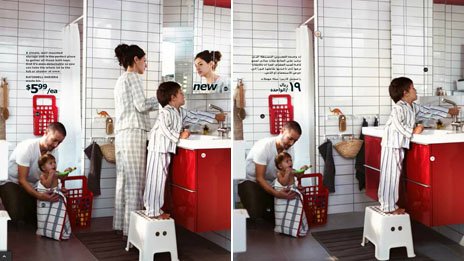
Scrubbing the bathroom got a whole new meaning in the Saudi Arabian Ikea catalog. The Swedish home and furnishings retailer faced criticism after reports surfaced that Ikea digitally erased women from pictures in the Saudi version of the catalog.

In one picture of a family in a bathroom, the mother standing at the sink with her son was removed. Even one of the retailer’s own designers, Clara Gausch, was erased from a photo featuring four of the brand’s designers.

Sweden’s trade minister Ewa Björling told the newspaper Metro the vanishing women were a “sad example” of gender inequality in Saudi Arabia, where women aren’t allowed to drive and must be covered in public.

In a statement to the BBC, the company said “excluding women from the Saudi Arabian version of the catalogue is in conflict with the Ikea Group values.” It blamed the missing women on the franchisee who runs Ikea’s Saudi operations and said, “We do not accept any kind of discrimination.”

While every media outlet around is poking fun at the Swedish furniture icon (and Swedes take their human rights and equality issues very, very seriously), the question I’d ask Ikea’s Saudi franchise is who do you think is buying your furniture? I’ve rarely seen any man in Ikea either in Riyadh or Jeddah deciding on what will go in the house.

So, how is getting rid of women in the catalogue going to help shift furniture? How does ignoring your target audience and not promoting your brand values with half of the population, the half that (mainly) look after domestic matters. So again, what was Saudi’s Ikea franchise thinking? Forget the women, let’s keep the conservatives happy. And yes, you can find women’s pictures being published in Saudi Arabia so why did the franchise take the risk?

The dangers of speaking your mind online – lessons from the Middle East

Kuwaiti graphic designer Mohammed Sharaf @MohammadRSharaf created the following image to support Nasser Abdul during his trial for tweeting offensive material

The internet is full of misconceptions. I often feel that most people think that the world wide web is a place where they can go to say anything, both positive and (most often) negative. The past 18 months and pending legislation should make anyone and everyone think twice about the above. Cases in Saudi Arabia, Bahrain, and Kuwait have cast aside the notion that cyberspace is a domain where anything and everything goes.

A number of trials and guilty verdicts both underline the importance of tempering what people say online as well as underscore what authorities do and do not deem as illegal. The first high-profile legal proceedings took place in Kuwait when in June of last year a Kuwaiti national was charged with slandering Bahrain’s royal family and a religious group.

Despite claiming that his Twitter account was hacked Nasser Abdul was found guilty and sentenced to three months in jail which he had already served by the time his sentence was pronounced. There have been other cases in Kuwait, including the prosecution and sentencing of Mubarak Al-Bathali to six years in jail (this was commuted to six months) for Tweets attacking certain religious groups.

The most famous case of jailing for tweeting is that of Hamza Kashgari, who published three tweets about an imaginary meeting between himself and the Prophet Mohammed. His comments drew an instant reaction from Saudis online; in the hours that followed over 30,000 tweets regarding Kashgari were published online. Kashgari was accused of apostasy and fled to Malaysia. He was deported back to Saudi Arabia and jailed. Kashgari is still in detention, despite pleas by his family for his release and his apology for his actions (the basic story and roundup can be read here on Wikipedia).

Bahrain’s authorities have also taken to court individuals for publishing their thoughts in online public forums. The most famous and most recent case is that of activist Nabeel Rajab who tweeted about the Prime Minister’s visit to Muharraq in June and was accused of publicly insulting Muharraq’s residents for their support of Sheikh Khalifa bin Salman al-Khalifa. According to Bahrain’s prosecutor Rajab had claimed that Muharraq’s residents had only welcomed the Prime Minister during a visit because he had offered them subsidies.

Bahrain’s Information Affairs Authority said his acquittal on defamation charges “was due to the judge’s uncertainty regarding the evidence submitted to support the lawsuit”. Rajab, who has spent two months in jail while awaiting the outcome of this and another case, had been faced with possible charges before for his use of Twitter, in 2011, in what would have been the first such case in the Middle East.

Clearly the Arab Spring, which has led to regime change in three Middle East countries and is still being felt across the region, has sharpened the thinking of numerous governments across the region. According to media reports in June of this year, Bahrain is introducing legislation to curb misuse of social media.

I am still trying to fully understand the full implications of Bahrain’s proposed social media law, but I am assuming that this would cover and make an illegal offense the publishing of any comments online or through social media that would appear to contradict government policy or government statements. Kuwait is also leaning in this direction, as this editorial by Reuters makes clear.

What is clear is that the Middle East’s online community is becoming increasingly politicized. I’d argue that many people, frustrated with the lack of political debate in traditional media, are going online to voice their issues and concerns. The Dubai School of Government has estimated that there are 1.3 million active users on Twitter in the region.

Switching tack slightly, how will the increase in political discourse affect online communication efforts/campaigns? Will communication professionals and agencies steer completely away from anything that could be construed as political or biased to one community? And will we see more people using online aliases? While many governments would like to regulate online activity, how are they going to force users to reveal their true identities when using services that are based in Europe or the US?

Would we even see sites such as Facebook or Twitter blocked by governments in the region (this did happen in Egypt during January 2011 when the authorities tried to stop any and all access to social networking sites)? That’s the logical conclusion, but how would you do this when these sites have become part of people’s everyday lives? As always, there seem to be many more questions than answers when it comes to the Middle East. The freedom to voice one’s thoughts online are no exception.

A timeless video of Wadi Rum. Don’t you wish you were here?

A diversion here from the norm, but this video is beautiful. The location is Wadi Rum in Jordan, where Lawrence of Arabia was shot. Just click play and enjoy!

Is talent enough? Does the #Gulf have enough #creative #marketing #talent?

This week I wrote a fun piece for the UAE-based internet news portal Kipp Report rebutting arguments put forth by the head of creative marketing and advertising agency Leo Burnett.

I’m not going to repaste the stores word for word but you can find both pieces linked here. You can find my piece, Is talent enough, via this link. The piece by Kamal Dimachkie, executive regional managing director of Leo Burnett – UAE, Kuwait and Lower Gulf, can be found here.

What I’d like is to hear from UAE and GCC nationals who are either working in this sector or who have a passion for advertising, branding and marketing. What are your thoughts on this subject? And what would you like the industry to do to encourage local talent?

And for all of my friends, family and everybody else out there in the blogosphere I’d like to say Ramadan Kareem! We’re a day into the holy month but it’s never too late to express our blessings for this month. My wife designed the visuals below (and she’s a GCC national! Go figure…)

Ramadan Mubarak to you all!