Is a lack of Arabic content and low digital spending a challenge or opportunity for MENA marketers?

What should one be doing online in the Middle East? It’s always been a mystery, to me at least, that companies aren’t more active in the digital space in the region. Well, the researchers at the Northwestern University in Qatar and the Doha Film Institute have come up with some findings that underline how organizations are missing the boat when it comes to the Arab consumer and the internet (there’s been plenty of coverage on the study, including this piece on Stepfeed).

Firstly, let’s look at Arabic language content on the web. The researchers used a number of methods to understand how much Arabic content was online. One of the most interesting means used was to look at the 50 most popular web sites in Egypt, Qatar, Saudi and the UAE based on Alexa rankings to understand if Arabic was used and, if so, whether Arabic was the primary or secondary language. The results may, or may not, surprise you.
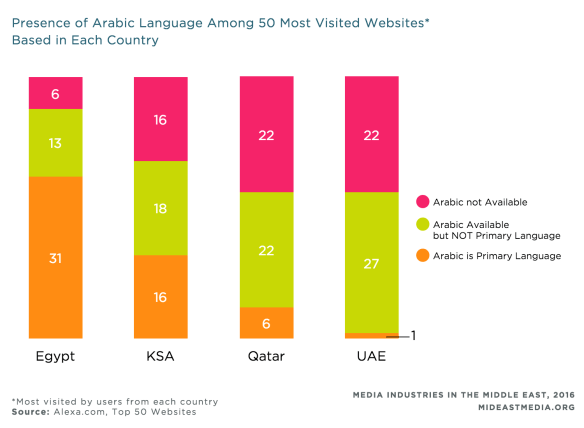
The research surveyed the 50 most visited websites in each country to understand how Arabic was used.

The research surveyed the 50 most visited websites in each country to understand how Arabic was used.

As the report itself states:

Despite a rapid increase in the number of Arabic-speaking Internet users, Arabic content remains one of the most under-represented languages online in terms of its share of the world’s websites. Even in predominantly Arabic-speaking countries like Egypt, a third of the top 50 visited websites are either not available in Arabic or do not include Arabic as the “default” or primary language.

It’s not all bad news however, according to Klaus Schoenbach, Associate Dean for Research, at Northwestern University in Qatar. He believes that content generated by users, particularly on social media, makes up for this corporate shortfall.

The findings do not necessarily suggest that Arabic content is low overall. Relative to the approximately 6 percent of Arabic speakers in the world, it is true that there are a disproportionately low number of Arabic websites on the Internet; however, by some metrics Arabic has a disproportionately high representation in social media. One possible reason for this could be that much of the Arab world came fully online during or after the rise of a social-dominated Internet, which replaced the original website-based Internet.

Still, the question remains. Why are businesses not focusing more on Arabic? Isn’t this a huge (and easy) opportunity to get right?

The second obvious challenge is spending online. Right, let me ask you lot. Who uses the internet? Did you use it today? Did you use it for a couple of hours? You probably answered in the affirmative to all of those questions. And yet, ad spending online in the MENA region is only 10 percent. To quote from the research:

Advertising on digital media is continuing to grow both globally and regionally. Worldwide, total digital advertising spend has sustained high growth over the past five years at an 18 percent CAGR. While MENA only represents 0.3 percent of global digital ad spend, it has grown at a phenomenal CAGR of 39 percent, by far the biggest growth rate in the world and almost double the rate of most other markets. Digital ad revenues were worth USD 550 million in 2015, contributing to about 10n percent of the region’s total ad revenues. But while MENA’s digital share of ad spend is catching up, it is still far behind advanced markets, where digital ad spend typically holds a 30 percent share.

This chart tracks approximate online spending from 2010 to 2015 both in terms of revenues as well as  a percentage of total ad spending.

This chart tracks approximate online spending from 2010 to 2015 both in terms of revenues as well as a percentage of total ad spending.

Considering the ubiquity of online usage across the Gulf, including via mobile, the question one must ask is obvious. Why isn’t more being spent online? Consumers are online, so shouldn’t marketers be online with their brands as well?

The full report can be accessed at http://www.mideastmedia.org. It’s well worth a read for anyone interested in media across the region.

What does Authenticity mean in the Gulf?

Are you being authentic? And what does authenticity mean to us in the Gulf?

Are you being authentic? And what does authenticity mean to us in the Gulf?

The notion of authenticity, that feeling of genuineness, has long been an issue to us communicators. The theory goes that the more authentic we (or our clients) are, the more people will believe us and like us. Even the use of the word authentic has grown; in the US, the word’s use has grown 74.5% since 2012 according to the Holmes Report, to 8,069 press releases and 20,471 media stories.

Well, you’d think that being in a world where everything is online it’d be harder than ever to fake it. Well, an Australian teen with over half a million followers on Instagram has put the sword to that theory. Here’s an excerpt from The Guardian on Essena O’Neill and how she strived to be perfect online:

An Australian teenager with more than half a million followers on Instagram has quit the platform, describing it as “contrived perfection made to get attention”, and called for others to quit social media – perhaps with help from her new website.

Essena O’Neill, 18, said she was able to make an income from marketing products to her 612,000 followers on Instagram – “$2000AUD a post EASY”. But her dramatic rejection of social media celebrity has won her praise.

On 27 October she deleted more than 2,000 pictures “that served no real purpose other than self-promotion”, and dramatically edited the captions to the remaining 96 posts in a bid to to reveal the manipulation, mundanity, and even insecurity behind them.

At a recent event I was chairing, one of the speakers told an anecdote about a Saudi youngster who claimed to be an entrepreneur, partly because it is the popular thing to do and also because he was unemployed. The experience also reminded me of comments left on a popular website about two local entrepreneurs who have set up their own business. Three of the comments were negative, and called into question the ‘authenticity’ of the two young gentlemen. One person wrote, “I have also noticed many so called ‘Entrepreneurs’ are only ‘Instagram-perneurs'”.

The question then comes to mind – who is being genuine and how can we tell if they’re genuine? Will the media challenge people on their achievements? Will the public call out these people? We live in a region where social media is all pervasive and yet, due to various barriers such as culture, language and traditions, it can be truly difficult to know if someone is being genuine or not. For me, the best way to understand the true meaning of authenticity is to grasp its meaning – one who does things himself/herself.

What are your thoughts on authenticity and the Gulf? Do people live to a certain image, or are they true to themselves? And what does this mean for how we communicate? I’d love to hear your thoughts on the issue.

Flip-Flopping during a crisis – how Damac’s handling of the Trump backlash has proved costly

First you don't see it, then you do. Damac initially removed Trump's name after his comments on Muslims, only to restore it a couple of days after (top photo by Reuters/bottom photo by  Rahul Gajjar of Khaleej Times)

First you don’t see it, then you do. Damac initially removed Trump’s name after his comments on Muslims, only to restore it a couple of days after (top photo by Reuters/bottom photo by Rahul Gajjar of Khaleej Times)

Imagine for a moment, if you will, one of your key business partners/influencers saying something controversial. Imagine that they’ve just racially attacked your most important group of customers. And then imagine that, rather than dumping this partner, you instead flip-flop around the issue and end up not only looking rather foolish, but do yourself and your reputation a fair amount of harm in the process.

If you work at Damac, you don’t need to imagine any of the above. The Dubai-headquartered real estate developer, which counts Donald Trump as one of its business partners, has been flip-flopping since Trump came out with a comment on the 7th of December that there should be a “total and complete shutdown of Muslims” entering the United States. This statement, which was made following the deadly shootings in California’s San Bernardino, weren’t the first Trump had made about Muslims. He had previously that he was in favour of shutting down American mosques and establishing a database for all Muslims living in the US or giving them a form of special identification that noted their religion.

Damac’s relationship with Trump International includes branding for two Trump-branded gold courses and a collection luxury villas at the developer’s Akoya project in Dubai. I don’t know the full extent of the relationship, but local newspaper 7DAYS claimed that, in addition to the licensing fees that Damac would have to pay to Trump for the use of his name and image, Trump himself had invested in the project.

Following the controversy around Trump’s latest Muslim statements, Damac put out a statement that could be called, at best, avoiding the issue.

Damac Properties senior vice president Niall McLoughlin told 7DAYS in a statement: “We would like to stress that our agreement is with the Trump Organisation as one of the premium golf course operators in the world and as such we would not comment further on Mr Trump’s personal or political agenda, nor comment on the internal American political debate scene.”

Instead of publicly taking Trump to task and distancing the company from his statements, Damac took a different approach. A couple of days after the outcry, on the 10th of December Damac took Donald Trump down – his image and name that is, from their developments. To quote from 7DAYS.

Hoardings that previously carried photos of the billionaire businessman advertising Damac’s Trump-branded golf course and luxury villas stood bare on Umm Suquiem Road on Thursday, right at the entrance to the development.

All well and good you may think – Damac quietly rebranded their development and distanced themselves from Trump. However, in a further twist, Trump’s name was back on billboards two days later, on the 12th of December. Here’s how the English-daily Khaleej Times put it:

On Friday, a prominent advertising billboard showing Trump golfing that had stood at the Akoya development, where the housing and one of the golf courses is being built, was gone. All that remained of it was the board’s brown wooden background. Another billboard declaring the development “The Beverly Hills of Dubai” still stood nearby.

Trump’s name also appeared to have been pulled off one sign greeting visitors to the complex. The sign, outside a sales office at the site, originally had Trump’s name in lettering on a stone wall. But on Friday the letters were littering the ground in front of it.

A second, similar sign facing a major road was intact with Trump’s name on it. Earlier in the week, that sign had been taken down but by Friday, it was back in place.

“The exterior signage at Trump International Golf Club, Dubai was temporarily removed on Tuesday for a short period of time, however as of last night, the signage is back up and fully intact,” the Trump Organization said in a statement to The Associated Press on Friday.

Also, the Damac webpage dedicated to the Trump PRVT gated community, which is part of the development, appeared to have been removed, leading only to a “not found” page.

Since the development is still under construction, the removal of the branding with Trump’s name and image seemed to be largely symbolic. It was not known if it signaled Damac will outright break the licensing contract.

Damac Properties has declined to comment on the removal of Trump’s name and billboard from the property. It earlier said it “would not comment further on Mr. Trump’s personal or political agenda, nor comment on the internal American political debate scene.”

To change the issue, Damac has switched tactic. Instead of talking politics, the developer announced that it would guarantee rental returns for those buying in its Akoya (Trump-branded) project. The National broke the story last week.

Damac Properties, the developer caught in a storm over its partnership with the controversial US presidential hopeful Donald Trump, is offering lucrative rental returns on some of its properties to lure investors.

Damac, which said it would stick with Trump International despite his anti-Muslim tirade, is providing a 24 per cent rental guarantee on selected units in Dubai, including the Akoya project associated with the billionaire, the developer said in a statement.

Owners of selected properties will be able to secure an eight per cent annual return in the first three years after handover.

The company was offering these returns because it believes the Dubai property market is “set for stable growth in the medium term”, Damac said. “We have seen quite a bit of scaremongering in the market in recent months, which can have a detrimental effect on sentiment in the market,” said Niall McLoughlin, the senior vice president at Damac. “By providing such a high, tax-free offering on our units, we are putting our head above the rest and underwriting any fluctuations that may occur down the line.”

Reputational issues become even more important for companies which are listed, as Damac is. Damac’s shares initially fell 15 percent following the muted response. Investors may also not have appreciated the rental guarantee initiative, as you can see from the share price chart below.

Damac's share price fell after the initial outcry. The share price has also fallen following Damac's attempts to repair the reputational damage through the rental incentive promise.

Damac’s share price fell after the initial outcry. The share price has also fallen following Damac’s attempts to repair the reputational damage through the rental incentive promise.

While I don’t know the relationship between the two, would Damac have been wiser to have taken an initial hit and exited the contract with Trump rather than flip-flopping on the issue, drawing it out and drawing more attention to the brand association? Add in the costs with guaranteeing rental returns in addition to the share drop, and this crisis will prove costly both in the short as well as the long-term. To me, the media and the company’s shareholders the answer about whether or not to dump Trump – and take a short term hit through contractual obligations but save the company’s reputation and keep shareholders and customers happy – seems fairly obvious.

Getting engagement right – Zain Kuwait’s ‘We Know You Well’ ads

Advertising is a tortuous task – get it wrong (which most brands do) and your advert is either forgotten or, even worse, hated. Consumers will turn over as soon as they view the advert or hear the copy. But when a brand gets the advert right, the content becomes engaging, entertaining and even iconic. Think Fairy, Hamlet or Heineken.

Unlike in the UK, brands in the Middle East are loathe to do things differently. The Kuwait-based telco Zain is different however. They’re often looking at pushing the envelope in terms of both creativity and message.

My wife stumbled across a couple of adverts run by Zain this Ramadan. Named ‘We Know You Well’, these adverts which are purely aimed at promoting the brand are a fun poke at the younger generation of Kuwaitis and how, despite their lifestyle changes, they still revert to their old selves. If you know any Gulf Arabs, especially Kuwaitis, Saudis or Bahrainis, ask them to explain the particulars to you. The message in the second video is easier to understand, but the nuances and details, from the accents to the music and the voice-over text are uniquely understandable to anyone who knows Kuwait. The title of the adverts also plays on the telco’s own name (Zain means well or good in Arabic).

The adverts are simple, the message is clear, and the content is not only engaging but entertaining (both thanks to the voice-over as well as the acting). The characters are believable as well. All in all, they’re a powerful piece of content which consumers can not only understand but enjoy.

For an added extra, Zain also released a behind-the-scenes video on social media.

If you want to be bold, then look no further than Zain Kuwait and how the telco does advertising. You are truly Zain my friends…

Coca-Cola, tackling prejudice & swapping television advertising for digital and CSR this Ramadan

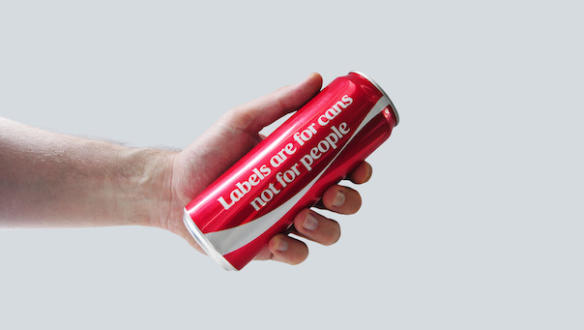
Is Coca-Cola's anti-prejudice message a winner this Ramadan?

Is Coca-Cola’s anti-prejudice message a winner this Ramadan?

A global icon and the brand that defined Christmas has been making waves this Ramadan. Coca-Cola, which spent $3.3 billion on advertising globally in 2013, made a surprise announcement this Ramadan through its Egyptian subsidiary. Instead of spending sizable sums of money on television spots during Ramadan, which is the peak viewing season, the Egyptian operation would only spend money on paid digital spots on Facebook and YouTube. To quote from the company’s press release (please do excuse the hyperbole, the writer was probably on a sugar rush whilst penning this):

This festive season Coca Cola is giving back to the Egyptian community by replacing their always hotly-anticipated television ads with a unique campaign against prejudice rolling out exclusively on digital media. Their TV ad budget is instead being poured into their project of developing 100 villages. In recent days they have also galvanised Egypt’s digital population, pledging that for every post featuring a finger raised against prejudice (symbolising one extra second) they will donate one additional pound to their project.

While the idea of saving advertising money by pulling television ads and using that budget to spend on CSR is different to say the least, especially for a household brand such as Coca-Cola (and, which, in any case isn’t true as Coca-Cola has spent heavily on pan-Arab television advertising), the notion of tackling prejudice is an interesting angle for Coca-Cola to take.

Coca-Cola has launched a number of video shorts for YouTube and Facebook about prejudice, with the key tag line that we should look beyond the seven seconds it takes to form an opinion about others. Have a look at the below (unfortunately, they’re only in Arabic).

Coca-Cola Middle East is taking a similar approach to its Ramadan messaging, by promoting a world without labels through abandoning its own labeling.

To quote from Coca-Cola’s own website:

“A limited-edition run of red Coca-Cola cans features the brand’s white dynamic ribbon, but not its signature scripted logo. The backs of the cans include the anti-prejudice, pro-tolerance message: “Labels are for cans, not people.”

“Coca-Cola Middle East also released a video documenting a unique social experiment that highlights stereotyping in society. The short film shows how Coke invited six strangers to an iftar – the nightly fast-breaking meal during the holy month of Ramadan, which runs through July 17 – in the dark. The guests conversed without forming prejudices about their fellow diners based on physical appearance.”

Coca-Cola’s approach to Ramadan has been both welcomed as well as questioned. Dubai-based public relations professional and blogger Alexander McNabb posted a list of hilarious thoughts which he shared with Coca-Cola’s media agency about the announcement. Go have a read, and let me know what you think about what Coca-Cola is doing this Ramadan.

The Hulk, Cairo Living and a Mountain View – The Unique World of Egyptian Advertising

Anyone who has experienced life in Cairo will be able to understand this copy

Anyone who has experienced life in Cairo will be able to understand this copy

To me, Egyptian advertising is like Marmite. I either love it or hate it. To most of us raised in the region who used to watch lots of Arabic TV, we’ll often know where a commercial is conceptualized and produced. The accents obviously play a part, but it’s more about the humor being used and how the actors communicate with each other.

Recently, I came across one advert which had me in stitches. For anyone who has ever lived in Cairo and who has experienced the trials and tribulations of getting anything done in the city which is nicknamed the mother of the world will understand the point behind these adverts. Mind you, I doubt that they got licensing from Marvel to use the Hulk character in the ads.

There’s not just one advert by this company (what they do and the implied benefits are obvious at the end of the adverts), but a series of different copies which all run on the same theme which were developed for last Ramadan. They’ve recently been airing on MBC. Watch, enjoy and let me know if it passes your Marmite test.

A hijab, bacon and McDonalds’ breakfasts – the wonderful world of Ramadan advertising

Ramadan is a wonderful month, a time of spirituality for the world’s Muslims. It’s also the time of year when the advertising rules change as Muslims fast during the daylight hours and look to spend their nights either with family or in prayer.

In keeping with reaching out to Muslims, advertisers need to be ever-aware of religious sensitivities. Brands often feel the need to make a change to their ads. One such change, which was spotted by Dubai-based communications professional Mohammed Kharroubi (Twitter handle @mkdubai), involved the retailer Carrefour. Spot the change below.

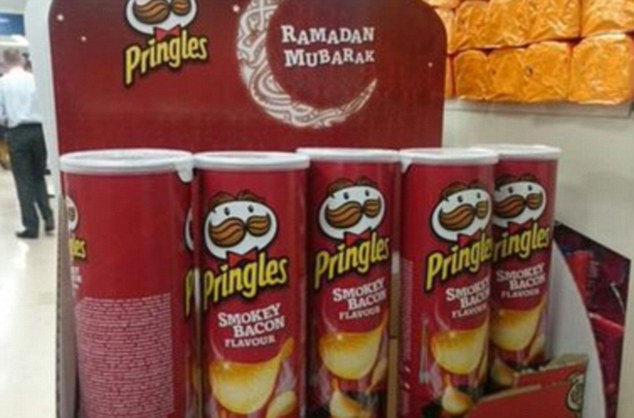
Brands sometimes get things horrendously wrong. Another retailer, the UK retailer Tesco, made a huge faux-pas, when they promoted smokey bacon-flavor Pringles as part of a Ramadan promotion. For those who don’t know, any pork-related products are considered haraam in Islam and are not consumed by Muslims. The below image went viral and has resulted in masses of media coverage in the UK.

Tesco has been pilloried on social media for selling smokey bacon-flavoured Pringles as part of a Ramadan promotion

Tesco has been pilloried on social media for selling smokey bacon-flavoured Pringles as part of a Ramadan promotion

And then, there’s the bizarre. According to Dubai-based marketing consultant Hussein Dajani, McDonalds has been running advertising for its breakfasts this month on the radio on Dubai. Unfortunately, Muslims fast during the day, and most of the McDonalds restaurants serving breakfast will be closed.

With Ramadan, it really does seem that while some brands are able to adapt and thrive, others need to do their homework. What are your thoughts? And do you have your own examples of successful and unsuccessful Ramadan advertising?

Will Etihad’s use of Twitter for Premium customer communications take off?

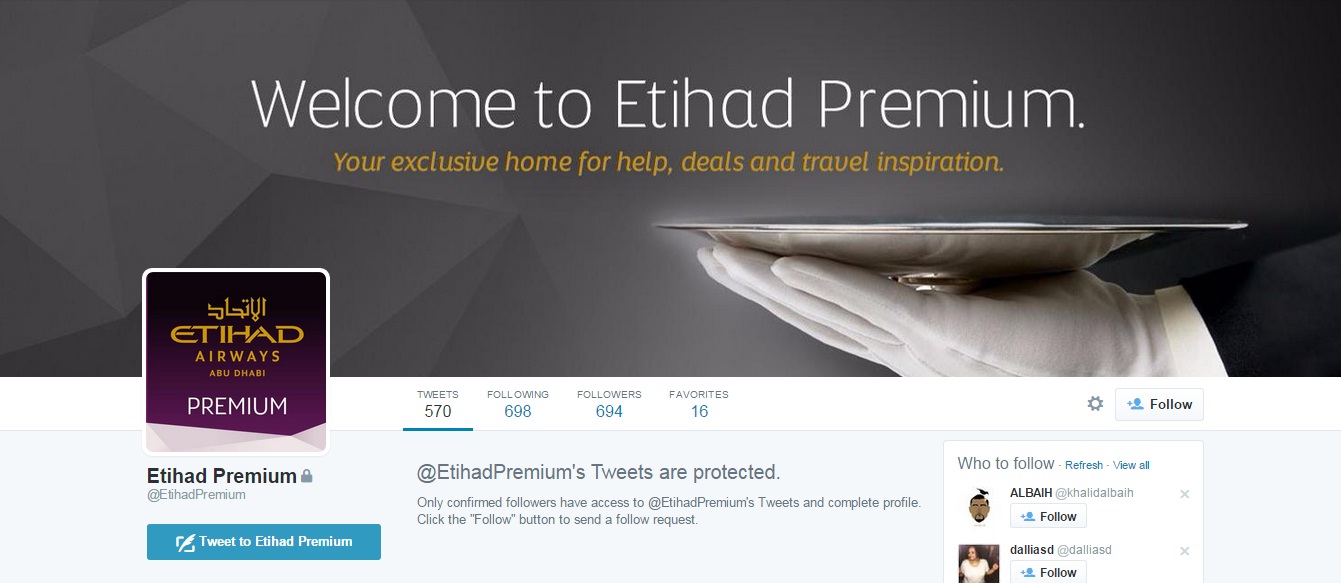
Etihad's Premium Twitter account is an exclusive account just for Etihad's Gold customers. Is Twitter the right channel for reaching out to premium customers however?

Etihad’s Premium Twitter account is an exclusive account just for Etihad’s Gold customers. Is Twitter the right channel for reaching out to premium customers however?

Excuse the pun in the title, but Etihad caught my eye this week with the news that it has set up a new Twitter account to communicate exclusively with Etihad Guest Gold members. The account, named @EtihadPremium, was launched at the beginning of May and Etihad Guest Gold members, Etihad customers who have flown 50,000 tier miles or 40 tier segments in one 12 month period, received emails on the new service. Below is the text of the email that Etihad sent out to its Etihad Guest Gold members over a month ago (courtesy of www.flyertalk.com).

We’ve launched a Twitter Channel to better serve you! We value your loyalty and have created a new channel that delivers a range of benefits with you, our guest, in mind.

Etihad Guest Gold members can now follow us on http://www.twitter.com/EtihadPremium and enjoy the following exclusive benefits:

Five minute response times
Dedicated service
Retro mileage claims
Exclusive deals

To sign up, please:

Email us at socialmedia@etihad.ae with: a photocopy of your Etihad Guest Card, Date of Birth, Post Code, Twitter Handle.
Please allow 24 hours for review and verification.
Post-verification, our team will follow you on Twitter and send a confirmation email.
Follow us back at http://www.twitter.com/EtihadPremium

The choice of Twitter has sparked some debate online. Hussein Dajani, a UAE-based social media commentator, listed on his LinkedIn profile some of the reasons why he thought Etihad’s use of Twitter didn’t make sense.

1- Etihad already has many existing Twitter accounts (Etihad Airways, Etihad Deals, Etihad Help, etc). Do people (Premium or not) really need one more account to follow?
2- Most of the “Premium” users are high profile people, how many of those are actually on Twitter or would use Twitter when having an inquiry or a complaint?
3- Will Etihad block a person if he / she no longer remains as a Premium customer?
4- How is Etihad being transparent and “fair” to all its customers when treating them differently?
5- Can’t Etihad identify who are its Premium customers from non Premium customers and get their Twitter handles?

Etihad’s social media lead Asif Khan shared his opinion as well. According to Asif, the reasons why Etihad went with Twitter for this concept were the customers themselves.

Etihad has public Twitter accounts and pretty tight SLAs for them – all users (Premium and non-Premium). This is an additional Twitter account for Premium members because there was massive demand – we have done proper research and tried to fulfill appetite – not just another channel launch. You’d be surprised to know how many Premium inquiries we receive. It’s just having a unique key number of managing first class and business class guests on a contact centre – different is its a Twitter account.

Just to clarify, this is an additional channel for communication with our high-valued guests – not the ONLY channel. There are other traditional channels that are being used – dedicated contact centre number, email address, etc. etc. Not sure if I entirely agree with your one-many concept because end of the day we’re not broadcasting information on this channel (one-many) because the intent is to have meaningful personalised conversation with each premium customer with contextual information available to us.

With premium customers, personalization is key. They want a one-to-one conversation, and they want the best possible support. Talking to a Facebook executive recently, she told me that Whatsapp was the sleeping giant of the Middle East’s digital sector. Back in March, Whatsapp was named the region’s most popular means of online communication by a survey commissioned by the Dubai Government.

But let’s go further. Whatsapp is one-to-one communication, through which one can share images, video, and recorded audio messages (we can’t use Whatsapp Call in the UAE as it’s blocked on a national level). Whatsapp can also share the user’s location or a contact, and its secure. Unlike a Twitter handle, I can’t communicate with another Whatsapp user unless I know their mobile number – and, let’s face it, how many premium customers will be flying around the world without a mobile?

The other concern I have is about Twitter and its security. What will Etihad do if the Twitter account is hacked? How can it safeguard the information of these premium customers?

The response to Etihad’s initiative has been mixed on travel websites such as OneMileAtATime and FlyerTalk, with some premium passengers praising the move, others saying they don’t have a Twitter account, and some going so far as to say that Etihad needs to improve its overall customer service levels available through its existing social media accounts.

I’d be fascinated to see how this works for Etihad. The initiative is bold, but with the choice of communications being Twitter will it work as Etihad hopes?

A McLaren and Bentley for the masses in the UAE? Should luxury go mainstream?

The beauty about luxury is that it isn’t for everyone. Luxury is exclusive, it’s a statement of position. Luxury isn’t about function but form and beauty. Luxury automotives can cost more than a decent-sized house, and when you consider that the likes of Rolls-Royce only sold 3,630 cars in 2013 (which was a record year for them fyi), then one gets to truly understand how exclusive luxury is.

So imagine my surprise when I saw a couple of weeks ago adverts for Bentley with copy that read a Flying Spur could be mine for only AED11,514.00 per month – that’s about US$3,000). Few people would be able to afford a car worth about US$200,000 when new. While the payment option, spread over several years, makes sense financially, what harm does it do to the brand for those wealthy enough not to need financing? Would they want to see the car driven by the masses?

What does this sort of offer do to a brand such as Bentley? Does it help or harm the brand in the eyes of Bentley's original target audience?

What does this sort of offer do to a brand such as Bentley? Does it help or harm the brand in the eyes of Bentley’s original target audience?

It gets better. The same dealer in the UAE who sells Bentley also has the rights to McLaren. And what do you do with a supercar which costs over US$220,000? You offer it on installment at AED9,300 a month.

Do you have a spare 10,000 Dirhams to spare a month? Why not buy a McLaren supercar?

Do you have a spare 10,000 Dirhams to spare a month? Why not buy a McLaren supercar?

While brands nee to make money to survive and grow, what is the reputational cost and the impact on brand equity of such offers which change both a product’s positioning as well as its target audience? What are your thoughts? Is this a creative, original idea to build a brand? Or does it do more harm than good?