Saudi women raising the bar – Somayya Jabarti becomes the first female newspaper editor in the Gulf

Somayya Jabarti has become the first female editor-in-chief in the Gulf region. She’ll be leading the Saudi-based Saudi Gazette following Khaled Almaeena’s departure (image source: metrotvnews.com)

Saudi Arabia often gets a bad wrap when it comes to how it treats its women. However, for those of us who have lived in the Kingdom, we know of the strength and abilities of Saudi women. They’re tenacious, eloquent, hard working and, in my view, a wonderful bunch. The latest media announcement coming out of the Kingdom has made headlines the world over.

On Sunday, the English-language newspaper Saudi Gazette announced that its editor-in-chief Khaled Almaeena would be stepping down from his role with immediate effect. Almaeena, who joined the Saudi Gazette in October 2011, penned his own farewell letter which was published on the newspaper’s front page. It’s a wonderful read and spells out Almaeena’s views on how a newspaper should be run and why editors should be pushing the boundaries when it comes to reporting contentious issues.

Unarguably the most important announcement made by Khaled and the Saudi Gazette that morning was the promotion of Somayya Jabarti to the top editorial position in the newspaper. I’m going to quote directly from Khaled’s piece:

Today I proudly leave my nominee, a female journalist — Somayya Jabarti — who will take the helm of the paper. She has been associated with me for almost 13 years, and I’ve had the goal almost as long of wanting to see a Saudi woman enter the male-dominated bastion of editors-in-chief. It was not a question of gender but of merit that decided and earned her this opportunity. I am proud to have played a role in her career. She is determined and dedicated, and I can assure her and the team that I will be there to assist and advise, so that Saudi Gazette further advances as a media unit in a highly competitive and digital age.

I’ve known of Somayya for many years and I’ve interacted with her on a number of occasions. She’s tenacious, independent and determined that she and her team cover the news without self-censoring the editorial (this is still a common trend in the Gulf). I’d go further however, and say that Somayya is representative of today’s Saudi women. Saudi women are often viewed from outside the Kingdom as oppressed, as in need of help and support.

However, my own experiences have often shown the opposite to be true. If anything, Saudi women are the most independent in the Gulf when it comes to wanting a career and earning a living. If anything, Somayya is proof of what Saudi women are capable of and how the Kingdom is changing. For me, what’s most telling is that this first didn’t happen in other Gulf states which often tout how they’re advancing women’s rights, but in Saudi. I often feel that the pressures Saudi women face mold them, make them become stronger and more focused. Saudi women have learned to fight and they’re no longer willing to wait for change or to accept what they’re being given with platitudes.

In the Kingdom all top editorial positions at the country’s newspapers are approved by the Ministry of Information and Culture and so Somayya’s appointment would have been given the government’s blessing. I’ll leave the last word to the lady herself, for an interview she gave with Al-Arabiya. I’m sure she’ll do her fellow Saudi women proud!

“There’s a crack that has been made in the glass ceiling. And I’m hoping it will be made into a door. This is a first for a Saudi daily… A mold has been broken where editors-in-chief of Saudi daily newspapers are concerned. Being the first Saudi woman [newspaper editor] is going to be double the responsibility… One’s actions will reflect upon my fellow Saudi women.”

Goodbye Dr Taryam, Hello Al Otaiba – Changes in the UAE’s Media Landscape

Mohammed Al Otaiba has taken up the top job at The National, despite having no prior media experience (image source: The National)

The past couple of days have been one of loss and change for the UAE’s newspapers. On the same day, news pieces announced the passing of Dr Taryam, the co-founder of the largest Arabic-language newspaper Al Khaleej, and the appointment of Mohammed Al Otaiba as the editor-in-chief of Abu Dhabi’s English-language daily, The National.

Dr Abdullah Taryam was one of the founders of the country’s Arabic media industry; He established Al Khaleej newspaper with his brother, the late Taryam Omran Taryam in Sharjah in 1970. After initial difficulties – the paper wasn’t printed for eight years during 1972 and 1980 due to funding – Al Khaleej grew to become what is the Dar Al Khaleej newspaper group which includes English-language daily The Gulf Today, Arabic-language weekly political magazine Al Shuruq and the Arabic-language family magazine Kol Al Usra. With a PhD in modern history from Exeter University Dr Taryam also held the posts of Minister of Education and Minister of Justice for the UAE. Gulf News wrote an extensive obituary on Dr Taryam which can be read here.

On the morning of the 30th The National announced its own change at the top, namely the appointing of Mohammed Al Otaiba as the editor-in-chief. I’m going to lift the text from The National’s piece rather than summarize.

“We are pleased to announce the appointment of Mohammed Al Otaiba as editor-in-chief of The National and are confident that his well-rounded experience in media, foreign policy and diplomacy will add a valuable global perspective to The National,” said Saif Saeed Ghobash, the acting chief executive officer of Abu Dhabi Media, which publishes The National.

Mr Al Otaiba said: “I am delighted to join The National newspaper and to be granted the opportunity to be part of a true success story for English journalism in the UAE. Writing has been a strong passion of mine for years and I look forward to being part of such a dynamic team of journalists.”

Mr Al Otaiba has a background in diplomacy and media, including 10 years representing the UAE at the UN in New York, Beijing and London.

He recently served as head of Image Nation Abu Dhabi, a division of Abu Dhabi Media. After being appointed head of the organisation in October 2011 he helped develop Abu Dhabi’s film industry.

Mr Al Otaiba’s appointment comes at a time when the newspaper is strengthening its local news coverage, Abu Dhabi Media said in a statement on Thursday.

It has recently supplemented its coverage with focus pages and a larger national news section, “boosting its reputation as a key English-language newspaper of record reflecting and supporting the country’s development and achievements,” the company said.

Abu Dhabi Media manages 18 broadcast, publishing and digital media brands and is considered among the fastest growing organisations in the region.

Mr Al Otaiba holds a bachelor’s degree in mechanical engineering from the American University in Cairo, and a master’s degree in administrative studies from Boston University, with a concentration in multinational commerce.

The reaction to the news has been interesting to watch, with observers noting Al Otaiba’s lack of newspaper and media experience.

The piece in The National does seem to be contradictory, with Al Otaiba’s international experience praised and then noting The National’s increased focus on local reporting. Al Otaiba’s appointment may be an attempt to ensure that The National is fully aligned with the official line. The paper, which was ostensibly founded to promote a free local press, has suffered over the past couple of years as it has attempted to promote a higher quality of journalism whilst ensuring that it doesn’t upset the national authorities and its owner, the Abu Dhabi Government.

It’ll be interesting to see how Al Otaiba does and how The National’s newsroom responds to the change. On the 30th January we’ve lost one renowned local media figure; have we been given another one in his stead?

What a difference a day makes – the media shift in Bahrain and public perception

It’s often said that 24 hours in the newsroom is a unique experience and Bahrain’s media is no different. The island nation’s media has been reporting on the difficult situation the country is going through for the past couple of years. Wednesday the 15th of January was no different from the past couple of months in that the Kingdom’s English-language media were reporting on government efforts to keep the country safe (much of the focus was on social media and Twitter in particular. The below is a shot of the front page.

The Front Page of Bahrain's Gulf Daily News for the 15 January 2014

The Front Page of Bahrain’s Gulf Daily News for the 15 January 2014

That night, news leaked about national reconciliation talks between Bahrain’s Crown Prince and the largest opposition party Al-Wefaq. As expected, the local media carried the news on their front pages.

The front page of Gulf Daily News from the 16 January. Notice a change in tone?

The front page of Gulf Daily News from the 16 January. Notice a change in tone?

While I won’t discuss the politics of the issue, what I do find interesting is the remarkable shift in position over 24 hours and how groups are described by the media from the one issue to the other. While it may be easy to control the dialogue and the messaging for one of the parties in Bahrain, it’s not so easy to shift public perception. Time will tell what difference this particular 24 hours have made, not only to the media’s take on affairs but also how the public perceives the situation as reported in the media.

The Chicago Tribune and how to get audience participation right through social media

I wanted to highlight this remarkable site from the Chicago Tribune. The blog, which will be hosted for a year and has the hashtag #trib2014, hosts reader photos from Instagram and enables participation through developing weekly themes. The newspaper’s staff are curating the site, but the visuals and captions are stunning. The weekly themes allow for a higher level of audience participation and give readers something to focus on rather than asking for their own images of a generic subject. Have a look at the below images from the blog. I can’t wait for someone to do this type of thing in the Gulf (just so you know, I’m extremely patient).

http://instagram.com/p/jHZ9XpuLdG/

http://instagram.com/p/jMbI0duLfo/

http://instagram.com/p/i1eLDLuLX3/

The Sheikh Mohammed School of Communication

I’m no posterboy for Dubai I’ll admit. But I do admire how the Emirate’s ruler communicates with the media. The BBC aired an interview with Sheikh Mohammed Bin Rashid Al Maktoum this week and the piece made headlines the world over. Sheikh Mo as he’s known here shared his thoughts on everything from Iran, Syria and Egypt to horse doping and human rights in the UAE. Sheikh Mohammed talks plainly, he gets to the point, and he admits when things go wrong; asked about the jailing of a number of young men for a spoof video Sheikh Mohammed says:

“We try to change it. We are not perfect and we try to change it. Any mistakes, we go in and try to change it. We’re not perfect, but we are doing our best.”

What’s fascinated me the most has been how the media industry has taken its pick of quotes to build headlines around. For the UAE’s media the key talking points were Sheikh Mohammed’s call to lift sanctions on Iran and his views on Syria and the need for Syria’s President Bashar Al Assad to step down. His views on Egypt’s General El-Sisi dominated the Egyptian papers.

If you want to watch and learn from Sheikh Mohammed School of Communication and see a leader who is unique in terms of how he interacts with the media then watch the interview on the BBC on the 17 January at 04:30 GMT & 09:30 GMT and read the article by the BBC’s Jon Sopel here. You can watch a teaser below from the original airing of the interview yesterday.

I wish there were more leaders in the Gulf who’d talk to and with the media.

The concept of bona fide and the threat to the UAE’s classifieds industry

If the 7Days report is acted upon soon by the country’s authorities will this mean the end of classified adverts in the UAE? (image source: cre8network.com)

I’m playing catch-up at the moment on the blog, due to moving house and having too many things to do and not enough hours in the day. One piece which did catch my eye was a report in 7Days. The piece, which was entitled ‘UAE Interior Ministry warns newspapers against maids, tutors ads’, quotes a Major General at the UAE’s Interior Ministry as saying:

“Newspapers need to be careful before putting job adverts for domestic workers such as nannies, maids, drivers and private tutors in their publications.

“Publications need to first verify the identities of these people and confirm they are staying legally in the country before they advertise their services.”

The officer notes the numerous reports from families of children being abused by the domestic help or private tutors hired through classifieds. The Major General quotes a recent incident in Abu Dhabi when police arrested a teacher whom allegedly kissed and molested two girls during a private lesson at their home.

“The Australian parents of the girls reported the 58-year-old Egyptian man to police after their daughters, aged eight and 13, told them the private tutor kissed them and also touched the older girl during a maths lessons.

The parents told police they had contacted the teacher through a newspaper advert.”

I want to bring up the concept of bona fide or good faith, the term that encompasses a sincere belief or motive without any malice or the desire to defraud others. It derives from the translation of the Latin term bona fide, and courts use the two terms interchangeably. Just as any other party, newspapers and other providers of classified services including online sites such as Dubizzle need to trust that the other party they’re dealing with are acting in good faith and telling the truth.

To ask newspapers to do due diligence on each and every person advertising as a tutor and/or maid would seem to be a tall task. What would newspapers be asking for? How would they be able to do a background check? And for online sites which host thousands of adverts, would they even have the human resources for such a task?

Revealingly, the 7Days article ends by noting that the tutor to the Australian family had earlier been deported after he was convicted of molesting a child, but returned to the UAE by sneaking through one of the country’s ports. Maybe it’s not the newspapers who should be doing due diligence, but rather other parties?

XPRESS – the UAE’s investigative newspaper

Over the past couple of weekends I’ve become increasingly irritated. It’s not that I don’t like weekends; on the contrary I enjoy the time away from work. However, I’ve become accustomed to picking up the XPRESS newspaper. The title, which was launched in March 2007, is a weekly newspaper which is published by Al Nisr Group (Al Nisr also publishes Gulf News).

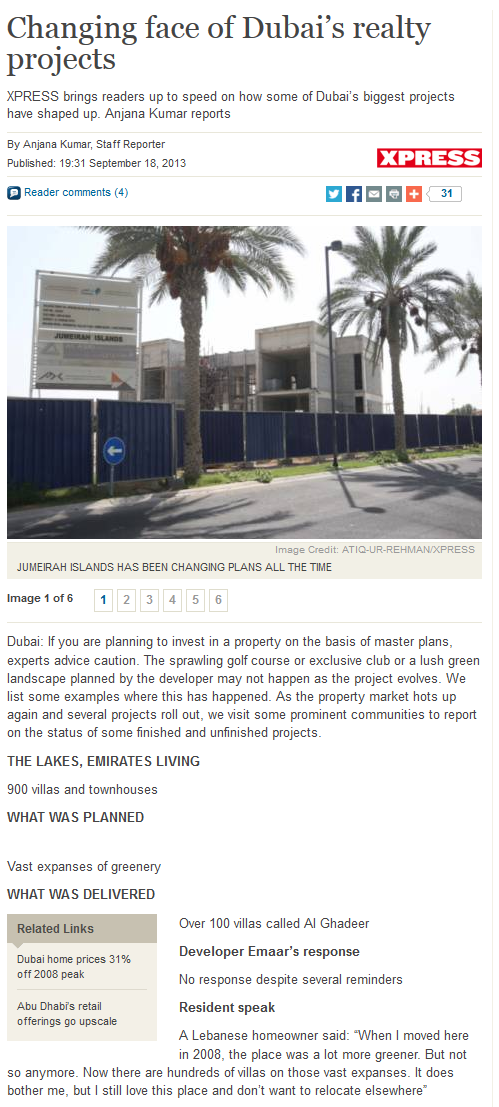
The paper, which describes itself as a community paper, is released every Thursday. Of late, XPRESS has focused on investigative pieces and has run a number of pieces that have caught my eye. Some of the best include a report on the changing face of a number of Dubai’s largest real estate projects (see the below or click on this link), the cost of wasted medicines to the country’s coffers and insurance firms, and the horror story of how the MMA forex scam robbed thousands of their money.

XPRESS regularly focuses on stories that engage the community including this piece on how developers have not kept their word on project developments

XPRESS regularly focuses on stories that engage the community including this piece on how developers have not kept their word on project developments

There have been some duds including a scandalous piece that seemed to suggest expats were more inclined to engage in illegal sexual acts which focused on a Norwegian lady who was raped and yet charged by the local police (this piece and the comments by a number of Emirati lawyers still shocks me). But in general XPRESS is a wonderful read which often puts other newspapers to shame. If you have a spare copy save it for me!

Another breaking news piece by XPRESS which wasn't picked up by other media outlets in the UAE

Another breaking news piece by XPRESS which wasn’t picked up by other media outlets in the UAE

Copy and Paste: Gitex news and repeating the same message

I used to joke with a good friend of mine who works as a journalist that companies would often recycle news year after year during the region’s largest technology exhibition. I’d tell him that firms would simply change the date of the previous year’s press release and joke that maybe he’d do the same.

I was reading over one news piece from Dubai Airport Free Zone (DAFZA) during this year’s GITEX. The piece, which I’m pasting below and which is linked to here, is on the launch of the organization’s first official mobile application.

DAFZA launches its first mobile application, in 2013

DAFZA launches its first mobile application, in 2013

I thought I’d seen the news before, so obviously I asked Google. And what did I find?

DAFZA launches its first mobile application news, from GITEX 2011

DAFZA launches its first mobile application news, from GITEX 2011

Copy and paste anyone?

Five tips on how to survive and thrive during Gitex

It’s here, the region’s most manic event. Gitex, the Gulf Information Technology Exhibition, is to public relations and media people what Christmas is to parents of little children who believe in Father Christmas; a ruthless, insane, once-in-a-year event where everyone wants what’s on their wish list and you have to deliver.

From someone who’s done his fair share of Gitex exhibitions both as a journo, a PR person and as one of the organizers, here’s my five top tips on how not just to survive Gitex but thrive despite all of the noise, confusion, and occasional tantrums (you know whom these executives and organizers are). So here we go!

1) A phone with an endless battery

At Gitex your phone will be ringing incessantly. No one has died, there’s no new births to report, and the world is not coming to an end. But if you’re a journalist you’ll be every PR person’s best friend for five days (especially if you work for the official publisher ITP). And if you’re a PR person the pressure to deliver interviews will quickly build to a crescendo. Every single journalist within a four-hour flight will be on your quick dial list. Just don’t let the phone die.

Make sure your phone battery never, ever dies during Gitex. Or else you’ll never be forgiven. (image source: Daily Mail)

2) Lots and lots and lots of caffeine

You will not eat or sleep during Gitex. What you will live on is caffeine and taurine. You will drink coffee, tea, and Red Bull like its water. Gitex veterans will normally lug around with them a couple of cans of energy drinks. And for those new to Gitex, bring lots of small change. The venue doesn’t sell cheap beverages (there is however a supermarket around the corner in the DWTC residences, besides the metro station and opposite Pizza Express).

The above is one way to carry your Red Bull during Gitex, though it’s not recommended. (image source: wikimedia)

3) Ear Plugs

Gitex is noisy. Actually that’s wrong. Gitex is deafening. Exhibitors assume that the higher the wattage from their surround sound system, the more people will stop and watch the models… ahem, executives talking about their business. Gitex is the exhibition equivalent of a Tuesday night club which is hosting a drum and bass session combined with a ladies free-entry policy. If you want to ensure that you leave with your hearing intact then take ear plugs with you. Just don’t forget to take them out when you’re interviewing/arranging for interviews.

Pillows won’t help with the noise pollution at Gitex. Get some ear plugs. (image source: http://www.alpinehearingprotection.com)

4) Panadol, Ibuprofen, Vicodin…

You get the point. At some time during Gitex, you’re going to be hit by the mother of all headaches. Be prepared, take lots of meds with you. And if you don’t have any and the dreaded throbbing and pain strikes then head on down to the pharmacy on the concourse to grab your pain killer of choice.

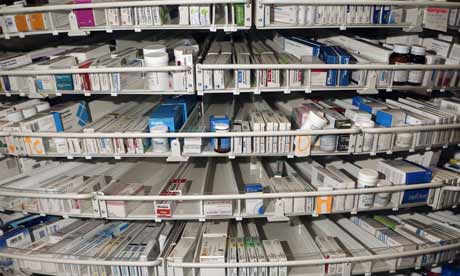
Bring drugs, lots of drugs! You will need them. (image source: The Guardian)

5) The Patience of a Saint

At some point you’re going to be surrounded by screaming, nagging executives who are behaving like a bunch of toddlers/prima donnaa. There’s really thing that you can do, apart from swallow your pride, paint a smile on your face, and remain calm. Gitex would test the patience of the Dalai Lama, so remember you’re not alone in your frustrations. For the week however, you will have to suffer in silence. Remember that patience is a virtue so stay calm!

Keep calm, take a deep breath. Gitex will soon be over. (image source: http://www.keepcalm-o-matic.co.uk)

What’s your top tips for Gitex? Share and share alike. Remember, we’re in this together!

The End of the Fattah Era at Abu Dhabi’s The National

How will The National change following Fattah’s departure to the world of Public Relations? (image source: http://www.capitalnewyork.com)

As they say, all things must come to an end. This month in the United Arab Emirates we witnessed a rare occurrence, the departure of an editor-in-chief at one of the national newspapers. After five years Hassan Fattah stepped down. The news wasn’t surprising to most of us media watchers when it was officially announced by The National on the 2nd of October. The news had been unofficially published by Capital New York on the 19th of September after personal emails had been leaked to The National staffers (one email apparently contained an employment contract from Fattah’s new employers).

Fattah’s time at The National hasn’t been without controversy. The paper, which was once dubbed “The New York Times of the Middle East”, once held aloft the ideals of freedom of the press and professional journalism in a region that suffers from a lack of both. Today, while The National is a quality read it hasn’t lived up to the goals that its founders and editorial team strived for at the paper’s launch.

Instead, judging by the number of pieces that have been written about The National by blogs and other online news outlets the paper has been riven by leadership issues at the top by people who have had to juggle the demands of producing good quality editorial alongside keeping the newspaper’s owners, Abu Dhabi Media Company, happy. The nadir was reached when disgruntled employees started a Facebook site with the aim of highlighting their unhappiness at how the newspaper was run.

Fattah has moved on to the dark side, to the world of public relations. He’ll be heading up communications for a company that is not much loved in the UAE – GEMS, the ‘world’s largest private education company’. It’ll be interesting to see how he copes with the move; public relations isn’t the easiest profession at the best of times but trying to prove that paying more per year for a child’s education than one would pay for an MBA in a top UK University is good value for money would be a stretch for even the most experienced communications spin doctor. How will Fattah cope with keeping his employer happy and the press onside whilst trying to convince a skeptical public about GEMS’ altruism and the value for money provided by its services for example?

However, my gaze will remain firmly on The National. The paper is still one of my favourites and I believe that despite all of the events of the last couple of years there remains the promise of a publication which can raise journalistic standards in the Gulf. Call me naive, simple or whatever else you want, but I’d rather live in hope that The National can return to the vision spelt out by Abu Dhabi Media chairman Mohamed Khalaf Al Mazrouei on the eve of its inauguration, of “a free, professional and enlightened press” that will play a key role in the development of the country. Am I asking too much? Let’s hope not.