Block and Bridge the SABIC way – an example from the World Economic Forum

Al-Mady is a media veteran and knows how to handle journalists through the use of techniques such as block and bridge (picture source: Arabianoilandgas.com)

There’s few companies which have a better reputation in the Middle East than SABIC. Founded almost forty years ago, Saudi Basic Industries Corporation has grown to become one of the world’s largest chemicals businesses and one of the top 100 corporations worldwide. SABIC is the largest public company as listed on Saudi Arabia’s stock exchange.

But no matter how well you try, there’s always some things that you can do better. SABIC’s CEO Mohammed Al Mady was at the World Economic Forum last week which was held in Jordan. Al Mady was speaking on a panel discussion alongside Saudi Arabia’s Princess Ameerah al-Taweel, the wife of Al Waleed Bin Talal and one of Saudi Arabia’s most outspoken women when it comes to female rights and the issue of change in the Kingdom.

Unsurprisingly, the issue of women’s employment in the Kingdom came up. This topic has been a major issue of debate over the past couple of years as the Kingdom has pondered how best to get women into work without upsetting cultural sensitivities.

The below quotes are from an article on Arabian Business which are a discussion between Princess Ameerah al-Taweel and SABIC CEO Mohammed Al Mady. It makes for an interesting if embarrassing read.

While a member of the audience during a separate WEF session on the Arab employment crisis, Princess Ameerah challenged Saudi Basic Industries Corporation (SABIC) CEO Mohammed Al Mady to explain why his company had not “opened the door” to Saudi women.

Al Mady defended the company by saying it had employed 50 women, but the audience laughed when it was revealed SABIC had 20,000 employees.

“We have been slow for sure,” Al Mady conceded.

“That was not really by design that we want to be against women or anything, but we want to get the best practice done in Saudi Arabia because there are many mistakes that have happened and it really gives bad names for the employees and the employers.

“Now we’re in a position to get the best practices and do it in our company and you will see a big change.”

Well, yes, it’s not the best publicity for SABIC especially when one considers that most of SABIC’s plants are in the Eastern Region where women have been employed in mechanical roles by Saudi Aramco. However, what Al Mady did was a classic public relations tactic; he blocked and bridged. The technique is well-known and allows the interviewee to switch attention back to a key message or talking point. And Al-Mady spoke about a perennial favourite, military conscription. Below are quotes from both Arabian Business and Al-Arabiya.net.

“The countries have to work very hard in how to change the perception of their youth so that they can accept the existing jobs.

“How do we change them? Governments have to probably draft them into the military for six months before they go into the job market … [to] give them resilience, [teach] them how to be modest, how to work, how to take the ladder step by step until they reach what they want.”

“It gives them resilience… they have to take the ladder step-by-step before they get what they want. The countries have to work very hard and have to change the perception of their youth so that they can accept the existing jobs… The people themselves need to change.”

While I’m not completely sold on the concept of military service (it hasn’t done many favours to Egyptians, Syrians or Lebanese) Al-Mady’s block and bridge captured more headlines than the female employment gaffe and it says a great deal about Al-Mady’s media skills. If only more CEOs had his media abilities (maybe that’s a subject for another, future post).

Is the media a government tool or an independent voice – thoughts from Abu Dhabi

Freedom of expression or expression of national institutions? We’re still very much in the latter camp in the Middle East (image credit: http://www.menassat.com)

There was a fairly low key but important discussion this week in the UAE’s Federal National Council. The body, the closest thing that the UAE has to a parliament, welcomed Shaikh Abdullah Bin Zayed Al Nahyan, the country’s Foreign Minister, to discuss the issues of the media and the work of the National Media Council, the UAE’s regulatory body for the sector.

The below excerpts are from an article in Gulf News which ran this week. Have a read through the quotes:

The National Media Council came under fire from the House for its “weak role in [the] Emiratisation of the media, dominance of foreign media content and lack of plans to promote the [UAE’s] cultural identity.”

The NMC was also criticised for the lack of coordination between the media outlets and universities, lack of training programmes for journalists and broadcasters, and a failure by media outlets to address concerns of citizens.

The FNC also voiced concern over the UAE’s low ranking in the press freedom index. Ali Jasem, a member from Umm Al Quwain, said the UAE ranked 158th on the Press Freedom Index last year.

Shaikh Abdullah said he expected that the ranking will improve once the new media law is issued with an article that bans jailing journalists for exercising their duties.

Shaikh Abdullah said discussions in the FNC lacked a uniform stand on the issue of freedom of expression.
“Some members demand a higher ceiling of freedom and less control, while others call for censorship, which is confusing,” Shaikh Abdullah said.

Shaikh Abdullah reiterated that the NMC respected the editorial policies of all media outlets operating in the country and that it never intervened in their work or nature of their content.

“The country’s policy is to leave the executive work to the media outlets, whether owned by the local governments or the private sector, so that there will be no contradiction between [the NMC’s] work and theirs,” he added.

Shaikh Abdullah said media outlets are “our partners and they are wholeheartedly contributing to the UAE’s media strategies.

It’s fairly common in the Middle East for the media to be seen as a tool of government policy. The media reiterates the government line and rarely engages in debate. This viewpoint hasn’t changed much despite attempts by global media outlets, newswires such as Reuters and Bloomberg, to write uncensored about a range of social, political and cultural issues.

What’s noticable from the above is that even in a country which is fairly media-friendly by the standards of the Middle East there’s still a view that the media needs to be an instrument of policy which ‘promotes cultural and national identity.’ I’ve been incredibly fortunate to have been raised in a part of the world where a strong, independent media fosters debate, promotes transparency and holds others to account. How far are we from this state of affairs in the Middle East? Your guess is as good as mine. However, in the meantime I’ll keep flying the flag for a media sector that has the teeth to do its job and act as an independent voice for discussion, debate and originality.

How to pull off a public relations fake coup – the handsome Emirati who didn’t get kicked out of Saudi

Saudi Arabia often has the ability to surprise, delight and amaze in equal measures. But every now and then, it’s not the Magic Kingdom that surprises as much as the lack of knowledge and ignorance shown by the outside world. One story broke in April that didn’t fail to grab headlines the world over.

Allegedly three Emirati men were kicked out of Saudi Arabia’s largest cultural festival by the religious authorities for “being too handsome”. The three men were asked to leave Janadriyah and then deported from Saudi to protect the virtues of the Saudi women present. The story was broken in America by Jezebel and the piece makes for a very entertaining read.

There’s been literally thousands of pieces now written on this and the ensuing ‘outing’ of one of the men, an aspiring actor whose name is Omar Borkan Al Gala.

Unfortunately ladies, which Omar obviously exists the story is a hoax. LiveLeak website was one of the first to break the news of the hoax and this is how whoever was behind the public relations coup did it.

Let’s start firstly with the facts. We have three Emirati men who were kicked out of Janadriyah. Firstly, this is feasible. Riyadh is a conservative place and the religious authorities are present at Janadriyah to monitor all the naughtiness that goes on. However, having been to the Festival a number of times these three would have had to have whipped off their kandouras/thobs to get kicked out such is the amount of inappropriate behaviour that can occur at Janadriyah.

There was an incident at the UAE pavilion when one of the religious authorities objected to Emirati singer Aryam’s presence at the event. He himself tried to force her removal but was instead arrested by the National Guard. The incident was captured on Youtube and is below.

The other apparent truth is that one of the three Emiratis who was outed was present at Janadriyah. However, he had gone into the family section where single male bachelors are not allowed and started dancing. His dancing apparently wasn’t to the taste of everyone present and he was asked to leave the area according to LiveLeak which quotes from a news piece which now seems to have disappeared.

And that seems to be the basis for what then happened.

Someone with an active imagination, a good deal of time and a great deal of media talent spotted an opportunity to seed a story with Elaph.com, an online website that focuses on news in Saudi Arabia. The original story, which has disappeared into the caches of the internet, wrote that three Emiratis had been deported from the Janadriyah Festival and Saudi Arabia for being too handsome. There was a quote to this effect from an ‘unnamed’ Saudi official.

The story quickly snowballed after getting picked up by the English press in the Kingdom, and one of the three men, Omar Borkan Al Gala, apparently outed himself on his Facebook page. The man became a celebrity overnight. He’s been interviewed worldwide and he’s already picked up acting work.

The story surrounding Borkan Al Gala, which loosely translates to Volcano of Love, contains numerous inaccuracies. The first is deportation from Saudi Arabia. As an Emirati and a GCC National he cannot be deported from Saudi Arabia under these circumstances. I’ve never even heard of a GCC National being deported from one country to another. Strike one…

Secondly, the other two Emiratis have never been outed. You’d think that they’d be in on the act as well and keen to grab their fifteen minutes of fame. But unfortunately, the ladies will have to wait for their pictures to be plastered over the web. Strike two…

And finally, the story broke via a news website from an ‘unnamed Saudi official’. Saudi officials rarely speak out of turn, especially on such a topic. It took over a week for Al Gala’s name to be ‘leaked’. In this day and age of instant social media updates, I’d have assumed that this story and the identity of the three Emirati men would have been the news item on both Saudi and Emirati Arabic-language Twitter networks. But no, that wasn’t the case. Strike three…

I’ve got to give it to Al Gala. He’s made the most of the opportunity, of the ignorance about Saudi Arabia, and of the lack of fact-checking on this one. It’s a fun story and one which doesn’t do any harm. But seriously, being too handsome for Saudi? Have the Emiratis met any Saudi boys lately? In the words of my partner, “Saudi men are much more attractive…”

He got kicked out of Saudi and I didn’t? But I’m impossibly handsome (source: http://www.hippobrigade.com)

Getting the communications balance right – Ras al-Khaimah, beaches and modesty

This slideshow requires JavaScript.

I do feel for anyone who has to communicate on behalf of a government body in the Gulf. That’s especially so in places where there’s conflicting, divergent views resulting from a strong cultural diversity and significant business interests with the outside world. I remember the late Yasser Arafat often getting away with making one point in Arabic and then saying the exact opposite in English (there’s many other examples out there too). With the advent of the internet, social media, and a horde of citizen journalists out there in cyberspace it’s no longer possible to say explicitly different things to different constituents.

In this week’s The National newspaper in the UAE there was a great example of the above. On the 22nd of April police from the Emirate of Ras al-Khaimah announced a bikini ban for the area’s beaches. Ras al-Khaimah is a beautiful part of the United Arab Emirates. With a population of just over a quarter of a million people Ras al-Khaimah is known for its pristine beaches, and also for its rapidly growing tourism sector and free trade zone. However, the Emirate is also conservative. Trying to balance the two interests, tourism and tradition, isn’t easy as the below quotes from The National’s article on the 22nd April illustrates.

Bikinis have been banned from public beaches in the emirate as police urge residents to “use common sense” and dress modestly.

The municipality and police have put up signs on public beaches that state: “All coastgoers should commit to public morality and modest clothing”.

Offenders will be given a warning and after a second warning, they could face an unspecified fine.

The two most popular beaches in Ras Al Khaimah are located next to hotels where swimmers sunbathe in thong bikinis or trunks alongside women in burkinis, a modest full-body swimsuit designed for Muslim women.

On weekends and at sunsets, RAK’s public beaches fill with women in full hijab, who come with their families. Women in swimwear are a rare sight at these beaches and there are no women-only beaches in RAK.

In a plea to the public, police urged beachgoers to comply with “public morality and dressing modestly” to respect the country’s traditions and culture.

The move followed complaints by families about tourists who attended public beaches wearing indecent clothing.

The public have greeted the ban in Ras Al Khaimah, a conservative emirate with a large Emirati population. In RAK, it is common for women to dress for the beach by putting on more clothing so that they do not attract attention from men.

“I totally agree with that [ban] for us because it’s not a respectful thing to have on our beaches,” said Hessa Ahmed, a 31-year-old Emirati mother-of-two.

Many people, like Ms Ahmed, would like tourists to cover up but are too shy or polite to approach them. Her last visit to the beach ended abruptly when a man and woman in revealing swimwear sat near her family.

“I wasn’t sure about what she was going to do,” said Ms Ahmed. “I was afraid she would take off her top. So I preferred just to drive away just in case anything was going to happen, so I would just be away and my kids wouldn’t see them.

“There was no sign or board to inform these people you shouldn’t wear this, you shouldn’t wear that.”

Ras Al Khaimah has adopted a lenient approach to public dress in hotels but customs remains overwhelmingly conservative in public spaces, such as shopping malls.

The above was a great piece and insight into the challenges facing a country that is looking to adapt culture with business. And then came the follow-up article the next day in The National.

Police have backtracked over their statement that bikinis and tight trunks are banned from public beaches.

Revealing swimwear is not officially outlawed but strongly discouraged because of cultural sensitivities, police clarified.

“We respect the rights for people. We follow UAE law,” said Maj Marwan Al Mansoori, the head of public relations and moral guidance for RAK Police.

“Our campaign is not about catching people. We just want to tell people about our culture and our community.”

“You should respect our culture and our community rights but you have your rights,” said Maj Al Mansoori. “If it is under our law, you can do it.

“We wanted to tell people what we are thinking. It is communication between cultures. We want to explain this to people.”

It’s worth reading both articles in full, and to put this in its full context few Westerners will use a public beach in Ras al-Khaimah; all the hotels have private beaches which are fully equipped and only for the use of guests. However, such communications outreach isn’t going to help draw foreigners to a part of the country and world that has everything to offer. Perception is everything, especially online when social media is involved. The more people who talk about an issue, the more that issue or perspective is believed no matter its veracity.

This is a reminder about the challenges of trying to get the communications balance right in today’s connected world, where a tourism can view such news pieces while booking their vacation just as easily as a local sitting for a tea and reading the morning newspaper. Media relations is a tough job and I do hope that lessons are learned from this and that the right balance is found, both in terms of educating foreigners coming in (can you really tell someone what to wear after they’ve seen the glossy brochure/website, booked, traveled and arrived) and in preserving local cultural norms. And remember, if nothing else works there’s always the burkini!

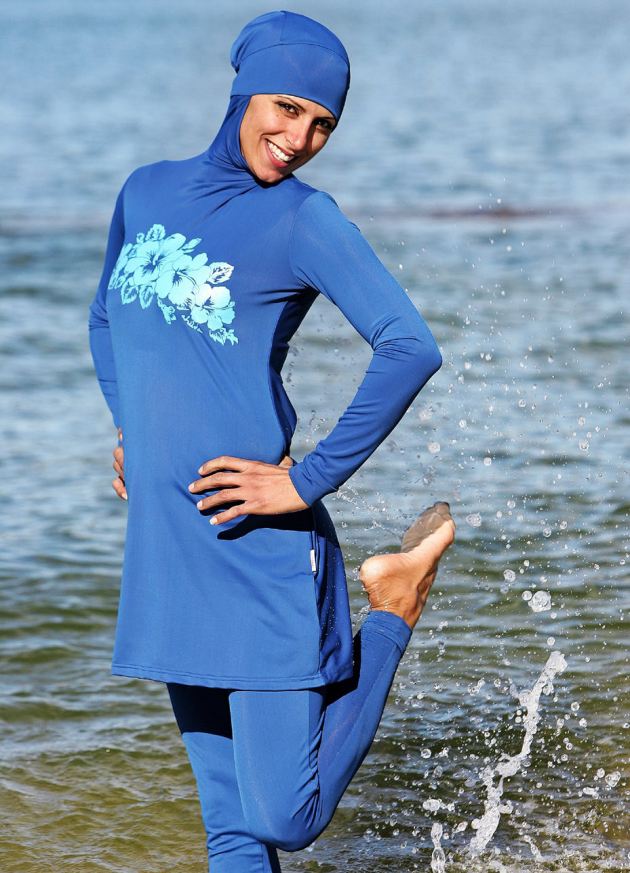
The burkini! Foot flicking and hands on hips are optional (credit alrasub.com)

A view into Saudi Arabia with the BBC’s Frank Gardner

Saudi Arabia is a fascinating country but unfortunately it’s not the most accessible of places. The BBC’s Frank Gardner returned to the Kingdom after a number of years away from Saudi Arabia. I’m not going to write further about the news piece as my words will not do justice to the programme. Enjoy, turn up the volume, and glimpse into a country and a society that is experiencing a radical change (my only caveat is that I’m more optimistic on how Saudi Arabia is doing).

Trials and Tribulations at Abu Dhabi’s The National

The National, Abu Dhabi’s English-language newspaper, hasn’t had a quiet week. First comes a blog post which The National admitted was ‘one of the most controversial ever’ in the paper’s five year history. The blog, which was written by an intern journalist named Ayesha Al-Khoori, was pilloried for its description of her driving habits and speeding even though she herself was attempting to argue that lowering the UAE’s driving minimum driving age from 18 would be a mistake. This blog, which garnered hundreds of responses and mentions on the comments section as well as on social media sites, was followed by an attempt at an apology which for me seemed to miss the point (Ayesha claimed her message was lost, but I’d argue that there was no consistency in her initial message).

For a review of the blog and The National’s editorial guidelines including how it reviews and edits work (which didn’t seem to be the case with Ayesha’s blog) then read this piece by Mita56 which sums everything up nicely.

To top off a bad start to the week, someone made a serious error when writing The National’s daily electronic newsletter (have a shufty below).

Have a look and spot the boo-boo. It's a big one.

Have a look and spot the boo-boo. It’s a big one.

If you didn’t spot the mistake, I’ll give you a hint. The late person referred to in the photo-caption should be the founder of the country (Allah yurhamu) rather than HRH his son who is very much alive and is the President of the United Arab Emirates.

The National has been stung recently by a couple of tell-all pieces by ex-journalists. One of the most recent was Tom OHara, who wrote a warts-and-all account of his two years in Abu Dhabi in the American Journalism Review in December 2012/January 2013. You can read his revealing piece here.

I was at the launch party for The National in 2008 and remember the roster of journalists on display. There was a Pulitzer-prize winner reporting for the paper even. Hopes were high that we’d have a newspaper with the temerity to tell it like it was, which is still a rarity in the Middle East. Over the years I’ve looked forward to reading The National’s copy from a group of journalists whom I have dealt with and whom I think very highly of.

As a former journalist I respect and admire good journalism. In today’s Gulf we need more quality content to explain the why behind the what. My hope is that The National’s management steer the paper back to what it aimed to be five years back, to “establish an institution on par with some of the greatest newspapers in the world.” Trials and tribulations are all well and good (unless you’re the person behind the drama), but The National needs to raise its standards and focus our attention back on the quality of its content. The National, we need you more than ever.

A blogging masterclass with David Hobby at GPP

Am taking the weekend off to go to school! And today is going to be an exciting one! I’m attending a one-day class hosted by Gulf Photo Plus on blogging given by David Hobby. David is a one-man blogging machine with over ten blogs on the go. Over 15,000 people find his site through Google searches alone every day. And boy does he talk! David you should have video blogs if you don’t already.

The write-up from GPP’s website is below… Will let you know how it goes.

Whether you are a photographer, another kind of creative or work for just about any company with an internet presence, a well-run blog may be the most powerful tool on the web. And for those who are willing to take the reins of a company blog, this might be the closest thing to “fire proof” that exists in 2013. Employees who can expand a company’s footprint through effective social media are far more valuable to the business.

A well-crafted blog can do many things. It can establish both recognition and credibility. It can produce income. It can produce strong search engine optimization. It can create a direct channel to your customers, present and future. But blogging does not come naturally for most people. While the platforms may be easy to learn, the process itself can be daunting.

How do you choose a name for your blog? How do you create a voice? Why is it important to understand organic SEO? Where do great ideas come from, and how do you shape them for your blog? For company bloggers, how do you strike a balance between being corporate and being human? Where do you look for ongoing inspiration? How do you leverage external platforms? What steps can you take to help something go viral?

David Hobby created Strobist.com in 2006. Five years on, it receives over 3,000,000 page views a month and was recently named one of the Best 25 Blogs in the World by Time Magazine.

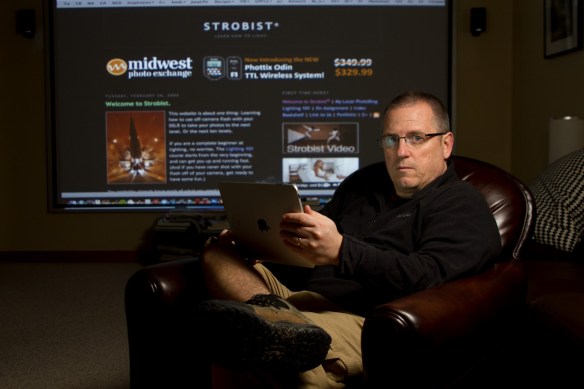
David Hobby is the man behind strobist.com. If you haven’t checked it out please do, now! (credit: lisadierolfphotography.com)

David Hobby is the man behind strobist.com. If you haven’t checked it out please do, now! (credit: lisadierolfphotography.com)

One story, two different takes – How Saudi Gazette is reporting and Arab News isn’t

One story has dominated Saudi media for the past week, the tragedy of 13-year-old Reham Al-Hakami who contracted HIV through a mistaken blood transfusion at a government-run hospital in the south of the country (I’ll cover this story and the outcry it has caused in a blog-post soon).

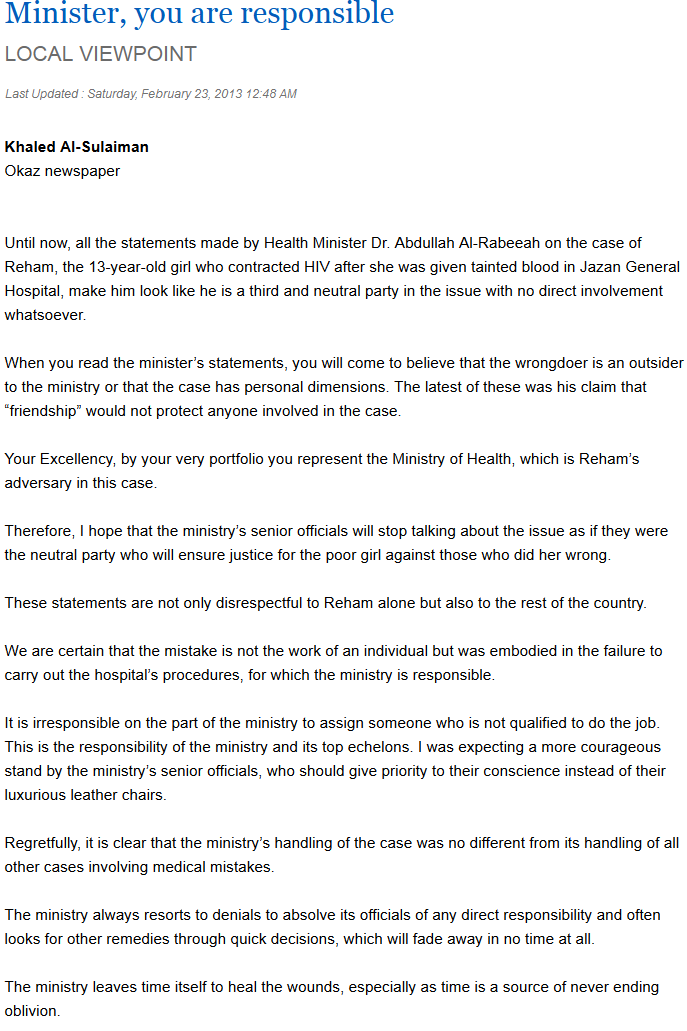
However, reading the English-language press today is a confusing affair. If you pick up Saudi Gazette, you’ll find not one piece but two on Reham. The first is a news item about another Saudi woman who has contracted AIDS. The second is a scathing opinion piece from the paper’s Arabic-language sister publication Okaz written by columnist Khaled Al-Sulaiman.

The column, which was first published in the Arabic-language daily Okaz, was rerun in Saudi Gazette

The column, which was first published in the Arabic-language daily Okaz, was rerun in Saudi Gazette

And then there’s the main piece on the Ministry of Health in Arab News, which focuses on a letter from the King thanking “the Health Minister Dr. Abdullah Al-Rabeeah and for obtaining certificates from the US-based Joint Commission International (JCI) for 15 medical facilities and accreditation from the Central Board of Accreditation for Healthcare Institutions (CBAHI) for 50 hospitals over the past 12 months.”

And here is the main piece on the Ministry of Health from Arab News. There's a second article covered, which is also not related to Reham

And here is the main piece on the Ministry of Health from Arab News. There’s a second article covered, which is also not related to Reham

I know which newspaper I’d rather be reading today. The team at Saudi Gazette and its owners should be praised for their editorial integrity and coverage of the issue.

Incidentally, Arab News is known as the Green Truth owing to the colour of its front and back pages and the quality of its copy. While the colour print hasn’t changed there’s been a noticeable shift in editorial since Khaled Al Maeena left at the end of 2011. During those two years Arab News has had two editors-in-chief (Abdulwahab Al-Faiz and now Mohammed Fahad Al-Harthi) and has lost staff to Saudi Gazette. I for one hope that Arab News receives the investment and political backing from its owner SRMG that the newspaper needs to compete editorially with Saudi Gazette.

The benefits of spell-checking in the Middle East: GCC Chief condoms Bahrain

I’ve often considered being a journalist in the Middle East a curse. I’m surrounded by poorly spelled English signage, all of which I not-so-secretly want to correct. I used to find myself shaking my head from side to side as I’d count all the grammatical and spelling mistakes in certain areas of Riyadh.

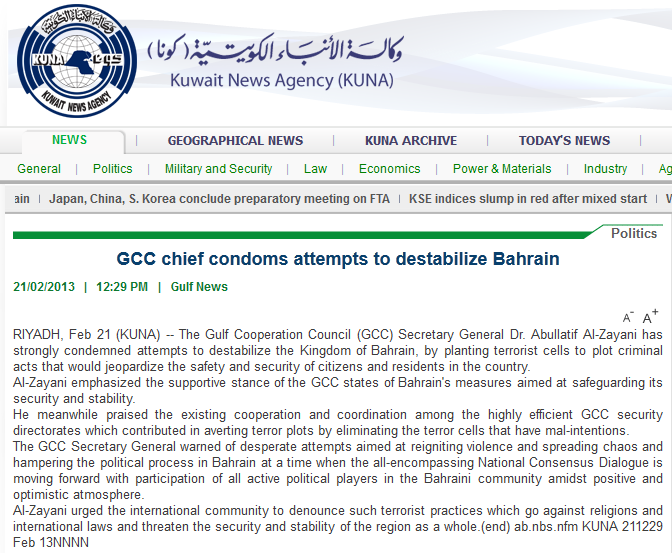
While those in charge of signage may have the excuse of not being near a spell-checker when producing the prints, journalists cannot plead the same. And the below is just a shocker. I’m assuming that KUNA, Kuwait’s News Agency, has a good roster of staff to both write, edit, and proof-read. I just hope that someone amends this story and quick. But for posterity here’s a screen capture.

The headline says it all...

The headline says it all…

My recollections of Saudi Arabia’s Prince Mugrin

Saudi Arabia’s next Second Deputy Prime Minister Prince Mugrin Bin Abdulaziz Al Saud whom we found to be a captivating individual

For all you Saudi fans and fanatics out there, the news of Prince Mugrin’s appointment as the second deputy prime minister took most by surprise. There’s a wonderful piece on Prince Mugrin and what this means to Saudi Arabia here by Michael Stephens. However, it is possible that Prince Mugrin, who is the youngest surviving son of the founder of the Kingdom, would become King.

I’m not going to go over the same ground that every Saudi watcher has covered over the past few days. What I will do is recall me and my wife’s personal memories of Mugrin from 2007. We were media partners to the first e-government conference in Saudi Arabia, e-Transactions, and had unfettered access to the event and its speakers. Prince Mugrin was, if I remember correctly, the only royal family member to both attend and speak at the event.

Prince Mugrin was on a panel which was addressing the issue of bureaucracy as it relates to online services. What struck my wife in particular was how candid the Prince was, particularly in relation to Saudi government. In effect, he said that Saudi Arabia had far too much bureaucracy and that e-government could not be in place sooner. For a prince who is first-tier (even the royal family in KSA has rankings) and who held the position of head of the Saudi Intelligence at the time Mugrin seemed acutely aware of the problems that faced society. We were impressed by his open demeanor and his directness.

A more lasting impression, and probably an indication as to why Mugrin is reportedly close to King Abdullah, was made during Mugrin’s tour of the exhibitor partners. Again, as the publisher of the media guides to the event, we had a stand in the exhibition area. A number of the team on the stand were female, and Prince Mugrin greeted them all warmly and even going so far as to shake their hands and asking them about the conference.

To this day my wife who was at the stand when Prince Mugrin visited talks fondly of the encounter. While much has been made of the succession remaining with the sons of the founder of the Kingdom rather than being passed down to the next generation of the Al Saud family, I’m optimistic that Prince Mugrin will continue to promote King Abdullah’s agenda to slowly but surely reform the Kingdom’s government and cultural practices.