Unknown's avatar

About alexofarabia

I'm am obsessive compulsive communicator who has lived in the Gulf for almost a decade. Enjoying the challenge of working in a region where you've got to be innovative, patient and determined to make things happen. Miss being a full-time journalist! Miss family even more! Sometimes I mouth off, but more often I grit my teeth and try to encourage change through a smile (not as easy as you think). Despite now living in Dubai Bahrain is home for me.

Islam, Politics and Activism – the most popular Saudi-based Muslim scholars on Twitter

It can be both fascinating and bizarre to compare regions and cultures through any lens. A couple of articles on the issue of Twitter, its users and the number of their followers caught my eye this week. The first was a piece entitled Our cleric and their Lady Gaga by Saudi media analyst Yasser Al-Ghaslan (Yasser can be followed on Twitter at @alghaslan).

I’m going to start providing brief profiles of the most popular (which I’m defining here as most followed) users of Twitter in Saudi Arabia and then profile users in other countries around the Gulf.

First up, let’s profile the most popular users in Saudi. It may be no surprise that religious figures are the top Tweeters in Saudi Arabia. The below is a top five list of Saudi religious figures.

1. Dr Mohammed Al-Arefe/@MohamadAlarefe – relatively young in comparison to his peers (he was born in 1970), Dr Mohammed Al-Arefe is possibly the most followed person in the Middle East on Twitter with 2.3 million followers. Dr Al-Arefe is a insatiable user of social media (there are several channels on Youtube named after him), and he’s been a pioneer in his use of social media including working with corporate sponsors such as Du to answer questions about religion through Twitter and other digital media channels.

Dr Al-Arefe involves himself in a number of political issues; he recently organized a fundraiser for Syrian refugees and tweeted about Arab Muslims in Iran. Dr Al-Arefe is generally considered to be a mainstream Saudi religious figure in terms of his outlook and views.

With over 2.3 million followers Dr Al-Arefe is the most popular Twitter user in the Middle East

2. Dr Ayed Al Qarnee/@Dr_alqarnee – Dr Ayed Al Qarnee is a well-known Islamic scholar who is best known outside of Saudi for his publications which include Don’t Be Sad (La Tahzan) and also Do Not Despair (La Tayass) which was blacklisted after Dr Al Qarnee admitted plagiarizing another author. Dr Al Qarnee has over 1.5 million followers on Twitter, and he’s also active on Facebook and Youtube.

Dr Al Qarnee is often viewed as a progressive in terms of his comments and thoughts. He was one of the first popular scholars in Saudi to rule that Islam does not prohibit women from driving. He has worked with corporations such as telco operator Zain Saudi to promote Islam through digital channels. Unthinkable for most scholars in Saudi, Dr Al Qarnee also collaborated with popular Saudi singer Mohammed Abdu. Dr Al Qarnee also uses Twitter to promote Muslim causes worldwide. He’s been prominent of his support for the Syrian people against the Syrian government and has recently been Tweeting about oppressed Muslim communities in Burma.

Dr Al Qarnee is one of the most outspoken and popular Islamic scholars on Twitter today.

3. Dr Salman Al Auda/@salman_alodah – Dr Al Auda is possibly the best known of the five religious figures on this list due to his media work and his jailing and subsequent rehabilitation. Born in 1955 or 1956 in Buraidah, Al-Qassim, Al Auda studied under a number of prominent conservative scholars including Abd al-Aziz ibn Abd Allah ibn Baaz and Muhammad ibn al Uthaymeen. Al Auda was jailed for five years for preaching against the Saudi government. Before his imprisonment Dr Al Auda was an ultraconservative; after his release Dr Al Auda became a different person. He preaches coexistence and tolerance with other religions. Dr Al Audah is the editor of website Islam Today, he regularly appeared on TV network MBC and he uses the internet to give lectures to his followers.

Dr Al Auda has a huge following on Twitter and to date he’s the most prominent user of the service having sent over 14 thousand messages to his fans

After Dr Al Audah it’s more difficult to discern who should make up the remainder of the list. If I’ve got this wrong then please do let me know and I’ll amend.

4. Dr Tareq AlSuwaidan/@TareqAlSuwaidan – While not a Saudi (Dr AlSuwaidan is Kuwaiti by nationality), Dr AlSuwaidan is an ever-present face on both traditional and social media channels. While Dr AlSuwaidan is the least orthodox of those on this list (his PhD was in petroleum engineering rather than religious studies), he was an early adopter of television with shows across a number of networks. A self-pronounced moderate, Dr AlSuwaidan has just under 700 thousand followers on Twitter and 460 thousand likes on his Facebook page. He has applications available through Apple’s iTunes online store.

Dr AlSuwaidan is a regular user of Twitter, where he generally preaches dialogue and tolerance. Dr AlSuwaidan is less involved in politics than the other preachers on the list. However, he has taken a strong stance on Syria to support activists opposed to the regime.

Dr AlSuwaidan is the most popular Kuwaiti scholar online and on social media with just under 700,000 followers

5. Adnan Al-Arour/@AdnanAlarour – The final person on the list is Sheikh Adnan Al-Arour. Riyadh-based but originally hailing from Hama in Syria, Al-Arour is a conservative cleric who studied under a number of prominent Saudi scholars including Abd al-Aziz ibn Abd Allah ibn Baaz. Al-Arour has had a number of books published and regularly appeared on Safa TV, an Islamic satellite channel based in Egypt. Al-Arour has just under 500 thousand followers on Twitter and over a 100 thousand likes on Facebook.

What marks Al-Arour out from his peers on the list is his involvement in the conflict in Syria. Most of Al-Arour’s online dialogue revolves around events in Syria and his vocal support for the ending of the country’s present regime.

Riyadh-based Syrian religious figure Sheikh Adnan Al-Arour has just under half a million followers on Twitter. His main focus is on events in Syria

While nearly all of the messaging put out by those listed above is in Arabic, the Financial Times’ correspondent in Riyadh Abeer Allam wrote a sharp piece on the phenomenon which is well worth a read. The article can be viewed here.

As a final twist to the above Saudi-based newspaper Al Eqtisadiah wrote a piece about Saudi celebrities buying followers on Twitter. The article’s main points were reproduced here in English on Al Arabiya. Two of the five scholars listed above are mentioned in the article. If I ever have the time I may check out these allegations. If anyone else has done then please do drop me a line.

A Bahraini tradition – spending the night with the kids for #Gergaoun

Ramadan is a wonderful month for so many different reasons. One of my favourite nights during the holy month is Gergaoun, which is celebrated in both Kuwait and Bahrain on the 14th of Ramadan (Gergaoun is also celebrated in the UAE but a month beforehand).

I’ve been told by family that Gergaoun’s roots hail back to the birth of the Prophet’s grandson Hassan. The Prophet came bearing sweets to celebrate the occasion (if there’s other reasons for Gergaoun, I’d love to hear them).

During Gergaoun children wear traditional dress such as jalabiyas and thobs before rushing out into the streets and knocking on every door in the neighbourhood with their empty Gergaoun bags in their hands. They’re handed chocolates, candies, crisps, pastries, popcorn, juice, pizza etc (you get the picture by now…) and only head back home once their bags are full of goodies and sweets.

During Gergaoun families will often gather together to play games. Older children and some of the adults will dress up as Fraysa or the horseman to wander the neighborhood, sing Gergaoun songs and beat traditional drums.

Enough of me and my poor excuse for an explanation as to how fun Gergaoun is. Have a look at this classic clip from Bahrain TV. The video features popular singer Mohammed Yousef who is belting out the Gergaoun song which all the children recite when going from house to house. The clip also features the Fraysa or horseman. I just love the traditional costumes that the children wear. And believe me, when it comes to collecting sweets not even Halloween tops Gergaoun. These kids are just voracious when it comes to grabbing anything sweet and sugary in their vicinity!

Muck Rack and monitoring media on #Twitter and Social Media cc@muckrack

Forgive the name. Muck Rack isn’t probably what you think. If you’re a comms professional and you frequently use Twitter (or other social media tools) to both monitor and reach out to journalists then this web-based application will be ideal for you.

So what does Muck Rack do? Essentially Muck Rack tracks what journalists are saying about the top news of the moment across a range of . A subscription version monitors what journalists are saying about any given topic and sends real-time press alerts to subscribers based on options such as keywords used.

Muck Rack’s set-up and operating model aims to ensure that only journalists are monitored – journalists are vetted manually before being added to Muck Rack’s monitoring lists (if I’m wrong Muck Rack then please do correct me on this one). To quote Muck Rack, “by verifying the journalists on social media who do the muckraking for major media outlets and analyzing what they say in real time, Muck Rack delivers a glimpse of tomorrow’s newspaper to you today.”

Muck Rack claims to list thousands of journalists on Twitter, Facebook, Tumblr, Quora, Google+, LinkedIn and more. Apart from Al Jazeera English most would appear to be based in the US and Europe (you can see a full listing here), and I don’t have details as to how many are in emerging markets such as the Middle East. Plus, I’m still not sure if languages other than those based on the Roman alphabet are catered to.

Muck Rack has a handy daily email service which will analyze what journalists are saying on a variety of topics which is also free to sign up for and can be accessed from here. The good news for hacks is that if you’re a journalist you can avail of the paid-for service for free. Communications and PR professionals will have to pay.

The service starts at 99 dollars a month and includes a license for one user, the ability to create three media lists and alerts, a power search function, and access to the journalist directory.

There’s probably much more I should be saying about this service, but so far it seems to be very handy for reaching out to media online. Muck Rack also writes a helpful blog which is worth a read.

For those curious people out there here’s a screen shot of how Muck Rack works when searching for trending topics. The below was analysis of messaging on the issue of Twitter suspending journalist Guy Adams for posting NBC chief’s email address.

A snapshot of reporting from Muck Rack on a trending topic taken from a WSJ blog

Do you know which videos are the most watched on #Youtube?

Youtube has changed how we view and understand video on the internet. But despite the site’s importance (Youtube streams four billion videos a day), many agencies or corporate firms don’t use Youtube or monitor its content.

If you’re looking for an easier way of measuring trends such as top rated, most favourited, most shared and trending videos then check out http://yt-feeds.appspot.com/. This site, which allows you to access Youtube’s API feeds, will tell you what you need to know about 18 different categories of videos from 34 different countries or regions (the Middle East region includes details for Saudi Arabia, Egypt and the United Arab Emirates).

Youtube’s API feeds site is incredibly easy to use and will help you better understand which videos are proving popular online

And as an extra treat, check out this video from the team behind Youtube’s most popular Saudi comedy channel/program, La Yekthar. This is a short clip for the comedy team, and while the dialogue is in Arabic I’m sure you’ll understand the underlying comedy.

If you’re interested in knowing about La Yekthar then have a read of this profile of one of the comedians behind the show. The shows that the La Yekthar team post onto Youtube are usually viewed a million times plus. I hope you enjoy the clip below.

Justice for Natalie: Using social media to rally the public and gain media support. #Justicefornatalie

Every once in a while, you come across a story that is heartbreaking. What happened to Natalie Creane is tragic. Four years ago Natalie and her new fiance celebrated their engagement by staying at the Emirates Palace Hotel in Abu Dhabi. After arriving she opened the wardrobe door and bent to put her shoes in the wardrobe. She looked up as a wooden panel fell from the front of the AV unit and hit her on the head, right on the temporal lobe.

According to a number of sites set up on her behalf Natalie was diagnosed with intractable refractory epilepsy and brain trauma. Since then she has been in four comas, she suffers from seizures which cause her to collapse suddenly and she has frequently sustained serious injuries during these seizures, including broken bones. Natalie has been on ventilators, had blood clots in her lung and leg, extreme blood toxicity, paralysis, temporary loss of sight, massive hair loss, severe debilitating headaches, temporary loss of speech, confusion, permanent memory loss, insomnia, constant infections due to suppressed immunity and has been admitted over 20 times to intensive care. Natalie suffers from Post Traumatic Intractable Refractory Epilepsy and Traumatic Brain Injury.

Despite all that has happened to her Natalie’s case with the Emirates Palace Hotel is still outstanding. The Emirates Palace Hotel initially referred the family to its insurance company. After talks with the company broke down, the family was faced with the hotel’s lawyers. Forced to take their case to court, a full two years after the accident, the family is still fighting for justice now – four years on from Natalie’s accident.

After four years of what I can imagine to be a living nightmare, including two years of litigation, Natalie’s family have finally gone public. They set up a Facebook page on the 9th of July which you can see here, and the family also set up two twitter handles, @JusticeForNatal and @JusticeForNat.

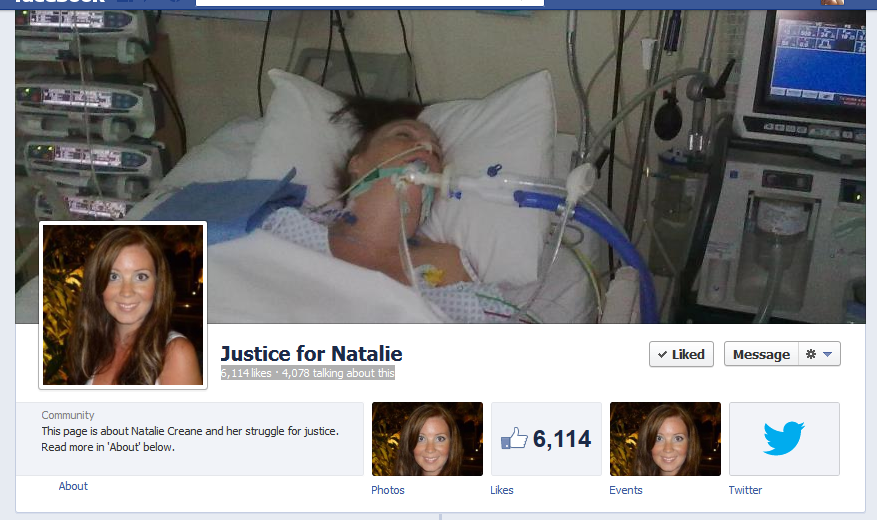
As of today, the Facebook page has 6,114 likes. Even more importantly when it comes to measuring influence and importance on Facebook 4,078 users are currently talking about Natalie. Here’s a screenshot of her page below.

The Justice for Natalie Facebook Page has only been live a few weeks but has already gone viral in the UAE and beyond

Her family have made use of Twitter to get her story noticed by media through retweets and mentions, posting pictures both via Twitter and Pinterest, and using the hashtag #justicefornatalie (there was some initial confusion online around the 20th when the Twitter handle switched from @justicefornatal to @justicefornat).

Ten days after setting up the social media channels Natalie’s story broke in mainstream media with a news piece in the UAE’s largest English circulation newspaper Gulf News followed by news pieces online at Albawaba and in print with another English-language UAE newspaper, 7Days. Natalie’s story has since been covered by global news outlets such as the BBC and the Huffington Post.

(Natalie’s story was first covered here last year by the National, but owing to the UAE’s defamation and libel laws newspapers use initials rather than full names when covering an active case).

Natalie’s family have also set up an online petition via Care2 where they’re aiming to gather 2,000 signatures (the petition is here and they’ve set up Team Natalie Marathon in Abu Dhabi for November (you can sign up here).

There’s even videos on Youtube, including the below which was put together by a supporter of the campaign.

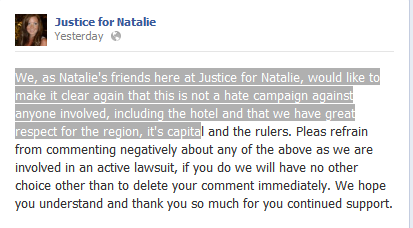
Natalie’s family have stressed that the campaign has one aim, namely to raise her case’s profile and find some settlement so that Natalie can receive the support that she so desperately needs.

Rather than being a negative, hate campaign against the hotel the family are using human interest messages and regular updates on Natalie’s condition to attract attention and build a community online. In the space of two and a half weeks Natalie’s case has gotten more attention than it has done over four years. Understandably, the family have tried to get this issue resolved in a way that will not prejudice a court settlement, but with Natalie’s condition not improving it’s understandable that they feel the best way to ensure that their daughter has the care she needs is now through public relations.

Natalie is currently in a public hospital in Dubai, Rashid Hospital, where she is receiving palliative care. As her family write on Natalie’s Facebook page, “she urgently needs to receive specialist neurological help but the family has spent all they have over the past four years as they fought to get the hotel to step up and admit its liability for an incident which has resulted in such appalling consequences for Natalie.”

I for one hope that the Emirates Palace Hotel and the Kempinski Hotels group which manages the property settle this as soon as possible. They’re harming their own reputation. And, most importantly, they are denying their own responsibility to provide care for an incident which could be said to be a result of their own negligence.

How online communities have rallied round Natalie’s family is remarkable. And it goes to show how effective social media today can be in highlighting a worthy cause. Let’s all hope that Natalie finally gets justice and receives the support she needs to recover from all that has happened to her.

Supporting Saudi’s first female athletes. #London2012 #Olympics

Last night was a magical occasion. From James Bond to the Queen jumping out of a helicopter (admittedly, a double) and Mr Bean’s cameo with the London philharmonic orchestra. My own personal highlight was worth the wait. As the teams made their way into the arena three teams sent for the first time sent female athletes. The first was Brunei. Some time after Qatar’s first female athletes made their way into the arena. Finally, the wait was over. Saudi’s first female athletes appeared. Wodjan Shahrkhani and Sarah Attar walked with their heads held high and waved to the crowd. They were joined by Arwa Mutabagani, the female team manager, former professional show-jumper and mother of Saudi Arabian rider and Olympic hopeful Dalma Rushdi Malhas.

From left to right: Attar, Shahrkhani, and Mutabagani represent Saudi Arabia during the opening ceremony for London 2012

For anyone who has been following this little slice of history in the making, there’s been controversy and debate both inside Saudi Arabia and abroad about Saudi women taking part. I referred to this in a previous post. There’s still uncertainty as to whether Shahrkhani, who is supposed to be competing in judo, will be able to take part and still wear the hijab, the piece of clothing that covers her hair.

Sarah Attar will be the first Saudi woman to run in the Olympics when she competes in the 800 meters

The debate online outside Saudi Arabia has focused on women’s right and how the Kingdom is still not doing enough when it comes to promoting and protecting their equality. A good post that sums up the contrasting arguments found in yesterday’s and today’s media has been written by Huffington Post producer Ahmed Shihab-Eldin and can be accessed here.

Having lived in both Jeddah and Riyadh for years I’m proud to be able to call many Saudis, both male and female, good friends. There’s no simple answers in a country that could be said to be more diverse and varied than any other in the Middle East region.

I am however, even prouder of Attar and Shahrkhani. Whether or not people think that their participation is a symbolic gesture, they are there in London as athletes and they have set a first for their country and Saudi women. History has been made and Saudi Arabia no longer stands alone as the one country that didn’t send women to the Olympic games. The support for the ladies online and on social media forums has been overwhelming. There has been criticism as well, as this post by Amira Al Hussaini on the online portal Global Voices points out, but I would like to think that these people are a small, vocal minority (this is a great update story to the original Global Voices post by Bikaya Masr).

Their participation at London 2012 shows that change is possible – one could say it is inevitable – and that others will benefit from what Attar and Shahrkhani are doing at the London 2012 Olympics. I’ll be cheering them on during the games and I’m sure that millions of others will be behind them for all that they have and are achieving.

If anyone knows of a Twitter hashtag for supporting the ladies do let me know in the comments section.

The ladies will be flying the flag for their country during London 2012

PS you can support Sarah via her Facebook page here. I haven’t seen one for Wojdan yet, but if there is a site I’ll add it here.

Yes, that is a camel on the road running next to the car

I love to post random videos. And this is a beauty. In Saudi seeing a camel by the side of the road isn’t unusual. The drive from Dubai to Al Ain used to be infamous for car-camel crashes (due to a camel’s body weight, height in relation to a car bonnet and its spindly legs, if you hit one it’d fall through the windscreen and seriously injure or kill the driver and front seat passenger). However, having a camel running up a bypass off Dubai’s main highway is unheard of (at least over the past couple of years).

So next time you drive, never mind those inane motorists, the plodding trucks and speeding taxis. It’s the camel that you have to take care to avoid. Especially while filming a clip for Youtube.

Oops. Time Out Dubai, Bars, Ramadan and #StopTimeOutDubai

Outrage, anger, and disapproval on today’s UAE Twitter feeds. There are times when you hold your head on your hands and wonder how anyone could have posted this or that online.

The veritable Time Out Dubai got itself into a pickle today with the below article which was published online.

The offending article on Time Out Dubai’s website today. The 5 to try: bars in Ramadan piece was pulled down earlier today

While Dubai does have its fair share of bars, the timing of the article wasn’t in the best possible taste. The holy month of Ramadan began last week. Ramadan is a time for reflection, abstinence and fasting for Muslims. While alcohol is not consumed by practicing Muslims it is freely available in Dubai. Places that serve alcohol during Ramadan do little to promote themselves during this month, and it’s beyond me why this article was even commissioned. Putting bar in the same sentence as Ramadan is bound to cause trouble and/or offense.

I don’t know for how long the article has been online but the tweets were rolling in thick and fast last evening and this morning. Here’s a couple of them below.

https://twitter.com/RoMaNiSta_8/status/227409821618536448

https://twitter.com/ShooshyDoll/status/227682853742329856

While there has been an angry reaction from many people online, there’s also been a good deal of messages defending Time Out Dubai (maybe not so much for the article per se, but for other reasons). Here’s a couple of examples.

I must give kudos to Time Out Dubai for their actions today. The magazine editors have taken down the offending article and they’ve apologized online and through social media. They moved quickly to undo the damage, promise that the incident won’t be repeated in the future and, most importantly, say sorry.

The only question now is, with this so much energy going into a campaign to preserving the sanctity of Ramadan will we see people online start rallying for other worthy causes? Famine in Yemen perhaps? Civil war in Syria? Let’s hope so.

Is the Middle East’s Communications Business now 24/7 due to #SocialMedia?

There have been a slew of articles coming out from the US and Europe on social media and when to communicate to ensure that a message gets heard by a maximum number of people. Blogs from Bitly and other social media tools have highlighted the issue of timing and its importance in terms of how content goes viral.

The When Should I Post this Infographic by digital agency Raka was based on Bitly’s data for social media content distribution

I hadn’t heard of anything along those lines in the Middle East until recently, when one agency told me they’d won a contract to promote a national sports league via social media. The agency in question claimed that they had an ace up their sleeve during the pitch; they’d guaranteed the client that they would communicate in the evenings during the matches themselves, rather than promoting the games during office hours.

The thinking was simple. The target audience would be most focused on the sport an hour or two before, during and an hour or two after the games.

By that logic, wouldn’t the same also ring true for a variety of other audiences across the region? For example, for non-alcoholic drinks such as Barbican one of the prime times for selling is during football games. Similarly, wouldn’t restaurants and other venues which do most of their business in the evening do well to communicate afternoons and evenings rather than in the morning?

It’s an interesting one to think about for marketing and communications professionals. I’d love to see someone coming up with similar studies to the bitly blog and Infographic above, particularly for the GCC region. But I’m guessing most business and brand-related social media communications in the Middle East are being posted during office hours.

Everyone I know in the marcomms industry has a smartphone, a laptop, a tablet, and a 3G mobile connection. Connectivity doesn’t seem to be the issue to communicating outside of office hours, so then what is? Is it all down to the permissions and approvals processes that companies here have in place?

There are a myriad of tools which can help measure responses and even suggest the optimal time to post messages on social media based on previous data. One to look at is Crowdbooster. This online tool is free to use and you can use it to schedule messages to Twitter and Facebook. If you’re looking for a basic but useful tool to work out when to post to social media, try out Crowdbooster.

Crowdbooster is a great tool to use when you need to know the best timings for posting messages

But do remember, don’t sleep and tweet or Facebook! Or else you might end up writing something that you will regret.

Got sacked? On Twitter? #Maradona and #AlWasl

The Argentinian footballer and manager Maradona has always be a figure of controversy. A media scum has followed his every move. Maradona’s move to and time at the UAE football club AlWasl has been filled full of incidents. The last headline for the Argentinian may be one of the strangest I have seen for some time.

His fourteen month stint in charge of the football team came to an abrupt end last week when Maradona was fired. This may not be too much of a surprise based on the club’s performances and results. However, how did Maradona first learn he was given the boot? By Twitter.

Can you imagine getting fired? By Twitter? Article from Mashable

There’s been countless articles written and published on Maradona’s claim that he was let go by Twitter (the original goal.com article is here and another one by the UAE’s Gulf News is here.

How did this happen? And legal implications does this have? Needless to say, Maradona’s time at AlWasl has ended with a bang. I for one will miss him in the Gulf.