
One story, two different takes – How Saudi Gazette is reporting and Arab News isn’t

One story has dominated Saudi media for the past week, the tragedy of 13-year-old Reham Al-Hakami who contracted HIV through a mistaken blood transfusion at a government-run hospital in the south of the country (I’ll cover this story and the outcry it has caused in a blog-post soon).

However, reading the English-language press today is a confusing affair. If you pick up Saudi Gazette, you’ll find not one piece but two on Reham. The first is a news item about another Saudi woman who has contracted AIDS. The second is a scathing opinion piece from the paper’s Arabic-language sister publication Okaz written by columnist Khaled Al-Sulaiman.
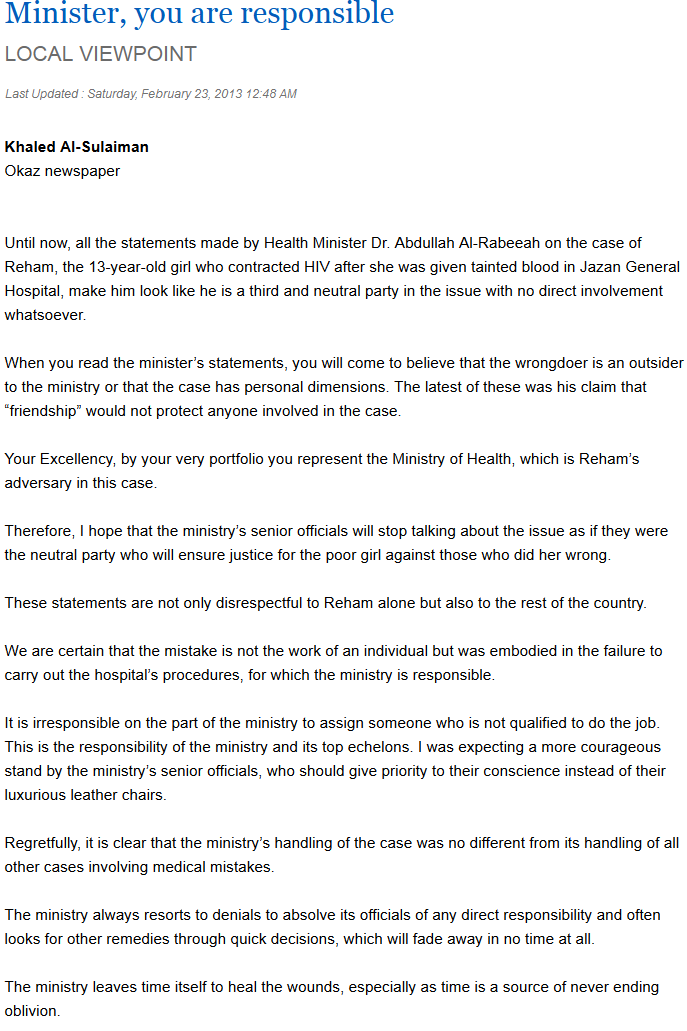
The column, which was first published in the Arabic-language daily Okaz, was rerun in Saudi Gazette

The column, which was first published in the Arabic-language daily Okaz, was rerun in Saudi Gazette

And then there’s the main piece on the Ministry of Health in Arab News, which focuses on a letter from the King thanking “the Health Minister Dr. Abdullah Al-Rabeeah and for obtaining certificates from the US-based Joint Commission International (JCI) for 15 medical facilities and accreditation from the Central Board of Accreditation for Healthcare Institutions (CBAHI) for 50 hospitals over the past 12 months.”

And here is the main piece on the Ministry of Health from Arab News. There's a second article covered, which is also not related to Reham

And here is the main piece on the Ministry of Health from Arab News. There’s a second article covered, which is also not related to Reham

I know which newspaper I’d rather be reading today. The team at Saudi Gazette and its owners should be praised for their editorial integrity and coverage of the issue.

Incidentally, Arab News is known as the Green Truth owing to the colour of its front and back pages and the quality of its copy. While the colour print hasn’t changed there’s been a noticeable shift in editorial since Khaled Al Maeena left at the end of 2011. During those two years Arab News has had two editors-in-chief (Abdulwahab Al-Faiz and now Mohammed Fahad Al-Harthi) and has lost staff to Saudi Gazette. I for one hope that Arab News receives the investment and political backing from its owner SRMG that the newspaper needs to compete editorially with Saudi Gazette.
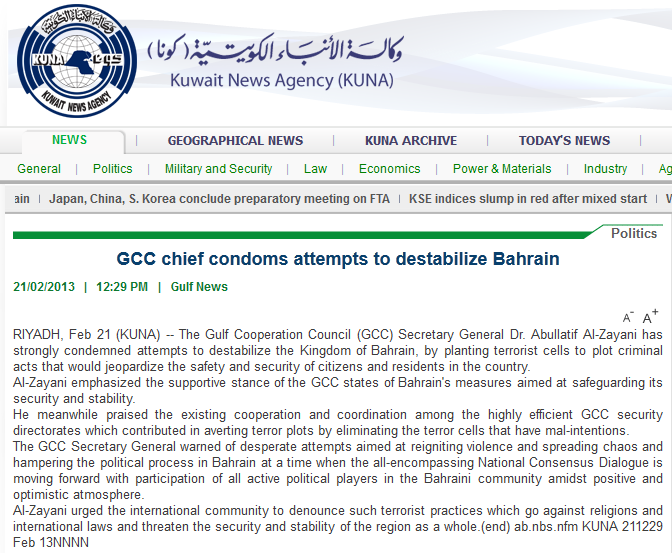
The benefits of spell-checking in the Middle East: GCC Chief condoms Bahrain

I’ve often considered being a journalist in the Middle East a curse. I’m surrounded by poorly spelled English signage, all of which I not-so-secretly want to correct. I used to find myself shaking my head from side to side as I’d count all the grammatical and spelling mistakes in certain areas of Riyadh.

While those in charge of signage may have the excuse of not being near a spell-checker when producing the prints, journalists cannot plead the same. And the below is just a shocker. I’m assuming that KUNA, Kuwait’s News Agency, has a good roster of staff to both write, edit, and proof-read. I just hope that someone amends this story and quick. But for posterity here’s a screen capture.

The headline says it all...

The headline says it all…

Where does self-censorship begin in the Gulf?

Has much changed in the Gulf? Looking back over the last 12 months, the headlines have rightly been dominated by news of events in Egypt and Syria. On the sidelines, Iran, Israel and Palestine have filled the column inches. In comparison, the Gulf seems to have changed little.

Most of us know to think before we speak. We understand that certain issues may be difficult to discuss during certain occasions. And then there’s self-censorship, the concept of altering the spoken and written word, picture, or other published material out of concern about the consequences.

Having talked to people I admire from the art world, publishing and the online communities there is a concern and fear that the boundaries of expression are shifting. The region’s powers that be are not just watching and listening, but they are also taking action. The number of persons questioned and detained for stating their views or thoughts publicly seems to have increased, and the media coverage surrounding these events has certainly gone up several notches.

So where does that leave those writers, publishers, artists and the like who live in the Gulf? We’ve always had soft censorship in the region’s media, the concept of avoiding sensitive topics to not upset advertisers, the authorities/media owners.

However, today’s conservative wave (it may be even called a tsunami if the levels of monitoring and action pick up pace) following the Arab Spring has come up against an awakening of expression brought about by social media tools. Who will win out?

The question in my mind today is where are the red lines? What should be spoken about and when should one stay silent? And can one censor the web today without unplugging oneself from the internet?

Has there been an increase in self-censorship across the Gulf?

Saudi-based journalists to follow – Reem Shamseddine

Following on from a recent post about one of my favourite journalists who covers issues related to the Kingdom, here’s a second piece for those interested in the media world of Saudi Arabia.

There are few newswires in the Kingdom (the most prominent are Bloomberg, Dow Jones, and Reuters) and the best established is Reuters. The venerable London-based news agency was the first to set up shop in Riyadh and has since expanded its bureaus to Jeddah and Al-Khobar.

Reuters has some stellar reporters working in and covering Saudi Arabia. For me, their star is the person who has been serving Reuters the longest in Saudi Arabia. Reem Shamseddine is Reuter’s main correspondent for Saudi Arabia’s energy sector and it’s a position that she has held for almost four years. During that time she’s broken every major energy story in Saudi Arabia, and in the process covering giants such as Aramco, SABIC, Dow Chemicals, Maaden etc…

Despite the size of the oil and gas industry and affiliated sectors in Saudi Arabia (the Kingdom is one of the largest oil exporters worldwide), there’s no more challenging assignment than trying to break through the myriad number of embedded public relations professionals to actually get to and report the actual story. Reem has consistently shown an ability to develop contacts and to understand the issues that are central to Saudi Arabia’s energy industry.

Reem is the type of journalist who will be thoroughly prepared for an interview and will question the interviewee on every subject. She’ll quite literally leave no stone unturned in her search for a story or piece of information.

If you’re eager to read more about Reem’s work, have a look at these articles online including interviews with the Deputy Minister for Electricity and Water and the Chairman of Saudi Electricity Company Dr Saleh Al-Awaji, an overview of Saudi Arabia’s mining sector, and of course numerous pieces with Aramco including this one on its production plans.

If you’re working in the energy or industrial sector there are a handful of journalists that you must know and deal with. Reem Shamseddine should be at the top of that list. Reem can be reached by email at Reem.Shamseddine(at)thomsonreuters.com and at Twitter on the handle @shamseddine_r

Reem Shamseddine has met with and interviewed the good and the great of Saudi Arabia’s oil and gas industry and energy sector such as the Minister for Oil Ali Al-Naimi

Is talent enough? Does the #Gulf have enough #creative #marketing #talent?

This week I wrote a fun piece for the UAE-based internet news portal Kipp Report rebutting arguments put forth by the head of creative marketing and advertising agency Leo Burnett.

I’m not going to repaste the stores word for word but you can find both pieces linked here. You can find my piece, Is talent enough, via this link. The piece by Kamal Dimachkie, executive regional managing director of Leo Burnett – UAE, Kuwait and Lower Gulf, can be found here.

What I’d like is to hear from UAE and GCC nationals who are either working in this sector or who have a passion for advertising, branding and marketing. What are your thoughts on this subject? And what would you like the industry to do to encourage local talent?

And for all of my friends, family and everybody else out there in the blogosphere I’d like to say Ramadan Kareem! We’re a day into the holy month but it’s never too late to express our blessings for this month. My wife designed the visuals below (and she’s a GCC national! Go figure…)

Ramadan Mubarak to you all!

How to defuse a crisis at a Gulf-based telco? Tell the journalist there’s no story.

I love talking to journalists. They’re often witty, sometimes charming. One thing that journalists have an abundance of are stories and anecdotes. I’ve dealt with one Gulf-based telecommunications firm for a couple of reasons of late, and it’s a fascinating company due to internal issues and ambitions. However, this firm has faced accusations of poor customer service in its home market. Consumer anger recently came to a head with calls for a symbolic, hour-long boycott of the company’s products and services.

I’m not going to name the firm, but if you do a search on Google you won’t have to search long and hard for the story or its context.

While this in itself is an interesting development, the mark of a good communications team will be able to step in, work with journalists and bring out the positive of any negative story. This didn’t happen to one journalist colleague who inquired about the boycott. An experienced reporter on a global title, she emailed a PR executive at a public relations firm representing the telco asking about the boycott.

The response was abysmal. Rather than talking through the issue, explain the company’s attempts to improve its customer service and put right the company’s standing amongst its customers the PR executive pulled his face and told the journalist there was no story.

Telling a journalist those three words – there’s no story – is akin to holding up a red rag to a bull. Following on from this faux pas the executive then started to vent his belief (off the record) that the competition was behind the boycott.
Needless to say, despite his best efforts he failed to put over to the journalist anything remotely useful that would have conveyed how much his client were investing in time and money into their customer service.

What happened? An article in a global business title which prominently featured comments from those spearheading the boycott and a single quote from the company in question. That story was syndicated both regionally and globally. This company has operations in 17 countries and ambitions to operate telecommunications networks in many more locations.

The damage done to the firm’s reputation can’t be measured. However, there’s always time to put right what has been done. Get in touch with the journalist, show them that the company cares, that it aims to redouble its efforts. Even if the journalist doesn’t write a follow-up story you’ve left a positive impression.

To date has there been any follow-up? Unfortunately not. But then again, who needs good communications and media outreach when you’re a government-owned firm with a sizable marketing budget and only one competitor in your home market? Do you really want to have a frank and open dialogue with the media and your customers? Or are you happy with being subjected to boycott campaigns simply because you don’t want to listen and you think there’s no story? How you defuse the situation is your choice.

About time…

After years of saying that I’m going to blog, I’m putting up the first post in what seems to be an age or three. The aim of this blog is to talk about marketing, media communications, which is what I do for a living.

My blog will also look at life in Saudi Arabia in particular and the wider Gulf region in general. As someone who has deep roots in this part of the world through family, friends and work I sometimes feel that I should talk more about the positives and negatives of life in Arabia.

Enjoy the blog and feel free to post comments, send me emails or tweet. Yalla!