Local Insights – the UAE’s Media Coverage of the Conflict in Yemen

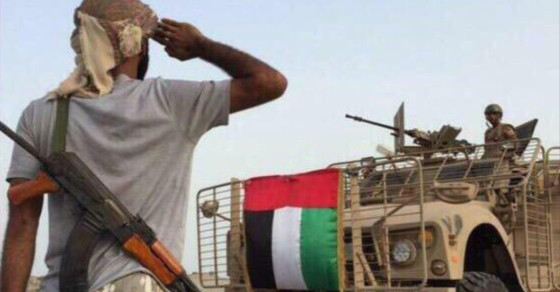
The conflict in Yemen and the UAE's involvement has helped to bring the community together, according to Emirati editors (image source: vocativ.com)

The conflict in Yemen and the UAE’s involvement has helped to bring the community together, according to Emirati editors (image source: vocativ.com)

I wanted to share a fascinating view into Arabic-language media opinions here in the UAE. This week saw the Emirati Media Forum here in Dubai. One of the topics up for discussion was the coverage of the conflict in Yemen. The conflict, which the UAE has been an active participant in since March of this year, has claimed the lives of approximately 70 Emirati combatants. The text below is from Gulf News and is a unique glimpse into how the conflict and those Emiratis who have died have helped to shape the Arabic-language media sector in the UAE and its coverage of the conflict.

The ability of Emiratis to transform tragedy into a sense of unity and national pride was the focal point of discussion at the second session at the Emirati Media Forum.

The session’s theme was ‘The UAE media’s responsible stance on the Yemen events’.

Mohammad Yousuf, president of the UAE Journalists Association, said the media was able to transform the sense of shock, tragedy and loss to positivity and pride.

Sami Al Riyami, Editor-in-Chief of Emarat Al Youm, said the Yemen war was a new experience for the UAE and for the people in the media sector.

“The news came as a shock to us too, as we are humans and Emiratis before we are media people. We were shaken by it as we were not used to seeing the bodies of our martyrs wrapped in the UAE flag — it’s an overwhelming sight. But we were able to turn the tragedy into love and pride for our country,” he said.

Explaining through various media channels why the UAE went to war, what the martyrs died for and what war entails helped in [achieving] this transformation, he said.

The media had no shortage of stories of heroism to write about, Al Riyami said, as the stories just presented themselves.

“It was not about scooping [from] other media outlets; we were all working together so we could get the information out to the people.” Al Riyami said.

In one instance, he said, one of their correspondents lost contact and they had no material to publish. Al Riyami said he called one of his contacts in another newspaper, who gave him the news material to fill the gap in coverage.

“It is our national duty, not a competition about who is getting exclusive content,” he said.

Ali Obaid Al Hameli, director of Dubai TV’s News Centre, said that with the loss of the first martyr on July 16 this year, media outlets felt a great sense of responsibility on how best to break this news to the people of the UAE and, more importantly, to the families of the martyrs.

“The UAE leaders’ engagement and stance and their heartfelt visits to the families of the martyrs and the wounded helped change people’s attitudes and made our job easier,” he said.

He said that they were shocked when they visited martyrs’ families, as the families were the ones consoling them and raising their spirits and not the other way round.

“Many of the families wished that they had more children — brothers and sons — to fight for the UAE,” Al Hamli said.

Abdul Hady Al Shaikh, executive director of Abu Dhabi TV, said that the media also shed light on the humanitarian efforts of the UAE in Yemen — and not just on the military intervention.

“We also wanted to show the Yemeni streets and people, not just coverage of our troops there,” he said.

On the topic of social media’s role, Al Riyami said it is every Emirati’s duty to offset rumours that surface on this platform, by giving correct information on the subject.

How to control the message Egyptian style

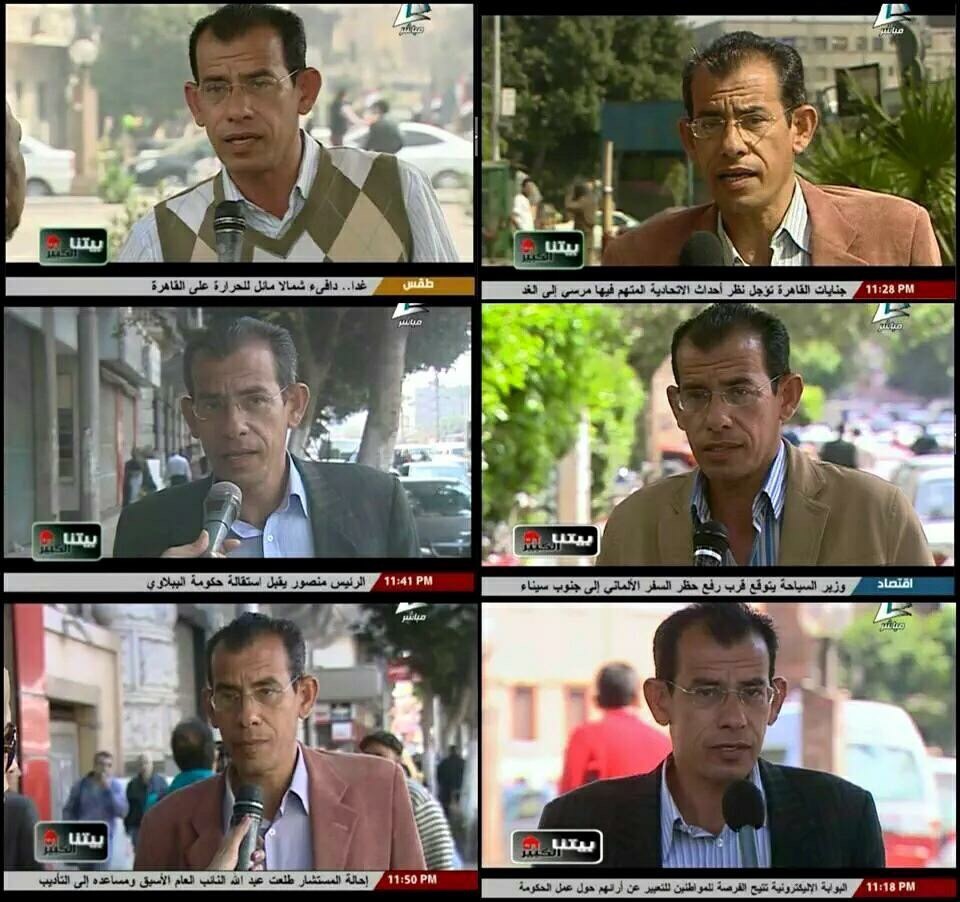
Us communications professionals think that we  control the message. In Egypt, that couldn’t be farther from the truth.

The below image has been circulating on Facebook for a couple of days now. It’s supposedly clips from random street interviews with Egyptians for one TV station in Cairo. But, as you sharp-eyed lot may have noticed, this is either the same man or Egyptian men all look the same.

As the saying goes, if you want something doing right then do it yourself. And this channel obviously doesn’t want the wrong message getting out.


Arab News, Molouk Ba-Isa, the Axact scandal and how the Arab media lost a world exclusive in 2009

Molouk Ba-Isa broke the Axact story five years before the New York Times. And then her story was pulled by the management of Arab News two weeks after it was published (image source: Saudi Gazette)

Molouk Ba-Isa broke the Axact story five years before the New York Times. And then her story was pulled by the management of Arab News two weeks after it was published (image source: Saudi Gazette)

While there’s plenty of media titles in the Middle East region – by all accounts the Gulf is the one part of the world where print is still making a profit – there’s few occasions I can remember where the region has had a world exclusive.

There’s always an exception to the rule, and unsurprisingly the person who has been in the limelight recently is a Saudi-based journalist called Molouk Ba-Isa. For those who know her, Molouk is a no-nonsense reporter who often tackles items of interest to her readers and who produces original news rather than copying and pasting news releases.

Molouk’s name was mentioned in the New York Times, as the journalist who first broke the Axact fake diploma scandal. To quote from the first piece the New York Times wrote on the story, in which it broke news of the scandal:

Heavy scrutiny by investigators, politicians and the fractious Pakistani media sector has mounted over the past week for Axact, a Karachi-based software company that has made millions selling fake degrees through a sprawling empire of school websites.

Axact, which has its headquarters in Karachi, Pakistan, ostensibly operates as a software company. Axact runs hundreds of websites, many of which purport to be online universities and high schools based in the United States.

Axact has thrived for more than a decade on its ability to hide links between its operation in Karachi and hundreds of fictitious online schools, many of them claiming to be American. But more such links are coming to light in the days since The New York Times published a detailed account of the company’s operations.

The Axact story wasn’t broken by the New York Times, but rather by Molouk Ba-Isa, who was writing for the Arab News back in 2009. Again, to quote from the New York Times:

For years, former employees said, Axact’s diploma certificates were shipped to customers across the globe through a courier service in Dubai, to give the impression of being based in that city’s free trade zone. But that facade nearly collapsed in 2009, when a technology journalist from Saudi Arabia started looking more closely.

The journalist, Molouk Ba-Isa, was following up on a report that Rochville University had awarded a master’s in business administration to an American pug named Chester. Although Rochville’s physical location was a mystery, Ms. Ba-Isa learned from a courier company official in Dubai that the degree originated from Axact’s office in Karachi.

But when The Arab News published her report, naming Axact, she said her editors received a strongly worded legal threat from company lawyers, and the article was removed from the Internet. This week, Ms. Ba-Isa said in an email that she felt vindicated.

In her weekly article for the Saudi Gazette, Molouk wrote about her Axact story which was published both in print and, even more importantly for a company which sells degrees via the internet, online.

On October 7, 2009, I received an email from Abdul Karim Khan & Company with a subject line “Cease and Desist.” The email was sent from akkc2005@yahoo.com, copied to legal@axact.com.

Abdul Karim Khan & Company, claimed to be “Advocates, Attorneys and Legal Consultants,” located at Suite No. 1108, 11th Floor, Kashif Centre, Sharah-e-Faisal, Karachi.

The email stated that the lawyers represented Axact (Pvt.) Ltd and they were putting forward a Cease and Desist Letter authored by Fahim ul Karim.

The letter demanded that the article published on October 6 be removed from arabnews.com or prosecution would proceed. Arab News was also included and threatened in the Cease and Desist Letter.

Immediately, I was asked by senior Arab News staff to provide evidence for all allegations in my report. I turned over my notes and the taped interview with Vicky Phillips, the founder of GetEducated.com, whose dog had been awarded the degree.

I provided telephone numbers for the shippers in Dubai and images of the shipping label. Within a week of the first email, the legal documents arrived from Pakistan to Jeddah by courier.

Once the article had been up on the website for two weeks, senior management at the newspaper made the decision to take the report down to stop any lawsuit.

However, no apology was issued and my report was never retracted. I continued to dig for information about Axact’s illegal activities.

While Molouk should be praised for her pioneering work, why didn’t the management at Arab News and its publisher defend her reporting and keep it online? Did they really fear a court case? Do they bear responsibility for those who have been defrauded by Axact in the five years since that initial piece was published by Molouk? And what does this say about investigative journalist in the Middle East?

A global scoop which never was… Molouk, you did a fantastic job. If only our publishers are as brave as our journalists, maybe this piece would have had a different ending. Ultimately, I’ll leave the last word to Molouk.

My thanks go out to all those who have helped to publicize Axact’s alleged malfeasance. Keep up the good work.

How can the UAE encourage more locals to enter the media industry?

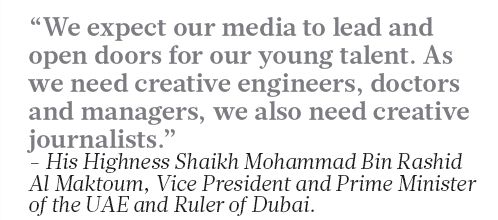
The words of HH Sheikh Mohammad during the Emirati Media Forum. The country is looking to encourage more locals to enter the media industry

The words of HH Sheikh Mohammad during the Emirati Media Forum. The country is looking to encourage more locals to enter the media industry

This month we’ve been treated to not one but two regional forums focusing on the media sector. First we had the Abu Dhabi Media Summit. Not to be outdone, Dubai held the second edition of the Emirati Media Forum (EMF). The words above were the highlight of the event, and Sheikh Mohammed bin Rashid Al Maktoum, Vice-President and Prime Minister of the UAE and Ruler of Dubai, spoke about the need for there to be more nationals in the media sector.

Reinforcing the message, UAE Minister for State and Chairman of Sky News Arabia Dr Sultan Ahmed Al Jaber spoke on the need for the country’s media to, as Gulf Today put it, become proactive and anticipative, provide deep analysis and interpretation for the current events, carry its social and cultural responsibilities, deliver our message and voice to the world and reflects our sound peaceful culture.

“Over the past years, UAE media has registered many successes and achievements and we need to adopt a balanced and objective strategy that shall contribute in enhancing and bolstering UAE creditability regionally and internationally.”

“When I call for a proactive role, I do not mean exaggeration but rather I call upon our national media to be an icon for ethics and professionalism.”

As a former journalist in the UAE and someone who has dealt extensively with media across the Gulf, the country doesn’t lack for journalists or publications. However, the vast majority of journalists are expats. Even on the Arabic side, most of the media are from Egypt, Jordan or Lebanon.

Whilst it could be argued that the media industry in the Gulf isn’t respected or held in the same regard as in other geographies such as Europe or America, most of the countries in the region have a high percentage of nationals working as journalists – most of the Arabic-language journalists in Saudi are locals, while Bahraini journalists include the head of the local AP bureau. Kuwait has the most lively political publications, which are mostly fueled by local columnists and writers. If countries like Bahrain and Kuwait, two countries with national populations roughly the size of the UAE, how can the UAE promote media among their nationals? Here’s a couple of ideas to get nationals more engaged in the media:

1) Encourage critical thinking and debate – it’s probably no surprise that Kuwait and Saudi have the largest number of local writers, thanks in part to debates around issues such as governance, politics and other issues which matter to local communities. The greater the range of views and opinions that are on offer locally, the greater the public engagement with that media. Conversely, the greater the degree of monotony the less interest there is in the media.

2) Support an independent press – there’s some confusion in the region in terms of what the media is and what its job is. As many media outlets are government owned, they’re often seen as a voice for the authorities. Independent media are generally viewed as more credible, more likely to take on vested interests and promote investigative journalism. Independent media help to promote a strong civil society that in turn promotes transparency and ethics.

3) Engage nationals from a young age – there are some up-and-coming young Emiratis in the media sector who are producing great work. They’re the exception however. Most of the nationals in the media are older and occupy higher positions. We need young role-models for today’s Emirati students to follow, role-models who will tell of the long days, of the persistence on chasing a lead, and of the exhilaration in scoring a scoop.

As was touched upon at the Emirati Media Forum, the Internet is disrupting traditional media. In America dozens of newspapers have had to close shop due to our changing media consumption habits. In a world where stories are broken and shared virally online, many are arguing that traditional media is not needed as it has been for decades. I disagree. Good local analysis can put any news story in context. This is where a strong press plays a role.

For a country that wants to be the first in everything it does, the UAE needs to look again at the local media and ask where is the country’s Al Jazeera, and where are UAE journalists who can be compared to the likes Saudi presenter Turki Al Dakhil, Bahraini editor-in-chief Mansour Al-Jamri, and Kuwaiti journalist Mohammed Al-Sager, all of whom are well respected, famous figures in the media industries in their home countries and abroad.

If the UAE wants a strong media presence and aims to attract more UAE nationals into the sector, then there has to be a shift towards a strong, empowered media that can tell the country’s story through its own words. A mature media that can speak on its own behalf, that has a reputation for holding others to account, and which strengthens local communities can only be good for everyone in the country, most of all its nationals, and will help to attract young nationals who want to support their country’s development as well as be involved in what is one of the most exciting jobs anyone can do.

I’m going to end this piece with a quote from the Columbia School of Journalism, of what media can do for a country.

Journalism exposes corruption, draws attention to injustice, holds politicians and businesses accountable for their promises and duties. It informs citizens and consumers, helps organize public opinion, explains complex issues and clarifies essential disagreements. Journalism plays an irreplaceable role in both democratic politics and market economies.

For those in the industry, I’d love to hear your feedback.

How to, and how not to, pitch to the media

Let’s get rid of those bad pitches and give journalists fewer reasons to use the delete button (image source: http://www.meltwater.com)

Having worked as a journalist, as the head of an agency, and finally on the client side, I’ve learned a fair few lessons on the art of pitching a story. The beauty about the communications industry is that no matter how many year’s you’ve put in, you still keep learning. This was the case on Monday of this week, when I received an agency email pitch which basically used the client’s latest piece of coverage as the pitch.

Thanks to that experience I’m sharing with you some tips on how to properly pitch to the media, developed by Forbes contributor Cheryl Connor. They’re simple but effective, and they focus on the content and the delivery rather than the traditional media relations approach used still by many in the region.

1. Choose a target. And make sure the target will actually fit. For example, thousands of companies through the years have attempted to pitch The Wall Street Journal’s Walt Mossberg on writing about products such as network traffic management tools. Yet he specializes in covering products consumers would use. A good fit? Not at all.

2. Read the writer’s prior articles. Thoroughly. Read them with an eye for their interests, their themes, and the way your idea would help extend their subject matter further. (Not “I see you wrote about XX, so how about you write about it again?”) When you make your pitch, let the writer know how and where your idea might fit. Think through the idea through the reporter’s eyes—how will this piece be of interest and need to the reader? How will it meet the criteria the publication and the writer’s section and assignments must meet?

3. Pitch a story—don’t pitch your company. Believe it or not, your company and product, by themselves, are not an interesting topic. But as part of a broader story or an example of a pervasive need or a message—now they can shine. Think of what that story might be and imagine what it might look like in the hands of the reporter you’ve chosen. From that point of view, prepare your pitch. Make your pitch by email first. Let it gel for at least an afternoon, or preferably for a day. If the idea is a good one, the reporter may respond right away. If you don’t hear back, perhaps the next step is a call. When you call, refer to the earlier message. Regardless of whether the reporter has seen it or not, re-forward as a courtesy as you are talking to allow the individual to scan the high points of the message and preliminarily respond.

4. Be respectful of the reporter’s right to make the decision. As tempting as it is to ply the reporter with a strong armed pitch, you will be more successful by respecting the reporter’s right to say yes or no, while providing them with as many meaningful reasons as possible to have the desire to say yes. Is the story an exclusive? An idea or a slant that hasn’t been offered to anybody else? Will it be of broad need and interest to the reporter’s readers or viewers, and does it give them strong news or an angle on the information that hasn’t been presented before? All of these ideas will help.

5. When you speak to the reporter, get straight to the point. The whole idea of buttering a reporter up to the topic you called for is a bad one. Clearly you phoned because you wanted something. With the first words out of your mouth, let them know what it is, and what your reasons are for thinking it’s a good idea. If it’s yes, follow through quickly with the next steps. If not, why not? For another person or with another approach could it be a better idea? With the business of the call handled, you can then visit with the reporter for a bit and catch up if they have the time and the willingness. And at that point, they’ll know the personal interest is sincere.

6. Be honest and transparent about your desire for the interview or the meeting. For example, I was extremely annoyed to get an urgent message from a vendor needing my next available time to discuss their public relations only to find out their one and only reason for the appointment was to give me a demonstration of a product they were hoping I would cover for Forbes. And it was a product that didn’t fit my area of coverage, at that. The executives wasted an hour and a half of their time and mine. Not only will they not see coverage, but the company they represent will now find it highly difficult to get a return appointment with me when they genuinely do want to meet to discuss their PR.

7. If you can’t reach the reporter, avoid the temptation to call repeatedly. Listen to the reporter’s voice mail—it will often provide you with clues. For example, the reporter may be on vacation this week—out sick—moved to another beat (or even another publication) or may be so adamantly opposed to voice messages that you should be aware the message will likely never be heard (or may even offend them). If you do leave a message, one message in a day is ample. If the reporter has left a cell number on the message, refrain from using it unless the matter is genuinely urgent. They’ll appreciate the courtesy you use in reaching out in the ways they most like to be contacted.

8. Consider the strengths of Twitter. Twitter can often be a clue as to where the reporter is and what they are doing on that day. For example, if they Tweet they just arrived at the Oracle World trade show, it’s no wonder they didn’t answer the office phone. Now you know. Time your next call for after the event. Also, many reporters will respond to direct messages through Twitter faster than any other mechanism. Use that advantage, when you can take it, with skill.

These points reflect my own sentiments. A pitch should be interesting and to the point, add value to the journalist and her/his audience and relevant to the journalist’s beat. Communicators are story-tellers. The more interesting our story, the better the chance that the journalist will say yes to the pitch. There’s far too many badly thought-out pitches being made, mass emails promoting a person or a company. The next time you pitch, send the email to a colleague and ask them to answer you, in all honesty, if they’d buy your pitch.

Arabtec and its executive hiring campaign in Saudi

After a couple of weeks hiatus from blogging due to studies I thought I’d get back into the mix with a short and yet intriguing look at an advertising campaign run by one of the largest construction companies in the Gulf. The company that built the world’s tallest building, the Burj Khalifa, has been expanding of late. As part of its drive to grow its business in Saudi Arabia, the firm placed the below advert in most of the largest newspapers in Saudi Arabia.

Aside from costing what I guess to be about a million Riyals/Dirhams, my question would be what was the purpose of the campaign? Was it to hire a local executives, or was it to drive awareness? If you know, then please do tell!

What's the reason for this advert? And will it help in attracting the right candidate or a couple of thousand CVs?

What’s the reason for this advert? And will it help in attracting the right candidate or a couple of thousand CVs?

Copy and Paste: Gitex news and repeating the same message

I used to joke with a good friend of mine who works as a journalist that companies would often recycle news year after year during the region’s largest technology exhibition. I’d tell him that firms would simply change the date of the previous year’s press release and joke that maybe he’d do the same.

I was reading over one news piece from Dubai Airport Free Zone (DAFZA) during this year’s GITEX. The piece, which I’m pasting below and which is linked to here, is on the launch of the organization’s first official mobile application.

DAFZA launches its first mobile application, in 2013

DAFZA launches its first mobile application, in 2013

I thought I’d seen the news before, so obviously I asked Google. And what did I find?

DAFZA launches its first mobile application news, from GITEX 2011

DAFZA launches its first mobile application news, from GITEX 2011

Copy and paste anyone?

Five tips on how to survive and thrive during Gitex

It’s here, the region’s most manic event. Gitex, the Gulf Information Technology Exhibition, is to public relations and media people what Christmas is to parents of little children who believe in Father Christmas; a ruthless, insane, once-in-a-year event where everyone wants what’s on their wish list and you have to deliver.

From someone who’s done his fair share of Gitex exhibitions both as a journo, a PR person and as one of the organizers, here’s my five top tips on how not just to survive Gitex but thrive despite all of the noise, confusion, and occasional tantrums (you know whom these executives and organizers are). So here we go!

1) A phone with an endless battery

At Gitex your phone will be ringing incessantly. No one has died, there’s no new births to report, and the world is not coming to an end. But if you’re a journalist you’ll be every PR person’s best friend for five days (especially if you work for the official publisher ITP). And if you’re a PR person the pressure to deliver interviews will quickly build to a crescendo. Every single journalist within a four-hour flight will be on your quick dial list. Just don’t let the phone die.

Make sure your phone battery never, ever dies during Gitex. Or else you’ll never be forgiven. (image source: Daily Mail)

2) Lots and lots and lots of caffeine

You will not eat or sleep during Gitex. What you will live on is caffeine and taurine. You will drink coffee, tea, and Red Bull like its water. Gitex veterans will normally lug around with them a couple of cans of energy drinks. And for those new to Gitex, bring lots of small change. The venue doesn’t sell cheap beverages (there is however a supermarket around the corner in the DWTC residences, besides the metro station and opposite Pizza Express).

The above is one way to carry your Red Bull during Gitex, though it’s not recommended. (image source: wikimedia)

3) Ear Plugs

Gitex is noisy. Actually that’s wrong. Gitex is deafening. Exhibitors assume that the higher the wattage from their surround sound system, the more people will stop and watch the models… ahem, executives talking about their business. Gitex is the exhibition equivalent of a Tuesday night club which is hosting a drum and bass session combined with a ladies free-entry policy. If you want to ensure that you leave with your hearing intact then take ear plugs with you. Just don’t forget to take them out when you’re interviewing/arranging for interviews.

Pillows won’t help with the noise pollution at Gitex. Get some ear plugs. (image source: http://www.alpinehearingprotection.com)

4) Panadol, Ibuprofen, Vicodin…

You get the point. At some time during Gitex, you’re going to be hit by the mother of all headaches. Be prepared, take lots of meds with you. And if you don’t have any and the dreaded throbbing and pain strikes then head on down to the pharmacy on the concourse to grab your pain killer of choice.

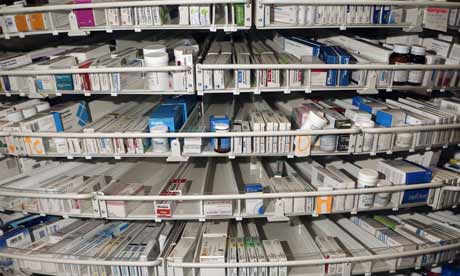
Bring drugs, lots of drugs! You will need them. (image source: The Guardian)

5) The Patience of a Saint

At some point you’re going to be surrounded by screaming, nagging executives who are behaving like a bunch of toddlers/prima donnaa. There’s really thing that you can do, apart from swallow your pride, paint a smile on your face, and remain calm. Gitex would test the patience of the Dalai Lama, so remember you’re not alone in your frustrations. For the week however, you will have to suffer in silence. Remember that patience is a virtue so stay calm!

Keep calm, take a deep breath. Gitex will soon be over. (image source: http://www.keepcalm-o-matic.co.uk)

What’s your top tips for Gitex? Share and share alike. Remember, we’re in this together!

Why stonewalling the media is always a bad idea: Nakheel and Arabian Business

Another day, another flood. Nakheel’s attempts to stem the tide of negative PR by not talking to media simply won’t work (image source: arabianbusiness.com

For those that don’t know Nakheel, you’re in for a treat. The Dubai government-owned real estate developer and the name behind the world-famous Palm Jumeirah is a byword for customer relations fiascoes these days. The company has run into a number of public relations calamities over the past two year, including issues such as service fees, numerous floods, and, most recently, a new development with lakes forming from putrid water.

Like any other company, Nakheel has both fans and detractors. However, a recent story on Nakheel by popular Dubai-based news portal Arabian Business raised my interest. The piece, which was about the recent flooding at Nakheel’s Al Furjan development, included a significant paragraph at the end.

* Nakheel no longer responds to media enquiries from Arabian Business, nor does it grant this publication access to any of its media events or announcements.

When a company feels that it has to stonewall, restrict access to and stop all relations with a media outlet there’s something very wrong. Whatever the company expects to gain from this action, I can guarantee all that will result is more negative publicity and an inability to counter negative stories by providing comments from the company itself.

In these cases, my advice to any company facing a barrage of negative media is understand what is at the core is the issue and why there’s so much negativity surrounding the company’s public perception. For Nakheel, maybe their time would be better spent addressing customer service and engineering issues rather than duking it out with the media. In the meantime I’m looking forward to reading more stories about the company on Arabian Business.

Is the media a government tool or an independent voice – thoughts from Abu Dhabi

Freedom of expression or expression of national institutions? We’re still very much in the latter camp in the Middle East (image credit: http://www.menassat.com)

There was a fairly low key but important discussion this week in the UAE’s Federal National Council. The body, the closest thing that the UAE has to a parliament, welcomed Shaikh Abdullah Bin Zayed Al Nahyan, the country’s Foreign Minister, to discuss the issues of the media and the work of the National Media Council, the UAE’s regulatory body for the sector.

The below excerpts are from an article in Gulf News which ran this week. Have a read through the quotes:

The National Media Council came under fire from the House for its “weak role in [the] Emiratisation of the media, dominance of foreign media content and lack of plans to promote the [UAE’s] cultural identity.”

The NMC was also criticised for the lack of coordination between the media outlets and universities, lack of training programmes for journalists and broadcasters, and a failure by media outlets to address concerns of citizens.

The FNC also voiced concern over the UAE’s low ranking in the press freedom index. Ali Jasem, a member from Umm Al Quwain, said the UAE ranked 158th on the Press Freedom Index last year.

Shaikh Abdullah said he expected that the ranking will improve once the new media law is issued with an article that bans jailing journalists for exercising their duties.

Shaikh Abdullah said discussions in the FNC lacked a uniform stand on the issue of freedom of expression.
“Some members demand a higher ceiling of freedom and less control, while others call for censorship, which is confusing,” Shaikh Abdullah said.

Shaikh Abdullah reiterated that the NMC respected the editorial policies of all media outlets operating in the country and that it never intervened in their work or nature of their content.

“The country’s policy is to leave the executive work to the media outlets, whether owned by the local governments or the private sector, so that there will be no contradiction between [the NMC’s] work and theirs,” he added.

Shaikh Abdullah said media outlets are “our partners and they are wholeheartedly contributing to the UAE’s media strategies.

It’s fairly common in the Middle East for the media to be seen as a tool of government policy. The media reiterates the government line and rarely engages in debate. This viewpoint hasn’t changed much despite attempts by global media outlets, newswires such as Reuters and Bloomberg, to write uncensored about a range of social, political and cultural issues.

What’s noticable from the above is that even in a country which is fairly media-friendly by the standards of the Middle East there’s still a view that the media needs to be an instrument of policy which ‘promotes cultural and national identity.’ I’ve been incredibly fortunate to have been raised in a part of the world where a strong, independent media fosters debate, promotes transparency and holds others to account. How far are we from this state of affairs in the Middle East? Your guess is as good as mine. However, in the meantime I’ll keep flying the flag for a media sector that has the teeth to do its job and act as an independent voice for discussion, debate and originality.