The Middle East and its addiction to Facebook – 2013 stats and figures

Yes, we Arabs have adopted Facebook as our own (image source: muslimscrisisgroup.wordpress.com)

Most of us in the region already know how effective and powerful Facebook is. The social media site played a prominent role in the Arab Spring, particularly in Egypt, and its popularity has endured in the face of challenges from other services such as Twitter and YouTube (I’m not even going to mention Google+ in the same sentence).

Facebook released some figures this week about the site’s usage in the Middle East. According to Facebook’s head of MENA Jonathan Labin over twenty eight million people in the Middle East and North Africa are using Facebook every day. Fifty six million use the site every month and of those thirty three use a phone or tablet device to check their profile. Fifteen million people access the site on a daily basis from their mobiles.

I’m going to give you a little more insight into a couple of different regions: Saudi Arabia; Egypt; the GCC; North Africa, and the Levant. The below figures, which were compiled last month, give a good deal of insight into gender split, age, marriage status, number of friends and page likes, access methods, and interface usage. If you’re a marketer in this region and you’re not using or leveraging Facebook (especially on mobile) then start rethinking your advertising and communications approach.

Social media and diplomacy – @IsraelintheGCC, Israel’s virtual embassy in the Gulf

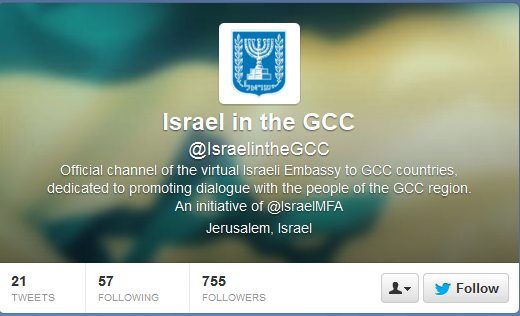
The launch of the @IsraelintheGCC twitter account is a cheap but potentially effective media channel for the Israeli government

The launch of the @IsraelintheGCC twitter account is a cheap but potentially effective media channel for the Israeli government

No matter your political persuasion, you have to admit that the Israelis are an ingenious bunch. Their latest idea is a simple concept, a virtual embassy for a part of the world where there’s little/no Israeli State presence, the Gulf. Israel, which doesn’t enjoy official diplomatic relations with any of the Gulf states, has launched a ‘virtual embassy in the Gulf’ through Twitter. The account, which is named @IsraelintheGCC, aims to “open lines of dialogue” with people living in the Gulf according to a report by the UAE-based English-language daily Gulf News. According to the Israeli daily Haaretz, the person behind the idea is Yoram Morad, Director of the Department of Digital Diplomacy at the Ministry of Foreign Affairs of Israel.

Not unsurprisingly, Israel has always faced challenges when trying to communicate its point of view to its Arab neighbours. However, that hasn’t stopped the State from engaging various mediums to argue for its policies. Israel launched an Arabic-language television channel in 1994 following the announcement of the Israeli-Palestinian peace process. The establishment of the @IsraelintheGCC twitter account follows news of a potential re-engagement between the Israelis and Palestinians as well as mounting pressure on Iran to halt its nuclear enrichment programme.

It could be argued that Israel has been much more active than the Arab states in terms of communicating its key messages – there were plans to launch a Hebrew-language channel in Egypt as of last year according to the Christian Science Monitor, but I haven’t heard much in the way of an actual launch.

The messaging employed by @IsraelintheGCC, which is being run by the Twitter account of the Israeli Foreign Ministry, would appear to be aimed at propagating a more diplomatic tone than that of Israel’s internal politics. The account, which has tweeted 21 times to date, has only quoted the country’s Prime Minister twice (its fair to say that Bibi Netanyahu wouldn’t win many popularity contests in the Gulf), but it has talked about social media in the Arab world, sustainability issues, and wished followers a Ramadan Kareem. The one time Netanyahu has been quoted was in relation to European sanctions on the Lebanese organization Hizbollah which isn’t well liked in the Gulf due to its pro-Iranian stance. There are tweets in Arabic too. Have a look at some of the posts below.

Over the past couple of years social media has allowed companies, politicians and celebrities to directly bypass the media and reach out directly to anyone that wants to listen. Now the same can be said of social media for States who, for diplomatic reasons, cannot establish a physical presence. I’ll be following the account, and am looking forward to seeing how long this project lasts, how much dialogue it generates and how successful it becomes for the Israeli government.

Will there be more Farsi-language newspapers? On its 35th birthday Al-Sharq Al-Awsat goes Iranian

Al-Sharq Al-Awsat in Farsi? It’s going to happen, and most likely soon.


There’s few pan-Arab newspapers of note. Al-Sharq Al-Awsat, or AAA as I and others so lazily call it, is one of those papers that is everywhere and which demands respect. The green-tinted paper, which only this week celebrated its 35th anniversary and which was one of the first to be printed offshore in London, is a must-read for anyone looking to understand politics in the Gulf and between the Gulf states and the rest of the Middle East.

Owned by the Saudi Research and Marketing Group, the paper is set to again make history by being the first tier-one newspaper in the region to publish in Farsi. While I don’t have the full details on when or how (I’m assuming that the focus will be more on online rather than an actual print version simply to reach as many Farsi speakers inside and outside Iran), the move may mark the beginning of an effort by Saudi Arabia – the Saudi Research and Marketing Group is run and majority owned by the Saudi Royal family – to proactively communicate with Iran’s people directly in their own language.

The timing is also fascinating, coming as it does after the conclusion of Iran’s former President Ahmadinejad’s time in office and the election of the new President-elect Hassan Rouhani. Rouhani has been described as a moderate and one of his many tasks may include reducing the amount of censorship imposed on Iranians living in their own country; Iran has one of the most sophisticated web filter systems active globally today allowing the Government to block any external site at will.

Al-Sharq Al-Awsat’s Farsi move may be long overdue. There’s been concerted efforts by the Iranian Government for some time to speak directly to an Arab audience, most noticeably through its television station Press TV. Will other Gulf governments follow Al-Sharq Al-Awsat’s lead and print their own Farsi language paper or launch more Farsi-language websites?

Lessons in cultural misunderstandings from the Gulf

Are we more a melting pot or a basket-case of cultural groups? (picture source: http://kidspartyheaven.wordpress.com)


The Arabian Gulf is often called a melting pot of cultures, where diverse groups and nationalities meet, work and live together and understand one another. Every now and then, there are moments when a different reality comes to light, when it’s blindingly obvious that we still have a long way to go.

I had the pleasure of having two of those ‘cultural moments’ last Wednesday. The first was with Emirates, the national airline of Dubai. Emirates is an interesting organization, in that it’s one of the most profitable airlines in the world, is owned by the Government of Dubai, and yet most of its senior management is not from the Gulf region.

I enjoy flying Emirates, and I often receive a great service from the airline. I had to rebook both my and my wife’s ticket and pay for the difference over the phone. All went smoothly, until it came to the issue of payment. You see, the habit in the most of the Arab world, and particularly in the Gulf, is for the wife not to take her husband’s name for religious reasons. And yet, I couldn’t pay for her ticket over the phone because my surname obviously is different. The lady on the other end of the phone wasn’t an Arab, but she wasn’t the person who drew up the rules at an airline owned by an Arab government.

Cultural misunderstanding one was resolved not through explaining why my and my wife’s names were different – I did try my best – but for other reasons (I’m a Skywards airline rewards member, which solves everything over the phone). The second cultural crossed-wires was much more fun and less painful but just as much an eye-opener.

I received a message from a friend asking for information about a company I know. Here I was naively thinking he was looking for a job. Instead, he’d been asked by a parent to check up on a person at the company whom a family member had received a proposal of marriage from.

While I’m never averse to providing a job reference or to help someone in their search for the right role, I explained that I may have to draw the line on background checking someone I didn’t know to help facilitate (or not) a marriage request.

We often talk about melting pots, about coming together and living alongside others in harmony et cetera. But how much do we really know about the other? And how often does our lack of cultural awareness catch us out? With Ramadan only a few days away maybe it’s time we did more to understand each other and our diverse backgrounds?

Is too much government intervention good or bad for innovation in the Gulf?

Is the Gulf’s innovation being hindered by too much government intervention? (credit: techpionions.com)

There’s been a couple of news stories recently that caught my eye. One was an interview on Kipp Report with the managing director of an online website called Tejuri.com. The article, which you can reach here, focuses on how Tejuri.com positions itself as the official online distribution channel for retailers registered with the Emirate’s Department of Economic Development.

Aside from the wisdom of launching an online distribution channel that is government-supported in the year 2013, the piece got me thinking about other areas. One example is non-governmental work, which (surprise, surprise) is often not only regulated but led by government-related bodies. And then you’ve got the ultimate example of government intervention, which is the ownership of the upstream and downstream oil and petrochemical sectors, numerous financial institutions and other businesses. And then there’s the sovereign wealth funds.

My question to these and other government interventions is how much do these activities stunt growth and disrupt innovation? Here I’m going to refer to United Nations World Intellectual Property Organization and Insead that ranks the top ten most innovative countries. The original piece from Bloomberg is here.

Switzerland, Sweden and Singapore are the most innovative countries in the world, according to a study by the United Nations World Intellectual Property Organization and Insead that found a wide gap between rich and poor nations.

Innovation is an important engine of growth and new jobs, the Global Innovation Index 2012, which ranked 141 economies, showed. The index considered institutions, human capital and research, infrastructure and market and business sophistication as well as as the results of innovation such as patents and software in determining how countries fared.

Finland ranked fourth, followed by the U.K., the Netherlands, Denmark, Hong Kong, Ireland and the U.S.

Numerous surveys such as the above and this research one by the United Nations University show that governments help foster innovation most through investing in social capital (read education) and through financial funding – the irony in some parts of the Gulf is that education is in the hands of the private sector rather than the government. Governments then have to step back and then let individuals and businesses get on with it. The same can be said of the non-governmental sector, which, pretty obviously, works best without governmental support s groups and communities work to best pinpoint social issues and tackle them.

The argument often goes that entrepreneurs drive innovation and that governments need to reduce their interventions, reduce bureaucracy and increase financial support for small to medium sized firms to drive growth. However, is that what we are seeing in the Gulf? Or are we still not fulfilling our potential due to too much, rather than too little, government intervention?

Are Saudis the most open nation in the Gulf?

Saudi Arabia’s society is changing at a much faster rate than many of its neighbours

Hands up all those people who’ve heard of or been to the cosmopolitan Dubai. I’m sure that you’ll know about Qatar, the country that has made a name for itself by investing all over Europe and for winning the 2022 World Cup. And there’s Kuwait, probably best known for its role in the first and second Gulf wars. One of the most beautiful countries I’ve ever visited, one could say that Oman unfortunately isn’t as well known abroad as it should be.

And then there’s Saudi Arabia, a mysterious land which up until recently was spoken of in Chinese whispers. The Magic Kingdom was a country that was known for oil, religious and cultural conservatism. Despite the spread of the internet and the ensuing countless videos and other types of multimedia information hosted online Saudi Arabia is still an unknown to most people.

The country’s reputation, image and visa regime doesn’t help to educate foreigners, but I’ve been struck recently on a number of occasions how open today’s Saudis are. This is especially true of the younger generation. Many of the Saudis I know who are under the age of 40 will talk about anything and everything, especially in a closed environment. They’re knowledgeable, they’ll know much more about the workings of the country and national government than is written about or published in the news. And they’re not afraid to be blunt about what is right and what is wrong when it comes to public policy.

Having lived in Saudi for a fair few years I’ve always been fascinated by how Saudis are becoming ever more open to sharing their views with people they know and trust, especially in the setting of the Majlis where the men traditionally gather in the evening to discuss both personal and business issues.

The difference in openness between Saudis and other GCC nationals is becoming ever more noticeable. While traditionally the most open society in the Gulf, Bahrain has been transformed due to the events of the past two years. Both Qataris and Emiratis are very welcoming, but they’re less inclined than Saudis to talk at length with foreigners on the issues that are shaping their respective countries.

And then there’s the Kuwaitis, who are probably definitely the most outspoken people in the Gulf. But for me, today’s Saudis are more open because many will acknowledge both the positives and negatives of their country.

I’m not suggesting that the country is a bastion of diverse views which are aired in public by all and sundry. There are still many subjects that are taboo, but many barriers have been broken over the past two years partly thanks to the widespread adoption of social media by many young Saudis. Just think of any controversial topic in the Gulf, and you’re going to find it being discussed in Saudi by bloggers, on Twitter and Facebook.

Looking forward, I can only hope that this openness will be a blessing to the Kingdom as it looks to tackle issues such as unemployment, the changing role of women in the society, graft and governance. These subjects will be better dealt with if there’s an open dialogue between the country’s nationals. As always, I’m optimistic about where Saudi Arabia is headed and would like to hear if you agree with me or not about my thoughts.

Where does self-censorship begin in the Gulf?

Has much changed in the Gulf? Looking back over the last 12 months, the headlines have rightly been dominated by news of events in Egypt and Syria. On the sidelines, Iran, Israel and Palestine have filled the column inches. In comparison, the Gulf seems to have changed little.

Most of us know to think before we speak. We understand that certain issues may be difficult to discuss during certain occasions. And then there’s self-censorship, the concept of altering the spoken and written word, picture, or other published material out of concern about the consequences.

Having talked to people I admire from the art world, publishing and the online communities there is a concern and fear that the boundaries of expression are shifting. The region’s powers that be are not just watching and listening, but they are also taking action. The number of persons questioned and detained for stating their views or thoughts publicly seems to have increased, and the media coverage surrounding these events has certainly gone up several notches.

So where does that leave those writers, publishers, artists and the like who live in the Gulf? We’ve always had soft censorship in the region’s media, the concept of avoiding sensitive topics to not upset advertisers, the authorities/media owners.

However, today’s conservative wave (it may be even called a tsunami if the levels of monitoring and action pick up pace) following the Arab Spring has come up against an awakening of expression brought about by social media tools. Who will win out?

The question in my mind today is where are the red lines? What should be spoken about and when should one stay silent? And can one censor the web today without unplugging oneself from the internet?

Has there been an increase in self-censorship across the Gulf?

Finance and entrepreneurship goes digital with souqalmal.com

I love entrepreneurs, I really do. At their best they’re gutsy, bold, decisive, innovative, and they’re not afraid of risk. Frankly, we need more entrepreneurs in the Middle East.

I had the pleasure and the opportunity to meet the person behind the idea of souqalmal.com last week. After stints with GE, Mastercard and the consultancy firm Bain Ambareen Musa took the jump into the entrepreneurial space to found souqalmal.com.

Souqalmal.com is the first website I’ve come across in the region which provides a comprehensive view of a variety of financial products, including credit cards, personal finance, home and vehicle finance, insurance and personal banking accounts. In other words the portal is an Gulf-based version of money.co.uk (the site presently caters to Kuwait, Saudi Arabia, and the UAE) and is both incredibly easy to use as well as very handy when comparing different products in the market.

Souqalmal isn’t just about providing the basic data however. The site lets subscribers rate products, just as you would do on a Tripadvisor for a hotel or amazon.com for a book. As a consumer you get to rate that service and provide your input to hundreds and thousands of others who will be using the site. That consumer feedback element should raise the bar for the financial services industry in the region by highlighting what is both good and bad about the product and it services.

What I love most about what Ambareen is doing is that she’s established a business that is providing a much-needed public service. She’s dived in, she’s pushing ahead, and I do believe that she and souqalmal.com will improve what and how the financial sector offers and deals with the region’s consumers. I for one wish her all the success in the world, and can’t wait to start putting down my thoughts on souqalmal’s review sections!

Will Souqalmal.com and one person’s entrepreneurial spirit change the face of consumer banking in the Gulf? Let’s hope so!

Twitter and politics in the Middle East – Arab political figures on Twitter

Following on from a previous post on the top religious figures in Saudi Arabia using Twitter I’m profiling a couple of the most prolific political and governmental officials and rulers in the Gulf.

If you’re looking for a good resource on global political movers and shakers then check out the Twiplomacy report by global PR agency Burson-Marsteller. There’s some interesting insights here, though I hope the below snapshot will give you a little more information on the Middle East region in particular.

So here’s the top five six countdown. I could add a lot more and I hopefully will do over time.

1. Jordan’s Queen Rania Al Abdullah.
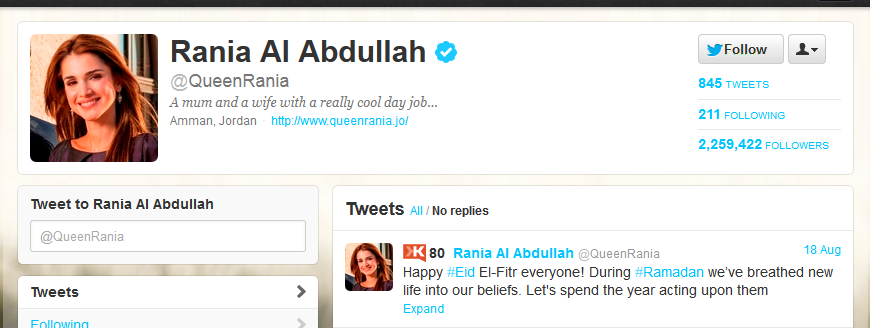
Jordan’s Queen Rania is the most popular political figure in the region with over two million followers.

The most popular political figure on Twitter is not based in the Gulf, but rather on the Arabian Peninsula’s periphery. Jordan’s Queen Rania Al Abdullah is without a doubt the most popular government-related figure in the Middle East (I saw government as her husband King Abdullah II is the head of state). To date she has amassed two and a quarter million Twitter followers. The Queen usually tweets about charitable issues which she is involved in or supports, such as education, healthcare, and youth-related schemes. Queen Rania also has a YouTube channel and Facebook site as well as her own website at http://www.queenrania.jo.

Queen Rania has used social media to engage in conversation. The best known example is a campaign launched in 2008 entitled Send me your Stereotypes. The Queen asked people to send her their questions about Islam and the Arab world. She talked about topics such as honour killings, terrorism and women in the Middle East.

Queen Rania started using Twitter in the Spring of 2009 and she has occasionally used the site to answer questions from followers. She is not a prolific user of Twitter (having sent 845 tweets her account averages less than a tweet a day), and her engagement and communications are spread across all of her social media channels. Queen Rania messages in English primarily rather than Arabic.

2. Sheikh Mohammed bin Rashid Al Maktoum

Sheikh Mohammed passed the one million mark on Twitter at the end of July 2012

The ruler of the Emirate of Dubai and the Vice President of the United Arab Emirates, Sheikh Mohammed bin Rashid Al Maktoum has a large following on Twitter through which he disseminates information on Dubai’s economic development, charitable initiatives, and (sometimes) religion.

Sheikh Mohammed often writes in Arabic to address issues which are important to UAE nationals. In addition to his twitter feed there’s a Facebook site which was set up in June 2009 and has over 600k likes and a more recent Youtube page which was set up in February of this year but which already has 580 thousand video views.

Sheikh Mohammed tweets on average less than once a day (he posts at approximately the same rate as Queen Rania and has posted to date 862 tweets) but he does retweet fairly often (once every 9.1 Tweets). An avid horse racer, the Sheikh does talk about his passion for racing as well as the environment.

3. Abdul Aziz Bin Fahd Al Saud

Abdul Aziz Bin Fahad is an avid user of Twitter and has written just under 5,500 tweets in 10 months.

The claimed twitter account of the youngest (and it’s always claimed the favourite) son of Saudi Arabia’s late King Fahd Bin Abdul Aziz Al Saud has only been active since November of last year but already has 637 thousand followers. The account, which hasn’t been verified by Twitter, is supposedly owned by Abdul Aziz Bin Fahd Al Saud (the account is his initials followed by his birth year).

While not in government, as a son of Saudi Arabia’s previous king Abdul Aziz Bin Fahd Al Saud wields considerable influence in the Kingdom both through his family as well as his various assets. He owns half of MBC, the Middle East’s largest broadcaster, as well as other investments both regionally and globally. Abdul Aziz was previously head of the Diwan of the Council of Ministers in the Saudi government.

Tweeting exclusively in Arabic Abdul Aziz Bin Fahd Al Saud talks about both the mundane (for example sending holiday greetings to followers) to voicing his support for the Saudi King (and his uncle) Abdullah. Abdul Aziz Bin Fahd Al Saud has written about controversial topics such as trying to stop the broadcasting of MBC’s latest Ramadan blockbuster Omar, which was based on the life of the Prophet’s companion Omar Bin Al-Khattab, as well as allegations of excess leveled against him by others using Twitter.

On average Abdul Aziz Bin Fahd Al Saud writes twenty tweets a day and regularly engages with followers.

4. Sheikh Abdullah ibn Zayed Al Nahayan

Abdullah ibn Zayed Al Nahayan engages more with followers on Twitter on a daily basis than any other minister in the region

The UAE’s Foreign Minister is another avid Twitterer. Despite only having joined the social media site in November 2011 Sheikh Abdullah ibn Zayed Al Nahayan has written over 7,600 tweets at a rate of 24 a day.

Writing in Arabic Sheikh Abdullah focuses on national and regional issues related to the UAE such as the Abu Mousa island dispute between the UAE and Iran as well as more general topics such as religion and culture.

Sheikh Abdullah often engages with his audience which is mainly UAE and GCC nationals and retweets every 2.5 tweets. Over half of Sheikh Abdullah’s tweets are replies to followers.

5. Doctor Walid Al-Tabtabai

Doctor Walid Al-Tabtabai is a controversial figure in Kuwaiti politics both for his views as well as his use of Twitter

One of Kuwait’s most colourful politicians, Doctor Walid Al-Tabtabai is a conservative Islamist (Salafist) member of parliament who has attracted controversy for many of his views (which he frequently expresses via his unverified Twitter account). Dr Al-Tabtabai talks most frequently about Kuwaiti and regional politics with his 227 thousand plus followers which he has built up since joining Twitter in November 2010.

Dr Al-Tabtabai was at the center of a legal case when he posted screenshots of a Kuwaiti national’s Twitter page and demanded the man be arrested for what were described as “insulting tweets of the Sunni sect and severe criticism and insults to the Saudi and Bahraini regimes for their stand against the Bahraini protests.”

The case was one of the first in the Gulf to see someone being prosecuted for airing their views on Twitter. However, as a parliamentarian Dr Al-Tabtabai enjoys immunity from public prosecution.

On average Dr Al-Tabtabai writes 7.3 tweets per day in Arabic and retweets every 2.2 Tweets.

6. Khalid ibn Ahmed Al Khalifa

Diplomat, Ambassador, Foreign Minister of Bahrain, Bon Vivant… Khalid Al khalifa is many things on Twitter

With possibly the best Twitter bio of any politician in the Middle East and over nine thousand tweets sent it’s maybe no surprise that Bahrain’s Foreign Minister has been so active on Twitter. Khalid Al Khalifa has had to contend with the diplomatic consequences of Bahrain’s security policies following a year and a half of demonstrations against the government.

The Foreign Minister is one of Bahrain’s most outspoken figures online and uses his Twitter feed to talk about government policy as well as to promote the Bahraini government’s point of view overseas as well as at home.

Khalid Al Khalifa also tweets on issues not related to Bahrain such as regional politics, and frequently talks about his travels and his meetings with other politicians. He also frequently uploads pictures to his Twitter account. The Minister retweets every 5.4 tweets and writes in both English and Arabic.
Is talent enough? Does the #Gulf have enough #creative #marketing #talent?

This week I wrote a fun piece for the UAE-based internet news portal Kipp Report rebutting arguments put forth by the head of creative marketing and advertising agency Leo Burnett.

I’m not going to repaste the stores word for word but you can find both pieces linked here. You can find my piece, Is talent enough, via this link. The piece by Kamal Dimachkie, executive regional managing director of Leo Burnett – UAE, Kuwait and Lower Gulf, can be found here.

What I’d like is to hear from UAE and GCC nationals who are either working in this sector or who have a passion for advertising, branding and marketing. What are your thoughts on this subject? And what would you like the industry to do to encourage local talent?

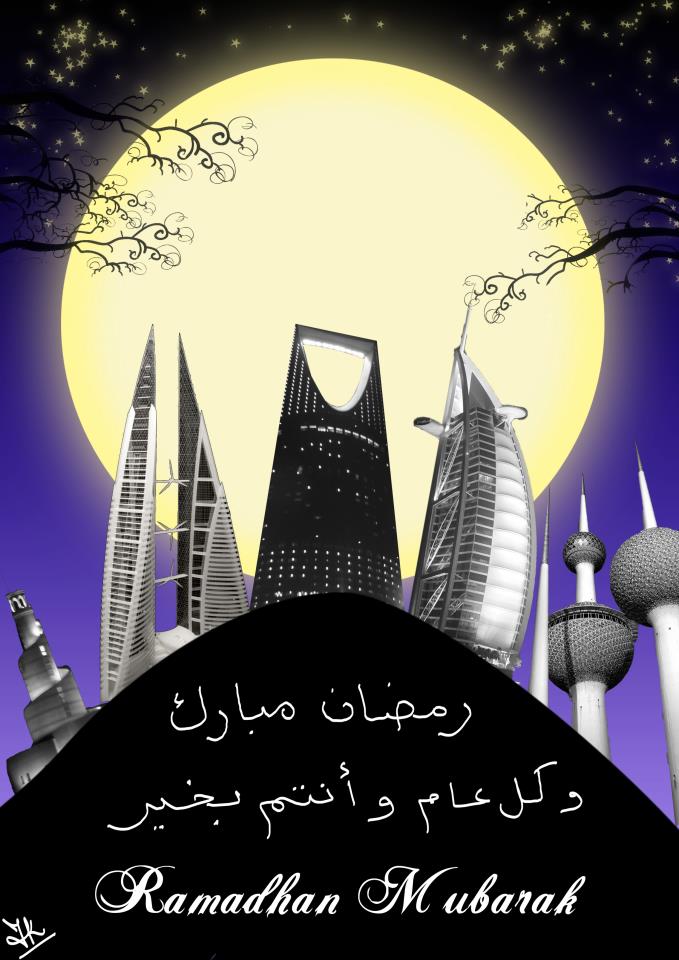
And for all of my friends, family and everybody else out there in the blogosphere I’d like to say Ramadan Kareem! We’re a day into the holy month but it’s never too late to express our blessings for this month. My wife designed the visuals below (and she’s a GCC national! Go figure…)

Ramadan Mubarak to you all!