Hashtag hijacking and the need for authenticity – the #EtisalatChallenge

Let’s face it, social media is entertaining. As communicators, we really do need to think through the consequences of using digital. But sometimes, the best of intentions just aren’t enough. Companies who don’t think through the reasoning behind their campaigns will face a backlash online, including derision, contempt, and abuse.

There are many examples globally of hashtag hijacking; possibly the best is McDonalds and its #McStories campaign. Fortunately for us in the Middle East, we now have our own example of how not to launch a hashtag on Twitter. A couple of days back the Abu Dhabi-based telecommunications operator launched an advertising campaign called the #EtisalatChallenge. The idea is simple enough – Etisalat challenges consumers to find offers and prices that are better than their own and they’ll match or beat that offer. You will literally see the below advert everywhere across the UAE at the moment.
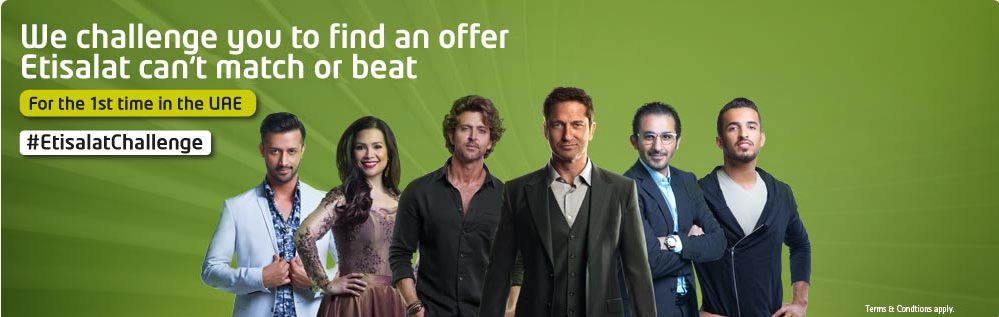
Are you ready for the #EtisalatChallenge?

Are you ready for the #EtisalatChallenge?

Now, there’s a couple of issues here. The first is pretty basic; the UAE’s telco market is a duopoly. Both operators are government-owned and there’s not much in the way of competition when compared to other. The second is Etisalat’s reputation. The company isn’t the most consumer-friendly in terms of its support. Shortly after Etisalat launched its hashtag #EtisalatChallenge (complete with a huge marketing campaign), the hashtag itself was taken over by customers complaining about high costs and poor service.

Despite the obvious backfiring of the campaign (and, as you can see from the tweets below, the campaign has been taken over by negative sentiment), Etisalat has persevered with the #EtisalatChallenge.

https://twitter.com/mkdubai/status/595950565483380736

https://twitter.com/ThatGuyNoman/status/595958586204905473

What’s even stranger is the number of bots, of Twitter accounts which are automated which have are now tweeting the same message about the campaign.

https://twitter.com/ThatGuyNoman/status/596655103928438784

The other element of the campaign which is intriguing is the number of celebrities that Etisalat has brought in. There is one of Scotland’s finest, Gerald Butler, Bollywood actor Hrithik Roshan, and Filipina actress and singer Lea Salonga. Etisalat has also paid a number of the UAE’s leading social media influencers. While the use of social media influencers to support marketing campaigns is becoming standard practice, the #EtisalatChallenge in unusual in that many of the influencers have previously worked for the UAE’s rival operator Du. Have a look below.

Emirati social media celebrity Mthayel Al Ali was a Du supporter

Emirati social media celebrity Mthayel Al Ali was a Du supporter

But now Emirati social media celebrity Mthayel Al Ali is also an Etisalat fan

But now Emirati social media celebrity Mthayel Al Ali is also an Etisalat fan

Egyptian footballer and model Sherif Fayed was part of Du's marketing before his switch to Etisalat

Egyptian footballer and model Sherif Fayed was part of Du’s marketing before his switch to Etisalat

Egyptian footballer and model Sherif Fayed is also a fan of green as he shifts to #EtisalatChallenge
Egyptian footballer and model Sherif Fayed is also a fan of green as he shifts to #EtisalatChallenge

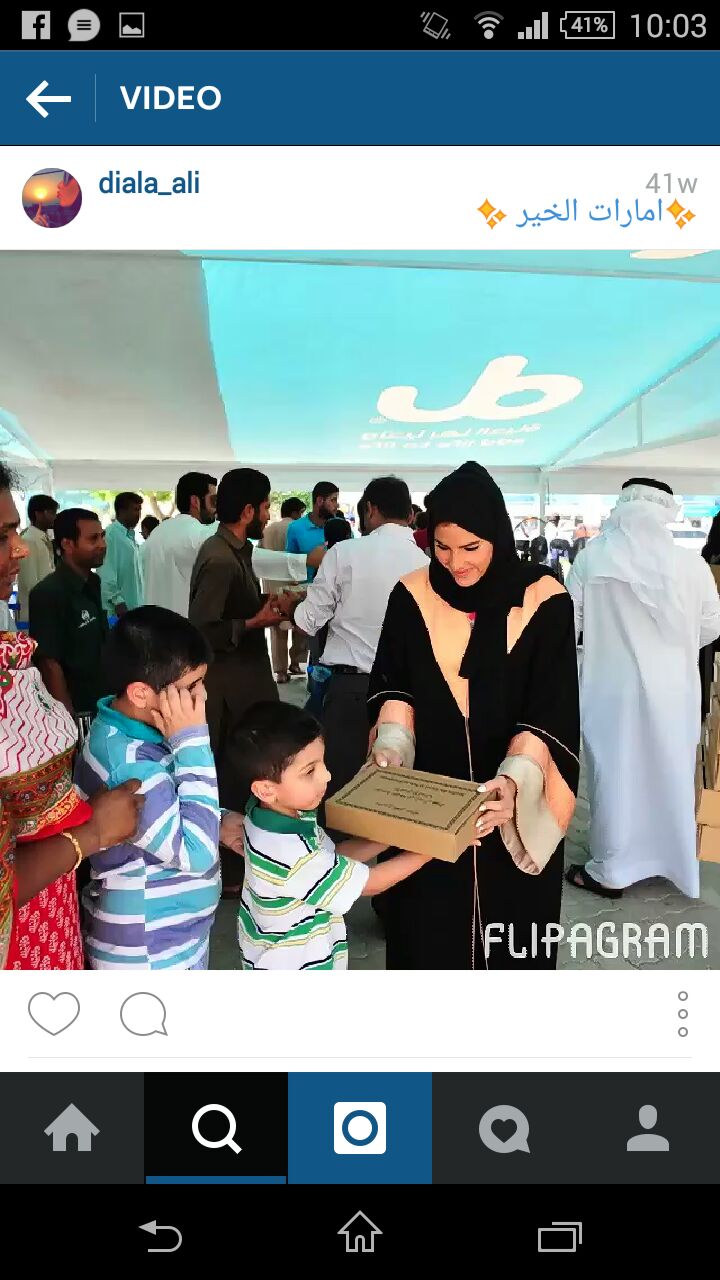
Before her support for the #EtisalatChallenge UAE media personality Diala Ali was a Du supporter.

Before her support for the #EtisalatChallenge UAE media personality Diala Ali was a Du supporter.

From blue to green - UAE media personality Diala Ali shows her support for the #Etisalat Challenge

From blue to green – UAE media personality Diala Ali shows her support for the #Etisalat Challenge

While one can easily fault Etisalat for getting out the cash and spending a fortune on social media endorsements, these online influencers are more to blame in my eyes. They’re doing their own brands more harm than good by changing from one corporate brand to the other so quickly. Their authenticity is at stake, and for someone who runs a social media agency Mthayel Al Ali should understand that authenticity matters to fans, and fans are the reason these people are paid to endorse brands. There’s little long-term thinking from influencers who have worked with Du previously and whom are now working with Etisalat.

Going beyond the pains of creating corporate hashtags (which, in this case clearly don’t work), what was Etisalat thinking? And what is it still thinking, seeing as the campaign is failing so badly? Come on, share with me your #EtisalatChallenge!

Did Skydive Dubai do enough communications following the tragic death of skydiver Majed Al Shuaiby?

There are days I love my job as a communicator. And then there are days when my heart breaks. One of those days was last week, with the tragic news of a death at Skydive Dubai. Majed Al Shuaiby was an experienced skydiver – he had over 700 dives under his belt according to the local media. On April the 30th Majed took to the skies. Unfortunately, his parachute did not open and he died on impact.

This news, as sad as it is, is also newsworthy. We have a young man, who is only 35 years old, who perished whilst undertaking a sport which is often thought of as high risk. The accident made the news, with coverage nationally and regionally (Majed was a Saudi national). Unsurprisingly, the news first appeared on social media, on the evening of the 30th, the day of the accident.

In a tribute Majed’s name trended on Twitter in Saudi with the hashtag #ماجد_الشعيبي.

Many of those who were online and who knew of the accident started to reach out to Skydive Dubai. The initial reaction was, to put it mildly, disappointing.

https://twitter.com/ammorsy/status/593784283237457921

What Skydive Dubai did, a day after the accident, was put up a post on its Facebook Desert Campus page and push users there. There’s no separate post on Skydive Dubai’s main Facebook page and no posts on Twitter.

The holding statement above has been used for media attribution as well, as can be seen from The National’s story.

Was the statement from Skydive Dubai enough or could they have done more?

Was the statement from Skydive Dubai enough or could they have done more?

While the investigation is still under way to determine what happened, could Skydive Dubai have done more to publicly address the incident and offer their condolences to the family, whilst also addressing concerns around the safety of skydiving?

No one wants to go through a crisis, especially when people are injured or there’s a fatality. However, we as communicators are on the front line to advise our employers and communicate in a way that is respectful, that comforts, and that shows we are also human. As we say, perception is reality and Skydive Dubai’s initial response, to block users, would seem entirely at odds with what communicators should do in a crisis. Going beyond that, is a holding statement enough? We need to present both the facts and show our emotion. We should never simply ignore bad news, and block conversations. Could Skydive Dubai have done more? Do let me know your thoughts.

On a final note, I’d like to convey my condolences to Majed’s family. Allah yurhamu and may god bless his soul.

The National and how it (finally) got the Saayidat Gas Blast story right

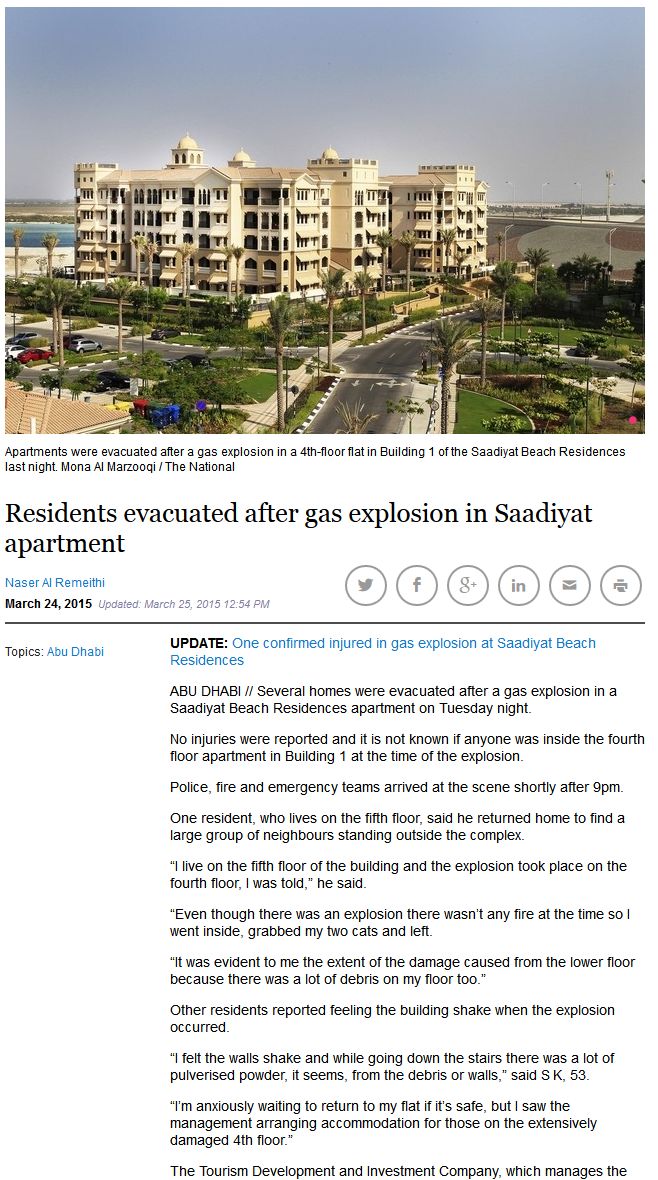
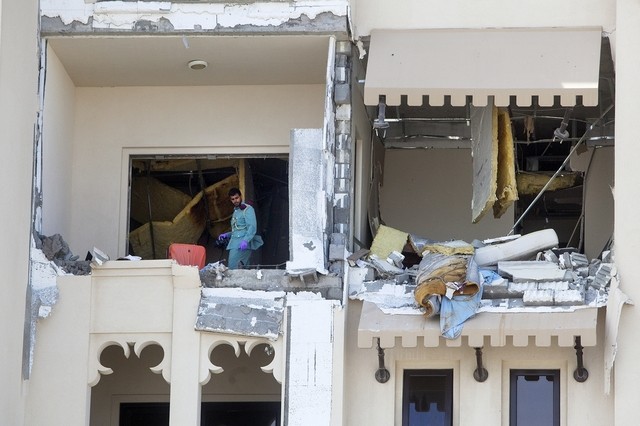
The money picture of the gas blast flat was captured on the second day by The National (image source: The National)

The money picture of the gas blast flat was captured on the second day by The National (image source: The National)

As an ex-journalist who nowadays spends more time in corporate communications than writing for the press, I still enjoy spending time reading what the media produce. One local story was particularly moving for me. On the 24th of March, in the evening, a gas explosion tore through the compound where me and my wife live in Abu Dhabi. My wife felt the blast, which she described as feeling like an earthquake.

As you’d expect, the incident made the news. Abu Dhabi-based English-language newspaper The National was quick out of the blocks to cover the incident with an online piece posted the same night. While the speed of the output was noteworthy, the paper got several essential facts wrong.

The first was the explosion’s timing – the incident happened at 7.30pm and emergency services were quickly on site afterwards. Secondly, and even more importantly, there were injuries despite the article’s assertion that no injuries were reported (two ambulances were on-site). And thirdly, a stock image of the building was used rather than a picture of the location following the blast (the compound is thirty minutes drive from The National’s offices).

The National's first story on the Saadiyat gas blast was quick to print but important details were wrong

The National’s first story on the Saadiyat gas blast was quick to print but important details were wrong

The piece didn’t feel as if it was put together in the right fashion, as if there wasn’t anyone on site from the paper to collect statements and talk to the authorities. It felt as if it was a desk-job. There was definitely no photographer on site to take the gold-ticket picture which would have set the stage for the piece.

However, the next day The National upped the ante in their second piece. First of all, they had the picture of the gas-blast flat which the first piece desperately needed. This money shot was supplemented by additional images. The piece confirmed the one injury. The piece was much stronger in terms of its facts as well as the emotional focus of the residents who were in the building when the blast occurred and their fears and concerns.

Was there still an issue? As far I am concerned, yes. The piece was almost a gushing testimonial to the compound’s developer TDIC. I felt as if TDIC had commissioned the piece, rather than having a piece written about them by an objective journalist (disclaimer – both TDIC and The National enjoy shared ownership, though that shouldn’t have any bearing on editorial independence). Have a look at the extract from the article and tell me what your opinion is.

Ionnais Xenakis, 27, a pilot with Etihad, lives on the fourth floor with his wife Erini, 27, a few apartments away from the flat where the explosion occurred.

“I was sitting on the sofa with my husband and baby. We heard a loud noise and a vibration,” Mrs Xenakis said.

“We weren’t sure what it was so we grabbed our baby and dog, and ran. We saw our neighbour Barry who was injured in the explosion. He told us that he turned on his light and then the apartment exploded.

“He has just moved into the building and told us that his gas wasn’t even connected yet. It was a little difficult to get out of the emergency exit because it was dark, and the emergency doors were damaged and blocked the path,” she said.

“We helped him out until the paramedics came. It was tough, but the one thing that we can all agree upon is TDIC’s swift reaction and assistance.

“They supported us like a family. They did more than we expected them to do. I was even given a stroller for my baby by one of the employees.

“They also gave me everything I needed for my baby. They were there, attending to all of our needs about 15 minutes after the explosion.”

TDIC made arrangements for the Xenakis family’s dog and cat to be taken to the Australian Veterinary Clinic in Abu Dhabi.

The third and fourth pieces by The National switched from reporting on the blast to the feelings of the residents and their concerns about the safety of their homes. The third piece was much shorter, but it was all the better for it. The fourth piece followed in a similar vein, and both included quotes from two residents (albeit the same residents). There was also the required comment from the local authorities on the steps they were taking to reassure the public – this gas blast was the second in the capital in the space of a week.

The paper saved the best for last, with a piece at the beginning of this week on the injured man himself and his own story as to what happened that night. The journalist rounded off the piece with a final comment from one of the residents.

Residents were displaced for several days. Some tenants from the blast floor are still being housed at the Anantara Eastern Mangroves by the Tourism Development and Investment Company. They are eager to find out what caused the explosion.

“It’s important to identify the error behind this because I believe it could’ve been prevented,” said L R, a neighbour of Mr Johnson. “A poor man was seriously injured because of this. We don’t need hard lessons and tragic stories to learn from our mistakes.”

The National did the right thing and got the piece right, with rolling coverage on the story and a focus on the facts as well as a human-interest element that rounded off the coverage. The journalist made amends for the initial piece which was lacking in both information and visuals to craft a number of pieces that hit the mark every time. The only thing left to say is to wish the person injured in the blast, Barry Johnson, a speedy recovery. It was a memorable night for all the wrong reasons, and I hope that he will be back on his feet and fully recovered sooner rather than later. I hope to read about Barry’s recovery in The National as soon as it happens.

I’d like to wish Barry Johnson a speedy recovery and I hope to read the news soon in The National (image source: The National)

How to destroy a brand through poor communications – the Nakheel example

Nakheel_flags

I’ll admit it. Every now and then I do get pangs of schadenfreude when I see brands being pulled up online by the media and the public. However, seeing a brand destroy itself is a different proposition.

I’ve been watching Nakheel for some time, and I’ve written about the company and its bad media habits before. The Dubai government-owned real-estate developer is responsible for some of the Emirate’s most iconic projects, including the Palm Jumeirah and The World. However, its customer service is, unfortunately, just as infamous as its successes are famous.

Last week, Sarah Townsend of Arabian Business wrote a scathing piece on Nakheel. Entitled ‘Nakheel PR: The toughest job in Dubai?’, she took a sledgehammer to Nakheel’s reputation The article is well worth a read, especially for those of us whom have spent long enough in the region to forget what quality journalism looks like.

If it were just one person taking aim at Nakheel, the issue would be manageable. However, due to our digital world reputation-bashing is a team sport. The article has gathered seventeen comments, all negative and some from disgruntled Nakheel owners. My favorite is the below.

A comment from a not-very-happy Nakheel property resident on the Palm

A comment from a not-very-happy Nakheel property resident on the Palm

On top of this, Nakheel is facing additional issues regarding its stalled Palm Jebel Ali project. However, it’s not the media which is causing trouble for Nakheel, but rather angry investors who have yet to see their properties take shape after years of delay. To quote from The National.

Hundreds of investors on Dubai’s Palm Jebel Ali have called on developer Nakheel to restart the project.

An estimated 400 to 450 people, most of whom made down payments during Dubai’s boom years between 2004 and 2008, find themselves in financial limbo.

All the units under the Palm Jebel Ali project, including its signature and garden villas and water homes, are “under cancellation”, according to Dubai’s Land Department.

In November, 74 homeowners wrote to Mohammed Al Shaibani, the head of the Ruler’s Court and Dubai Investment Authority, to look into the matter.

“The lack of certainty as to when our homes will be built has caused, and is causing, tremendous financial and emotional suffering for us and our families, and many of us continue to endure ongoing mortgage and rental costs while we are waiting,” the letter says. “Many of us have invested our life savings into the Palm Jebel Ali.”

Over a 100 Palm Jebel Ali owners have set up a group on Twitter with the handle @PJAOwners to lobby the government on their issue (bizarrely Nakheel doesn’t have an account on Twitter and there are several Facebook accounts, none of which seem to be legitimate).

For an organization which claims to be one of the largest and most successful property developers in the world, the media issues that Nakheel has gotten itself into are unforgivable (blacklisting the media doesn’t help). Having said that, many of the company’s issues are rather to do with how they operate. Public relations can never be used as a figleaf for unpopular or damaging actions. As Mark Twain said, “The public is the only critic whose opinion is worth anything at all.”

At the end of her article Townsend stated that Nakheel are looking for a PR exec to join their ranks. I could be even bolder and suggest that they look at how they do business and rebuild their reputation first. Anything else would be putting the cart before the horse and will continue to destroy what is left of Nakheel’s brand. I’m betting things will get worse for Nakheel in terms of its brand image and reputation. But I won’t take any pleasure from watching this sorry story of a brand being destroyed from within.

What not to say on live TV – Qatar Airway’s CEO and the bull**** comment on CNN Money

There’s few things worse to do on live television than swearing. Unless you’re a CEO that is. After being accused of treating foreign workers, especially female cabin crew, with disdain in an article published in the Washington Post (the article is entitled ‘The surprising ways in which some flight attendants are still made to live in the 1960s’), Akbar al-Baker did the media rounds to defend his airline’s position and dismiss the claims. Watch the video and the offending comment for yourselves.

To say Akbar al-Baker is gaffe-prone would be an understatement. He has led the airline since 1997 through a period of unparalleled growth. However, when does a leader become a liability? Is Akbar al-Baker, of which much has been said by former staff, a liability to the airline and to Qatar?

Inauspicious Beginnings or PR Coup: Al Waleed’s Al-Arab TV station and how it was shut down on its opening day by Bahrain

Al Waleed’s Al-Arab is now known worldwide thanks to Bahrain’s closure of its operations on its first day of broadcasting (image source: http://www.bbc.com)

Have you heard of the saying, ‘There is no such thing as bad publicity’? If you’re a communications professional at BP or you work for Bill Cosby you may feel differently, but the quote, often attributed to the American self-publicist PT Barnum, still rings true in terms of brand awareness and familiarity.

One man who doesn’t lack for publicity is the Saudi Prince Al Waleed Bin Talal Al Saud. Al Waleed, who has long had an interest in the media (he owns stakes in News Corp, Fox and Saudi Research and Publishing Group), set out his own media vision for the region a couple of years back when he announced his intention to set up his own news channel. Named Al-Arab, the channel would compete with the likes of Al-Jazeera and MBC Al-Arabiya to shape the news agenda.

After years of planning, the channel went live this week. Al-Arab is based in Bahrain, ostensibly to allow the channel to benefit from Bahrain’s relative media freedoms and, as the channel’s general manager and Saudi journalist Jamal Khashoggi put it, to cover “all views” in the region.

On its first day of operations the channel was temporarily suspended by Bahrain’s information ministry. Akhbar al-Khaleej, a pro-government paper, reported that the suspension was due to the channel “not adhering to the norms prevalent in Gulf countries”.

The allegation is that Bahrain’s government took offense to an interview aired with Bahraini opposition activist and politician Khalil al-Marzooq, who was talking about Manama’s decision at the weekend to revoke the citizenship of 72 Bahrainis.

The closure has made headlines worldwide, and has guaranteed headlines for Al-Arab in capitals such as Washington, London, Paris and Berlin. While the closure may have been an operational nightmare, for a publicist it has been a coup. As Oscar Wilde put it, the only thing worse than being talked about is not being talked about. By this measure Al Waleed should be delighted with the launch of his television channel.

The stunt may have also have helped to cement Al-Arab’s position as a channel that will tackle any and all subjects. Before the channel’s launch, Khashoggi stated the need to be both bold in terms of talking about taboos as well as the need to discuss issues from a balanced perspective. “We are going to be neutral; we are not going to take sides,” he said. “We are going to bring in all sides in any conflict because right now we have a conflict in almost every Arab country.”

By setting down this marker from day one, will Al-Arab be able to set itself apart from other channels in the region which do have particular media biases. Will Al-Arab create a middle ground that wins over Arab audiences?

According to Al-Arab’s Twitter feed the station will be operational again soon. I for one can’t wait to watch its re-launch.

And if you want to see the alleged reason for why Al-Arab was shut down watch the clip below.

Lost in the fog – is Etihad’s social media crisis down to an operational failure?

For some passengers, the experience of the fog and resultant delays weren’t helped by Etihad’s social media support despite the best efforts of the social media team (image source: http://www.todayszaman.com)

I love challenges. I’m an even bigger fan of crises. They seem to bring out the best in us, pushing us to our limits and testing our abilities. While I admit to enjoying being put through the ringers, I do feel for Etihad’s social media team during a bout of fog at the beginning of January. On the first Saturday of the year, during a peak time of year for travel, think fog descended on the UAE’s capital and closed Abu Dhabi International Airport for just over an hour. The airport’ closure affected Etihad’s scheduling for several days.

Before I go further, let me brief you on the airline’s communications outreach. Etihad has a sophisticated social media set-up, including a dedicated Twitter account for Etihad’s customer service, at @EtihadHelp, as well as customer support on Facebook. Etihad’s response time is usually less than 20 minutes, and each and every customer correspondence from the team is signed off by the team member’s initials.

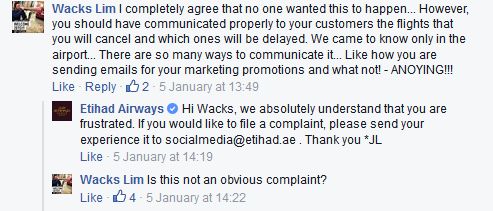
The fog literally consumed the social media team however. As people, the one instance that we can all agree on is that we hate anything going wrong when we travel, including travel delays and lost luggage. Stories of delays, including passengers stranded on the tarmac for half a day, without food or information, made headlines globally. Etihad’s social media channels were replete with angry passengers looking for a solution to their problems. Have a look at some of the exchanges below as well as media coverage.

This is one example of many of the discussions that took place on Facebook between Etihad and its customers following the fog

This is one example of many of the discussions that took place on Facebook between Etihad and its customers following the fog

https://twitter.com/ravaliareddy/status/551286654938251264

A number of thoughts come to mind. While Etihad has a stellar social media operation, how much leverage does the social media have over operations. Or to put it slightly differently, what accountability is there between operations and the social media team. Does the organizational structure, either formal or informal, help or hinder the social media team’s operations on behalf of customers? Etihad is a large organization of just under 15,000 employees; what can the social media team do on the customer’s behalf?

I’ll admit, these are special circumstances. Thousands of passengers were either stranded or had their luggage misplaced. However, we now live in a connected world where consumers’ expectations are amplified. While social media can speed up communications with consumers, is social media being set up to fail if operations cannot keep up? What are your thoughts?

Should executives say sorry? Just Falafel’s ‘we forgot about the food’

Do you agree or disagree with what  Mohamad Bitar did, and why?

Do you agree or disagree with what Mohamad Bitar did, and why?

Should we admit when things don’t go the way we planned? It’s a tough one. Few corporates hold up their hands when plans go awry (unless there’s a crisis of biblical proportions). US-based corporates such as Walmart are now taking on media outlets to argue their point (this post from Walmart is a remarkable example of fighting back).

Even fewer company bosses in the Gulf go off track and talk from the heart. However, as with everything there are exceptions. Just Falafel is often touted as a home-grown success story, a tale of how a local brand has become global. Founded in 2007 in Abu Dhabi, the falafel-focused outlet has approximately 52 stores in 18 countries according to its website.

However, the chain isn’t to everyone’s tastes. A news story on the English-language website Arabian Business which announced the reasons for the departure of the chain’s former CEO Fadi Malas was used as a comment board by readers to explain their reasons for not liking the brand’s falafel.

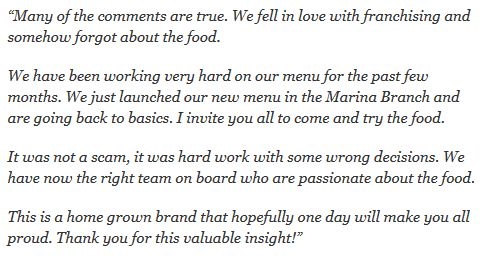
Fair enough you may say. But what followed was either inspirational or horrifying depending on which side of the open/control communications fence you’re on. The Just Falafel founder and MD, Mohamad Bitar, took to the site’s comments section to explain how the company had “forgot about the food”.

The comment as written by just Falafel's Bitar on ArabianBusiness.com

The comment as written by just Falafel’s Bitar on ArabianBusiness.com

The hacks at Arabian Business then took Bitar’s comments and span out a new story, to which readers took to explain what they believe went wrong and how Just Falafel can put it right.

For some consumers, an admission of error can be a powerful tool to reassess and re-engage with a brand. For others, it’s all about projecting an image that others can believe in, and not deviating from that message. Is Mohamad Bitar’s message a moment of genius (if we were in America, I’m sure we’d be calling his move crowd innovation), or does it signal a need for someone to crack the whip at the brand and get everyone on message?

Your thoughts?

Why stonewalling the media is always a bad idea: Nakheel and Arabian Business

Another day, another flood. Nakheel’s attempts to stem the tide of negative PR by not talking to media simply won’t work (image source: arabianbusiness.com

For those that don’t know Nakheel, you’re in for a treat. The Dubai government-owned real estate developer and the name behind the world-famous Palm Jumeirah is a byword for customer relations fiascoes these days. The company has run into a number of public relations calamities over the past two year, including issues such as service fees, numerous floods, and, most recently, a new development with lakes forming from putrid water.

Like any other company, Nakheel has both fans and detractors. However, a recent story on Nakheel by popular Dubai-based news portal Arabian Business raised my interest. The piece, which was about the recent flooding at Nakheel’s Al Furjan development, included a significant paragraph at the end.

* Nakheel no longer responds to media enquiries from Arabian Business, nor does it grant this publication access to any of its media events or announcements.

When a company feels that it has to stonewall, restrict access to and stop all relations with a media outlet there’s something very wrong. Whatever the company expects to gain from this action, I can guarantee all that will result is more negative publicity and an inability to counter negative stories by providing comments from the company itself.

In these cases, my advice to any company facing a barrage of negative media is understand what is at the core is the issue and why there’s so much negativity surrounding the company’s public perception. For Nakheel, maybe their time would be better spent addressing customer service and engineering issues rather than duking it out with the media. In the meantime I’m looking forward to reading more stories about the company on Arabian Business.

One place you don’t want to be for Eid – Stuck at Riyadh Airport with @BritishAirways

Video

http://www.youtube.com/watch?v=i6kT9UBxrvM&feature=youtu.be

Where do you want to be on your first day of Eid/vacation? It’s not the most pleasant experience being stuck at any airport in the world, but this story does break my heart. The above video was posted today after what appears to be a nightmare experience. The below text is from one of the passengers on BA262 which was supposed to leave on the 7th of August from Riyadh to London Heathrow but arrived three flights and a day later than scheduled. And while safety is of paramount importance and these things do happen I have to ask, why didn’t BA do better in terms of its customer service?

On checking into the airport the flight BA262 on 7th Aug 2013 from Riyadh to London was delayed by 20 minutes. This was extended to nearly 4 hours with statements every hour. The air conditioning within the airport was not working and the status updates very vague and not helpful. No refreshments were made available and the passengers left to fend for themselves. Finally we did board the aircraft and took off from Riyadh, however approx 30 minutes into the flight we started circling Riyadh and did not go anywhere. We were then told that there was an issue with the main wing flaps jamming and had to eject 20 tonnes of fuel and return to Riyadh.

The emergency landing was fast and hard but fortunately the pilot was good and we made a safe landing.

Passengers disembarked and went through a living nightmare from start to finish and ended up leaving the airport with no support from BA what so ever!!!!

The aircraft, we were told was fixed and we were to return the next day to take off at 0700hrs. We ended up taking off close to 0900hrs 8 Aug, again we climbed and again the same issue occurred about 30 minutes into the flight. The main wing flaps jammed again. we then went through the same scenario of dumping the fuel and then another emergency landing back at Riyadh airport. This time there was screaming and crying within the aircraft and again blue lights chasing us up the runway. On coming to a stand still there was a person who was took ill and passed out and the para medics were dispatched to attend the aircraft to treat the person.

BA you have en-dangered peoples lives, you have not been there when needed, you are a disgrace!!!!