The benefits of spell-checking in the Middle East: GCC Chief condoms Bahrain

I’ve often considered being a journalist in the Middle East a curse. I’m surrounded by poorly spelled English signage, all of which I not-so-secretly want to correct. I used to find myself shaking my head from side to side as I’d count all the grammatical and spelling mistakes in certain areas of Riyadh.

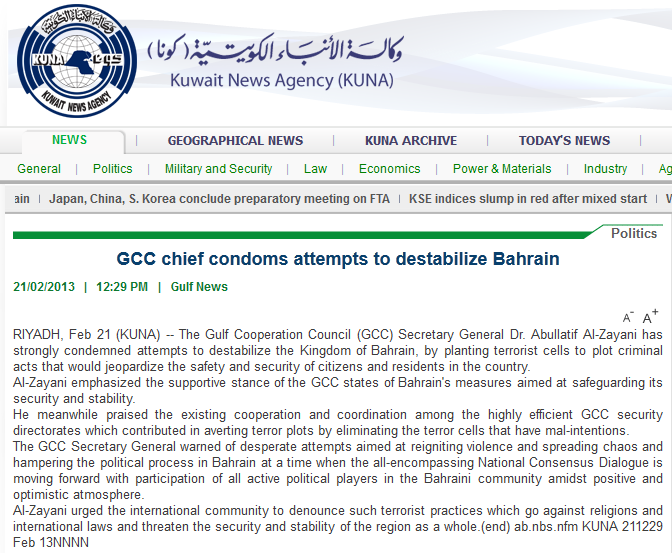
While those in charge of signage may have the excuse of not being near a spell-checker when producing the prints, journalists cannot plead the same. And the below is just a shocker. I’m assuming that KUNA, Kuwait’s News Agency, has a good roster of staff to both write, edit, and proof-read. I just hope that someone amends this story and quick. But for posterity here’s a screen capture.

The headline says it all...

The headline says it all…

Cafe Lilou – Bahrain’s cake heaven

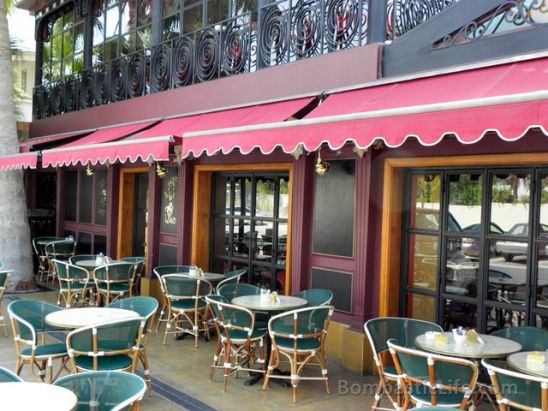
I love cakes. And there’s one place I love more than anywhere else when it comes to cakes. Cafe Lilou is an institution in Bahrain, it’s a place where people meet and forget about trivialities such as calories. There’s two sides to Cafe Lilou – the first is the cafe itself which is fairly easy to spot (pictured below) just after Gulf Hotel.

This is the coffee shop that everybody in Bahrain knows and loves. It’s jam-packed at any time of day or night (credit: Bombasticlife.com)

And then there is the bakery which is hidden behind the back of the cafe about 500 yards away in a warren of small lanes. This place is an Aladdin’s Cave when it comes to cakes. The team here can and do make anything, and their flavours include chocolate fudge, chocolate pistachio, vanilla nutella oreo, chocolate nutella oreo, marble cake, vanilla fudge, rose cake, red velvet cake and almond cake. In addition there’s fruit flavoured cakes.

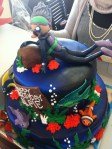
If you doubt my words as to the skills of the team at Cafe Lilou, have a look at these two beauties. One is a Hello Kitty Cake from Lilou’s stock catalog. The second is a custom design for me. And what’s even better than the design is the taste. Wooooowwww!

If you want to know more about Cafe Lilou and gain several kilos in the process then visit their Facebook page and get dialing!

Juice that pains the heart

Image

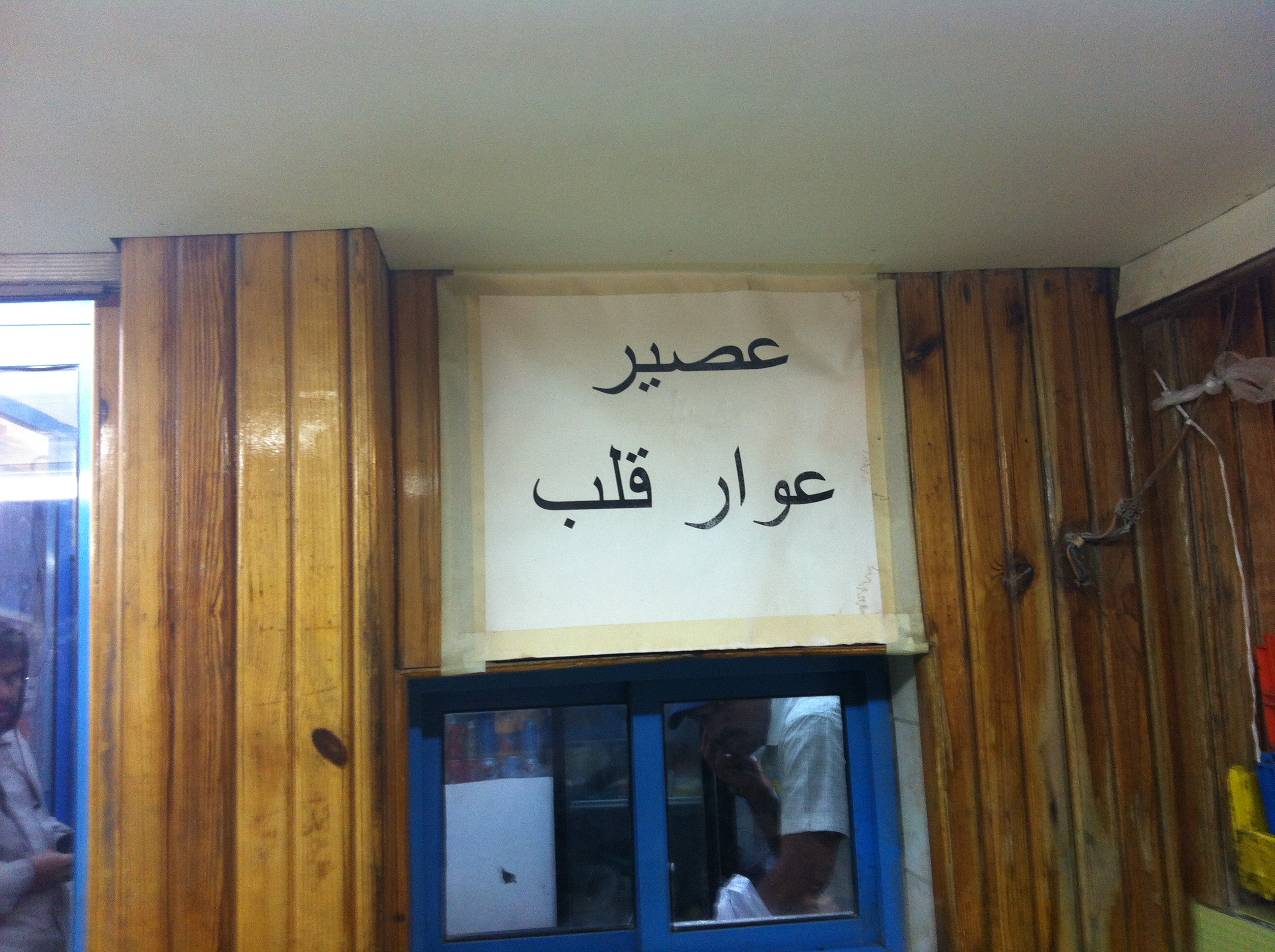
No, this isn’t a 1980s love ballad or a line from a new age diet fad. This sign, and the line above, can be found at our favourite juice shop in Bahrain. The Arabic literally reads as juice that will pain the heart. It’s very tasty and doesn’t give me indigestion, but then I do have a cast-iron tummy.

PS there’s more prose at this place. Apparently, they also do cordon-bleu grilled meat sandwiches.

I don't think these guys read the marketing manual (unless they skipped to the shock marketing chapter)

I don’t think these guys read the marketing manual (unless they skipped to the shock marketing chapter)

Get your V for Vendetta masks, now in Bahrain!

Image

While walking to pick up the tamees and nakhi I spotted this bizarre advert in a certain part of Bahrain. Needless to say, we’re way past Bonfire Night, so I wonder what people would want to buy a V for Vendetta mask for? And are there any freebies which come along with the purchase?

Anybody in Bahrain fancy a V for Vendetta mask?

Anybody in Bahrain fancy a V for Vendetta mask?

Are Saudis the most open nation in the Gulf?

Saudi Arabia’s society is changing at a much faster rate than many of its neighbours

Hands up all those people who’ve heard of or been to the cosmopolitan Dubai. I’m sure that you’ll know about Qatar, the country that has made a name for itself by investing all over Europe and for winning the 2022 World Cup. And there’s Kuwait, probably best known for its role in the first and second Gulf wars. One of the most beautiful countries I’ve ever visited, one could say that Oman unfortunately isn’t as well known abroad as it should be.

And then there’s Saudi Arabia, a mysterious land which up until recently was spoken of in Chinese whispers. The Magic Kingdom was a country that was known for oil, religious and cultural conservatism. Despite the spread of the internet and the ensuing countless videos and other types of multimedia information hosted online Saudi Arabia is still an unknown to most people.

The country’s reputation, image and visa regime doesn’t help to educate foreigners, but I’ve been struck recently on a number of occasions how open today’s Saudis are. This is especially true of the younger generation. Many of the Saudis I know who are under the age of 40 will talk about anything and everything, especially in a closed environment. They’re knowledgeable, they’ll know much more about the workings of the country and national government than is written about or published in the news. And they’re not afraid to be blunt about what is right and what is wrong when it comes to public policy.

Having lived in Saudi for a fair few years I’ve always been fascinated by how Saudis are becoming ever more open to sharing their views with people they know and trust, especially in the setting of the Majlis where the men traditionally gather in the evening to discuss both personal and business issues.

The difference in openness between Saudis and other GCC nationals is becoming ever more noticeable. While traditionally the most open society in the Gulf, Bahrain has been transformed due to the events of the past two years. Both Qataris and Emiratis are very welcoming, but they’re less inclined than Saudis to talk at length with foreigners on the issues that are shaping their respective countries.

And then there’s the Kuwaitis, who are probably definitely the most outspoken people in the Gulf. But for me, today’s Saudis are more open because many will acknowledge both the positives and negatives of their country.

I’m not suggesting that the country is a bastion of diverse views which are aired in public by all and sundry. There are still many subjects that are taboo, but many barriers have been broken over the past two years partly thanks to the widespread adoption of social media by many young Saudis. Just think of any controversial topic in the Gulf, and you’re going to find it being discussed in Saudi by bloggers, on Twitter and Facebook.

Looking forward, I can only hope that this openness will be a blessing to the Kingdom as it looks to tackle issues such as unemployment, the changing role of women in the society, graft and governance. These subjects will be better dealt with if there’s an open dialogue between the country’s nationals. As always, I’m optimistic about where Saudi Arabia is headed and would like to hear if you agree with me or not about my thoughts.

What is the future of the internet in the Middle East?

The past week has thrown out a couple of fun and serious stories and news reports about the internet in the Middle East. The first was Iran reportedly deciding to create its own version of YouTube in order to filter out what it deems to be inappropriate content posted on the world’s largest video-sharing network. There’s a screenshot from the Mehr site, which loads remarkably slowly for a site which hosts videos for viewing and sharing, below.

Will Iran's version of Youtube be as big a hit as the original?

Will Iran’s version of Youtube be as big a hit as the original?

The second story wasn’t as funny. The International Telecommunications Union had gathered its member states in Dubai to discuss a number of issues at the World Conference on International Telecommunications. The one which hit the headlines was internet regulation. In short, a number of countries from the Middle East and other emerging regions submitted proposals that would have allowed member countries to monitor and control data flowing through their respective parts of the internet.

While this is already happening in many parts of the world, the proposed resolution would have basically made it legal and proper for all 190 or so of the ITU’s “member states” to have the power to regulate the Internet to promote security, fight spam, et cetera.

A number of opinions and views can be found online on the issue, including interesting posts by technology historian Peter Salus entitled The UN and your Business: Why ITU Dubai Loss is your Gain and Why the ITU is the wrong place to set Internet standards by Tech writer Timothy B. Lee.

I for one am concerned about the future of the internet and online access. While internet filtering and domain blocking isn’t new to the Middle East (the Gulf’s telecommunications bodies block material that they deems offensive including religious or pornographic material) it’s clear that the past two years have opened a Pandora’s box when it comes to control of the internet. Governments in Egypt and Tunisia tried to close off access to the internet to stop revolution. That didn’t work. Gulf countries have legislated against online threats. As I’ve pointed out above Iran is building its own country-wide internet whilst blocking access to foreign-hosted sites that pose a threat to the Islamic Republic.

So where are we headed to next? How far will governments in the Middle East go in order to secure their own national communications networks? And is there anybody or anyone out there who will bring some common sense to the issue of web regulation in the Middle East?

While I don’t expect multinationals like Google and Yahoo (or even Facebook) to step up to the plate and say to Arab governments we will not regulate the web for you (after all, Yahoo and Google didn’t say no to China), I am hopeful that the region’s populations will become more vocal about their online rights. Egyptians and Tunisians have proved that they will demand and protect their new-found rights. Let’s hope others, especially in the Gulf, will begin to seriously think about what their governments are doing online and asking:

  • Who is watching me online?
  • What online data do they want and why?
  • Can I be jailed for my online activities? Do I have to self-censor my thoughts and activities?

What is the future of the internet in the Middle East? Are we headed towards a patchwork of national or regional wide webs aka Iran? Or will sense prevail? Goodness knows we need commerce and entrepreneurship to flourish in this region to generate more jobs and an open internet is essential to both. Answers on an email, an online comment, or (if your connection is monitored) a postcard please!

Are you up for some (more) government censorship and online monitoring?

Lessons on leadership… Apple, Bahrain and Dubai

It’s (hopefully) common sense that leadership can make or break any company or organisation. A leader, normally the CEO, will define the company’s direction, they will set the agenda, lead the execution and innovate.

Leaders like Steve Jobs define their organisation and create success on their own terms, much like Dubai’s Sheikh Mohammed Al Maktoum has done.

The late, great Steve Jobs has been acclaimed as one of the best CEOs in business. Jobs did it his way, he focused on the business and on creating works of art/technology that changed how we live our lives.

For me, the Apple of today is different to the Apple of yesterday. Nothing would go out of the door until Jobs was satisfied that the product was right and ready.

A simple example is cited by Mike Elgan in his recent article on Apple.

Apple had been developing the iPhone for years. After major arguments about materials, the team had decided to use reinforced plastic on the screens for the first version. That was the plan, and everybody spent more than a year working on it.

Just one month before the first iPhone shipped, Jobs summoned his team and issued an edict: The screen would be glass. He just didn’t like the plastic screen.

Of course, Job wasn’t perfect. He had his flaws. But I can’t imagine that Jobs would have let Apple Maps into the world without the solution being ready (the linked article here does make the point that Jobs himself was late to realize the importance of a maps application). As a leader could we imagine anyone else taking Apple forward better than Jobs? No. That is evident more so today when he’s missed.

So how is this relevant to us in the desert? I was talking to a work colleague, a well-respected Emirati, about the Gulf and how it has developed. He was talking about Bahrain, and commenting on how 20 to 30 years back Bahrain was where Emiratis would travel to shop and vacation.

What he was saying made sense to me; Bahrain had a well-developed economy at the time and Dubai was setting out on the journey to become one of the globe’s trading hubs. Bahrain was the GCC’s banking hub, Gulf Air was the airline of the region, and the island could do no wrong.

Fast-track to today, and it’s as if the roles have been reversed. Dubai is now the trading hub for the region, and it’s the one must-visit destination for business and tourism. Emirates is the world’s largest airline by passenger numbers, Dubai-owned Jumeirah is becoming a global brand for the hospitality sector, and, despite the credit crunch, Dubai is still thriving. As for Bahrain, it’s fair to say that the country isn’t doing as well as Dubai.

Countries are no different from companies. The leadership shown by the ruler, the prime minister or whoever at the top can be and often is the difference between success and failure. Nowhere is that more apparent than in today’s Gulf and in the vision set out by Dubai’s ruler Sheikh Mohammed Al Maktoum. Leadership is success, and a lack of leadership can be the opposite.

The dangers of speaking your mind online – lessons from the Middle East

Kuwaiti graphic designer Mohammed Sharaf @MohammadRSharaf created the following image to support Nasser Abdul during his trial for tweeting offensive material

The internet is full of misconceptions. I often feel that most people think that the world wide web is a place where they can go to say anything, both positive and (most often) negative. The past 18 months and pending legislation should make anyone and everyone think twice about the above. Cases in Saudi Arabia, Bahrain, and Kuwait have cast aside the notion that cyberspace is a domain where anything and everything goes.

A number of trials and guilty verdicts both underline the importance of tempering what people say online as well as underscore what authorities do and do not deem as illegal. The first high-profile legal proceedings took place in Kuwait when in June of last year a Kuwaiti national was charged with slandering Bahrain’s royal family and a religious group.

Despite claiming that his Twitter account was hacked Nasser Abdul was found guilty and sentenced to three months in jail which he had already served by the time his sentence was pronounced. There have been other cases in Kuwait, including the prosecution and sentencing of Mubarak Al-Bathali to six years in jail (this was commuted to six months) for Tweets attacking certain religious groups.

The most famous case of jailing for tweeting is that of Hamza Kashgari, who published three tweets about an imaginary meeting between himself and the Prophet Mohammed. His comments drew an instant reaction from Saudis online; in the hours that followed over 30,000 tweets regarding Kashgari were published online. Kashgari was accused of apostasy and fled to Malaysia. He was deported back to Saudi Arabia and jailed. Kashgari is still in detention, despite pleas by his family for his release and his apology for his actions (the basic story and roundup can be read here on Wikipedia).

Bahrain’s authorities have also taken to court individuals for publishing their thoughts in online public forums. The most famous and most recent case is that of activist Nabeel Rajab who tweeted about the Prime Minister’s visit to Muharraq in June and was accused of publicly insulting Muharraq’s residents for their support of Sheikh Khalifa bin Salman al-Khalifa. According to Bahrain’s prosecutor Rajab had claimed that Muharraq’s residents had only welcomed the Prime Minister during a visit because he had offered them subsidies.

Bahrain’s Information Affairs Authority said his acquittal on defamation charges “was due to the judge’s uncertainty regarding the evidence submitted to support the lawsuit”. Rajab, who has spent two months in jail while awaiting the outcome of this and another case, had been faced with possible charges before for his use of Twitter, in 2011, in what would have been the first such case in the Middle East.

Clearly the Arab Spring, which has led to regime change in three Middle East countries and is still being felt across the region, has sharpened the thinking of numerous governments across the region. According to media reports in June of this year, Bahrain is introducing legislation to curb misuse of social media.

I am still trying to fully understand the full implications of Bahrain’s proposed social media law, but I am assuming that this would cover and make an illegal offense the publishing of any comments online or through social media that would appear to contradict government policy or government statements. Kuwait is also leaning in this direction, as this editorial by Reuters makes clear.

What is clear is that the Middle East’s online community is becoming increasingly politicized. I’d argue that many people, frustrated with the lack of political debate in traditional media, are going online to voice their issues and concerns. The Dubai School of Government has estimated that there are 1.3 million active users on Twitter in the region.

Switching tack slightly, how will the increase in political discourse affect online communication efforts/campaigns? Will communication professionals and agencies steer completely away from anything that could be construed as political or biased to one community? And will we see more people using online aliases? While many governments would like to regulate online activity, how are they going to force users to reveal their true identities when using services that are based in Europe or the US?

Would we even see sites such as Facebook or Twitter blocked by governments in the region (this did happen in Egypt during January 2011 when the authorities tried to stop any and all access to social networking sites)? That’s the logical conclusion, but how would you do this when these sites have become part of people’s everyday lives? As always, there seem to be many more questions than answers when it comes to the Middle East. The freedom to voice one’s thoughts online are no exception.
A Bahraini tradition – spending the night with the kids for #Gergaoun

Ramadan is a wonderful month for so many different reasons. One of my favourite nights during the holy month is Gergaoun, which is celebrated in both Kuwait and Bahrain on the 14th of Ramadan (Gergaoun is also celebrated in the UAE but a month beforehand).

I’ve been told by family that Gergaoun’s roots hail back to the birth of the Prophet’s grandson Hassan. The Prophet came bearing sweets to celebrate the occasion (if there’s other reasons for Gergaoun, I’d love to hear them).

During Gergaoun children wear traditional dress such as jalabiyas and thobs before rushing out into the streets and knocking on every door in the neighbourhood with their empty Gergaoun bags in their hands. They’re handed chocolates, candies, crisps, pastries, popcorn, juice, pizza etc (you get the picture by now…) and only head back home once their bags are full of goodies and sweets.

During Gergaoun families will often gather together to play games. Older children and some of the adults will dress up as Fraysa or the horseman to wander the neighborhood, sing Gergaoun songs and beat traditional drums.

Enough of me and my poor excuse for an explanation as to how fun Gergaoun is. Have a look at this classic clip from Bahrain TV. The video features popular singer Mohammed Yousef who is belting out the Gergaoun song which all the children recite when going from house to house. The clip also features the Fraysa or horseman. I just love the traditional costumes that the children wear. And believe me, when it comes to collecting sweets not even Halloween tops Gergaoun. These kids are just voracious when it comes to grabbing anything sweet and sugary in their vicinity!

Understanding the #Gulf through the #Olympics

It’s always interesting to view the Gulf through the prism of global events such as the Olympics. Much has been made of the ping-pong played by Saudi Arabia’s Olympic committee with the International Olympic Committee in respects to sending Saudi females athletes to the 2012 Olympics. A good overview of the affair can be read here in a piece by the Wall Street Journal’s Ellen Knickmeyer.

The paragraph below is from Knickmeyer’s article (Knickmeyer can be followed on Twitter at @EllenKnickmeyer)

“Saudi Arabia ended its status as the last Olympic nation to refuse to send women athletes to the Olympics, agreeing just two weeks before the start of the London games to field two young female competitors, the International Olympic Committee announced.”

The Saudi female athlete saga has been making headlines globally, both in print and via broadcast outlets. Al Jazeera covered the news extensively and featured clips of one of the two Saudi ladies. Sarah Attar is a 17-year-old, California-raised and -trained track competitor who will race in the 800-meters.

Knickmeyer and others have noted that despite the gravity of the decision to finally send Saudi female athletes to the Olympics the news has not even been registered by the country’s official media outlets. “The kingdom’s state media, which recently announced the men’s teams for the games, made no public comment by Thursday evening on sending women as well.”

Contrast this to Kuwait, which is sending its first female swimmer (yes, swimmer) to the Olympics. She’s interviewed here by the Kuwait Times.

Faye Sultan is also featured in an interview below with the BBC (unfortunately this video can’t be embedded but can be accessed via the link below).

Kuwait's Faye Sultan to make Olympic history

She was also documented at a semi final Women’s 50m freestyle race at the Hungarian National Swimming Championship 2012 a couple of months back. The video is embedded below and you can make out Faye from her swimming cap which has the Kuwaiti flag emblazoned on it.

And then there is Bahrain. According to Bahrain’s largest circulation English newspaper fourteen Bahrainis will be going for gold when they compete against the world’s best at the London Olympics later this month. The article goes onto say that Bahrain’s medal hopefuls include Mahboob Hassan, Adam Ismail, Shawqi Jamal, Haleem Jabry, Bilal Ali, Mariam Jamal, Mimi Salim, Shama Mubarak, Taj Baba, Jamila Shami and Maitha Lahdan.

Now we get to the fun part. If you’re a Bahraini or know Bahrain you’re probably going to know that those names aren’t your typical family names found in Muharraq, Manama or Riffa. Mahboob Hassan is a Kenyan who was naturalized in 2005/2006. Bilisuma Shugi is an Ethiopian, while Tareq Mubarak Taher is also a Kenyan who changed his name from Dennis Kipkurui Sang.

Meet the Bahrain Olympians and spot how many are actually Bahraini

Bahraini nationals often voice concerns about the number of naturalized Bahrainis in certain segments of government (the best example would be the police force which employs few native Bahrainis). And what has been the reaction of Bahrainis to the above? One person started a hashtag called #uniteafrica while the most popular tweet was the below.

All in all, an interesting view into the culture of the Gulf through their Olympic policies. And no, I’m not even going to cover Qatar and their Brazilian/Uruguayan B football squad.