GEMS foot-in-mouth syndrome and the curious case of the disappearing comments

Please don’t put your foot in your mouth. If you have to say something do mutter the words when the room is empty, or when you’re in the middle of the ocean. And it’s also advisable to stay away from media (image credit: http://www.ronedmondson.com)

There’s a condition that I like to name foot-in-mouth syndrome. Basically, foot-in-mouth happens when an executive talks to a journalist and doesn’t think before they speak. This results in classic ‘how did they say that’ quotes which often whip up a storm of protests from all and sundry.

This week we had one of the best foot-in-mouth moments I’ve read for some time. The chairman of GEMS Education, the UAE’s largest provider of primary and secondary education, gave an interview to Gulf Business. The story was rapidly picked up by Arabian Business and has provoked hundreds of comments from some very angry parents. The quotes which did the (most) damage were below.

Parents have no right to complain about fees if they choose a high school they cannot afford, GEMS Education chairman said of “grumbling” parents in an interview with Gulf Business.

“If you put your children in a school that you can’t afford then you can’t grumble,” Sunny Varkey said.
“You understand what I’m saying? You must choose a school that you can afford.

“It’s normal human behaviour [for parents] to defend fees. But parents can very well see which are the schools that are good, outstanding, fair, or not good. And, accordingly, they can choose a school.”

I love media sites on the internet, partly because of the ability to leave comments and the inevitable pearls of wisdom that readers leave. Varkey’s foot-in-mouth (and if you can’t see why this is a disaster of an interview for Varkey, you’re beyond the pale) was attacked from all sides by parents. Comments included such wonders as ‘It’s no wonder GEMS and HSBC (?) are the two most hated firms in the UAE’, and ‘If graduates from your schools are as arrogant as you are then your schools are definitely not worth the tuition. I would highly recommend getting media training before giving out interviews.’

I wish I could show you more comments; the last time I saw the piece with the comments section still live there were 98 printed which must be a record for the site. However, Arabian Business’ publisher ITP has taken off comments for this piece, either due to the severity of the comments or, more likely, someone possibly threatening legal action.

What happened to the comments on Sunny Varkey’s case of foot-in-mouth? I don’t know. But I can at least leave you this cached screen shot to show you that what goes on the internet can always be found!
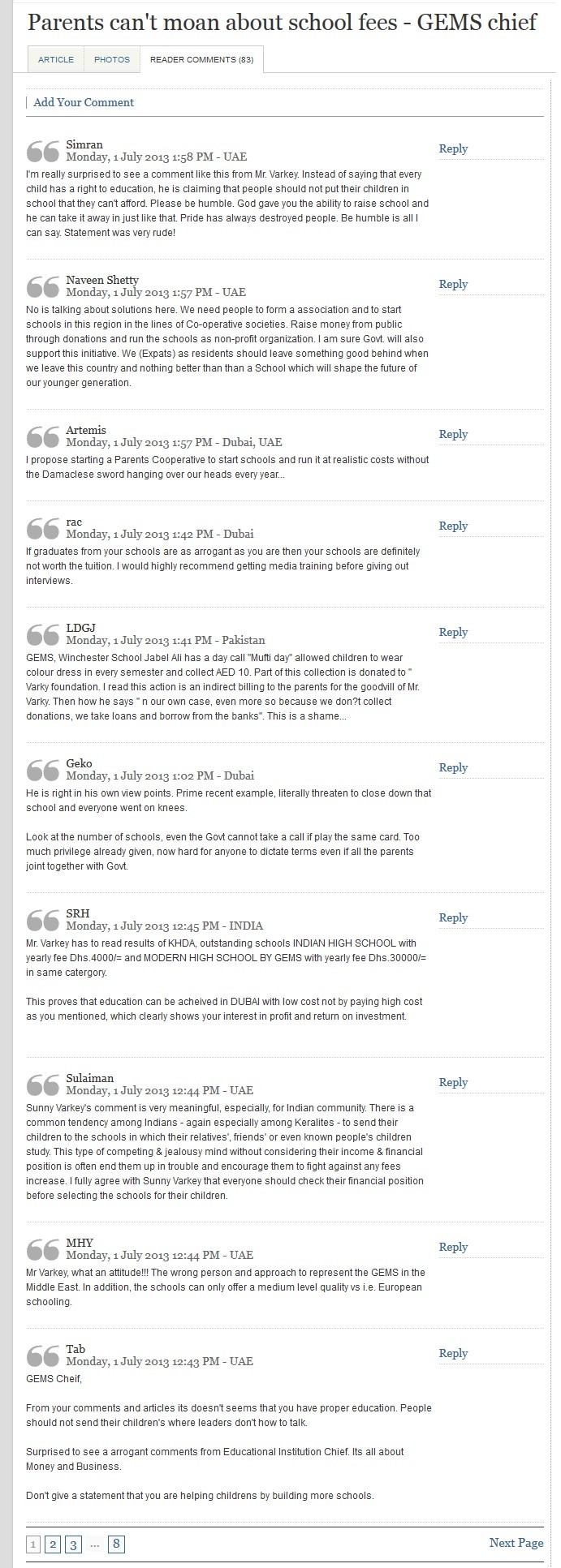
Where did the comments go? Only ITP and GEMS will know!

Where did the comments go? Only ITP and GEMS will know!

Is Dubai ready for what comes after the Expo 2020 win?

Is Dubai ready for the scrutiny that will follow the Expo 2020 win? Has the country learned any lessons from Qatar’s FIFA World Cup experiences? (image credit: http://www.expo2020dubai.ae)

The stage is all set, the bids are in. If I were a betting man I’d probably place my house on Dubai winning the Expo 2020, the World Fair that is set to be held in 2020 and which is expected to attract millions of visitors over a six month period. Of the other four national/city bidders Thailand has pulled out of the process and of the other three (Brazil, Turkey and Russia), two have been experiencing mass protests of late relating to governance issues (that’s a very PC way of saying riots, teargas and and general chaos as played out on television).

The bidding for the Expo 2020 is winding up this summer with a vote and decision expected by November. But if/when Dubai does win, what next? Ok, we have the plans to build a World Fair that is expected to bring in over 30 million people but as Qatar now understands the big events also bring major scrutiny.

Let me explain further; Qatar’s winning of the 2022 FIFA World Cup was exceptional and unexpected by most. Almost immediately after Qatar won the bid the questions came flying in. How does Qatar treat its ‘enslaved’ foreign workers? Will the beer flow for the fans? And, the most bizarre one I’m sure for the Qataris, will homosexuals be allowed to go to Qatar without facing the risk of being arrested? As they’ve found out, the bigger the event the greater the level of questioning on issues, many of which may not be directly related to the event.

I wonder how much Dubai is ready for this level of scrutiny? The Emirate suffered during the global economic crisis, and it could be argued that Dubai’s cause wasn’t helped by its lack of transparency on financial issues. How will Dubai cope with the level and intensity of questioning that will come win the Expo 2020 win? While I don’t see the Expo as being as high profile an event as the FIFA 2022 World Cup, Dubai and the UAE aren’t so dissimilar to Qatar in terms of issues such as labour rights, security issues and freedom of expression.

Is Dubai ready for the questions that will come after, Inshallah, the Emirate wins the Expo 2020 win? What do you think?

Is the media a government tool or an independent voice – thoughts from Abu Dhabi

Freedom of expression or expression of national institutions? We’re still very much in the latter camp in the Middle East (image credit: http://www.menassat.com)

There was a fairly low key but important discussion this week in the UAE’s Federal National Council. The body, the closest thing that the UAE has to a parliament, welcomed Shaikh Abdullah Bin Zayed Al Nahyan, the country’s Foreign Minister, to discuss the issues of the media and the work of the National Media Council, the UAE’s regulatory body for the sector.

The below excerpts are from an article in Gulf News which ran this week. Have a read through the quotes:

The National Media Council came under fire from the House for its “weak role in [the] Emiratisation of the media, dominance of foreign media content and lack of plans to promote the [UAE’s] cultural identity.”

The NMC was also criticised for the lack of coordination between the media outlets and universities, lack of training programmes for journalists and broadcasters, and a failure by media outlets to address concerns of citizens.

The FNC also voiced concern over the UAE’s low ranking in the press freedom index. Ali Jasem, a member from Umm Al Quwain, said the UAE ranked 158th on the Press Freedom Index last year.

Shaikh Abdullah said he expected that the ranking will improve once the new media law is issued with an article that bans jailing journalists for exercising their duties.

Shaikh Abdullah said discussions in the FNC lacked a uniform stand on the issue of freedom of expression.
“Some members demand a higher ceiling of freedom and less control, while others call for censorship, which is confusing,” Shaikh Abdullah said.

Shaikh Abdullah reiterated that the NMC respected the editorial policies of all media outlets operating in the country and that it never intervened in their work or nature of their content.

“The country’s policy is to leave the executive work to the media outlets, whether owned by the local governments or the private sector, so that there will be no contradiction between [the NMC’s] work and theirs,” he added.

Shaikh Abdullah said media outlets are “our partners and they are wholeheartedly contributing to the UAE’s media strategies.

It’s fairly common in the Middle East for the media to be seen as a tool of government policy. The media reiterates the government line and rarely engages in debate. This viewpoint hasn’t changed much despite attempts by global media outlets, newswires such as Reuters and Bloomberg, to write uncensored about a range of social, political and cultural issues.

What’s noticable from the above is that even in a country which is fairly media-friendly by the standards of the Middle East there’s still a view that the media needs to be an instrument of policy which ‘promotes cultural and national identity.’ I’ve been incredibly fortunate to have been raised in a part of the world where a strong, independent media fosters debate, promotes transparency and holds others to account. How far are we from this state of affairs in the Middle East? Your guess is as good as mine. However, in the meantime I’ll keep flying the flag for a media sector that has the teeth to do its job and act as an independent voice for discussion, debate and originality.

How to pull off a public relations fake coup – the handsome Emirati who didn’t get kicked out of Saudi

Saudi Arabia often has the ability to surprise, delight and amaze in equal measures. But every now and then, it’s not the Magic Kingdom that surprises as much as the lack of knowledge and ignorance shown by the outside world. One story broke in April that didn’t fail to grab headlines the world over.

Allegedly three Emirati men were kicked out of Saudi Arabia’s largest cultural festival by the religious authorities for “being too handsome”. The three men were asked to leave Janadriyah and then deported from Saudi to protect the virtues of the Saudi women present. The story was broken in America by Jezebel and the piece makes for a very entertaining read.

There’s been literally thousands of pieces now written on this and the ensuing ‘outing’ of one of the men, an aspiring actor whose name is Omar Borkan Al Gala.

Unfortunately ladies, which Omar obviously exists the story is a hoax. LiveLeak website was one of the first to break the news of the hoax and this is how whoever was behind the public relations coup did it.

Let’s start firstly with the facts. We have three Emirati men who were kicked out of Janadriyah. Firstly, this is feasible. Riyadh is a conservative place and the religious authorities are present at Janadriyah to monitor all the naughtiness that goes on. However, having been to the Festival a number of times these three would have had to have whipped off their kandouras/thobs to get kicked out such is the amount of inappropriate behaviour that can occur at Janadriyah.

There was an incident at the UAE pavilion when one of the religious authorities objected to Emirati singer Aryam’s presence at the event. He himself tried to force her removal but was instead arrested by the National Guard. The incident was captured on Youtube and is below.

The other apparent truth is that one of the three Emiratis who was outed was present at Janadriyah. However, he had gone into the family section where single male bachelors are not allowed and started dancing. His dancing apparently wasn’t to the taste of everyone present and he was asked to leave the area according to LiveLeak which quotes from a news piece which now seems to have disappeared.

And that seems to be the basis for what then happened.

Someone with an active imagination, a good deal of time and a great deal of media talent spotted an opportunity to seed a story with Elaph.com, an online website that focuses on news in Saudi Arabia. The original story, which has disappeared into the caches of the internet, wrote that three Emiratis had been deported from the Janadriyah Festival and Saudi Arabia for being too handsome. There was a quote to this effect from an ‘unnamed’ Saudi official.

The story quickly snowballed after getting picked up by the English press in the Kingdom, and one of the three men, Omar Borkan Al Gala, apparently outed himself on his Facebook page. The man became a celebrity overnight. He’s been interviewed worldwide and he’s already picked up acting work.

The story surrounding Borkan Al Gala, which loosely translates to Volcano of Love, contains numerous inaccuracies. The first is deportation from Saudi Arabia. As an Emirati and a GCC National he cannot be deported from Saudi Arabia under these circumstances. I’ve never even heard of a GCC National being deported from one country to another. Strike one…

Secondly, the other two Emiratis have never been outed. You’d think that they’d be in on the act as well and keen to grab their fifteen minutes of fame. But unfortunately, the ladies will have to wait for their pictures to be plastered over the web. Strike two…

And finally, the story broke via a news website from an ‘unnamed Saudi official’. Saudi officials rarely speak out of turn, especially on such a topic. It took over a week for Al Gala’s name to be ‘leaked’. In this day and age of instant social media updates, I’d have assumed that this story and the identity of the three Emirati men would have been the news item on both Saudi and Emirati Arabic-language Twitter networks. But no, that wasn’t the case. Strike three…

I’ve got to give it to Al Gala. He’s made the most of the opportunity, of the ignorance about Saudi Arabia, and of the lack of fact-checking on this one. It’s a fun story and one which doesn’t do any harm. But seriously, being too handsome for Saudi? Have the Emiratis met any Saudi boys lately? In the words of my partner, “Saudi men are much more attractive…”

He got kicked out of Saudi and I didn’t? But I’m impossibly handsome (source: http://www.hippobrigade.com)

Getting the communications balance right – Ras al-Khaimah, beaches and modesty

This slideshow requires JavaScript.

I do feel for anyone who has to communicate on behalf of a government body in the Gulf. That’s especially so in places where there’s conflicting, divergent views resulting from a strong cultural diversity and significant business interests with the outside world. I remember the late Yasser Arafat often getting away with making one point in Arabic and then saying the exact opposite in English (there’s many other examples out there too). With the advent of the internet, social media, and a horde of citizen journalists out there in cyberspace it’s no longer possible to say explicitly different things to different constituents.

In this week’s The National newspaper in the UAE there was a great example of the above. On the 22nd of April police from the Emirate of Ras al-Khaimah announced a bikini ban for the area’s beaches. Ras al-Khaimah is a beautiful part of the United Arab Emirates. With a population of just over a quarter of a million people Ras al-Khaimah is known for its pristine beaches, and also for its rapidly growing tourism sector and free trade zone. However, the Emirate is also conservative. Trying to balance the two interests, tourism and tradition, isn’t easy as the below quotes from The National’s article on the 22nd April illustrates.

Bikinis have been banned from public beaches in the emirate as police urge residents to “use common sense” and dress modestly.

The municipality and police have put up signs on public beaches that state: “All coastgoers should commit to public morality and modest clothing”.

Offenders will be given a warning and after a second warning, they could face an unspecified fine.

The two most popular beaches in Ras Al Khaimah are located next to hotels where swimmers sunbathe in thong bikinis or trunks alongside women in burkinis, a modest full-body swimsuit designed for Muslim women.

On weekends and at sunsets, RAK’s public beaches fill with women in full hijab, who come with their families. Women in swimwear are a rare sight at these beaches and there are no women-only beaches in RAK.

In a plea to the public, police urged beachgoers to comply with “public morality and dressing modestly” to respect the country’s traditions and culture.

The move followed complaints by families about tourists who attended public beaches wearing indecent clothing.

The public have greeted the ban in Ras Al Khaimah, a conservative emirate with a large Emirati population. In RAK, it is common for women to dress for the beach by putting on more clothing so that they do not attract attention from men.

“I totally agree with that [ban] for us because it’s not a respectful thing to have on our beaches,” said Hessa Ahmed, a 31-year-old Emirati mother-of-two.

Many people, like Ms Ahmed, would like tourists to cover up but are too shy or polite to approach them. Her last visit to the beach ended abruptly when a man and woman in revealing swimwear sat near her family.

“I wasn’t sure about what she was going to do,” said Ms Ahmed. “I was afraid she would take off her top. So I preferred just to drive away just in case anything was going to happen, so I would just be away and my kids wouldn’t see them.

“There was no sign or board to inform these people you shouldn’t wear this, you shouldn’t wear that.”

Ras Al Khaimah has adopted a lenient approach to public dress in hotels but customs remains overwhelmingly conservative in public spaces, such as shopping malls.

The above was a great piece and insight into the challenges facing a country that is looking to adapt culture with business. And then came the follow-up article the next day in The National.

Police have backtracked over their statement that bikinis and tight trunks are banned from public beaches.

Revealing swimwear is not officially outlawed but strongly discouraged because of cultural sensitivities, police clarified.

“We respect the rights for people. We follow UAE law,” said Maj Marwan Al Mansoori, the head of public relations and moral guidance for RAK Police.

“Our campaign is not about catching people. We just want to tell people about our culture and our community.”

“You should respect our culture and our community rights but you have your rights,” said Maj Al Mansoori. “If it is under our law, you can do it.

“We wanted to tell people what we are thinking. It is communication between cultures. We want to explain this to people.”

It’s worth reading both articles in full, and to put this in its full context few Westerners will use a public beach in Ras al-Khaimah; all the hotels have private beaches which are fully equipped and only for the use of guests. However, such communications outreach isn’t going to help draw foreigners to a part of the country and world that has everything to offer. Perception is everything, especially online when social media is involved. The more people who talk about an issue, the more that issue or perspective is believed no matter its veracity.

This is a reminder about the challenges of trying to get the communications balance right in today’s connected world, where a tourism can view such news pieces while booking their vacation just as easily as a local sitting for a tea and reading the morning newspaper. Media relations is a tough job and I do hope that lessons are learned from this and that the right balance is found, both in terms of educating foreigners coming in (can you really tell someone what to wear after they’ve seen the glossy brochure/website, booked, traveled and arrived) and in preserving local cultural norms. And remember, if nothing else works there’s always the burkini!

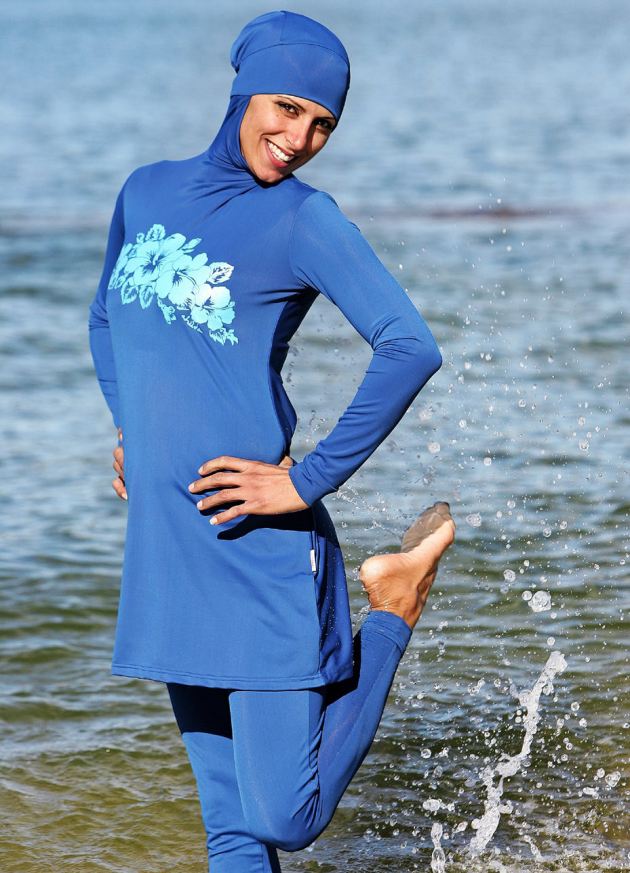
The burkini! Foot flicking and hands on hips are optional (credit alrasub.com)

Forget the debt – Dubai cops now have a Lamborghini and Ferrari (and more Salik toll gates)

Who needs to think about debt when you’re out and about driving a supercar. In their wisdom and in a public relations exercise that is reminiscent of the city pre-2008, Dubai police unveiled the latest addition to their motor pool last week. The US$400,000 Lamborghini Aventador can do speeds of up to 349km/h and will be used to chase down whoever has the balls to think they can speed in Dubai and not get caught. I’m still trying to work out how they’d stop criminals, but I’d assume the very fact that a cop is driving one of these cars would be enough to startle transgressors into taking their foot off the accelerator.

In preparation for the hard work of bringing law-breakers to justice, the Lamborghini and its driving team were dispatched to Dubai Mall to drive around the world’s largest shopping center and pose for pictures. The aim? To show tourists “how classy Dubai is”.

But Dubai Police didn’t just stop there. The news was followed a couple of days later by the announcement that they’d be adding a Ferrari as well. After all, just having a Lamborghini alone is so passe, especially since the UK, Qatar and Italy also did the same several years back. The Ferrari FF is cheaper than the Lamborghini and sells for 900,000 Dirhams or just over US$250,000 dollars. The supercar is slightly zippier than the Lamborghini (I’ve been told) and does 0-100km in a 3.7 seconds. And it has more storage space, including room for two Krispy Kreme dozen donut boxes and paper coffee cups.

To your left, the Ferrari FF. And to your right, the Lamborghini Aventador. It’s Dubai’s version of toys for the cops (credit: Emirates 24/7)

With impeccable timing, Dubai’s Roads and Transport Authority also announced that two new Salik toll gates would be going live on the Dubai-Sharjah border. The gates will collect a toll of 4 Dirhams from each car that passes through them, and the full story plus lots of interesting comments can be read here on ArabianBusiness.com. One adventurous resident posted his take on both stories. I like the idea.

Dubai’s new Ferrari fund, brought to you by the RTA (credit: @danielmarcevans)

On a serious note, most of us could agree that we’re living in an age of austerity. Dubai itself hasn’t been immune from the global economic drop, and the city-state will have to pay US$22 billion of debt next year according to rating agency Moody’s. Most countries worldwide have had to cut back on spending, and if this idea had been ventured in Europe you’d probably find someone losing their job. With so much money to pay off does this send out the right message about debt and responsibility, both on a local and a global level.

While both supercar stories make for great PR, I wonder what thought went into the decision especially with the timing of the two new toll gates. Have the silly days returned to Dubai? For a city that has done so much good and yet still has many challenges to face, I do hope not.

No mention has been made if Dubai Police have insurance for the Lamborghini or the Ferrari.

Is too much government intervention good or bad for innovation in the Gulf?

Is the Gulf’s innovation being hindered by too much government intervention? (credit: techpionions.com)

There’s been a couple of news stories recently that caught my eye. One was an interview on Kipp Report with the managing director of an online website called Tejuri.com. The article, which you can reach here, focuses on how Tejuri.com positions itself as the official online distribution channel for retailers registered with the Emirate’s Department of Economic Development.

Aside from the wisdom of launching an online distribution channel that is government-supported in the year 2013, the piece got me thinking about other areas. One example is non-governmental work, which (surprise, surprise) is often not only regulated but led by government-related bodies. And then you’ve got the ultimate example of government intervention, which is the ownership of the upstream and downstream oil and petrochemical sectors, numerous financial institutions and other businesses. And then there’s the sovereign wealth funds.

My question to these and other government interventions is how much do these activities stunt growth and disrupt innovation? Here I’m going to refer to United Nations World Intellectual Property Organization and Insead that ranks the top ten most innovative countries. The original piece from Bloomberg is here.

Switzerland, Sweden and Singapore are the most innovative countries in the world, according to a study by the United Nations World Intellectual Property Organization and Insead that found a wide gap between rich and poor nations.

Innovation is an important engine of growth and new jobs, the Global Innovation Index 2012, which ranked 141 economies, showed. The index considered institutions, human capital and research, infrastructure and market and business sophistication as well as as the results of innovation such as patents and software in determining how countries fared.

Finland ranked fourth, followed by the U.K., the Netherlands, Denmark, Hong Kong, Ireland and the U.S.

Numerous surveys such as the above and this research one by the United Nations University show that governments help foster innovation most through investing in social capital (read education) and through financial funding – the irony in some parts of the Gulf is that education is in the hands of the private sector rather than the government. Governments then have to step back and then let individuals and businesses get on with it. The same can be said of the non-governmental sector, which, pretty obviously, works best without governmental support s groups and communities work to best pinpoint social issues and tackle them.

The argument often goes that entrepreneurs drive innovation and that governments need to reduce their interventions, reduce bureaucracy and increase financial support for small to medium sized firms to drive growth. However, is that what we are seeing in the Gulf? Or are we still not fulfilling our potential due to too much, rather than too little, government intervention?

Geant launches a budget brand called… Advert (in Arabic)

I love budget brands. I used to live on them when I was a uni student. There’s nothing better than paying as little as possible for the basics, especially when money is tight and we don’t want to forgo those everyday essentials as well as a treat now and then. I was excited to see Geant in the UAE launching a low-cost series of items. Low-cost brands haven’t been common in the Middle East despite the increasing popularity of hypermarkets in the Gulf.

Geant plumped for the name Elan in English, which could suggest inspiration or style. So far so good (though one could ask if the concept of inspiration fits well with budget tissues, mineral water and ketchup). But then we come to the Arabic. And here’s where we have a concern. Elan has been translated as اعلان which means… advert.

I don’t understand the thinking behind the brand’s naming. Was someone thinking this space would be sold? How did brand manager think this would resonate with Arab shoppers? Would you buy a bottle of mineral water called Advert?

Kudos to Geant for taking the initiative to launch a budget brand, especially when food and household prices are rising. But please think about that naming good people. You can do so much better.

PS for a full list of what Geant sells in its Elan range click on this link.

Trials and Tribulations at Abu Dhabi’s The National

The National, Abu Dhabi’s English-language newspaper, hasn’t had a quiet week. First comes a blog post which The National admitted was ‘one of the most controversial ever’ in the paper’s five year history. The blog, which was written by an intern journalist named Ayesha Al-Khoori, was pilloried for its description of her driving habits and speeding even though she herself was attempting to argue that lowering the UAE’s driving minimum driving age from 18 would be a mistake. This blog, which garnered hundreds of responses and mentions on the comments section as well as on social media sites, was followed by an attempt at an apology which for me seemed to miss the point (Ayesha claimed her message was lost, but I’d argue that there was no consistency in her initial message).

For a review of the blog and The National’s editorial guidelines including how it reviews and edits work (which didn’t seem to be the case with Ayesha’s blog) then read this piece by Mita56 which sums everything up nicely.

To top off a bad start to the week, someone made a serious error when writing The National’s daily electronic newsletter (have a shufty below).

Have a look and spot the boo-boo. It's a big one.

Have a look and spot the boo-boo. It’s a big one.

If you didn’t spot the mistake, I’ll give you a hint. The late person referred to in the photo-caption should be the founder of the country (Allah yurhamu) rather than HRH his son who is very much alive and is the President of the United Arab Emirates.

The National has been stung recently by a couple of tell-all pieces by ex-journalists. One of the most recent was Tom OHara, who wrote a warts-and-all account of his two years in Abu Dhabi in the American Journalism Review in December 2012/January 2013. You can read his revealing piece here.

I was at the launch party for The National in 2008 and remember the roster of journalists on display. There was a Pulitzer-prize winner reporting for the paper even. Hopes were high that we’d have a newspaper with the temerity to tell it like it was, which is still a rarity in the Middle East. Over the years I’ve looked forward to reading The National’s copy from a group of journalists whom I have dealt with and whom I think very highly of.

As a former journalist I respect and admire good journalism. In today’s Gulf we need more quality content to explain the why behind the what. My hope is that The National’s management steer the paper back to what it aimed to be five years back, to “establish an institution on par with some of the greatest newspapers in the world.” Trials and tribulations are all well and good (unless you’re the person behind the drama), but The National needs to raise its standards and focus our attention back on the quality of its content. The National, we need you more than ever.

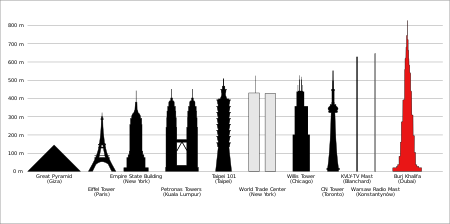
The biggest, flashiest and most expensive… Dubai’s obsession with superlatives

When it comes to Dubai you just can’t keep a good thing down…

It was a satirical website that got me onto this topic. I was on one of my favourite web sites in Dubai, the Pan-Arabia Enquirer, enjoying a parody of the stereotypical superlative press release that used to be all the rage in Dubai before the financial crisis (I’ll admit to having written a couple of those releases in my time pre-2008). If you enjoy your Middle Eastern satire served piping hot and creamy have a read at the parody here and check out the site.

Well, back to the subject of the post and it seems that the superlative is making a comeback in the part of the world in the only way possible… the biggest, flashiest, and most expensive is back with the world’s most expensive abaya (only costing 65 million Dirhams) which made an appearance in Dubai to the most lucrative photography competition in the world (with prize money totaling 300,000 Euros in case you’re wondering), and then there’s the most prestigious and richest horse race in the world.

The list of the biggest and the best is endless. There’s so many world records over here that Guinness opened up an office here just to keep up and reduce their costs (it’s cheaper to have someone over here permanently than keep flying them over I’m guessing).

What’s the reason behind the drive to constantly go above and beyond and splash the cash? Is it for the publicity, the attention or recognition? There’s no end to the next big thing in this remarkable city, but I’m hoping that the concept of less is more one day catches on in Dubai (and if it does you can be sure Dubai will do it better than anyone else and go more Spartan than the Greeks).