Findings on Brand Building and Trust – YouGov/MEPRA Research for Bahrain, Kuwait, Oman and Qatar (Part 1)

trust-in-blue-marker

Trust is one of those intangibles which we as communicators must always focus on. Trust, that notion of one person relying on and believing in a second person, is key to changing attitudes and behavior. But how do you build trust, and what channels should you focus on? These are the questions that we need to answer to be able to do our job of building and protecting reputations. So, where should one begin when looking to build trust?

Based on research by YouGov, which was commissioned by the Middle East Public Relations Association and which included a survey of across the six Gulf states (Bahrain, Kuwait, Oman, Qatar, Saudi Arabia and the United Arab Emirates), Egypt, Jordan, and Lebanon, the place to begin isn’t online, but rather face-to-face. Fake media, less impactful advertising, and third-party advocacy are also reshaping where consumers in the region put their trust.

This is the first of four blog posts on the issue, to explore the findings country-by-country. but here’s the big picture headlines from the research, which surveyed 4,475 people across the region.

The first three posts will be a glimpse into the results, country-by-country, for Bahrain, Kuwait, Oman and Qatar, followed by Saudi and the United Arab Emirates in the second post later on in the week. The Levant and Egypt will follow next week. I’ll share big picture thoughts next week, in partnership with Gulf News.

Bahrain

Bahrain Map

152 people were surveyed in Bahrain, a third of whom were nationals and two-thirds expat.

Family, Friends and Third Parties

Bahrain’s population think highly of their friends and family. They scored the second highest in the Gulf for trust in face-to-face conversations with friends and family about products and services, at 88%. That trust doesn’t carry online, to social media; only 42% of respondents trust social media posts from friends and family about products and services. In contrast, 20% find such posts untrustworthy.

When it comes to third party endorsements, 69% of respondents agreed that they had more trust in what a third party says about a good or a service than what a brand says about its own goods and services. Only 8% disagreed.

Trust in Social Media

When it comes to social media posts by influencers, and people with lots of followers on products and services, there’s less trust and more distrust. Only 28% trust such posts, opposed to the 34% who show mistrust.

While social media has become more of an important source of information to Bahrain’s residents than it was five years ago (55% agreed with this statement, opposed to 14% who disagreed), just under half (47%) have low trust in what they see online (interestingly, the percentage of those who don’t is also 14%).

When it comes to the most popular social media channels for information on goods and services, Facebook topped the list (31%), followed by Instagram (27%), and WhatsApp came third (11%). A note on the research here – Twitter doesn’t appear in the responses, presumably as it wasn’t included in the survey options.

Trust in Media & Advertising 

Trust in media and advertising in Bahrain is mixed. At the top was a surprising choice – brand websites; 40% of respondents trust what they see on a brand’s own website. Newspapers and magazines were second, at 38%, website articles at 36%, and TV and radio reporting both at 34% respectively.

Bringing up the rear were billboards at 31%, television ads at 29%, radio advertising at 24%, blogs at 22%, and online advertising at 20%. Trust has fallen in advertising over the past five years, with 68% saying they trust advertising less now than they did five years ago. While you may think this is good news for trust in media, you’d be wrong. Almost three-quarters of respondents (74%), agreed with the statement that so-called ‘fake news’ has lowered their trust in mainstream news media. Only 7% disagreed.

Kuwait
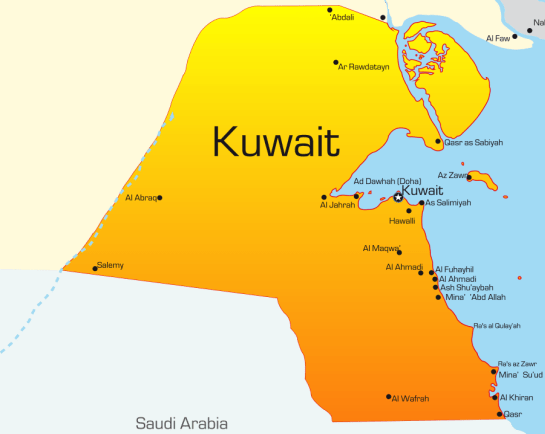
kuwait map

251 people were surveyed in Kuwait, just under a fifth of whom were nationals and over four-fifths expat.

Family, Friends and Third Parties

Kuwaiti residents are a little less trusting of their friends and family than their Bahraini counterparts; 85% said they found service and product recommendations in face-to-face conversations with friends and family as trustworthy. However, they’re more trusting than others online; 53% trust social media posts from friends and family about products and services. In contrast, 15% find such posts untrustworthy.

Third party endorsements are less trusted among Kuwait-based respondents; 63% said they had more trust in what a third party says about a good or a service than what a brand says about its own goods and services. Only 6% disagreed.

Trust in Social Media

Considering the number of social media influencers based in Kuwait, the response to the question of influencer trustworthiness was fascinating. Only a quarter of respondents found influencer posts on products and services trustworthy, compared to 31% who didn’t.

Social media has become an essential source of information on goods and services to people in Kuwait, according to the survey, with two-thirds agreeing that social media had become more important compared to five years back. However, trust online is an issue, with 48% having low trust in what they see online (this is opposed to 16% who don’t).

The most popular social media channels for information on goods and services are Facebook, which dominates at 56%, followed by Instagram (17%) and WhatsApp (9%).

Trust in Media & Advertising

Kuwait’s respondents view media in a similar fashion to their Bahraini brethren in terms of their most trusted choice, which was a brand’s own website (47%). The next most trusted medium was website articles (34%), and radio stories (32%). Newspapers and television fare worse, at 28% and 30% respectively, which is surprising considering Kuwait’s wide selection of newspapers and television (Kuwait has the most open media in the Gulf). Blogs were the least trusted, at 28%. Seven out of ten respondents (71%) said that fake news has dented their trust in mainstream media reporting.

Radio and online advertising are the least trusted, both with a 23% approval rating. Television advertising fares slightly better, at 28%. The most trusted advertising medium was that of outdoor, with billboards scoring a 33% approval rating. Two-thirds of respondents trust advertising less today than they did five years ago, with ten percent disagreeing. Similar to Bahrain, just under three-quarters of respondents (71%), agreed with the statement that so-called ‘fake news’ has lowered their trust in mainstream news media (5% disagreed).

Oman

omanmap

The map of Oman excluding Musandam

151 people were surveyed in Oman, over 57% of whom were Omani nationals and 43% were expats.

Family, Friends and Third Parties

The Oman-based respondents were the least trusting of face-to-face recommendations for products and services from friends and family; 83% said they’d trust such a recommendation. That dropped to 43% for recommendations from family and friends on social media; in contrast, 23% of Omani respondents don’t trust product and service recommendations on social media from friends and family.

Third party endorsements are trusted by three-fifths of the respondents in Oman, with 12% distrusting what a third party says about a good or a service compared to what a brand says about its own goods and services.

Trust in Social Media

When it comes to influencers and social media, there’s little to tell when it comes to trust and mistrust – 33% trust posts by influencers or people with large followings recommending products and services, but 34% say the opposite.

Roughly half of respondents (52%) say that social media is a more important source of information about products and services than five years back. Half of the respondents (48%) have low trust in terms of what they see online (14% don’t).

Facebook is the most popular social media network, but only by a slim margin. A quarter of respondents said it was the most useful for information on products and services, compared to Instagram (19%), and WhatsApp (15%). LinkedIn came fourth, with 12%.

Trust in Media & Advertising

Trust in media among the Omani respondents is much higher when compared to the results from Bahrain and Kuwait. Radio is trusted the most (45%), followed by newspapers and television (both at 42%). Unlike Bahrain and Kuwait where they were the most trusted, brand websites are the fourth most-trusted, at 39%. Website articles are trusted by a third, with blogs coming in last at 29%. Sixty-three percent of respondents agreed with the statement that so-called ‘fake news’ has lowered their trust in mainstream news media, opposed to 13% who feel to the contrary.

When it comes to advertising, billboards and television are the most trusted, with 32% ratings respectively. Radio follows in third place, at 29%, with online advertising as a source of information abut products and services only trusted by 19%. Approximately 58% of respondents trust advertising today less than they did five years ago, compared to 11% who don’t. Fake news is little less of an issue in Oman, where 63% agreed with the statement that so-called ‘fake news’ has lowered their trust in mainstream news media. In contrast, 13% disagreed with the statement.

Qatar

map-qatar

150 people were surveyed in Qatar, 5% of whom were Qatari nationals and 95% were expats.

Family, Friends and Third Parties

The Qatar-based respondents were the most trusting of face-to-face recommendations for products and services from friends and family; 93% said they’d trust such a recommendation. That dropped to 57% for recommendations from family and friends on social media. Only 15% of Qatari respondents would not trust product and service recommendations on social media from friends and family.

Third party endorsements are trusted by two-thirds of the respondents in Qatar. However, 11% distrust whatever a third party says about a good or a service compared to what a brand says about its own goods and services.

Trust in Social Media

Qatar residents are similarly torn when it comes to trusting product and service recommendations from social media influencers or people with large numbers of followers. Roughly 30% do trust such recommendations, whereas 27% don’t.

However, what’s not up for debate is the importance of social media as a source of information on products and services today compared to five years back – 57% said it was, compared to 13% who said it isn’t. When it comes to trust in social media, almost half (47%) have low trust in what they see online, compared to 13% who don’t.

When it comes to which social media network is the most popular for finding information on products and services, Facebook is the leader by far with 60% of the vote. Surprisingly, LinkedIn is second with 10%. One in ten say that they don’t find any social media network useful for finding information.

Trust in Media & Advertising

The media trend in Qatar follows that of Bahrain and Kuwait; brand websites are the most trusted for information on products and services, at 44%. What does buck the trend is the second most-trusted source, which is website articles at 35%. Considering Qatar’s extensive media sector, trust in other media doesn’t show much difference to the other countries above: newspapers are trusted by 33%; radio by 31%, and television by 28%. Blogs are the least trusted, at 20%. Roughly 68% agree with the statement that so-called ‘fake news’ has lowered trust in mainstream news media, with 9% disagreeing.

Advertising fares worse, with the most popular medium, namely billboards, only scoring a 31% trust rating. Television follows at 29%, radio at 23%, and online at only 20%. Approximately two-thirds or 67% of respondents trust advertising today less than they did five years ago, compared to 10% who disagree. When it comes to fake news, 68% agreed with the statement that so-called ‘fake news’ has lowered their trust in mainstream news media, and 9% disagreed.

My 2018 Predictions and Hopes for the PR & Communications Function (Part 1)

crystal-ball-ss-1920

Here’s my top four predictions for 2018 and what we as an industry will need to tackle (image source: http://www.marketingland.com)

I’m writing this in the spirit of the very best forecasters, the people who put thoughts onto paper at the beginning of the year which turn out to be so wide of the mark a couple of months down the line that I will be forced into hiding.

So, here we go. I’ve sorted the post into two parts. The first is what I think will happen (hence predictions) over the course of the next twelve months. My hopes will follow tomorrow.

2018 Predictions

  1. More Political Uncertainty  If you think 2017 was tough when it came to political leadership (or lack thereof), you haven’t seen anything yet. We’ve had a taste of 2018 and what to expect in the region with the US decision to recognize Jerusalem as Israel’s capital. This will be the year when US foreign policy shifts 180 degrees, on all sorts of issues. And others will behave accordingly. Other groups will need to step into the breach, and that means either the business community or the public. Expect more proactive lobbying and public affairs, and more reactive shifts in corporate social responsibility strategies.
  2. More Online Regulation  2017 may have been a great year for the likes of Facebook and Google (both registered record-high share prices in 2017), but last year may become a Pyrrhic victory for them, and other social media firms. Calls are growing in the US for broadcast regulations on political advertising to include social media following alleged Russian meddling in the 2016 Presidential elections, whilst European regulators are exploring how they can force the likes of Facebook, Google and Twitter to take more action on extremist content online – this will include fines. Even in the region, there’s a concerted effort to update laws to better regulate topics such as influencer marketing – keep an eye out for the UAE’s new digital legislation in 2018. Whatever happens in 2018, expect social media platforms, and the content hosted on them, to be more closely regulated.
  3. Expect more Online Crises – This may not be that surprising (yes, I can see you scratching your head and wondering why I’ve put this in). But I don’t mean an irritated consumer posting a piece of content about their poor customer service experience. Rather, I’m talking cyber-espionage, hacking, and whistleblowing. Last year we witnessed political disputes which were initiated by website hacks, a sustained series of leaks from email accounts which had been broken into, the hijacking of social media accounts, and more whistleblowing leaks. 2018 won’t be any different; in fact, this year will only see even more illegal activity online. 2018 could be the year when online hackers shift from politics to brand-jacking, targeting corporates for money (think bots artificially spreading content that impacts brand and corporate reputations). As an industry, we’re going to have to do a much better job of understanding the technical aspects of the online world.
  4. The Agency Model Breaks/Evolves – This isn’t an issue which has gotten nearly enough attention over the past couple of years (with the possible exception of the good work done by the team at the Holmes Report). Agencies aren’t making much, if any, money these days. Costs are high, talent is scarce, and clients are cutting budgets or shifting money into other areas. Publicly-listed PR agencies are looking at single-digit growth globally, and geographies which offered more, the likes of China and the Middle East, have also slowed down. With more competition both within the industry and without the industry, especially from the advertising and management consultancy sector, will 2018 be the year when agencies look to change how they approach client servicing, or is it the year when clients look to alternatives. There’s already a growing trend in the Middle East to embed agency people into the organization, essentially turning them into contracted roles, especially in government and semi-government organizations. Time will tell, but it’s clear to me that we need a healthy agency model for us to sustain the industry.

So there you have my four basic predictions. What are your thoughts? As always, I look forward to hearing from you.

A New Year’s Wish – For PR people to disclose their client relationships (especially on social media)

full disclosure

Can we have more disclosure when it comes to agency-client relationships and content in the region? (image source: multiplesclerosis.net)

When I was young, naive and altruistic, I used to wish for all sorts of lovely things, like peace in the Middle East, an end to discrimination and that type of stuff. Now, I’m (a little) older, and my New Year’s wish list is a little shorter, and, I hope, much more reasonable.

On my 2018 list, there’s one wish. And I need your help to make it happen. It’s pretty simple really. All I’d like is a little more transparency in the region’s public relations industry. I’ve seen a couple of recent examples from senior executives on the agency side, and there seems to be a trend of agency people writing content for sharing, either on social media or through traditional media, which promotes their clients either directly or indirectly. Two examples from this month are below.

What’s also disappointing is that when asked about a client relationship, there’s no response.

My point isn’t about the content – both pieces are well written. Rather, it’s about the need to fully disclose our relationships as PR practitioners and communicators. We talk about the need to be open, and to foster debate. By not disclosing our paid relationships, and not responding when asked, we are doing neither. And, in case you didn’t know, disclosure is legally mandated by the Federal Trade Commission in the United States, the Advertising Standards Authority in the United Kingdom, and by other authorities in Europe.

NicolasTeneoADNOCPost

Teneo has been advising ADNOC on the ADNOC Distribution IPO. However, there’s no disclaimer here of this, or no response to a direct question.

The below tweet links to an opinion piece on Arabian Business, where a Burson Marsteller client is referenced (the Islamic Military Counter Terrorism Coalition) by the writer, who is the Chief Executive Officer of the public relations agency ASDA’A Burson-Marsteller. There’s no disclosure of this relationship, the opposite to how Ford is referenced in the article. And there’s no response to the question either.

https://twitter.com/alex_malouf/status/945707229503770628

To show those in the region how it can and should be done, have a look at the below from Bob Pickard, the Canada-based principal at Signal Leadership Communication. In his Tweet he’s not even referencing a client, but rather sharing his opinion as a client himself. His words underline exactly why we need to disclose our paid relationships, due to the implicit bias it causes.

My company mandates that I disclose when I tweet about a company issue, by using hashtags such as #employee, clearly stating my employer in my social media profile, and through any other means that would remove any doubt as to my relationship with the company. I’d also hope that companies here in the region would adopt similar transparency policies. They’re easy to find online – here’s one from P&G from 2011 which is openly available on the internet.

So, are you with me? Can we have disclosure and transparency when it comes to client relationships in the region? As always, let me know your thoughts.


Research: Online Influencers in the UAE widespread, but measurement & transparency still lagging

InfluencerMarketingResearchBPG

The latest research by BPG, Cohn & Wolfe and YouGov underlines how mainstream online influencer marketing has become. It also highlights areas for improvement in areas such as measurement and transparency

If you needed any more evidence that online influencer marketing is here to stay, then continue reading. The latest research by BPG Cohn & Wolfe and YouGov answers a host of questions as to what is happening on social media channels, and raises even more on areas such as measurement and transparency.

Sampling over 100 in-house marketing and communication experts and brand managers across a diverse range of industries in the UAE, the results show that influencer marketing is very much mainstream:

  • 94% of polled marketeers say engaging with social media influencers benefits their brand
  • 49% currently work with social media influencers in the region
  • 43% spend up to US$10,000 per social media influencer campaign

That’s the good news (especially if you’re an ‘influencer’). The reasons behind using influencer marketing and engagement are a little more varied, as you can see below. The top three reasons for using influencers are 1) to reach various groups and demographics, 2) boost a brand’s presence online, and 3) a complement to traditional advertising. As for what influencers will be doing, they’re most likely to be 1) mentioning brands, 2) providing event coverage, and 3) reviewing products.

The Value of Influencer Marketing

There are of course challenges. Firstly, there’s not a big pool of influencers, and those who are in the market focus on specific areas (fashion, food, cars… repeat). Over half (55%) of those polled said the biggest challenge they face is finding relevant influencers. Putting two and two together, this challenge may partly be of our own doing; it seems that rather than working with those who could be defined as micro-influencers, marketers and communicators want influencers who have a large audience. The second most common challenge (41%) is negotiating terms and conditions, which would suggest that most influencers are working freelance. This has to change next year – the introduction of VAT should mean that those influencers who are paid financially will have to register their own company or work through an agency.

most successful influencers

And then there’s the issues of money and measurement. While budgets would seem to be growing in this area – most budgets are now between 1,000 to 10,000 US dollars – social media influencers are most likely to charge per post or video (47%) or by an exchange of free products and experiences (47%), closely followed by cost per engagement (41%). There’s less of a focus on cost per click or cost per acquisition engagement, suggesting that whoever is negotiating isn’t familiar with digital advertising (both these models are the most commonly used sales models in digital advertising).

social media charging

And then there’s outcome measurement and transparency, two areas that show some concerning results. Just over a third of respondents (37%) said they’re measuring the ROI of their spend on sales and business results (I’d have hoped for a higher number, especially on the consumer side), followed by engagement (29%), and traffic to websites (18%). When it comes to disclosure, of influencers having to write that content is sponsored (which is a legal requirement in some markets such as the US and the UK, and is legally required of firms who are publicly listed in those countries), we must do better. Just under two-thirds (63%) sometimes request influencers to publish a disclaimer. Almost a quarter (24%) never influencers to publish a disclaimer. This isn’t my idea of transparency, and this will have to change if we’re to gain the trust of the people we want to engage with (it may also change next year when new legislation comes in).

measurement & transparency

So there you have it. If you’d like to see the survey summary then please do visit the MEPRA website. I’m also including a link to the Influencer Marketing Survey raw data here.

If you work with influencers, or are defined as one, then what do you think about these results. Do they bear out to what you see, especially in terms of platforms being used (Snapchat at 2%, and Twitter at 10%) and how influencers are engaging online? And how would you like the industry to evolve? As always, do drop me a line. I’d love to hear from you.

The 3 issues today’s crisis comms professional needs to tackle

prepared

Make sure that you’re prepared for these three big issues which are shifting the crisis comms goalposts (image source: http://www.bairdscmc.com)

It doesn’t take a genius to tell you that the world is changing, and with it the way that crises develop. I was listening to a very engaging podcast by the Gulf News business team, with communications professional Omar Qirem (check out the post here).

While the conversation touched on a host of crisis issues and triggers, there were three big issues that are relatively new, and which are shifting the crisis communications landscape.

Hacking and Emails

Long gone are the days when whistleblowers would walk out of offices with a suitcase full of papers. Today, information is conveyed electronically, and all it took for Chelsea Manning to leak hundreds of thousands of US military documents to Wikileaks was a single USB drive. Hacking is becoming a real problem for both governments the world over, as well as corporates (just ask Sony).

Hacking is developing from the well-understood concept of the ethically-troubled whistleblower to groups-for-hire who are ready and willing to hack email servers, or public domain accounts in the search of damaging information. Hackers can also attack websites and social media accounts to fake news, or even create fake sites which are mirrored on the real thing.

We’re going to have to become more aware of these threats, and develop mitigation strategies, including better security (at the very least, please use two-factor authentication as much as you can and don’t use the same password for every single account), and also educate executives on the need to communicate differently. What you write can be leaked; are you willing to see that email on the front page of a newspaper, or a website?

The Rise of Values-Based Communication

Consumers aren’t just interested in what brands make and sell. They want to know what we stand for. This public interest has partly been driven by the political climate in the US and Western Europe and by the behavior of millennials and their increasing skepticism of established institutions. For brands, value-based communications is a key point of differentiation, particularly for industries which have been impacted by technology-driven commoditization. Think of Paul Unilever’s Polman and his passionate belief in sustainability.

Conversely, executive behavior which is looked down upon by the public can have serious business implications. Whilst the official reasons for Uber being stripped of its London license were due to questions around passenger safety and drivers’ rights, the behavior and words of former CEO Travis Kalanick haven’t done Uber any good. The apology proffered by the new CEO, Dara Khosrowshahi, seems to have gone a long way to defusing some of the tension between Uber and Transport for London which oversees the company’s license to operate.

Data and Online Regulation

We’ve been living in the internet age for over two decades now, and business has benefited from a relative lack of legislation and regulation about what can and can’t be done online, particularly with data. That has slowly changed as governments have sought to understand how the internet has changed our lives. Upcoming legislation in Europe, the General Data Protection Regulation (GDPR), is going to change how corporations monitor and store data (it’s been covered in some detail by Rachel Miller for the CIPR). There’s no doubt in my mind that the online and social media networks will also have to deal with more governmental oversight. There’s been a string of scandals around issues such as extremist content on YouTube,  Facebook and the Trump election, and Twitter’s lack of action on far-right hate speech.

Whilst I’m certain that more regulation is coming, and soon, it’s far too early to say how this will change how we as communicators operate online. There will be more data-related crises, either due to how data is collected and used, or due to an inability to adhere to these new rules.

As always, I’d love to know your thoughts. What issues do we need to better understand when it comes to modern-day crises? Please do share with me your thoughts.

The Business of Influence book review: Are we ready for the Chief Influence Officer?

Sheldrake_Influence_jkt_hi.pdf

Philip Sheldrake’s ideas on the subject of influencer marketing and social media should be standard reading for all communicators.

I’m hoping to review more literature on marketing and communications on the blog over the coming months. First up is a must-read by Philip Sheldrake, which covers a area which is need of a serious improvement by our industry – influencer management.

Philip’s narrative and clarity of thought are superb; there’s an easy flow to the book which makes reading it a delight. The book is also written to cater to those who don’t have much communications experience (many people working with influencers have little communications knowledge).

The first couple of chapters look at the theory underpinning influence. He introduces his six influence flows, which simplifies how communications occurs between different groups (the visual is below).

six-influence-flows

The book highlights the measurement trap of “we can, rather than we should,” and shows practitioners how to use influence-centric approaches (the caveat here is that there’s no one way to measure influence, and influence is a complex concept).

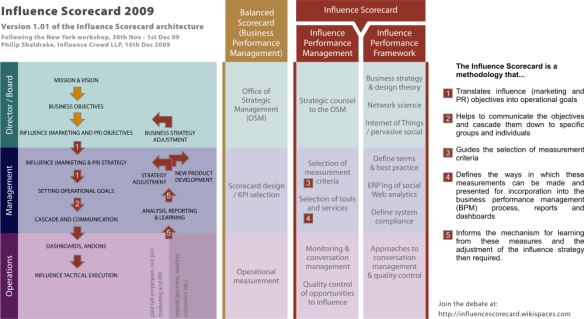
The first of the two big “ahas” of the book are Sheldrake’s influencer scorecard. This is a framework which he has developed, based on the balanced scorecard approach used in strategy, to make influencer marketing more scientific. What the influencer scorecard does (and you can see how it’s set out below), is enable communicators and marketers to implement measures, targets and reporting which are continuous and which feed into the business. In effect, it allows us to better show the value we are bringing to the organization through influencer marketing, using measures and goals which have a clear business impact. There’s almost forty pages dedicated to this concept, so I’m not going to do Sheldrake’s model any justice here (in other words, go and read the book).

influence-scorecard-architecture

What excites me the most about his thinking is the second revelation. Sheldrake argues that organizations will need to take influence much more seriously, and re-design their organizational structure around a new role, the Chief Influence Officer. I’ll quote from the book:

The Chief Influence Officer is charged with making the art and science of influencing and being influenced a core organizational discipline. They will be keen to network with peers in other organizations, to share best practice, to identify, refine and codify proven techniques, and to flag up unseen or unanticipated flaws in the processes described in this book… In my opinion, the role of Chief Influence Officer will be regarded as being on a par with the COO, as CEO-in-waiting.

The Chief Influence Officer will sit at the nexus of marketing, PR, customer service, HR, product development and operations. He or she will lead all communications and marketing, and be responsible for every touchpoint with the customer, with suppliers and partners. In short, the Chief Influence Officer could be the next step for the Chief Communications Officer.

I haven’t read a book with so many original thoughts for some time. If you’re working in influencer marketing and you want a dose of inspiration as to how to do things right, get your hands on Philip Sheldrake’s The Business of Influence. You can thank me later.

The Media, the Web and Influence – a Journalist’s Response

 I wrote earlier this year about the waning influence of media, and how the media could tackle this through more transparency and better use of digital.

The piece elicited a response from one journalist here in the UAE whom I greatly respect. I wanted to share that response with you below.

On auditing and transparency:

Yes, there’s a lack of transparency and yes, there should be auditing but I’m not sure how much that would help. Most advertisers either don’t care or don’t understand that a publication with smaller numbers but the right target audience could still be valuable. In any case, an insane amount of deals are done because the media planners/agency guys and publishers are friends. So to your point, even if there were to be proper auditing, I’m not sure how much it would help the media industry regain its influence. 

On influencers and audience profiles:
Okay, the media and influencers should be treated separately. By default, media (and journalists) are – or should be – influencers, but in the context of the way the term is used here, they are not. So, why are we talking about an influencer who will give a breakdown of their followers? This is an issue, but a completely separate one.
With regards to media building reader profiles, yes they should but it’s important to define whether it should be sales or editorial. The issue of trust and transparency is relatively not as pressing when dealing with editorial because they have nothing to gain per se by bluffing/inflating numbers and audiences. Moreover, if editorial is interested in covering a story, they will do so (or at least, they should) regardless of PR/comms professionals pitching or not pitching said story. In fact, PR/comms need to think beyond what they want to communicate and instead look at what journalists want to do and try and be a part of that – something I’m sure you’re more than familiar with. It’s frustrating, to say the least, to speak to a company when they want to push something but not when you’d like them to weigh in on something.
On journalists as influencers:
There needs to be a line between journalism and whatever passes as content nowadays. Journalists should NOT be content creators and distributors for brands. It has to be either/or. They can’t have a balanced view if they’re speaking for a brand (understandably so)…it’s the whole reason we strive to keep editorial and sales apart. If anything, we need more journalists – not content creators or influencers – to dig up new stories, angles, and perhaps most importantly, be brave enough to pursue those stories.
Have a view? If you do, then drop me a line. I’d love to hear your thoughts. And to the journalist who wrote this, I’d like to say thank you.

How the Media Industry can regain its influence in today’s Social Media world

Is Print Dead

Print may not be dead in the region, but are there way that the media industry can regain influence lost to social media celebrities? (image source http://abcodigital.com)

I recently had an email exchange with a colleague in the PR industry here in Dubai on the issue of the communications industry and how to develop. I asked, what do we need to do better to make the communications function in the region better. His response was fascinating. To quote:

The truth remains that more and more media outlets are closing down, journalists being made redundant, consumers not reading much – but “following” social trends!

All what most of us have done is jump into the “influencer” band-wagon and discuss $ rates on the number of posts along with potentially a storyline. This should change. We need to find something more creative than being short-sighted to tap into the money.

But what keeps me awake at night (beyond other things, of course!) is what if media outlets close down, journalism as a profession becomes history – who the hell do we pitch our stories to?

While it’s true that the PR industry in the region has had a hand in the rapid and prominent rise of social media influencers, what about the case for the PR industry’s role in the declining influence of media, particularly print.

Here’s my two cents on how the media in the Gulf should work to regain its influence in today’s digital age. Let’s start with a look at one issue which the media has struggled with, namely transparency:

  • Audited Media – The number of audited print publications in the region is relatively low (we’re probably talking percentage-wise in the single digits). Whilst publishers such as ITP, and, most especially, Motivate have pushed for audited print titles, few others have followed suit. Audited numbers make our job of targeting the right media easy; we’re able to easily compare media titles, understand the reader breakdown and make a judgement as to whether a certain title is worth working with editorially (and then, later down the line, through advertising). It helps PRs clearly align media outreach with the business strategy, and it gives us trusted, independently audited numbers to back up our approach.
  • Unaudited Media – The vast majority of media in the region isn’t audited. Their numbers cannot be verified, and my assumption (which I assume is commonly shared in the industry), is that distribution numbers and readership is over-inflated. There’s no way that we can trust the circulation numbers given by publishers, and there’s no way that we can trust that the audience that we need to reach is seeing our messaging.
  • Advertising Media – Forgive the name for this third category. This is media which is created solely for the purposes of capturing advertising revenues, with limited to no circulation. With little to no circulation to talk of – in contrast to the publicized circulation numbers – such media and their publishers have done little to no favor to the reputation of media in the region. And it doesn’t help our cause in promoting media as the most effective means to reach out to our target audience, especially when the publication has effectively no audience.

The second issue is digital. Whilst some publishers, titles and journalists have embraced digital platforms including websites, podcasts, vlogs and social media, others have yet to leverage the power of online distribution and amplification. Digital remains a challenge for much of the media industry globally; no newspaper has been able to make a profit and run its business from its online sales revenues. However, with consumers in the Gulf region essentially living their lives online, does it make sense for traditional media publications to not be online?

The other aspect of digital which media needs to leverage is its ability to engage in real time with its audience, and build audience profiles. I’m yet to see or meet an influencer who will be able to give me an up-to-date breakdown of their followers’ interests, age ranges, geographies and other demographics. The media can and should be helping to build up reader profiles which in turn will help us work with them to target the right audiences. This requires trust and transparency, which is still hard to come by with many titles (see the above).

I feel its especially important that journalists build their online profiles. While many are being laid off as publications shrink, brands need reputable voices to work with. For me, there’s little comparison between a professional journalist and a social media influencer in the Gulf (there are exceptions). When reviewing a product, it’s much more likely that a journalist will give a less biased viewpoint, and will include both positives as well as negatives. That builds integrity and trust with readers, which advertisers should seek out as the holy grail of brand building. Journalists need to think about transitioning into content creators and distributors for brands, much like their social media influencer counterparts. The difference will be in their ability to tell a balanced story that is trusted by their readers.

Whilst the region’s media scene is slowly feeling the impact of ad spending shifting online (just look at the recent closures, including 7Days), I cannot and don’t want to image a day where we have no media to work with. The media industry has to play its part in changing to meet the needs of consumers, through embracing both transparency and digital platforms. I have a great deal of respect for the professionalism and expertise of many publications and journalists in the region, and I know how influential they can be. We need to ensure that their influence is recognized in a fashion that is understood outside of the media industry, by businesses who want to engage publicly.

Do you have any inputs or thoughts on the media industry and how they should change to remain relevant? If yes, then please do share them with me in the comments below.

Will Dubai’s social media business license regulate the influencer space?

social media influencers

There’s been little legislation specifically looking at social media selling or influencer marketing across the Gulf

As anyone who works in the social media space in the Gulf knows, there’s nothing in the way of regulation. We’re working in a space which is poorly understood when it comes to legality and regulation (though, as I’ve written about before, any sponsored content is legislated for by the UAE’s advertising law).

This may be about to change however. Last week, Dubai’s Department of Economic Development launched a new business license, designed for those wishing to conduct business online, via social media. Here’s more details from Arabian Business.

Dubai’s Department of Economic Development (DED) has launched a new e-Trader licence to allow Emiratis and GCC citizens in Dubai to conduct business activities on social networking sites.

The DED’s Business Registration and Licensing (BRL) sector said the initiative is part of enhancing transparency and regulating the practice of offering products and services for sale on social media.

The e-Trader licence can be registered under the name of a single owner only and the owner must be an Emirati or GCC citizen aged 18 or above and residing in Dubai.
Nearly 3,000 e-Traders are expected to be licensed in Dubai in 2017.

At the event, there were a number of social media influencers, including Emirati comedian and instagrammer Kanu AlKendi (you can see his post below).

https://www.instagram.com/p/BRqE3yGBcZK/?taken-by=kanu7alkendi&hl=en

One of the reasons given for the launch of this license was to enhance consumer confidence in online businesses. “Licensing a business activity enhances consumer confidence on one hand and on the other, it removes the risk of infringement on a reserved trade name or other intellectual property, explained Omar Bushahab, CEO for the Business Registration & Licensing (BRL) sector of the Department of Economic Development. “A license guarantees the rights of everyone concerned and defines the legal accountability of the merchant.”

Transparency (or the lack of) has been a major talking point when it comes to influencer marketing in the region. While some businesses have to ensure that their influencers publicly state that their content is paid for (mainly those registered or publicly listed in jurisdictions with a legal framework around online marketing), the majority of advertisers and social media influencers don’t.

I understand that governmental bodies have been looking at ways to regulate the influencer industry – I don’t think I’ve seen a campaign over the last year which hasn’t featured an influencer. This may be a first step. However, more may be to come in relation to legislation covering influencers, particularly those who aren’t Gulf nationals (which is essentially the majority).

“One of the key challenges in the DED launch narrative is the condition that all license holders must be GCC citizen. This may prove difficult or restrictive to the large expatriate population across Dubai,” Lindsay Wakefield, a retail analyst, told Gulf News.

For agencies who are working in this area, it’s more than advisable to get legal advice as to how you and your clients should be engaging with influencers.

The rise of the Khaleeji Woman as online content creators (part two)

As it’s International Women’s Day, I couldn’t wait any longer and, I’ll be brutally honest, I wanted to see lots of cake porn! Here’s the second of a two-part guest blog on how women across the Gulf are using social media and their skills not only to create entertaining and informative content, but to also earn a living. In this second post, Paul Kelly, creative director and co-founder at Digital Ape, argues that brands need to rethink how they both develop and execute content creation strategies with online female content creators in the Gulf. Enjoy the read, and let Paul know what you think!

During the last post, we discussed a survey of MENA based women, and their attitudes to content, particularly food content online. This week we will focus on the content creators who these surveyed women follow and imitate. We will look at how they are creating engaging content and why that matters for brands and publishing houses alike.

How are they doing it?

People are attracted to people. If I can find someone online, who understands what happens in my day, speaks my dialect and knows what I need better than say a publisher in Dubai, then I will follow their content, and my friends will too.

Women across the GCC are doing this in their millions, Khaleeji women want to see themselves reflected in their entertainment, and they want advice and recommendations tailored to them. Gone are the days when they must consume content created by an American in New York, and served to them on TV or in print. Women from the UAE to Saudi and beyond and seeking out other women who look like them, speak like them and understand their lives.

This I believe is one of the reasons why old fashioned publishing houses, should be quaking in their boots. As much as we try, Western or Levantine men in Dubai will never truly understand what Khaleeji women want in entertainment content, and now that they have a choice, these women will choose to consume content made by their peers and when that happens at scale, these content creators become publishers in their own right.

A content creator who builds an audience and keeps them engaged is no different to a publisher, and creators with a female Khaleeji audience, have an audience underserved by content, and exponential growth rates equal revenue.

The train-wreck.

So how has it come to influencers being ridiculed for their work? Worse still, how has it come to people calling themselves influencers, buying audiences and getting a free meal ticket?

Aside from the typical Dubai-syndrome of echo chamber marketing; it’s a mix of naïve marketing managers chasing trends, agencies ill-equipped for creative relationships (trying to replace banner ad revenue) and people who see social media as a shortcut to making a quick dirham.

Instead of actively investing the time needed in these powerful communities, brands, in place of real strategies, throw wads of cash at so-called influencers and hope for big results, often leading to disappointment.

At Digital Ape, we’ve got this down to an art. Just like money is a hygiene factor when it comes to employment, so too is it when it comes to dealing with real people creating content. It’s about giving content creators what they need; Props, filming equipment, sessions with filmmakers, assistance in real-time sessions with editing, contract help, this way everyone gets the best of the relationship. Creators develop better content with help from the brand thereby growing audiences, which in turn helps the brand. Women develop a revenue stream from content that fits and that the audience understands. This isn’t horse trading it’s about developing a win-win situation for creators, brands and audiences.

Find the fit for your brand by having an empathetic network of people to draw on, then seek out their audiences. Work WITH them. Don’t use influencers, work with your content creators. It’s an investment that pays handsomely.

 The future.

It’s no surprise that local publishing houses are scrambling to get on board with the creator craze – they after all, were the content creators and influencers of an older generation. Less able to respond to a new reality of screens and pixels, and even less able to understand how to convert revenue from the eyeballs they’ve been left behind as content becomes borderless and habits are quickly changing.

After all, is what someone like PewDiePie doing any different to what VICE was doing in 2010? Arguably with 54mn subscribers (at time of writing) on YouTube he has as much impact as a medium sized cable network. Is Kim Kardashian any different to Hello! Circa 1998? Her ability to shift units of anything she sells is phenomenal.

Some will argue until that until we have proper regulation in the GCC we’ll never achieve a level of sophistication that will mean any content creator is taken seriously.

Forget that.

What I am, and us at Digital Ape say, is that the content creators are the new publishers. Instead of being locked up in an edit suite at MBC, they are at home in their own bedrooms with their phones, doing the exact same thing, for an audience which increases with every post.

What we are seeing is a new model of content democracy where the 1% who make the content for the 99% are now starting to take back their revenue. Where once it was the Newscorps or CNN’s or ITP’s relying on their talent to sell time, space or inches, it’s now the Felix’s, Rayyan’s and countless mothers, wives and daughters who have a passion to create that will shape our entertainment for the next 20 years.

Digital Ape’s research with MENA women underlines the role digital plays in offline purchase intent